Intro to Tenths
Ages 8–10 · 7 minutes · Math
Represent tenths on a shaded grid model
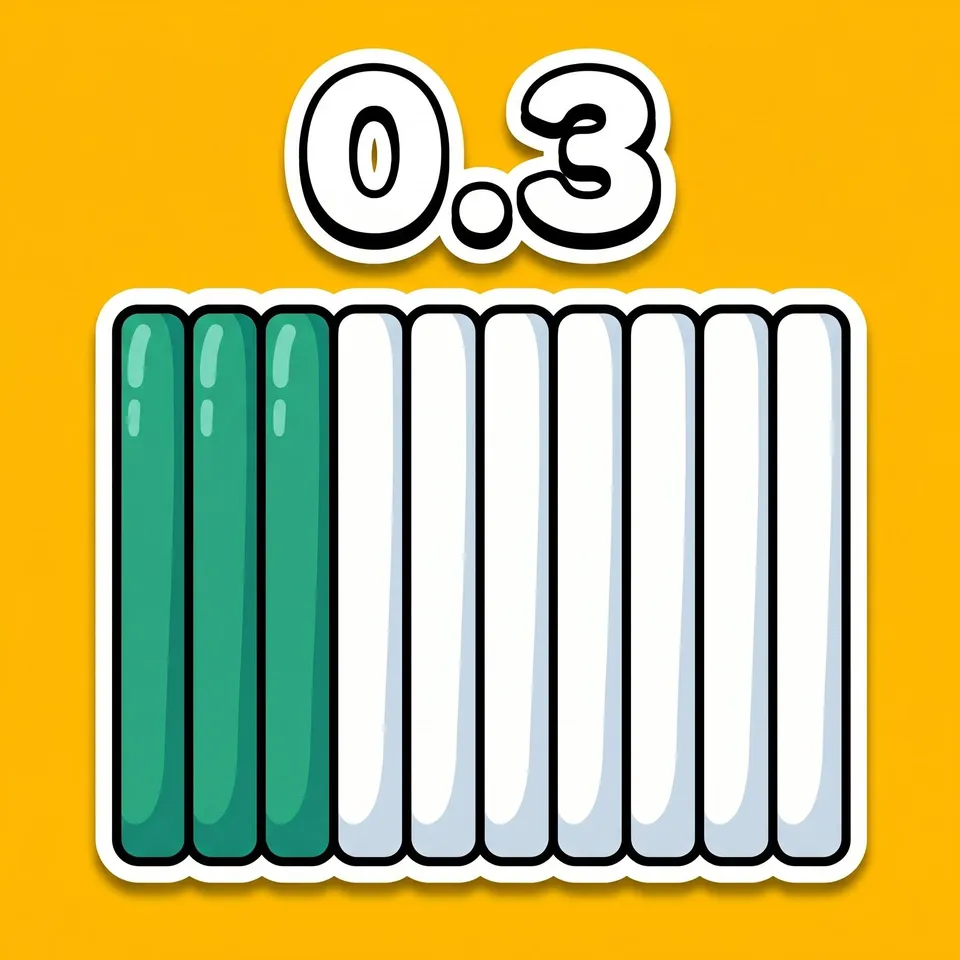
Students will identify decimal numbers by using a ten-strip grid model to visualize tenths such as 0.3 and 0.7. Students will represent parts of a whole with fractions while converting those fractions to the proper decimal tenth. At the end of the lesson, students will be introduced to comparing decimals which will continue to be explored in the next lesson. Prior knowledge of basic fractions is recommended.
Part of
Standards alignment
Common Core State Standards
- 4.NF.C.6 — Use decimal notation for fractions with denominators 10 or 100. For example, rewrite 0.62 as 62/100; describe a length as 0.62 meters; locate 0.62 on a number line diagram.
- 3.NF.A.1 — Understand a fraction 1/b as the quantity formed by 1 part when a whole is partitioned into b equal parts; understand a fraction a/b as the quantity formed by a parts of size 1/b.
- 4.NF.C.7 — Compare two decimals to hundredths by reasoning about their size. Recognize that comparisons are valid only when the two decimals refer to the same whole. Record the results of comparisons with the symbols >, =, or <, and justify the conclusions, e.g., by using a visual model.
Alabama
- MA19.4.18 — Use models and decimal notation to represent fractions with denominators of 10 and 100.
- MA19.4.19 — Use visual models and reasoning to compare two decimals to hundredths (referring to the same whole), recording comparisons using symbols >, =, or <, and justifying the conclusions.
Alaska
- 4.NF.6 — Use decimal notation for fractions with denominators 10 or 100. For example, rewrite 0.62 as 62/100; describe a length as 0.62 meters; locate 0.62 on a number line diagram.
- 3.NF.1 — Understand a fraction 1/b (e.g., 1/4) as the quantity formed by 1 part when a whole is partitioned into b (e.g., 4) equal parts; understand a fraction a/b (e.g., 2/4) as the quantity formed by a (e.g., 2) parts of size 1/b. (e.g., 1/4)
- 4.NF.7 — Compare two decimals to hundredths by reasoning about their size. Recognize that comparisons are valid only when the two decimals refer to the same whole. Record the results of comparisons with the symbols >, =, or <, and justify the conclusions (e.g., by using a visual model).
Arizona
- 4.NF.C.6 * — Use decimal notation for fractions with denominators 10 (tenths) or 100 (hundredths), and locate these decimals on a number line.
- 3.NF.A.1 — Understand a fraction 1/b as the quantity formed by 1 part when a whole is partitioned into b equal parts; understand a fraction a/b as the quantity formed by a parts of size 1/b.
Arkansas
- 4.NPV.10 — Apply decimal notation for fractions with denominators 10 or 100.
- 4.NPV.6 — Compare two decimals to the hundredths place, using symbols (<, =, >) to record the results of comparisons.
California
- 4.NF.C.6 — Use decimal notation for fractions with denominators 10 or 100. For example, rewrite 0.62 as 62/100; describe a length as 0.62 meters; locate 0.62 on a number line diagram.
- 4.NF.C.7 — Compare two decimals to hundredths by reasoning about their size. Recognize that comparisons are valid only when the two decimals refer to the same whole. Record the results of comparisons with the symbols >, =, or < , and justify the conclusions, e.g., by using the number line or another visual model.
- 3.NF.A.1 — Understand a fraction 1/b as the quantity formed by 1 part when a whole is partitioned into b equal parts; understand a fraction a/b as the quantity formed by a parts of size 1/b.
Colorado
- 4.NF.C.6 — Use decimal notation for fractions with denominators 10 or 100. For example, rewrite 0.62 as 62/100; describe a length as 0.62 meters; locate 0.62 on a number line diagram.
- 4.NF.C.7 — Compare two decimals to hundredths by reasoning about their size. Recognize that comparisons are valid only when the two decimals refer to the same whole. Record the results of comparisons with the symbols > , = , or < , and justify the conclusions, e.g., by using a visual model.
Connecticut
- 4.NF.C.6 — Use decimal notation for fractions with denominators 10 or 100. For example, rewrite 0.62 as 62/100; describe a length as 0.62 meters; locate 0.62 on a number line diagram.
- 4.NF.C.7 — Compare two decimals to hundredths by reasoning about their size. Recognize that comparisons are valid only when the two decimals refer to the same whole. Record the results of comparisons with the symbols >, =, or <, and justify the conclusions, e.g., by using a visual model.
- 3.NF.A.1 — Understand a fraction 1/b as the quantity formed by 1 part when a whole is partitioned into b equal parts; understand a fraction a/b as the quantity formed by a parts of size 1/b.
Delaware
- 4.NF.C.6 — Use decimal notation for fractions with denominators 10 or 100. For example, rewrite 0.62 as 62/100; describe a length as 0.62 meters; locate 0.62 on a number line diagram.
- 4.NF.C.7 — Compare two decimals to hundredths by reasoning about their size. Recognize that comparisons are valid only when the two decimals refer to the same whole. Record the results of comparisons with the symbols >, =, or <, and justify the conclusions, e.g., by using a visual model.
- 3.NF.A.1 — Understand a fraction 1/b as the quantity formed by 1 part when a whole is partitioned into b equal parts; understand a fraction a/b as the quantity formed by a parts of size 1/b.
Florida
- MA.4.FR.1.2 — Use decimal notation to represent fractions with denominators of 10 or 100, including mixed numbers and fractions greater than 1, and use fractional notation with denominators of 10 or 100 to represent decimals.
- MA.4.NSO.1.5 — Plot, order and compare decimals up to the hundredths.
- MA.3.FR.1.1 — Represent and interpret unit fractions in the form 1/n as the quantity formed by one part when a whole is partitioned into n equal parts.
Georgia
- 4.NR.5.2 — Represent, read, and write fractions with denominators of 10 or 100 using decimal notation, and decimal numbers to the hundredths place as fractions, using concrete materials and drawings.
- 4.NR.5 — Solve real-life problems involving addition, equivalence, comparison of fractions with denominators of 10 and 100, and comparison of decimal numbers as tenths and hundredths using part-whole strategies and visual models.
- 4.NR.5.3 — Compare two decimal numbers to the hundredths place by reasoning about their size. Record the results of comparisons with the symbols >, =, or <, and justify the conclusions.
Hawaii
- 4.NF.C.6 — Use decimal notation for fractions with denominators 10 or 100.
- 3.NF.A.1 — Understand a fraction 1/b as the quantity formed by 1 part when a whole is partitioned into b equal parts; understand a fraction a/b as the quantity formed by a parts of size 1/b.
- 4.NF.C.7 — Compare two decimals to hundredths by reasoning about their size. Recognize that comparisons are valid only when the two decimals refer to the same whole. Record the results of comparisons with the symbols >, =, or <, and justify the conclusions, e.g., by using a visual model.
Idaho
- 4.NF.C.6 — Use decimal notation to represent fractions with denominators 10 or 100.
- 4.NF.C.7 — Compare two decimals to hundredths by reasoning about their size.
- 3.NF.A.1 — Understand a fraction 1/b as the quantity formed by one part when a whole (a single unit) is partitioned into 𝑏 equal parts; understand a/b as the quantity formed by a parts of size 1/b
- 4.NF.C.7.b — Record the results of the comparisons with the symbols >, =, and <, and justify the conclusions using visual representations and/or verbal reasoning.
Illinois
- 4.NF.C.6 — Use decimal notation for fractions with denominators 10 or 100. For example, rewrite 0.62 as 62/100; describe a length as 0.62 meters; locate 0.62 on a number line diagram.
- 3.NF.A.1 — Understand a fraction 1/b as the quantity formed by 1 part when a whole is partitioned into b equal parts; understand a fraction a/b as the quantity formed by a parts of size 1/b.
- 4.NF.C.7 — Compare two decimals to hundredths by reasoning about their size. Recognize that comparisons are valid only when the two decimals refer to the same whole. Record the results of comparisons with the symbols >, =, or <, and justify the conclusions, e.g., by using a visual model.
Indiana
- 4.NS.5 — Write tenths and hundredths in decimal and fraction notations. Use words, models, standard form, and expanded form to represent decimal numbers to hundredths. Mentally calculate fraction and decimal equivalents for halves and fourths (e.g., 1/2 = 0.5 = 0.50, 7/4 = 1 3/4 = 1.75). (E)
- 4.NS.6 — Compare two decimals to hundredths by reasoning about their size based on the same whole. Record the results of comparisons with the symbols > , = , or < , and justify the conclusions (e.g., by using a visual model). (E)
Iowa
- 4.NF.C.6 — Use decimal notation for fractions with denominators 10 or 100. For example, rewrite 0.62 as 62/100 and locate 0.62 on a number line.
- 4.NF.C.7 — Compare two decimals to hundredths by reasoning about their size, recording the results of comparisons with the symbols >, =, or <. Recognize that comparisons are valid only when the two decimals refer to the same whole. Show decimals on a number line diagram and be able to justify numerical statements of decimal comparison by using a visual fraction model.
- 3.NF.A.1 — Understand a fraction 1/b as the quantity formed by 1 part when a whole is partitioned into 𝑏𝑏 equal parts; understand a fraction a/b as the quantity formed by a part of size 1/b .
Kansas
- 4.NF.6 — Use decimal notation for fractions with denominators 10 or 100. For example, rewrite 0.62 as 62/100; describe a length as 0.62 meters; locate 0.62 on a number line diagram.
- 3.NF.1 — Understand a fraction 1/b as the quantity formed by 1 part when a whole is partitioned into b equal parts; understand a fraction a/b as the quantity formed by a parts of size 1/b.
- 4.NF.7 — Compare two decimals to hundredths by reasoning about their size. Recognize that comparisons are valid only when the two decimals refer to the same whole. Record the results of comparisons with the relational symbols > , < , = , or ≠ , and justify the conclusions, (e.g. by using a visual model.).
Kentucky
- KY.4.NF.6 — Use decimal notation for fractions with denominators 10 or 100.
- KY.3.NF.1 — Understand a fraction 1/b as the quantity formed by 1 part when a whole is partitioned into b equal parts; understand a fraction a/b as the quantity formed by a parts of size 1/b.
- KY.4.NF.7.a — Compare two decimals to hundredths by reasoning about their size.
Louisiana
- 4.NF.C.6 — Use decimal notation for fractions with denominators 10 or 100. For example, rewrite 0.62 as 62/100; describe a length as 0.62 meters; locate 0.62 on a number line diagram.
- 4.NF.C.7 — Compare two decimals to hundredths by reasoning about their size. Recognize that comparisons are valid only when the two decimals refer to the same whole. Record the results of comparisons with the symbols >, =, or < , and justify the conclusions, e.g., by using a visual model.
Maine
- 4.NF.C.6 — Use decimal notation for fractions with denominators 10 or 100. For example, rewrite 0.62 as 62/100; describe a length as 0.62 meters; locate 0.62 on a number line diagram.
- 4.NF.C.7 — Compare two decimals to hundredths by reasoning about their size. Recognize that comparisons are valid only when the two decimals refer to the same whole. Record the results of comparisons with the symbols > , = , or < , and justify the conclusions, e.g., by using a visual model.
- 3.NF.A.1 — Understand a unit fraction 1/b as the quantity formed by 1 part when a whole is partitioned into b equal parts; understand a fraction a/b as the quantity formed by a parts of size 1/b.
Maryland
- 4.NF.C.6 — Use decimal notation for fractions with denominators 10 or 100. For example, rewrite 0.62 as 62/100; describe a length as 0.62 meters; locate 0.62 on a number line diagram.
- 3.NF.A.1 — Understand a fraction (1/b) as the quantity formed by 1 part when a whole is partitioned into b equal parts; understand a fraction (a/b) as the quantity formed by a parts of size (1/b).
- 4.NF.C.7 — Compare two decimals to hundredths by reasoning about their size. Recognize that comparisons are valid only when the two decimals refer to the same whole. Record the results of comparisons with the symbols >, =, or <, and justify the conclusions, e.g., by using a visual model.
Massachusetts
- 4.NF.C.6 — Use decimal notation to represent fractions with denominators 10 or 100. For example, rewrite 0.62 as 62/100; describe a length as 0.62 meters; locate 0.62 on a number line diagram.
- 3.NF.A.1 — Understand a fraction 1/b as the quantity formed by 1 part when a whole (a single unit) is partitioned into b equal parts; understand a fraction a/b as the quantity formed by a parts of size 1/b.
- 4.NF.C.7 — Compare two decimals to hundredths by reasoning about their size. Recognize that comparisons are valid only when the two decimals refer to the same whole. Record the results of comparisons with the symbols >, =, or <, and justify the conclusions, e.g., by using a visual model.
Michigan
- 4.NF.C.6 — Use decimal notation for fractions with denominators 10 or 100. For example, rewrite 0.62 as 62/100; describe a length as 0.62 meters; locate 0.62 on a number line diagram.
- 3.NF.A.1 — Understand a fraction 1/b as the quantity formed by 1 part when a whole is partitioned into b equal parts; understand a fraction a/b as the quantity formed by a parts of size 1/b.
- 4.NF.C.7 — Compare two decimals to hundredths by reasoning about their size. Recognize that comparisons are valid only when the two decimals refer to the same whole. Record the results of comparisons with the symbols >, =, or <, and justify the conclusions, e.g., by using a visual model.
Minnesota
- 4.1.2.5 — Compare and order decimals and whole numbers using place value, a number line and models such as grids and base 10 blocks.
- 4.1.2.6 — Read and write tenths and hundredths in decimal and fraction notations using words and symbols; know the fraction and decimal equivalents for halves and fourths. For example: 1/2 = 0.5 = 0.50 and 7/4 = 1 3/4 = 1.75, which can also be written as one and three-fourths or one and seventy-five hundredths.
- 4.1.2.4 — Read and write decimals with words and symbols; use place value to describe decimals in terms of thousands, hundreds, tens, ones, tenths, hundredths and thousandths. For example: Writing 362.45 is a shorter way of writing the sum: 3 hundreds + 6 tens + 2 ones + 4 tenths + 5 hundredths, which can also be written as: three hundred sixty-two and forty-five hundredths.
Mississippi
- 4.NF.6 — Use decimal notation for fractions with denominators 10 or 100. For example, rewrite 0.62 as 62/100; describe a length as 0.62 meters; locate 0.62 on a number line diagram.
- 3.NF.1 — Understand a fraction 1/b as the quantity formed by 1 part when a whole is partitioned into b equal parts; understand a fraction a/b as the quantity formed by a parts of size 1/b.
- 4.NF.7 — Compare two decimals to hundredths by reasoning about their size. Recognize that comparisons are valid only when the two decimals refer to the same whole. Record the results of comparisons with the symbols >, =, or < , and justify the conclusions, e.g., by using a visual model.
Missouri
- 4.NF.C.10 — Understand that fractions and decimals are equivalent representations of the same quantity.
- 4.NF.C.9 — Use decimal notation for fractions with denominators of 10 or 100.
- 4.NF.C.11 — Read, write and identify decimals to the hundredths place using number names, base ten numerals and expanded form.
- 4.NF.C.12 — Compare two decimals to the hundredths place using the symbols > , = or < , and justify the solution.
Montana
- 4.NF.C.6 — Use decimal notation for fractions with denominators 10 or 100. For example, rewrite 0.62 as 62/100; describe a length as 0.62 meters; locate 0.62 on a number line diagram.
- 3.NF.A.1 — Understand a fraction 1/b as the quantity formed by 1 part when a whole is partitioned into b equal parts; understand a fraction a/b as the quantity formed by a parts of size 1/b.
- 4.NF.C.7 — Compare two decimals to hundredths by reasoning about their size. Recognize that comparisons are valid only when the two decimals refer to the same whole. Record the results of comparisons with the symbols > , = , or < , and justify the conclusions, e.g., by using a visual model.
Nebraska
- 4.N.1.a — Read, write, and demonstrate multiple equivalent representations for whole numbers up to 1,000,000 and decimals to the hundredths using visual representations, standard form, and expanded form.
- 4.N.1.d — Use decimal notation for fractions with denominators of 10 or 100 (e.g., 43/100 = 0.43).
- 4.N.1.b — Represent and justify comparisons of whole numbers up to 1,000,000 and decimals through the hundredths place using number lines and reasoning strategies.
- 4.N.2 — Fractions and Decimals: Students will extend understanding of fractions by equivalence and ordering and will develop an understanding of decimals.
- 3.N.2.b — Find parts of a whole using visual fraction models.
Nevada
- 4.NF.C.6 — Use decimal notation for fractions with denominators 10 or 100. For example, rewrite 0.62 as 62/100; describe a length as 0.62 meters; locate 0.62 on a number line diagram.
- 3.NF.A.1 — Understand a fraction 1/b as the quantity formed by 1 part when a whole is partitioned into b equal parts; understand a fraction a/b as the quantity formed by a parts of size 1/b.
- 4.NF.C.7 — Compare two decimals to hundredths by reasoning about their size. Recognize that comparisons are valid only when the two decimals refer to the same whole. Record the results of comparisons with the symbols >, =, or <, and justify the conclusions, e.g., by using a visual model.
New Hampshire
- 4.NF.C.6 — Use decimal notation for fractions with denominators 10 or 100. For example, rewrite 0.62 as 62/100; describe a length as 0.62 meters; locate 0.62 on a number line diagram.
- 3.NF.A.1 — Understand a fraction 1/b as the quantity formed by 1 part when a whole is partitioned into b equal parts; understand a fraction a/b as the quantity formed by a parts of size 1/b.
- 4.NF.C.7 — Compare two decimals to hundredths by reasoning about their size. Recognize that comparisons are valid only when the two decimals refer to the same whole. Record the results of comparisons with the symbols >, =, or <, and justify the conclusions, e.g., by using a visual model.
New Jersey
- 4.NF.C.6 — Use decimal notation for fractions with denominators 10 or 100. For example, rewrite 0.62 as 62/100; describe a length as 0.62 meters; locate 0.62 on a number line diagram.
- 4.NF.C.7 — Compare two decimals to hundredths by reasoning about their size. Recognize that comparisons are valid only when the two decimals refer to the same whole. Record the results of comparisons with the symbols >, =, or <, and justify the conclusions, e.g., by using a visual model.
- 3.NF.A.1 — Understand a fraction 1/b as the quantity formed by 1 part when a whole is partitioned into b equal parts; understand a fraction a/b as the quantity formed by a parts of size 1/b.
New Mexico
- 4.NF.C.6 — Use decimal notation for fractions with denominators 10 or 100. For example, rewrite 0.62 as 62/100; describe a length as 0.62 meters; locate 0.62 on a number line diagram.
- 3.NF.A.1 — Understand a fraction 1/b as the quantity formed by 1 part when a whole is partitioned into b equal parts; understand a fraction a/b as the quantity formed by a parts of size 1/b.
- 4.NF.C.7 — Compare two decimals to hundredths by reasoning about their size. Recognize that comparisons are valid only when the two decimals refer to the same whole. Record the results of comparisons with the symbols >, =, or <, and justify the conclusions, e.g., by using a visual model.
New York
- NY-4.NF.6 — Use decimal notation for fractions with denominators 10 or 100.
- NY-4.NF.7 — Compare two decimals to hundredths by reasoning about their size. Recognize that comparisons are valid only when two decimals refer to the same whole. Record the results of comparisons with the symbols >, =, or < , and justify the conclusions.
- NY-3.NF.1 — Understand a unit fraction, 1/b, is the quantity formed by 1 part when a whole is partitioned into b equal parts. Understand a fraction a/b as the quantity formed by a parts of size 1/b.
North Carolina
- NC.4.NF.6 — Use decimal notation to represent fractions. • Express, model and explain the equivalence between fractions with denominators of 10 and 100. • Use equivalent fractions to add two fractions with denominators of 10 or 100. • Represent tenths and hundredths with models, making connections between fractions and decimals.
- NC.4.NF.7 — Compare two decimals to hundredths by reasoning about their size using area and length models, and recording the results of comparisons with the symbols > , = , or < . Recognize that comparisons are valid only when the two decimals refer to the same whole.
North Dakota
- 4.NO.NF.1 — Express equivalent fractions with a denominator of 10 and a denominator of 100 to generate a decimal notation.
- 4.NO.NBT.2 — Compare two numbers to the millions place and decimals to the hundredths place, using symbols >, < and =. Justify comparisons based on the value of the digits.
Ohio
- 4.NF.6 — Use decimal notation for fractions with denominators 10 or 100. For example, rewrite 0.62 as 62/100; describe a length as 0.62 meters; locate 0.62 on a number line diagram.
- 4.NF.7 — Compare two decimals to hundredths by reasoning about their size. Recognize that comparisons are valid only when the two decimals refer to the same whole. Record the results of comparisons with the symbols > , = , or < , and justify the conclusions, e.g., by using a visual model.
- 3.NF.1 — Understand a fraction 1/b as the quantity formed by 1 part when a whole is partitioned into b equal parts; understand a fraction a/b as the quantity formed by a parts of size 1/b.
Oklahoma
- 4.N.3.6 — Represent tenths and hundredths with concrete and pictorial models, making connections between fractions and decimals.
- 4.N.3 — Represent and compare fractions and decimals in real-world and mathematical situations; use place value to understand decimal quantities.
- 4.N.3.8 — Compare and order decimals and whole numbers using place value and various models including but not limited to grids, number lines, and base 10 blocks.
Oregon
- 4.NF.C.6 — Use and interpret decimal notation for fractions with denominators 10 or 100.
- 4.NF.C.7 — Use decimal notation for fractions with denominators 10 or 100. Compare two decimals to hundredths place by reasoning about their size, and record the comparison using the symbols >, =, or <.
Pennsylvania
- CC.2.1.4.C.3 — Connect decimal notation to fractions, and compare decimal fractions (base 10 denominator, e.g., 19/100).
- CC.2.1.3.C.1 — Explore and develop an understanding of fractions as numbers.
Rhode Island
- 4.NF.C.6 — Use decimal notation to represent fractions with denominators 10 or 100. For example, rewrite 0.62 as 62/100 ; describe a length as 0.62 meters; locate 0.62 on a number line diagram.
- 4.NF.C.7 — Compare two decimals to hundredths by reasoning about their size. Recognize that comparisons are valid only when the two decimals refer to the same whole. Record the results of comparisons with the symbols >, =, or <, and justify the conclusions, e.g., by using a visual model.
- 3.NF.A.1 — Understand a fraction 1/b as the quantity formed by 1 part when a whole (a single unit) is partitioned into b equal parts; understand a fraction a/b as the quantity formed by a parts of size 1/b.
South Carolina
- 4.NSF.6 — Write a fraction with a denominator of 10 or 100 using decimal notation, and read and write a decimal number as a fraction.
- 4.NSF.7 — Compare and order decimal numbers to hundredths, and justify using concrete and visual models.
South Dakota
- 4.NF.C.6 — Read and write decimal notation for fractions with denominators 10 or 100. Locate these decimals on a number line.
- 4.NF.C.7 — Compare two decimals to hundredths by reasoning about their size. Recognize that comparisons are valid only when the two decimals refer to the same whole. Record the results of comparisons with the symbols > , < , or = , and justify the conclusions.
- 3.NF.A.1 — Understand a fraction 1/b as the quantity formed by 1 part when a whole is partitioned into b equal parts (example: 1 part out of 4 equal parts is the same as 1/4); understand a fraction a/b as the quantity formed by a parts of size 1/b. (example:3/4 is the same as 3 one-fourths (1/4, 1/4, 1/4).
Tennessee
- 4.NF.C.6 — Read and write decimal notation for fractions with denominators 10 or 100. Locate these decimals on a number line.
- 3.NF.A.1 — Understand a unit fraction, 1/b, as the quantity formed by 1 part when a whole is partitioned into b equal parts; understand a non-unit fraction, n/b, as the quantity formed by n parts of size 1/b. For example, 3/4 represents a quantity formed by 3 parts of size 1/4.
- 4.NF.C.7 — Compare two decimals to hundredths by reasoning about their size. Recognize that comparisons are valid only when the two decimals refer to the same whole. Use the symbols > , = , or < to show the relationship and justify the conclusions.
Texas
- 4.2E — represent decimals, including tenths and hundredths, using concrete and visual models and money;
- 4.2G — relate decimals to fractions that name tenths and hundredths; and
- 4.2F — compare and order decimals using concrete and visual models to the hundredths;
Utah
- 4.NF.6 — Use decimal notation for fractions with denominators 10 or 100. For example, rewrite 0.62 as 62/100, describe a length as 0.62 meters; locate 0.62 on a number line diagram.
- 4.NF.7 — Compare two decimals to hundredths by reasoning about their size. Recognize that comparisons are valid only when the two decimals refer to the same whole. Record the results of comparisons with the symbols > , = , or < , and justify the conclusions,* for example, by using a visual model.*
- 3.NF.1.a — Understand a fraction 1/b as the quantity formed by one part when a whole is partitioned into b equal parts.
Vermont
- 4.NF.C.6 — Use decimal notation for fractions with denominators 10 or 100. For example, rewrite 0.62 as 62/100; describe a length as 0.62 meters; locate 0.62 on a number line diagram.
- 3.NF.A.1 — Understand a fraction 1/b as the quantity formed by 1 part when a whole is partitioned into b equal parts; understand a fraction a/b as the quantity formed by a parts of size 1/b.
- 4.NF.C.7 — Compare two decimals to hundredths by reasoning about their size. Recognize that comparisons are valid only when the two decimals refer to the same whole. Record the results of comparisons with the symbols >, =, or <, and justify the conclusions, e.g., by using a visual model.
Virginia
- 4.NS.4b — Represent and identify decimals expressed through thousandths, using concrete, pictorial, and numerical representations.
- 4.NS.4c — Read and write decimals expressed through thousandths, using concrete, pictorial, and numerical representations.
- 4.NS.5a — Represent fractions (proper or improper) and/or mixed numbers as decimals through hundredths, using multiple representations, limited to halves, fourths, fifths, tenths, and hundredths.*
- 4.NS.5b — Identify and model equivalent relationships between fractions (proper or improper) and/or mixed numbers and decimals, using halves, fourths, fifths, tenths, and hundredths.*
- 4.NS.4 — The student will use mathematical reasoning and justification to represent, compare, and order decimals through thousandths, with and without models. Students will demonstrate the following Knowledge and Skills:
Washington
- 4.NF.C.6 — Use decimal notation for fractions with denominators 10 or 100. For example, rewrite 0.62 as 62/100; describe a length as 0.62 meters; locate 0.62 on a number line diagram.
- 4.NF.C.7 — Compare two decimals to hundredths by reasoning about their size. Recognize that comparisons are valid only when the two decimals refer to the same whole. Record the results of comparisons with the symbols >, =, or <, and justify the conclusions, e.g., by using a visual model.
Washington, D.C.
- 4.NF.C.6 — Use decimal notation for fractions with denominators 10 or 100. For example, rewrite 0.62 as 62/100; describe a length as 0.62 meters; locate 0.62 on a number line diagram.
- 3.NF.A.1 — Understand a fraction 1/b as the quantity formed by 1 part when a whole is partitioned into b equal parts; understand a fraction a/b as the quantity formed by a parts of size 1/b.
- 4.NF.C.7 — Compare two decimals to hundredths by reasoning about their size. Recognize that comparisons are valid only when the two decimals refer to the same whole. Record the results of comparisons with the symbols >, =, or <, and justify the conclusions, e.g., by using a visual model.
West Virginia
- M.4.17 — Use decimal notation for fractions with denominators 10 or 100 (e.g., rewrite 0.62 as 62/100; describe a length as 0.62 meters; locate 0.62 on a number line diagram).
- M.4.18 — Compare two decimals to hundredths by reasoning about their size. Recognize that comparisons are valid only when the two decimals refer to the same whole. Record the results of comparisons with the symbols >, = or <, and justify the conclusions by using a visual model.
Wisconsin
- M.4.NF.C.6 — Use decimal notation for fractions with denominators 10 or 100, connect decimals to real-world contexts, and represent with visual models (e.g., number line or area model).
- M.4.NF.C.7 — Compare decimals to hundredths by reasoning about their size and using benchmarks. Recognize that comparisons are valid only when the decimals refer to the same whole. Justify the conclusions, by using explanations or visual models (e.g., number line or area model) and describe the result of the comparison using words and symbols ( >, =, and < ).
- M.3.NF.A.1 — Understand a unit fraction as the quantity formed when a whole is partitioned into equal parts and explain that a unit fraction is one of those parts (e.g., 1/4). Understand fractions are composed of unit fractions.
Wyoming
- 4.NF.H.6 — Use decimal notation for fractions with denominators 10 or 100.
- 4.NF.H — Understand decimal notation for fractions, and compare decimal fractions.
- 4.NF.H.7 — Compare and order decimal numbers to hundredths and justify by using concrete and visual models. Record the results of comparisons with the words "is greater than," "is equal to," "is less than," and with the symbols > , = , and < .