South Dakota
Ages 5–11 · 10 minutes · Geography
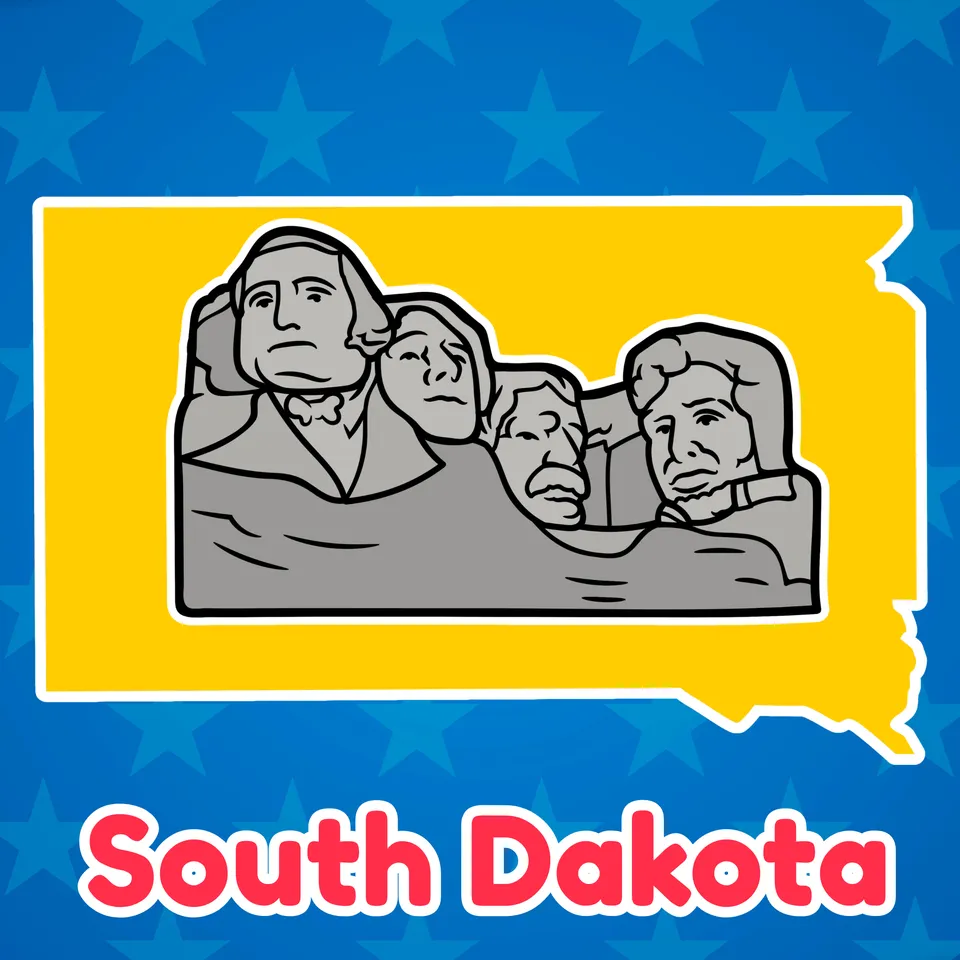
Rush on over to see Mount Rushmore
From giant stone faces to wild fossil-filled lands, South Dakota is packed with adventure! Visit Mount Rushmore and the towering Crazy Horse Memorial. Explore ancient discoveries in Badlands National Park, where extinct animals like mammoths and saber-toothed cats once roamed. With winding caves at Wind Cave National Park, colorful ring-necked pheasants and tasty foods like bison burgers and kuchen, South Dakota is full of big sights and bold flavors!
Part of
Standards alignment
Common Core State Standards
- Some kinds of plants and animals that once lived on Earth are no longer found anywhere.
- D2.Geo.6.K-2 — Individually and with others, students… Identify some cultural and environmental characteristics of specific places.
- 4-ESS1-1 — Identify evidence from patterns in rock formations and fossils in rock layers to support an explanation for changes in a landscape over time.
- D2.Geo.3.3-5 — Individually and with others, students… Use maps of different scales to describe the locations of cultural and environmental characteristics.
- D2.Geo.3.K-2 — Individually and with others, students… Use maps, globes, and other simple geographic models to identify cultural and environmental characteristics of places.
Alabama
- SC23.4.11 — Construct explanations of Earth's changes over time through slow and rapid processes, citing evidence found in rock formations and fossils in rock layers.
- SS10.2.2.4 — Describing the history of American symbols and monuments
- SS10.5.13.2 — Locating on a map states, capitals, and important geographic features west of the Mississippi River
- SS10.2.10.1 — Comparing physical features of regions throughout the United States
Alaska
- Some kinds of plants and animals that once lived on Earth are no longer found anywhere.
- 1 — know that places have distinctive geographic characteristics;
- 5 — describe and demonstrate how places and regions serve as cultural symbols, such as the Statue of Liberty;
- Fossils provide evidence about the types of organisms that lived long ago and also about the nature of their environments.
- 2 — understand the people and the political, geographic, economic, cultural, social, and environmental events that have shaped the history of the state, the United States, and the world;
Arizona
- 1.H4.1 — Explain and explore origins of key American symbols, documents, landmarks, holidays, and leaders as well as their importance from the past to the present in our country. • Symbols include but are not limited to American flag, bald eagle, Statue of Liberty, White House, Washington Monument, Mount Rushmore, Liberty Bell, United States Capitol, and Arizona state symbols • Holidays include but are not limited to Columbus Day, Thanksgiving, Veterans Day, Memorial Day, Labor Day, Presidents Day, Martin Luther King Jr. Day, Independence Day, Constitution Day, and Arizona Statehood Day • Leaders include but are not limited to local and/or Tribal leaders, state leaders, and national leaders
- 1.H4.2 — Draw upon fictional stories, biographies, and non-fiction/informational text to identify historical figures in your community, state, and nation and explain their significance in history and in the present day.
- 2.G1.1 — Use and construct maps, graphs, and other geographic representations of familiar and unfamiliar places in the world; and locate physical and human features. • Key physical features include but are not limited to seven continents, oceans, lakes, rivers, mountain ranges, coasts, seas, and deserts • Key human features include but are not limited to equator, hemispheres, North and South Pole, cities, states, countries, regions, and landmarks
- 1.L4U3.11 — Ask questions and explain how factors can cause species to go extinct.
- 5.G1.1 — Use and construct maps and graphs to represent changes in the United States. • Key concepts include but are not limited to physical and human features of the United States, the regions of the United States and their characteristics, geographic location of major events, the growth of the United States through territorial expansion, demographic changes, and the states and their capitals
Arkansas
- Some kinds of plants and animals that once lived on Earth are no longer found anywhere.
- H.1.2.5 — Explain state and national historical symbols and landmarks and the people and events associated with them.
- Fossils provide evidence about the types of organisms that lived long ago and also about the nature of their environments.
- 4-ESS1-1 — Identify evidence from patterns in rock formations and fossils in rock layers to support an explanation for changes in a landscape over time.
California
- Some kinds of plants and animals that once lived on Earth are no longer found anywhere.
- 3-LS4-1 — Analyze and interpret data from fossils to provide evidence of the organisms and the environments in which they lived long ago.
- 4-ESS1-1 — Identify evidence from patterns in rock formations and fossils in rock layers to support an explanation for changes in a landscape over time.
- 3.4.3 — Know the histories of important local and national landmarks, symbols, and essential documents that create a sense of community among citizens and exemplify cherished ideals (e.g., the U.S. flag, the bald eagle, the Statue of Liberty, the U.S. Constitution, the Declaration of Independence, the U.S. Capitol).
Colorado
- LS4.A — Evidence of Common Ancestry and Diversity: Some kinds of plants and animals that once lived on Earth are no longer found anywhere. Fossils provide evidence about the types of organisms that lived long ago and also about the nature of their environments.
- SC.4.3.1.a — Identify evidence from patterns in rock formations and fossils in rock layers to support an explanation for changes in a landscape over time.
- SS.3.2.1 — Use geographic tools to develop spatial thinking skills.
- SS.5.2.1 — Use geographic tools and sources to research and answer questions about United States geography.
Connecticut
- Some kinds of plants and animals that once lived on Earth are no longer found anywhere.
- GEO 2.6 — Identify cultural and environmental characteristics of a place/region.
- 3-LS4-1 — Analyze and interpret data from fossils to provide evidence of the organisms and the environments in which they lived long ago.
- GEO 3.3 — Use maps of different scales to describe the locations of cultural and environmental characteristics.
- GEO 4.4 — Explain how the cultural and environmental characteristics of places change over time.
Delaware
- Some kinds of plants and animals that once lived on Earth are no longer found anywhere.
- G.1.4-5a — Students will demonstrate development of mental maps of Delaware and of the United States which include the relative location and characteristics of major physical features, political divisions, and human settlements. Grade 4
- G.1.K-3a — Students will understand the nature and uses of maps, globes, and other geo-graphics. Grade K and Grade 3
- H.4.K-3b — Students will develop an awareness of major events and people in United States and Delaware history. • Who lives here and how did they get here? (immigrants, demographics, ethnic and religious groups) • Important people in our past • Different kinds of communities in Delaware and the United States
- 4-ESS1-1 — Identify evidence from patterns in rock formations and fossils in rock layers to support an explanation for changes in a landscape over time.
Florida
- SS.3.G.2.5 — Identify natural and man-made landmarks in the United States, Canada, Mexico, and the Caribbean.
- SS.3.G.2.4 — Describe the physical features of the United States, Canada, Mexico, and the Caribbean.
- SS.5.G.1.6 — Locate and identify states, capitals, and United States Territories on a map.
Georgia
- SS1H1.a — Identify the contributions made by these figures: Benjamin Franklin (inventor/author/ statesman), Thomas Jefferson (Declaration of Independence), Meriwether Lewis and William Clark with Sacagawea (exploration), Theodore Roosevelt (National Parks and the environment), George Washington Carver (science), and Ruby Bridges (civil rights).
Hawaii
- Some kinds of plants and animals that once lived on Earth are no longer found anywhere.
- Fossils provide evidence about the types of organisms that lived long ago and also about the nature of their environments.
- 4-ESS1-1 — Identify evidence from patterns in rock formations and fossils in rock layers to support an explanation for changes in a landscape over time.
- SS.2.3.13.4 — Describe major geographic features of places using maps, photos, and other geographic representations
- SS.3.3.14.4 — Analyze how cultural practices create and influence communities
Idaho
- Some kinds of plants and animals that once lived on Earth are no longer found anywhere. (5- LS-2.1)
- 5.SS.2.1.4 — Name and locate the 50 States and their Capitals, and U.S. Territories.
- Local, regional, and global patterns of rock formations reveal changes over time due to earth forces, such as earthquakes. The presence and location of certain fossil types indicate the order in which rock layers were formed. (4-ESS-1.1)
- Fossils provide evidence about the types of organisms that lived long ago and also about the nature of their environments. (5-LS-2.1)
Illinois
- LS4.A-E1 — Some kinds of plants and animals that once lived on Earth are no longer found anywhere. (Note: moved from K-2)
- LS4.A-E2 — Fossils provide evidence about the types of organisms that lived long ago and also about the nature of their environments.
- 4-ESS1-1 — Identify evidence from patterns in rock formations and fossils in rock layers to support an explanation for changes in a landscape over time.
- SS.2.G.1 — With guidance and support, use print and digital maps, globes and other simple geographic models to identify cultural and environmental characteristics of places.
Indiana
- 3.ESS.4 — Determine how fossils are formed, discovered, layered over time, and used to provide evidence of the organisms and the environments in which they lived long ago.
- 5.G.2 — Use maps and globes to locate states, capitals, major cities, major rivers, the Great Lakes, and mountain ranges in the United States. (E)
- 3.G.2 — Label a map of the Midwest, identifying states, major rivers, lakes, and the Great Lakes. (E)
Iowa
- Some kinds of plants and animals that once lived on Earth are no longer found anywhere.
- Fossils provide evidence about the types of organisms that lived long ago and also about the nature of their environments.
- 3-LS4-1 — Analyze and interpret data from fossils to provide evidence of the organisms and the environments in which they lived long ago.
- 4-ESS1-1 — Identify evidence from patterns in rock formations and fossils in rock layers to support an explanation for changes in a landscape over time.
Kansas
- Some kinds of plants and animals that once lived on Earth are no longer found anywhere.
- Fossils provide evidence about the types of organisms that lived long ago and also about the nature of their environments.
- 4-ESS1-1 — Identify evidence from patterns in rock formations and fossils in rock layers to support an explanation for changes in a landscape over time.
- Local, regional, and global patterns of rock formations reveal changes over time due to earth forces, such as earthquakes. The presence and location of certain fossil types indicate the order in which rock layers were formed.
Kentucky
- Some kinds of plants and animals that once lived on Earth are no longer found anywhere.
- 2.G.GR.1 — Examine geographic features of places in North America, using a variety of geographic data, including maps, photos and other geographic tools.
- 4-ESS1-1 — Identify evidence from patterns in rock formations and fossils in rock layers to support an explanation for changes in a landscape over time.
- 4-LS4-1. — Analyze and interpret data from fossils to provide evidence of the organisms and the environments in which they lived long ago.
Louisiana
- 3.20 — Describe the geographic features of places in the United States.
- 3.6 — Identify and describe national historical figures, celebrations, and symbols. a. Describe the achievements of George Washington, Thomas Jefferson, Lewis and Clark, Sacagawea, Abraham Lincoln, Frederick Douglass, Harriet Tubman, Sojourner Truth, Sitting Bull, George Washington Carver, Susan B. Anthony, Mabel Ping-Hua Lee, Theodore Roosevelt, the Wright Brothers, Thomas Edison, Henry Ford, Alexander Graham Bell, Dr. Martin Luther King Jr., Jackie Robinson, Sally Ride, Katherine Johnson, and Mae Jemison. b. Describe the significance of state and nationally designated holidays, including New Year’s Day, the birthday of Martin Luther King, Jr., Inauguration Day, Washington’s Birthday, Mardi Gras, Memorial Day, Juneteenth, Independence Day, Labor Day, Columbus Day, Veterans Day, Thanksgiving Day, Christmas Day. c. Describe the history of American symbols, including the Liberty Bell, U.S. flag (etiquette, customs pertaining to the display and use of the flag), bald eagle, national anthem, Uncle Sam, Statue of Liberty, The Pledge of Allegiance, and the national motto “In God We Trust.” d. Identify and describe man-made American monuments and landmarks including the Gateway Arch, the Golden Gate Bridge, Jefferson Memorial, Dr. Martin Luther King Jr. Memorial in Washington D.C, Lincoln Memorial, Mount Rushmore, Pearl Harbor Museum, September 11 Memorial and Museum, Statue of liberty, the Tomb of the Unknown Soldier, U.S. Capitol, Washington Monument, and the White House. e. Identify and describe natural American landmarks, including the Grand Canyon, Mississippi River, Monument Valley, Niagara Falls, Rocky Mountains, Smoky Mountains, and Yellowstone National Park.
- 3-LS4-1 — Analyze and interpret data from fossils to provide evidence of the organisms and the environments in which they lived long ago.
- 4-ESS1-1 — Identify evidence from patterns in rock formations and fossils in rock layers to support an explanation for changes in a landscape over time.
- 2.7 — Identify and describe national historical figures, celebrations, symbols, and places. a. Identify and describe the Founding Fathers, including George Washington, Thomas Jefferson, Benjamin Franklin, Patrick Henry, John Adams, John Hancock, and James Madison. b. Identify and describe historical female figures, including Abigail Adams, Anne Hutchinson, Dolley Madison, Betsy Ross, and Phillis Wheatley. c. Describe the significance of state and nationally designated holidays, including New Year’s Day, the birthday of Martin Luther King, Jr., Inauguration Day, Washington’s Birthday, Mardi Gras, Memorial Day, Juneteenth, Independence Day, Labor Day, Columbus Day, Veterans Day, Thanksgiving Day, and Christmas Day. d. Describe the history of American symbols, including the Liberty Bell, United States flag (etiquette, customs pertaining to the display and use of the flag), bald eagle, national anthem, Uncle Sam, Statue of Liberty, The Pledge of Allegiance, and the national motto “In God We Trust.” e. Identify and describe man-made American monuments and landmarks including the Gateway Arch, the Golden Gate Bridge, Jefferson Memorial, Dr. Martin Luther King Jr. Memorial in Washington D.C, Lincoln Memorial, Mount Rushmore, Pearl Harbor Museum, September 11 Memorial and Museum, Statue of Liberty, the Tomb of the Unknown Soldier, U.S. Capitol, Washington Monument, and the White House. f. Identify and describe natural American landmarks, including the Grand Canyon, Mississippi River, Monument Valley, Niagara Falls, Rocky Mountains, Smoky Mountains, and Yellowstone National Park.
Maine
- 3-LS4-1 — Analyze and interpret data from fossils to provide evidence of the organisms and the environments in which they lived long ago.
- 4-ESS1-1 — Identify evidence from patterns in rock formations and fossils in rock layers to support an explanation for changes in a landscape over time.
Maryland
- DCI.LS4.A.3-5.1 — Some kinds of plants and animals that once lived on Earth are no longer found anywhere.
- 4-ESS1-1 — Identify evidence from patterns in rock formations and fossils in rock layers to support an explanation for changes in a landscape over time.
- DCI.ESS1.C.3-5.1 — Local, regional, and global patterns of rock formations reveal changes over time due to earth forces, such as earthquakes. The presence and location of certain fossil types indicate the order in which rock layers were formed.
Massachusetts
- 3-LS4-1 — Use fossils to describe types of organisms and their environments that existed long ago and compare those to living organisms and their environments. Recognize that most kinds of plants and animals that once lived on Earth are no longer found anywhere.
- 4.T4c.2 — Describe the diverse cultural nature of the region, including contributions of Native Peoples (e.g., Sioux, Mandan, Ojibwe/Chippewa), African Americans, Europeans and immigrant groups from other regions of the world.
- 4.T4c.1 — On a political map of the United States, locate the states in the Midwest; add to the timeline the admission dates for states in the Midwest (listed alphabetically: Illinois-1818, Indiana-1816, Iowa-1846, Kansas-1861, Michigan-1838, Minnesota-1858, Missouri-1821, Nebraska-1867, North Dakota-1889, Ohio-1803, South Dakota-1889, Wisconsin-1848).
Michigan
- 4-ESS1-1 — Identify evidence from patterns in rock formations and fossils in rock layers to support an explanation for changes in a landscape over time.
- 4–G1.0.3 — Use geographic tools and technologies, stories, songs, and pictures to answer geographic questions about the United States.
- 4–G2.0.2 — Locate and describe human and physical characteristics of major U.S. regions and compare them to the Great Lakes region.
Minnesota
- 2.3.1.1.3 — Use maps, photos or other geographic tools to identify and locate major landmarks or major physical features of the United States. For example: Physical features—the Atlantic Coast, Rocky Mountains, Mississippi River, Lake Superior. Landmarks—Statue of Liberty, Angel Island, Gateway Arch in St. Louis, Mount Rushmore, Crazy Horse Memorial.
- 4.3.2.3.1 — Locate and identify the physical and human characteristics of places in the United States, and also Canada or Mexico. For example: Physical characteristics—landforms (Rocky Mountains), ecosystems (forest), bodies of water (Mississippi River, Hudson Bay), soil, vegetation, weather and climate. Human characteristics— structures (Statue of Liberty), bridges (Golden Gate Bridge), canals (Erie Canal), cities, political boundaries, population distribution, settlement patterns, language, ethnicity, nationality, religious beliefs.
- 4.3.2.4.1 — Name and locate states and territories, major cities and state capitals in the United States.
- 4E.3.2.1.1 — Identify evidence from patterns in rock formations and fossils in rock layers to support an explanation for changes in a landscape over time. (P: 6, CC: 1, CI: ESS1)
Mississippi
- K.H.2.1 — Identify historical figures that are used as symbols of American culture (e.g., currency, monuments, and place names, etc.).
- L.K.4.1 — Obtain information from informational text or other media to document and report examples of different plants or animals that are extinct.
- 5.10.2 — Identify and label each of the 50 states on a map.
- K.H.1.2 — Identify school, community, state, and national symbols.
- 1.H.1.2 — Examine the significant contributions of historical figures to the local community, state, and United States.
Missouri
- Some kinds of plants and animals that once lived on Earth are no longer found anywhere.
- 2.PC.1.F.b — Recognize and explain the significance of national symbols including national landmarks, national parks, and important memorials.
- Fossils provide evidence about the types of organisms that lived long ago and also about the nature of their environments.
- 4.EG.5.B.a — Name and locate specific regions, states, capitals, river systems and mountain ranges in the United States based on historical or current topics.
- 4.ESS1.C.1 — Identify evidence from patterns in rock formations and fossils in rock layers to support an explanation for changes in a landscape over time.
Montana
- 4- ESS1-1 — identify evidence from patterns in rock formations and fossils in rock layers to support an explanation for changes in a landscape over time;
- SS.G.3.3 — identify landforms and other physical characteristics of the Americas.
- SS.G.5.1 — identify and label US regions, territories, states and their capitals/major cities;
Nebraska
- Some kinds of plants and animals that once lived on Earth are no longer found anywhere.
- SS K.4.3.a — Recognize historical people from a variety of cultures.
- SS 5.3.1.a — Use maps and atlases to locate major human and physical features in the United States.
- SC.4.13.4.A — Identify evidence from patterns in rock formations and fossils in rock layers to support an explanation for changes in a landscape over time.
Nevada
- 4-ESS1-1 — Identify evidence from patterns in rock formations and fossils in rock layers to support an explanation for changes in a landscape over time.
New Hampshire
- Some kinds of plants and animals that once lived on Earth are no longer found anywhere.
- SS.HI.4.1.3 — Describe the significance of national and New Hampshire celebrations, monuments, symbols and documents, e.g., Veteran's Day, the Statue of Liberty, Old Man of the Mountain, and the preamble to the New Hampshire Constitution. (Themes: B: Civic Ideals, Practices, and Engagement, C: People, Places and Environment)
- Fossils provide evidence about the types of organisms that lived long ago and also about the nature of their environments.
- SS.GE.4.1.3 — Locate major physical and human features in the United States and on Earth, e.g., mountain ranges, principal parallels or meridians. (Themes: C: People, Places and Environment, G: Science, Technology, and Society)
- 4-ESS1-1 — Identify evidence from patterns in rock formations and fossils in rock layers to support an explanation for changes in a landscape over time.
New Jersey
- Some kinds of plants and animals that once lived on Earth are no longer found anywhere.
- Local, regional, and global patterns of rock formations reveal changes over time due to earth forces, such as earthquakes. The presence and location of certain fossil types indicate the order in which rock layers were formed.
- 4-ESS1-1 — Identify evidence from patterns in rock formations and fossils in rock layers to support an explanation for changes in a landscape over time.
- 6.1.5.HistorySE.2 — Construct an argument for the significant and enduring role of historical symbols, monuments, and holidays and how they affect the American identity.
New Mexico
- K.10 — Identify the local, state, and national symbols (e.g., flag, bird, song).
- Some kinds of plants and animals that once lived on Earth are no longer found anywhere.
- 5.27 — Using a map, identify and locate the 50 states in the United States and know the capitals of each state along with the surrounding U.S. territories.
- 4-ESS1-1 — Identify evidence from patterns in rock formations and fossils in rock layers to support an explanation for changes in a landscape over time.
New York
- 2.3d — Symbols of American democracy serve to unite community members.
- Some kinds of plants and animals that once lived on Earth are no longer found anywhere.
- 4-ESS1-1 — Identify evidence from patterns in rock formations and fossils in rock layers to support an explanation for changes in a landscape over time.
- E.1.3 — Study about the major social, political, economic, cultural, and religious developments in New York State and United States history involves learning about the important roles and contributions of individuals and groups.
- E.3.1 — Geography can be divided into six essential elements which can be used to analyze important historic, geographic, economic, and environmental questions and issues. These six elements include: the world in spatial terms, places and regions, physical settings (including natural resources), human systems, environment and society, and the use of geography. (Adapted from The National Geography Standards, 1994: Geography for Life)
North Carolina
- 2.G.1.1 — Recognize absolute and relative location of various settlements, territories, and states in the development of the American nation.
- LS.4.2 — Understand the use of fossils as evidence of the history of Earth and its changing life forms.
- LS.4.2.2 — Analyze and interpret data to explain how fossils suggest ideas about Earth's early environment.
- 1.G.1.1 — Use maps, globes, and/or digital representations to identify various types of landforms of places around the world.
North Dakota
- Some kinds of plants and animals that once lived on Earth are no longer found anywhere. Fossils provide evidence about the types of organisms that lived long ago and also about the nature of their environments.
- 4-ESS1-1 — Identify evidence from patterns in rock formations and fossils in rock layers to support an explanation for changes in a landscape over time.
- 3-LS4-1 — Analyze and interpret data from fossils to provide evidence of the organisms and the environments in which they lived long ago.
Ohio
- 1.5 — Places are distinctive because of their physical characteristics (land forms and bodies of water) and human characteristics (structures built by people).
- 2.LS.2 — All organisms alive today result from their ancestors, some of which may be extinct. Not all kinds of organisms that lived in the past are represented by living organisms today.
- 5.10 — The Western Hemisphere is culturally diverse (eg., language, food, religion, art, music) due to the influences and interactions of a variety of world cultures.
Oklahoma
- Some kinds of plants and animals that once lived on Earth are no longer found anywhere. (3.LS4.1)
- Fossils provide evidence about the types of organisms that lived long ago and also about the nature of their environments. (3.LS4.1)
- 4.2.5 — Identify and locate on a political map the fifty states and the United States capitol.
- 4.3.2 — Examine the characteristics of culture, including the distribution and complexity of the regions of the United States. A. Identify the characteristics of culture (language, customs, beliefs, food, clothing, shelter) and compare the cultural characteristics of different regions of the United States. B. Explain how the characteristics of culture affect the ways in which people live.
- 4.ESS1.1 — Identify evidence from patterns in rock formations and fossils in rock layers to support an explanation for changes in a landscape over time.
- 1.3.2 — Describe the contributions of people and groups who have shaped our history and ways we commemorate important places and events of the past.
Oregon
- 3.LS4.1 — Analyze and interpret data from fossils to provide evidence of the organisms and the environments in which they lived long ago. [Clarification Statement: Examples of data could include type, size, and distributions of fossil organisms. Examples of fossils and environments could include marine fossils found on dry land, tropical plant fossils found in Arctic areas, and fossils of extinct organisms.] [Assessment Boundary: Assessment does not include identification of specific fossils or present plants and animals. Assessment is limited to major fossil types and relative ages.]
- 4.ESS1.1 — Identify evidence from patterns in rock formations and fossils in rock layers to support an explanation for changes in a landscape over time. [Clarification Statement: Examples of evidence from patterns could include rock layers with shell fossils above rock layers with plant fossils and no shells, indicating a change from water to land over time; and, a canyon with different rock layers in the walls and a river in the bottom, indicating that over time a river cut through the rock.] [Assessment Boundary: Assessment does not include specific knowledge of the mechanism of rock formation or memorization of specific rock formations and layers. Assessment is limited to relative time.]
- 6.19 — Examine the historic and current contributions and relevance of indigenous cultures.
Pennsylvania
- 8.3.3.A. — Identify contributions of individuals and groups to United States history.
- 8.3.3.B. — Identify and describe primary documents, material artifacts and historic sites important in United States history.
- Some kinds of plants and animals that once lived on Earth are no longer found anywhere.
- 7.1.3.B — Identify and locate places and regions.
- 7.2.3.A — Identify the physical characteristics of places and regions.
Rhode Island
- SS3.4.2 — States in the Midwest Explain the states that make up the Midwestern region including their admittance to the United States and their identities
- SS3.4.4 — The Midwestern region today Argue how the geography and environment of the Midwestern region contributed to its social, cultural, and economic development
- Some kinds of plants and animals that once lived on Earth are no longer found anywhere.
- SS3.4.1 — Geography and environment of the Midwest Explain the geography and environment of the Midwestern region of the United States
- SS3.4.3 — Peoples over time in the Midwest Analyze the ways diverse peoples have come to live in the Midwestern region of the United States over time
South Carolina
- 3-LS4-1.DCI.A: — Evidence of Common Ancestry and Diversity Some kinds of plants and animals that once lived on Earth are no longer found anywhere. Fossils provide evidence about the types of organisms that lived long ago and also about the nature of their environments. NRC Framework Link
- 4-ESS1-1. — Identify evidence from patterns in rock formations and fossils in rock layers to support an explanation for changes in a landscape over time. Clarification Statement: Examples of evidence from patterns could include rock layers with marine shell fossils above rock layers with plant fossils and no shells, indicating a change from land to water over time; and a canyon with different rock layers in the walls and a river in the bottom, indicating that over time a river cut through the rock. State Assessment Boundary: Assessment does not include specific knowledge of the mechanism of rock formation or memorization of specific rock formations and layers. Assessment is limited to relative time.
- 2.G.2 — Describe and compare various landforms over time within the U.S. through the use of primary and secondary sources. This indicator was developed to encourage inquiry into using historic images, maps, narratives, texts, or video, to investigate and compare different landforms around the U.S.
- 3-LS4-1. — Analyze and interpret data from fossils to provide evidence of organisms and the environments in which they lived long ago. Clarification Statement: Examples could include marine fossils found on dry land and tropical plant fossils found in cold regions. State Assessment Boundary: Assessment does not include identification of specific fossils or fossils of organisms still in existence. Assessment is limited to major fossil types and relative ages.
South Dakota
- 4.G.1.1 — Locate major political and physical features of South Dakota and the United States on a map or globe
- 3.C.1.1 — Research and explain the meaning behind South Dakota’s symbols
- 4-ESS1-1 — Identify evidence from patterns in rock formations and fossils in rock layers to support an explanation for changes in a landscape over time.
- 4.H.2.3 — Describe the influence of notable South Dakotans of the development of our state
- 3-LS4-1 — Analyze and interpret data from fossils to provide evidence of the organisms and the environments in which they lived long ago.
Tennessee
- 2.20 — Identify and examine the significance of well-known national symbols and landmarks, including: Mt. Rushmore, the White House, the Statue of Liberty, and the bald eagle.
- 3.09 — Identify and locate the fifty states of the U.S.
- 4.LS4.1 — Obtain information about what a fossil is and ways a fossil can provide information about the past.
Texas
- 2.11D — identify symbols such as state and national birds and flowers and Uncle Sam; and
- 2.1B — identify and explain the significance of various community, state, and national landmarks such as monuments and government buildings.
- 5.16D — explain the significance of important landmarks, including the White House, the Statue of Liberty, and Mount Rushmore.
- 5.6C — locate on a map important political features such as the five largest cities by population in the United States and the 50 states; and
Utah
- 1.2.3.d — Identify national symbols, documents, and landmarks (e.g., Declaration of Independence, U.S. Constitution, Liberty Bell, Washington Monument).
- K.2.3.b — Recognize state and national symbols (e.g., state and national flags, bald eagle, seagull, Statue of Liberty).
- 4.1.4 — Engage in argument based on patterns in rock layers and fossils found in those layers to support an explanation that environments have changed over time. Emphasize the relationship between fossils and past environments. Examples could include tropical plant fossils found in Arctic areas and rock layers with marine shell fossils found above rock layers with land plant fossils. (ESS1.C)
Vermont
- Some kinds of plants and animals that once lived on Earth are no longer found anywhere.
- D2.Geo.6.K-2 — Individually and with others, students… Identify some cultural and environmental characteristics of specific places.
- Fossils provide evidence about the types of organisms that lived long ago and also about the nature of their environments.
- D2.Geo.3.K-2 — Individually and with others, students… Use maps, globes, and other simple geographic models to identify cultural and environmental characteristics of places.
- 4-ESS1-1 — Identify evidence from patterns in rock formations and fossils in rock layers to support an explanation for changes in a landscape over time.
Virginia
- 2.12.c — The student will apply history and social science skills to connect geography to landmarks and historic events including, but not limited to Yellowstone National Park.
- 2.5.b — The student will use history and social science skills to identify the geographic location, use of resources, and contributions of Indigenous people past and present, including Indigenous nations and tribes of the Plains.
- 5.8.e — Fossils and geologic patterns provide evidence of Earth’s change.
- 2.5.d — The student will use history and social science skills to identify the geographic location, use of resources, and contributions of Indigenous people past and present, including understanding tribal sovereignty, and the importance of land, history, and culture.
- USI.1.c — The student will apply history and social science skills to understand the geography of North America by locating the 50 states.
Washington
- G1.3.2 — Investigate the physical, political, and cultural characteristics of places, regions, and people in North America, including the location of the fifty states within the regions of the United States.
- Some kinds of plants and animals that once lived on Earth are no longer found anywhere.
- G2.2.1 — Identify some common and unique cultural and environmental characteristics of specific places.
- 4-ESS1-1 — Identify evidence from patterns in rock formations and fossils in rock layers to support an explanation for changes in a landscape over time.
- G1.3.1 — Examine and use maps and globes to understand the regions of North America in the past and present.
Washington, D.C.
- 3-LS4-1 — Analyze and interpret data from fossils to provide evidence of the organisms and the environments in which they lived long ago.
- 4-ESS1-1 — Identify evidence from patterns in rock formations and fossils in rock layers to support an explanation for changes in a landscape over time.
West Virginia
- S.4.10 — Identify evidence from patterns in rock formations and fossils in rock layers to support an explanation for changes in a landscape over time.
- S.4.11 — Analyze and interpret data from fossils to provide evidence of the organisms and the environments in which they lived long ago.
- SS.3.19 — Compare and contrast regions of the United States in regard to plant and animal life, landforms, climate and human interactions with the environment.
- SS.5.17 — Compare and contrast the various regions of the United States; locate each of the fifty United States and correlate them with their regions.
- SS.2.15 — Identify cultural contributions and differences made by people from the various regions in the United States using literature, documents and oral accounts.
Wisconsin
- SS.Geog1.b.1-2 — Identify physical and human characteristics of a place using maps, graphs, photographs, and other representations.
- Some living organisms resemble organisms that once lived on Earth. Fossils provide evidence about the types of organisms and environments that existed long ago.
- SS.Geog4.a.4 — Describe how certain places may have meanings that distinguish them from other places (e.g., cemetery, places of worship, state or national parks, historical park, or battlefield). Compare and contrast the human characteristics of rural, suburban, urban, and tribal locations in Wisconsin and the United States. Identify and describe how people may view places in the community differently (e.g., students and senior citizens responding to a new playground).
- SS.PS1.a.K-1 — Describe symbols, songs, and traditions that identify our state and country. Assess the importance of rules and laws at home, in school, and in the community.
Wyoming
- 3-LS4-1 — Analyze and interpret data from fossils to provide evidence of the organisms and the environments in which they lived long ago.
- 4-ESS1-1 — Identify evidence from patterns in rock formations and fossils in rock layers to support an explanation for changes in a landscape over time.
- SS5.5.2 — Physical Place and Region Explain how physical features, patterns, and systems impact different regions and how these features may help us generalize and compare areas within the reservation, state, nation, or world. RL.3.2, RL.4.7, RL.4.9 RI.3.3, RI.4.3, RI.5.3 W.3.2, W.3.7, W.4.2.b W.5.2.b W.5.7 SL.3.4