The Area Formula
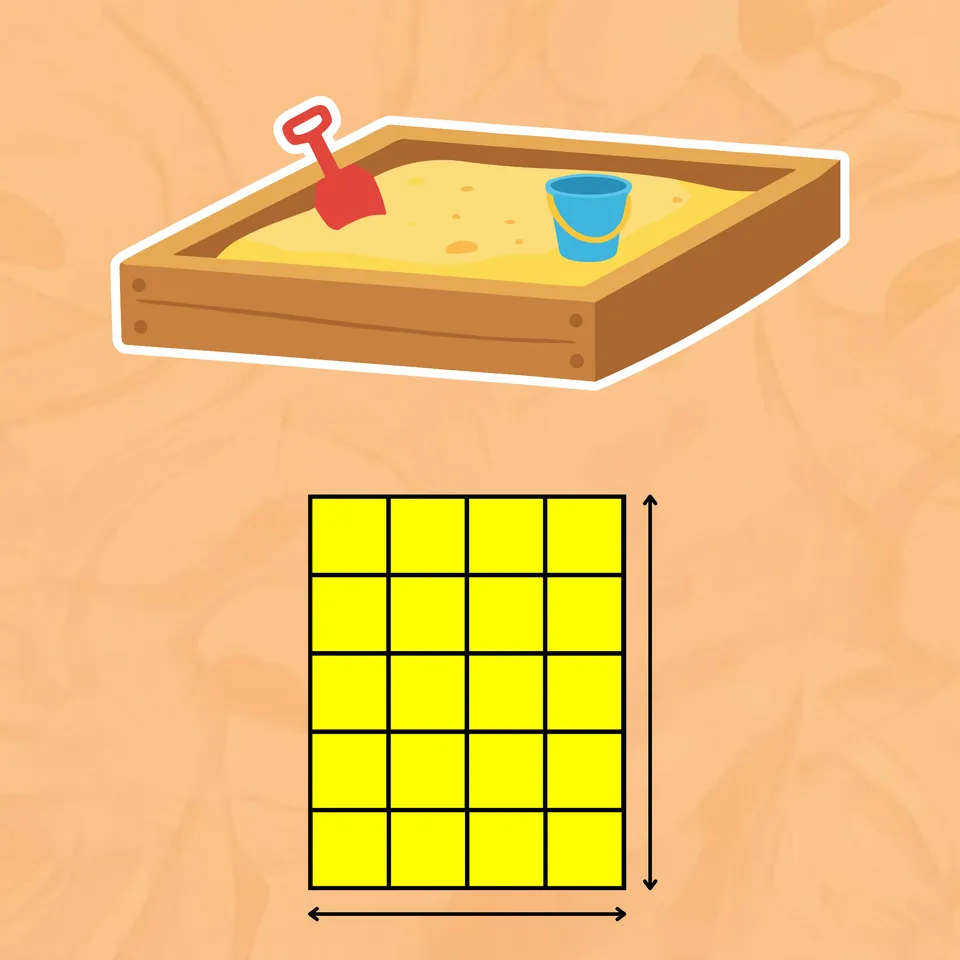
Ages 8–11 · 6 minutes · Math
Discover how the area formula can be used to quickly calculate areas of rectangles
Students will learn the formula Area = Length × Width and use multiplication to calculate areas of rectangles
Part of
Standards alignment
Common Core State Standards
- 3.MD.C.7 — Relate area to the operations of multiplication and addition.
- 3.MD.C.7.a — Find the area of a rectangle with whole-number side lengths by tiling it, and show that the area is the same as would be found by multiplying the side lengths.
- 3.MD.C.7.b — Multiply side lengths to find areas of rectangles with whole-number side lengths in the context of solving real world and mathematical problems, and represent whole-number products as rectangular areas in mathematical reasoning.
- 3.MD.C.6 — Measure areas by counting unit squares (square cm, square m, square in, square ft, and improvised units).
- 4.MD.A.3 — Apply the area and perimeter formulas for rectangles in real world and mathematical problems. For example, find the width of a rectangular room given the area of the flooring and the length, by viewing the area formula as a multiplication equation with an unknown factor.
Alabama
- MA19.3.22 — Relate area to the operations of multiplication using real-world problems, concrete materials, mathematical reasoning, and the distributive property.
- MA19.3.20 — Find the area of a rectangle with whole number side lengths by tiling without gaps or overlays and counting unit squares.
- MA19.4.23 — Apply area and perimeter formulas for rectangles in real-world and mathematical situations.
Alaska
- 3.MD.9.a — Find the area of a rectangle with whole-number side lengths by tiling it, and show that the area is the same as would be found by multiplying the side lengths. For example, after tiling rectangles, develop a rule for finding the area of any rectangle.
- 3.MD.9.b — Multiply side lengths to find areas of rectangles with whole number side lengths in the context of solving real world and mathematical problems, and represent whole-number products as rectangular areas in mathematical reasoning.
- 3.MD.9 — Relate area to the operations of multiplication and addition.
- 4.MD.3 — Apply the area and perimeter formulas for rectangles in real world and mathematical problems. For example, find the width of a rectangular room given the area of the flooring and the length, by viewing the area formula as a multiplication equation with an unknown factor.
Arizona
- 3.MD.C.7.a — Find the area of a rectangle with whole-number side lengths by tiling it, and show that the area is the same as would be found by multiplying the side lengths.
- 3.MD.C.7.b — Multiply side lengths to find areas of rectangles with whole-number side lengths in the context of solving real world and mathematical problems, and represent whole-number products as rectangular areas in mathematical reasoning.
- 3.MD.C.7 * — Relate area to the operations of multiplication and addition.
- 3.OA.A.1 — Interpret products of whole numbers as the total number of objects in equal groups (e.g., interpret 5 x 7 as the total number of objects in 5 groups of 7 objects each).
- 3.MD.C.6 — Measure areas by counting unit squares (square cm, square m, square in, square ft, and improvised units).
Arkansas
- 3.GM.6 — Find the area of a rectangle with whole number side lengths by modeling with unit squares and multiplying the side lengths to show the results are the same.
- 3.GM.7 — Multiply side lengths to find areas of rectangles with whole number side lengths in the context of solving real- world and mathematical problems.
- 3.GM.5 — Describe area as the number of unit squares that cover a plane figure without gaps and overlaps.
- 4.GM.7 — Apply the area and perimeter formulas for rectangles and figures composed of two or more rectangles in real-world situations.
California
- 3.MD.C.7.a — Find the area of a rectangle with whole-number side lengths by tiling it, and show that the area is the same as would be found by multiplying the side lengths.
- 3.MD.C.7.b — Multiply side lengths to find areas of rectangles with whole-number side lengths in the context of solving real world and mathematical problems, and represent whole-number products as rectangular areas in mathematical reasoning.
- 3.MD.C.6 — Measure areas by counting unit squares (square cm, square m, square in, square ft, and improvised units).
- 4.MD.A.3 — Apply the area and perimeter formulas for rectangles in real world and mathematical problems. For example, find the width of a rectangular room given the area of the flooring and the length, by viewing the area formula as a multiplication equation with an unknown factor.
Colorado
- 3.MD.C.7.a — Find the area of a rectangle with whole-number side lengths by tiling it, and show that the area is the same as would be found by multiplying the side lengths.
- 3.MD.C.7.b — Multiply side lengths to find areas of rectangles with whole-number side lengths in the context of solving real-world and mathematical problems, and represent whole-number products as rectangular areas in mathematical reasoning.
- 3.MD.C.6 — Measure areas by counting unit squares (square cm, square m, square in, square ft, and improvised units).
- 3.MD.C.7 — Use concepts of area and relate area to the operations of multiplication and addition.
Connecticut
- 3.MD.C.7.a — Find the area of a rectangle with whole-number side lengths by tiling it, and show that the area is the same as would be found by multiplying the side lengths.
- 3.MD.C.7.b — Multiply side lengths to find areas of rectangles with whole-number side lengths in the context of solving real world and mathematical problems, and represent whole-number products as rectangular areas in mathematical reasoning.
- 3.MD.C.6 — Measure areas by counting unit squares (square cm, square m, square in, square ft, and improvised units).
- 3.MD.C.7 — Relate area to the operations of multiplication and addition.
Delaware
- 3.MD.C.7.a — Find the area of a rectangle with whole-number side lengths by tiling it, and show that the area is the same as would be found by multiplying the side lengths.
- 3.MD.C.7.b — Multiply side lengths to find areas of rectangles with whole-number side lengths in the context of solving real world and mathematical problems, and represent whole-number products as rectangular areas in mathematical reasoning.
- 3.MD.C.7 — Relate area to the operations of multiplication and addition.
- 3.MD.C.5 — Recognize area as an attribute of plane figures and understand concepts of area measurement.
- 5.NF.B.4.b — Find the area of a rectangle with fractional side lengths by tiling it with unit squares of the appropriate unit fraction side lengths, and show that the area is the same as would be found by multiplying the side lengths. Multiply fractional side lengths to find areas of rectangles, and represent fraction products as rectangular areas.
Florida
- MA.3.GR.2.2 — Find the area of a rectangle with whole-number side lengths using a visual model and a multiplication formula.
- MA.3.GR.2.3 — Solve mathematical and real-world problems involving the perimeter and area of rectangles with whole-number side lengths using a visual model and a formula.
- MA.3.NSO.2.4 — Multiply two whole numbers from 0 to 12 and divide using related facts with procedural reliability.
- MA.3.GR.2.1 — Explore area as an attribute of a two-dimensional figure by covering the figure with unit squares without gaps or overlaps. Find areas of rectangles by counting unit squares.
Georgia
- 3.GSR.7 — Identify area as a measurable attribute of rectangles and determine the area of a rectangle presented in real-life, mathematical problems.
- 3.GSR.7.3 — Discover and explain how area can be found by multiplying the dimensions of a rectangle.
- 3.GSR.7.2 — Determine the area of rectangles (or shapes composed of rectangles) presented in relevant problems by tiling and counting.
Hawaii
- 3.MD.C.7a — Find the area of a rectangle with whole-number side lengths by tiling it, and show that the area is the same as would be found by multiplying the side lengths.
- 3.MD.C.7b — Multiply side lengths to find areas of rectangles with whole-number side lengths in the context of solving real world and mathematical problems, and represent whole-number products as rectangular areas in mathematical reasoning.
- 3.MD.C.7 — Relate area to the operations of multiplication and addition.
- 4.MD.A.3 — Apply the area and perimeter formulas for rectangles in real world and mathematical problems.
Idaho
- 3.MD.C.7.a — Find the area of a rectangle with whole-number side lengths by tiling it, and show that the area is the same as would be found by multiplying the side lengths.
- 3.MD.C.7.b — Multiply side lengths to find areas of rectangles with whole-number side lengths in the context of solving real-world and mathematical problems, and represent whole-number products as rectangular areas in mathematical reasoning.
- 3.MD.C.7 — Relate area to the operations of multiplication and addition.
- 4.MD.A.3 — Apply the area and perimeter formulas for rectangles in real-world and mathematical problems.
- 3.MD.C.6 — Measure areas by counting unit squares (square cm, square m, square in, square ft, and nonstandard units).
Illinois
- 3.MD.C.7.a — Find the area of a rectangle with whole-number side lengths by tiling it, and show that the area is the same as would be found by multiplying the side lengths.
- 3.MD.C.7.b — Multiply side lengths to find areas of rectangles with whole-number side lengths in the context of solving real world and mathematical problems, and represent whole-number products as rectangular areas in mathematical reasoning.
- 3.MD.C.7 — Relate area to the operations of multiplication and addition.
- 3.OA.A.1 — Interpret products of whole numbers, e.g., interpret 5 × 7 as the total number of objects in 5 groups of 7 objects each. For example, describe a context in which a total number of objects can be expressed as 5 × 7.
- 4.MD.A.3 — Apply the area and perimeter formulas for rectangles in real world and mathematical problems. For example, find the width of a rectangular room given the area of the flooring and the length, by viewing the area formula as a multiplication equation with an unknown factor.
Indiana
- 3.M.5 — Find the area of a rectangle with whole-number side lengths by modeling with unit squares, and show that the area is the same as would be found by multiplying the side lengths. Identify and draw rectangles with the same perimeter and different areas or with the same area and different perimeters. (E)
- 3.CA.3 — Model the concept of multiplication of whole numbers using equal-sized groups, arrays, area models, and equal intervals on a number line. Model the properties of 0 and 1 in multiplication using objects or drawings. (E)
- 4.M.4 — Apply the area and perimeter formulas for rectangles to solve real-world and other mathematical problems. Investigate the area of complex shapes composed of rectangles by decomposing them into non-overlapping rectangles and adding the areas of the non-overlapping parts; apply this technique to solve real-world problems and other mathematical problems. (E)
- PS.8 — Look for and express regularity in repeated reasoning.
Iowa
- 3.MD.C.7.a — Find the area of a rectangle with whole-number side lengths by tiling it and show that the area is the same as would be found by multiplying the side lengths.
- 3.MD.C.7.b — Multiply side lengths to find areas of rectangles with whole-number side lengths in the context of solving real world and mathematical problems.
- 3.MD.C.6 — Measure areas by counting unit squares (square cm, square m, square in, square ft, and improvised units).
- 3.MD.C.7 — Relate area to the operations of multiplication and addition.
- 4.MD.A.3 — Apply the area and perimeter formulas for rectangles in real world and mathematical problems. For example, find the width of a rectangular room given the area of the flooring and the length, by viewing the area formula as a multiplication equation with an unknown factor.
Kansas
- 3.MD.8.a — Find the area of a rectangle with whole-number side lengths by tiling it, and show that the area is the same as would be found by multiplying the side lengths.
- 3.MD.8.b — Multiply side lengths to find areas of rectangles with whole-number side lengths in the context of solving real world and mathematical problems, and represent whole-number products as rectangular areas in mathematical reasoning.
- 3.MD.7 — Measure areas by counting unit squares (square cm, square m, square in, square ft, and non-standard square units).
- 3.MD.8 — Relate area to the operations of multiplication and addition
- 3.OA.1 — Interpret products of whole numbers, (e.g. interpret 5 ⋅ 7 as the total number of objects in 5 groups of 7 objects each.)
Kentucky
- KY.3.MD.7 — Relate area to the operations of multiplication and addition.
- KY.3.MD.7.a — Find the area of a rectangle with whole-number side lengths by tiling it and show the area is the same as would be found by multiplying the side lengths.
- KY.3.MD.7.b — Multiply side lengths to find areas of rectangles with whole- number side lengths in the context of solving real world and mathematical problems and represent whole-number products as rectangular areas in mathematical reasoning.
- KY.4.MD.3 — Apply the area and perimeter formulas for rectangles in real world and mathematical problems.
Louisiana
- 3.MD.C.7.a — Find the area of a rectangle with whole-number side lengths by tiling it, and show that the area is the same as would be found by multiplying the side lengths.
- 3.MD.C.7.b — Multiply side lengths to find areas of rectangles with whole-number side lengths in the context of solving real world and mathematical problems, and represent whole-number products as rectangular areas in mathematical reasoning.
- 3.MD.C.7 — Relate area to the operations of multiplication and addition.
- 3.MD.C.6 — Measure areas by counting unit squares (square cm, square m, square in, square ft, and improvised units).
Maine
- 3.MD.C.7a — Find the area of a rectangle with whole-number side lengths by tiling it and show that the area is the same as would be found by multiplying the side lengths.
- 3.MD.C.7b — Multiply side lengths to find areas of rectangles with whole-number side lengths in the context of solving real world and mathematical problems and represent whole-number products as rectangular areas in mathematical reasoning.
- 4.MD.A.3 — Apply the area and perimeter formulas for rectangles in real world and mathematical problems. For example, find the width of a rectangular room given the area of the flooring and the length, by viewing the area formula as a multiplication equation with an unknown factor.
- 3.MD.C.6 — Measure areas by counting unit squares (square cm, square m, square in, square ft, and non- standard units
Maryland
- 3.MD.C.7.a — Find the area of a rectangle with whole-number side lengths by tiling it, and show that the area is the same as would be found by multiplying the side lengths.
- 3.MD.C.7.b — Multiply side lengths to find areas of rectangles with whole-number side lengths in the context of solving real world and mathematical problems, and represent whole-number products as rectangular areas in mathematical reasoning.
- 3.MD.C.7 — Relate area to the operations of multiplication and addition.
- 4.MD.A.3 — Apply the area and perimeter formulas for rectangles in real world and mathematical problems. For example, find the width of a rectangular room given the area of the flooring and the length, by viewing the area formula as a multiplication equation with an unknown factor.
Massachusetts
- 3.MD.C.7.a — Find the area of a rectangle with whole-number side lengths by tiling it, and show that the area is the same as would be found by multiplying the side lengths.
- 3.MD.C.7.b — Multiply side lengths to find areas of rectangles with whole-number side lengths in the context of solving real-world and mathematical problems, and represent whole-number products as rectangular areas in mathematical reasoning.
- 3.MD.C.6 — Measure areas by counting unit squares (square cm, square m, square in., square ft., and non-standard units).
- 3.MD.C.7 — Relate area to the operations of multiplication and addition.
Michigan
- 3.MD.C.7.a — Find the area of a rectangle with whole-number side lengths by tiling it, and show that the area is the same as would be found by multiplying the side lengths.
- 3.MD.C.7.b — Multiply side lengths to find areas of rectangles with whole-number side lengths in the context of solving real world and mathematical problems, and represent whole-number products as rectangular areas in mathematical reasoning.
- 3.MD.C.7 — Relate area to the operations of multiplication and addition.
- 3.OA.A.1 — Interpret products of whole numbers, e.g., interpret 5 × 7 as the total number of objects in 5 groups of 7 objects each. For example, describe a context in which a total number of objects can be expressed as 5 × 7.
- 4.MD.A.3 — Apply the area and perimeter formulas for rectangles in real world and mathematical problems. For example, find the width of a rectangular room given the area of the flooring and the length, by viewing the area formula as a multiplication equation with an unknown factor.
Minnesota
- 4.3.2.3 — Understand that the area of a two-dimensional figure can be found by counting the total number of same size square units that cover a shape without gaps or overlaps. Justify why length and width are multiplied to find the area of a rectangle by breaking the rectangle into one unit by one unit squares and viewing these as grouped into rows and columns. For example: How many copies of a square sheet of paper are needed to cover the classroom door? Measure the length and width of the door to the nearest inch and compute the area of the door.
- 3.1.2.3 — Represent multiplication facts by using a variety of approaches, such as repeated addition, equal-sized groups, arrays, area models, equal jumps on a number line and skip counting. Represent division facts by using a variety of approaches, such as repeated subtraction, equal sharing and forming equal groups. Recognize the relationship between multiplication and division.
- 4.3.2.4 — Find the areas of geometric figures and real-world objects that can be divided into rectangular shapes. Use square units to label area measurements.
Mississippi
- 3.MD.7.a — Find the area of a rectangle with whole-number side lengths by tiling it, and show that the area is the same as would be found by multiplying the side lengths.
- 3.MD.7.b — Multiply side lengths to find areas of rectangles with whole-number side lengths (where factors can be between 1 and 10, inclusively) in the context of solving real world and mathematical problems, and represent whole-number products as rectangular areas in mathematical reasoning.
- 3.MD.6 — Measure areas by counting unit squares (square cm, square m, square in, square ft, and improvised units).
- 3.MD.7 — Relate area to the operations of multiplication and addition.
- 4.MD.3 — Apply the area and perimeter formulas for rectangles in real world and mathematical problems. For example, find the width of a rectangular room given the area of the flooring and the length, by viewing the area formula as a multiplication equation with an unknown factor.
Missouri
- 3.GM.C.11 — Demonstrate that tiling a rectangle to find the area and multiplying the side lengths result in the same value.
- 3.GM.C.12 — Multiply whole-number side lengths to solve problems involving the area of rectangles.
- 4.GM.C.8 — Apply the area and perimeter formulas for rectangles to solve problems.
- 3.GM.C.10 — Label area measurements with squared units.
Montana
- 3.MD.C.7.a — Find the area of a rectangle with whole-number side lengths by tiling it, and show that the area is the same as would be found by multiplying the side lengths.
- 3.MD.C.7.b — Multiply side lengths to find areas of rectangles with whole-number side lengths in the context of solving real world and mathematical problems, and represent whole-number products as rectangular areas in mathematical reasoning.
- 3.MD.C.7 — Relate area to the operations of multiplication and addition.
- 4.MD.A.3 — Apply the area and perimeter formulas for rectangles in real world and mathematical problems. For example, find the width of a rectangular room given the area of the flooring and the length, by viewing the area formula as a multiplication equation with an unknown factor.
Nebraska
- 3.G.2.c — Find the area of a rectangle with whole-number side lengths by modeling with unit squares; show that area can be additive and is the same as would be found by multiplying the side lengths.
- 3.A.1.f — Use drawings, words, arrays, symbols, repeated addition, equal groups, and number lines to interpret and explain the meaning of multiplication and division and their relationship.
- 3.G.2.b — Use concrete and pictorial models to measure areas in square units by counting square units.
- 4.G.3.a — Apply perimeter and area formulas for rectangles to solve authentic problems.
Nevada
- 3.MD.C.7.a — Find the area of a rectangle with whole-number side lengths by tiling it, and show that the area is the same as would be found by multiplying the side lengths.
- 3.MD.C.7.b — Multiply side lengths to find areas of rectangles with whole-number side lengths in the context of solving real world and mathematical problems, and represent whole-number products as rectangular areas in mathematical reasoning.
- 3.MD.C.7 — Relate area to the operations of multiplication and addition.
- 4.MD.A.3 — Apply the area and perimeter formulas for rectangles in real world and mathematical problems. For example, find the width of a rectangular room given the area of the flooring and the length, by viewing the area formula as a multiplication equation with an unknown factor.
- 3.MD.C.6 — Measure areas by counting unit squares (square cm, square m, square in, square ft, and improvised units).
New Hampshire
- 3.MD.C.7 — Relate area to the operations of multiplication and addition.
- 3.MD.C.7.a — Find the area of a rectangle with whole-number side lengths by tiling it, and show that the area is the same as would be found by multiplying the side lengths.
- 3.MD.C.7.b — Multiply side lengths to find areas of rectangles with whole-number side lengths in the context of solving real world and mathematical problems, and represent whole-number products as rectangular areas in mathematical reasoning.
- 3.MD.C.6 — Measure areas by counting unit squares (square cm, square m, square in, square ft, and improvised units).
- 5.NF.B.4.b — Find the area of a rectangle with fractional side lengths by tiling it with unit squares of the appropriate unit fraction side lengths, and show that the area is the same as would be found by multiplying the side lengths. Multiply fractional side lengths to find areas of rectangles, and represent fraction products as rectangular areas.
New Jersey
- 3.MD.C.7a — Find the area of a rectangle with whole-number side lengths by tiling it, and show that the area is the same as would be found by multiplying the side lengths.
- 3.MD.C.7b — Multiply side lengths to find areas of rectangles with whole number side lengths in the context of solving real world and mathematical problems, and represent whole-number products as rectangular areas in mathematical reasoning.
- 3.MD.C.7 — Relate area to the operations of multiplication and addition.
- 4.MD.A.3 — Apply the area and perimeter formulas for rectangles in real world and mathematical problems. For example, find the width of a rectangular room given the area of the flooring and the length, by viewing the area formula as a multiplication equation with an unknown factor.
New Mexico
- 3.MD.C.7.a — Find the area of a rectangle with whole-number side lengths by tiling it, and show that the area is the same as would be found by multiplying the side lengths.
- 3.MD.C.7.b — Multiply side lengths to find areas of rectangles with whole-number side lengths in the context of solving real world and mathematical problems, and represent whole-number products as rectangular areas in mathematical reasoning.
- 3.MD.C.7 — Relate area to the operations of multiplication and addition.
- 4.MD.A.3 — Apply the area and perimeter formulas for rectangles in real world and mathematical problems. For example, find the width of a rectangular room given the area of the flooring and the length, by viewing the area formula as a multiplication equation with an unknown factor.
- 3.MD.C.6 — Measure areas by counting unit squares (square cm, square m, square in, square ft, and improvised units).
New York
- NY-3.MD.7.a — Find the area of a rectangle with whole-number side lengths by tiling it, and show that the area is the same as would be found by multiplying the side lengths.
- NY-3.MD.7.b — Multiply side lengths to find areas of rectangles with whole-number side lengths in the context of solving real world and mathematical problems, and represent whole-number products as rectangular areas in mathematical reasoning.
- NY-3.MD.6 — Measure areas by counting unit squares.
- NY-3.MD.7 — Relate area to the operations of multiplication and addition.
- NY-4.MD.3 — Apply the area and perimeter formulas for rectangles in real world and mathematical problems.
North Carolina
- NC.3.MD.7 — Relate area to the operations of multiplication and addition. • Find the area of a rectangle with whole-number side lengths by tiling it, and show that the area is the same as would be found by multiplying the side lengths. • Multiply side lengths to find areas of rectangles with whole-number side lengths in the context of solving problems, and represent whole-number products as rectangular areas in mathematical reasoning. • Use tiles and/or arrays to illustrate and explain that the area of a rectangle can be found by partitioning it into two smaller rectangles, and that the area of the large rectangle is the sum of the two smaller rectangles.
- NC.3.MD.5 — Find the area of a rectangle with whole-number side lengths by tiling without gaps or overlaps and counting unit squares.
- NC.3.OA.1 — For products of whole numbers with two factors up to and including 10: • Interpret the factors as representing the number of equal groups and the number of objects in each group. • Illustrate and explain strategies including arrays, repeated addition, decomposing a factor, and applying the commutative and associative properties.
- NC.4.MD.3 — Solve problems with area and perimeter. • Find areas of rectilinear figures with known side lengths. • Solve problems involving a fixed area and varying perimeters and a fixed perimeter and varying areas. • Apply the area and perimeter formulas for rectangles in real world and mathematical problems.
North Dakota
- 3.GM.M.8 — Find the area of a rectangle with whole-number side lengths by modeling with unit squares; show that area can be additive and is the same as would be found by multiplying the side lengths.
- 4.GM.M.5 — Apply the area and perimeter formulas for rectangles, including connected rectangular figures, in problems.
- 3.AR.OA.1 — Using mental strategies, multiply and divide basic facts within 100. Automatically multiply and divide up to 5x5 and 10s facts.
Ohio
- 3.MD.7.a — Find the area of a rectangle with whole number side lengths by tiling it, and show that the area is the same as would be found by multiplying the side lengths.
- 3.MD.7.b — Multiply side lengths to find areas of rectangles with whole number side lengths in the context of solving real-world and mathematical problems, and represent whole number products as rectangular areas in mathematical reasoning.
- 3.MD.6 — Measure areas by counting unit squares (square cm, square m, square in, square ft, and improvised units).
- 3.MD.7 — Relate area to the operations of multiplication and addition.
Oklahoma
- 3.GM.2.2 — Analyze why length and width are multiplied to find the area of a rectangle by decomposing the rectangle into one unit by one unit squares and viewing these as rows and columns to determine the area.
- 3.GM.2.4 — Find the area of two-dimensional figures by counting the total number of same-size unit squares that fill the shape without gaps or overlaps.
Oregon
- 3.GM.C.7 — Relate area to multiplication and addition. Use relevant representations to solve problems in authentic contexts.
- 3.GM.C.6 — Measure areas by counting standard and non-standard unit squares.
- 4.GM.B.6 — Apply the area and perimeter formulas for rectangles in authentic contexts and mathematical problems.
- 3.GM.C.5 — Recognize area as an attribute of plane figures and understand concepts of area measurement presented in authentic contexts by tiling and counting unit squares.
Pennsylvania
- CC.2.4.3.A.5 — Determine the area of a rectangle and apply the concept to multiplication and to addition.
- CC.2.2.3.A.1 — Represent and solve problems involving multiplication and division.
- CC.2.2.3.A.3 — Demonstrate multiplication and division fluency.
Rhode Island
- 3.MD.C.7.a — Find the area of a rectangle with whole-number side lengths by tiling it, and show that the area is the same as would be found by multiplying the side lengths.
- 3.MD.C.7.b — Multiply side lengths to find areas of rectangles with whole-number side lengths in the context of solving real world and mathematical problems, and represent whole-number products as rectangular areas in mathematical reasoning.
- 3.MD.C.6 — Measure areas by counting unit squares (square cm, square m, square in, square ft, and non-standard units).
- 3.MD.C.7 — Relate area to the operations of multiplication and addition.
South Carolina
- 3.MDA.5c — Understand the concept of area measurement to include determine the area of a rectilinear polygon and relate to multiplication and addition.
- 3.ATO.3 — Solve real-world problems involving equal groups, area/array, and number line models using basic multiplication and related division facts. Represent the problem situation using an equation with a symbol for the unknown.
- 3.MDA.5b — Understand the concept of area measurement to include measure area by building arrays and counting standard unit squares.
- 4.MDA.3 — Apply the area and perimeter formulas for rectangles.
South Dakota
- 3.MD.C.7.a — Find the area of a rectangle with whole-number side lengths by tiling it, and show that the area is the same as would be found by multiplying the side lengths.
- 3.MD.C.7.b — Multiply side lengths to find areas of rectangles with whole-number side lengths in the context of solving real world and mathematical problems, and represent whole-number products as rectangular areas in mathematical reasoning.
- 3.MD.C.7 — Relate area to the operations of multiplication and addition.
- 4.MD.A.3 — Apply the area and perimeter formulas for rectangles in real world and mathematical problems. For example, find the width of a rectangular room given the area of the flooring and the length, by viewing the area formula as a multiplication equation with an unknown factor.
Tennessee
- 3.MD.C.7.a — Find the area of a rectangle with whole-number side lengths by tiling it and show that the area is the same as would be found by multiplying the side lengths.
- 3.MD.C.7.b — Multiply side lengths to find areas of rectangles with whole number side lengths in the context of solving real-world and mathematical problems and represent whole-number products as rectangular areas in mathematical reasoning.
- 3.MD.C.7 — Relate area of rectangles to the operations of multiplication and addition.
- 4.MD.A.3 — Know and apply the area and perimeter formulas for rectangles in real- world and mathematical contexts. For example, find the width of a rectangular room given the area of the flooring and the length, by viewing the area formula as a multiplication equation with an unknown factor.
- 3.MD.C.6 — Measure areas by counting unit squares (square centimeters, square meters, square inches, square feet, and improvised units).
Texas
- 3.6C — determine the area of rectangles with whole number side lengths in problems using multiplication related to the number of rows times the number of unit squares in each row;
- 4.5C — use models to determine the formulas for the perimeter of a rectangle (l + w + l + w or 2l + 2w), including the special form for perimeter of a square (4s) and the area of a rectangle (l × w); and
- 3.4E — represent multiplication facts by using a variety of approaches such as repeated addition, equal-sized groups, arrays, area models, equal jumps on a number line, and skip counting;
- 4.5D — solve problems related to perimeter and area of rectangles where dimensions are whole numbers.
Utah
- 3.MD.7.a — Find the area of a rectangle with whole-number side lengths by tiling it, and show that the area is the same as would be found by multiplying the side lengths.
- 3.MD.7.b — Multiply side lengths to find areas of rectangles with whole-number side lengths in the context of solving real-world and mathematical problems, and represent wholenumber products as rectangular areas in mathematical reasoning.
- 3.MD.6 — Measure area by counting unit squares (square centimeters, square meters, square inches, square feet, and improvised units).
- 3.MD.7 — Relate area to the operations of multiplication and addition (refer to 3.OA.5).
- 4.MD.3 — Apply the area and perimeter formulas for rectangles in real-world and mathematical problems. For example, find the width of a rectangular room given the area of the flooring and the length, by viewing the area formula as a multiplication equation with an unknown factor.
Vermont
- 3.MD.C.7.a — Find the area of a rectangle with whole-number side lengths by tiling it, and show that the area is the same as would be found by multiplying the side lengths.
- 3.MD.C.7.b — Multiply side lengths to find areas of rectangles with whole-number side lengths in the context of solving real world and mathematical problems, and represent whole-number products as rectangular areas in mathematical reasoning.
- 3.MD.C.7 — Relate area to the operations of multiplication and addition.
- 4.MD.A.3 — Apply the area and perimeter formulas for rectangles in real world and mathematical problems. For example, find the width of a rectangular room given the area of the flooring and the length, by viewing the area formula as a multiplication equation with an unknown factor.
Virginia
- 4.MG.3a — Use concrete materials and pictorial models to develop a formula for the area and perimeter of a rectangle (including a square).
- 4.MG.3b — Determine the area and perimeter of a rectangle when given the measure of two adjacent sides (in whole number units), with and without models.
- 3.CE.2a — Represent multiplication and division of whole numbers through 10 × 10, including in a contextual situation, using a variety of approaches and models (e.g., repeated addition/subtraction, equal-sized groups/sharing, arrays, equal jumps on a number line, using multiples to skip count).
- 4.MG.3f — Solve contextual problems involving area and perimeter of rectangles and squares.
Washington
- 3.MD.C.7.a — Find the area of a rectangle with whole-number side lengths by tiling it, and show that the area is the same as would be found by multiplying the side lengths.
- 3.MD.C.7.b — Multiply side lengths to find areas of rectangles with whole-number side lengths in the context of solving real world and mathematical problems, and represent whole-number products as rectangular areas in mathematical reasoning.
- 3.MD.C.7 — Relate area to the operations of multiplication and addition.
- 4.MD.A.3 — Apply the area and perimeter formulas for rectangles in real world and mathematical problems. For example, find the width of a rectangular room given the area of the flooring and the length, by viewing the area formula as a multiplication equation with an unknown factor.
Washington, D.C.
- 3.MD.C.7.a — Find the area of a rectangle with whole-number side lengths by tiling it, and show that the area is the same as would be found by multiplying the side lengths.
- 3.MD.C.7.b — Multiply side lengths to find areas of rectangles with whole-number side lengths in the context of solving real world and mathematical problems, and represent whole-number products as rectangular areas in mathematical reasoning.
- 3.MD.C.7 — Relate area to the operations of multiplication and addition.
- 4.MD.A.3 — Apply the area and perimeter formulas for rectangles in real world and mathematical problems. For example, find the width of a rectangular room given the area of the flooring and the length, by viewing the area formula as a multiplication equation with an unknown factor.
West Virginia
- M.3.24 — Relate area to the operations of multiplication and addition. a. Find the area of a rectangle with whole-number side lengths by tiling it and show that the area is the same as would be found by multiplying the side lengths. b. Multiply side lengths to find areas of rectangles with whole number side lengths in the context of solving real-world and mathematical problems and represent wholenumber products as rectangular areas in mathematical reasoning. c. Use tiling to show in a concrete case that the area of a rectangle with wholenumber side lengths a and b + c is the sum of a x b and ax c. Use area models to represent the distributive property in mathematical reasoning. d. Recognize area as additive and find areas of rectilinear figures by decomposing them into non-overlapping rectangles and adding the areas of the non-overlapping parts, applying this technique to solve real-world problems.
- M.3.1 — Interpret products of whole numbers, e.g., interpret 5 x 7 as the total number of objects in 5 groups of 7 objects each (e.g., describe context in which a total number of objects can be expressed as 5 x 7).
- M.3.22 — Recognize area as an attribute of plane figures and understand concepts of area measurement. a. A square with side length 1 unit, called "a unit square," is said to have "one square unit" of area and can be used to measure area. b. A plane figure which can be covered without gaps or overlaps by b unit squares is said to have an area of b square units.
- M.3.23 — Measure areas by counting unit squares (square cm, square m, square in, square ft. and improvised units).
- M.4.21 — Apply the area and perimeter formulas for rectangles in real-world and mathematical problems by viewing the area formula as a multiplication equation with an unknown factor (e.g., find the width of a rectangular room given the area of the flooring and the length).
Wisconsin
- M.3.MD.C.7 — Relate area to the operations of multiplication and addition. a. Find the area of a rectangle with whole-number side lengths by tiling it, and show that the area is the same as would be found by multiplying the side lengths. b. Multiply side lengths to find areas of rectangles with whole number side lengths in the context of solving real-world and mathematical problems, and represent whole-number products as rectangular areas in mathematical reasoning. c. Use tiling to show in a concrete case that the area of a rectangle with whole-number side lengths a and b + c is the sum of a x b and a x c. Use area models to represent the distributive property in mathematical reasoning. d. Recognize area as additive. Find areas of rectilinear figures by decomposing them into non-overlapping rectangles and adding the areas of the non-overlapping parts, applying this technique to solve real-world problems.
- M.3.MD.C.6 — Measure areas by counting unit squares (square cm, square m, square in, square ft., and improvised units).
- M.3.OA.A.1 — Interpret products of whole numbers, e.g., interpret 5 x 7 as the total number of objects in 5 groups of 7 objects each.
Wyoming
- 3.MD.I.7.A — Find the area of a rectangle with whole-number side lengths (dimensions) by multiplying them. Show that this area is the same as when counting unit squares.
- 3.MD.I.7.B — Multiply side lengths to find areas of rectangles with whole-number side lengths in the context of solving real world and mathematical problems, and represent whole-number products as rectangular areas in mathematical reasoning.
- 3.MD.I.6 — Measure areas by counting unit squares (square cm, square m, square in., square ft, and improvised units).
- 3.MD.I.7 — Relate area to the operations of multiplication and addition.
- 4.MD.I.3 — Apply the area and perimeter formulas for rectangles in real world and mathematical problems.