Subtracting Fractions Level 1
Ages 9–11 · 3 minutes · Math
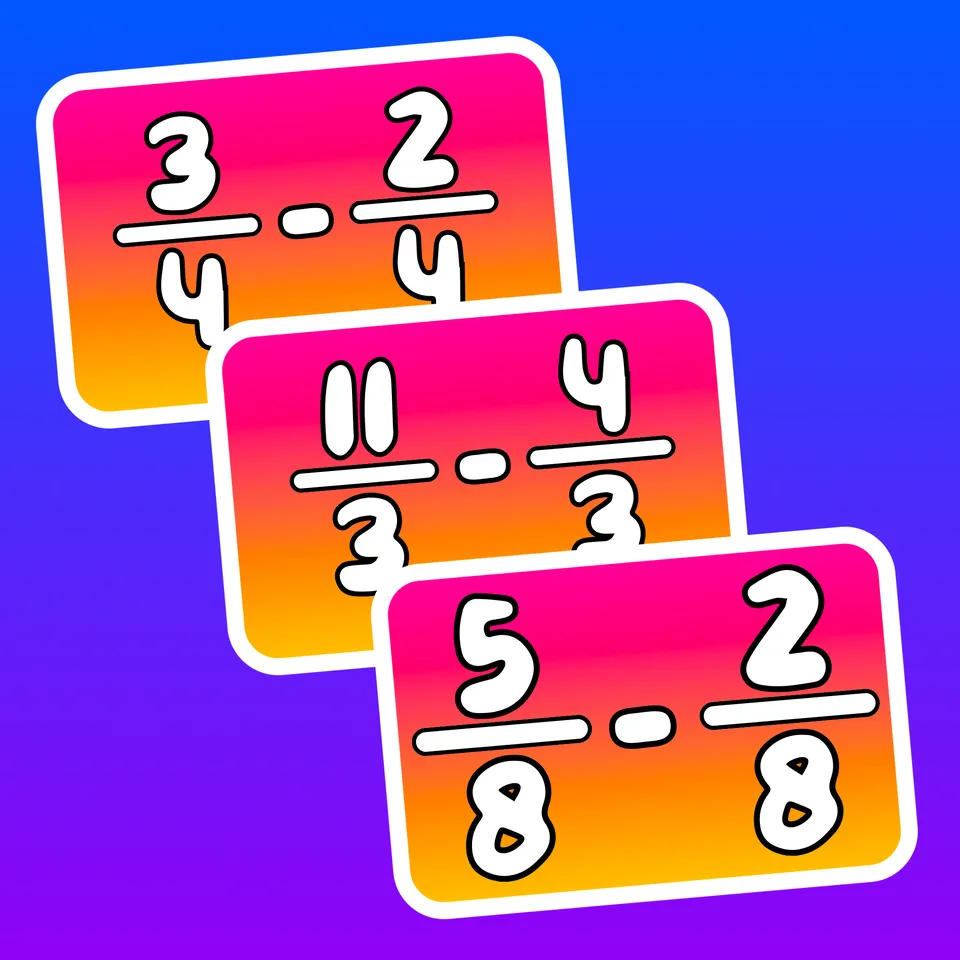
Use flashcards to practice subtracting fractions with the same denominator!
Use flashcards to practice subtracting fractions with the same denominator! Help Ivan the Ibex reach the finish line! Practice makes perfect, so keep trying until you can get all the questions correct before the countdown runs out.
Part of
Standards alignment
Common Core State Standards
- 4.NF.B.3 — Understand a fraction a/b with a > 1 as a sum of fractions 1/b.
- 4.NF.B.3.a — Understand addition and subtraction of fractions as joining and separating parts referring to the same whole.
Alabama
- MA19.4.15b — Add and subtract fractions and mixed numbers with like denominators using fraction equivalence, properties of operations, and the relationship between addition and subtraction.
Alaska
- 4.NF.3.a — Understand addition and subtraction of fractions as joining and separating parts referring to the same whole.
Arizona
- 4.NF.B.3 * — Understand a fraction a/b with a > 1 as a sum of fractions 1/b.
- 4.NF.B.3.a — Understand addition and subtraction of fractions as joining and separating parts referring to the same whole.
Arkansas
- 4.CAR.5 — Add and subtract fractions, including mixed numbers, with like denominators, using visual fraction models and equations. • Fractions include: denominators 2, 3, 4, 5, 6, 8, 10, 12, and 100
California
- 4.NF.B.3 — Understand a fraction a/b with a > 1 as a sum of fractions 1/b.
- 4.NF.B.3.a — Understand addition and subtraction of fractions as joining and separating parts referring to the same whole.
Colorado
- 4.NF.B.3 — Understand a fraction a/b with a > 1 as a sum of fractions 1/b.
- 4.NF.B.3.a — Understand addition and subtraction of fractions as joining and separating parts referring to the same whole.
Connecticut
- 4.NF.B.3 — Understand a fraction a/b with a > 1 as a sum of fractions 1/b.
- 4.NF.B.3.a — Understand addition and subtraction of fractions as joining and separating parts referring to the same whole.
Delaware
- 4.NF.B.3.a — Understand addition and subtraction of fractions as joining and separating parts referring to the same whole.
- 4.NF.B.3 — Understand a fraction a/b with a > 1 as a sum of fractions 1/b.
Florida
- MA.4.FR.2.2 — Add and subtract fractions with like denominators, including mixed numbers and fractions greater than one, with procedural reliability.
- MA.K12.MTR.3.1 — Complete tasks with mathematical fluency. Mathematicians who complete tasks with mathematical fluency: • Select efficient and appropriate methods for solving problems within the given context. • Maintain flexibility and accuracy while performing procedures and mental calculations. • Complete tasks accurately and with confidence. • Adapt procedures to apply them to a new context. • Use feedback to improve efficiency when performing calculations.
Georgia
- 4.NR.4.6 — Add and subtract fractions and mixed numbers with like denominators using a variety of tools.
- 4.NR.4 — Solve real-life problems involving addition, subtraction, equivalence, and comparison of fractions with denominators of 2, 3, 4, 5, 6, 8, 10, 12, and 100 using part-whole strategies and visual models.
Hawaii
- 4.NF.B.3a — Understand addition and subtraction of fractions as joining and separating parts referring to the same whole.
- 4.NF.B.3 — Understand a fraction a/b with a > 1 as a sum of fractions 1/b.
Idaho
- 4.NF.B.3 — Understand a fraction a/b with a > 1 as a sum of fractions 1/b
- 4.NF.B.3.a — Understand addition and subtraction of fractions as joining and separating parts referring to the same whole.
Illinois
- 4.NF.B.3.a — Understand addition and subtraction of fractions as joining and separating parts referring to the same whole.
- 4.NF.B.3 — Understand a fraction a/b with a > 1 as a sum of fractions 1/b.
Indiana
- 4.CA.6 — Add and subtract fractions with common denominators using visual fraction models. Decompose non-unit fractions to represent them as iterations of unit fractions. (E)
Iowa
- 4.NF.B.3.a — Understand addition and subtraction of fractions as joining and separating parts referring to the same whole.
- 4.NF.B.3 — Understand a fraction a/b with a > 1 as a sum of fractions 1/b. For example, 3/4 = 1/4 + 1/4 + 1/4$.
Kansas
- 4.NF.3.a — Understand addition and subtraction of fractions as joining and separating parts referring to the same whole.
- 4.NF.3 — Understand a fraction a/b with a > 1 as a sum of fractions 1/b.
Kentucky
- KY.4.NF.3.a — Understand addition and subtraction of fractions as joining and separating parts referring to the same whole.
- KY.4.NF.3 — Understand a fraction a/b with a > 1 as a sum of fractions 1/b.
Louisiana
- 4.NF.B.3 — Understand a fraction a/b with a > 1 as a sum of fractions 1/b. (Denominators are limited to 2, 3, 4, 5, 6, 8, 10, 12, and 100.)
- 4.NF.B.3.a — Understand addition and subtraction of fractions as joining and separating parts referring to the same whole.
Maine
- 4.NF.B.3a — Understand addition and subtraction of fractions as joining and separating parts referring to the same whole.
- 4.NF.B.3 — Understand a fraction a/b with a > 1 as a sum of fractions 1/b.
Maryland
- 4.NF.B.3.a — Understand addition and subtraction of fractions as joining and separating parts referring to the same whole.
- 4.NF.B.3 — Understand a fraction a/b with a > 1 as a sum of fractions 1/b.
Massachusetts
- 4.NF.B.3 — Understand a fraction a/b with a > 1 as a sum of fractions 1/b.
- 4.NF.B.3.a — Understand addition and subtraction of fractions as joining and separating parts referring to the same whole. (The whole can be a set of objects.)
Michigan
- 4.NF.B.3 — Understand a fraction a/b with a > 1 as a sum of fractions 1/b.
- 4.NF.B.3.a — Understand addition and subtraction of fractions as joining and separating parts referring to the same whole.
Minnesota
- 4.1.2.3 — Use fraction models to add and subtract fractions with like denominators in real-world and mathematical situations. Develop a rule for addition and subtraction of fractions with like denominators.
- 5.1.3.1 — Add and subtract decimals and fractions, using efficient and generalizable procedures, including standard algorithms.
Mississippi
- 4.NF.3 — Understand a fraction a/b with a > 1 as a sum of fractions 1/b.
- 4.NF.3.a — Understand addition and subtraction of fractions as joining and separating parts referring to the same whole.
Missouri
- 4.NF.B.6 — Solve problems involving adding and subtracting fractions and mixed numbers with like denominators.
- 4.NF.B.4 — Understand addition and subtraction of fractions as joining/composing and separating/decomposing parts referring to the same whole.
Montana
- 4.NF.B.3.a — Understand addition and subtraction of fractions as joining and separating parts referring to the same whole.
- 4.NF.B.3 — Understand a fraction a/b with a > 1 as a sum of fractions 1/b.
Nebraska
- 4.N.3.c — 4.N.3.d 4.N.3.e Add and subtract fractions and mixed numbers with like denominators. Solve authentic problems involving addition and subtraction of fractions and mixed numbers with like denominators. Multiply a fraction by a whole number using visual fraction models and properties of operations.
- 4.N.3 — Operations with Fractions: Students will understand and demonstrate fractional computation.
Nevada
- 4.NF.B.3.a — Understand addition and subtraction of fractions as joining and separating parts referring to the same whole.
- 4.NF.B.3 — Understand a fraction a/b with a > 1 as a sum of fractions 1/b.
New Hampshire
- 4.NF.B.3.a — Understand addition and subtraction of fractions as joining and separating parts referring to the same whole.
- 4.NF.B.3 — Understand a fraction a/b with a > 1 as a sum of fractions 1/b.
New Jersey
- 4.NF.B.3a — Understand addition and subtraction of fractions as joining and separating parts referring to the same whole.
- 4.NF.B.3 — Understand a fraction a/b with a > 1 as a sum of fractions 1/b.
New Mexico
- 4.NF.B.3.a — Understand addition and subtraction of fractions as joining and separating parts referring to the same whole.
- 4.NF.B.3 — Understand a fraction a/b with a > 1 as a sum of fractions 1/b.
New York
- NY-4.NF.3 — Understand a fraction a/b with a > 1 as a sum of fractions 1/b.
- NY-4.NF.3.a — Understand addition and subtraction of fractions as joining and separating parts referring to the same whole.
North Carolina
- NC.4.NF.3 — Understand and justify decompositions of fractions with denominators of 2, 3, 4, 5, 6, 8, 10, 12, and 100. • Understand addition and subtraction of fractions as joining and separating parts referring to the same whole. • Decompose a fraction into a sum of unit fractions and a sum of fractions with the same denominator in more than one way using area models, length models, and equations. • Add and subtract fractions, including mixed numbers with like denominators, by replacing each mixed number with an equivalent fraction, and/or by using properties of operations and the relationship between addition and subtraction. • Solve word problems involving addition and subtraction of fractions, including mixed numbers by writing equations from a visual representation of the problem.
North Dakota
- 4.NO.NF.6 — Solve authentic word problems by adding and subtracting fractions and mixed numbers with like denominators (proper and improper fractions limited to denominators of 2, 3, 4, 5, 6, 8, 10, 12, and 100).
Ohio
- 4.NF.3 — Understand a fraction a/b with a > 1 as a sum of fractions 1/b.
- 4.NF.3.a — Understand addition and subtraction of fractions as joining and separating parts referring to the same whole.
Oklahoma
- 4.N.3.5 — Use models to add and subtract fractions with like denominators.
- 5.N.3 — Add and subtract fractions with like and unlike denominators, mixed numbers, and decimals to solve real- world and mathematical problems.
Oregon
- 4.NF.B.3 — Understand a fraction (a/b) as the sum (a) of fractions of the same denominator (1/b). Solve problems in authentic contexts involving addition and subtraction of fractions referring to the same whole and having like denominators.
Pennsylvania
- CC.2.1.4.C.2 — Build fractions from unit fractions by applying and extending previous understandings of operations on whole numbers.
Rhode Island
- 4.NF.B.3.a — Understand addition and subtraction of fractions as joining and separating parts referring to the same whole. (The whole can be a set of objects).
- 4.NF.B.3 — Understand a fraction a/b with a > 1 as a sum of fractions 1/b.
South Carolina
- 4.NSF.3 — Develop an understanding of addition and subtraction of fractions (i.e., denominators 2, 3, 4, 5, 6, 8, 10, 12, 25, 100) based on unit fractions.
South Dakota
- 4.NF.B.3.a — Add and subtract of fractions e.g., joining and separating parts referring to the same whole.
Tennessee
- 4.NF.B.3.a — Understand addition and subtraction of fractions as joining and separating parts referring to the same whole.
Texas
- 4.3E — represent and solve addition and subtraction of fractions with equal denominators using objects and pictorial models that build to the number line and properties of operations;
- 5.3K — add and subtract positive rational numbers fluently; and
Utah
- 4.NF.3.a — Understand addition and subtraction of fractions as joining and separating parts referring to the same whole.
Vermont
- 4.NF.B.3 — Understand a fraction a/b with a > 1 as a sum of fractions 1/b.
- 4.NF.B.3.a — Understand addition and subtraction of fractions as joining and separating parts referring to the same whole.
Virginia
- 4.CE.3a — Estimate and determine the sum or difference of two fractions (proper or improper) and/or mixed numbers, having like denominators limited to 2, 3, 4, 5, 6, 8, 10, and 12 (e.g., 3/8 + 3/8 , 21/5 + 4/5 , 7/4 - 5/4 ) and simplify the resulting fraction. Addition and subtraction with fractions may include regrouping.*
- 4.CE.3 — The student will estimate, represent, solve, and justify solutions to single-step problems, including those in context, using addition and subtraction of fractions (proper, improper, and mixed numbers with like denominators of 2, 3, 4, 5, 6, 8, 10, and 12), with and without models; and solve single-step contextual problems involving multiplication of a whole number (12 or less) and a unit fraction, with models. Students will demonstrate the following Knowledge and Skills:
Washington
- 4.NF.B.3.a — Understand addition and subtraction of fractions as joining and separating parts referring to the same whole.
- 4.NF.B.3 — Understand a fraction a/b with a > 1 as a sum of fractions 1/b.
Washington, D.C.
- 4.NF.B.3 — Understand a fraction a/b with a > 1 as a sum of fractions 1/b.
- 4.NF.B.3.a — Understand addition and subtraction of fractions as joining and separating parts referring to the same whole.
West Virginia
- M.4.14 — Understand the fraction a/b, with a> 1, as the sum of a of the fractions 1/b. a. Add and subtract fractions with like denominators. Understand addition and subtraction of fractions as joining and separating parts referring to the same whole. b. Decompose a fraction into a sum of fractions with the same denominator in more than one way, recording each decomposition by an equation. Justify decompositions by using a visual fraction model (e.g., 3/8 = 1/8 + 1/8 + 1/8; 3/8 = 1/8 + 2/8; 2 1/8 = 1 + 1 + 1/8 = 8/8 + 8/8 + 1/8). c. Add and subtract mixed numbers with like denominators by replacing each mixed number with an equivalent fraction greater than one and/or by using properties of operations and the relationship between addition and subtraction. Identify the two whole numbers a mixed number is between. d. Solve word problems involving addition and subtraction of fractions referring to the same whole and having like denominators by using visual fraction models and equations to represent the problem.
- MHM8 — Look for and express regularity in repeated reasoning.
Wisconsin
- M.4.NF.B.3 — Understand composing and decomposing fractions. a. Understand addition and subtraction of fractions as joining and separating parts referring to the same whole. b. Decompose a fraction into a sum of unit fractions and/or multiples of that unit fraction in more than one way, recording each decomposition by an equation. Justify decompositions with explanations, visual fraction models, or equations. For example: 3/8 = 1/8 + 1/8 + 1/8; 3/8 = 1/8 + 2/8; 2 1/8 = 1 + 1 + 1/8 = 8/8 + 8/8 + 1/8. c. Add and subtract fractions, including mixed numbers, with like denominators (e.g., 3/8 + 2/8) and related denominators (e.g., 1/2 +1/4, 1/3 + 1/6) by using visual fraction models (e.g., tape diagrams and number lines), properties of operations, and the relationship between addition and subtraction. d. Solve word problems involving addition and subtraction of fractions with like and related denominators, including mixed numbers, by using visual fraction models and equations to represent the problem. Students are not required to rename fractions in lowest terms nor use least common denominators.
Wyoming
- 4.NF.G — Build fractions from unit fractions by applying and extending previous understandings of operations on whole numbers (limited to denominators 2, 3, 4, 5, 6, 8, 10, 12, and 100).
- 4.NF.G.3 — Understand a fraction a/b with a > 1 as a sum of unit fractions (1/b).
- 4.NF.G.3.A — Understand addition and subtraction of fractions as joining and separating parts referring to the same whole.