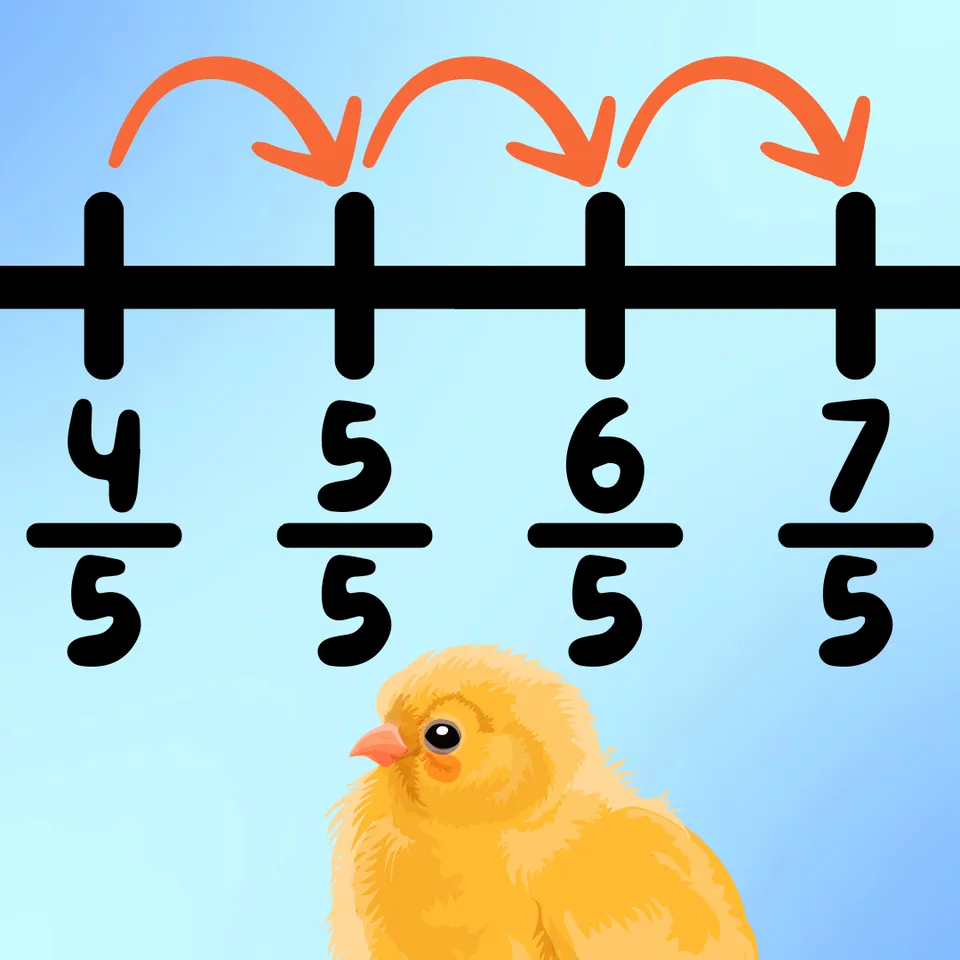
Adding Fractions With Number Lines
Ages 9–11 · 9 minutes · Math
Help Ethan add fractions to track a baby chick’s weight
In this intermediate fractions lesson, students will learn and practice:
- Using number lines to visualize fraction values
- Isolating important numbers from a word problem
- Adding fractions with the same denominator using number lines
Part of
Standards alignment
Common Core State Standards
- 4.NF.B.3.a — Understand addition and subtraction of fractions as joining and separating parts referring to the same whole.
- 4.NF.B.3.d — Solve word problems involving addition and subtraction of fractions referring to the same whole and having like denominators, e.g., by using visual fraction models and equations to represent the problem.
- 4.NF.B.3 — Understand a fraction a/b with a > 1 as a sum of fractions 1/b.
- 3.NF.A.2 — Understand a fraction as a number on the number line; represent fractions on a number line diagram.
Alabama
- MA19.4.15b — Add and subtract fractions and mixed numbers with like denominators using fraction equivalence, properties of operations, and the relationship between addition and subtraction.
- MA19.4.15c — Solve word problems involving addition and subtraction of fractions and mixed numbers having like denominators, using drawings, visual fraction models, and equations to represent the problem.
- MA19.4.15 — Model and justify decompositions of fractions and explain addition and subtraction of fractions as joining or separating parts referring to the same whole.
- MA19.3.14 — Interpret a fraction as a number on the number line; locate or represent fractions on a number line diagram.
Alaska
- 4.NF.3 — Understand a fraction a/b with a > 1 as a sum of fractions 1/b.
- 4.NF.3.d — Solve word problems involving addition and subtraction of fractions referring to the same whole and having like denominators (e.g., by using visual fraction models and equations to represent the problem).
- 4.MD.2 — Use the four operations to solve word problems involving distances, intervals of time, liquid volumes, masses of objects, and money, including problems involving simple fractions or decimals, and problems that require expressing measurements given in a larger unit in terms of a smaller unit. Represent measurement quantities using diagrams such as number line diagrams that feature a measurement scale.
- 4.NF.3.a — Understand addition and subtraction of fractions as joining and separating parts referring to the same whole.
- 3.NF.2 — Understand a fraction as a number on the number line; represent fractions on a number line diagram.
Arizona
- 4.NF.B.3.d — Solve word problems involving addition and subtraction of fractions referring to the same whole and having like denominators, e.g., by using visual fraction models and equations to represent the problem.
- 4.NF.B.3 * — Understand a fraction a/b with a > 1 as a sum of fractions 1/b.
- 4.NF.B.3.a — Understand addition and subtraction of fractions as joining and separating parts referring to the same whole.
Arkansas
- 4.CAR.5 — Add and subtract fractions, including mixed numbers, with like denominators, using visual fraction models and equations. • Fractions include: denominators 2, 3, 4, 5, 6, 8, 10, 12, and 100
- 4.CAR.9 — Solve real-world problems involving the addition and subtraction of fractions; include mixed numbers with like denominators, using visual fraction models or equations. • Fractions include: denominators 2, 3, 4, 5, 6, 8, 10, 12, and 100
- 3.NPV.9 — Identify and represent a non-unit fraction as a number on the number line, including fractions greater than one. • Fractions include: denominators 2, 3, 4, 6, and 8
California
- 4.NF.B.3.d — Solve word problems involving addition and subtraction of fractions referring to the same whole and having like denominators, e.g., by using visual fraction models and equations to represent the problem.
- 3.NF.A.2 — Understand a fraction as a number on the number line; represent fractions on a number line diagram.
- 4.NF.B.3.a — Understand addition and subtraction of fractions as joining and separating parts referring to the same whole.
Colorado
- 4.NF.B.3 — Understand a fraction a/b with a > 1 as a sum of fractions 1/b.
- 4.NF.B.3.d — Solve word problems involving addition and subtraction of fractions referring to the same whole and having like denominators, e.g., by using visual fraction models and equations to represent the problem.
- 3.NF.A.2 — Describe a fraction as a number on the number line; represent fractions on a number line diagram.
Connecticut
- 4.NF.B.3.a — Understand addition and subtraction of fractions as joining and separating parts referring to the same whole.
- 4.NF.B.3.d — Solve word problems involving addition and subtraction of fractions referring to the same whole and having like denominators, e.g., by using visual fraction models and equations to represent the problem.
- 3.NF.A.2 — Understand a fraction as a number on the number line; represent fractions on a number line diagram.
- 4.NF.B.3 — Understand a fraction a/b with a > 1 as a sum of fractions 1/b.
Delaware
- 4.NF.B.3.a — Understand addition and subtraction of fractions as joining and separating parts referring to the same whole.
- 4.NF.B.3.d — Solve word problems involving addition and subtraction of fractions referring to the same whole and having like denominators, e.g., by using visual fraction models and equations to represent the problem.
- 3.NF.A.2 — Understand a fraction as a number on the number line; represent fractions on a number line diagram.
- 4.NF.B.3 — Understand a fraction a/b with a > 1 as a sum of fractions 1/b.
Florida
- MA.4.AR.1.2 — Solve real-world problems involving addition and subtraction of fractions with like denominators, including mixed numbers and fractions greater than one.
- MA.4.FR.2.2 — Add and subtract fractions with like denominators, including mixed numbers and fractions greater than one, with procedural reliability.
- MA.4.FR.1.4 — Plot, order and compare fractions, including mixed numbers and fractions greater than one, with different numerators and different denominators.
Georgia
- 4.NR.4.6 — Add and subtract fractions and mixed numbers with like denominators using a variety of tools.
- 4.NR.4 — Solve real-life problems involving addition, subtraction, equivalence, and comparison of fractions with denominators of 2, 3, 4, 5, 6, 8, 10, 12, and 100 using part-whole strategies and visual models.
Hawaii
- 4.NF.B.3 — Understand a fraction a/b with a > 1 as a sum of fractions 1/b.
- 4.NF.B.3a — Understand addition and subtraction of fractions as joining and separating parts referring to the same whole.
- 4.NF.B.3d — Solve word problems involving addition and subtraction of fractions referring to the same whole and having like denominators, e.g., by using visual fraction models and equations to represent the problem.
- 3.NF.A.2 — Understand a fraction as a number on the number line; represent fractions on a number line diagram.
Idaho
- 4.NF.B.3.a — Understand addition and subtraction of fractions as joining and separating parts referring to the same whole.
- 4.NF.B.3.d — Solve word problems involving addition and subtraction of fractions, including mixed numbers, with the same denominator. Justify the conclusions using a visual fraction model and/or verbal reasoning.
- 4.NF.B.3 — Understand a fraction a/b with a > 1 as a sum of fractions 1/b
Illinois
- 4.NF.B.3 — Understand a fraction a/b with a > 1 as a sum of fractions 1/b.
- 4.NF.B.3.d — Solve word problems involving addition and subtraction of fractions referring to the same whole and having like denominators, e.g., by using visual fraction models and equations to represent the problem.
- 3.NF.A.2 — Understand a fraction as a number on the number line; represent fractions on a number line diagram.
- 4.NF.B.3.a — Understand addition and subtraction of fractions as joining and separating parts referring to the same whole.
Indiana
- 4.CA.6 — Add and subtract fractions with common denominators using visual fraction models. Decompose non-unit fractions to represent them as iterations of unit fractions. (E)
- 4.CA.8 — Solve real-world problems involving addition and subtraction of fractions referring to the same whole and having common denominators (e.g., by using visual fraction models and equations to represent the problem). (E)
- 4.NS.2 — Model mixed numbers and improper fractions using visual fraction models such as number lines and area models. Use a visual fraction model to show the equivalency between whole numbers and whole numbers as fractions.
Iowa
- 4.NF.B.3.d — Solve word problems involving addition and subtraction of fractions referring to the same whole and having like denominators, by using visual fraction models and or equations to represent the problem.
- 3.NF.A.2 — Understand a fraction as a number on the number line; represent fractions on a number line diagram.
- 4.NF.B.3.a — Understand addition and subtraction of fractions as joining and separating parts referring to the same whole.
- 4.NF.B.3.c — Add and subtract mixed numbers with like denominators and show sums and differences of mixed numbers on a number line diagram.
Kansas
- 4.NF.3.a — Understand addition and subtraction of fractions as joining and separating parts referring to the same whole.
- 4.NF.3.d — Solve word problems involving addition and subtraction of fractions referring to the same whole and having like denominators, e.g. by using visual fraction models and equations to represent the problem.
- 4.NF.3 — Understand a fraction a/b with a > 1 as a sum of fractions 1/b.
- 3.NF.2 — Understand a fraction as a number on the number line; represent fractions on a number line diagram.
Kentucky
- KY.4.NF.3 — Understand a fraction a/b with a > 1 as a sum of fractions 1/b.
- KY.4.NF.3.a — Understand addition and subtraction of fractions as joining and separating parts referring to the same whole.
- KY.4.NF.3.d — Solve word problems involving addition and subtraction of fractions referring to the same whole and having like denominators.
Louisiana
- 4.NF.B.3.d — Solve word problems involving addition and subtraction of fractions referring to the same whole and having like denominators, e.g., by using visual fraction models and equations to represent the problem.
- 4.MD.A.2 — Use the four operations to solve word problems involving distances, intervals of time, liquid volumes, masses of objects, and money, including problems involving whole numbers and/or simple fractions (addition and subtraction of fractions with like denominators and multiplying a fraction times a fraction3 or a whole number), and problems that require expressing measurements given in a larger unit in terms of a smaller unit. Represent measurement quantities using diagrams such as number line diagrams that feature a measurement scale.
- 4.NF.B.3.a — Understand addition and subtraction of fractions as joining and separating parts referring to the same whole.
- 4.NF.B.3 — Understand a fraction a/b with a > 1 as a sum of fractions 1/b. (Denominators are limited to 2, 3, 4, 5, 6, 8, 10, 12, and 100.)
Maine
- 4.NF.B.3a — Understand addition and subtraction of fractions as joining and separating parts referring to the same whole.
- 4.NF.B.3d — Solve word problems involving addition and subtraction of fractions referring to the same whole and having like denominators, e.g., by using visual fraction models and equations to represent the problem.
- 4.MD.A.2 — Use the four operations to solve word problems involving distances, intervals of time, liquid volumes, masses of objects, and money, including problems involving simple fractions or decimals, and problems that require expressing measurements given in a larger unit in terms of a smaller unit. Represent measurement quantities using diagrams such as number line diagrams that feature a measurement scale.
- 4.NF.B.3 — Understand a fraction a/b with a > 1 as a sum of fractions 1/b.
- 3.NF.A.2 — Understand a fraction as a number on the number line; represent fractions on a number line diagram.
Maryland
- 4.NF.B.3.d — Solve word problems involving addition and subtraction of fractions referring to the same whole and having like denominators, e.g., by using visual fraction models and equations to represent the problem.
- 3.NF.A.2 — Understand a fraction as a number on the number line; represent fractions on a number line diagram.
- 4.NF.B.3 — Understand a fraction a/b with a > 1 as a sum of fractions 1/b.
- 4.NF.B.3.a — Understand addition and subtraction of fractions as joining and separating parts referring to the same whole.
Massachusetts
- 4.NF.B.3 — Understand a fraction a/b with a > 1 as a sum of fractions 1/b.
- 4.NF.B.3.d — Solve word problems involving addition and subtraction of fractions referring to the same whole and having like denominators, e.g., by using drawings or visual fraction models and equations to represent the problem.
- 3.NF.A.2 — Understand a fraction as a number on the number line; represent fractions on a number line diagram.
- 4.NF.B.3.a — Understand addition and subtraction of fractions as joining and separating parts referring to the same whole. (The whole can be a set of objects.)
Michigan
- 4.NF.B.3 — Understand a fraction a/b with a > 1 as a sum of fractions 1/b.
- 4.NF.B.3.d — Solve word problems involving addition and subtraction of fractions referring to the same whole and having like denominators, e.g., by using visual fraction models and equations to represent the problem.
- 4.NF.B.3.a — Understand addition and subtraction of fractions as joining and separating parts referring to the same whole.
- 3.NF.A.2 — Understand a fraction as a number on the number line; represent fractions on a number line diagram.
Minnesota
- 4.1.2.3 — Use fraction models to add and subtract fractions with like denominators in real-world and mathematical situations. Develop a rule for addition and subtraction of fractions with like denominators.
- 4.1.2.2 — Locate fractions on a number line. Use models to order and compare whole numbers and fractions, including mixed numbers and improper fractions. For example: Locate 5/3 and 1 3/4 on a number line and give a comparison statement about these two fractions, such as " 5/3 is less than 1 3/4."
- 5.1.3.2 — Model addition and subtraction of fractions and decimals using a variety of representations. For example: Represent 2/3 + 1/4 and 2/3 - 1/4 by drawing a rectangle divided into 4 columns and 3 rows and shading the appropriate parts or by using fraction circles or bars.
Mississippi
- 4.NF.3.a — Understand addition and subtraction of fractions as joining and separating parts referring to the same whole.
- 4.NF.3.d — Solve word problems involving addition and subtraction of fractions referring to the same whole and having like denominators, e.g., by using visual fraction models and equations to represent the problem.
- 4.NF.3 — Understand a fraction a/b with a > 1 as a sum of fractions 1/b.
- 3.NF.2 — Understand a fraction as a number on the number line; represent fractions on a number line diagram.
Missouri
- 4.NF.B.6 — Solve problems involving adding and subtracting fractions and mixed numbers with like denominators.
- 4.NF.B.4 — Understand addition and subtraction of fractions as joining/composing and separating/decomposing parts referring to the same whole.
- 3.NF.A.3 — Represent fractions on a number line.
Montana
- 4.NF.B.3.a — Understand addition and subtraction of fractions as joining and separating parts referring to the same whole.
- 4.NF.B.3.d — Solve word problems within cultural contexts, including those of Montana American Indians, involving addition and subtraction of fractions referring to the same whole and having like denominators, e.g., by using visual fraction models and equations to represent the problem.
- 4.NF.B.3 — Understand a fraction a/b with a > 1 as a sum of fractions 1/b.
- 3.NF.A.2 — Understand a fraction as a number on the number line; represent fractions on a number line diagram.
Nebraska
- 4.N.3.b — Explain the meaning of addition and subtraction of fractions with like denominators using visual fraction models, properties of operations, and reasoning strategies.
- 4.N.3.c — 4.N.3.d 4.N.3.e Add and subtract fractions and mixed numbers with like denominators. Solve authentic problems involving addition and subtraction of fractions and mixed numbers with like denominators. Multiply a fraction by a whole number using visual fraction models and properties of operations.
- 4.N.3 — Operations with Fractions: Students will understand and demonstrate fractional computation.
- 4.N.2.a — Explain and demonstrate how a mixed number is equivalent to a fraction greater than one and how a fraction greater than one is equivalent to a mixed number using visual fraction models and reasoning strategies.
Nevada
- 4.NF.B.3 — Understand a fraction a/b with a > 1 as a sum of fractions 1/b.
- 4.NF.B.3.a — Understand addition and subtraction of fractions as joining and separating parts referring to the same whole.
- 4.NF.B.3.d — Solve word problems involving addition and subtraction of fractions referring to the same whole and having like denominators, e.g., by using visual fraction models and equations to represent the problem.
- 3.NF.A.2 — Understand a fraction as a number on the number line; represent fractions on a number line diagram.
New Hampshire
- 4.NF.B.3.a — Understand addition and subtraction of fractions as joining and separating parts referring to the same whole.
- 4.NF.B.3.d — Solve word problems involving addition and subtraction of fractions referring to the same whole and having like denominators, e.g., by using visual fraction models and equations to represent the problem.
- 4.NF.B.3 — Understand a fraction a/b with a > 1 as a sum of fractions 1/b.
- 3.NF.A.2 — Understand a fraction as a number on the number line; represent fractions on a number line diagram.
New Jersey
- 4.NF.B.3 — Understand a fraction a/b with a > 1 as a sum of fractions 1/b.
- 4.NF.B.3d — Solve word problems involving addition and subtraction of fractions referring to the same whole and having like denominators, e.g., by using visual fraction models and equations to represent the problem.
- 4.NF.B.3a — Understand addition and subtraction of fractions as joining and separating parts referring to the same whole.
- 4.MD.A.2 — Use the four operations to solve word problems involving distances, intervals of time, liquid volumes, masses of objects, and money, including problems involving simple fractions or decimals, and problems that require expressing measurements given in a larger unit in terms of a smaller unit. Represent measurement quantities using diagrams such as number line diagrams that feature a measurement scale.
New Mexico
- 4.NF.B.3 — Understand a fraction a/b with a > 1 as a sum of fractions 1/b.
- 4.NF.B.3.d — Solve word problems involving addition and subtraction of fractions referring to the same whole and having like denominators, e.g., by using visual fraction models and equations to represent the problem.
- 4.NF.B.3.a — Understand addition and subtraction of fractions as joining and separating parts referring to the same whole.
- 3.NF.A.2 — Understand a fraction as a number on the number line; represent fractions on a number line diagram.
New York
- NY-4.NF.3.a — Understand addition and subtraction of fractions as joining and separating parts referring to the same whole.
- NY-4.NF.3.d — Solve word problems involving addition and subtraction of fractions referring to the same whole and having like denominators.
- NY-3.NF.2 — Understand a fraction as a number on the number line; represent fractions on a number line.
- NY-4.NF.3 — Understand a fraction a/b with a > 1 as a sum of fractions 1/b.
North Carolina
- NC.4.NF.3 — Understand and justify decompositions of fractions with denominators of 2, 3, 4, 5, 6, 8, 10, 12, and 100. • Understand addition and subtraction of fractions as joining and separating parts referring to the same whole. • Decompose a fraction into a sum of unit fractions and a sum of fractions with the same denominator in more than one way using area models, length models, and equations. • Add and subtract fractions, including mixed numbers with like denominators, by replacing each mixed number with an equivalent fraction, and/or by using properties of operations and the relationship between addition and subtraction. • Solve word problems involving addition and subtraction of fractions, including mixed numbers by writing equations from a visual representation of the problem.
North Dakota
- 4.NO.NF.6 — Solve authentic word problems by adding and subtracting fractions and mixed numbers with like denominators (proper and improper fractions limited to denominators of 2, 3, 4, 5, 6, 8, 10, 12, and 100).
- 3.NO.NF.2 — Represent and understand a fraction as a number on a number line.
- 4.NO.NF.2 — Explain and demonstrate how a mixed number is equivalent to a fraction greater than one and how a fraction greater than one is equal to a mixed number using visual fraction models and reasoning strategies (proper and improper fractions limited to denominators of 2, 3, 4, 5, 6, 8, 10, 12, and 100).
Ohio
- 4.NF.3.a — Understand addition and subtraction of fractions as joining and separating parts referring to the same whole.
- 4.NF.3.d — Solve word problems involving addition and subtraction of fractions referring to the same whole and having like denominators, e.g., by using visual fraction models and equations to represent the problem.
- 3.NF.2 — Understand a fraction as a number on the number line; represent fractions on a number line diagram.
- 4.NF.3 — Understand a fraction a/b with a > 1 as a sum of fractions 1/b.
Oklahoma
- 4.N.3.5 — Use models to add and subtract fractions with like denominators.
- 5.N.3.2 — Illustrate addition and subtraction of fractions with like and unlike denominators, mixed numbers, and decimals using a variety of mathematical models (e.g., fraction strips, area models, number lines, fraction rods).
- 5.N.3.3 — Add and subtract fractions with like and unlike denominators, mixed numbers, and decimals, involving money, measurement, geometry, and data. Use various models and efficient strategies, including but not limited to standard algorithms.
Oregon
- 4.NF.B.3 — Understand a fraction (a/b) as the sum (a) of fractions of the same denominator (1/b). Solve problems in authentic contexts involving addition and subtraction of fractions referring to the same whole and having like denominators.
- 3.NF.A.2 — Understand a fraction as a number on the number line; Represent fractions on a number line diagram.
Pennsylvania
- CC.2.1.4.C.2 — Build fractions from unit fractions by applying and extending previous understandings of operations on whole numbers.
- CC.2.1.3.C.1 — Explore and develop an understanding of fractions as numbers.
Rhode Island
- 4.NF.B.3.d — Solve word problems involving addition and subtraction of fractions referring to the same whole and having like denominators, e.g., by using drawings or visual fraction models and equations to represent the problem.
- 4.NF.B.3 — Understand a fraction a/b with a > 1 as a sum of fractions 1/b.
- 4.NF.B.3.a — Understand addition and subtraction of fractions as joining and separating parts referring to the same whole. (The whole can be a set of objects).
- 4.NF.B.3.c — Add and subtract mixed numbers with like denominators, e.g., by replacing each mixed number with an equivalent fraction, and/or by using properties of operations and the relationship between addition and subtraction.
South Carolina
- 4.NSF.3 — Develop an understanding of addition and subtraction of fractions (i.e., denominators 2, 3, 4, 5, 6, 8, 10, 12, 25, 100) based on unit fractions.
- 4.PS.2d — Connect the meaning of mathematical operations to the context of a given situation.
- 3.NSF.3 — Develop an understanding of mixed numbers (i.e., denominators 2, 3, 4, 6, 8, 10) as iterations of unit fractions on a number line.
South Dakota
- 4.NF.B.3.a — Add and subtract of fractions e.g., joining and separating parts referring to the same whole.
- 4.NF.B.3.d — Solve word problems involving addition and subtraction of fractions referring to the same whole and having like denominators, e.g., by using visual fraction models and equations to represent the problem.
- 3.NF.A.2 — Understand a fraction as a number on the number line; represent fractions on a number line diagram.
- 4.NF.B.3 — Understand a fraction a/b with a > 1 as a sum of fractions 1/b. For example, 4/5 = 1/5 + 1/5 + 1/5 + 1/5.
Tennessee
- 4.NF.B.3.a — Understand addition and subtraction of fractions as joining and separating parts referring to the same whole.
- 4.NF.B.3.d — Solve contextual problems involving addition and subtraction of fractions referring to the same whole and having like denominators.
- 4.NF.B.3 — Understand a fraction a/b with a > 1 as a sum of fractions 1/b. For example, 4/5 = 1/5 +1/5 + 1/5 + 1/5.
Texas
- 4.3E — represent and solve addition and subtraction of fractions with equal denominators using objects and pictorial models that build to the number line and properties of operations;
- 4.3G — represent fractions and decimals to the tenths or hundredths as distances from zero on a number line.
Utah
- 4.NF.3 — Understand a fraction a/b with a >1 as a sum of fractions 1/b. In other words, any fraction is a sum of unit fractions.
- 4.NF.3.d — Solve word problems involving addition and subtraction of fractions referring to the same whole and having like denominators, for example, by using visual fraction models and equations to represent the problem.
- 3.NF.2 — Understand a fraction as a number on the number line; represent fractions on a number line diagram.
- 4.NF.3.a — Understand addition and subtraction of fractions as joining and separating parts referring to the same whole.
- 5.MP.5 — Use appropriate tools strategically.
Vermont
- 4.NF.B.3.a — Understand addition and subtraction of fractions as joining and separating parts referring to the same whole.
- 4.NF.B.3.d — Solve word problems involving addition and subtraction of fractions referring to the same whole and having like denominators, e.g., by using visual fraction models and equations to represent the problem.
- 3.NF.A.2 — Understand a fraction as a number on the number line; represent fractions on a number line diagram.
- 4.NF.B.3 — Understand a fraction a/b with a > 1 as a sum of fractions 1/b.
Virginia
- 4.CE.3a — Estimate and determine the sum or difference of two fractions (proper or improper) and/or mixed numbers, having like denominators limited to 2, 3, 4, 5, 6, 8, 10, and 12 (e.g., 3/8 + 3/8 , 21/5 + 4/5 , 7/4 - 5/4 ) and simplify the resulting fraction. Addition and subtraction with fractions may include regrouping.*
- 4.CE.3b — Estimate, represent, solve, and justify solutions to single-step contextual problems using addition and subtraction with fractions (proper or improper) and/or mixed numbers, having like denominators limited to 2, 3, 4, 5, 6, 8, 10, and 12, and simplify the resulting fraction. Addition and subtraction with fractions may include regrouping.
- 4.CE.3 — The student will estimate, represent, solve, and justify solutions to single-step problems, including those in context, using addition and subtraction of fractions (proper, improper, and mixed numbers with like denominators of 2, 3, 4, 5, 6, 8, 10, and 12), with and without models; and solve single-step contextual problems involving multiplication of a whole number (12 or less) and a unit fraction, with models. Students will demonstrate the following Knowledge and Skills:
- 5.CE.2c — Estimate and solve single-step and multistep contextual problems involving addition and subtraction with fractions (proper or improper) and/or mixed numbers having like and unlike denominators, with and without models. Denominators should be limited to 2, 3, 4, 5, 6, 8, 10, and 12. Answers should be expressed in simplest form.
Washington
- 4.NF.B.3 — Understand a fraction a/b with a > 1 as a sum of fractions 1/b.
- 4.NF.B.3.a — Understand addition and subtraction of fractions as joining and separating parts referring to the same whole.
- 4.NF.B.3.d — Solve word problems involving addition and subtraction of fractions referring to the same whole and having like denominators, e.g., by using visual fraction models and equations to represent the problem.
- 4.MD.A.2 — Use the four operations to solve word problems involving distances, intervals of time, liquid volumes, masses of objects, and money, including problems involving simple fractions or decimals, and problems that require expressing measurements given in a larger unit in terms of a smaller unit. Represent measurement quantities using diagrams such as number line diagrams that feature a measurement scale.
Washington, D.C.
- 4.NF.B.3.a — Understand addition and subtraction of fractions as joining and separating parts referring to the same whole.
- 4.NF.B.3.d — Solve word problems involving addition and subtraction of fractions referring to the same whole and having like denominators, e.g., by using visual fraction models and equations to represent the problem.
- 3.NF.A.2 — Understand a fraction as a number on the number line; represent fractions on a number line diagram.
- 4.NF.B.3 — Understand a fraction a/b with a > 1 as a sum of fractions 1/b.
West Virginia
- M.4.14 — Understand the fraction a/b, with a> 1, as the sum of a of the fractions 1/b. a. Add and subtract fractions with like denominators. Understand addition and subtraction of fractions as joining and separating parts referring to the same whole. b. Decompose a fraction into a sum of fractions with the same denominator in more than one way, recording each decomposition by an equation. Justify decompositions by using a visual fraction model (e.g., 3/8 = 1/8 + 1/8 + 1/8; 3/8 = 1/8 + 2/8; 2 1/8 = 1 + 1 + 1/8 = 8/8 + 8/8 + 1/8). c. Add and subtract mixed numbers with like denominators by replacing each mixed number with an equivalent fraction greater than one and/or by using properties of operations and the relationship between addition and subtraction. Identify the two whole numbers a mixed number is between. d. Solve word problems involving addition and subtraction of fractions referring to the same whole and having like denominators by using visual fraction models and equations to represent the problem.
- M.4.20 — Use the four operations to solve word problems involving distances, intervals of time, liquid volumes, masses of objects, and money, including problems involving simple fractions or decimals and problems that require expressing measurements given in a larger unit in terms of a smaller unit. Represent measurement quantities using diagrams such as number line diagrams that feature a measurement scale.
Wisconsin
- M.4.NF.B.3 — Understand composing and decomposing fractions. a. Understand addition and subtraction of fractions as joining and separating parts referring to the same whole. b. Decompose a fraction into a sum of unit fractions and/or multiples of that unit fraction in more than one way, recording each decomposition by an equation. Justify decompositions with explanations, visual fraction models, or equations. For example: 3/8 = 1/8 + 1/8 + 1/8; 3/8 = 1/8 + 2/8; 2 1/8 = 1 + 1 + 1/8 = 8/8 + 8/8 + 1/8. c. Add and subtract fractions, including mixed numbers, with like denominators (e.g., 3/8 + 2/8) and related denominators (e.g., 1/2 +1/4, 1/3 + 1/6) by using visual fraction models (e.g., tape diagrams and number lines), properties of operations, and the relationship between addition and subtraction. d. Solve word problems involving addition and subtraction of fractions with like and related denominators, including mixed numbers, by using visual fraction models and equations to represent the problem. Students are not required to rename fractions in lowest terms nor use least common denominators.
- M.3.NF.A.2 — Understand and represent a fraction as a number on the number line. a. Understand the whole on a number line is defined as the interval from 0 to 1 and the unit fraction is defined by partitioning the interval into equal parts (i.e., equal-sized lengths). b. Represent fractions on a number line by iterating lengths of the unit fraction from 0. Recognize that the resulting interval represents the size of the fraction and that its endpoint locates the fraction as a number on the number line.
Wyoming
- 4.NF.G.3.A — Understand addition and subtraction of fractions as joining and separating parts referring to the same whole.
- 4.NF.G.3.D — Solve word problems involving addition and subtraction of fractions referring to the same whole and having like denominators.
- 3.NF.F.2 — Understand and represent fractions on a number line diagram.
- 4.MD.I.2 — Use the four operations to solve word problems involving distances, intervals of time, liquid volumes, masses of objects, and money, including problems involving simple fractions or decimals, and problems that require expressing measurements given in a larger unit in terms of a smaller unit. Represent measurement quantities using diagrams such as number line diagrams that feature a measurement scale.
- 4.NF.G — Build fractions from unit fractions by applying and extending previous understandings of operations on whole numbers (limited to denominators 2, 3, 4, 5, 6, 8, 10, 12, and 100).