Simple Machines: Screws
Ages 6–9 · 9 minutes · Science
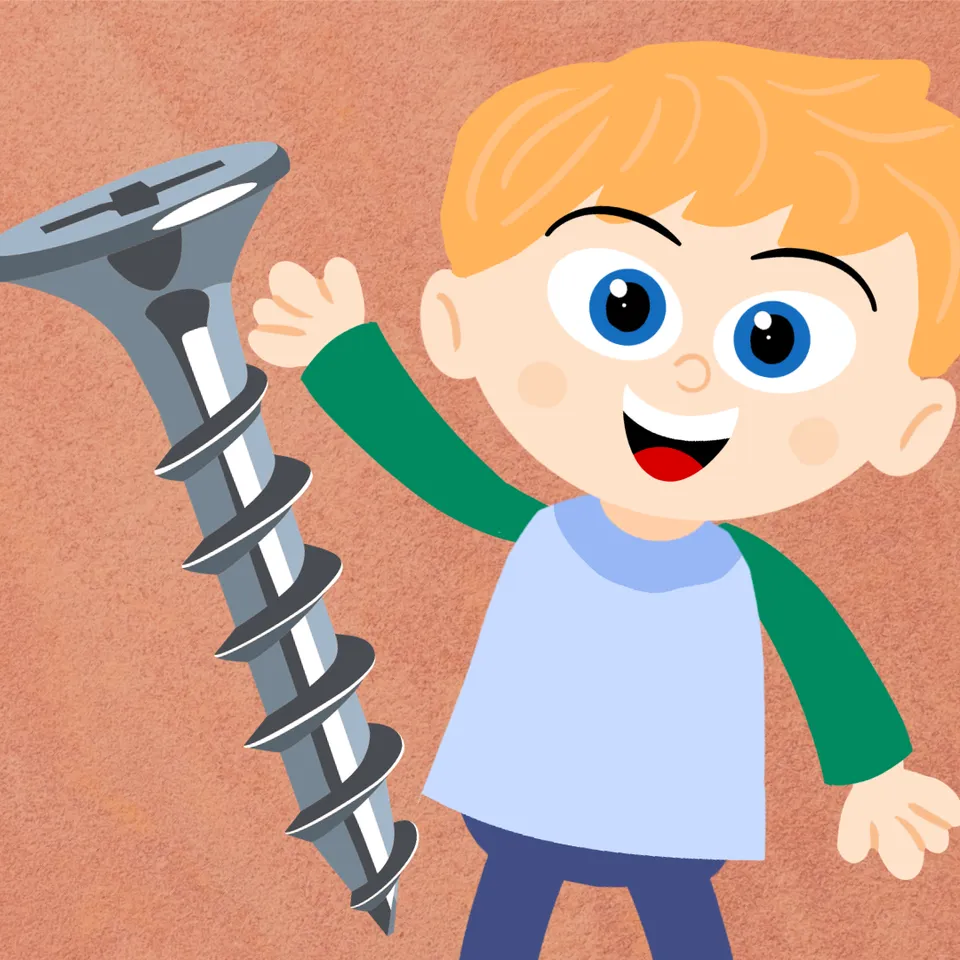
Can a screw replace a shovel to make a hole? Dig in to find out!
Screws may be familiar as fasteners, but that's not their only use. Students will explore how screws transform rotational motion to linear motion, as well as how screws can amplify force to make jobs easier. They will also consider a wide variety of examples from corkscrews to augers to the Archimedes Screw.
No specific background required.
Part of
Standards alignment
Common Core State Standards
- Make predictions based on prior experiences.
- The shape and stability of structures of natural and designed objects are related to their function(s).
- K-2-ETS1-1 — Ask questions, make observations, and gather information about a situation people want to change to define a simple problem that can be solved through the development of a new or improved object or tool.
- Pushes and pulls can have different strengths and directions.
Alabama
- SC23.3.1 — Conduct investigations to explain the effects of balanced and unbalanced forces exerted on an object, varying the size, number, and direction of the forces.
- SC23.K.1 — Plan and carry out investigations to determine the effects of forces of different strengths and directions on the motion of an object, including speed, direction, and distance traveled.
Alaska
- The shape and stability of structures of natural and designed objects are related to their function(s).
- Define a simple problem that can be solved through the development of a new or improved object or tool.
- Apply scientific ideas to solve design problems.
- K-2-ETS1-1 — Ask questions, make observations, and gather information about a situation people want to change to define a simple problem that can be solved through the development of a new or improved object or tool.
Arizona
- The shape and stability of structures of natural and designed objects are related to their function(s).
- 1.P3U1.3 — Plan and carry out investigations which demonstrate how equal forces can balance objects and how unequal forces can push, pull, or twist objects, making them change their speed, direction, or shape.
- U2 — The knowledge produced by science is used in engineering and technologies to solve problems and/or create products.
- Define a simple problem that can be solved through the development of a new or improved object or tool.
Arkansas
- A situation that people want to change or create can be approached as a problem to be solved through engineering.
- 1-ETS1-1 — Ask questions, make observations, and gather information about a situation people want to change to define a simple problem that can be solved through the development of a new or improved object or tool.
- Pushes and pulls can have different strengths and directions.
California
- The shape and stability of structures of natural and designed objects are related to their function(s).
- K-2-ETS1-1 — Ask questions, make observations, and gather information about a situation people want to change to define a simple problem that can be solved through the development of a new or improved object or tool.
- Pushes and pulls can have different strengths and directions.
Colorado
- PS2.A — Forces and Motion: Each force acts on one particular object and has both strength and a direction. An object at rest typically has multiple forces acting on it, but they add to give zero net force on the object. Forces that do not sum to zero can cause changes in the object’s speed or direction of motion. (Boundary: Qualitative and conceptual, but not quantitative addition of forces is used at this level). The patterns of an object’s motion in various situations can be observed and measured; when that past motion exhibits a regular pattern, future motion can be predicted from it. (Boundary: Technical terms, such as magnitude, velocity, momentum and vector quantity, are not introduced at this level, but the concept that some quantities need both size and direction to be described is developed.)
- PS2.B — Types of Interactions: Objects in contact exert forces on each other.
- Define a simple problem that can be solved through the development of a new or improved object or tool.
Connecticut
- Make predictions based on prior experiences.
- Pushes and pulls can have different strengths and directions.
- The shape and stability of structures of natural and designed objects are related to their function(s).
- K-2-ETS1-1 — Ask questions, make observations, and gather information about a situation people want to change to define a simple problem that can be solved through the development of a new or improved object or tool.
Delaware
- The shape and stability of structures of natural and designed objects are related to their function(s).
- K-2-ETS1-1 — Ask questions, make observations, and gather information about a situation people want to change to define a simple problem that can be solved through the development of a new or improved object or tool.
- Generate and/or compare multiple solutions to a problem.
Florida
- SC.1.P.12.1 — Demonstrate and describe the various ways that objects can move, such as in a straight line, zigzag, back-and-forth, round-and-round, fast, and slow.
- SC.2.P.13.1 — Investigate the effect of applying various pushes and pulls on different objects.
- SC.1.P.13.1 — Demonstrate that the way to change the motion of an object is by applying a push or a pull.
Georgia
- S4P3.c — Ask questions to identify and explain the uses of simple machines (lever, pulley, wedge, inclined plane, wheel and axle, and screw) and how forces are changed when simple machines are used to complete tasks.
Hawaii
- The shape and stability of structures of natural and designed objects are related to their function(s).
- K-2-ETS1-1 — Ask questions, make observations, and gather information about a situation people want to change to define a simple problem that can be solved through the development of a new or improved object or tool.
- Systems in the natural and designed world have parts that work together.
Idaho
- Force applied to an object can alter the position and motion of that object: revolve, rotate, float, sink, fall, and at rest. (3-PS-1.2)
- A situation that people want to change or create can be approached as a problem to be solved through engineering. Such problems may have many acceptable solutions. (K-PS-1.2)
- Pushes and pulls can have different strengths and directions. (K-PS-1.1, K-PS-1.2)
Illinois
- PS2.A-P1 — Pushes and pulls can have different strengths and directions.
- SF-P1 — The shape and stability of structures of natural and designed objects are related to their function(s).
- CEDS-E4 — Apply scientific ideas to solve design problems.
Indiana
- 3.PS.2 — Identify types of simple machines and their uses. Investigate and build simple machines to understand how they are used.
- SEPS.6 — Constructing explanations (for science) and designing solutions (for engineering)
Iowa
- Define a simple problem that can be solved through the development of a new or improved object or tool.
- The shape and stability of structures of natural and designed objects are related to their function(s).
- K-2-ETS1-1 — Ask questions, make observations, and gather information about a situation people want to change to define a simple problem that can be solved through the development of a new or improved object or tool.
- Generate and/or compare multiple solutions to a problem.
Kansas
- Make predictions based on prior experiences.
- Systems in the natural and designed world have parts that work together.
- K-2-ETS1-1 — Ask questions, make observations, and gather information about a situation people want to change to define a simple problem that can be solved through the development of a new or improved object or tool.
- Pushes and pulls can have different strengths and directions.
Kentucky
- Pushes and pulls can have different strengths and directions.
- A situation that people want to change or create can be approached as a problem to be solved through engineering. Such problems may have many acceptable solutions.
- The shape and stability of structures of natural and designed objects are related to their function(s).
- Make predictions based on prior experiences.
Louisiana
- The shape and stability of structures of natural and designed objects are related to their function(s).
- Define a simple problem that can be solved through the development of a new or improved object or tool.
- K-2-ETS1-1 — Ask questions, make observations, and gather information about a situation people want to change to define a simple problem that can be solved through the development of a new or improved object or tool.
- Apply scientific ideas to solve design problems.
Maine
- The shape and stability of structures of natural and designed objects are related to their function(s).
- K-2-ETS1-1 — Ask questions, make observations, and gather information about a situation people want to change to define a simple problem that can be solved through the development of a new or improved object or tool.
- Apply scientific ideas to solve design problems.
- Systems in the natural and designed world have parts that work together.
Maryland
- CCC.4.K-2.1 — Systems in the natural and designed world have parts that work together.
- CCC.6.K-2.1 — The shape and stability of structures of natural and designed objects are related to their function(s).
- DCI.PS2.A.K-2.1 — Pushes and pulls can have different strengths and directions.
- SEP.1.K-2.3 — Define a simple problem that can be solved through the development of a new or improved object or tool.
- SEP.3.K-2.6 — Make predictions based on prior experiences.
Massachusetts
- 1.K-2-ETS1-1 — Ask questions, make observations, and gather information about a situation people want to change that can be solved by developing or improving an object or tool.*
- 3-PS2-1 — Provide evidence to explain the effect of multiple forces, including friction, on an object. Include balanced forces that do not change the motion of the object and unbalanced forces that do change the motion of the object.
- K-PS2-1 — Compare the effects of different strengths or different directions of pushes and pulls on the motion of an object.
Michigan
- K-2-ETS1-1 — Ask questions, make observations, and gather information about a situation people want to change to define a simple problem that can be solved through the development of a new or improved object or tool.
- Constructing Explanations and Designing Solutions
Minnesota
- 3.2.2 — Students will be able to use their understanding of scientific principles and the engineering design process to design solutions that meet established criteria and constraints.*
- 3.4.2.3.1 — Explain how an invention of the past changed life at that time, including positive, negative and unintended outcomes. For example: Inventions—Roman aqueducts, Chinese compass, cuneiform.
Mississippi
- P.2.6.2 — Generate and answer questions about the relationship between (1) friction and the motion of objects and (2) friction and the production of heat.
- P.3.6.1 — Compare and contrast the effects of different strengths and directions of forces on the motion of an object (e.g., gravity, polarity, attraction, repulsion, or strength).
Missouri
- 4.PS3.C.1 — Use models to explain that simple machines change the amount of effort force and/or direction of force.
- Apply scientific ideas to solve design problems.
Montana
- constructing explanations as it applies to science and designing solutions as it applies to engineering
Nebraska
- Make predictions based on prior experiences.
- Pushes and pulls can have different strengths and directions.
- Define a simple problem that can be solved through the development of a new or improved object or tool.
- The shape and stability of structures of natural and designed objects are related to their function(s).
- Generate and/or compare multiple solutions to a problem.
Nevada
- The shape and stability of structures of natural and designed objects are related to their function(s).
- K-2-ETS1-1 — Ask questions, make observations, and gather information about a situation people want to change to define a simple problem that can be solved through the development of a new or improved object or tool.
- Generate and/or compare multiple solutions to a problem.
- Describe how specific images (e.g., a diagram showing how a machine works) support a scientific or engineering idea.
New Hampshire
- Make predictions based on prior experiences.
- The shape and stability of structures of natural and designed objects are related to their function(s).
- K-2-ETS1-1 — Ask questions, make observations, and gather information about a situation people want to change to define a simple problem that can be solved through the development of a new or improved object or tool.
- Generate and/or compare multiple solutions to a problem.
New Jersey
- Define a simple problem that can be solved through the development of a new or improved object or tool.
- Systems in the natural and designed world have parts that work together.
- The shape and stability of structures of natural and designed objects are related to their function(s).
- Make predictions based on prior experiences.
New Mexico
- Make predictions based on prior experiences.
- A situation that people want to change or create can be approached as a problem to be solved through engineering.
- Apply scientific ideas to solve design problems.
- The shape and stability of structures of natural and designed objects are related to their function(s).
New York
- The shape and stability of structures of natural and designed objects are related to their function(s).
- Systems in the natural and designed world have parts that work together.
- Apply scientific ideas to solve design problems.
- Pushes and pulls can have different strengths and directions.
- Make predictions based on prior experiences.
North Carolina
- PS.K.2.2 — Carry out investigations to illustrate different ways objects and organisms move (to include falling to the ground when dropped): straight, zigzag, round and round, back and forth, fast and slow.
- PS.3.2 — Understand motion and factors that affect motion.
- PS.K.2.2 — Carry out investigations to illustrate different ways objects and organisms move (to include falling to the ground when dropped): straight, zigzag, round and round, back and forth, fast and slow.
North Dakota
- A situation that people want to change or create can be approached as a problem to be solved through engineering.
- K-2-ET1-1 — Ask questions, make observations, and gather information to define a simple problem (a situation people want to change) that can be solved through the development of a new or improved object or tool.
- Pushes and pulls can have different strengths and directions.
Ohio
- 1.PS.2 — Objects can be moved in a variety of ways, such as straight, zigzag, circular and back and forth.
- 2.PS.1 — Forces change the motion of an object.
Oklahoma
- Pushes and pulls can have different strengths and directions. (K.PS2.1, K.PS2.2)
- Define a simple problem that can be solved through the development of a new or improved object or tool.
- Make predictions based on prior experiences.
- The shape and stability of structures of natural and designed objects are related to their function(s). (1.PS4.4, 1.LS1.1, 2.LS2.2)
- Scientific discoveries about the natural world can often lead to new and improved technologies, which are developed through the engineering design process. (3.PS2.4)
Oregon
- 1.ETS1.1 — Ask questions, make observations, and gather information about a situation people want to change to define a simple problem that can be solved through the development of a new or improved object or tool. [Clarification Statement: Identifying a problem or need is necessary before designing a solution. For example, students can describe desired features or tools to solve a simple problem.][assessment boundary: assessment does not include information regarding constraints (restraints or limitations).]
- 2.ETS1.1 — Ask questions, make observations, and gather information about a situation people want to change to define a simple problem that can be solved through the development of a new or improved object or tool. [Clarification Statement: Identifying a problem or need is necessary before designing a solution. For example, students can describe desired features or tools to solve a simple problem.][assessment boundary: assessment does not include information regarding constraints (restraints or limitations).]
Pennsylvania
- 3.5.3-5.L — Demonstrate how tools and machines extend human capabilities, such as holding, lifting, carrying, fastening, separating, and computing.
- 3.5.K-2.G — Explain the tools and techniques that people use to help them do things.
- 3.5.K-2.C — Explain ways that technology helps with everyday tasks. Contrasting the lifestyles of earlier societies with their own will provide ample examples.
- 3.5.K-2.N — Analyze how things work.
Rhode Island
- The shape and stability of structures of natural and designed objects are related to their function(s).
- K-2-ETS1-1 — Ask questions, make observations, and gather information about a situation people want to change to define a simple problem that can be solved through the development of a new or improved object or tool.
- Describe how specific images (e.g., a diagram showing how a machine works) support a scientific or engineering idea.
- Generate and/or compare multiple solutions to a problem.
South Carolina
- K-PS2-1.DCI.A: — Forces and Motion Pushes and pulls can have different strengths and directions. Pushing or pulling on an object can change the speed or direction of its motion and can start or stop it. NRC Framework Link
- K-PS2-2.ETS1.A: — Defining and Delimiting an Engineering Problem A situation that people want to change or create can be approached as a problem to be solved through engineering. Such problems may have many acceptable solutions. NRC Framework Link
- 3-PS2-1.DCI.B: — Types of Interactions Objects in contact exert forces on each other. NRC Framework Link
South Dakota
- The shape and stability of structures of natural and designed objects are related to their function(s).
- Define a simple problem that can be solved through the development of a new or improved object or tool.
- K-2-ETS1-1 — Ask questions, make observations, and gather information about a situation people want to change to define a simple problem that can be solved through the development of a new or improved object or tool.
- Make predictions based on prior experiences.
Tennessee
- 2.ETS1.1 — Define a simple problem that can be solved through the development of a new or improved object or tool by asking questions, making observations, and gather accurate information about a situation people want to change.
- 3.ETS2.1 — Identify and demonstrate how technology can be used for different purposes.
- 5.ETS2.2 — Describe how human beings have made tools and machines (X-ray cameras, microscopes, satellites, computers) to observe and do things that they could not otherwise sense or do at all, or as quickly or efficiently.
Texas
- 1.6C — demonstrate and record the ways that objects can move such as in a straight line, zig zag, up and down, back and forth, round and round, and fast and slow.
Utah
- Students investigate and explain causal relationships in order to make tests and predictions.
- Students relate the shape and structure of an object or living thing to its properties and functions.
Vermont
- Describe how specific images (e.g., a diagram showing how a machine works) support a scientific or engineering idea.
- The shape and stability of structures of natural and designed objects are related to their function(s).
- Define a simple problem that can be solved through the development of a new or improved object or tool.
- Systems in the natural and designed world have parts that work together.
- Make predictions based on prior experiences.
Virginia
- 3.2.c — Simple machines increase or change the direction of a force.
- 3.2.d — Simple and compound machines have many applications.
- 1.2.a — Objects may have straight, circular, spinning, and back-and-forth motions.
- 3.1.d.iii — Describe how scientific ideas apply to design solutions.
Washington
- The shape and stability of structures of natural and designed objects are related to their function(s).
- Pushes and pulls can have different strengths and directions.
- Make predictions based on prior experiences.
- K-2-ETS1-1 — Ask questions, make observations, and gather information about a situation people want to change to define a simple problem that can be solved through the development of a new or improved object or tool.
Washington, D.C.
- The shape and stability of structures of natural and designed objects are related to their function(s).
- K-2-ETS1-1 — Ask questions, make observations, and gather information about a situation people want to change to define a simple problem that can be solved through the development of a new or improved object or tool.
- Generate and/or compare multiple solutions to a problem.
West Virginia
- Building and appropriately using science domain vocabulary and phrases
- Determining the relationships between structure and function
- Constructing explanations and designing solutions
- S.2.12 — Ask questions, make observations, and gather information about a situation people want to change to define a simple problem that can be solved through the development of a new or improved object or tool.
Wisconsin
- Students use evidence and ideas in designing solutions. This includes the following: Use tools and materials to design and/or build a device that solves a specific problem or a solution to a specific problem. Generate and compare multiple solutions to a problem.
- Students observe the shape and stability of structures of natural and designed objects are related to their function(s).
- A situation that people want to change or create can be approached as a problem to be solved through engineering. Asking questions, making observations, and gathering information are helpful in thinking about problems. Before beginning to design a solution, it is important to clearly understand the problem.
- People of diverse backgrounds can become scientists and engineers. People have practiced science and engineering for a long time. Creativity and imagination are important to science and engineering.
- SCI.1.PS.2.A — Forces and Motion
Wyoming
- The shape and stability of structures of natural and designed objects are related to their function(s).
- K-2-ETS1-1 — Ask questions, make observations, and gather information about a situation people want to change to define a simple problem that can be solved through the development of a new or improved object or tool.
- SS2.4.2 — Identify tools and technologies, including those of Indigenous Tribes of Wyoming, that made or make life easier and sustainable (e.g., cars for getting one place to another, washing machines for washing clothes, flashlights to see in the dark, and usage of bison and natural resources). 2.MD.7 – 8 K-2-ETS1-1 – ETS1-3
- Make predictions based on prior experiences.