Simple Machines: Levers
Ages 6–9 · 12 minutes · Science
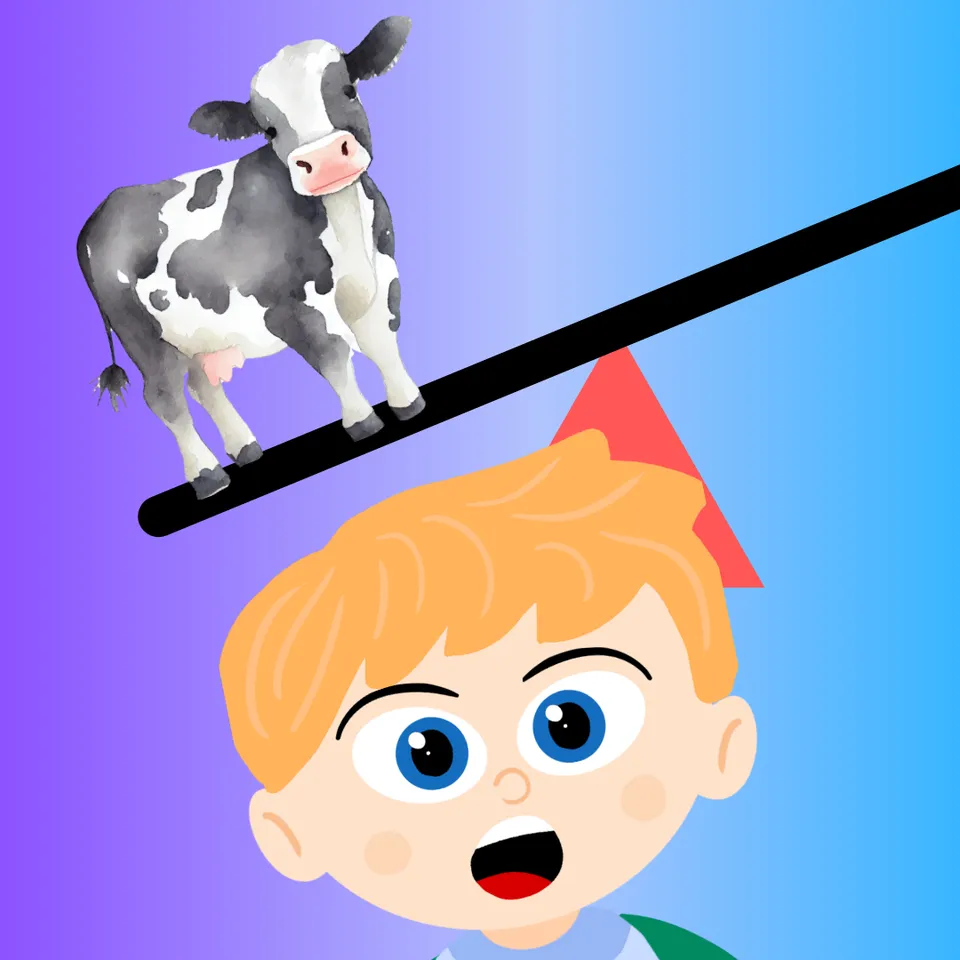
Help lift Brandon's spirits (and a cow) with levers!
Even complex mechanical problems can have simple solutions. Students will join Brandon to learn how levers can magnify and redirect forces. They will consider levers around the playground and the farm, as well as how the position of a fulcrum can change the force.
No specific background required.
Part of
Standards alignment
Common Core State Standards
- Generate and/or compare multiple solutions to a problem.
- Make predictions based on prior experiences.
- Pushes and pulls can have different strengths and directions.
- K-2-ETS1-1 — Ask questions, make observations, and gather information about a situation people want to change to define a simple problem that can be solved through the development of a new or improved object or tool.
- 3-PS2-1 — Plan and conduct an investigation to provide evidence of the effects of balanced and unbalanced forces on the motion of an object.
Alabama
- SC23.3.1 — Conduct investigations to explain the effects of balanced and unbalanced forces exerted on an object, varying the size, number, and direction of the forces.
- SC23.K.1 — Plan and carry out investigations to determine the effects of forces of different strengths and directions on the motion of an object, including speed, direction, and distance traveled.
- SC23.K.2 — Analyze data from investigations to determine whether a design solution provides sufficient force to change the speed or direction of an object.
Alaska
- Make predictions based on prior experiences.
- Generate and/or compare multiple solutions to a problem.
- Pushes and pulls can have different strengths and directions.
- Develop and/or use a model to represent amounts, relationships, relative scales (bigger, smaller), and/or patterns in the natural and designed world(s).
- K-2-ETS1-1 — Ask questions, make observations, and gather information about a situation people want to change to define a simple problem that can be solved through the development of a new or improved object or tool.
Arizona
- 1.P3U1.3 — Plan and carry out investigations which demonstrate how equal forces can balance objects and how unequal forces can push, pull, or twist objects, making them change their speed, direction, or shape.
- Systems in the natural and designed world have parts that work together.
- Use tools and materials provided to design a device or solution to a specific problem.
- P3 — Changing the movement of an object requires a net force to be acting on it.
- Develop and/or use models (i.e., diagrams, drawings, physical replicas, dioramas, dramatizations, or storyboards) that represent amounts, relationships, relative scales (bigger, smaller), and/or patterns in the natural and designed worlds.
Arkansas
- Each force acts on one particular object and has both strength and a direction. An object at rest typically has multiple forces acting on it, but they add to give zero net force on the object. Forces that do not sum to zero can cause changes in the object’s speed or direction of motion. (Boundary: Qualitative and conceptual, but not quantitative addition of forces are used at this level.)
- 3-PS2-1 — Plan and conduct an investigation to provide evidence of the effects of balanced and unbalanced forces on the motion of an object.
- 3-PS2-2 — Make observations and/or measurements of an object’s motion to provide evidence that a pattern can be used to predict future motion.
- Define a simple design problem that can be solved through the development of an object, tool, process, or system and includes several criteria for success and constraints on materials, time, or cost.
California
- 3-5-ETS1-2 — Generate and compare multiple possible solutions to a problem based on how well each is likely to meet the criteria and constraints of the problem.
- 3-PS2-1 — Plan and conduct an investigation to provide evidence of the effects of balanced and unbalanced forces on the motion of an object.
- K-2-ETS1-1 — Ask questions, make observations, and gather information about a situation people want to change to define a simple problem that can be solved through the development of a new or improved object or tool.
- Pushes and pulls can have different strengths and directions.
Colorado
- SC.3.1.1.a — Plan and conduct an investigation to provide evidence of the effects of balanced and unbalanced forces on the motion of an object.
- Define a simple problem that can be solved through the development of a new or improved object or tool.
- PS2.A — Forces and Motion: Each force acts on one particular object and has both strength and a direction. An object at rest typically has multiple forces acting on it, but they add to give zero net force on the object. Forces that do not sum to zero can cause changes in the object’s speed or direction of motion. (Boundary: Qualitative and conceptual, but not quantitative addition of forces is used at this level). The patterns of an object’s motion in various situations can be observed and measured; when that past motion exhibits a regular pattern, future motion can be predicted from it. (Boundary: Technical terms, such as magnitude, velocity, momentum and vector quantity, are not introduced at this level, but the concept that some quantities need both size and direction to be described is developed.)
- SC.3.1.1.b — Make observations and/or measurements of an object’s motion to provide evidence that a pattern can be used to predict future motion.
Connecticut
- Make predictions based on prior experiences.
- Pushes and pulls can have different strengths and directions.
- Generate and/or compare multiple solutions to a problem.
- K-2-ETS1-1 — Ask questions, make observations, and gather information about a situation people want to change to define a simple problem that can be solved through the development of a new or improved object or tool.
- 3-PS2-1 — Plan and conduct an investigation to provide evidence of the effects of balanced and unbalanced forces on the motion of an object.
Delaware
- Pushes and pulls can have different strengths and directions.
- K-2-ETS1-1 — Ask questions, make observations, and gather information about a situation people want to change to define a simple problem that can be solved through the development of a new or improved object or tool.
- Develop and/or use a model to represent amounts, relationships, relative scales (bigger, smaller), and/or patterns in the natural and designed world(s).
- Make predictions based on prior experiences.
Florida
- SC.2.P.13.4 — Demonstrate that the greater the force (push or pull) applied to an object, the greater the change in motion of the object.
- SC.2.P.13.1 — Investigate the effect of applying various pushes and pulls on different objects.
- SC.1.P.13.1 — Demonstrate that the way to change the motion of an object is by applying a push or a pull.
Georgia
- S4P3.c — Ask questions to identify and explain the uses of simple machines (lever, pulley, wedge, inclined plane, wheel and axle, and screw) and how forces are changed when simple machines are used to complete tasks.
- S4P3.a — Plan and carry out an investigation on the effects of balanced and unbalanced forces on an object and communicate the results.
Hawaii
- K-2-ETS1-1 — Ask questions, make observations, and gather information about a situation people want to change to define a simple problem that can be solved through the development of a new or improved object or tool.
- Pushes and pulls can have different strengths and directions.
- Make predictions based on prior experiences.
- 3-5-ETS1-2 — Generate and compare multiple possible solutions to a problem based on how well each is likely to meet the criteria and constraints of the problem.
- 3-PS2-1 — Plan and conduct an investigation to provide evidence of the effects of balanced and unbalanced forces on the motion of an object.
Idaho
- Each force acts on one particular object with both strength and a direction. An object at rest typically has multiple forces acting on it, but they add to give zero net force on the object. Forces that do not sum to zero can cause changes in the object’s speed or direction of motion. (Boundary: Qualitative and conceptual, but not quantitative, additions of forces are used at this level.) (3-PS-1.1)
- A situation that people want to change or create can be approached as a problem to be solved through engineering. Such problems may have many acceptable solutions. (K-PS-1.2)
- Pushes and pulls can have different strengths and directions. (K-PS-1.1, K-PS-1.2)
- 3-PS-1.1 — Students who demonstrate understanding can: Plan and conduct an investigation to provide evidence of the effects of balanced and unbalanced forces on the motion of an object.
Illinois
- 3-5-ETS1-2 — Generate and compare multiple possible solutions to a problem based on how well each is likely to meet the criteria and constraints of the problem.
- 3-PS2-1 — Plan and conduct an investigation to provide evidence of the effects of balanced and unbalanced forces on the motion of an object.
- CEDS-E4 — Apply scientific ideas to solve design problems.
- PS2.A-E1 — Each force acts on one particular object and has both strength and a direction. An object at rest typically has multiple forces acting on it, but they add to give zero net force on the object. Forces that do not sum to zero can cause changes in the object’s speed or direction of motion. (Boundary: Qualitative and conceptual, but not quantitative addition of forces are used at this level.)
Indiana
- 3.PS.2 — Identify types of simple machines and their uses. Investigate and build simple machines to understand how they are used.
- 3-5.E.1 — Identify a simple problem with the design of an object that reflects a need or a want. Include criteria for success and constraints on materials, time, or cost.
- 3.PS.1 — Plan and conduct an investigation to provide evidence of the effects of balanced and unbalanced forces on the motion of an object.
Iowa
- Make predictions based on prior experiences.
- Pushes and pulls can have different strengths and directions.
- Generate and/or compare multiple solutions to a problem.
- Develop and/or use a model to represent amounts, relationships, relative scales (bigger, smaller), and/or patterns in the natural and designed world(s).
- 3-PS2-1 — Plan and conduct an investigation to provide evidence of the effects of balanced and unbalanced forces on the motion of an object.
- K-2-ETS1-1 — Ask questions, make observations, and gather information about a situation people want to change to define a simple problem that can be solved through the development of a new or improved object or tool.
Kansas
- Generate and/or compare multiple solutions to a problem.
- K-2-ETS1-1 — Ask questions, make observations, and gather information about a situation people want to change to define a simple problem that can be solved through the development of a new or improved object or tool.
- Make predictions based on prior experiences.
- Pushes and pulls can have different strengths and directions.
- 3-PS2-1 — Plan and conduct an investigation to provide evidence of the effects of balanced and unbalanced forces on the motion of an object.
Kentucky
- Pushes and pulls can have different strengths and directions.
- Make predictions based on prior experiences.
- Generate and/or compare multiple solutions to a problem.
- K-2-ETS1-1 — Ask questions, make observations, and gather information about a situation people want to change to define a simple problem that can be solved through the development of a new or improved object or tool.
- Pushing or pulling on an object can change the speed or direction of its motion and can start or stop it.
Louisiana
- Make predictions about what would happen if a variable changes.
- 3-5-ETS1-1 — Define a simple design problem reflecting a need or a want that includes specified criteria for success and constraints on materials, time, or cost.
- 3-5-ETS1-2 — Generate and compare multiple possible solutions to a problem based on how well each is likely to meet the criteria and constraints of the problem.
- 3-PS2-1 — Plan and conduct an investigation to provide evidence of the effects of balanced and unbalanced forces on the motion of an object.
Maine
- 3-5-ETS1-1 — Define a simple design problem reflecting a need or a want that includes specified criteria for success and constraints on materials, time, or cost.
- 3-5-ETS1-2 — Generate and compare multiple possible solutions to a problem based on how well each is likely to meet the criteria and constraints of the problem.
- 3-PS2-1 — Plan and conduct an investigation to provide evidence of the effects of balanced and unbalanced forces on the motion of an object.
- Make predictions about what would happen if a variable changes.
- 3-PS2-2 — Make observations and/or measurements of an object’s motion to provide evidence that a pattern can be used to predict future motion.
- K-2-ETS1-1 — Ask questions, make observations, and gather information about a situation people want to change to define a simple problem that can be solved through the development of a new or improved object or tool.
Maryland
- DCI.PS2.A.K-2.1 — Pushes and pulls can have different strengths and directions.
- SEP.2.K-2.3 — Develop and/or use a model to represent amounts, relationships, relative scales (bigger, smaller), and/or patterns in the natural and designed world(s).
- K-2-ETS1-1 — Ask questions, make observations, and gather information about a situation people want to change to define a simple problem that can be solved through the development of a new or improved object or tool.
- SEP.3.K-2.6 — Make predictions based on prior experiences.
- SEP.6.K-2.3 — Generate and/or compare multiple solutions to a problem.
Massachusetts
- 3-PS2-1 — Provide evidence to explain the effect of multiple forces, including friction, on an object. Include balanced forces that do not change the motion of the object and unbalanced forces that do change the motion of the object.
- 3.3-5-ETS1-1 — Define a simple design problem that reflects a need or a want. Include criteria for success and constraints on materials, time, or cost that a potential solution must meet.*
- 3.3-5-ETS1-2 — Generate several possible solutions to a given design problem. Compare each solution based on how well each is likely to meet the criteria and constraints of the design problem.*
- K-PS2-1 — Compare the effects of different strengths or different directions of pushes and pulls on the motion of an object.
Michigan
- 3-PS2-1 — Plan and conduct an investigation to provide evidence of the effects of balanced and unbalanced forces on the motion of an object.
- 3-PS2-2 — Make observations and/or measurements of an object’s motion to provide evidence that a pattern can be used to predict future motion.
- K-2-ETS1-1 — Ask questions, make observations, and gather information about a situation people want to change to define a simple problem that can be solved through the development of a new or improved object or tool.
Minnesota
- 2P.2.2.1.1 — Identify and predict quantitative patterns of the effects of balanced and unbalanced forces on the motion of an object. (P: 5, CC: 1, CI: PS2)
- 2.2.1 — Students will be able to use mathematics to represent physical variables and their relationships; compare mathematical expressions to the real world; and engage in computational thinking as they use or develop algorithms to describe the natural or designed worlds.
- 3.1.1 — Students will be able to develop, revise, and use models to represent the students’ understanding of phenomena or systems as they develop questions, predictions and/or explanations, and communicate ideas to others.
Mississippi
- P.2.6.1 — Conduct a structured investigation to collect, represent, and analyze data from observations and measurements to demonstrate the effects of pushes and pulls with different strengths and directions. Communicate findings (e.g., models or technology).
- P.3.6.1 — Compare and contrast the effects of different strengths and directions of forces on the motion of an object (e.g., gravity, polarity, attraction, repulsion, or strength).
Missouri
- 4.PS3.C.1 — Use models to explain that simple machines change the amount of effort force and/or direction of force.
- Apply scientific ideas to solve design problems.
- Develop and/or use models to describe and/or predict phenomena.
- 4.PS2.B.2 — Predict how changes in either the amount of force applied to an object or the mass of the object affects the motion (speed and direction) of the object.
- Generate and compare multiple solutions to a problem based on how well they meet the criteria and constraints of the design solution.
Montana
- 3-PS2-1 — plan and conduct an investigation to provide evidence of the effects of balanced and unbalanced forces on the motion of an object;
- constructing explanations as it applies to science and designing solutions as it applies to engineering
- K-PS2-1 — plan and conduct an investigation to compare the effects of different strengths or different directions of pushes and pulls on the motion of an object;
Nebraska
- Each force acts on one particular object and has both strength and a direction. An object at rest typically has multiple forces acting on it, but they add to give zero net force on the object. Forces that do not sum to zero can cause changes in the object’s speed or direction of motion. (Boundary: Qualitative and conceptual, but not quantitative addition of forces are used at this level.)
- Make predictions about what would happen if a variable changes.
- Apply scientific ideas to solve design problems.
- Generate and compare multiple solutions to a problem based on how well they meet the criteria and constraints of the design solution.
- SC.3.1.1.A — Plan and conduct an investigation to provide evidence of the effects of balanced and unbalanced forces on the motion of an object.
Nevada
- Make predictions based on prior experiences.
- Pushes and pulls can have different strengths and directions.
- K-2-ETS1-1 — Ask questions, make observations, and gather information about a situation people want to change to define a simple problem that can be solved through the development of a new or improved object or tool.
- 3-PS2-1 — Plan and conduct an investigation to provide evidence of the effects of balanced and unbalanced forces on the motion of an object.
New Hampshire
- Make predictions based on prior experiences.
- Pushes and pulls can have different strengths and directions.
- Generate and/or compare multiple solutions to a problem.
- Develop and/or use a model to represent amounts, relationships, relative scales (bigger, smaller), and/or patterns in the natural and designed world(s).
- K-2-ETS1-1 — Ask questions, make observations, and gather information about a situation people want to change to define a simple problem that can be solved through the development of a new or improved object or tool.
New Jersey
- Make predictions based on prior experiences.
- Generate and/or compare multiple solutions to a problem.
- Each force acts on one particular object and has both strength and a direction. An object at rest typically has multiple forces acting on it, but they add to give zero net force on the object. Forces that do not sum to zero can cause changes in the object’s speed or direction of motion. (Boundary: Qualitative and conceptual, but not quantitative addition of forces are used at this level.)
- 3-PS2-1 — Plan and conduct an investigation to provide evidence of the effects of balanced and unbalanced forces on the motion of an object.
- 3-PS2-2 — Make observations and/or measurements of an object’s motion to provide evidence that a pattern can be used to predict future motion.
New Mexico
- K-2-ETS1-1 — Ask questions, make observations, and gather information about a situation people want to change to define a simple problem that can be solved through the development of a new or improved object or tool.
- Make predictions based on prior experiences.
- Pushes and pulls can have different strengths and directions.
- A situation that people want to change or create can be approached as a problem to be solved through engineering.
- Generate and/or compare multiple solutions to a problem.
New York
- Make predictions based on prior experiences.
- Generate and/or compare multiple solutions to a problem.
- Develop and/or use a model to represent amounts, relationships, relative scales (bigger, smaller), and/or patterns in the natural and designed world(s).
- Pushes and pulls can have different strengths and directions.
- K-2-ETS1-1 — Ask questions, make observations, and gather information about a situation people want to change to define a simple problem that can be solved through the development of a new or improved object or tool.
North Carolina
- PS.3.2 — Understand motion and factors that affect motion.
- PS.3.2.1 — Carry out investigations to infer changes in speed or direction resulting from forces acting on an object.
North Dakota
- K-2-ET1-1 — Ask questions, make observations, and gather information to define a simple problem (a situation people want to change) that can be solved through the development of a new or improved object or tool.
- Each force acts on one particular object and has both strength and a direction. An object at rest typically has multiple forces acting on it, but they add to give zero net force on the object. Forces that do not sum to zero can cause changes in the object’s speed or direction of motion.
- 3-5-ET1-1 — Define a simple design problem reflecting a need or a want that includes specified criteria for success and constraints on materials, time, or cost.
- 3-5-ET1-2 — Generate and compare multiple possible solutions to a problem based on how well each is likely to meet the criteria and constraints of the problem.
- 3-PS2-1 — Plan and conduct an investigation to prove the effects of balanced and unbalanced forces on the motion of an object.
Ohio
- 2.PS.1 — Forces change the motion of an object.
- 1.PS.2 — Objects can be moved in a variety of ways, such as straight, zigzag, circular and back and forth.
Oklahoma
- Make predictions about what would happen if a variable changes.
- Possible solutions to a problem are limited by available materials and resources (constraints). (4.PS3.4)
- A situation that people want to change or create can be approached as a problem to be solved through engineering. (K.PS2.2)
- Generate and/or compare multiple solutions to a problem.
- 3.PS2.1 — Plan and conduct investigations on the effects of balanced and unbalanced forces on the motion of an object.
Oregon
- 3.PS2.1 — Plan and conduct an investigation to provide evidence of the effects of balanced and unbalanced forces on the motion of an object. [Clarification Statement: Examples could include an unbalanced force on one side of a ball can make it start moving; and, balanced forces pushing on a box from both sides will not produce any motion at all.] [Assessment Boundary: Assessment is limited to one variable at a time: number, size, or direction of forces. Assessment does not include quantitative force size, only qualitative and relative. Assessment is limited to gravity being addressed as a force that pulls objects down.]
- 3.PS2.2 — Make observations and/or measurements of an object’s motion to provide evidence that a pattern can be used to predict future motion. [Clarification Statement: Examples of motion with a predictable pattern could include a child swinging in a swing, a ball rolling back and forth in a bowl, and two children on a see-saw.] [Assessment Boundary: Assessment does not include technical terms such as period and frequency.]
- 2.ETS1.1 — Ask questions, make observations, and gather information about a situation people want to change to define a simple problem that can be solved through the development of a new or improved object or tool. [Clarification Statement: Identifying a problem or need is necessary before designing a solution. For example, students can describe desired features or tools to solve a simple problem.][assessment boundary: assessment does not include information regarding constraints (restraints or limitations).]
Pennsylvania
- 3.5.3-5.L — Demonstrate how tools and machines extend human capabilities, such as holding, lifting, carrying, fastening, separating, and computing.
- Each force acts on one particular object and has both strength and a direction. An object at rest typically has multiple forces acting on it, but they add to give zero net force on the object. Forces that do not sum to zero can cause changes in the object’s speed or direction of motion. (Boundary: Qualitative and conceptual, but not quantitative addition of forces are used at this level.)
- Make predictions about what would happen if a variable changes.
- 3.2.3.A — Make and communicate observations and/or measurements of an object’s motion to provide evidence that a pattern can be used to predict future motion. 3.2.3.B Plan and conduct an investigation to provide evidence of the effects of balanced and unbalanced forces on the motion of an object.
- 3.5.K-2.G — Explain the tools and techniques that people use to help them do things.
Rhode Island
- Make predictions based on prior experiences.
- Pushes and pulls can have different strengths and directions.
- Develop and/or use a model to represent amounts, relationships, relative scales (bigger, smaller), and/or patterns in the natural and designed world(s).
- K-2-ETS1-1 — Ask questions, make observations, and gather information about a situation people want to change to define a simple problem that can be solved through the development of a new or improved object or tool.
South Carolina
- 3-PS2-1. — Plan and conduct an investigation to provide evidence of the effects of balanced and unbalanced forces on the motion of an object. Clarification Statement: Examples could include an unbalanced force on one side of a ball, which causes motion; and balanced forces pushing on a box from opposite sides, which does not cause motion. State Assessment Boundary: Assessment is limited to one variable at a time: number, size, or direction of forces. Assessment does not include quantitative force size, only qualitative and relative. Assessment is limited to gravity being addressed as a force that pulls objects down.
- 3-PS2-1.DCI.A: — Forces and Motion Each force acts on one particular object and has both strength and a direction. An object at rest typically has multiple forces acting on it, but they add to give zero net force on the object. Forces that do not sum to zero can cause changes in the object’s speed or direction of motion. NRC Framework Link
- 3-PS2-2. — Make observations and measurements of an object’s motion to provide evidence that a pattern can be used to predict future motion. Clarification Statement: Examples of motion with a predictable pattern could include a pendulum swinging, a ball rolling back and forth in a bowl, and two children on a seesaw. State Assessment Boundary: Assessment does not include technical terms such as period and frequency.
- 3-PS2-4.SEP.A: — Constructing Explanations and Designing Solutions Constructing explanations and designing solutions in 3-5 builds on K-2 experiences and progresses to the use of evidence in constructing explanations that specify variables that describe and predict phenomena and in designing multiple solutions to design problems. Generate and compare multiple solutions to a problem based on how well they meet the criteria and constraints of the design solution. NRC Framework Link
South Dakota
- Make predictions about what would happen if a variable changes.
- 3-5-ETS1-2 — Generate and compare multiple possible solutions to a problem based on how well each is likely to meet the criteria and constraints of the problem.
- 3-PS2-1 — Plan and carry out an investigation to provide evidence of the effects of balanced and unbalanced forces on the motion of an object.
- Develop and/or use models to describe and/or predict phenomena.
- 3-5-ETS1-1 — Define a simple design problem reflecting a need or a want that includes specified criteria for success and constraints on materials, time, or cost.
Tennessee
- 2.PS2.2 — Evaluate the effects of different strengths and directions of a push or a pull on the motion of an object.
- 2.ETS1.1 — Define a simple problem that can be solved through the development of a new or improved object or tool by asking questions, making observations, and gather accurate information about a situation people want to change.
- 2.PS2.3 — Recognize the effect of multiple pushes and pulls on an object's movement or non-movement.
- 2.ETS1.4 — Compare and contrast solutions to a design problem by using evidence to point out strengths and weaknesses of the design.
Texas
- 1.7A — explain how pushes and pulls can start, stop, or change the speed or direction of an object's motion; and
- 2.7B — plan and conduct a descriptive investigation to demonstrate how the strength of a push and pull changes an object's motion.
- 3.6B — demonstrate and observe how position and motion can be changed by pushing and pulling objects such as swings, balls, and wagons; and
- 3.7A — demonstrate and describe forces acting on an object in contact or at a distance, including magnetism, gravity, and pushes and pulls; and
Utah
- Students develop physical, conceptual, and other models to represent relationships, explain mechanisms, and predict outcomes.
- 3.3.1 — Plan and carry out investigations that provide evidence of the effects of balanced and unbalanced forces on the motion of an object. Emphasize investigations where only one variable is tested at a time. Examples could include an unbalanced force on one side of a ball causing it to move and balanced forces pushing on a box from both sides producing no movement. (PS2.A, PS2.B)
- K.3.1 — Plan and conduct an investigation to compare the effects of different strengths or different directions of forces on the motion of an object. Emphasize forces as a push and pull on an object. The idea of strength should be kept separate from the idea of direction. Non-contact forces, such as magnets and static electricity, will be taught in Grades 3 through 5. (PS2.A, PS2.B, PS2.C, PS3.C)
- 3.3.5 — Design a solution to a problem in which a device functions by using scientific ideas about magnets. Define the problem, identify criteria and constraints, develop possible solutions using models, analyze data from testing solutions, and propose modifications for optimizing a solution. Examples could include a latch or lock used to keep a door shut or a device to keep two moving objects from touching each other. (PS2.B, ETS1.A, ETS1.B, ETS1.C)
Vermont
- Pushes and pulls can have different strengths and directions.
- Generate and/or compare multiple solutions to a problem.
- K-2-ETS1-1 — Ask questions, make observations, and gather information about a situation people want to change to define a simple problem that can be solved through the development of a new or improved object or tool.
- Make predictions based on prior experiences.
- 3-PS2-1 — Plan and conduct an investigation to provide evidence of the effects of balanced and unbalanced forces on the motion of an object.
Virginia
- 3.2.c — Simple machines increase or change the direction of a force.
- 3.2.d — Simple and compound machines have many applications.
- 3.1.a.i — Ask questions that can be investigated and predict reasonable outcomes.
- 3.1.d.iii — Describe how scientific ideas apply to design solutions.
Washington
- Pushes and pulls can have different strengths and directions.
- Make predictions based on prior experiences.
- 3-5-ETS1-2 — Generate and compare multiple possible solutions to a problem based on how well each is likely to meet the criteria and constraints of the problem.
- 3-PS2-1 — Plan and conduct an investigation to provide evidence of the effects of balanced and unbalanced forces on the motion of an object.
- K-2-ETS1-1 — Ask questions, make observations, and gather information about a situation people want to change to define a simple problem that can be solved through the development of a new or improved object or tool.
Washington, D.C.
- Make predictions based on prior experiences.
- K-2-ETS1-1 — Ask questions, make observations, and gather information about a situation people want to change to define a simple problem that can be solved through the development of a new or improved object or tool.
- Generate and/or compare multiple solutions to a problem.
- 3-PS2-1 — Plan and conduct an investigation to provide evidence of the effects of balanced and unbalanced forces on the motion of an object.
- Develop and/or use a model to represent amounts, relationships, relative scales (bigger, smaller), and/or patterns in the natural and designed world(s).
West Virginia
- Investigating and explaining cause and effect
- S.2.12 — Ask questions, make observations, and gather information about a situation people want to change to define a simple problem that can be solved through the development of a new or improved object or tool.
- S.3.1 — Plan and conduct an investigation to provide evidence of the effects of balanced and unbalanced forces on the motion of an object.
- Developing and using models
Wisconsin
- Students use evidence and ideas in designing solutions. This includes the following: Use tools and materials to design and/or build a device that solves a specific problem or a solution to a specific problem. Generate and compare multiple solutions to a problem.
- Students learn that events have causes that generate observable patterns. They design simple tests to gather evidence to support or refute their own ideas about causes.
- Students define simple problems that can be solved through the development of a new or improved object or tool.
- Students understand objects and organisms can be described in terms of their parts and that systems in the natural and designed world have parts that work together.
- SCI.1.PS.2.A — Forces and Motion
Wyoming
- 3-PS2-2 — Make observations and/or measurements of an object’s motion to provide evidence that a pattern can be used to predict future motion.
- Make predictions about what would happen if a variable changes.
- Generate and compare multiple solutions to a problem based on how well they meet the criteria and constraints of the design solution.
- The effect of unbalanced forces on an object results in a change of motion. Patterns of motion can be used to predict future motion. Some forces act through contact, some forces act even when the objects are not in contact. The gravitational force of Earth acting on an object near Earth’s surface pulls that object toward the planet’s center.
- 3-PS2-1 — Plan and conduct an investigation to provide evidence of the effects of balanced and unbalanced forces on the motion of an object.