Delaware
Ages 5–11 · 16 minutes · Geography
For such a small state, Delaware has a ton of interesting plants and animals (including lots and lots of chickens!)
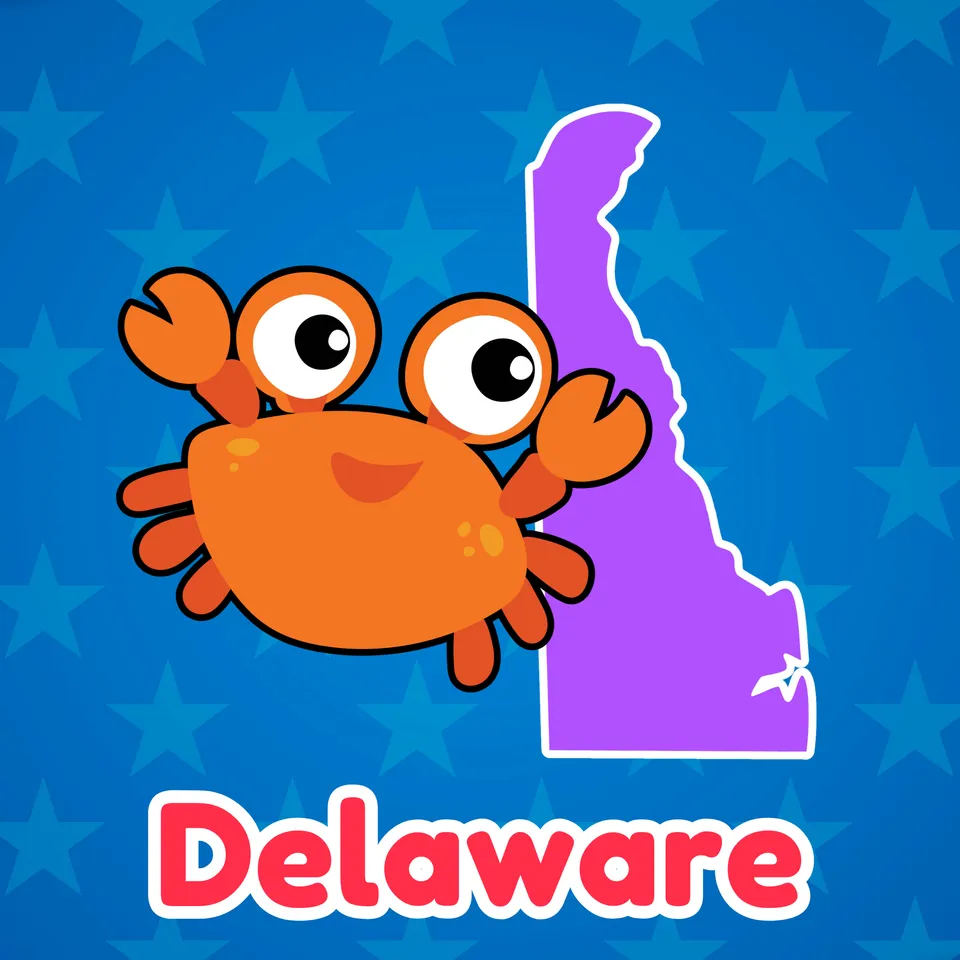
What do the horseshoe crab, Rehoboth Beach and the Dover Motor Speedway have in common? They all call Delaware home.
No prior knowledge needed.
Part of
Standards alignment
Common Core State Standards
- D2.Geo.6.K-2 — Individually and with others, students… Identify some cultural and environmental characteristics of specific places.
- D2.Geo.3.K-2 — Individually and with others, students… Use maps, globes, and other simple geographic models to identify cultural and environmental characteristics of places.
Alabama
- SS10.2.10 — Identify ways people throughout the country are affected by their human and physical environments.
- SS10.2.6 — Identify states, continents, oceans, and the equator using maps, globes, and technology.
- SS10.2.1.2 — Recognizing basic principles of the Declaration of Independence, the Constitution of the United States, the establishment of the three branches of government, and the Emancipation Proclamation
- SS10.2.10.3 — Recognizing benefits of recreation and tourism at state and national parks (Alabama)
Alaska
- 1 — know that places have distinctive geographic characteristics;
- 1 — use maps and globes to locate places and regions;
- There are many different kinds of living things in any area, and they exist in different places on land and in water.
Arizona
- 2.G1.1 — Use and construct maps, graphs, and other geographic representations of familiar and unfamiliar places in the world; and locate physical and human features. • Key physical features include but are not limited to seven continents, oceans, lakes, rivers, mountain ranges, coasts, seas, and deserts • Key human features include but are not limited to equator, hemispheres, North and South Pole, cities, states, countries, regions, and landmarks
- 1.H4.1 — Explain and explore origins of key American symbols, documents, landmarks, holidays, and leaders as well as their importance from the past to the present in our country. • Symbols include but are not limited to American flag, bald eagle, Statue of Liberty, White House, Washington Monument, Mount Rushmore, Liberty Bell, United States Capitol, and Arizona state symbols • Holidays include but are not limited to Columbus Day, Thanksgiving, Veterans Day, Memorial Day, Labor Day, Presidents Day, Martin Luther King Jr. Day, Independence Day, Constitution Day, and Arizona Statehood Day • Leaders include but are not limited to local and/or Tribal leaders, state leaders, and national leaders
- 5.G1.1 — Use and construct maps and graphs to represent changes in the United States. • Key concepts include but are not limited to physical and human features of the United States, the regions of the United States and their characteristics, geographic location of major events, the growth of the United States through territorial expansion, demographic changes, and the states and their capitals
- 2.C2.1 — Describe roles and responsibilities of people in authority within our country and world.
Arkansas
- C.1.2.4 — Explain the significance of state and national symbols, patriotic songs, and mottos: • American flag • Flag etiquette • Star Spangled Banner • Recitation of Pledge of Allegiance* • National Motto: In God we Trust* • State Seal • Diana fritillary butterfly • Fiddle • Quartz • Bauxite • Pink Tomato
- G.1.2.2 — Describe the physical and human characteristics of a place using geographic tools such as maps, globes, and charts.
- C.1.1.4 — Describe state and national symbols and patriotic songs: • American flag • Flag etiquette • Star Spangled Banner • Recitation of Pledge of Allegiance • “Arkansas” by Eva Ware Barnett • White-Tailed Deer • Milk • Square Dance • Diamond
- G.1.3.5 — Investigate the cultural characteristics of various places and regions from around the world.
California
- There are many different kinds of living things in any area, and they exist in different places on land and in water.
- 3.4.3 — Know the histories of important local and national landmarks, symbols, and essential documents that create a sense of community among citizens and exemplify cherished ideals (e.g., the U.S. flag, the bald eagle, the Statue of Liberty, the U.S. Constitution, the Declaration of Independence, the U.S. Capitol).
- 1.3.3 — Identify American symbols, landmarks, and essential documents, such as the flag, bald eagle, Statue of Liberty, U.S. Constitution, and Declaration of Independence, and know the people and events associated with them.
Colorado
- PGS.4 — Examine the characteristics of places and regions, and the changing nature among geographic and human interactions.
- SS.1.2.1 — Use geographic terms and tools to describe places and spaces.
- SS.2.2.1 — Use geographic terms and tools to locate and describe spatial patterns and places.
Connecticut
- GEO 2.6 — Identify cultural and environmental characteristics of a place/region.
- GEO 2.3 — Use geographic representations to identify cultural and environmental characteristics of place.
- GEO 3.2 — Use maps, satellite images, photographs, and other representations to explain relationships between the locations of places and regions and their environmental characteristics.
- There are many different kinds of living things in any area, and they exist in different places on land and in water.
- GEO 3.3 — Use maps of different scales to describe the locations of cultural and environmental characteristics.
Delaware
- G.1.4-5a — Students will demonstrate development of mental maps of Delaware and of the United States which include the relative location and characteristics of major physical features, political divisions, and human settlements. Grade 4
- G.1.K-3a — Students will understand the nature and uses of maps, globes, and other geo-graphics. Grade K and Grade 3
- H.4.K-3b — Students will develop an awareness of major events and people in United States and Delaware history. • Who lives here and how did they get here? (immigrants, demographics, ethnic and religious groups) • Important people in our past • Different kinds of communities in Delaware and the United States
- There are many different kinds of living things in any area, and they exist in different places on land and in water.
Florida
- SS.5.G.1.6 — Locate and identify states, capitals, and United States Territories on a map.
- SS.3.G.2.5 — Identify natural and man-made landmarks in the United States, Canada, Mexico, and the Caribbean.
Hawaii
- There are many different kinds of living things in any area, and they exist in different places on land and in water.
- SS.1.2.14.3 — Investigate cultural and environmental characteristics of your community
- 2-LS4-1 — Make observations of plants and animals to compare the diversity of life in different habitats.
- SS.2.1.6.1 — Investigate school, community, and national leaders and their responsibilities
Idaho
- There are many different kinds of living things in any area, and they exist in different places on land and in water. (2-LS-2.1)
- 5.SS.2.1.4 — Name and locate the 50 States and their Capitals, and U.S. Territories.
Illinois
- SS.2.G.1 — With guidance and support, use print and digital maps, globes and other simple geographic models to identify cultural and environmental characteristics of places.
- SS.1.G.1 — With guidance and support, construct and interpret print and digital maps and other cultural representations of familiar places.
- LS4.D-P1 — There are many different kinds of living things in any area, and they exist in different places on land and in water.
Indiana
- 2.H.4 — Identify and describe community celebrations, symbols, and traditions, and explain why they are important.
- 5.G.2 — Use maps and globes to locate states, capitals, major cities, major rivers, the Great Lakes, and mountain ranges in the United States. (E)
- K.LS.2 — Describe and compare the physical features of common living plants and animals.
Iowa
- SS.K.14. — Compare environmental characteristics in Iowa with other places.
- 2-LS4-1 — Make observations of plants and animals to compare the diversity of life in different habitats.
Kansas
- There are many different kinds of living things in any area, and they exist in different places on land and in water.
- All animals need food in order to live and grow. They obtain their food from plants or from other animals. Plants need water and light to live and grow.
Kentucky
- There are many different kinds of living things in any area, and they exist in different places on land and in water.
- 2-LS4-1 — Make observations of plants and animals to compare the diversity of life in different habitats.
Louisiana
- 2.21 — Describe geographic features and physical characteristics of places in the United States and the world, including mountains, hills, plains, deserts, coasts, islands, peninsulas, lakes, oceans, and rivers.
- 2-LS4-1 — Make observations of plants and animals to compare the diversity of life in different habitats.
- 2.11 — Explain the purpose of rules and laws in the United States.
- 3.21 — Interpret geographic features of the United States using a variety of tools such as different types of maps and photos.
Maine
- 2-LS4-1 — Make observations of plants and animals to compare the diversity of life in different habitats.
Maryland
- DCI.LS4.D.K-2.1 — There are many different kinds of living things in any area, and they exist in different places on land and in water.
Massachusetts
- 1.T2.3 — Explain that a city that is called a capital is the center of government for a state or nation.
- 1.T2.1 — Explain that a map represents spaces and helps one identify locations and features.
- 1.T2.2 — Identify and use language for cardinal directions (north, east, south, west) when locating and describing places on a map; use a map to identify the location of major cities and capitals (e.g., Boston, Massachusetts, Washington D.C., Mexico City, Mexico) and investigate factors that explain why these locations became important cities.
- K-LS1-1 — Observe and communicate that animals (including humans) and plants need food, water, and air to survive. Animals get food from plants or other animals. Plants make their own food and need light to live and grow.
Michigan
- 4–G1.0.3 — Use geographic tools and technologies, stories, songs, and pictures to answer geographic questions about the United States.
- 4–G1.0.1 — Identify questions geographers ask in examining the United States.
- K–G1.0.1 — Recognize that maps and globes represent places.
Minnesota
- 4.3.2.4.1 — Name and locate states and territories, major cities and state capitals in the United States.
- 2.3.1.1.3 — Use maps, photos or other geographic tools to identify and locate major landmarks or major physical features of the United States. For example: Physical features—the Atlantic Coast, Rocky Mountains, Mississippi River, Lake Superior. Landmarks—Statue of Liberty, Angel Island, Gateway Arch in St. Louis, Mount Rushmore, Crazy Horse Memorial.
- 2.3.1.1.4 — Use maps, photos, or other geographic tools to answer basic questions about where people are located. For example: Where are we? What is this location like? What are the characteristics of this location? How has this place been affected by the movement of people, goods and ideas? How do people modify the environment to fit their needs? How do people organize locations into regions? How is this place similar to or different from other places?
- 4.3.2.3.1 — Locate and identify the physical and human characteristics of places in the United States, and also Canada or Mexico. For example: Physical characteristics—landforms (Rocky Mountains), ecosystems (forest), bodies of water (Mississippi River, Hudson Bay), soil, vegetation, weather and climate. Human characteristics— structures (Statue of Liberty), bridges (Golden Gate Bridge), canals (Erie Canal), cities, political boundaries, population distribution, settlement patterns, language, ethnicity, nationality, religious beliefs.
- 0.1.2.2.1 — Describe symbols, songs and traditions that identify our nation and state. For example: American Flag, bald eagle, White House, Statue of Liberty, Pledge of Allegiance, Minnesota state flag.
Mississippi
- 5.9.2 — Identify school, community, state, and national symbols (e.g., United States flag, American eagle, etc.).
- 5.10.2 — Identify and label each of the 50 states on a map.
- K.H.1.2 — Identify school, community, state, and national symbols.
Missouri
- There are many different kinds of living things in any area, and they exist in different places on land and in water.
- 4.EG.5.B.a — Name and locate specific regions, states, capitals, river systems and mountain ranges in the United States based on historical or current topics.
- 5.EG.5.B.a — Name and locate specific regions, states, capitals, river systems and mountain ranges in the United States based on historical or current topics.
Montana
- 2-LS4-1 — make observations of plants and animals to compare and contrast the diversity of life in different habitats.
- SS.G.5.1 — identify and label US regions, territories, states and their capitals/major cities;
- SS.G.2.1 — use the basic components of a map to identify physical and political features, including American Indian reservations; and
Nebraska
- SS 4.1.2.b — Investigate the meaning of state symbols, songs, and holidays.
- SS 1.3.2 — Explore places and regions.
- SS 3.3.1.d — Locate specific places on maps and globes.
- SS K.3.2 — Explore places and regions.
- There are many different kinds of living things in any area, and they exist in different places on land and in water.
Nevada
- There are many different kinds of living things in any area, and they exist in different places on land and in water.
- 2-LS4-1 — Make observations of plants and animals to compare the diversity of life in different habitats.
New Hampshire
- SS.GE.2.1.3 — Identify major physical and human features in the United States and on Earth, e.g., cities, oceans, or continents. (Themes: C: People, Places and Environment, G: Science, Technology, and Society)
- SS.GE.2.2.1 — Explore the physical and human characteristics of place, e.g., roads, schools or mountains. (Themes: C: People, Places and Environment, E: Cultural Development, Interaction, and Change, G: Science, Technology, and Society)
- There are many different kinds of living things in any area, and they exist in different places on land and in water.
- SS.GE.4.2.1 — Describe the physical and human characteristics of places, e.g., land forms or where people live. (Themes: C: People, Places and Environment, E: Cultural Development, Interaction, and Change, G: Science, Technology, and Society)
- SS.GE.4.3.4 — Recognize the components and distribution of ecosystems, e.g., the location of certain plants and animals or the food chain. (Themes: C: People, Places and Environment)
- SS.CV.2.1.2 — Identify documents and symbols that embody the core ideals of the United States Government, e.g., the bald eagle, the Pledge of Allegiance. (Themes: B: Civic Ideals, Practices, and Engagement, J: Human Expression and Communication)
New Jersey
- 6.1.2.Geo.HE.3 — Identify cultural and environmental characteristics of different regions in New Jersey and the United States.
- There are many different kinds of living things in any area, and they exist in different places on land and in water.
- 6.1.2.Geo.SV.1 — Use maps to identify physical features (e.g., continents, oceans, rivers, lakes, mountains).
New Mexico
- K.10 — Identify the local, state, and national symbols (e.g., flag, bird, song).
- 1.18 — Use a variety of maps to locate specific places and identify major landforms, bodies of water, and other places of significance around the United States.
- 5.27 — Using a map, identify and locate the 50 states in the United States and know the capitals of each state along with the surrounding U.S. territories.
- There are many different kinds of living things in any area, and they exist in different places on land and in water.
New York
- E.3.1 — Geography can be divided into six essential elements which can be used to analyze important historic, geographic, economic, and environmental questions and issues. These six elements include: the world in spatial terms, places and regions, physical settings (including natural resources), human systems, environment and society, and the use of geography. (Adapted from The National Geography Standards, 1994: Geography for Life)
- There are many different kinds of living things in any area, and they exist in different places on land and in water.
- 3 — Geography
- E.5.1 — The study of civics, citizenship, and government involves learning about political systems; the purposes of government and civic life; and the differing assumptions held by people across time and place regarding power, authority, governance, and law. (Adapted from The National Standards for Civics and Government, 1994)
North Carolina
- 2.G.1.1 — Recognize absolute and relative location of various settlements, territories, and states in the development of the American nation.
- K.G.1.1 — Use maps, globes, and/or digital representations to locate places in the classroom, school, community, and around the world.
- 1.B.1.1 — Identify cultural practices and traditions in local communities and places around the world.
North Dakota
- There are many kinds of living things in any area, and they exist in different places on land and in water.
- 2-LS4-1 — Make observations of plants and animals to compare the diversity of life in different habitats.
- K-LS1-1 — Describe patterns, through observation, of what plants and animals (including humans) need to survive.
Ohio
- 1.4 — Maps can be used to locate and identifyplaces.
- 1.5 — Places are distinctive because of their physical characteristics (land forms and bodies of water) and human characteristics (structures built by people).
- K.LS.2 — Living things have physical traits and behaviors, which influence their survival.
Oklahoma
- 4.2.5 — Identify and locate on a political map the fifty states and the United States capitol.
- There are many different kinds of living things in any area and they exist in different places on land and in water. (2.LS4.1)
Oregon
- 2.14 — Use and apply cardinal directions to locate and identify features on maps (such as oceans, cities, continents).
- 2.LS4.1 — Make observations of plants and animals to compare the diversity of life in different habitats. [Clarification Statement: Emphasis is on the diversity of living things in each of a variety of different habitats.] [Assessment Boundary: Assessment does not include specific animal and plant names in specific habitats.]
Pennsylvania
- 7.1.3.B — Identify and locate places and regions.
- 7.2.3.A — Identify the physical characteristics of places and regions.
- 7.1.3.A — Identify geographic tools and their uses.
- 7.3.3.B — Identify the human characteristics of places and regions by their cultural characteristics.
- 7.3.3.E — Identify the human characteristics of places and regions by their political activities.
Rhode Island
- SS3.2.2 — States in the Northeast Explain the states that make up the Northeastern region including their admittance to the United States and their identities
- SS3.2.1 — Geography and environment of the Northeast Explain the geography and environment of the Northeastern region of the United States
- 2-LS4-1 — Make observations of plants and animals to compare the diversity of life in different habitats.
- SS3.2.4 — The Northeastern region today Argue how the geography and environment of the Northeastern region contributed to its social, cultural, and economic development
South Carolina
- 3.1.3.PR — Identify the spatial hierarchy of political and physical geographic features. This indicator prompts students to inquire about spatial hierarchies (i.e. scale) to understand connections between Earth's systems. Political features include cities, states, and countries. Physical features include forests, mountains, oceans, and rivers.
- 2-LS4-1.DCI.D: — Biodiversity and Humans There are many different kinds of living things in any area, and they exist in different places on land and in water. NRC Framework Link
South Dakota
- 3.C.1.1 — Research and explain the meaning behind South Dakota’s symbols
- 4.G.1.1 — Locate major political and physical features of South Dakota and the United States on a map or globe
- K.G.1.1 — Recognize that maps and globes represent places
Tennessee
- 3.09 — Identify and locate the fifty states of the U.S.
Texas
- 2.11D — identify symbols such as state and national birds and flowers and Uncle Sam; and
- 1.13A — explain state and national patriotic symbols, including the United States and Texas flags, the Liberty Bell, the Statue of Liberty, and the Alamo;
- 2.4B — locate places, including the local community, Texas, the United States, the state capital, the U.S. capital, and the bordering countries of Canada and Mexico on maps and globes.
- 5.6C — locate on a map important political features such as the five largest cities by population in the United States and the 50 states; and
Utah
- 2.2.3.b — Identify community and state symbols, documents and landmarks (e.g., city hall, county courthouse, state capitol, Utah State Constitution, flag, holidays).
- K.2.3.b — Recognize state and national symbols (e.g., state and national flags, bald eagle, seagull, Statue of Liberty).
- 2.2.3.c — Identify and explain the significance of various national symbols, documents, and landmarks (e.g., Declaration of Independence, Constitution, flag, Pledge of Allegiance, national monuments, national capitol building).
Vermont
- D2.Geo.3.K-2 — Individually and with others, students… Use maps, globes, and other simple geographic models to identify cultural and environmental characteristics of places.
- D2.Geo.6.K-2 — Individually and with others, students… Identify some cultural and environmental characteristics of specific places.
- There are many different kinds of living things in any area, and they exist in different places on land and in water.
- D2.Geo.2.K-2 — Individually and with others, students… Use maps, graphs, photographs, and other representations to describe places and the relationships and interactions that shape them.
- D2.Geo.3.3-5 — Individually and with others, students… Use maps of different scales to describe the locations of cultural and environmental characteristics.
Virginia
- Skill.2.b — The student will apply history and social science skills to the content by applying geographic skills to identify and understand geographic features and connections.
- USI.1.c — The student will apply history and social science skills to understand the geography of North America by locating the 50 states.
- 2.4.b — The student will apply history and social science skills to recognize state and national symbols including, but not limited to explaining the meaning behind symbols including, but not limited to the American flag, bald eagle, Washington Monument, Liberty Bell, and Statue of Liberty.
- Skill.2.c — The student will apply history and social science skills to the content by demonstrating curiosity and critical thinking through questioning and drawing conclusions.
Washington
- G1.3.2 — Investigate the physical, political, and cultural characteristics of places, regions, and people in North America, including the location of the fifty states within the regions of the United States.
- G2.2.1 — Identify some common and unique cultural and environmental characteristics of specific places.
- G1.2.2 — Use maps, globes, and other simple geographic models to identify cultural and environmental characteristics of places.
- G1.2.3 — Use maps, graphs, photographs and other representations to describe places and the relationships and interactions that shape them.
- There are many different kinds of living things in any area, and they exist in different places on land and in water.
Washington, D.C.
- K.20 — Explain the concept of relative location using directional words.
West Virginia
- Use maps, globes, and other simple geographic models to identify cultural and environmental characteristics of places.
- Use maps, graphs, photographs, and other representations to describe places.
- SS.3.13 — Distinguish between a continent, country, state and capital.
- SS.3.19 — Compare and contrast regions of the United States in regard to plant and animal life, landforms, climate and human interactions with the environment.
- SS.5.17 — Compare and contrast the various regions of the United States; locate each of the fifty United States and correlate them with their regions.
Wisconsin
- SS.Geog1.b.1-2 — Identify physical and human characteristics of a place using maps, graphs, photographs, and other representations.
- SS.PS1.a.K-1 — Describe symbols, songs, and traditions that identify our state and country. Assess the importance of rules and laws at home, in school, and in the community.
- SS.Geog4.a.2 — Categorize characteristics of the local community (e.g., weather and climate, population, landforms, vegetation, culture, industry). Describe how certain places have meanings that distinguish them from other places. (e.g., shopping mall, park, places of worship).
- SS.Geog5.b.2 — Identify natural resources (e.g., fertile soil, forests, mining) of a place and provide examples of how those resources are used.
Wyoming
- SS2.5.1 — Spatial Use a map, globe, and mental mapping to identify familiar areas and simple patterns and create maps using various media. 2-ESS2-2
- SS2.1.2 — Identify the symbols and traditional practices, including those of Indigenous Tribes of Wyoming (e.g. Arapaho and Shoshone flags, songs, and pledges), that honor patriotism in the United States.
- SS2.5.3 — Human Place and Movement Use the human features of a community to describe what makes that community unique (e.g., cultural, language, religion, food, clothing, political, economic, population, and types of jobs in an area) and why others move to or from that place. RL.1.2, RL.2.3 RI.1.3, Rl.2.2, RI.2.10 W.K.2, W.K.7 W.1.1, W.1.7 W.2.1 W.2.7 SL.K.4, SL.1.4, SL.2.2 K-2-ETS1-1
- A range of different organisms lives in different places.
- SS2.5.2 — Physical Place and Region Identify, describe, and use local physical and human characteristics to discuss the similarities and differences between parts of the community (e.g., neighborhoods, schools, towns, and reservation communities). RL.1.2, RL.2.3 RI.1.3, Rl.2.2, RI.2.10 W.K.2, W.K.7 W.1.1, W.1.7 W.2.1, W.2.7 SL.K.4, SL.1.4, SL.2.2