The 3 Little Pigs
Ages 3–6 · 19 minutes · Math, English, Stories
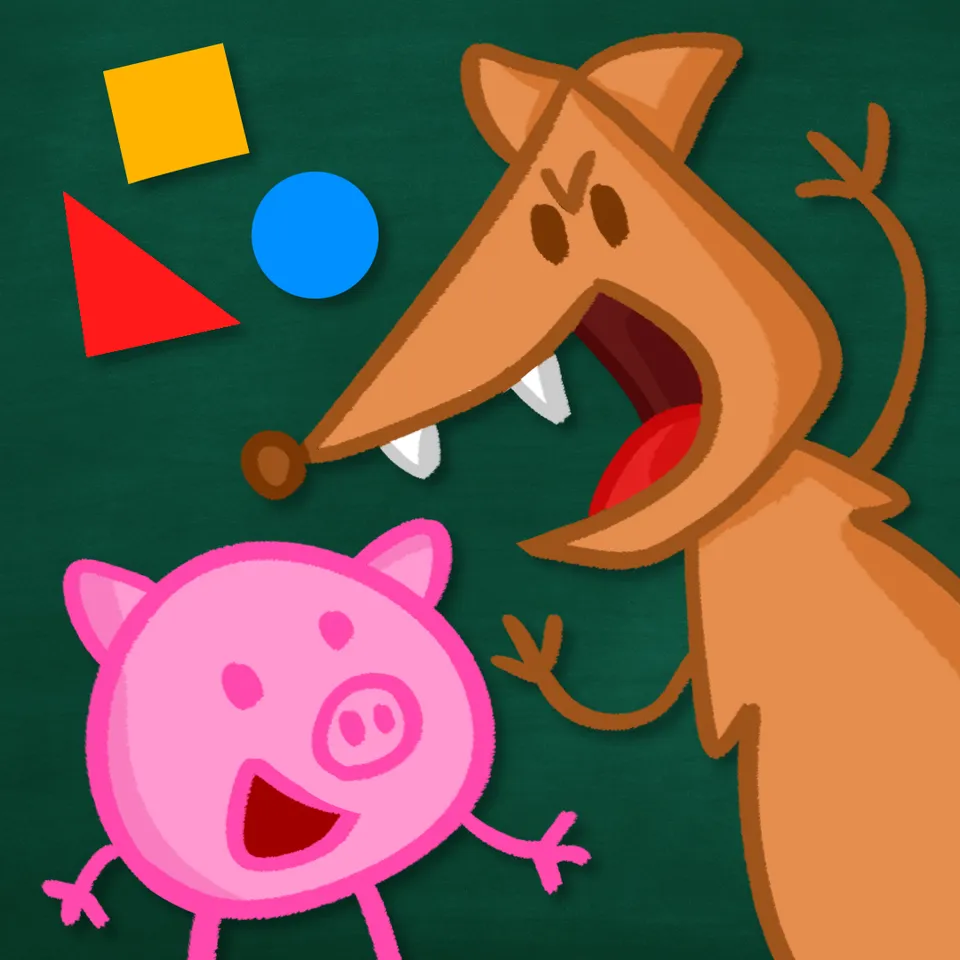
Oink oink oink, 1 2 3! An interactive story with shapes, basic addition, and funny pigs.
Oink! A twist on the classic Three Little Pigs: in this version, the pigs build houses based on different shapes. Students will learn about triangles, circles, squares, and more, as they help the pigs outsmart a big bad wolf and add up the hairs on their chinny chin chins. If your student knows how to count, they are ready for this interactive story.
Part of
Standards alignment
Common Core State Standards
- K.G.A.2 — Correctly name shapes regardless of their orientations or overall size.
- K.G.B.4 — Analyze and compare two- and three-dimensional shapes, in different sizes and orientations, using informal language to describe their similarities, differences, parts (e.g., number of sides and vertices/"corners") and other attributes (e.g., having sides of equal length).
- 1.OA.A.2 — Solve word problems that call for addition of three whole numbers whose sum is less than or equal to 20, e.g., by using objects, drawings, and equations with a symbol for the unknown number to represent the problem.
- K.G.A.1 — Describe objects in the environment using names of shapes, and describe the relative positions of these objects using terms such as above, below, beside, in front of, behind, and next to.
- ELD-SI.K-3.Inform — Multilingual learners will… • Define and classify objects or concepts • Describe characteristics, patterns, or behavior • Describe parts and wholes • Sort, clarify, and summarize ideas • Summarize information from interaction with others and from learning experiences
Alabama
- MA19.K.19 — Correctly name shapes regardless of their orientations or overall sizes.
- MA19.K.21 — Analyze and compare two- and three-dimensional shapes, in different sizes and orientations, using informal language to describe their similarities, differences, parts (number of sides and vertices or "corners"), and other attributes.
- MA19.K.5 — Count to answer "how many?" questions.
- MA19.1.2 — Solve word problems that call for addition of three whole numbers whose sum is less than or equal to 20 by using concrete objects, drawings, or equations with a symbol for the unknown number to represent the problem.
- MA19.K.4d — Explain that each successive number name refers to a quantity that is one larger.
Alaska
- K.CC.5 — Count to answer "how many?" questions about as many as 20 things arranged in a line, a rectangular array or a circle, or as many as 10 things in a scattered configuration; given a number from 1-20, count out that many objects.
- K.G.2 — Name shapes (squares, circles, triangles, rectangles, hexagons, cubes, cones, cylinders, and spheres) regardless of their orientation or overall size.
- K.G.4 — Analyze and compare two- and three-dimensional shapes, in different sizes and orientations, using informal language to describe their similarities, differences, parts (e.g., number of sides and vertices), and other attributes (e.g., having sides of equal lengths).
- K.OA.2 — Add or subtract whole numbers to 10 (e.g., by using objects or drawings to solve word problems).
- K.OA.6 — Recognize, identify and continue simple patterns of color, shape, and size.
Arizona
- K.CC.B.5 — Count to answer "how many?" questions about as many as 20 things arranged in a line, a rectangular array, or a circle, or as many as 10 things in a scattered configuration; given a number from 1—20, count out that many objects.
- K.G.A.2 — Correctly name shapes regardless of their orientation or overall size (e.g., circle, triangle, square, rectangle, rhombus, trapezoid, hexagon, cube, cone, cylinder, sphere).
- K.G.B.4 — Analyze and compare two- and three-dimensional shapes, in different sizes and orientations, using informal language to describe their similarities, differences, parts (e.g., number of sides and vertices/"corners") and other attributes (e.g., having sides of equal length).
- 1.OA.A.2 — Solve word problems that call for addition of three whole numbers whose sum is less than or equal to 20, e.g., by using objects, drawings, and equations with a symbol for the unknown number to represent the problem.
- K.CC.A.2 — Count forward from a given number other than one, within the known sequence (e.g., "Starting at the number 5, count up to 11.").
- K.RL.1 — With prompting and support, ask and answer questions about key details in a text.
Arkansas
- K.GM.2 — Name shapes correctly regardless of their orientation or overall size. • Shapes include: squares, circles, triangles, rectangles, hexagons, cubes, cones, cylinders, and spheres
- K.GM.4 — Analyze and sort a variety of two and three-dimensional shapes using informal language to describe their similarities, differences, and other attributes.
- K.NPV.2 — Count a set of objects up to 20 using one-to-one correspondence, demonstrating that the last number stated indicates the number of objects in the set regardless of the arrangement.
- K.CAR.1. — Use objects, fingers, mental images, drawings, sounds, acting out situations, or verbal explanations to represent addition and subtraction from 0 to 10.
- 1.CAR.7 — Solve real-world problems involving addition of three whole numbers whose sum is less than or equal to 20.
California
- K.CC.B.5 — Count to answer "how many?" questions about as many as 20 things arranged in a line, a rectangular array, or a circle, or as many as 10 things in a scattered configuration; given a number from 1—20, count out that many objects.
- K.G.A.1 — Describe objects in the environment using names of shapes, and describe the relative positions of these objects using terms such as above, below, beside, in front of, behind, and next to.
- K.G.A.2 — Correctly name shapes regardless of their orientations or overall size.
- K.G.B.4 — Analyze and compare two- and three-dimensional shapes, in different sizes and orientations, using informal language to describe their similarities, differences, parts (e.g., number of sides and vertices/"corners") and other attributes (e.g., having sides of equal length).
- 1.OA.A.2 — Solve word problems that call for addition of three whole numbers whose sum is less than or equal to 20, e.g., by using objects, drawings, and equations with a symbol for the unknown number to represent the problem.
- K.OA.A.1 — Represent addition and subtraction with objects, fingers, mental images, drawings, sounds (e.g., claps), acting out situations, verbal explanations, expressions, or equations.
Colorado
- P.G.A.1 — Name and describe shapes in terms of length of sides, number of sides, and number of angles/corners.
- P.G.A.2 — Correctly name basic shapes (circle, square, rectangle, triangle) regardless of size and orientation.
- P.G.A.3 — Analyze, compare, and sort two-and three-dimensional shapes and objects in different sizes. Describe their similarities, differences, and other attributes, such as size and shape.
- P.OA.B.2 — Duplicate simple patterns in a different location than demonstrated, such as making the same alternating color pattern with blocks at a table that was demonstrated on the rug. Extend patterns, such as making an eight-block tower of the same pattern that was demonstrated with four blocks.
- P.CC.C.4 — Use the number name of the last object counted to answer “How many?” questions for up to approximately 10 objects.
- P.OA.A.3 — With adult assistance, begin to use counting on (adding 1 or 2, for example) from the larger number for addition.
- K.CC.A.2 — Count forward beginning from a given number within the known sequence (instead of having to begin at 1).
Connecticut
- K.CC.B.5 — Count to answer "how many?" questions about as many as 20 things arranged in a line, a rectangular array, or a circle, or as many as 10 things in a scattered configuration; given a number from 1—20, count out that many objects.
- K.G.A.2 — Correctly name shapes regardless of their orientations or overall size.
- K.G.B.4 — Analyze and compare two- and three-dimensional shapes, in different sizes and orientations, using informal language to describe their similarities, differences, parts (e.g., number of sides and vertices/"corners") and other attributes (e.g., having sides of equal length).
- K.CC.A.2 — Count forward beginning from a given number within the known sequence (instead of having to begin at 1).
- K.OA.A.1 — Represent addition and subtraction with objects, fingers, mental images, drawings, sounds (e.g., claps), acting out situations, verbal explanations, expressions, or equations.
Delaware
- K.CC.B.5 — Count to answer "how many?" questions about as many as 20 things arranged in a line, a rectangular array, or a circle, or as many as 10 things in a scattered configuration; given a number from 1—20, count out that many objects.
- K.G.A.2 — Correctly name shapes regardless of their orientations or overall size.
- K.G.B.4 — Analyze and compare two- and three-dimensional shapes, in different sizes and orientations, using informal language to describe their similarities, differences, parts (e.g., number of sides and vertices/"corners") and other attributes (e.g., having sides of equal length).
- 1.OA.A.2 — Solve word problems that call for addition of three whole numbers whose sum is less than or equal to 20, e.g., by using objects, drawings, and equations with a symbol for the unknown number to represent the problem.
- K.G.A.1 — Describe objects in the environment using names of shapes, and describe the relative positions of these objects using terms such as above, below, beside, in front of, behind, and next to.
- K.OA.A.1 — Represent addition and subtraction with objects, fingers, mental images, drawings, sounds (e.g., claps), acting out situations, verbal explanations, expressions, or equations.
Florida
- MA.K.GR.1.1 — Identify two- and three-dimensional figures regardless of their size or orientation. Figures are limited to circles, triangles, rectangles, squares, spheres, cubes, cones and cylinders.
- MA.K.GR.1.2 — Compare two-dimensional figures based on their similarities, differences and positions. Sort two-dimensional figures based on their similarities and differences. Figures are limited to circles, triangles, rectangles and squares.
- MA.K.NSO.1.1 — Given a group of up to 20 objects, count the number of objects in that group and represent the number of objects with a written numeral. State the number of objects in a rearrangement of that group without recounting.
- MA.K.GR.1.4 — Find real-world objects that can be modeled by a given two- or three-dimensional figure. Figures are limited to circles, triangles, rectangles, squares, spheres, cubes, cones and cylinders.
- MA.K.NSO.3.1 — Explore addition of two whole numbers from 0 to 10, and related subtraction facts.
- MA.K12.MTR.5.1 — Use patterns and structure to help understand and connect mathematical concepts. Mathematicians who use patterns and structure to help understand and connect mathematical concepts: • Focus on relevant details within a problem. • Create plans and procedures to logically order events, steps or ideas to solve problems. • Decompose a complex problem into manageable parts. • Relate previously learned concepts to new concepts. • Look for similarities among problems. • Connect solutions of problems to more complicated large-scale situations.
Georgia
- K.GSR.8 — Identify, describe, and compare basic shapes encountered in the environment, and form two-dimensional shapes and three-dimensional figures.
- K.GSR.8.1 — Identify, sort, classify, analyze, and compare two- dimensional shapes and three-dimensional figures, in different sizes and orientations, using informal language to describe their similarities, differences, number of sides and vertices, and other attributes.
- K.PAR.6.1 — Create, extend, and describe repeating patterns with numbers and shapes, and explain the rationale for the pattern.
- K.NR.1.1 — Count up to 20 objects in a variety of structured arrangements and up to 10 objects in a scattered arrangement.
- K.NR.1.3 — Given a number from 1-20, identify the number that is one more or one less.
- K.NR.5.3 — Use a variety of strategies to solve addition and subtraction problems within 10.
Hawaii
- K.CC.B.5 — Count to answer "how many?" questions about as many as 20 things arranged in a line, a rectangular array, or a circle, or as many as 10 things in a scattered configuration; given a number from 1—20, count out that many objects.
- K.G.A.2 — Correctly name shapes regardless of their orientations or overall size.
- K.G.B.4 — Analyze and compare two- and three-dimensional shapes, in different sizes and orientations, using informal language to describe their similarities, differences, parts (e.g., number of sides and vertices/"corners") and other attributes (e.g., having sides of equal length).
- K.OA.A.1 — Represent addition and subtraction with objects, fingers, mental images, drawings, sounds (e.g., claps), acting out situations, verbal explanations, expressions, or equations.
- K.CC.A.2 — Count forward beginning from a given number within the known sequence (instead of having to begin at 1).
- K.G.A.1 — Describe objects in the environment using names of shapes, and describe the relative positions of these objects using terms such as above, below, beside, in front of, behind, and next to.
- K.L.5a — Sort common objects into categories (e.g., shapes, foods) to gain a sense of the concepts the categories represent.
Idaho
- K.CC.B.5 — Given a group of up to 20 objects, count the number of objects in that group and state the number of objects in a rearrangement of that group without recounting. Given a verbal or written number from zero to 20, count out that many objects.
- K.G.A.2 — Correctly name shapes regardless of their orientations or overall size.
- K.G.B.4 — Analyze and compare two- and three-dimensional shapes, in different sizes and orientations, using informal language to describe their similarities, differences, parts, and other attributes.
- 1.OA.A.2 — Solve word problems that call for addition of three whole numbers whose sum is less than or equal to 20 by using physical, visual, and symbolic representations.
- K.OA.A.2 — Solve addition and subtraction word problems within ten by using physical, visual, and symbolic representations.
- K.CC.B.4.c — Understand that each successive number name refers to a quantity that is one larger. Recognize the “one more” pattern of counting using objects.
- K.MD.A.2 — Directly compare two objects with a measurable attribute in common, to see which object has “more of”/ “less of” the attribute, and describe the difference.
Illinois
- K.CC.B.5 — Count to answer "how many?" questions about as many as 20 things arranged in a line, a rectangular array, or a circle, or as many as 10 things in a scattered configuration; given a number from 1—20, count out that many objects.
- K.G.A.2 — Correctly name shapes regardless of their orientations or overall size.
- K.G.B.4 — Analyze and compare two- and three-dimensional shapes, in different sizes and orientations, using informal language to describe their similarities, differences, parts (e.g., number of sides and vertices/"corners") and other attributes (e.g., having sides of equal length).
- 1.OA.A.2 — Solve word problems that call for addition of three whole numbers whose sum is less than or equal to 20, e.g., by using objects, drawings, and equations with a symbol for the unknown number to represent the problem.
- K.OA.A.1 — Represent addition and subtraction with objects, fingers, mental images, drawings, sounds (e.g., claps), acting out situations, verbal explanations, expressions, or equations.
Indiana
- K.CA.4 — Create, extend, and give an appropriate rule for simple repeating and growing patterns with numbers and shapes.
- K.G.1 — Compare two- and three-dimensional shapes in different sizes and orientations, using informal language to describe their similarities, differences, parts (e.g., number of sides and vertices/"corners"), and other attributes (e.g., having sides of equal length).
- K.NS.3 — Say the number names in standard order when counting objects, pairing each object with one and only one number name and each number name with one and only one object. Understand that the last number name said describes the number of objects counted and that the number of objects is the same regardless of their arrangement or the order in which they were counted. Count out the number of objects, given a number from 1 to 20. (E)
- 1.G.1 — Distinguish between defining attributes of two- and three-dimensional shapes (e.g., triangles are closed and three-sided) versus non-defining attributes (e.g., color, orientation, overall size). Create and draw two-dimensional shapes with defining attributes.
- K.RC.7 — Identify and sort pictures of objects into categories (e.g., colors, shapes, opposites) through oral discussions. (E)
Iowa
- K.CC.B.5 — Count to answer "how many?" questions about as many as 20 things arranged in a line, a rectangular array, or a circle, or as many as 10 things in a scattered configuration. Given a number from 1–20, count out that many objects.
- K.G.A.2 — Correctly name shapes regardless of their orientations or overall size.
- K.G.B.4 — Analyze and compare two- and three-dimensional shapes, in varied sizes and orientations, using informal language to describe their similarities, differences, parts and other attributes. For example, number of sides and vertices/corners and having sides of equal length.
- 1.OA.A.2 — Solve word problems that call for addition of three whole numbers whose sum is less than or equal to 20. For example, by using objects, drawings, and equations with a symbol for the unknown number to represent the problem.
- K.G.A.3 — Identify shapes as two-dimensional (lying in a plane, "flat") or three-dimensional ("solid").
Kansas
- K.CC.5 — Count to answer “how many?” up to 20 concrete or pictorial objects arranged in a line, a rectangular array, or a circle, or as many as 10 objects in a scattered configuration; given a number from 1 to 20, count out that many objects.
- K.G.2 — Correctly gives most precise name of shapes regardless of their orientations (position and direction in space) or overall size.
- K.G.4 — Analyze and compare two- and three-dimensional shapes, in different sizes and orientations (position and direction in space), using informal language to describe their similarities, differences, parts (e.g. number of sides and vertices/“corners”) and other attributes (e.g. having sides of equal length).
- K.CC.2 — Count forward beginning from a given number within the known sequence (instead of having to begin at 1).
- K.OA.1 — Represent addition and subtraction with objects, fingers, mental images, drawings, sounds (e.g. claps), acting out situations, verbal explanations, expressions, or equations.
- K.G.3 — Identify shapes as two-dimensional (lying in a plane, “flat”) or three-dimensional (“solid”).
Kentucky
- KY.K.G.1 — Name and describe shapes in the environment.
- KY.K.G.2 — Correctly name shapes regardless of orientations or overall size.
- KY.K.G.4 — Describe the similarities, differences and attributes of two and three dimensional shapes using different sizes and orientations.
- KY.1.OA.2 — Solve word problems that call for addition of three whole numbers whose sum is less than or equal to 20, by using objects, drawings and equations with a symbol for one unknown number to represent the problem.
- KY.K.CC.5.b — Count to answer “how many?” questions with as many as 10 things in a scattered configuration.
- RL.K.1 — With prompting and support, ask and answer explicit questions about key ideas and details, and make logical inferences to construct meaning from the text.
Louisiana
- K.CC.B.5 — Count to answer "how many?" questions.
- K.G.A.2 — Correctly name shapes regardless of their orientations or overall size.
- K.G.B.4 — Analyze and compare two- and three-dimensional shapes, in different sizes and orientations, using informal language to describe their similarities, differences, parts (e.g., number of sides and vertices/"corners") and other attributes (e.g., having sides of equal length).
- K.CC.A.2 — Count forward beginning from a given number within the known sequence (instead of having to begin at 1).
- K.OA.A.1 — Represent addition and subtraction with objects, fingers, mental images, drawings, sounds (e.g., claps), acting out situations, verbal explanations, expressions, or equations.
- 1.OA.A.2 — Solve word problems that call for addition of three whole numbers whose sum is less than or equal to 20, e.g., by using objects, drawings, and equations with a symbol for the unknown number to represent the problem.
Maine
- K.CC.B.5 — Count to answer “how many?” questions about as many as 20 things arranged in a line, a rectangular array, or a circle, or as many as 10 things in a scattered configuration; given a number from 1-20, count out that many objects.
- K.G.A.2 — Correctly name shapes regardless of their orientations or overall size.
- K.G.B.4 — Analyze and compare two- and three-dimensional shapes, in different sizes and orientations, using informal language to describe their similarities, differences, parts (e.g., number of sides and vertices/"corners") and other attributes (e.g., having sides of equal length).
- 1.G.A.1 — Distinguish between defining attributes (e.g., triangles are closed and three-sided) versus non-defining attributes (e.g., color, orientation, overall size); build and draw shapes to possess defining attributes.
- 1.OA.A.2 — Solve word problems that call for addition of three whole numbers whose sum is less than or equal to 20, (e.g., by using objects, drawings, and equations with a symbol for the unknown number to represent the problem.)
- K.CC.A.2 — Count forward beginning from a given number within the known sequence (instead of having to begin at 1)
Maryland
- K.CC.B.5 — Count to answer "how many?" questions about as many as 20 things arranged in a line, a rectangular array, or a circle, or as many as 10 things in a scattered configuration; given a number from 1—20, count out that many objects.
- K.G.A.2 — Correctly name shapes regardless of their orientations or overall size.
- K.G.B.4 — Analyze and compare two- and three-dimensional shapes, in different sizes and orientations, using informal language to describe their similarities, differences, parts (e.g., number of sides and vertices/"corners") and other attributes (e.g., having sides of equal length).
- 1.OA.A.2 — Solve word problems that call for addition of three whole numbers whose sum is less than or equal to 20, e.g., by using objects, drawings, and equations with a symbol for the unknown number to represent the problem.
- K.CC.B.4.c — Understand that each successive number name refers to a quantity that is one larger.
- PK.MD.A.2 — Directly compare two objects with a measurable attribute in common, using words such as “bigger/smaller,” “longer/shorter,” “lighter/heavier,” or “taller/shorter”. . Order up to 3 objects by a measureable attribute (e.g., biggest to smallest)
Massachusetts
- K.CC.B.5 — Count to answer "how many?" questions about as many as 20 things arranged in a line, a rectangular array, or a circle, or as many as 10 things in a scattered configuration; given a number from 1–20, count out that many objects.
- K.G.A.2 — Correctly name shapes regardless of their orientation or overall size.
- K.G.B.4 — Analyze and compare two- and three-dimensional shapes, in different sizes and orientations, using informal language to describe their similarities, differences, parts (e.g., number of sides and vertices/"corners") and other attributes (e.g., having sides of equal length).
- PK.G.A.2 — Identify various two-dimensional shapes using appropriate language.
- 1.OA.A.2 — Solve word problems that call for addition of three whole numbers whose sum is less than or equal to 20, e.g., by using objects, drawings, and equations with a symbol for the unknown number to represent the problem.
- K.CC.B.4.c — Understand that each successive number name refers to a quantity that is one larger. Recognize the one more pattern of counting using objects.
Michigan
- K.CC.B.5 — Count to answer "how many?" questions about as many as 20 things arranged in a line, a rectangular array, or a circle, or as many as 10 things in a scattered configuration; given a number from 1—20, count out that many objects.
- K.G.A.2 — Correctly name shapes regardless of their orientations or overall size.
- K.G.B.4 — Analyze and compare two- and three-dimensional shapes, in different sizes and orientations, using informal language to describe their similarities, differences, parts (e.g., number of sides and vertices/"corners") and other attributes (e.g., having sides of equal length).
- 1.OA.A.2 — Solve word problems that call for addition of three whole numbers whose sum is less than or equal to 20, e.g., by using objects, drawings, and equations with a symbol for the unknown number to represent the problem.
- K.CC.A.2 — Count forward beginning from a given number within the known sequence (instead of having to begin at 1).
Minnesota
- K.1.2.1 — Use objects and draw pictures to find the sums and differences of numbers between 0 and 10.
- K.2.1.1 — Identify, create, complete, and extend simple patterns using shape, color, size, number, sounds and movements. Patterns may be repeating, growing or shrinking such as ABB, ABB, ABB or ●,●●,●●●.
- K.3.1.1 — Recognize basic two- and three-dimensional shapes such as squares, circles, triangles, rectangles, trapezoids, hexagons, cubes, cones, cylinders and spheres.
- 0.2.5.2 — Verbally or visually respond to a story, with support and guidance.
- 1.3.1.1 — Describe characteristics of two- and three-dimensional objects, such as triangles, squares, rectangles, circles, rectangular prisms, cylinders, cones and spheres.
- K.3.2.1 — Use words to compare objects according to length, size, weight and position. For example: Use same, lighter, longer, above, between and next to. Another example: Identify objects that are near your desk and objects that are in front of it. Explain why there may be some objects in both groups.
Mississippi
- K.CC.5 — Count to answer “how many?” questions about as many as 20 things arranged in a line, a rectangular array, or a circle, or as many as 10 things in a scattered configuration; given a number from 1–20, count out that many objects.
- K.G.2 — Correctly name shapes regardless of their orientations or overall size.
- K.G.4 — Analyze and compare two- and three-dimensional shapes, in different sizes and orientations, using informal language to describe their similarities, differences, parts (e.g., number of sides and vertices/“corners”) and other attributes (e.g., having sides of equal length).
- K.OA.2 — Solve addition and subtraction word problems within 10 involving situations of adding to, taking from, putting together and taking apart with unknowns in all positions by using objects or drawings to represent the problem.
- K.CC.2 — Count forward beginning from a given number within the known sequence (instead of having to begin at 1).
- K.MD.2 — Directly compare two objects with a measurable attribute in common, to see which object has “more of”/“less of” the attribute, and describe the difference. For example, directly compare the heights of two children and describe one child as taller/shorter.
Missouri
- K.GM.C.6 — Identify shapes and describe objects in the environment using names of shapes, recognizing the name stays the same regardless of orientation or size.
- K.GM.C.8 — Identify and describe the attribute of shapes, and use the attributes to sort a collection of shapes.
- K.RA.A.1 — Represent addition and subtraction within 10.
- 1.RA.A.2 — Solve problems that call for addition of three whole numbers whose sum is within 20.
- K.GM.A.2 — Compare the measurable attributes of two objects.
Montana
- K.CC.B.5 — Count to answer "how many?" questions about as many as 20 things arranged in a line, a rectangular array, or a circle, or as many as 10 things in a scattered configuration; given a number from 1-20, count out that many objects from a variety of cultural contexts, including those of Montana American Indians.
- K.G.A.2 — Correctly name shapes regardless of their orientations or overall size.
- K.G.B.4 — Analyze and compare two- and three-dimensional shapes, in different sizes and orientations, using informal language to describe their similarities, differences, parts (e.g., number of sides and vertices/"corners") and other attributes (e.g., having sides of equal length).
- K.OA.A.2 — Solve addition and subtraction word problems from a variety of cultural contexts, including those of Montana American Indians, and add and subtract within 10, e.g., by using objects or drawings to represent the problem.
- K.MD.A.2 — Directly compare two objects with a measurable attribute in common, to see which object has "more of"/"less of" the attribute, and describe the difference. For example, directly compare the heights of two children and describe one child as taller/shorter.
- K.CC.A.2 — Count forward beginning from a given number within the known sequence (instead of having to begin at 1).
Nebraska
- K.G.1.a — Identify and name two-dimensional shapes including circles, triangles, squares, and rectangles regardless of orientation or size.
- 1.N.5.e — Solve problems that call for addition of three whole numbers whose sum is less than or equal to 20 using flexible strategies with objects, drawings, and/or equations.
- K.D.1.a — Identify, sort, and classify objects by size, shape, color, and other attributes.
- K.G.1 — Shapes and Their Attributes: Students will identify and represent the attributes of two-dimensional shapes and three- dimensional solids.
Nevada
- K.CC.B.5 — Count to answer "how many?" questions about as many as 20 things arranged in a line, a rectangular array, or a circle, or as many as 10 things in a scattered configuration; given a number from 1—20, count out that many objects.
- K.G.A.2 — Correctly name shapes regardless of their orientations or overall size.
- K.G.B.4 — Analyze and compare two- and three-dimensional shapes, in different sizes and orientations, using informal language to describe their similarities, differences, parts (e.g., number of sides and vertices/"corners") and other attributes (e.g., having sides of equal length).
- 1.OA.A.2 — Solve word problems that call for addition of three whole numbers whose sum is less than or equal to 20, e.g., by using objects, drawings, and equations with a symbol for the unknown number to represent the problem.
- K.CC.A.2 — Count forward beginning from a given number within the known sequence (instead of having to begin at 1).
- K.OA.A.1 — Represent addition and subtraction with objects, fingers, mental images, drawings, sounds (e.g., claps), acting out situations, verbal explanations, expressions, or equations.
New Hampshire
- K.CC.B.5 — Count to answer "how many?" questions about as many as 20 things arranged in a line, a rectangular array, or a circle, or as many as 10 things in a scattered configuration; given a number from 1—20, count out that many objects.
- K.G.A.2 — Correctly name shapes regardless of their orientations or overall size.
- K.G.B.4 — Analyze and compare two- and three-dimensional shapes, in different sizes and orientations, using informal language to describe their similarities, differences, parts (e.g., number of sides and vertices/"corners") and other attributes (e.g., having sides of equal length).
- 1.OA.A.2 — Solve word problems that call for addition of three whole numbers whose sum is less than or equal to 20, e.g., by using objects, drawings, and equations with a symbol for the unknown number to represent the problem.
- K.CC.A.2 — Count forward beginning from a given number within the known sequence (instead of having to begin at 1).
New Jersey
- K.CC.B.5 — Count to answer “how many?” questions about as many as 20 things arranged in a line, a rectangular array, or a circle, or as many as 10 things in a scattered configuration; given a number from 1–20, count out that many objects.
- K.G.A.2 — Correctly name shapes regardless of their orientations or overall size.
- K.G.B.4 — Analyze and compare two- and three-dimensional shapes, in different sizes and orientations, using informal language to describe their similarities, differences, parts (e.g., number of sides and vertices/“corners”) and other attributes (e.g., having sides of equal length).
- K.CC.A.2 — Count forward beginning from a given number within the known sequence (instead of having to begin at 1).
- K.OA.A.1 — Represent addition and subtraction up to 10 with objects, fingers, mental images, drawings , sounds (e.g., claps), acting out situations, verbal explanations, expressions, or equations.
- K.G.A.3 — Identify shapes as two-dimensional (lying in a plane, “flat”) or three-dimensional (“solid”).
New Mexico
- K.CC.B.5 — Count to answer "how many?" questions about as many as 20 things arranged in a line, a rectangular array, or a circle, or as many as 10 things in a scattered configuration; given a number from 1—20, count out that many objects.
- K.G.A.2 — Correctly name shapes regardless of their orientations or overall size.
- K.G.B.4 — Analyze and compare two- and three-dimensional shapes, in different sizes and orientations, using informal language to describe their similarities, differences, parts (e.g., number of sides and vertices/"corners") and other attributes (e.g., having sides of equal length).
- 1.OA.A.2 — Solve word problems that call for addition of three whole numbers whose sum is less than or equal to 20, e.g., by using objects, drawings, and equations with a symbol for the unknown number to represent the problem.
- K.CC.A.2 — Count forward beginning from a given number within the known sequence (instead of having to begin at 1).
New York
- NY-K.G.2 — Name shapes regardless of their orientation or overall size.
- NY-K.G.4 — Analyze, compare, and sort two- and three-dimensional shapes, in different sizes and orientations, using informal language to describe their similarities, differences, parts, and other attributes.
- NY-K.G.1 — Describe objects in the environment using names of shapes, and describe the relative positions of these objects using terms such as above, below, beside, in front of, behind, and next to.
- NY-PK.CC.4.a — Answer counting questions using as many as 10 objects arranged in a line, a rectangular array, and a circle. Answer counting questions using as many as 5 objects in a scattered configuration.
- NY-PK.OA.1 — Explore addition and subtraction by using objects, fingers, and responding to real world situations.
North Carolina
- NC.K.CC.5 — Count to answer “How many?” in the following situations: • Given a number from 1–20, count out that many objects. • Given up to 20 objects, name the next successive number when an object is added, recognizing the quantity is one more/greater. • Given 20 objects arranged in a line, a rectangular array, and a circle, identify how many. • Given 10 objects in a scattered arrangement, identify how many.
- NC.K.G.2 — Correctly name squares, circles, triangles, rectangles, hexagons, cubes, cones, cylinders, and spheres regardless of their orientations or overall size.
- NC.K.G.4 — Analyze and compare two- and three-dimensional shapes, in different sizes and orientations, using informal language to describe their similarities, differences, attributes and other properties.
- NC.1.OA.2 — Represent and solve word problems that call for addition of three whole numbers whose sum is less than or equal to 20, by using objects, drawings, and equations with a symbol for the unknown number.
- NC.K.CC.2 — Count forward beginning from a given number within the known sequence, instead of having to begin at 1.
- NC.K.CC.4 — Understand the relationship between numbers and quantities. • When counting objects, say the number names in the standard order, pairing each object with one and only one number name and each number name with one and only one object (one-to-one correspondence). • Recognize that the last number named tells the number of objects counted regardless of their arrangement (cardinality). • State the number of objects in a group, of up to 5 objects, without counting the objects (perceptual subitizing).
North Dakota
- K.AR.OA.6 — Recognize, duplicate, complete, and extend repeating patterns in a variety of contexts (e.g., shape, color, size, objects, sounds, movements).
- K.GM.G.1 — Name shapes and identify them as two-dimensional (squares, circles, triangles, rectangles) regardless of their orientations or overall sizes.
- K.GM.G.3 — Compare and classify two-dimensional shapes to describe their similarities, differences, and attributes (squares, circles, triangles, rectangles).
- K.NO.CC.5 — Count and tell how many objects up to 20 are in an arranged pattern or up to 10 objects in a scattered configuration. Represent a quantity of up to 20 with a numeral.
- 1.AR.OA.4 — Solve authentic word problems with addition, including three numbers and unknowns, within 20.
- K.R.8a — Respond to or reenact characters' feelings in a story, poem,or nursery rhyme during or after a shared reading or other text-listening experience.
Ohio
- K.CC.5 — Count to answer “how many?” questions about as many as 20 things arranged in a line, a rectangular array, or a circle, or as many as 10 things in a scattered configuration; given a number from 1-20, count out that many objects.
- K.G.2 — Correctly name shapes regardless of their orientations or overall size.
- K.G.4 — Describe and compare two- or three-dimensional shapes, in different sizes and orientations, using informal language to describe their commonalities, differences, parts, and other attributes.
- K.G.1 — Describe objects in the environment using names of shapes, and describe the relative positions of these objects using terms such as above, below, beside, in front of, behind, and next to.
- K.OA.1 — Represent addition and subtraction with objects, fingers, mental images, drawings, sounds such as claps, acting out situations, verbal explanations, expressions, or equations. Drawings need not show details, but should show the mathematics in the problem.
- K.CC.4.c — Understand that each successive number name refers to a quantity that is one larger.
Oklahoma
- K.A.1.2 — Recognize, duplicate, complete, and extend repeating, increasing, and decreasing patterns in a variety of contexts (i.e., shape, color, size, objects, sounds, movement).
- K.GM.1.1 — Recognize squares, circles, triangles, and rectangles.
- K.GM.1.3 — Identify attributes of two-dimensional shapes using informal and formal geometric language interchangeably, such as the number of corners/vertices and the number of sides/edges.
- K.GM.1.6 — Use basic shapes and spatial reasoning to represent objects in the real world.
- PK.N.2.3 — Understand the last numeral spoken when counting aloud tells how many total objects are in a set up to 10.
- K.GM.2.1 — Use words to compare objects according to length, size, weight, position, and location.
Oregon
- K.GM.A.2 — Correctly name common two-dimensional and three-dimensional geometric shapes regardless of their orientations or overall size.
- K.GM.B.4 — Analyze and compare two and three-dimensional shapes, in different sizes and orientations, using informal language to describe their similarities, differences, parts and attributes.
- K.NCC.B.5 — Count to answer “how many?” questions using up to 20 objects arranged in a variety of configurations or as 10 objects in a scattered configuration. Given a number from 1-20, count out that many objects.
- 1.OA.A.2 — Solve problems that call for addition of three whole numbers whose sum is less than or equal to 20 using objects, drawings or equations.
- K.GM.C.8 — Directly compare two objects with a measurable attribute in common, and describe which object has “more” or “less” of the attribute.
Pennsylvania
- CC.2.1.PreK.A.2 — Count to tell the number of objects.
- CC.2.3.PreK.A.1 — Identify and describe shapes.
- CC.2.3.PreK.A.2 — Analyze, compare, create, and compose shapes.
- CC.2.1.PreK.A.1 — Know number names and the count sequence.
- CC.2.3.K.A.1 — Identify and describe two- and three- dimensional shapes.
Rhode Island
- K.CC.B.5 — Count to answer "how many?" questions about as many as 20 things arranged in a line, a rectangular array, or a circle, or as many as 10 things in a scattered configuration; given a number from 1—20, count out that many objects.
- K.G.A.2 — Correctly name shapes regardless of their orientations or overall size.
- K.G.B.4 — Analyze and compare two- and three-dimensional shapes, in different sizes and orientations, using informal language to describe their similarities, differences, parts (e.g., number of sides and vertices/"corners") and other attributes (e.g., having sides of equal length).
- 1.OA.A.2 — Solve word problems that call for addition of three whole numbers whose sum is less than or equal to 20, e.g., by using objects, drawings, and equations with a symbol for the unknown number to represent the problem.
- K.CC.A.2 — Count forward beginning from a given number within the known sequence (instead of having to begin at one).
South Carolina
- K.ATO.6 — Describe simple repeating patterns using AB, AAB, ABB, and ABC type patterns.
- K.G.2 — Identify and describe a given shape and shapes of objects in everyday situations to include two-dimensional shapes (i.e., triangle, square, rectangle, hexagon, and circle) and three-dimensional shapes (i.e., cone, cube, cylinder, and sphere).
- K.G.4 — Analyze and compare two- and three-dimensional shapes of different sizes and orientations using informal language.
- K.NS.5 — Count a given number of objects from 1 – 20 and connect this sequence in a one-to-one manner.
- 1.ATO.2 — Solve real-world/story problems that include three whole number addends whose sum is less than or equal to 20.
South Dakota
- K.G.A.2 — Correctly name shapes regardless of their orientations or overall size.
Tennessee
- K.CC.B.6 — Count to answer “how many?” questions about as many as 20 things arranged in a line, a rectangular array, a circle, or as many as 10 things in a scattered configuration. Given a number from 1-20, count out that many objects.
- K.G.A.2 — Correctly name shapes and solids (squares, circles, triangles, rectangles, hexagons, cubes, cones, cylinders, and spheres) regardless of their orientations or overall size.
- K.OA.A.2 — Add and subtract within 10 to solve contextual problems with result/total unknown involving situations of add to, take from, and put together/take apart. Use objects, drawings, or equations to represent the problem.
- K.CC.A.4 — Recognize, describe, extend, and create patterns and explain a simple rule for a pattern using concrete materials. Analyze the structure of the repeating pattern by identifying the unit (core) of the pattern.
- K.G.A.1 — Describe objects in the environment using names of shapes and solids (squares, circles, triangles, rectangles, hexagons, cubes, cones, cylinders, and spheres). Describe the relative positions of these objects using terms such as above, below, beside, in front of, behind, between, and next to.
- K.MD.A.2 — Directly compare two objects with a measurable attribute in common, to describe which object has more of/less of the attribute. For example, directly compare the heights of two children and describe one child as taller/shorter.
Texas
- K.6A — identify two-dimensional shapes, including circles, triangles, rectangles, and squares as special rectangles;
- K.6D — identify attributes of two-dimensional shapes using informal and formal geometric language interchangeably;
- K.2C — count a set of objects up to at least 20 and demonstrate that the last number said tells the number of objects in the set regardless of their arrangement or order;
- K.2I — compose and decompose numbers up to 10 with objects and pictures.
- K.7B — compare two objects with a common measurable attribute to see which object has more of/less of the attribute and describe the difference.
- K.2D — recognize instantly the quantity of a small group of objects in organized and random arrangements;
Utah
- K.CC.5 — Use counting to answer questions about "how many." For example, 20 or fewer objects arranged in a line, a rectangular array, or circle; 10 or fewer objects in a scattered configuration. Using a number from 1–20, count out that many objects.
- K.G.2 — Correctly name shapes regardless of their orientations or overall sizes.
- K.G.4 — Analyze, compare, and sort two- and three-dimensional shapes and objects, in different sizes and orientations, using informal language to describe their similarities, differences, and other attributes (for example, color, size, shape, number of sides).
- K.G.1 — Describe objects in the environment using names of shapes, and describe the relative positions of these objects using terms such as above, below, beside, in front of, behind, and next to.
- K.OA.2 — Solve addition and subtraction word problems within 10. Use objects or drawings to represent the problem.
- P3.R.5 — With prompting and support, ask and answer simple questions about a text. (RL & RI)
Virginia
- K.MG.2a — Identify and name concrete and pictorial representations of circles, triangles, squares, and rectangles regardless of their orientation in space.
- K.MG.2b — Describe triangles, squares, and rectangles to include the number of sides and number of vertices.
- K.CE.1f — Model and solve single-step contextual problems (join, separate, and part-part-whole) using 10 or fewer concrete objects.
- K.MG.2c — Describe a circle using terms such as round and curved.
- K.MG.2d — Distinguish between examples and nonexamples of identified plane figures (circles, triangles, squares, and rectangles).
- K.NS.1a — Use one-to-one correspondence to determine how many are in a given set containing 30 or fewer concrete objects (e.g., cubes, pennies, balls), and describe the last number named as the total number of objects counted.
Washington
- K.CC.B.5 — Count to answer "how many?" questions about as many as 20 things arranged in a line, a rectangular array, or a circle, or as many as 10 things in a scattered configuration; given a number from 1—20, count out that many objects.
- K.G.A.2 — Correctly name shapes regardless of their orientations or overall size.
- K.G.B.4 — Analyze and compare two- and three-dimensional shapes, in different sizes and orientations, using informal language to describe their similarities, differences, parts (e.g., number of sides and vertices/"corners") and other attributes (e.g., having sides of equal length).
- K.CC.A.2 — Count forward beginning from a given number within the known sequence (instead of having to begin at 1).
- K.OA.A.1 — Represent addition and subtraction with objects, fingers, mental images, drawings, sounds (e.g., claps), acting out situations, verbal explanations, expressions, or equations.
- 1.OA.A.2 — Solve word problems that call for addition of three whole numbers whose sum is less than or equal to 20, e.g., by using objects, drawings, and equations with a symbol for the unknown number to represent the problem.
Washington, D.C.
- K.CC.B.5 — Count to answer "how many?" questions about as many as 20 things arranged in a line, a rectangular array, or a circle, or as many as 10 things in a scattered configuration; given a number from 1—20, count out that many objects.
- K.G.A.2 — Correctly name shapes regardless of their orientations or overall size.
- K.G.B.4 — Analyze and compare two- and three-dimensional shapes, in different sizes and orientations, using informal language to describe their similarities, differences, parts (e.g., number of sides and vertices/"corners") and other attributes (e.g., having sides of equal length).
- K.CC.A.2 — Count forward beginning from a given number within the known sequence (instead of having to begin at 1).
- K.OA.A.1 — Represent addition and subtraction with objects, fingers, mental images, drawings, sounds (e.g., claps), acting out situations, verbal explanations, expressions, or equations.
West Virginia
- M.K.21 — Correctly name shapes regardless of their orientations or overall size.
- M.K.23 — Analyze and compare two- and three-dimensional shapes, in different sizes and orientations, using informal language to describe their similarities, differences, parts (e.g., number of sides and vertices/ "corners"), and other attributes (e.g., having sides of equal length). Instructional Note: Student focus should include real-world shapes.
- M.K.5 — Count to answer questions (e.g., "How many?") about as many as 20 things arranged in a line, a rectangular array, a circle, or as many as 10 things in a scattered configuration; given a number from 1-20, count out that many objects.
- M.1.2 — Solve word problems that call for addition of three whole numbers whose sum is less than or equal to 20 (e.g., by using objects, drawings, and equations with a symbol for the unknown number to represent the problem).
- M.K.13 — Recognize and create recognizable patterns using colors, shapes, sizes, and sounds with support and guidance.
Wisconsin
- M.K.CC.B.6 — Count to answer "how many?" questions about as many as 20 things arranged in a line, a rectangular array, or a circle, or as many as 10 things in a scattered configuration; given a number from 1-20, count out that many objects.
- M.K.G.A.2 — Correctly name shapes regardless of their orientations or overall size.
- M.K.G.B.4 — Analyze and compare two- and three-dimensional shapes, in different sizes and orientations, using informal language to describe their similarities, differences, parts (e.g., number of sides and vertices/"corners") and other attributes (e.g., having sides of equal length).
- M.K.OA.A.1 — Represent addition and subtraction with objects, fingers, mental images, drawings, sounds (e.g., claps), acting out situations, verbal explanations, or numbers. Drawings need not show details but should show the mathematics in the problem.
- M.K.G.A.3 — Identify shapes as two-dimensional (lying in a plane, "flat") or three-dimensional ("solid").
Wyoming
- K.CC.B.5.A — Answer the question "how many?" by counting up to 20 objects arranged in a line, a rectangular array, a circle, or as many as 10 objects in a scattered configuration.
- K.G.H — Identify and describe shapes (squares, circles, triangles, rectangles, hexagons, cubes, cones, cylinders, and spheres).
- K.G.I.4 — Analyze and compare two- and three-dimensional shapes, using informal language to describe their similarities, differences, and attributes.
- 1.OA.A.2 — Solve word problems that call for the addition of three whole numbers whose sum is less than or equal to 20, by using objects, drawings, or equations.
- K.G.H.2 — Correctly name shapes regardless of their orientations or overall size.