Coin Counting Chaos
Ages 6–8 · 9 minutes · Math
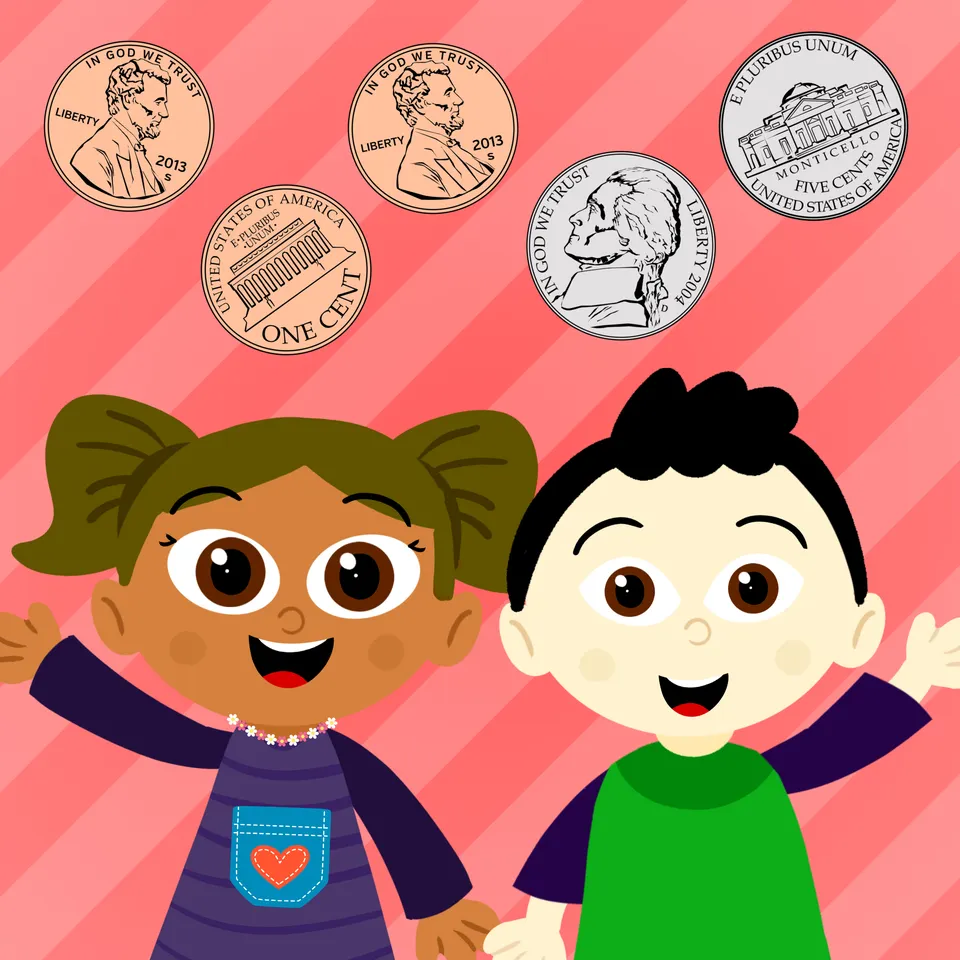
Help Edwin and Gabriella sort and count coins!
In this lesson, students will practice introductory money math skills including:
– Identifying different coin types in a group
– Counting how many of each type of coin there is in groups of two or three types of coins
Part of
Standards alignment
Common Core State Standards
- K.CC.B.5 — Count to answer "how many?" questions about as many as 20 things arranged in a line, a rectangular array, or a circle, or as many as 10 things in a scattered configuration; given a number from 1—20, count out that many objects.
- K.CC.B.4.a — When counting objects, say the number names in the standard order, pairing each object with one and only one number name and each number name with one and only one object.
- K.CC.B.4.b — Understand that the last number name said tells the number of objects counted. The number of objects is the same regardless of their arrangement or the order in which they were counted.
- K.CC.B.4 — Understand the relationship between numbers and quantities; connect counting to cardinality.
Alabama
- MA19.K.5 — Count to answer "how many?" questions.
- MA19.K.5b — Count using no more than 10 concrete objects in a scattered configuration.
- MA19.1.20 — Identify pennies and dimes by name and value.
- MA19.2.24a — Identify nickels and quarters by name and value.
- MA19.K.4 — Connect counting to cardinality using a variety of concrete objects.
Alaska
- K.CC.5 — Count to answer "how many?" questions about as many as 20 things arranged in a line, a rectangular array or a circle, or as many as 10 things in a scattered configuration; given a number from 1-20, count out that many objects.
- K.MD.3 — Classify objects into given categories (attributes). Count the number of objects in each category (limit category counts to be less than or equal to 10).
- K.MD.6 — Identify coins by name.
- 1.MD.7 — Organize, represent and interpret data with up to three categories. Ask and answer comparison and quantity questions about the data.
Arizona
- 1.MD.B.3b — Identify coins by name and value (pennies, nickels, dimes and quarters).
- 1.MD.C.4 — Organize, represent, and interpret data with up to three categories; ask and answer questions about the total number of data points, how many in each category, and how many more or less are in one category than in another.
- K.CC.B.5 — Count to answer "how many?" questions about as many as 20 things arranged in a line, a rectangular array, or a circle, or as many as 10 things in a scattered configuration; given a number from 1—20, count out that many objects.
- K.CC.B.4.a — When counting objects, say the number names in the standard order, pairing each object with one and only one number name and each number name with one and only one object.
Arkansas
- 1.GM.6 — Identify coins by name and value, including penny, nickel, dime, and quarter.
- K.NPV.2 — Count a set of objects up to 20 using one-to-one correspondence, demonstrating that the last number stated indicates the number of objects in the set regardless of the arrangement.
- K.DA.1 — Collect, sort, and organize data into two or three categories, using real-object graphs and picture graphs.
- 1.DA.2 — Ask and answer questions about the total number represented such as how many in each category and how many more or less in one category compared to another.
California
- 1.MD.C.4 — Organize, represent, and interpret data with up to three categories; ask and answer questions about the total number of data points, how many in each category, and how many more or less are in one category than in another.
- K.CC.B.5 — Count to answer "how many?" questions about as many as 20 things arranged in a line, a rectangular array, or a circle, or as many as 10 things in a scattered configuration; given a number from 1—20, count out that many objects.
- K.CC.B.4.a — When counting objects, say the number names in the standard order, pairing each object with one and only one number name and each number name with one and only one object.
Colorado
- K.CC.B.5 — Count to answer “how many?” questions about as many as 20 things arranged in a line, a rectangular array, or a circle, or as many as 10 things in a scattered configuration; given a number from 1–20, count out that many objects.
- K.MD.B.3 — Classify objects into given categories; count the numbers of objects in each category and sort the categories by count. (Limit category counts to be less than or equal to 10.)
- K.CC.B.4.a — When counting objects, say the number names in the standard order, pairing each object with one and only one number name and each number name with one and only one object.
- K.CC.B.4.b — Understand that the last number name said tells the number of objects counted. The number of objects is the same regardless of their arrangement or the order in which they were counted.
Connecticut
- K.CC.B.5 — Count to answer "how many?" questions about as many as 20 things arranged in a line, a rectangular array, or a circle, or as many as 10 things in a scattered configuration; given a number from 1—20, count out that many objects.
- 1.MD.C.4 — Organize, represent, and interpret data with up to three categories; ask and answer questions about the total number of data points, how many in each category, and how many more or less are in one category than in another.
- K.CC.B.4.a — When counting objects, say the number names in the standard order, pairing each object with one and only one number name and each number name with one and only one object.
Delaware
- K.CC.B.5 — Count to answer "how many?" questions about as many as 20 things arranged in a line, a rectangular array, or a circle, or as many as 10 things in a scattered configuration; given a number from 1—20, count out that many objects.
- 1.MD.C.4 — Organize, represent, and interpret data with up to three categories; ask and answer questions about the total number of data points, how many in each category, and how many more or less are in one category than in another.
- K.CC.B.4.a — When counting objects, say the number names in the standard order, pairing each object with one and only one number name and each number name with one and only one object.
Florida
- MA.1.M.2.2 — Identify pennies, nickels, dimes and quarters, and express their values using the ¢ symbol. State how many of each coin equal a dollar.
- MA.K.DP.1.1 — Collect and sort objects into categories and compare the categories by counting the objects in each category. Report the results verbally, with a written numeral or with drawings.
- MA.K.NSO.1.1 — Given a group of up to 20 objects, count the number of objects in that group and represent the number of objects with a written numeral. State the number of objects in a rearrangement of that group without recounting.
- SS.K.E.1.2 — Recognize that United States currency comes in different forms.
Georgia
- K.MDR.7.2 — Classify and sort up to ten objects into categories by an attribute; count the number of objects in each category and sort the categories by count.
- 1.MDR.6.3 — Identify the value of quarters and compare the values of pennies, nickels, dimes, and quarters.
- K.NR.1.1 — Count up to 20 objects in a variety of structured arrangements and up to 10 objects in a scattered arrangement.
- K.NR.1.4 — Identify pennies, nickels, and dimes and know their name and value.
Hawaii
- 1.MD.C.4 — Organize, represent, and interpret data with up to three categories; ask and answer questions about the total number of data points, how many in each category, and how many more or less are in one category than in another.
- K.CC.B.5 — Count to answer "how many?" questions about as many as 20 things arranged in a line, a rectangular array, or a circle, or as many as 10 things in a scattered configuration; given a number from 1—20, count out that many objects.
- K.CC.B.4a — When counting objects, say the number names in the standard order, pairing each object with one and only one number name and each number name with one and only one object.
- K.CC.B.4b — Understand that the last number name said tells the number of objects counted. The number of objects is the same regardless of their arrangement or the order in which they were counted.
Idaho
- 1.MD.D.5 — Identify quarters, dimes, and nickels and relate their values to pennies. Find equivalent values (e.g., a nickel is equivalent to five pennies).
- 1.MD.C.4 — Organize, represent, and interpret data with up to three categories; ask and answer questions about the total number of data points, how many in each category, and how many more or less are in one category than in another.
- K.CC.B.5 — Given a group of up to 20 objects, count the number of objects in that group and state the number of objects in a rearrangement of that group without recounting. Given a verbal or written number from zero to 20, count out that many objects.
Illinois
- 1.MD.C.4 — Organize, represent, and interpret data with up to three categories; ask and answer questions about the total number of data points, how many in each category, and how many more or less are in one category than in another.
- K.CC.B.5 — Count to answer "how many?" questions about as many as 20 things arranged in a line, a rectangular array, or a circle, or as many as 10 things in a scattered configuration; given a number from 1—20, count out that many objects.
- 2.MD.C.8 — Solve word problems involving dollar bills, quarters, dimes, nickels, and pennies, using $ and ¢ symbols appropriately.
- K.CC.B.4.a — When counting objects, say the number names in the standard order, pairing each object with one and only one number name and each number name with one and only one object.
Indiana
- K.NS.3 — Say the number names in standard order when counting objects, pairing each object with one and only one number name and each number name with one and only one object. Understand that the last number name said describes the number of objects counted and that the number of objects is the same regardless of their arrangement or the order in which they were counted. Count out the number of objects, given a number from 1 to 20. (E)
- 1.M.3 — Identify the value of a penny, nickel, dime, and a collection of pennies, nickels, and dimes.
Iowa
- K.CC.B.5 — Count to answer "how many?" questions about as many as 20 things arranged in a line, a rectangular array, or a circle, or as many as 10 things in a scattered configuration. Given a number from 1–20, count out that many objects.
- 1.MD.IA.B.1 — Identify pennies and dimes and their values. Count a mixed collection of dimes and pennies to determine the cent value (total not to exceed 100 cents).
- 2.MD.IA.C.2 — Identify nickels, quarters and dollars and know their values. Conceptual
- K.CC.B.4.c — The last number name said tells the number of objects counted, objects may be counted in any order (cardinality).
Kansas
- 2.MD.9 — Identify coins and bills and their values.
- K.CC.5 — Count to answer “how many?” up to 20 concrete or pictorial objects arranged in a line, a rectangular array, or a circle, or as many as 10 objects in a scattered configuration; given a number from 1 to 20, count out that many objects.
- 1.MD.4 — Organize, represent, and interpret data with up to three categories; ask and answer questions about the total number of data points, how many in each category, and how many more or less are in one category than in another.
- K.CC.4.a — When counting objects, say each number’s name in sequential order, pairing each object with one and only one number name and each number name with one and only one object.
Kentucky
- KY.K.CC.5.b — Count to answer “how many?” questions with as many as 10 things in a scattered configuration.
- KY.K.MD.4 — Recognize and identify coins by name (penny, nickel, dime, quarter).
- KY.K.CC.4.a — When counting objects, say the number names in the standard order, pairing each object with one and only one number name and each number name with one and only one object.
- KY.K.CC.4.b — Understand that the last number name said tells the number of objects counted. The number of objects is the same regardless of their arrangement or the order in which they were counted.
Louisiana
- K.CC.B.5 — Count to answer "how many?" questions.
- K.MD.C.4 — Recognize pennies, nickels, dimes, and quarters by name and value (e.g., This is a nickel and it is worth 5 cents.)
- K.CC.B.4.a — When counting objects in standard order, say the number names as they relate to each object in the group, demonstrating one-to-one correspondence.
- K.CC.B.5.b — Count objects up to 10 in a scattered configuration.
Maine
- 1.MD.D.5 — Identify the coins and each corresponding value. (e.g. penny, nickel, dime, and quarter)
- K.CC.B.5 — Count to answer “how many?” questions about as many as 20 things arranged in a line, a rectangular array, or a circle, or as many as 10 things in a scattered configuration; given a number from 1-20, count out that many objects.
- 1.MD.C.4 — Organize, represent, and interpret data with up to three categories; ask and answer questions about the total number of data points, how many in each category, and how many more or less are in one category than in another.
- K.CC.B.4a — When counting objects, say the number names in the standard order, pairing each object with one and only one number name and each number name with one and only one object.
Maryland
- K.CC.B.4.a — When counting objects, say the number names in the standard order, pairing each object with one and only one number name and each number name with one and only one object.
- K.CC.B.5 — Count to answer "how many?" questions about as many as 20 things arranged in a line, a rectangular array, or a circle, or as many as 10 things in a scattered configuration; given a number from 1—20, count out that many objects.
- K.CC.B.4.b — Understand that the last number name said tells the number of objects counted. The number of objects is the same regardless of their arrangement or the order in which they were counted.
- PK.MD.B.3 — Sort objects into given categories and self-selected categories. Identify the attribute by which the objects were sorted. (Limit category counts to less than 5)
Massachusetts
- K.CC.B.4.a — When counting objects, say the number names in the standard order, pairing each object with one and only one number name and each number name with one and only one object.
- K.CC.B.5 — Count to answer "how many?" questions about as many as 20 things arranged in a line, a rectangular array, or a circle, or as many as 10 things in a scattered configuration; given a number from 1–20, count out that many objects.
- PK.MD.C.4 — Recognize that certain objects are coins and that dollars and coins represent money.
Michigan
- K.CC.B.4.a — When counting objects, say the number names in the standard order, pairing each object with one and only one number name and each number name with one and only one object.
- K.CC.B.5 — Count to answer "how many?" questions about as many as 20 things arranged in a line, a rectangular array, or a circle, or as many as 10 things in a scattered configuration; given a number from 1—20, count out that many objects.
- K.CC.B.4.b — Understand that the last number name said tells the number of objects counted. The number of objects is the same regardless of their arrangement or the order in which they were counted.
- 2.MD.C.8 — Solve word problems involving dollar bills, quarters, dimes, nickels, and pennies, using $ and ¢ symbols appropriately.
Minnesota
- 1.3.2.3 — Identify pennies, nickels and dimes; find the value of a group of these coins, up to one dollar.
- 2.3.3.2 — Identify pennies, nickels, dimes and quarters. Find the value of a group of coins and determine combinations of coins that equal a given amount. For example: 50 cents can be made up of 2 quarters, or 4 dimes and 2 nickels, or many other combinations.
- K.1.1.1 — Recognize that a number can be used to represent how many objects are in a set or to represent the position of an object in a sequence. For example: Count students standing in a circle and count the same students after they take their seats. Recognize that this rearrangement does not change the total number, but may change the order in which students are counted.
Mississippi
- 1.MD.4 — Organize, represent, and interpret data with up to three categories; ask and answer questions about the total number of data points, how many in each category, and how many more or less are in one category than in another.
- K.CC.5 — Count to answer “how many?” questions about as many as 20 things arranged in a line, a rectangular array, or a circle, or as many as 10 things in a scattered configuration; given a number from 1–20, count out that many objects.
- 1.MD.5.c — Count like U.S. coins up to the equivalent of a dollar.
Missouri
- K.GM.B.5 — Identify pennies, nickels, dimes and quarters.
- K.NS.B.5 — Say the number names when counting objects, in the standard order, pairing each object with one and only one number name and each number name with one and only one object.
- 1.DS.A.1 — Collect, organize and represent data with up to three categories.
- K.NS.B.6 — Demonstrate that the last number name said tells the number of objects counted and the number of objects is the same regardless of their arrangement or the order in which they were counted.
Montana
- K.MD.B.3 — Classify objects from a variety of cultural contexts, including those of Montana American Indians, into given categories; count the numbers of objects in each category, and sort the categories by count.
- 1.MD.C.4 — Organize, represent, and interpret data with up to three categories; ask and answer questions about the total number of data points, how many in each category, and how many more or less are in one category than in another.
- K.CC.B.5 — Count to answer "how many?" questions about as many as 20 things arranged in a line, a rectangular array, or a circle, or as many as 10 things in a scattered configuration; given a number from 1-20, count out that many objects from a variety of cultural contexts, including those of Montana American Indians.
- K.CC.B.4.a — When counting objects, say the number names in the standard order, pairing each object with one and only one number name and each number name with one and only one object from a variety of cultural contexts, including those of Montana American Indians.
Nebraska
- K.D.1 — Classification: Students will sort and classify objects using one or more attributes.
- K.G.3.a — Identify the name and value of pennies, nickels, and dimes.
- K.N.2.d — Count up to 20 objects arranged in a line, a rectangular array, or a circle, and count up to 10 objects in a scattered configuration.
- 1.G.3.b — Count collections of like coins (penny, nickel, and dime) relating to patterns of counting by 1s, 5s, and 10s.
Nevada
- K.CC.B.5 — Count to answer "how many?" questions about as many as 20 things arranged in a line, a rectangular array, or a circle, or as many as 10 things in a scattered configuration; given a number from 1—20, count out that many objects.
- 1.MD.C.4 — Organize, represent, and interpret data with up to three categories; ask and answer questions about the total number of data points, how many in each category, and how many more or less are in one category than in another.
- K.CC.B.4.a — When counting objects, say the number names in the standard order, pairing each object with one and only one number name and each number name with one and only one object.
New Hampshire
- K.CC.B.5 — Count to answer "how many?" questions about as many as 20 things arranged in a line, a rectangular array, or a circle, or as many as 10 things in a scattered configuration; given a number from 1—20, count out that many objects.
- 1.MD.C.4 — Organize, represent, and interpret data with up to three categories; ask and answer questions about the total number of data points, how many in each category, and how many more or less are in one category than in another.
- K.CC.B.4.a — When counting objects, say the number names in the standard order, pairing each object with one and only one number name and each number name with one and only one object.
- K.CC.B.4.b — Understand that the last number name said tells the number of objects counted. The number of objects is the same regardless of their arrangement or the order in which they were counted.
- SS.EC.2.4.1 — Identify the characteristics of money. (Themes: C: People, Places and Environment, D: Material Wants and Needs, G: Science, Technology, and Society)
New Jersey
- 1.MD.C.4 — Organize, represent, and interpret data with up to three categories; ask and answer questions about the total number of data points, how many in each category, and how many more or less are in one category than in another.
- K.CC.B.4a — When counting objects, say the number names in the standard order, pairing each object with one and only one number name and each number name with one and only one object.
- K.CC.B.5 — Count to answer “how many?” questions about as many as 20 things arranged in a line, a rectangular array, or a circle, or as many as 10 things in a scattered configuration; given a number from 1–20, count out that many objects.
- 2.MD.C.8 — Solve word problems involving dollar bills, quarters, dimes, nickels, and pennies, using $ and ¢ symbols appropriately. Example: If you have 2 dimes and 3 pennies, how many cents do you have?
New Mexico
- K.CC.B.4.a — When counting objects, say the number names in the standard order, pairing each object with one and only one number name and each number name with one and only one object.
- K.CC.B.5 — Count to answer "how many?" questions about as many as 20 things arranged in a line, a rectangular array, or a circle, or as many as 10 things in a scattered configuration; given a number from 1—20, count out that many objects.
- K.CC.B.4 — Understand the relationship between numbers and quantities; connect counting to cardinality.
- K.CC.B.4.b — Understand that the last number name said tells the number of objects counted. The number of objects is the same regardless of their arrangement or the order in which they were counted.
New York
- NY-1.MD.3.b — Recognize and identify coins (penny, nickel, dime, and quarter) and their value and use the cent symbol (¢) appropriately.
- NY-K.CC.5.a — Answer counting questions using as many as 20 objects arranged in a line, a rectangular array, and a circle. Answer counting questions using as many as 10 objects in a scattered configuration.
- NY-PK.MD.2 — Sort objects and shapes into categories; count the objects in each category.
- NY-K.CC.4.a — When counting objects, say the number names in the standard order, pairing each object with one and only one number name and each number name with one and only one object. (1:1 correspondence)
North Carolina
- NC.1.MD.5 — Identify quarters, dimes, and nickels and relate their values to pennies.
- NC.K.CC.5 — Count to answer “How many?” in the following situations: • Given a number from 1–20, count out that many objects. • Given up to 20 objects, name the next successive number when an object is added, recognizing the quantity is one more/greater. • Given 20 objects arranged in a line, a rectangular array, and a circle, identify how many. • Given 10 objects in a scattered arrangement, identify how many.
- NC.K.CC.4 — Understand the relationship between numbers and quantities. • When counting objects, say the number names in the standard order, pairing each object with one and only one number name and each number name with one and only one object (one-to-one correspondence). • Recognize that the last number named tells the number of objects counted regardless of their arrangement (cardinality). • State the number of objects in a group, of up to 5 objects, without counting the objects (perceptual subitizing).
- NC.1.MD.4 — Organize, represent, and interpret data with up to three categories. • Ask and answer questions about the total number of data points. • Ask and answer questions about how many in each category. • Ask and answer questions about how many more or less are in one category than in another.
North Dakota
- 1.GM.M.4 — Identify and tell the value of a dollar bill, quarter, dime, nickel, and penny.
- K.DPS.D.1 — Sort and classify objects (up to 10) based on attributes and explain the reasoning used.
- K.NO.CC.5 — Count and tell how many objects up to 20 are in an arranged pattern or up to 10 objects in a scattered configuration. Represent a quantity of up to 20 with a numeral.
Ohio
- 1.MD.3.b — Identify pennies and dimes by name and value.
- 2.MD.8.a — Identify nickels and quarters by name and value.
- K.CC.5 — Count to answer “how many?” questions about as many as 20 things arranged in a line, a rectangular array, or a circle, or as many as 10 things in a scattered configuration; given a number from 1-20, count out that many objects.
- K.MD.3 — Classify objects into given categories; count the numbers of objects in each category and sort the categories by count. The number of objects in each category should be less than or equal to ten. Counting and sorting coins should be limited to pennies.
Oklahoma
- K.N.4 — Identify coins by name.
- K.N.4.1 — Identify pennies, nickels, dimes, and quarters by name.
- K.A.1.1 — Sort and group up to 10 objects into a set based upon characteristics such as color, size, and shape. Explain verbally what the objects have in common.
- PK.N.2.2 — Use one-to-one correspondence in counting objects and matching groups of objects up to 10.
Oregon
- K.DR.B.2 — Analyze data sets by counting the number of objects in each category and interpret results by classifying and sorting objects by count.
- K.NCC.B.5 — Count to answer “how many?” questions using up to 20 objects arranged in a variety of configurations or as 10 objects in a scattered configuration. Given a number from 1-20, count out that many objects.
- K.5 — Identify forms of US money and explain how money is used.
- K.NCC.B.4 — Understand the relationship between numbers and quantities; connect counting to cardinality.
Pennsylvania
- CC.2.1.K.A.2 — Apply one-to-one correspondence to count the number of objects.
- CC.2.4.2.A.3 — Solve problems and make change using coins and paper currency with appropriate symbols.
Rhode Island
- K.MD.B.3 — Classify objects into given categories; count the numbers of objects in each category (up to and including 10) and sort the categories by count.
- K.CC.B.5 — Count to answer "how many?" questions about as many as 20 things arranged in a line, a rectangular array, or a circle, or as many as 10 things in a scattered configuration; given a number from 1—20, count out that many objects.
- 1.MD.D.5 — Identify the values of all U.S. coins and know their comparative values (e.g., a dime is of greater value than a nickel). Find equivalent values (e.g., a nickel is equivalent to 5 pennies). Use appropriate notation (e.g., 69¢). Use the values of coins in the solutions of problems (up to 100¢).
South Carolina
- 1.MDA.6 — Identify a penny, nickel, dime and quarter and write the coin values using a ȼ symbol.
- K.NS.5 — Count a given number of objects from 1 – 20 and connect this sequence in a one-to-one manner.
- K.NS.4a — Understand the relationship between number and quantity. Connect counting to cardinality by demonstrating an understanding that the last number said tells the number of objects in the set (cardinality).
- 1.MDA.4 — Collect, organize, and represent data with up to 3 categories using object graphs, picture graphs, t-charts and tallies.
South Dakota
- 2.MD.C.8.a — Recognize and know the value of coins up to one dollar.
- 2.MD.C.8 — Identify and count coins and bills and apply that understanding to solve word problems.
- K.CC.B.5 — Count to answer "how many?"
- K.CC.B.4.a — When counting objects, say the number names in the standard order, pairing each object with one and only one number name and each number name with one and only one object. (one-to-one correspondence).
Tennessee
- K.CC.B.6 — Count to answer “how many?” questions about as many as 20 things arranged in a line, a rectangular array, a circle, or as many as 10 things in a scattered configuration. Given a number from 1-20, count out that many objects.
- K.MD.B.3 — Identify the penny, nickel, dime, and quarter based on their attributes (size and color) and recognize the value of each.
- K.CC.B.5.a — When counting objects 1-20, say the number names in the standard order, using one-to-one correspondence.
- K.CC.B.5.b — Recognize that the last number name said tells the number of objects counted. The number of objects is the same regardless of their arrangement or the order in which they were counted.
Texas
- K.2C — count a set of objects up to at least 20 and demonstrate that the last number said tells the number of objects in the set regardless of their arrangement or order;
- 1.4A — identify U.S. coins, including pennies, nickels, dimes, and quarters, by value and describe the relationships among them;
- 1.8A — collect, sort, and organize data in up to three categories using models/representations such as tally marks or T-charts;
Utah
- K.CC.5 — Use counting to answer questions about "how many." For example, 20 or fewer objects arranged in a line, a rectangular array, or circle; 10 or fewer objects in a scattered configuration. Using a number from 1–20, count out that many objects.
- K.MD.3 — Classify objects into given categories; count the numbers of objects in each category and sort the categories by count. Limit the category counts to less than or equal to 10.
- 1.MD.5 — Identify the values of pennies, nickels, dimes and quarters and know their comparative values. (For example, a dime is of greater value than a nickel.) Use appropriate notation to designate a coin’s value. (For example, 5¢.)
- K.4.2.d — Recognize various forms of United States coins and currency.
- K.CC.4.a — When counting objects, say the numbers in the standard order. Pair each quantity of objects with one and only one number and each number with the correct quantity of objects.
Vermont
- K.CC.B.5 — Count to answer "how many?" questions about as many as 20 things arranged in a line, a rectangular array, or a circle, or as many as 10 things in a scattered configuration; given a number from 1—20, count out that many objects.
- K.CC.B.4.a — When counting objects, say the number names in the standard order, pairing each object with one and only one number name and each number name with one and only one object.
- K.CC.B.4.b — Understand that the last number name said tells the number of objects counted. The number of objects is the same regardless of their arrangement or the order in which they were counted.
- 2.MD.C.8 — Solve word problems involving dollar bills, quarters, dimes, nickels, and pennies, using $ and ¢ symbols appropriately.
Virginia
- 1.NS.1f — Identify a penny, nickel, and dime by their attributes and describe the number of pennies equivalent to a nickel and a dime.
- 1.PS.1a — Sort and classify concrete objects into appropriate subsets (categories) based on one or two attributes, such as size, shape, color, and/or thickness (e.g., sort a set of objects that are both red and thick).
- 2.NS.4a — Identify a quarter and its value and determine multiple ways to represent the value of a quarter using pennies, nickels, and/or dimes.
Washington
- 1.MD.C.4 — Organize, represent, and interpret data with up to three categories; ask and answer questions about the total number of data points, how many in each category, and how many more or less are in one category than in another.
- K.CC.B.5 — Count to answer "how many?" questions about as many as 20 things arranged in a line, a rectangular array, or a circle, or as many as 10 things in a scattered configuration; given a number from 1—20, count out that many objects.
- K.CC.B.4.a — When counting objects, say the number names in the standard order, pairing each object with one and only one number name and each number name with one and only one object.
- 2.MD.C.8 — Solve word problems involving dollar bills, quarters, dimes, nickels, and pennies, using $ and ¢ symbols appropriately.
Washington, D.C.
- K.CC.B.5 — Count to answer "how many?" questions about as many as 20 things arranged in a line, a rectangular array, or a circle, or as many as 10 things in a scattered configuration; given a number from 1—20, count out that many objects.
- 1.MD.C.4 — Organize, represent, and interpret data with up to three categories; ask and answer questions about the total number of data points, how many in each category, and how many more or less are in one category than in another.
- K.CC.B.4.a — When counting objects, say the number names in the standard order, pairing each object with one and only one number name and each number name with one and only one object.
- 2.MD.C.8 — Solve word problems involving dollar bills, quarters, dimes, nickels, and pennies, using $ and ¢ symbols appropriately.
West Virginia
- M.K.17 — Classify objects into given categories, count the numbers of objects in each category, and sort the categories by count. Category counts should be limited to less than or equal to 10. (e.g., Identify coins and sort them into groups of Ss or 10s.)
- M.K.18 — Identify coins: penny, nickel, dime, quarter.
- M.K.5 — Count to answer questions (e.g., "How many?") about as many as 20 things arranged in a line, a rectangular array, a circle, or as many as 10 things in a scattered configuration; given a number from 1-20, count out that many objects.
Wisconsin
- M.K.CC.B.6 — Count to answer "how many?" questions about as many as 20 things arranged in a line, a rectangular array, or a circle, or as many as 10 things in a scattered configuration; given a number from 1-20, count out that many objects.
- M.1.MD.C.4 — Organize, represent, and interpret data with up to three categories; ask and answer questions about the total number of data points, how many in each category, and how many more or less are in one category than in another.
- M.K.CC.B.4 — Understand the relationship between numbers and quantities; connect counting to cardinality. a. When counting objects, say the number names in the standard order, pairing each object with one and only one number name and each number name with one and only one object (one to one correspondence). b. When counting objects, say the number names in the standard order, pairing each object with one and only one number name and each number name with one and only one object (one to one correspondence). c. Understand that each successive number name refers to a quantity that is one larger and the previous number is one smaller (hierarchical inclusion).
- SS.Econ3.b.1 — Categorize types of money (e.g., coins, bills) and explain why money is used. Formulate reasons why people save.
Wyoming
- K.CC.B.5.A — Answer the question "how many?" by counting up to 20 objects arranged in a line, a rectangular array, a circle, or as many as 10 objects in a scattered configuration.
- K.MD.G.4 — Identify U.S. coins by name (pennies, nickels, dimes, and quarters).
- K.CC.B.4.A — Use one-to-one correspondence when counting objects.