Backpack Banking
Ages 6–8 · 8 minutes · Math
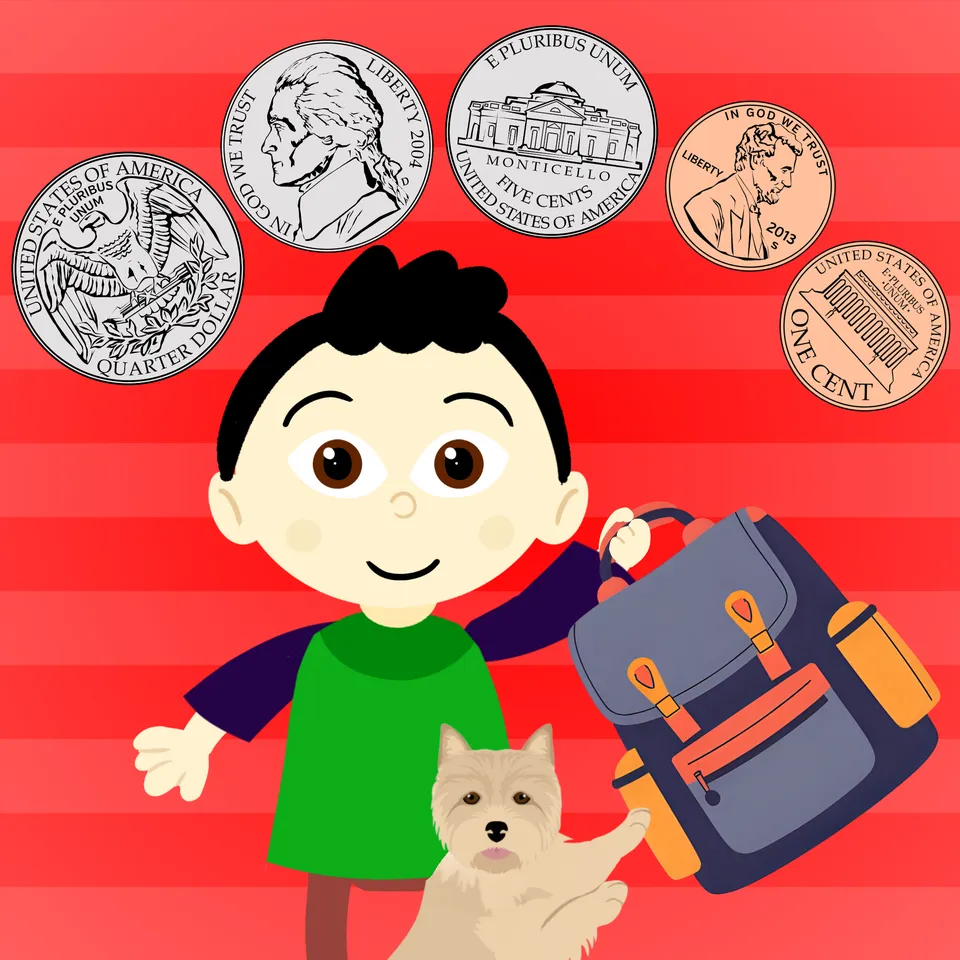
Help Edwin count the coins that he finds as he clears out his old backpack
In this lesson, students will practice intermediate money math skills including:
– Calculating values of mixed collections of coins up to 100 cents
Part of
Standards alignment
Common Core State Standards
- 2.MD.C.8 — Solve word problems involving dollar bills, quarters, dimes, nickels, and pennies, using $ and ¢ symbols appropriately.
- 1.OA.C.5 — Relate counting to addition and subtraction (e.g., by counting on 2 to add 2).
- 2.NBT.A.2 — Count within 1000; skip-count by 5s, 10s, and 100s.
- 2.NBT.B.5 — Fluently add and subtract within 100 using strategies based on place value, properties of operations, and/or the relationship between addition and subtraction.
Alabama
- MA19.2.24 — Solve problems with money.
- MA19.2.24b — Find the value of a collection of quarters, dimes, nickels, and pennies.
- MA19.2.24a — Identify nickels and quarters by name and value.
- MA19.2.7 — Count within 1000 by ones, fives, tens, and hundreds.
Alaska
- 1.MD.6 — Identify values of coins (e.g., nickel = 5 cents, quarter = 25 cents). Identify equivalent values of coins up to $1 (e.g., 5 pennies = 1 nickel, 5 nickels = 1 quarter).
- 2.MD.8 — Solve word problems involving dollar bills and coins using the $ and ¢ symbols appropriately.
- 2.NBT.2 — Count up to 1000, skip-count by 5s, 10s and 100s.
- 2.NBT.5 — Fluently add and subtract using numbers up to 100. Use: • strategies based on place value • properties of operations • and/or the relationship between addition and subtraction.
Arizona
- 2.MD.C.8 — Solve word problems involving collections of money, including dollar bills, quarters, dimes, nickels, and pennies. Record the total using $ and ¢ appropriately. See Table 1.
- 2.NBT.A.2 — Count within 1000; skip-count by 5s, 10s, and 100s.
- 2.NBT.B.5 — Fluently add and subtract within 100 using strategies based on place value, properties of operations, and/or the relationship between addition and subtraction.
- 1.MD.B.3b — Identify coins by name and value (pennies, nickels, dimes and quarters).
Arkansas
- 2.GM.12 — Count collections of mixed coins and solve real-world problems involving quarters, dimes, nickels, and pennies within 99¢ and whole dollar amounts.
- 1.GM.6 — Identify coins by name and value, including penny, nickel, dime, and quarter.
- 2.CAR.2 — Use computational fluency to add and subtract within 100 using strategies based on place value, properties of operations, or the relationship between addition and subtraction.
California
- 2.MD.C.8 — Solve word problems involving dollar bills, quarters, dimes, nickels, and pennies, using $ and ¢ symbols appropriately.
- 2.NBT.A.2 — Count within 1000; skip-count by 2s, 5s, 10s, and 100s.
- 1.OA.C.5 — Relate counting to addition and subtraction (e.g., by counting on 2 to add 2).
- 2.NBT.B.5 — Fluently add and subtract within 100 using strategies based on place value, properties of operations, and/or the relationship between addition and subtraction.
Colorado
- 2.MD.C.8 — Solve word problems involving dollar bills, quarters, dimes, nickels, and pennies, using $ and ¢ symbols appropriately. Example: If you have two dimes and three pennies, how many cents do you have?
- 1.NBT.C.4 — Add within 100, including adding a two-digit number and a one-digit number, and adding a two-digit number and a multiple of 10, using concrete models or drawings and strategies based on place value, properties of operations, and/or the relationship between addition and subtraction; relate the strategy to a written method and explain the reasoning used. Understand that in adding two-digit numbers, one adds tens and tens, ones and ones; and sometimes it is necessary to compose a ten.
- 2.NBT.A.2 — Count within 1000; skip-count by 5s, 10s, and 100s.
Connecticut
- 2.MD.C.8 — Solve word problems involving dollar bills, quarters, dimes, nickels, and pennies, using $ and ¢ symbols appropriately.
- 2.NBT.A.2 — Count within 1000; skip-count by 5s, 10s, and 100s.
- 2.NBT.B.5 — Fluently add and subtract within 100 using strategies based on place value, properties of operations, and/or the relationship between addition and subtraction.
- 1.OA.C.5 — Relate counting to addition and subtraction (e.g., by counting on 2 to add 2).
Delaware
- 2.MD.C.8 — Solve word problems involving dollar bills, quarters, dimes, nickels, and pennies, using $ and ¢ symbols appropriately.
- 2.NBT.A.2 — Count within 1000; skip-count by 5s, 10s, and 100s.
- 2.NBT.B.5 — Fluently add and subtract within 100 using strategies based on place value, properties of operations, and/or the relationship between addition and subtraction.
Florida
- MA.1.M.2.3 — Find the value of combinations of pennies, nickels and dimes up to one dollar, and the value of combinations of one, five and ten dollar bills up to 100. Use the ¢ and symbols appropriately.
- MA.2.M.2.2 — Solve one- and two-step addition and subtraction real-world problems involving either dollar bills within 100 or coins within 100¢ using and ¢ symbols appropriately.
- MA.1.M.2.2 — Identify pennies, nickels, dimes and quarters, and express their values using the ¢ symbol. State how many of each coin equal a dollar.
- MA.1.NSO.1.1 — Starting at a given number, count forward and backwards within 120 by ones. Skip count by 2s to 20 and by 5s to 100.
Georgia
- 2.MDR.6.2 — Find the value of a group of coins and determine combinations of coins that equal a given amount that is less than one hundred cents, and solve problems involving dollar bills, quarters, dimes, nickels, and pennies, using $ and ¢ symbols appropriately.
- 2.MDR.6 — Solve real-life problems involving time and money.
- 2.NR.1.2 — Count forward and backward by ones from any number within 1000. Count forward by fives from multiples of 5 within 1000. Count forward and backward by 10s and 100s from any number within 1000. Count forward by 25s from 0.
Hawaii
- 2.MD.C.8 — Solve word problems involving dollar bills, quarters, dimes, nickels, and pennies, using $ and ¢ symbols appropriately.
- 1.OA.C.5 — Relate counting to addition and subtraction (e.g., by counting on 2 to add 2).
- 2.NBT.A.2 — Count within 1000; skip-count by 5s, 10s, and 100s.
- 2.NBT.B.5 — Fluently add and subtract within 100 using strategies based on place value, properties of operations, and/or the relationship between addition and subtraction.
Idaho
- 2.MD.C.8 — Solve word problems involving dollar bills, quarters, dimes, nickels, and pennies (up to 10), using and ¢ symbols appropriately and whole-dollar amounts.
- 1.MD.D.5 — Identify quarters, dimes, and nickels and relate their values to pennies. Find equivalent values (e.g., a nickel is equivalent to five pennies).
- 2.NBT.A.2 — Count within 1,000; skip-count by fives, tens, and 100s. Identify patterns in skip counting starting at any number
- 2.NBT.B.5 — Fluently add and subtract whole numbers within 100 using understanding of place value and properties of operations.
Illinois
- 2.MD.C.8 — Solve word problems involving dollar bills, quarters, dimes, nickels, and pennies, using $ and ¢ symbols appropriately.
- 2.NBT.A.2 — Count within 1000; skip-count by 5s, 10s, and 100s.
- 2.NBT.B.5 — Fluently add and subtract within 100 using strategies based on place value, properties of operations, and/or the relationship between addition and subtraction.
Indiana
- 2.M.6 — Find the value of a collection of pennies, nickels, dimes, quarters, and dollars. (E)
- 1.CA.3 — Using number sense and place value strategies, add within 100, including adding a two-digit number and a one-digit number, and adding a two-digit number and a multiple of 10. Use models or drawings and strategies based on place value, properties of operations, and/or the relationship between addition and subtraction; describe the strategy and explain the reasoning used. (E)
- 1.M.3 — Identify the value of a penny, nickel, dime, and a collection of pennies, nickels, and dimes.
- 2.CA.1 — Solve real-world problems involving addition and subtraction within 100 in situations of adding to, taking from, putting together, taking apart, and comparing, with unknowns in all parts of the addition or subtraction problem (e.g., by using drawings and equations with a symbol for the unknown number to represent the problem). Use estimation to decide whether answers are reasonable in addition problems. (E)
- 2.NS.1 — Count by ones, twos, fives, tens, and hundreds up to at least 1,000 from any given number. (E)
Iowa
- 2.MD.C.8 — Solve word problems involving dollar bills, quarters, dimes, nickels, and pennies, using $ and ¢ symbols appropriately. For example, if you have 3 quarters, 2 dimes and 4 pennies, how many cents do you have? For this standard, it may be appropriate to record amounts using decimals but does not include adding and subtracting with decimals.
- 2.MD.IA.C.2 — Identify nickels, quarters and dollars and know their values. Conceptual
- 2.NBT.A.2 — Count forward and backward within 1,000; skip-count forward and backward by 5s, 10s, and 100s.
- 2.NBT.B.5 — Fluently add and subtract within 100 using strategies based on place value, properties of operations, and/or the relationship between addition and subtraction. Note: Fluency of this standard is critical by the end of grade level.
Kansas
- 2.MD.8 — Solve word problems involving dollar bills, quarters, dimes, nickels, and pennies, using $ and ¢ symbols appropriately (Do not use decimal point, if showing 25 cents, use the word cents or ¢). For example: If you have 2 dimes and 3 pennies, how many cents do you have?
- 2.MD.9 — Identify coins and bills and their values.
- 2.NBT.2 — Count within 1000; skip-count by 2s, 5s, 10s, and 100s; explain and generalize the patterns.
- 2.NBT.5 — Fluently (efficiently, accurately, and flexibly) add and subtract within 100 using strategies based on place value, properties of operations, and/or the relationship between addition and subtraction (e.g. composing/decomposing by like base-10 units, using friendly or benchmark numbers, using related equations, compensation, number line, etc.).
Kentucky
- KY.1.MD.3.b — Identify the coins by values (penny, nickel, dime, quarter).
- KY.2.MD.8 — Solve word problems with adding and subtracting within 100, (not using dollars and cents simultaneously) using the $ and ¢ symbols appropriately (not including decimal notation).
- KY.1.MD.3 — Assign values to time and money.
- KY.2.NBT.2 — Count forwards and backwards within 1000; skip-count by 5s, 10s and 100s.
Louisiana
- 2.MD.C.8 — Solve word problems involving dollar bills, quarters, dimes, nickels, and pennies, using $ and ¢ symbols appropriately.
Maine
- 2.MD.C.8 — Solve word problems involving dollar bills, quarters, dimes, nickels, and pennies, using $ and ¢ symbols appropriately. Example: If you have 2 dimes and 3 pennies, how many cents do you have?
- 1.MD.D.5 — Identify the coins and each corresponding value. (e.g. penny, nickel, dime, and quarter)
- 2.NBT.A.2 — Count within 1000; skip-count by 5s, 10s, and 100s. Identify patterns in skip counting at any number. (For example, 37, 47, 57 or 328, 428, 528, etc.)
- 2.NBT.B.5 — Fluently add and subtract within 100 using strategies based on place value, properties of operations, and/or the relationship between addition and subtraction.
Maryland
- 2.MD.C.8 — Solve word problems involving dollar bills, quarters, dimes, nickels, and pennies, using $ and ¢ symbols appropriately.
- 2.NBT.A.2 — Count within 1000; skip-count by 5s, 10s, and 100s.
- 2.NBT.B.5 — Fluently add and subtract within 100 using strategies based on place value, properties of operations, and/or the relationship between addition and subtraction.
Massachusetts
- 1.MD.D.5 — Identify the values of all U.S. coins and know their comparative values (e.g., a dime is of greater value than a nickel). Find equivalent values (e.g., a nickel is equivalent to five pennies). Use appropriate notation (e.g., 69¢). Use the values of coins in the solutions of problems (up to 100¢).
- 2.MD.C.8 — Solve word problems involving dollar bills, quarters, dimes, nickels, and pennies (up to 10), using and ¢ symbols appropriately and whole dollar amounts. For example, if you have 2 dimes and 3 pennies, how many cents do you have? If you have $3 and 4 quarters, how many dollars or cents do you have? (Students are not expected to use decimal notation.)
- 2.NBT.A.2 — Count within 1,000; skip-count by 5s, 10s, and 100s. Identify patterns in skip counting starting at any number.
Michigan
- 2.MD.C.8 — Solve word problems involving dollar bills, quarters, dimes, nickels, and pennies, using $ and ¢ symbols appropriately.
- 2.NBT.A.2 — Count within 1000; skip-count by 5s, 10s, and 100s.
- 2.NBT.B.5 — Fluently add and subtract within 100 using strategies based on place value, properties of operations, and/or the relationship between addition and subtraction.
- 2.OA.A.1 — Use addition and subtraction within 100 to solve one- and two-step word problems involving situations of adding to, taking from, putting together, taking apart, and comparing, with unknowns in all positions, e.g., by using drawings and equations with a symbol for the unknown number to represent the problem.
Minnesota
- 2.3.3.2 — Identify pennies, nickels, dimes and quarters. Find the value of a group of coins and determine combinations of coins that equal a given amount. For example: 50 cents can be made up of 2 quarters, or 4 dimes and 2 nickels, or many other combinations.
- 1.1.2.3 — Recognize the relationship between counting and addition and subtraction. Skip count by 2s, 5s, and 10s.
- 1.3.2.3 — Identify pennies, nickels and dimes; find the value of a group of these coins, up to one dollar.
- 2.1.2.5 — Solve real-world and mathematical addition and subtraction problems involving whole numbers with up to 2 digits.
Mississippi
- 2.MD.8.a — Solve word problems involving dollar bills, quarters, dimes, nickels, and pennies, using $ and ¢ symbols appropriately. Example: If you have 2 dimes and 3 pennies, how many cents do you have?
- 1.MD.5.a — Identify the value of all U.S. coins (penny, nickel, dime, quarter, half-dollar, and dollar coins). Use appropriate cent and dollar notation (e.g., 25¢, $1).
- 1.MD.5.c — Count like U.S. coins up to the equivalent of a dollar.
- 2.NBT.2 — Count within 1000; skip-count by 5s starting at any number ending in 5 or 0. Skip-count by 10s and 100s starting at any number.
Missouri
- 2.GM.D.12 — Find the value of combinations of dollar bills, quarters, dimes, nickels and pennies, using $ and ¢ appropriately.
- 1.GM.C.9 — Know the value of a penny, nickel, dime and quarter.
- 1.NS.A.4 — Count by 5s to 100 starting at any multiple of five.
- 1.NBT.A.4 — Count by 10s to 120 starting at any number.
Montana
- 2.MD.C.8 — Solve word problems involving dollar bills, quarters, dimes, nickels, and pennies, using $ and ¢ symbols appropriately.
- 2.NBT.A.2 — Count within 1000; skip-count by 5s, 10s, and 100s.
- 2.NBT.B.5 — Fluently add and subtract within 100 using strategies based on place value, properties of operations, and/or the relationship between addition and subtraction.
Nebraska
- 2.G.5 — Time and Money: Students will solve problems with dollar bills and coins and tell time to the nearest five-minute interval.
- 2.G.5.a — Solve problems involving dollar bills, quarters, dimes, nickels, and pennies using $ and ¢ symbols appropriately.
- 2.N.2.a — Count within 1,000, including skip counting by 5s, 10s, and 100s starting at a variety of multiples of 5, 10, or 100.
- 2.N.4.b — Add and subtract within 100 strategies based on place value including properties of operations, relationships between addition and subtraction, and algorithms.
Nevada
- 2.MD.C.8 — Solve word problems involving dollar bills, quarters, dimes, nickels, and pennies, using $ and ¢ symbols appropriately.
- 2.NBT.A.2 — Count within 1000; skip-count by 5s, 10s, and 100s.
- 2.NBT.B.5 — Fluently add and subtract within 100 using strategies based on place value, properties of operations, and/or the relationship between addition and subtraction.
- 1.OA.C.5 — Relate counting to addition and subtraction (e.g., by counting on 2 to add 2).
New Hampshire
- 2.MD.C.8 — Solve word problems involving dollar bills, quarters, dimes, nickels, and pennies, using $ and ¢ symbols appropriately.
- 2.NBT.A.2 — Count within 1000; skip-count by 5s, 10s, and 100s.
- 2.NBT.B.5 — Fluently add and subtract within 100 using strategies based on place value, properties of operations, and/or the relationship between addition and subtraction.
New Jersey
- 2.MD.C.8 — Solve word problems involving dollar bills, quarters, dimes, nickels, and pennies, using $ and ¢ symbols appropriately. Example: If you have 2 dimes and 3 pennies, how many cents do you have?
- 2.NBT.A.2 — Count within 1000; skip-count by 5s, 10s, and 100s.
- 2.NBT.B.5 — Fluently add and subtract within 100 using strategies based on place value, properties of operations, and/or the relationship between addition and subtraction.
- 1.OA.C.5 — Relate counting to addition and subtraction (e.g., by counting on 2 to add 2).
New Mexico
- 2.MD.C.8 — Solve word problems involving dollar bills, quarters, dimes, nickels, and pennies, using $ and ¢ symbols appropriately.
- 2.NBT.A.2 — Count within 1000; skip-count by 5s, 10s, and 100s.
- 2.OA.A.1 — Use addition and subtraction within 100 to solve one- and two-step word problems involving situations of adding to, taking from, putting together, taking apart, and comparing, with unknowns in all positions, e.g., by using drawings and equations with a symbol for the unknown number to represent the problem.
New York
- NY-2.MD.8.a — Count a mixed collection of coins whose sum is less than or equal to one dollar.
- NY-2.MD.8.b — Solve real world and mathematical problems within one dollar involving quarters, dimes, nickels, and pennies, using the ¢ (cent) symbol appropriately.
- NY-2.NBT.2 — Count within 1000; skip-count by 5s, 10s, and 100s.
- NY-1.MD.3.b — Recognize and identify coins (penny, nickel, dime, and quarter) and their value and use the cent symbol (¢) appropriately.
North Carolina
- NC.2.MD.8 — Solve word problems involving: • Quarters, dimes, nickels, and pennies within 99¢, using ¢ symbols appropriately. • Whole dollar amounts, using the $ symbol appropriately.
- NC.1.MD.5 — Identify quarters, dimes, and nickels and relate their values to pennies.
- NC.2.NBT.2 — Count within 1,000; skip-count by 5s, 10s, and 100s.
- NC.2.NBT.5 — Demonstrate fluency with addition and subtraction, within 100, by: • Flexibly using strategies based on place value, properties of operations, and/or the relationship between addition and subtraction. • Comparing addition and subtraction strategies, and explaining why they work. • Selecting an appropriate strategy in order to efficiently compute sums and differences.
North Dakota
- 2.GM.M.4 — Count collections of money (quarters, dimes, nickels, and pennies) relating to counting patterns by 1s, 5s, and 10s up to one dollar.
- 1.GM.M.4 — Identify and tell the value of a dollar bill, quarter, dime, nickel, and penny.
- 1.GM.M.5 — Count collections of coins (pennies, nickels, and dimes) relating to counting patterns by 1s, 5s, and 10s up to one dollar.
Ohio
- 2.MD.8.b — Find the value of a collection of quarters, dimes, nickels, and pennies.
- 2.MD.8 — Solve problems with money.
- 2.MD.8.a — Identify nickels and quarters by name and value.
- 2.NBT.2 — Count forward and backward within 1,000 by ones, tens, and hundreds starting at any number; skip-count by 5s starting at any multiple of 5.
- 2.NBT.5 — Fluently add and subtract within 100 using strategies based on place value, properties of operations, and/or the relationship between addition and subtraction.
Oklahoma
- 2.N.4 — Determine the value of a set of coins.
- 2.N.4.1 — Determine the value of a collection of coins up to one dollar using the cent symbol.
- 1.N.4.1 — Identify pennies, nickels, dimes, and quarters by name and value.
- 1.N.4.3 — Determine the value of a collection of pennies, nickels, or dimes up to one dollar, counting by 1s, 5s, and 10s.
Oregon
- 2.GM.D.11 — Solve problems in authentic contexts involving dollar bills, quarters, dimes, nickels, and pennies, using $ (dollars) and c (cents) symbols appropriately.
- 2.NBT.A.2 — Count within 1000; skip-count by 5's, 10's, and 100's.
- 2.NBT.B.5 — Fluently add & subtract within 100 using accurate, efficient, & flexible strategies based on place value, properties of operations, and/or the relationship between addition and subtraction.
Pennsylvania
- CC.2.4.2.A.3 — Solve problems and make change using coins and paper currency with appropriate symbols.
- CC.2.1.2.B.2 — Use place-value concepts to read, write, and skip count to 1000.
- CC.2.2.2.A.1 — Represent and solve problems involving addition and subtraction within 100.
Rhode Island
- 1.MD.D.5 — Identify the values of all U.S. coins and know their comparative values (e.g., a dime is of greater value than a nickel). Find equivalent values (e.g., a nickel is equivalent to 5 pennies). Use appropriate notation (e.g., 69¢). Use the values of coins in the solutions of problems (up to 100¢).
- 2.MD.C.8 — Solve word problems involving dollar bills, quarters, dimes, nickels, and pennies (up to 10), using and ¢ symbols appropriately and whole dollar amounts. For example, if you have 2 dimes and 3 pennies, how many cents do you have? If you have $3 and 4 quarters, how many dollars or cents do you have? (Students are not expected to use decimal notation.)
- 1.NBT.C.4 — Add within 100, including adding a two-digit number and a one-digit number, and adding a two-digit number and a multiple of 10, using concrete models or drawings and strategies based on place value, properties of operations, and/or the relationship between addition and subtraction; relate the strategy to a written method and explain the reasoning used. Understand that in adding two-digit numbers, one adds tens and tens, ones and ones; and sometimes it is necessary to compose a ten.
- 2.NBT.A.2 — Count within 1000; skip-count by 5s, 10s, and 100s. Identify patterns in skip counting starting at any number.
- 1.OA.C.5 — Relate counting to addition and subtraction (e.g., by counting on 2 to add 2).
South Carolina
- 2.MDA.7 — Solve real-world/story problems involving dollar bills using the $ symbol or involving quarters, dimes, nickels, and pennies using the ȼ symbol.
- 1.NSBT.1b — Extend the number sequence to count by fives and tens to 100, starting at any number.
- 2.NSBT.5 — Add and subtract fluently through 99 using knowledge of place value and properties of operations.
- 1.MDA.6 — Identify a penny, nickel, dime and quarter and write the coin values using a ȼ symbol.
South Dakota
- 2.MD.C.8 — Identify and count coins and bills and apply that understanding to solve word problems.
- 2.MD.C.8.a — Recognize and know the value of coins up to one dollar.
- 1.MD.B.5 — Identify nickels and understand that five pennies can be thought of as a nickel. Identify dimes and understand ten pennies can be thought of as a dime. Count the value of a set of coins comprised of pennies, nickels, and dimes.
- 2.NBT.A.2 — Count within 1000; skip-count by 5s, 10s, and 100s, starting from any number in its skip counting sequence.
- 2.NBT.B.5 — Fluently add and subtract within 100 using strategies based on place value, properties of operations, and/or the relationship between addition and subtraction.
Tennessee
- 2.MD.C.8 — Solve contextual problems involving amounts less than one dollar including quarters, dimes, nickels, and pennies using the ¢ symbol appropriately. Solve contextual problems involving whole number dollar amounts up to 100 using the symbol appropriately.
- 2.NBT.B.5 — Fluently add and subtract within 100 using properties of operations, strategies based on place value, and/or the relationship between addition and subtraction.
- 2.NBT.A.2 — Recognize, describe, extend, and create patterns when counting by ones, twos, fives, tens, and hundreds and use those patterns to predict the next number in the counting sequence up to 1000 through counting. For example: 111, 113, 115, ...; 82, 84, 86, ...; 370, 380, 390. ; 100, 200, 300,…; etc.
Texas
- 2.5A — determine the value of a collection of coins up to one dollar; and
- 1.4C — use relationships to count by twos, fives, and tens to determine the value of a collection of pennies, nickels, and/or dimes.
- 1.4A — identify U.S. coins, including pennies, nickels, dimes, and quarters, by value and describe the relationships among them;
Utah
- 2.MD.8 — Solve word problems involving dollar bills, quarters, dimes, nickels, and pennies, using $ and ¢ symbols appropriately. For example, if you have 2 dimes and 3 pennies, how many cents do you have?
- 1.MD.5 — Identify the values of pennies, nickels, dimes and quarters and know their comparative values. (For example, a dime is of greater value than a nickel.) Use appropriate notation to designate a coin’s value. (For example, 5¢.)
- 2.NBT.2 — Count within 1,000; skip-count by fives, tens, and hundreds.
- 2.NBT.5 — Fluently add and subtract within 100 using strategies based on place value, properties of operations, and/or the relationship between addition and subtraction.
Vermont
- 2.MD.C.8 — Solve word problems involving dollar bills, quarters, dimes, nickels, and pennies, using $ and ¢ symbols appropriately.
- 2.NBT.A.2 — Count within 1000; skip-count by 5s, 10s, and 100s.
- 2.NBT.B.5 — Fluently add and subtract within 100 using strategies based on place value, properties of operations, and/or the relationship between addition and subtraction.
- MP8 — Look for and express regularity in repeated reasoning.
Virginia
- 2.NS.4b — Count by ones, fives, tens, and twenty-fives to determine the value of a collection of mixed coins and one-dollar bills whose total value is $2.00 or less.
- 2.NS.4 — The student will solve problems that involve counting and representing money amounts up to $2.00. Students will demonstrate the following Knowledge and Skills:
Washington
- 2.MD.C.8 — Solve word problems involving dollar bills, quarters, dimes, nickels, and pennies, using $ and ¢ symbols appropriately.
- 2.NBT.A.2 — Count within 1000; skip-count by 5s, 10s, and 100s.
- 2.NBT.B.5 — Fluently add and subtract within 100 using strategies based on place value, properties of operations, and/or the relationship between addition and subtraction.
Washington, D.C.
- 2.MD.C.8 — Solve word problems involving dollar bills, quarters, dimes, nickels, and pennies, using $ and ¢ symbols appropriately.
- 2.NBT.A.2 — Count within 1000; skip-count by 5s, 10s, and 100s.
- 2.NBT.B.5 — Fluently add and subtract within 100 using strategies based on place value, properties of operations, and/or the relationship between addition and subtraction.
- 2.OA.A.1 — Use addition and subtraction within 100 to solve one- and two-step word problems involving situations of adding to, taking from, putting together, taking apart, and comparing, with unknowns in all positions, e.g., by using drawings and equations with a symbol for the unknown number to represent the problem.
West Virginia
- M.2.22 — Solve word problems involving dollar bills, quarters, dimes, nickels, and pennies, using $ and C symbols appropriately (e.g., If you have 2 dimes and 3 pennies, how many cents do I you have?).
- M.1.18 — Identify the value of coins and use dimes and pennies to model the relationship between money and place value (e.g., exchange 10 pennies for 1 dime or exchange 10 dimes for 1 dollar).
Wisconsin
- M.2.MD.C.8 — Solve word problems involving dollar bills, quarters, dimes, nickels, and pennies, using $ and ¢ symbols appropriately.
- M.2.NBT.A.2 — Count within 1,000; skip-count by fives, tens, and hundreds.
- M.2.NBT.B.5 — Flexibly and efficiently add and subtract within 100 using strategies based on place value, properties of operations, and/or the relationship between addition and subtraction. In Grade 2, subtraction with decomposition is an exception and may include drawings or representations.
Wyoming
- 2.MD.H.8 — Solve word problems up to 10 involving dollar bills, quarters, dimes, nickels, and pennies, using (dollars) and ¢ (cents) symbols appropriately.
- 1.MD.I.3.B — Identify U.S. coins by value (pennies, nickels, dimes, quarters).
- 1.OA.C.5 — Relate counting to addition and subtraction using strategies, such as, by counting on and back.
- 2.MD.H — Work with time and money.
- 1.NBT.G.4 — Add within 100, using concrete models or drawings and strategies based on place value: