Fruit Stand Finance
Ages 6–8 · 7 minutes · Math
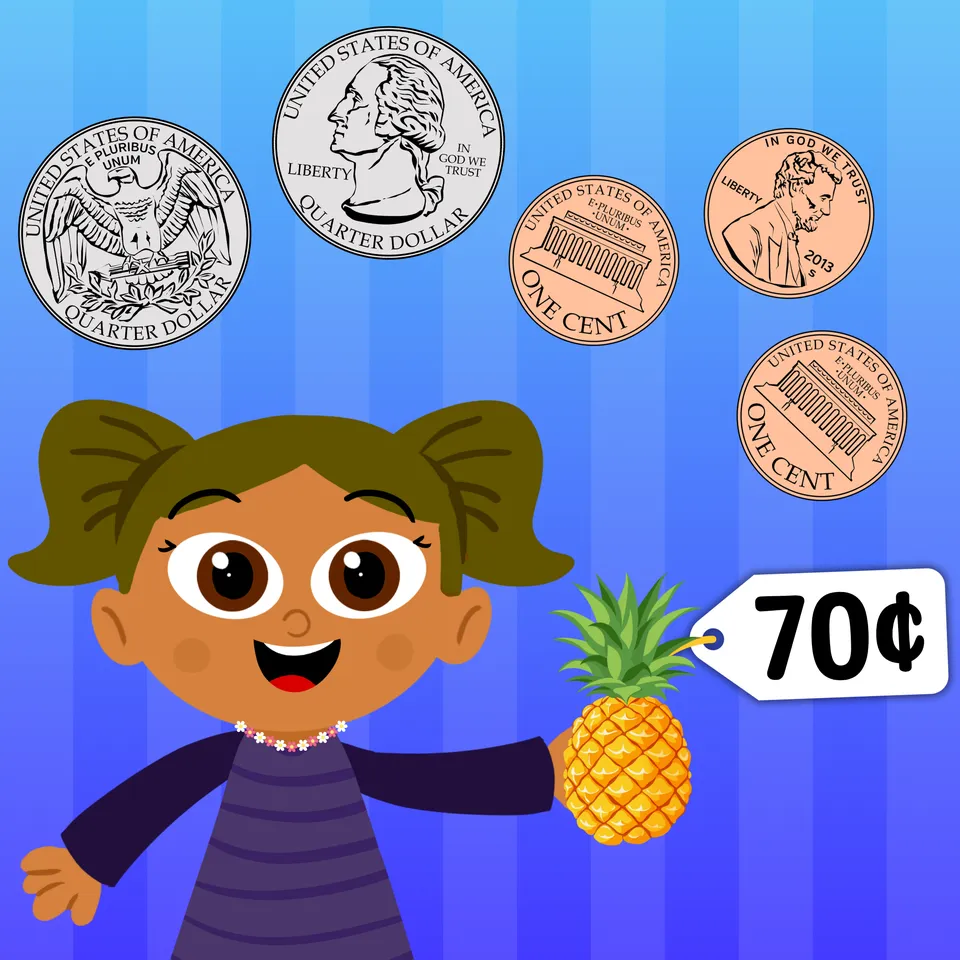
Help Gabriella and Tofu decide what they can buy at the farmers market!
In this lesson, students will practice introductory money math skills including:
– Calculating the value of small collections of two types of coins (continued)
– Determining if the value of coins is enough to purchase an item
Part of
Standards alignment
Common Core State Standards
- 2.MD.C.8 — Solve word problems involving dollar bills, quarters, dimes, nickels, and pennies, using $ and ¢ symbols appropriately.
- 2.OA.A.1 — Use addition and subtraction within 100 to solve one- and two-step word problems involving situations of adding to, taking from, putting together, taking apart, and comparing, with unknowns in all positions, e.g., by using drawings and equations with a symbol for the unknown number to represent the problem.
Alabama
- MA19.2.24 — Solve problems with money.
- MA19.2.24b — Find the value of a collection of quarters, dimes, nickels, and pennies.
- MA19.1.20 — Identify pennies and dimes by name and value.
- MA19.2.24a — Identify nickels and quarters by name and value.
- MA19.2.24c — Solve word problems by adding and subtracting within one dollar, using the $ and ¢ symbols appropriately (not including decimal notation).
Alaska
- 1.MD.6 — Identify values of coins (e.g., nickel = 5 cents, quarter = 25 cents). Identify equivalent values of coins up to $1 (e.g., 5 pennies = 1 nickel, 5 nickels = 1 quarter).
- 2.MD.8 — Solve word problems involving dollar bills and coins using the $ and ¢ symbols appropriately.
- 1.OA.5 — Relate counting to addition and subtraction (e.g., by counting on 2 to add 2).
Arizona
- 2.MD.C.8 — Solve word problems involving collections of money, including dollar bills, quarters, dimes, nickels, and pennies. Record the total using $ and ¢ appropriately. See Table 1.
- 1.MD.B.3b — Identify coins by name and value (pennies, nickels, dimes and quarters).
- 1.OA.C.5 — Relate counting to addition and subtraction (e.g., by counting on 2 to add 2).
Arkansas
- 2.GM.12 — Count collections of mixed coins and solve real-world problems involving quarters, dimes, nickels, and pennies within 99¢ and whole dollar amounts.
- 1.GM.6 — Identify coins by name and value, including penny, nickel, dime, and quarter.
California
- 2.MD.C.8 — Solve word problems involving dollar bills, quarters, dimes, nickels, and pennies, using $ and ¢ symbols appropriately.
- 2.OA.A.1 — Use addition and subtraction within 100 to solve one- and two-step word problems involving situations of adding to, taking from, putting together, taking apart, and comparing, with unknowns in all positions, e.g., by using drawings and equations with a symbol for the unknown number to represent the problem.
Colorado
- 2.MD.C.8 — Solve word problems involving dollar bills, quarters, dimes, nickels, and pennies, using $ and ¢ symbols appropriately. Example: If you have two dimes and three pennies, how many cents do you have?
- 2.OA.A.1 — Use addition and subtraction within 100 to solve one- and two-step word problems involving situations of adding to, taking from, putting together, taking apart, and comparing, with unknowns in all positions, e.g., by using drawings and equations with a symbol for the unknown number to represent the problem.
Connecticut
- 2.MD.C.8 — Solve word problems involving dollar bills, quarters, dimes, nickels, and pennies, using $ and ¢ symbols appropriately.
- 1.OA.C.5 — Relate counting to addition and subtraction (e.g., by counting on 2 to add 2).
- 2.NBT.B.5 — Fluently add and subtract within 100 using strategies based on place value, properties of operations, and/or the relationship between addition and subtraction.
Delaware
- 2.MD.C.8 — Solve word problems involving dollar bills, quarters, dimes, nickels, and pennies, using $ and ¢ symbols appropriately.
- 1.OA.C.5 — Relate counting to addition and subtraction (e.g., by counting on 2 to add 2).
- 2.OA.A.1 — Use addition and subtraction within 100 to solve one- and two-step word problems involving situations of adding to, taking from, putting together, taking apart, and comparing, with unknowns in all positions, e.g., by using drawings and equations with a symbol for the unknown number to represent the problem.
- MP4 — Model with mathematics.
Florida
- MA.2.M.2.2 — Solve one- and two-step addition and subtraction real-world problems involving either dollar bills within 100 or coins within 100¢ using and ¢ symbols appropriately.
- MA.1.M.2.2 — Identify pennies, nickels, dimes and quarters, and express their values using the ¢ symbol. State how many of each coin equal a dollar.
- MA.1.M.2.3 — Find the value of combinations of pennies, nickels and dimes up to one dollar, and the value of combinations of one, five and ten dollar bills up to 100. Use the ¢ and symbols appropriately.
Georgia
- 2.MDR.6 — Solve real-life problems involving time and money.
- 2.MDR.6.2 — Find the value of a group of coins and determine combinations of coins that equal a given amount that is less than one hundred cents, and solve problems involving dollar bills, quarters, dimes, nickels, and pennies, using $ and ¢ symbols appropriately.
- 2.NR.1.2 — Count forward and backward by ones from any number within 1000. Count forward by fives from multiples of 5 within 1000. Count forward and backward by 10s and 100s from any number within 1000. Count forward by 25s from 0.
Hawaii
- 2.MD.C.8 — Solve word problems involving dollar bills, quarters, dimes, nickels, and pennies, using $ and ¢ symbols appropriately.
- 2.NBT.B.5 — Fluently add and subtract within 100 using strategies based on place value, properties of operations, and/or the relationship between addition and subtraction.
Idaho
- 2.MD.C.8 — Solve word problems involving dollar bills, quarters, dimes, nickels, and pennies (up to 10), using and ¢ symbols appropriately and whole-dollar amounts.
- 2.NBT.A.2 — Count within 1,000; skip-count by fives, tens, and 100s. Identify patterns in skip counting starting at any number
- 1.MD.D.5 — Identify quarters, dimes, and nickels and relate their values to pennies. Find equivalent values (e.g., a nickel is equivalent to five pennies).
Illinois
- 2.MD.C.8 — Solve word problems involving dollar bills, quarters, dimes, nickels, and pennies, using $ and ¢ symbols appropriately.
- 2.NBT.B.5 — Fluently add and subtract within 100 using strategies based on place value, properties of operations, and/or the relationship between addition and subtraction.
Indiana
- 2.M.6 — Find the value of a collection of pennies, nickels, dimes, quarters, and dollars. (E)
- 2.NS.1 — Count by ones, twos, fives, tens, and hundreds up to at least 1,000 from any given number. (E)
- 3.M.4 — Find the value of any collection of coins and bills. Write amounts less than a dollar using the ¢ symbol and write larger amounts using the symbol in the form of dollars and cents (e.g., 4.59). Solve real-world problems to determine whether there is enough money to make a purchase. (E)
Iowa
- 2.MD.C.8 — Solve word problems involving dollar bills, quarters, dimes, nickels, and pennies, using $ and ¢ symbols appropriately. For example, if you have 3 quarters, 2 dimes and 4 pennies, how many cents do you have? For this standard, it may be appropriate to record amounts using decimals but does not include adding and subtracting with decimals.
- 2.MD.IA.C.2 — Identify nickels, quarters and dollars and know their values. Conceptual
Kansas
- 2.MD.8 — Solve word problems involving dollar bills, quarters, dimes, nickels, and pennies, using $ and ¢ symbols appropriately (Do not use decimal point, if showing 25 cents, use the word cents or ¢). For example: If you have 2 dimes and 3 pennies, how many cents do you have?
- 2.MD.9 — Identify coins and bills and their values.
- 2.NBT.5 — Fluently (efficiently, accurately, and flexibly) add and subtract within 100 using strategies based on place value, properties of operations, and/or the relationship between addition and subtraction (e.g. composing/decomposing by like base-10 units, using friendly or benchmark numbers, using related equations, compensation, number line, etc.).
Kentucky
- KY.2.MD.8 — Solve word problems with adding and subtracting within 100, (not using dollars and cents simultaneously) using the $ and ¢ symbols appropriately (not including decimal notation).
- KY.1.MD.3 — Assign values to time and money.
- KY.1.MD.3.b — Identify the coins by values (penny, nickel, dime, quarter).
- 2.E.MA.1 — Identify the cost of everyday, common goods.
Louisiana
- 2.MD.C.8 — Solve word problems involving dollar bills, quarters, dimes, nickels, and pennies, using $ and ¢ symbols appropriately.
- 2.OA.A.1 — Use addition and subtraction within 100 to solve one- and two-step word problems involving situations of adding to, taking from, putting together, taking apart, and comparing, with unknowns in all positions, e.g., by using drawings and equations with a symbol for the unknown number to represent the problem.
- K.MD.C.4 — Recognize pennies, nickels, dimes, and quarters by name and value (e.g., This is a nickel and it is worth 5 cents.)
Maine
- 2.MD.C.8 — Solve word problems involving dollar bills, quarters, dimes, nickels, and pennies, using $ and ¢ symbols appropriately. Example: If you have 2 dimes and 3 pennies, how many cents do you have?
- 1.MD.D.5 — Identify the coins and each corresponding value. (e.g. penny, nickel, dime, and quarter)
- 2.OA.A.1 — Use addition and subtraction within 100 to solve one- and two-step word problems involving situations of adding to, taking from, putting together, taking apart, and comparing, with unknowns in all positions, e.g., by using drawings and equations with a symbol for the unknown number to represent the problem.
Maryland
- 2.MD.C.8 — Solve word problems involving dollar bills, quarters, dimes, nickels, and pennies, using $ and ¢ symbols appropriately.
- 1.OA.C.5 — Relate counting to addition and subtraction (e.g., by counting on 2 to add 2).
- MP4 — Model with mathematics.
Massachusetts
- 1.MD.D.5 — Identify the values of all U.S. coins and know their comparative values (e.g., a dime is of greater value than a nickel). Find equivalent values (e.g., a nickel is equivalent to five pennies). Use appropriate notation (e.g., 69¢). Use the values of coins in the solutions of problems (up to 100¢).
- 2.MD.C.8 — Solve word problems involving dollar bills, quarters, dimes, nickels, and pennies (up to 10), using and ¢ symbols appropriately and whole dollar amounts. For example, if you have 2 dimes and 3 pennies, how many cents do you have? If you have $3 and 4 quarters, how many dollars or cents do you have? (Students are not expected to use decimal notation.)
Michigan
- 2.MD.C.8 — Solve word problems involving dollar bills, quarters, dimes, nickels, and pennies, using $ and ¢ symbols appropriately.
- 1.OA.C.5 — Relate counting to addition and subtraction (e.g., by counting on 2 to add 2).
- 2.OA.A.1 — Use addition and subtraction within 100 to solve one- and two-step word problems involving situations of adding to, taking from, putting together, taking apart, and comparing, with unknowns in all positions, e.g., by using drawings and equations with a symbol for the unknown number to represent the problem.
Minnesota
- 2.3.3.2 — Identify pennies, nickels, dimes and quarters. Find the value of a group of coins and determine combinations of coins that equal a given amount. For example: 50 cents can be made up of 2 quarters, or 4 dimes and 2 nickels, or many other combinations.
- 2.1.2.5 — Solve real-world and mathematical addition and subtraction problems involving whole numbers with up to 2 digits.
- 1.1.2.3 — Recognize the relationship between counting and addition and subtraction. Skip count by 2s, 5s, and 10s.
Mississippi
- 2.MD.8.a — Solve word problems involving dollar bills, quarters, dimes, nickels, and pennies, using $ and ¢ symbols appropriately. Example: If you have 2 dimes and 3 pennies, how many cents do you have?
- 1.MD.5.a — Identify the value of all U.S. coins (penny, nickel, dime, quarter, half-dollar, and dollar coins). Use appropriate cent and dollar notation (e.g., 25¢, $1).
- 1.MD.5.c — Count like U.S. coins up to the equivalent of a dollar.
- 2.OA.1 — Use addition and subtraction within 100 to solve one- and two-step word problems involving situations of adding to, taking from, putting together, taking apart, and comparing, with unknowns in all positions, e.g., by using drawings and equations with a symbol for the unknown number to represent the problem.
Missouri
- 2.GM.D.12 — Find the value of combinations of dollar bills, quarters, dimes, nickels and pennies, using $ and ¢ appropriately.
- 1.GM.C.9 — Know the value of a penny, nickel, dime and quarter.
- 1.NS.A.4 — Count by 5s to 100 starting at any multiple of five.
- 1.NBT.A.4 — Count by 10s to 120 starting at any number.
Montana
- 2.MD.C.8 — Solve word problems involving dollar bills, quarters, dimes, nickels, and pennies, using $ and ¢ symbols appropriately.
- 2.OA.A.1 — Use addition and subtraction within 100 to solve one- and two-step word problems involving situations within a cultural context, including those of Montana American Indians, of adding to, taking from, putting together, taking apart, and comparing, with unknowns in all positions, e.g., by using drawings and equations with a symbol for the unknown number to represent the problem.
Nebraska
- 2.G.5 — Time and Money: Students will solve problems with dollar bills and coins and tell time to the nearest five-minute interval.
- 2.G.5.a — Solve problems involving dollar bills, quarters, dimes, nickels, and pennies using $ and ¢ symbols appropriately.
- 2.N.2.a — Count within 1,000, including skip counting by 5s, 10s, and 100s starting at a variety of multiples of 5, 10, or 100.
- 2.N.5.a — Solve authentic problems involving addition and subtraction within 100 in situations of addition and subtraction, including adding to, subtracting from, joining and separating, and comparing situations with unknowns in all positions using objects, models, drawings, verbal explanations, expressions, and equations.
- SS 2.2.2 — Demonstrate knowledge of currency, its denominations, and use.
Nevada
- 2.MD.C.8 — Solve word problems involving dollar bills, quarters, dimes, nickels, and pennies, using $ and ¢ symbols appropriately.
- 1.OA.C.5 — Relate counting to addition and subtraction (e.g., by counting on 2 to add 2).
- 2.OA.A.1 — Use addition and subtraction within 100 to solve one- and two-step word problems involving situations of adding to, taking from, putting together, taking apart, and comparing, with unknowns in all positions, e.g., by using drawings and equations with a symbol for the unknown number to represent the problem.
New Hampshire
- 2.MD.C.8 — Solve word problems involving dollar bills, quarters, dimes, nickels, and pennies, using $ and ¢ symbols appropriately.
- 1.OA.C.5 — Relate counting to addition and subtraction (e.g., by counting on 2 to add 2).
- 2.OA.A.1 — Use addition and subtraction within 100 to solve one- and two-step word problems involving situations of adding to, taking from, putting together, taking apart, and comparing, with unknowns in all positions, e.g., by using drawings and equations with a symbol for the unknown number to represent the problem.
New Jersey
- 2.MD.C.8 — Solve word problems involving dollar bills, quarters, dimes, nickels, and pennies, using $ and ¢ symbols appropriately. Example: If you have 2 dimes and 3 pennies, how many cents do you have?
- 2.NBT.B.5 — Fluently add and subtract within 100 using strategies based on place value, properties of operations, and/or the relationship between addition and subtraction.
New Mexico
- 2.MD.C.8 — Solve word problems involving dollar bills, quarters, dimes, nickels, and pennies, using $ and ¢ symbols appropriately.
- 2.OA.A.1 — Use addition and subtraction within 100 to solve one- and two-step word problems involving situations of adding to, taking from, putting together, taking apart, and comparing, with unknowns in all positions, e.g., by using drawings and equations with a symbol for the unknown number to represent the problem.
New York
- NY-2.MD.8.a — Count a mixed collection of coins whose sum is less than or equal to one dollar.
- NY-2.MD.8.b — Solve real world and mathematical problems within one dollar involving quarters, dimes, nickels, and pennies, using the ¢ (cent) symbol appropriately.
- NY-1.MD.3.b — Recognize and identify coins (penny, nickel, dime, and quarter) and their value and use the cent symbol (¢) appropriately.
North Carolina
- NC.2.MD.8 — Solve word problems involving: • Quarters, dimes, nickels, and pennies within 99¢, using ¢ symbols appropriately. • Whole dollar amounts, using the $ symbol appropriately.
- NC.1.MD.5 — Identify quarters, dimes, and nickels and relate their values to pennies.
North Dakota
- 2.GM.M.4 — Count collections of money (quarters, dimes, nickels, and pennies) relating to counting patterns by 1s, 5s, and 10s up to one dollar.
- 1.NO.CC.5 — Skip count forward and backward by 5s and 10s from multiples and recognize the patterns of up to 10 skip counts.
- 1.GM.M.5 — Count collections of coins (pennies, nickels, and dimes) relating to counting patterns by 1s, 5s, and 10s up to one dollar.
Ohio
- 2.MD.8 — Solve problems with money.
- 2.MD.8.b — Find the value of a collection of quarters, dimes, nickels, and pennies.
- 2.MD.8.a — Identify nickels and quarters by name and value.
- 2.MD.8.c — Solve word problems by adding and subtracting within 100, dollars with dollars and cents with cents (not using dollars and cents simultaneously) using the $ and ₵ symbols appropriately (not including decimal notation).
Oklahoma
- 2.N.4 — Determine the value of a set of coins.
- 2.N.4.1 — Determine the value of a collection of coins up to one dollar using the cent symbol.
- 1.N.4.1 — Identify pennies, nickels, dimes, and quarters by name and value.
- 1.N.4.3 — Determine the value of a collection of pennies, nickels, or dimes up to one dollar, counting by 1s, 5s, and 10s.
- 3.N.4.1 — Use addition and subtraction to determine the value of a collection of coins up to one dollar using the cent symbol and in monetary transactions.
Oregon
- 2.GM.D.11 — Solve problems in authentic contexts involving dollar bills, quarters, dimes, nickels, and pennies, using $ (dollars) and c (cents) symbols appropriately.
- MP4 — Model with mathematics.
Pennsylvania
- CC.2.4.2.A.3 — Solve problems and make change using coins and paper currency with appropriate symbols.
- CC.2.1.2.B.2 — Use place-value concepts to read, write, and skip count to 1000.
- CC.2.2.2.A.1 — Represent and solve problems involving addition and subtraction within 100.
- CC.2.1.1.B.2 — Use place-value concepts to represent amounts of tens and ones and to compare two digit numbers.
Rhode Island
- 1.MD.D.5 — Identify the values of all U.S. coins and know their comparative values (e.g., a dime is of greater value than a nickel). Find equivalent values (e.g., a nickel is equivalent to 5 pennies). Use appropriate notation (e.g., 69¢). Use the values of coins in the solutions of problems (up to 100¢).
- 2.MD.C.8 — Solve word problems involving dollar bills, quarters, dimes, nickels, and pennies (up to 10), using and ¢ symbols appropriately and whole dollar amounts. For example, if you have 2 dimes and 3 pennies, how many cents do you have? If you have $3 and 4 quarters, how many dollars or cents do you have? (Students are not expected to use decimal notation.)
- 1.OA.C.5 — Relate counting to addition and subtraction (e.g., by counting on 2 to add 2).
South Carolina
- 2.MDA.7 — Solve real-world/story problems involving dollar bills using the $ symbol or involving quarters, dimes, nickels, and pennies using the ȼ symbol.
- 2.PS.2a — Make sense of quantities and their relationships in mathematical and real-world situations.
South Dakota
- 2.MD.C.8 — Identify and count coins and bills and apply that understanding to solve word problems.
- 2.MD.C.8.a — Recognize and know the value of coins up to one dollar.
- 2.MD.C.8.b — Solve word problems involving dollar bills, quarters, dimes, nickels, and pennies, using $ and ¢ symbols appropriately.
Tennessee
- 2.MD.C.8 — Solve contextual problems involving amounts less than one dollar including quarters, dimes, nickels, and pennies using the ¢ symbol appropriately. Solve contextual problems involving whole number dollar amounts up to 100 using the symbol appropriately.
- K.MD.B.3 — Identify the penny, nickel, dime, and quarter based on their attributes (size and color) and recognize the value of each.
- 1.NBT.C.5 — Add a two-digit number to a one-digit number and a two-digit number to a multiple of ten (within 100). Use concrete models, drawings, strategies based on place value, properties of operations, and/or the relationship between addition and subtraction to explain the reasoning used.
Texas
- 2.5A — determine the value of a collection of coins up to one dollar; and
- 1.4A — identify U.S. coins, including pennies, nickels, dimes, and quarters, by value and describe the relationships among them;
- 1.4C — use relationships to count by twos, fives, and tens to determine the value of a collection of pennies, nickels, and/or dimes.
Utah
- 2.MD.8 — Solve word problems involving dollar bills, quarters, dimes, nickels, and pennies, using $ and ¢ symbols appropriately. For example, if you have 2 dimes and 3 pennies, how many cents do you have?
- 1.MD.5 — Identify the values of pennies, nickels, dimes and quarters and know their comparative values. (For example, a dime is of greater value than a nickel.) Use appropriate notation to designate a coin’s value. (For example, 5¢.)
- 2.NBT.2 — Count within 1,000; skip-count by fives, tens, and hundreds.
- 2.OA.1 — Use addition and subtraction within 100 to solve one- and two-step word problems involving situations of adding to, taking from, putting together, taking apart, and comparing with unknowns in all positions, for example, by using drawings and equations with a symbol for the unknown number to represent the problem.
Vermont
- 2.MD.C.8 — Solve word problems involving dollar bills, quarters, dimes, nickels, and pennies, using $ and ¢ symbols appropriately.
- 2.OA.A.1 — Use addition and subtraction within 100 to solve one- and two-step word problems involving situations of adding to, taking from, putting together, taking apart, and comparing, with unknowns in all positions, e.g., by using drawings and equations with a symbol for the unknown number to represent the problem.
- D2.Eco.5.K-2 — Individually and with others, students… Identify prices of products in a local market.
Virginia
- 2.NS.4b — Count by ones, fives, tens, and twenty-fives to determine the value of a collection of mixed coins and one-dollar bills whose total value is $2.00 or less.
- 2.NS.4 — The student will solve problems that involve counting and representing money amounts up to $2.00. Students will demonstrate the following Knowledge and Skills:
- 2.NS.1c — Describe and use patterns in skip counting by multiples of 2 (to at least 50), and multiples of 5, 10, and 25 (to at least 200) to justify the next number in the counting sequence.
Washington
- 2.MD.C.8 — Solve word problems involving dollar bills, quarters, dimes, nickels, and pennies, using $ and ¢ symbols appropriately.
- 1.OA.C.5 — Relate counting to addition and subtraction (e.g., by counting on 2 to add 2).
- 2.OA.A.1 — Use addition and subtraction within 100 to solve one- and two-step word problems involving situations of adding to, taking from, putting together, taking apart, and comparing, with unknowns in all positions, e.g., by using drawings and equations with a symbol for the unknown number to represent the problem.
Washington, D.C.
- 2.MD.C.8 — Solve word problems involving dollar bills, quarters, dimes, nickels, and pennies, using $ and ¢ symbols appropriately.
- 1.OA.C.5 — Relate counting to addition and subtraction (e.g., by counting on 2 to add 2).
- MP1 — Make sense of problems and persevere in solving them.
West Virginia
- M.2.22 — Solve word problems involving dollar bills, quarters, dimes, nickels, and pennies, using $ and C symbols appropriately (e.g., If you have 2 dimes and 3 pennies, how many cents do I you have?).
- M.1.9 — Count to 120, starting at any number less than 120. In this range, read and write numerals and represent a number of objects with a written numeral. Skip count to 120 by 2's. Skip count to 120 by S's and lO's.
- M.K.18 — Identify coins: penny, nickel, dime, quarter.
- MHM1 — Make sense of problems and persevere in solving them.
Wisconsin
- M.2.MD.C.8 — Solve word problems involving dollar bills, quarters, dimes, nickels, and pennies, using $ and ¢ symbols appropriately.
- M.2.OA.A.1 — Use addition and subtraction within 100 to solve one- and two-step word problems involving situations of adding to, taking from, putting together, taking apart, and comparing, with unknowns in all positions, e.g., by using drawings and equations with a symbol for the unknown number to represent the problem.
- SS.Econ3.a.1 — Identify the cost of everyday goods (e.g., milk, bread, fruit, vegetables, cheese).
Wyoming
- 2.MD.H.8 — Solve word problems up to 10 involving dollar bills, quarters, dimes, nickels, and pennies, using (dollars) and ¢ (cents) symbols appropriately.
- 1.MD.I.3.B — Identify U.S. coins by value (pennies, nickels, dimes, quarters).
- SS2.3.2 — Identify how price may affect buying, selling, and saving decisions. 2.MD.8 CV5.1.1