Naming Written Fractions
Ages 7–9 · 3 minutes · Math
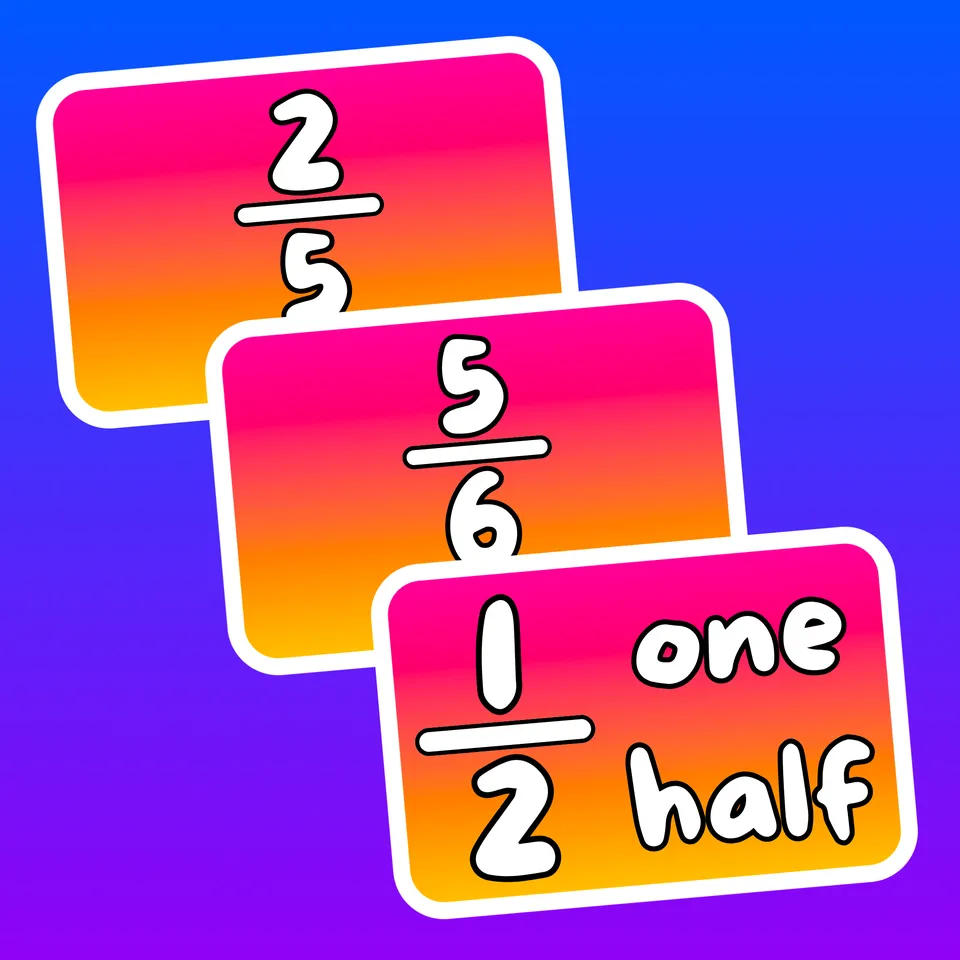
Use flashcards to practice naming fractions!
Use flashcards to practice naming fractions from their written form! Help Buttercup the Beagle reach the finish line! Practice makes perfect, so keep trying until you can get all the questions correct before the countdown runs out.
Part of
Standards alignment
Common Core State Standards
- 3.NF.A.1 — Understand a fraction 1/b as the quantity formed by 1 part when a whole is partitioned into b equal parts; understand a fraction a/b as the quantity formed by a parts of size 1/b.
- 3.NF.A.3.b — Recognize and generate simple equivalent fractions, e.g., 1/2 = 2/4, 4/6 = 2/3). Explain why the fractions are equivalent, e.g., by using a visual fraction model.
Alabama
- MA19.3.13 — Demonstrate that a unit fraction represents one part of an area model or length model of a whole that has been equally partitioned; explain that a numerator greater than one indicates the number of unit pieces represented by the fraction.
Alaska
- 3.NF.1 — Understand a fraction 1/b (e.g., 1/4) as the quantity formed by 1 part when a whole is partitioned into b (e.g., 4) equal parts; understand a fraction a/b (e.g., 2/4) as the quantity formed by a (e.g., 2) parts of size 1/b. (e.g., 1/4)
- 3.NF.3.b — Recognize and generate simple equivalent fractions (e.g., 1/2 = 2/4, 4/6 = 2/3). Explain why the fractions are equivalent (e.g., by using a visual fraction model).
Arizona
- 3.NF.A.1 — Understand a fraction 1/b as the quantity formed by 1 part when a whole is partitioned into b equal parts; understand a fraction a/b as the quantity formed by a parts of size 1/b.
- 3.NF.A.3.b — Recognize and generate simple equivalent fractions. Explain why the fractions are equivalent.
Arkansas
- 3.NPV.6 — Identify fractions as parts of a whole and parts of a collection or set. • Fractions include: denominators 2, 3, 4, 6, and 8
California
- 3.NF.A.1 — Understand a fraction 1/b as the quantity formed by 1 part when a whole is partitioned into b equal parts; understand a fraction a/b as the quantity formed by a parts of size 1/b.
- 3.NF.A.3.b — Recognize and generate simple equivalent fractions, e.g., 1/2 = 2/4, 4/6 = 1/2). Explain why the fractions are equivalent, e.g., by using a visual fraction model.
Colorado
- 3.NF.A.1 — Describe a fraction 1/b as the quantity formed by 1 part when a whole is partitioned into b equal parts; understand a fraction a/b as the quantity formed by a parts of size 1/b.
- 3.NF.A.3.b — Recognize and generate simple equivalent fractions, e.g., 1/2 = 2/4, 4/6 = 2/3). Explain why the fractions are equivalent, e.g., by using a visual fraction model.
Connecticut
- 3.NF.A.1 — Understand a fraction 1/b as the quantity formed by 1 part when a whole is partitioned into b equal parts; understand a fraction a/b as the quantity formed by a parts of size 1/b.
- 3.NF.A.3.b — Recognize and generate simple equivalent fractions, e.g., 1/2 = 2/4, 4/6 = 2/3). Explain why the fractions are equivalent, e.g., by using a visual fraction model.
Delaware
- 3.NF.A.1 — Understand a fraction 1/b as the quantity formed by 1 part when a whole is partitioned into b equal parts; understand a fraction a/b as the quantity formed by a parts of size 1/b.
- 3.NF.A.3.b — Recognize and generate simple equivalent fractions, e.g., 1/2 = 2/4, 4/6 = 2/3). Explain why the fractions are equivalent, e.g., by using a visual fraction model.
Florida
- MA.3.FR.1.3 — Read and write fractions, including fractions greater than one, using standard form, numeral-word form and word form.
Georgia
- 3.NR.4 — Represent fractions with denominators of 2, 3, 4, 6 and 8 in multiple ways within a framework using visual models.
- 3.NR.4.3 — Represent fractions, including fractions greater than one, in multiple ways.
- 3.NR.4.4 — Recognize and generate simple equivalent fractions.
Hawaii
- 3.NF.A.1 — Understand a fraction 1/b as the quantity formed by 1 part when a whole is partitioned into b equal parts; understand a fraction a/b as the quantity formed by a parts of size 1/b.
- 3.NF.A.3b — Recognize and generate simple equivalent fractions, e.g., 1/2 = 2/4, 4/6 = 2/3). Explain why the fractions are equivalent, e.g., by using a visual fraction model.
Idaho
- 3.NF.A.1 — Understand a fraction 1/b as the quantity formed by one part when a whole (a single unit) is partitioned into 𝑏 equal parts; understand a/b as the quantity formed by a parts of size 1/b
- 3.NF.A.3.b — Recognize and generate simple equivalent fractions, and explain why the fractions are equivalent, such as by using a visual fraction model.
Illinois
- 3.NF.A.1 — Understand a fraction 1/b as the quantity formed by 1 part when a whole is partitioned into b equal parts; understand a fraction a/b as the quantity formed by a parts of size 1/b.
- 3.NF.A.3.b — Recognize and generate simple equivalent fractions, e.g., 1/2 = 2/4, 4/6 = 2/3). Explain why the fractions are equivalent, e.g., by using a visual fraction model.
Indiana
- 3.NS.2 — Model unit fractions as the quantity formed by 1 part when a whole is partitioned into equal parts; model non-unit fractions as the quantity formed by iterations of unit fractions. [In grade 3, limit denominators of fractions to 2, 3, 4, 6, 8.] (E)
- 3.NS.4 — Use fraction models to represent two simple equivalent fractions with attention to how the number and size of the parts differ even though the quantities are the same. Use this principle to generate simple equivalent fractions (e.g., 1/2 = 2/4, 4/6 = 2/3).
Iowa
- 3.NF.A.1 — Understand a fraction 1/b as the quantity formed by 1 part when a whole is partitioned into 𝑏𝑏 equal parts; understand a fraction a/b as the quantity formed by a part of size 1/b .
- 3.NF.A.3.b — Recognize and generate simple equivalent fractions. For example, 1/2 = 2/4 , 4/6 = 2/3 . Explain why the fractions are equivalent. For example, by using a visual fraction model.
Kansas
- 3.NF.1 — Understand a fraction 1/b as the quantity formed by 1 part when a whole is partitioned into b equal parts; understand a fraction a/b as the quantity formed by a parts of size 1/b.
- 3.NF.3.b — Recognize and generate simple equivalent fractions, (e.g., 1/2 = 2/4, 4/6 = 2/3). Explain why the fractions are equivalent, e.g., by using a visual fraction model.
Kentucky
- KY.3.NF.1 — Understand a fraction 1/b as the quantity formed by 1 part when a whole is partitioned into b equal parts; understand a fraction a/b as the quantity formed by a parts of size 1/b.
- KY.3.NF.3.a — Understand two fractions as equivalent (equal) if they are the same size, or same point on a number line.
Louisiana
- 3.NF.A.1 — Understand a fraction 1/b, with denominators 2, 3, 4, 6, and 8, as the quantity formed by 1 part when a whole is partitioned into b equal parts; understand a fraction a/b as the quantity formed by a parts of size 1/b.
- 3.NF.A.3.b — Recognize and generate simple equivalent fractions, e.g., 1/2 = 2/4, 4/6 = 2/3). Explain why the fractions are equivalent, e.g., by using a visual fraction model.
Maine
- 3.NF.A.1 — Understand a unit fraction 1/b as the quantity formed by 1 part when a whole is partitioned into b equal parts; understand a fraction a/b as the quantity formed by a parts of size 1/b.
- 3.NF.A.3b — Recognize and generate simple equivalent fractions, e.g., 1/2 = 2/4, 4/6 = 2/3. Explain why the fractions are equivalent, e.g., by using a visual fraction model.
Maryland
- 3.NF.A.1 — Understand a fraction (1/b) as the quantity formed by 1 part when a whole is partitioned into b equal parts; understand a fraction (a/b) as the quantity formed by a parts of size (1/b).
- 3.NF.A.3.b — Recognize and generate simple equivalent fractions, e.g., (1/2) = (2/4), (4/6) = (2/3). Explain why the fractions are equivalent, e.g., by using a visual fraction model.
Massachusetts
- 3.NF.A.1 — Understand a fraction 1/b as the quantity formed by 1 part when a whole (a single unit) is partitioned into b equal parts; understand a fraction a/b as the quantity formed by a parts of size 1/b.
- 3.NF.A.3.b — Recognize and generate simple equivalent fractions, e.g., ½ = 2/4, 4/6 = 2/3. Explain why the fractions are equivalent, e.g., by using a visual fraction model.
Michigan
- 3.NF.A.1 — Understand a fraction 1/b as the quantity formed by 1 part when a whole is partitioned into b equal parts; understand a fraction a/b as the quantity formed by a parts of size 1/b.
- 3.NF.A.3.b — Recognize and generate simple equivalent fractions, e.g., 1/2 = 2/4, 4/6 = 2/3). Explain why the fractions are equivalent, e.g., by using a visual fraction model.
Minnesota
- 3.1.3.1 — Read and write fractions with words and symbols. Recognize that fractions can be used to represent parts of a whole, parts of a set, points on a number line, or distances on a number line. For example: Parts of a shape (3/4 of a pie), parts of a set (3 out of 4 people), and measurements (3/4 of an inch).
Mississippi
- 3.NF.1 — Understand a fraction 1/b as the quantity formed by 1 part when a whole is partitioned into b equal parts; understand a fraction a/b as the quantity formed by a parts of size 1/b.
- 3.NF.3.b — Recognize and generate simple equivalent fractions, e.g., 1/2 = 2/4, 4/6 = 2/3. Explain why the fractions are equivalent, e.g., by using a visual fraction model.
Missouri
- 3.NF.A.2 — Understand that when a whole is partitioned equally, a fraction can be used to represent a portion of the whole.
- 3.NF.A.1 — Understand a unit fraction as the quantity formed by one part when a whole is partitioned into equal parts.
Montana
- 3.NF.A.1 — Understand a fraction 1/b as the quantity formed by 1 part when a whole is partitioned into b equal parts; understand a fraction a/b as the quantity formed by a parts of size 1/b.
- 3.NF.A.3.b — Recognize and generate simple equivalent fractions, e.g., 1/2 = 2/4, 4/6 = 2/3). Explain why the fractions are equivalent, e.g., by using a visual fraction model.
Nebraska
- 3.N.2 — Fractions: Students will develop understanding of fractions as numbers.
- 3.N.2.d — Show and identify equivalent fractions using visual representations including pictures, manipulatives, and number lines.
Nevada
- 3.NF.A.1 — Understand a fraction 1/b as the quantity formed by 1 part when a whole is partitioned into b equal parts; understand a fraction a/b as the quantity formed by a parts of size 1/b.
- 3.NF.A.3.b — Recognize and generate simple equivalent fractions, e.g., 1/2 = 2/4, 4/6 = 2/3). Explain why the fractions are equivalent, e.g., by using a visual fraction model.
New Hampshire
- 3.NF.A.1 — Understand a fraction 1/b as the quantity formed by 1 part when a whole is partitioned into b equal parts; understand a fraction a/b as the quantity formed by a parts of size 1/b.
- 3.NF.A.3.b — Recognize and generate simple equivalent fractions, e.g., 1/2 = 2/4, 4/6 = 2/3). Explain why the fractions are equivalent, e.g., by using a visual fraction model.
New Jersey
- 3.NF.A.1 — Understand a fraction 1/b as the quantity formed by 1 part when a whole is partitioned into b equal parts; understand a fraction a/b as the quantity formed by a parts of size 1/b.
- 3.NF.A.3b — Recognize and generate simple equivalent fractions, e.g., 1/2 = 2/4, 4/6 = 2/3). Explain why the fractions are equivalent, e.g., by using a visual fraction model.
New Mexico
- 3.NF.A.1 — Understand a fraction 1/b as the quantity formed by 1 part when a whole is partitioned into b equal parts; understand a fraction a/b as the quantity formed by a parts of size 1/b.
- 3.NF.A.3.b — Recognize and generate simple equivalent fractions, e.g., 1/2 = 2/4, 4/6 = 2/3). Explain why the fractions are equivalent, e.g., by using a visual fraction model.
New York
- NY-3.NF.1 — Understand a unit fraction, 1/b, is the quantity formed by 1 part when a whole is partitioned into b equal parts. Understand a fraction a/b as the quantity formed by a parts of size 1/b.
North Carolina
- NC.3.NF.1 — Interpret unit fractions with denominators of 2, 3, 4, 6, and 8 as quantities formed when a whole is partitioned into equal parts; • Explain that a unit fraction is one of those parts. • Represent and identify unit fractions using area and length models.
- NC.3.NF.2 — Interpret fractions with denominators of 2, 3, 4, 6, and 8 using area and length models. • Using an area model, explain that the numerator of a fraction represents the number of equal parts of the unit fraction. • Using a number line, explain that the numerator of a fraction represents the number of lengths of the unit fraction from 0.
- NC.3.NF.3 — Represent equivalent fractions with area and length models by: • Composing and decomposing fractions into equivalent fractions using related fractions: halves, fourths and eighths; thirds and sixths. • Explaining that a fraction with the same numerator and denominator equals one whole. • Expressing whole numbers as fractions, and recognize fractions that are equivalent to whole numbers.
North Dakota
- 3.NO.NF.3 — Represent equivalent fractions using visual representations and number lines.
Ohio
- 3.NF.1 — Understand a fraction 1/b as the quantity formed by 1 part when a whole is partitioned into b equal parts; understand a fraction a/b as the quantity formed by a parts of size 1/b.
- 3.NF.3.b — Recognize and generate simple equivalent fractions, e.g., 1/2 = 2/4, 4/6 = 2/3. Explain why the fractions are equivalent, e.g., by using a visual fraction model.
Oklahoma
- 3.N.3.1 — Read and write fractions with words and symbols using appropriate terminology (i.e., numerator and denominator).
- 3.N.3 — Use and justify fractional representations in real-world and mathematical problems.
Oregon
- 3.NF.A.1 — Understand the concept of a unit fraction and explain how multiple copies of a unit fraction form a non-unit fraction.
- 3.NF.A.3 — Explain equivalence of fractions in special cases, and compare fractions by reasoning about their size.
Pennsylvania
- CC.2.1.3.C.1 — Explore and develop an understanding of fractions as numbers.
Rhode Island
- 3.NF.A.1 — Understand a fraction 1/b as the quantity formed by 1 part when a whole (a single unit) is partitioned into b equal parts; understand a fraction a/b as the quantity formed by a parts of size 1/b.
- 3.NF.A.3.b — Recognize and generate simple equivalent fractions, e.g., 1/2 = 2/4, 4/6 = 2/3). Explain why the fractions are equivalent, e.g., by using a visual fraction model.
South Dakota
- 3.NF.A.1 — Understand a fraction 1/b as the quantity formed by 1 part when a whole is partitioned into b equal parts (example: 1 part out of 4 equal parts is the same as 1/4); understand a fraction a/b as the quantity formed by a parts of size 1/b. (example:3/4 is the same as 3 one-fourths (1/4, 1/4, 1/4).
- 3.NF.A.3.b — Recognize and generate simple equivalent fractions, e.g., 1/2 = 2/4, 4/6 = 2/3). Explain why the fractions are equivalent, e.g., by using a visual fraction model.
Tennessee
- 3.NF.A.1 — Understand a unit fraction, 1/b, as the quantity formed by 1 part when a whole is partitioned into b equal parts; understand a non-unit fraction, n/b, as the quantity formed by n parts of size 1/b. For example, 3/4 represents a quantity formed by 3 parts of size 1/4.
- 3.NF.A.3.b — Recognize and generate simple equivalent fractions (e.g., 1/2 = 2/4, 4/6 = 2/3) and explain why the fractions are equivalent using a visual fraction model.
Texas
- 3.3A — represent fractions greater than zero and less than or equal to one with denominators of 2, 3, 4, 6, and 8 using concrete objects and pictorial models, including strip diagrams and number lines;
- 3.3C — explain that the unit fraction 1/b represents the quantity formed by one part of a whole that has been partitioned into b equal parts where b is a non-zero whole number;
Utah
- 3.NF.1 — Understand that a unit fraction has a numerator of one and a non-zero denominator.
- 3.NF.1.b — Understand a fraction a/b as the quantity formed by a parts of size 1/b. For example: 1/4 + 1/4 + 1/4 = 3/4.
- 3.NF.3.b — Recognize and generate simple equivalent fractions, such as 1/2 = 2/4, 4/6 = 2/3. Explain why the fractions are equivalent by using a visual fraction model, for example.
Vermont
- 3.NF.A.1 — Understand a fraction 1/b as the quantity formed by 1 part when a whole is partitioned into b equal parts; understand a fraction a/b as the quantity formed by a parts of size 1/b.
- 3.NF.A.3.b — Recognize and generate simple equivalent fractions, e.g., 1/2 = 2/4, 4/6 = 2/3). Explain why the fractions are equivalent, e.g., by using a visual fraction model.
Virginia
- 3.NS.3a — Represent, name, and write a given fraction (proper or improper) or mixed number with denominators of 2, 3, 4, 5, 6, 8, and 10 using:
- 3.NS.3 — The student will use mathematical reasoning and justification to represent and compare fractions (proper and improper) and mixed numbers with denominators of 2, 3, 4, 5, 6, 8, and 10), including those in context. Students will demonstrate the following Knowledge and Skills:
Washington
- 3.NF.A.1 — Understand a fraction 1/b as the quantity formed by 1 part when a whole is partitioned into b equal parts; understand a fraction a/b as the quantity formed by a parts of size 1/b.
- 3.NF.A.3.b — Recognize and generate simple equivalent fractions, e.g., 1/2 = 2/4, 4/6 = 2/3). Explain why the fractions are equivalent, e.g., by using a visual fraction model.
Washington, D.C.
- 3.NF.A.1 — Understand a fraction 1/b as the quantity formed by 1 part when a whole is partitioned into b equal parts; understand a fraction a/b as the quantity formed by a parts of size 1/b.
- 3.NF.A.3.b — Recognize and generate simple equivalent fractions, e.g., 1/2 = 2/4, 4/6 = 2/3). Explain why the fractions are equivalent, e.g., by using a visual fraction model.
West Virginia
- M.3.15 — Understand a fraction 1/b as the quantity formed by 1 part when a whole is partitioned into b equal parts; understand a fraction a/bas the quantity formed by a parts of size 1/b. Instructional Note: Fractions in this standard are limited to denominators of 2, 3, 4, 6, and 8.
- M.3.17 — Explain equivalence of fractions in special cases and compare fractions by reasoning about their size. a. Understand two fractions as equivalent ( equal) if they are the same size or the same point on a number line. b. Recognize and generate simple equivalent fractions (e.g., 1/2 = 2/4, 4/6 = 2/3). Explain why the fractions are equivalent (e.g., by using a visual fraction model). c. Express whole numbers as fractions and recognize fractions that are equivalent to whole numbers (e.g., express 3 in the form 3 = 3/1; recognize that 6/1 = 6; locate 4/4 and 1 at the same point of a number line diagram). d. Compare two fractions with the same numerator or the same denominator by reasoning about their size. Recognize that comparisons are valid only when the two fractions refer to the same whole. Record the results of comparisons with the symbols>,= or< and justify the conclusions (e.g., by using a visual fraction model). Instructional Note: Fractions in this standard am limited to de~nominators of 2, 3, 4, 6, and 8.
Wisconsin
- M.3.NF.A.1 — Understand a unit fraction as the quantity formed when a whole is partitioned into equal parts and explain that a unit fraction is one of those parts (e.g., 1/4). Understand fractions are composed of unit fractions.
Wyoming
- 3.NF.F — Develop understanding of fractions as numbers. (Limited to denominators 2, 3, 4, 6, and 8) * use horizontal fractions.
- 3.NF.F.1 — Understand a fraction 1/b as the quantity formed by 1 part when a whole is partitioned into b equal parts; understand a fraction a/b as the quantity formed by a parts of size 1/b.