Counting Coins: Level 1
Ages 6–8 · 4 minutes · Math
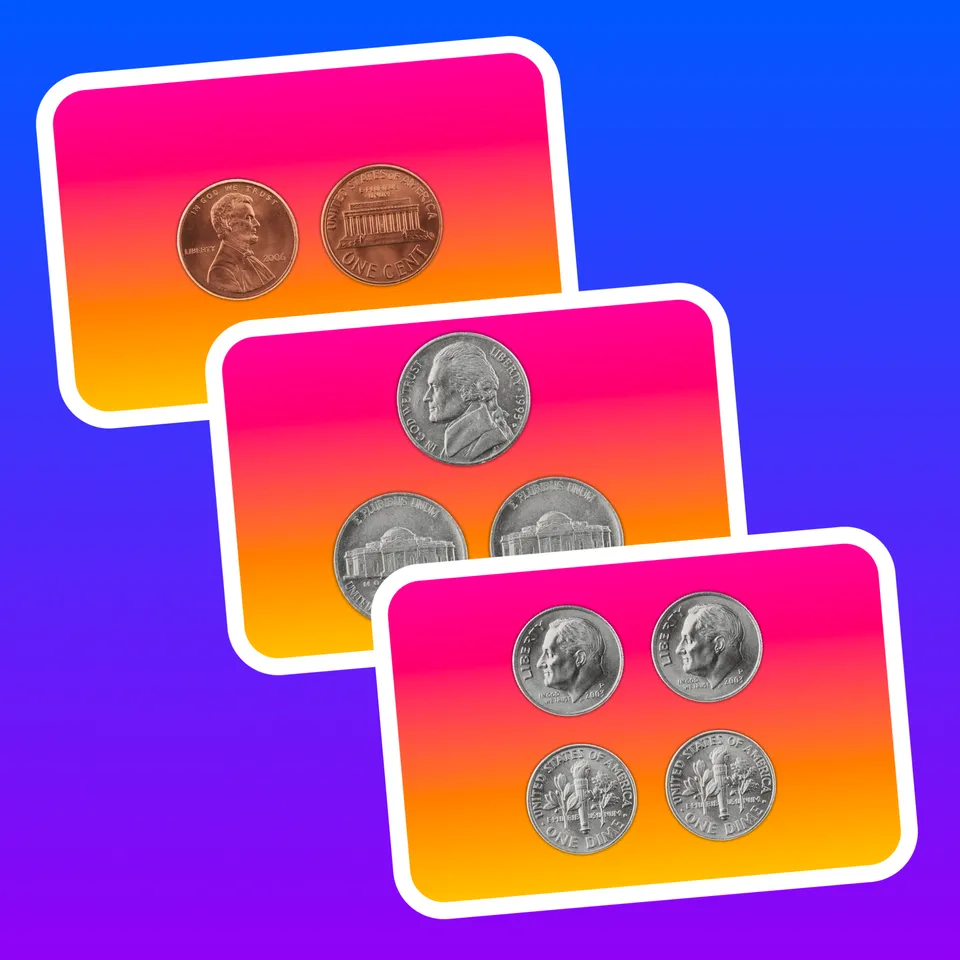
Use flashcards to practice calculating the value of coins!
Use flashcards to practice calculating the values of groups of coins, where each group is made up of only one type of coin! Help Rover the terrier reach the finish line! Practice makes perfect, so keep trying until you can get all the questions correct before the countdown runs out.
Part of
Standards alignment
Common Core State Standards
- 2.MD.C.8 — Solve word problems involving dollar bills, quarters, dimes, nickels, and pennies, using $ and ¢ symbols appropriately.
- 2.NBT.A.2 — Count within 1000; skip-count by 5s, 10s, and 100s.
Alabama
- MA19.2.24b — Find the value of a collection of quarters, dimes, nickels, and pennies.
- MA19.2.24 — Solve problems with money.
- MA19.2.7 — Count within 1000 by ones, fives, tens, and hundreds.
Alaska
- 1.MD.6 — Identify values of coins (e.g., nickel = 5 cents, quarter = 25 cents). Identify equivalent values of coins up to $1 (e.g., 5 pennies = 1 nickel, 5 nickels = 1 quarter).
- 1.CC.1 — Skip count by 2s and 5s.
- 2.NBT.2 — Count up to 1000, skip-count by 5s, 10s and 100s.
Arizona
- 1.MD.B.3b — Identify coins by name and value (pennies, nickels, dimes and quarters).
- 2.MD.C.8 — Solve word problems involving collections of money, including dollar bills, quarters, dimes, nickels, and pennies. Record the total using $ and ¢ appropriately. See Table 1.
- 2.NBT.A.2 — Count within 1000; skip-count by 5s, 10s, and 100s.
Arkansas
- 1.GM.7 — Count collections of like coins including pennies, nickels, and dimes to determine their total value up to 100 cents.
- 1.NPV.2 — Skip count forward by multiples of fives within 120.
California
- 2.MD.C.8 — Solve word problems involving dollar bills, quarters, dimes, nickels, and pennies, using $ and ¢ symbols appropriately.
- 2.NBT.A.2 — Count within 1000; skip-count by 2s, 5s, 10s, and 100s.
- MP8 — Look for and express regularity in repeated reasoning.
Colorado
- 2.MD.C.8 — Solve word problems involving dollar bills, quarters, dimes, nickels, and pennies, using $ and ¢ symbols appropriately. Example: If you have two dimes and three pennies, how many cents do you have?
- 2.NBT.A.2 — Count within 1000; skip-count by 5s, 10s, and 100s.
Connecticut
- 2.MD.C.8 — Solve word problems involving dollar bills, quarters, dimes, nickels, and pennies, using $ and ¢ symbols appropriately.
- 2.NBT.A.2 — Count within 1000; skip-count by 5s, 10s, and 100s.
Delaware
- 2.MD.C.8 — Solve word problems involving dollar bills, quarters, dimes, nickels, and pennies, using $ and ¢ symbols appropriately.
- 2.NBT.A.2 — Count within 1000; skip-count by 5s, 10s, and 100s.
Florida
- MA.1.M.2.3 — Find the value of combinations of pennies, nickels and dimes up to one dollar, and the value of combinations of one, five and ten dollar bills up to 100. Use the ¢ and symbols appropriately.
- MA.1.M.2.2 — Identify pennies, nickels, dimes and quarters, and express their values using the ¢ symbol. State how many of each coin equal a dollar.
Georgia
- 2.MDR.6.2 — Find the value of a group of coins and determine combinations of coins that equal a given amount that is less than one hundred cents, and solve problems involving dollar bills, quarters, dimes, nickels, and pennies, using $ and ¢ symbols appropriately.
- 2.NR.1.2 — Count forward and backward by ones from any number within 1000. Count forward by fives from multiples of 5 within 1000. Count forward and backward by 10s and 100s from any number within 1000. Count forward by 25s from 0.
- K.NR.1.4 — Identify pennies, nickels, and dimes and know their name and value.
- 1.MDR.6.3 — Identify the value of quarters and compare the values of pennies, nickels, dimes, and quarters.
Hawaii
- 2.MD.C.8 — Solve word problems involving dollar bills, quarters, dimes, nickels, and pennies, using $ and ¢ symbols appropriately.
- 2.NBT.A.2 — Count within 1000; skip-count by 5s, 10s, and 100s.
Idaho
- 1.MD.D.5 — Identify quarters, dimes, and nickels and relate their values to pennies. Find equivalent values (e.g., a nickel is equivalent to five pennies).
- 2.MD.C.8 — Solve word problems involving dollar bills, quarters, dimes, nickels, and pennies (up to 10), using and ¢ symbols appropriately and whole-dollar amounts.
- 1.NBT.A.1 — Starting at a given number, count forward and backwards within 120 by ones. Skip count by twos to 20, by fives to 100, and by tens to 120. In this range, read and write numerals and represent a number of objects with a written numeral.
Illinois
- 2.MD.C.8 — Solve word problems involving dollar bills, quarters, dimes, nickels, and pennies, using $ and ¢ symbols appropriately.
- 2.NBT.A.2 — Count within 1000; skip-count by 5s, 10s, and 100s.
Indiana
- 2.M.6 — Find the value of a collection of pennies, nickels, dimes, quarters, and dollars. (E)
- 1.M.3 — Identify the value of a penny, nickel, dime, and a collection of pennies, nickels, and dimes.
Iowa
- 2.MD.C.8 — Solve word problems involving dollar bills, quarters, dimes, nickels, and pennies, using $ and ¢ symbols appropriately. For example, if you have 3 quarters, 2 dimes and 4 pennies, how many cents do you have? For this standard, it may be appropriate to record amounts using decimals but does not include adding and subtracting with decimals.
- 1.MD.IA.B.1 — Identify pennies and dimes and their values. Count a mixed collection of dimes and pennies to determine the cent value (total not to exceed 100 cents).
- 2.MD.IA.C.2 — Identify nickels, quarters and dollars and know their values. Conceptual
- 2.NBT.A.2 — Count forward and backward within 1,000; skip-count forward and backward by 5s, 10s, and 100s.
Kansas
- 2.MD.8 — Solve word problems involving dollar bills, quarters, dimes, nickels, and pennies, using $ and ¢ symbols appropriately (Do not use decimal point, if showing 25 cents, use the word cents or ¢). For example: If you have 2 dimes and 3 pennies, how many cents do you have?
- 2.MD.9 — Identify coins and bills and their values.
- 2.NBT.2 — Count within 1000; skip-count by 2s, 5s, 10s, and 100s; explain and generalize the patterns.
Kentucky
- KY.1.MD.3.b — Identify the coins by values (penny, nickel, dime, quarter).
- KY.2.MD.8 — Solve word problems with adding and subtracting within 100, (not using dollars and cents simultaneously) using the $ and ¢ symbols appropriately (not including decimal notation).
- KY.2.NBT.2 — Count forwards and backwards within 1000; skip-count by 5s, 10s and 100s.
Louisiana
- 1.MD.D.5 — Determine the value of a collection of coins up to 50 cents. (Pennies, nickels, dimes, and quarters in isolation; not to include a combination of different coins.)
- K.MD.C.4 — Recognize pennies, nickels, dimes, and quarters by name and value (e.g., This is a nickel and it is worth 5 cents.)
- 2.NBT.A.2 — Count within 1000; skip-count by 5s, 10s, and 100s.
Maine
- 2.MD.C.8 — Solve word problems involving dollar bills, quarters, dimes, nickels, and pennies, using $ and ¢ symbols appropriately. Example: If you have 2 dimes and 3 pennies, how many cents do you have?
- 1.MD.D.5 — Identify the coins and each corresponding value. (e.g. penny, nickel, dime, and quarter)
- 2.NBT.A.2 — Count within 1000; skip-count by 5s, 10s, and 100s. Identify patterns in skip counting at any number. (For example, 37, 47, 57 or 328, 428, 528, etc.)
Maryland
- 2.MD.C.8 — Solve word problems involving dollar bills, quarters, dimes, nickels, and pennies, using $ and ¢ symbols appropriately.
- 2.NBT.A.2 — Count within 1000; skip-count by 5s, 10s, and 100s.
Massachusetts
- 1.MD.D.5 — Identify the values of all U.S. coins and know their comparative values (e.g., a dime is of greater value than a nickel). Find equivalent values (e.g., a nickel is equivalent to five pennies). Use appropriate notation (e.g., 69¢). Use the values of coins in the solutions of problems (up to 100¢).
- 2.NBT.A.2 — Count within 1,000; skip-count by 5s, 10s, and 100s. Identify patterns in skip counting starting at any number.
Michigan
- 2.MD.C.8 — Solve word problems involving dollar bills, quarters, dimes, nickels, and pennies, using $ and ¢ symbols appropriately.
- 2.NBT.A.2 — Count within 1000; skip-count by 5s, 10s, and 100s.
Minnesota
- 1.3.2.3 — Identify pennies, nickels and dimes; find the value of a group of these coins, up to one dollar.
- 1.1.2.3 — Recognize the relationship between counting and addition and subtraction. Skip count by 2s, 5s, and 10s.
- 2.3.3.2 — Identify pennies, nickels, dimes and quarters. Find the value of a group of coins and determine combinations of coins that equal a given amount. For example: 50 cents can be made up of 2 quarters, or 4 dimes and 2 nickels, or many other combinations.
Mississippi
- 1.MD.5.c — Count like U.S. coins up to the equivalent of a dollar.
- 1.MD.5.a — Identify the value of all U.S. coins (penny, nickel, dime, quarter, half-dollar, and dollar coins). Use appropriate cent and dollar notation (e.g., 25¢, $1).
Missouri
- 1.GM.C.9 — Know the value of a penny, nickel, dime and quarter.
- 2.GM.D.12 — Find the value of combinations of dollar bills, quarters, dimes, nickels and pennies, using $ and ¢ appropriately.
- 1.NS.A.4 — Count by 5s to 100 starting at any multiple of five.
- 1.NBT.A.4 — Count by 10s to 120 starting at any number.
Montana
- 2.MD.C.8 — Solve word problems involving dollar bills, quarters, dimes, nickels, and pennies, using $ and ¢ symbols appropriately.
- 2.NBT.A.2 — Count within 1000; skip-count by 5s, 10s, and 100s.
Nebraska
- 1.G.3.b — Count collections of like coins (penny, nickel, and dime) relating to patterns of counting by 1s, 5s, and 10s.
- 1.G.3 — Time and Money: Students will solve problems with coins and tell time to the half hour.
- 1.N.2.d — Understand patterns of skip counting by 2s, 5s, and 10s.
Nevada
- 2.MD.C.8 — Solve word problems involving dollar bills, quarters, dimes, nickels, and pennies, using $ and ¢ symbols appropriately.
- 2.NBT.A.2 — Count within 1000; skip-count by 5s, 10s, and 100s.
New Hampshire
- 2.MD.C.8 — Solve word problems involving dollar bills, quarters, dimes, nickels, and pennies, using $ and ¢ symbols appropriately.
- 2.NBT.A.2 — Count within 1000; skip-count by 5s, 10s, and 100s.
New Jersey
- 2.MD.C.8 — Solve word problems involving dollar bills, quarters, dimes, nickels, and pennies, using $ and ¢ symbols appropriately. Example: If you have 2 dimes and 3 pennies, how many cents do you have?
- 2.NBT.A.2 — Count within 1000; skip-count by 5s, 10s, and 100s.
New Mexico
- 2.MD.C.8 — Solve word problems involving dollar bills, quarters, dimes, nickels, and pennies, using $ and ¢ symbols appropriately.
- 2.NBT.A.2 — Count within 1000; skip-count by 5s, 10s, and 100s.
New York
- NY-1.MD.3.b — Recognize and identify coins (penny, nickel, dime, and quarter) and their value and use the cent symbol (¢) appropriately.
- NY-2.MD.8.b — Solve real world and mathematical problems within one dollar involving quarters, dimes, nickels, and pennies, using the ¢ (cent) symbol appropriately.
- NY-2.NBT.2 — Count within 1000; skip-count by 5s, 10s, and 100s.
North Carolina
- NC.1.MD.5 — Identify quarters, dimes, and nickels and relate their values to pennies.
- NC.2.MD.8 — Solve word problems involving: • Quarters, dimes, nickels, and pennies within 99¢, using ¢ symbols appropriately. • Whole dollar amounts, using the $ symbol appropriately.
- NC.2.NBT.2 — Count within 1,000; skip-count by 5s, 10s, and 100s.
North Dakota
- 1.GM.M.5 — Count collections of coins (pennies, nickels, and dimes) relating to counting patterns by 1s, 5s, and 10s up to one dollar.
- 1.NO.CC.5 — Skip count forward and backward by 5s and 10s from multiples and recognize the patterns of up to 10 skip counts.
- 2.GM.M.4 — Count collections of money (quarters, dimes, nickels, and pennies) relating to counting patterns by 1s, 5s, and 10s up to one dollar.
- 1.GM.M.4 — Identify and tell the value of a dollar bill, quarter, dime, nickel, and penny.
Ohio
- 2.MD.8.b — Find the value of a collection of quarters, dimes, nickels, and pennies.
- 2.MD.8 — Solve problems with money.
- 2.MD.8.a — Identify nickels and quarters by name and value.
- 1.MD.3.b — Identify pennies and dimes by name and value.
Oklahoma
- 1.N.4.3 — Determine the value of a collection of pennies, nickels, or dimes up to one dollar, counting by 1s, 5s, and 10s.
- 1.N.4 — Identify coins and their values.
Oregon
- 2.GM.D.11 — Solve problems in authentic contexts involving dollar bills, quarters, dimes, nickels, and pennies, using $ (dollars) and c (cents) symbols appropriately.
- 2.NBT.A.2 — Count within 1000; skip-count by 5's, 10's, and 100's.
Pennsylvania
- CC.2.4.2.A.3 — Solve problems and make change using coins and paper currency with appropriate symbols.
- CC.2.1.2.B.2 — Use place-value concepts to read, write, and skip count to 1000.
Rhode Island
- 1.MD.D.5 — Identify the values of all U.S. coins and know their comparative values (e.g., a dime is of greater value than a nickel). Find equivalent values (e.g., a nickel is equivalent to 5 pennies). Use appropriate notation (e.g., 69¢). Use the values of coins in the solutions of problems (up to 100¢).
- 2.NBT.A.2 — Count within 1000; skip-count by 5s, 10s, and 100s. Identify patterns in skip counting starting at any number.
- 2.MD.C.8 — Solve word problems involving dollar bills, quarters, dimes, nickels, and pennies (up to 10), using and ¢ symbols appropriately and whole dollar amounts. For example, if you have 2 dimes and 3 pennies, how many cents do you have? If you have $3 and 4 quarters, how many dollars or cents do you have? (Students are not expected to use decimal notation.)
South Carolina
- 1.MDA.6 — Identify a penny, nickel, dime and quarter and write the coin values using a ȼ symbol.
- 1.NSBT.1b — Extend the number sequence to count by fives and tens to 100, starting at any number.
- 2.MDA.7 — Solve real-world/story problems involving dollar bills using the $ symbol or involving quarters, dimes, nickels, and pennies using the ȼ symbol.
South Dakota
- 2.MD.C.8.a — Recognize and know the value of coins up to one dollar.
- 1.MD.B.5 — Identify nickels and understand that five pennies can be thought of as a nickel. Identify dimes and understand ten pennies can be thought of as a dime. Count the value of a set of coins comprised of pennies, nickels, and dimes.
- 2.MD.C.8 — Identify and count coins and bills and apply that understanding to solve word problems.
- 2.NBT.A.2 — Count within 1000; skip-count by 5s, 10s, and 100s, starting from any number in its skip counting sequence.
Tennessee
- 1.MD.B.4 — Count the value of a set of like coins less than one dollar using the ¢ symbol only.
- K.MD.B.3 — Identify the penny, nickel, dime, and quarter based on their attributes (size and color) and recognize the value of each.
Texas
- 1.4C — use relationships to count by twos, fives, and tens to determine the value of a collection of pennies, nickels, and/or dimes.
- 2.5A — determine the value of a collection of coins up to one dollar; and
- 1.4A — identify U.S. coins, including pennies, nickels, dimes, and quarters, by value and describe the relationships among them;
Utah
- 1.MD.5 — Identify the values of pennies, nickels, dimes and quarters and know their comparative values. (For example, a dime is of greater value than a nickel.) Use appropriate notation to designate a coin’s value. (For example, 5¢.)
- 2.NBT.2 — Count within 1,000; skip-count by fives, tens, and hundreds.
- 2.MD.8 — Solve word problems involving dollar bills, quarters, dimes, nickels, and pennies, using $ and ¢ symbols appropriately. For example, if you have 2 dimes and 3 pennies, how many cents do you have?
Vermont
- 2.MD.C.8 — Solve word problems involving dollar bills, quarters, dimes, nickels, and pennies, using $ and ¢ symbols appropriately.
- 2.NBT.A.2 — Count within 1000; skip-count by 5s, 10s, and 100s.
Virginia
- 1.NS.1g — Count by ones, fives, or tens to determine the value of a collection of like coins (pennies, nickels, or dimes), whose total value is 100 cents or less.
- 1.NS.1c — Represent forward counting patterns when counting by groups of 5 and groups of 10 up to 120 using a variety of tools (e.g., objects, coins, 120 chart).
Washington
- 2.MD.C.8 — Solve word problems involving dollar bills, quarters, dimes, nickels, and pennies, using $ and ¢ symbols appropriately.
- 2.NBT.A.2 — Count within 1000; skip-count by 5s, 10s, and 100s.
Washington, D.C.
- 2.MD.C.8 — Solve word problems involving dollar bills, quarters, dimes, nickels, and pennies, using $ and ¢ symbols appropriately.
- 2.NBT.A.2 — Count within 1000; skip-count by 5s, 10s, and 100s.
West Virginia
- M.1.18 — Identify the value of coins and use dimes and pennies to model the relationship between money and place value (e.g., exchange 10 pennies for 1 dime or exchange 10 dimes for 1 dollar).
- M.1.9 — Count to 120, starting at any number less than 120. In this range, read and write numerals and represent a number of objects with a written numeral. Skip count to 120 by 2's. Skip count to 120 by S's and lO's.
- M.2.22 — Solve word problems involving dollar bills, quarters, dimes, nickels, and pennies, using $ and C symbols appropriately (e.g., If you have 2 dimes and 3 pennies, how many cents do I you have?).
- M.K.19 — Count pennies to 20.
Wisconsin
- M.2.MD.C.8 — Solve word problems involving dollar bills, quarters, dimes, nickels, and pennies, using $ and ¢ symbols appropriately.
- M.2.NBT.A.2 — Count within 1,000; skip-count by fives, tens, and hundreds.
Wyoming
- 1.MD.I.3.B — Identify U.S. coins by value (pennies, nickels, dimes, quarters).
- 2.MD.H.8 — Solve word problems up to 10 involving dollar bills, quarters, dimes, nickels, and pennies, using (dollars) and ¢ (cents) symbols appropriately.