Learn to Spell: -ap words
Ages 4–6 · 4 minutes · English
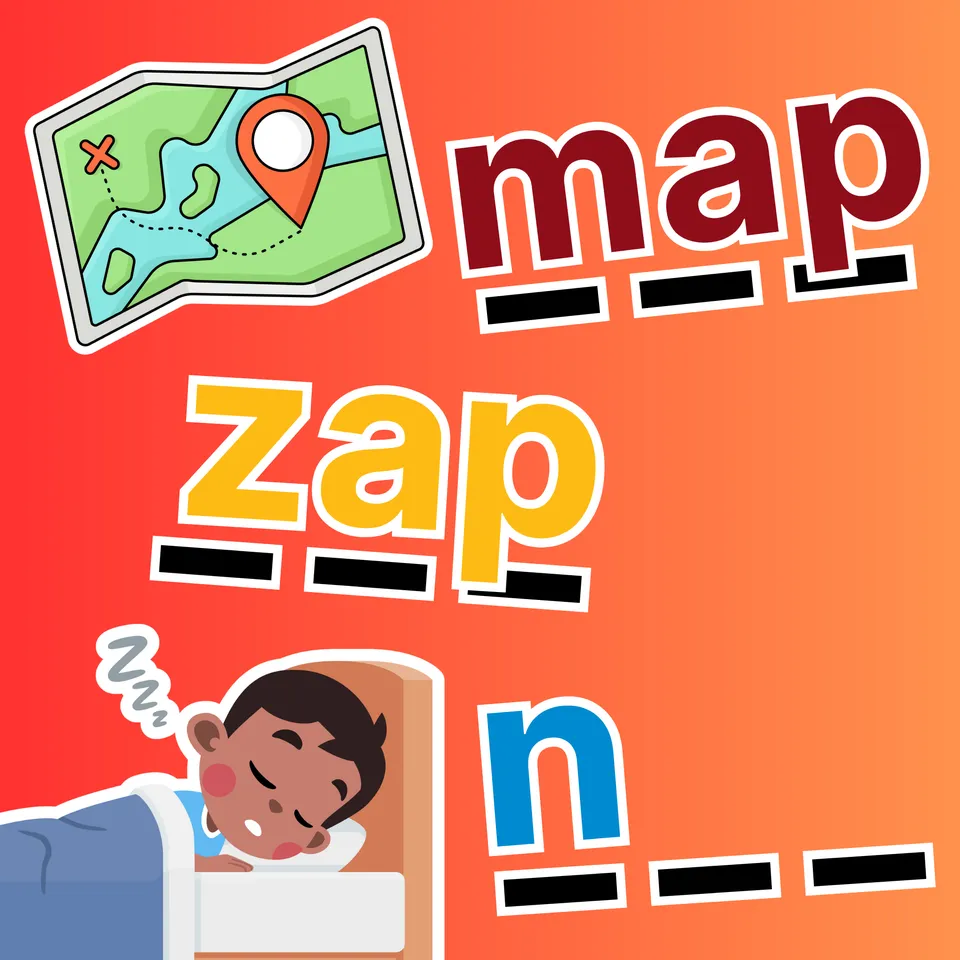
Practice spelling -ap words like nap, map and cap!
Students can build their beginner spelling skills by practicing spelling words with the -ap pattern such as map, nap, cap, tap and zap.
No prior experience is required.
Part of
Standards alignment
Common Core State Standards
- L.K.2.d — Spell simple words phonetically, drawing on knowledge of sound-letter relationships.
- RF.K.3.d — Distinguish between similarly spelled words by identifying the sounds of the letters that differ.
- L.K.2.c — Write a letter or letters for most consonant and short-vowel sounds (phonemes).
- RF.K.3.a — Demonstrate basic knowledge of one-to-one letter-sound correspondences by producing the primary or many of the most frequent sound for each consonant.
- RF.K.3.b — Associate the long and short sounds with common spellings (graphemes) for the five major vowels.
Alabama
- ELA21.K.10h — Distinguish between similarly spelled words by identifying the phonemes and graphemes that differ.
- ELA21.K.35b — With prompting and support, encode vowel-consonant (VC) and consonant-vowel-consonant (CVC) words, while using some knowledge of basic position-based rules for spelling English words.
- ELA21.K.10 — Apply knowledge of phoneme-grapheme correspondences and word-analysis skills to decode and encode (spell) words accurately in both isolation and in decodable, grade-appropriate text.
- ELA21.K.10c — Decode consonant-vowel-consonant (CVC) words in isolation and in decodable text.
Alaska
- L.K.2.d — Spell simple words phonetically, drawing on knowledge of sound-letter relationships.
- L.K.2.c — Write a letter or letters for most consonant and short-vowel sounds (phonemes).
- RF.K.3.a — Demonstrate basic knowledge of one-to-one letter-sound correspondences by producing the primary sound or many of the most frequent sounds for each consonant.
- RF.K.3.d — Distinguish between similarly spelled words by identifying the sounds of the letters that differ.
Arizona
- K.WF.3.b — Write or select an initial or final consonant when a medial vowel is provided.
- K.WF.3.c — Spell VC (Vowel-Consonant) (e.g., at, in) and CVC (Consonant-Vowel-Consonant) (e.g., pet, mud) words with short vowel sounds.
- K.RF.3.d — Distinguish between similarly spelled words by identifying the sounds of the letters that differ.
- K.WF.3 — Know and apply phonics and word analysis skills when encoding words.
- K.WF.3.a — Represent phonemes in simple words, using letter-sound relationships.
Arkansas
- K.FR.14.PE — Encode one-syllable words with single consonants and all short vowels (e.g., cat, net, hit, pop, pup).
- K.FR.16.PE — Encode words phonetically, drawing on knowledge of sound-letter relationships.
- K.FR.9.PD — Decode one-syllable words with single consonants and all short vowels (e.g., bag, sip, web, hog, cut).
- 1.FR.15.PE — Encode one-syllable words containing single consonants with multiple spellings for /z/ and /k/ (e.g., is, nose, zip; kite, cat, luck).
- K.FR.2.CP — Recognize that spoken words are represented in written language by specific sequences of letters and that print carries meaning (e.g., the spoken word “dog” is represented in print by d-o-g).
California
- L.K.2.c — Write a letter or letters for most consonant and short-vowel sounds (phonemes).
- L.K.2.d — Spell simple words phonetically, drawing on knowledge of sound-letter relationships.
- RF.K.3.d — Distinguish between similarly spelled words by identifying the sounds of the letters that differ.
- RF.K.3.a — Demonstrate basic knowledge of one-to-one letter-sound correspondences by producing the primary or many of the most frequent sound for each consonant.
- RF.K.3.b — Associate the long and short sounds with common spellings (graphemes) for the five major vowels. (Identify which letters represent the five major vowels [Aa, Ee, Ii, Oo, and Uu] and know the long and short sound of each vowel. More complex long vowel graphemes and spellings are targeted in the grade 1 phonics standards.)
Colorado
- RWC20-GR.K-S.2-GLE.3-EO.c.iv — Distinguish between similarly spelled words by identifying the sounds of the letters that differ.
- RWC20-GR.K-S.3-GLE.4-EO.b.iii — Write a letter or letters for most consonant and short-vowel sounds (phonemes).
- RWC20-GR.K-S.3-GLE.4-EO.b.iv — Spell simple words phonetically, drawing on knowledge of sound-letter relationships.
- RWC20-GR.K-S.2-GLE.3-EO.a.ii — Recognize that spoken words are represented in written language by specific sequences of letters.
- RWC20-GR.K-S.2-GLE.3-EO.c — Know and apply grade-level phonics and word analysis skills in decoding words.
- RWC20-GR.1-S.2-GLE.3-EO.c.viii — Use onsets and rimes to create new words (for example: ip to make dip, lip, slip, ship)
Connecticut
- L.K.2.c — Write a letter or letters for most consonant and short-vowel sounds (phonemes).
- L.K.2.d — Spell simple words phonetically, drawing on knowledge of sound-letter relationships.
- RF.K.3.d — Distinguish between similarly spelled words by identifying the sounds of the letters that differ.
- RF.K.3.a — Demonstrate basic knowledge of one-to-one letter-sound correspondences by producing the primary or many of the most frequent sound for each consonant.
- RF.K.2.c — Blend and segment onsets and rimes of single-syllable spoken words.
Delaware
- L.K.2.c — Write a letter or letters for most consonant and short-vowel sounds (phonemes).
- L.K.2.d — Spell simple words phonetically, drawing on knowledge of sound-letter relationships.
- RF.K.3.a — Demonstrate basic knowledge of one-to-one letter-sound correspondences by producing the primary or many of the most frequent sound for each consonant.
- RF.K.3.d — Distinguish between similarly spelled words by identifying the sounds of the letters that differ.
- RF.K.2.c — Blend and segment onsets and rimes of single-syllable spoken words.
Florida
- ELA.K.F.1.3 — Use knowledge of grade-appropriate phonics and word-analysis skills to decode words accurately. • Demonstrate knowledge of the most frequent sound for each consonant. • Demonstrate knowledge of the short and long sounds for the five major vowels. • Decode consonant-vowel-consonant (CVC) words. • Encode consonant-vowel-consonant (CVC) words.
- ELA.K.C.3.1 — Follow the rules of standard English grammar, punctuation, capitalization, and spelling appropriate to grade level.
Georgia
- ELAGSEKL2.d — Spell simple words phonetically, drawing on knowledge of sound-letter relationships.
- ELAGSEKL2.c — Write a letter or letters for most consonant and short-vowel sounds (phonemes).
- ELAGSEKRF1.b — Recognize that spoken words are represented in written language by specific sequences of letters.
- ELAGSEKRF3.c — Distinguish between similarly spelled words by identifying the sounds of the letters that differ.
Hawaii
- K.L.2d — Spell simple words phonetically, drawing on knowledge of sound-letter relationships.
- K.RF.3d — Distinguish between similarly spelled words by identifying the sounds of the letters that differ.
- K.L.2c — Write a letter or letters for most consonant and short-vowel sounds (phonemes).
- K.RF.2c — Blend and segment onsets and rimes of single-syllable spoken words.
Idaho
- K.FR.PH.3d — Distinguish between similarly spelled CVC words by identifying the sounds of the letters that differ.
- K.GC.M.3 — Spell words phonetically, drawing on knowledge of sound-letter relationships.
- K.FR.PC.1b — Recognize that spoken words are represented in written language by specific sequences of letters.
- K.FR.PH.3a — Demonstrate knowledge of one-to-one letter-sound correspondences by producing the most frequent sound for each consonant letter.
- 1.GC.M.3a — Use conventional spelling for words with common, taught spelling patterns and frequently occurring irregular words.
Illinois
- L.K.2.c — Write a letter or letters for most consonant and short-vowel sounds (phonemes).
- L.K.2.d — Spell simple words phonetically, drawing on knowledge of sound-letter relationships.
- RF.K.3.d — Distinguish between similarly spelled words by identifying the sounds of the letters that differ.
- RF.K.3.a — Demonstrate basic knowledge of one-to-one letter-sound correspondences by producing the primary or many of the most frequent sound for each consonant.
- RF.K.2.c — Blend and segment onsets and rimes of single-syllable spoken words.
Indiana
- K.W.8 — Demonstrate command of capitalization, punctuation, and spelling, focusing on: a. Capitalization – Capitalizing the first word in a sentence and the pronoun I. b. Punctuation – Recognizing and naming end punctuation. c. Encoding – Spelling simple words phonetically, drawing on phonemic awareness.
- K.RF.7 — Use letter-sound knowledge to decode the sound of each consonant. (E)
- K.RF.8 — Use letter-sound knowledge to decode words, including open and closed syllables, consonant digraphs, and blends. (E)
- K.RF.6 — Identify and produce the beginning, middle (medial), and final sounds in three and four phoneme words. (E)
Iowa
- RF.K.3 — Know and apply grade-level phonics, which includes word analysis skills to support decoding and encoding words.
- RF.K.3.d — Distinguish between similarly spelled words by identifying the sounds of the letters that differ.
- L.K.2 — Demonstrate command of the conventions of standard English capitalization, punctuation, and spelling when writing.
- RF.K.1.b — Recognize that spoken words are represented in written language by specific sequences of letters.
- RF.K.3.a — Demonstrate basic knowledge of phoneme-grapheme (one-to-one, letter-sound) correspondences by producing the primary and most frequent sounds for each consonant.
Kansas
- W.K.11.d — Spell simple words phonetically, drawing on knowledge of letter-sound relationships.
- RF.K.3.d — Distinguish between similarly spelled words by identifying the sounds of the letters that differ (e.g., bat/cat, bat/bit/, bat/bad).
- W.K.11.c — Write a letter or letters for most consonant and short vowel sounds.
- RF.K.3 — Know and apply grade-level phonics and word analysis skills in decoding words.
Kentucky
- L.K.2.d — Spell simple words phonetically, drawing on knowledge of sound-letter relationships.
- RF.K.3 — Know and apply grade-level phonics and word analysis skills in decoding words.
- RF.K.3.a — Demonstrate basic knowledge of one-to-one letter-sound correspondences by producing the primary or many of the most frequent sounds for each consonant.
- RF.K.3.d — Orally distinguish between similarly spelled words by identifying the sounds of the letters that differ.
Louisiana
- L.K.2.c — Write a letter or letters for most consonant and short-vowel sounds (phonemes).
- L.K.2.d — Spell simple words phonetically, drawing on knowledge of sound-letter relationships.
- RF.K.3.d — Distinguish between similarly spelled words by identifying the sounds of the letters that differ.
- RF.K.1.b — Recognize that spoken words are represented in written language by specific sequences of letters.
- RF.K.3.b — Associate the long and short sounds with common spellings (graphemes) for the five major vowels.
Maine
- L.2.K.d — Spell simple words phonetically, drawing on knowledge of sound-letter relationships.
- R.3.K.d — Distinguish between similarly spelled words by identifying the sounds of the letters that differ.
- L.2.K.c — Write a letter or letters for most consonant and short-vowel sounds (phonemes).
- R.1.K.b — Recognize that spoken words are represented in written language by specific sequences of letters.
Maryland
- L.K.2.d — Spell simple words phonetically, drawing on knowledge of sound-letter relationships.
- RF.K.3.d — Distinguish between similarly spelled words by identifying the sounds of the letters that differ.
- RF.K.1.b — Recognize that spoken words are represented in written language by specific sequences of letters.
- RF.K.3.a — Demonstrate basic knowledge of one-to-one letter-sound correspondences by producing the primary or many of the most frequent sound for each consonant.
- L.K.2 — Demonstrate command of the conventions of standard English capitalization, punctuation, and spelling when writing.
Massachusetts
- L.K.2.e — Spell simple words phonetically, drawing on knowledge of sound-letter relationships.
- RF.K.3.d — Distinguish between similarly spelled words by identifying the sounds of the letters that differ.
- RF.K.3 — Know and apply grade-level phonics and word analysis skills in decoding words.
- RF.K.3.a — Demonstrate basic knowledge of one-to-one letter-sound correspondences by producing the primary sound or many of the most frequent sounds for each consonant.
- RF.K.1.b — Recognize that spoken words are represented in written language by specific sequences of letters.
Michigan
- L.K.2.d — Spell simple words phonetically, drawing on knowledge of sound-letter relationships.
- RF.K.3.d — Distinguish between similarly spelled words by identifying the sounds of the letters that differ.
- L.K.2.c — Write a letter or letters for most consonant and short-vowel sounds (phonemes).
- RF.K.3.a — Demonstrate basic knowledge of one-to-one letter-sound correspondences by producing the primary or many of the most frequent sound for each consonant.
Minnesota
- 0.1.1.2.a — Know and apply grade-level phonics and word analysis skills in decoding words: decode words using one-to-one letter sound correspondences in three-phoneme CVC words and knowledge of word families, demonstrating both accuracy and automaticity.
- 1.2.1.2 — Accurately spell words in common word families and high-frequency words; use phonetic spelling for other words.
- 0.2.1.1 — Recognize that words are represented in written language by specific sequences of letters, which are separated by spaces, and put in a specific order to create a sentence.
- 0.2.1.2 — Demonstrate one-to-one letter-sound correspondence.
Mississippi
- L.K.2.c — Write a letter or letters for most consonant and short-vowel sounds (phonemes).
- L.K.2.d — Spell simple words phonetically, drawing on knowledge of sound-letter relationships.
- RF.K.3.d — Distinguish between similarly spelled words by identifying the sounds of the letters that differ.
- RF.K.3.a — Demonstrate basic knowledge of one-to-one letter-sound correspondences by producing the primary sound or many of the most frequent sounds for each consonant.
Missouri
- 1.L.1.B.e — spell words using regular spelling patterns
- K.RF.3.A.d — recognizing that new words can be created when letters are changed, added, or deleted and using letter-sound knowledge to write simple messages and words
- K.RF.3.A.a — producing and writing letter(s) for most short vowel and consonant sounds
- K.RF.3.A.c — blending letter sounds to decode simple words
Montana
- L.K.2.d — Spell simple words phonetically, drawing on knowledge of sound-letter relationships.
- RF.K.3.d — Distinguish between similarly spelled words by identifying the sounds of the letters that differ.
- L.K.2.c — Write a letter or letters for most consonant and short-vowel sounds (phonemes).
- RF.K.3.a — Demonstrate basic knowledge of one-to-one letter-sound correspondences by producing the primary or many of the most frequent sound for each consonant.
- RF.K.1.b — Recognize that spoken words are represented in written language by specific sequences of letters.
Nebraska
- LA.K.F.3.d — Encode consonant-vowel-consonant (CVC) words.
- LA.K.F.3.e — Distinguish between similarly spelled words by identifying the sounds of the letters that differ.
- LA.K.F.3 — Know and apply phonics and word analysis skills in decoding and encoding (spelling) words.
- LA.K.F.3.c — Decode consonant-vowel-consonant (CVC) words.
- LA.K.FW.2 — Demonstrate sound-letter concepts when writing.
Nevada
- L.K.2.d — Spell simple words phonetically, drawing on knowledge of sound-letter relationships.
- L.K.2.c — Write a letter or letters for most consonant and short-vowel sounds (phonemes).
- RF.K.3 — Know and apply grade-level phonics and word analysis skills in decoding words.
- RF.K.3.d — Distinguish between similarly spelled words by identifying the sounds of the letters that differ.
New Hampshire
- L.K.2.d — Spell simple words phonetically, drawing on knowledge of sound-letter relationships.
- RF.K.3.d — Distinguish between similarly spelled words by identifying the sounds of the letters that differ.
- L.K.2.c — Write a letter or letters for most consonant and short-vowel sounds (phonemes).
- RF.K.3.b — Associate the long and short sounds with common spellings (graphemes) for the five major vowels.
New Jersey
- L.K.2.d — Spell simple words phonetically, drawing on knowledge of sound-letter relationships.
- RF.K.3.d — Distinguish between similarly spelled words by identifying the sounds of the letters that differ (e.g., nap and tap; cat and cot).
- L.K.2.c — Write a letter or letters for most consonant and short-vowel sounds (phonemes).
- RF.K.3 — Know and apply grade-level phonics and word analysis skills in decoding and encoding words.
- RF.K.3.a — Demonstrate basic knowledge of one-to-one letter-sound correspondences by producing many of the most frequently used sounds of each consonant.
New Mexico
- L.K.2.d — Spell simple words phonetically, drawing on knowledge of sound-letter relationships.
- L.K.2.c — Write a letter or letters for most consonant and short-vowel sounds (phonemes).
- RF.K.3.d — Distinguish between similarly spelled words by identifying the sounds of the letters that differ.
- RF.K.3.a — Demonstrate basic knowledge of one-to-one letter-sound correspondences by producing the primary or many of the most frequent sound for each consonant.
New York
- KL2 — Demonstrate command of the conventions of academic English capitalization, punctuation, and spelling when writing. (See Notes for grade-band conventions.)
- KRF3b — Decode short vowel sounds with common spellings.
- KRF3c — Decode some regularly spelled one-syllable words.
- KRF1b — Recognize that spoken words are represented in written language by specific sequences of letters.
- KRF3a — Demonstrate one-to-one letter-sound correspondence by producing the primary sound or most frequent sound for each consonant.
North Carolina
- L.K.2 — Demonstrate command of the conventions of standard English capitalization, punctuation, and spelling when writing; demonstrate proficiency within the K-1 conventions continuum.
- RF.K.4 — Know and apply grade-level phonics and word analysis skills in decoding words.
- RF.K.4.d — Distinguish between similarly spelled words by identifying the sounds of the letters that differ.
- RF.K.4.b — Associate the long and short sounds with common spellings (graphemes) for the five major vowels.
- RF.K.3.c — Blend and segment onsets and rimes of single-syllable spoken words.
North Dakota
- K.F.9 — Encode words with phoneme-grapheme correspondences:
- K.F.9a — predictable consonants
- K.F.9b — predictable short vowels
- K.F.8 — Decode words with phoneme-grapheme correspondences:
Ohio
- L.K.2.c — Write a letter or letters for most consonant and short-vowel phonemes (sounds).
- L.K.2.d — Spell simple words phonetically, drawing on knowledge of sound-letter relationships.
- RF.K.3.d — Distinguish between similarly spelled words by identifying the sounds of the letters that differ.
- RF.K.1.b — Recognize that spoken words are represented in written language by specific sequences of letters.
- RF.K.3.a — Demonstrate basic knowledge of one-to-one grapheme (letter)-sound correspondences by producing the primary sound or many of the most frequent sounds for each consonant.
Oklahoma
- K.2.SE.2 — Students will represent all of the sounds in a Consonant/Vowel/Consonant (CVC) word logically in phonetic spelling (e.g., "kat" for cat or "fer" for fur).
- K.2.PA.5 — Students will blend and segment onset and rime in one-syllable spoken words (e.g., blending: /j/ + og = jog; segmenting: cat = /c/+ at).
- K.2.PWS.4 — Students will blend letter sounds to decode simple Vowel/Consonant (VC) and Consonant/Vowel/Consonant (CVC) words (e.g., VC words = at, in, up; CVC words = pat, hen, lot).
- K.2.PA.3 — Students will isolate and pronounce initial and final sounds in spoken words.
Oregon
- K.L.2d — Spell simple words phonetically.
- K.RF.3e — Decode cvc words.
- K.RF.3a — Demonstrate basic knowledge of one-to-one letter-sound correspondences by producing the primary or many of the most frequent sound for each consonant.
- K.RF.3d — Distinguish between similarly spelled words by identifying the sounds of the letters that differ.
- K.RF.2d — Blend and segment onsets and rimes of single-syllable spoken words.
Pennsylvania
- CC.1.1.K.D — Know and apply grade-level phonics and word analysis skills in decoding words. • Demonstrate basic knowledge of one-to-one letter-sound correspondence. • Associate the long and short sounds with common spellings for the five major vowels. • Read grade-level high-frequency sight words with automaticity. • Distinguish between similarly spelled words by identifying the sounds of the letters that differ.
- CC.1.4.K.F — Demonstrate a grade- appropriate command of the conventions of standard English grammar, usage, capitalization, punctuation, and spelling. • Capitalize the first word in a sentence and the pronoun I. • Recognize and use end punctuation. • Spell simple words phonetically.
- CC.1.1.K.C — Demonstrate understanding of spoken words, syllables, and sounds (phonemes). • Recognize and produce rhyming words. • Count, pronounce, blend, and segment syllables in spoken words. • Blend and segment onsets and rimes of single-syllable spoken words. • Isolate and pronounce the initial, medial vowel, and final sound (phonemes) in the three-phoneme (CVC) words.
- CC.1.4.K.L — Demonstrate a grade- appropriate command of the conventions of standard English grammar, usage, capitalization, punctuation, and spelling. • Capitalize the first word in a sentence and the pronoun I. • Recognize and use end punctuation. • Spell simple words phonetically.
- CC.1.4.K.R — Demonstrate a grade- appropriate command of the conventions of standard English grammar, usage, capitalization, punctuation, and spelling. • Capitalize first word in sentence and pronoun I. • Recognize and use end punctuation. • Spell simple words phonetically.
Rhode Island
- L.K.2.e — Spell simple words phonetically, drawing on knowledge of sound-letter relationships.
- RF.K.3.d — Distinguish between similarly spelled words by identifying the sounds of the letters that differ.
- L.K.2.d — Write a letter or letters for most consonant and short-vowel sounds (phonemes).
- RF.K.1.b — Recognize that spoken words are represented in written language by specific sequences of letters.
South Carolina
- ELA.K.F.3.8 — Decode and encode words using: a. VC; b. CV; c. CVC; d. consonant digraphs (i.e., ch, sh, th, wh); and e. combination (i.e., qu).
- ELA.K.F.3 — Know and apply phonics and word analysis skills in decoding and encoding words. (FK -1.3-2.18 LF BR-430)
- ELA.K.F.3.4 — Identify the vowel and produce the vowel sound in a printed syllable or word when decoding: a. in a closed syllable (VC: at; CVC: bat); b. in an open syllable (e.g. he, so, me, go, hi); and c. in a vowel- consonant-e (VCe) syllable with prompting and support.
- ELA.K.F.3.6 — Delete, add, and substitute the initial, medial, and final letters in CVC words to build or make new words.
South Dakota
- K.L.2.d — Spell simple words phonetically, drawing on knowledge of sound-letter relationships.
- K.L.2.c — Write a letter or letters for most consonant and short-vowel sounds (phonemes).
- K.RF.3 — Know and apply grade-level phonics and word analysis skills in decoding words.
- K.RF.2.c — Blend and segment onsets and rimes of single-syllable spoken words.
Tennessee
- K.FL.WC.4.d — Spell VC (at, in) and CVC (pet, mud) words with short vowels; spell V (a, I) and CV (be, go) words with long vowels.
- K.FL.PWR.3.d — Decode regularly spelled CVC words.
- K.FL.PWR.3.e — Distinguish between similarly spelled words by identifying the letters that differ.
- K.FL.WC.4.c — Represent phonemes first to last in simple words using letters (graphemes) such as rop for rope.
Texas
- K.2C.i — spelling words with VC, CVC, and CCVC;
- K.2C.ii — spelling words using sound-spelling patterns; and
- K.2B.ii — using letter-sound relationships to decode, including VC, CVC, CCVC, and CVCC words;
- K.2B.iii — recognizing that new words are created when letters are changed, added, or deleted such as it - pit - tip - tap; and
Utah
- K.R.3.b — Demonstrate mastery of short vowel sounds (/ă/, /ĕ/, /ĭ/, /ŏ/, /ŭ/) in isolation and in VC and CVC words in singlesyllable words.
- K.R.3 — Demonstrate mastery of age-appropriate phonics skills.
- K.R.3.a — Demonstrate mastery of all consonant names and sounds using one-to-one letter-sound correspondence (alphabetic principle).
- K.R.2.b — Identify the initial, medial, and final sound in 2–3 phoneme words.
Vermont
- L.K.2.d — Spell simple words phonetically, drawing on knowledge of sound-letter relationships.
- RF.K.3.d — Distinguish between similarly spelled words by identifying the sounds of the letters that differ.
- L.K.2.c — Write a letter or letters for most consonant and short-vowel sounds (phonemes).
- RF.K.1.b — Recognize that spoken words are represented in written language by specific sequences of letters.
- RF.K.3.a — Demonstrate basic knowledge of one-to-one letter-sound correspondences by producing the primary or many of the most frequent sound for each consonant.
Virginia
- K.FFW.2.A — Encode (spell) one syllable words with short vowels and one syllable words beginning or ending in a digraph (e.g., ch, sh, th, wh).
- K.FFR.2.B — Blend and segment one syllable words by onset and rime.
- K.FFR.3.G — Decode (read) and encode (spell) words with short vowels, including words beginning or ending in a digraph (e.g., ch, sh, th, wh).
- K.FFR.3.B — Identify common letter-sound correspondences.
Washington
- L.K.2.d — Spell simple words phonetically, drawing on knowledge of sound-letter relationships.
- RF.K.3.d — Distinguish between similarly spelled words by identifying the sounds of the letters that differ.
- L.K.2.c — Write a letter or letters for most consonant and short-vowel sounds (phonemes).
- RF.K.3.a — Demonstrate basic knowledge of one-to-one letter-sound correspondences by producing the primary or many of the most frequent sound for each consonant.
Washington, D.C.
- L.K.2.c — Write a letter or letters for most consonant and short-vowel sounds (phonemes).
- L.K.2.d — Spell simple words phonetically, drawing on knowledge of sound-letter relationships.
- RF.K.3.d — Distinguish between similarly spelled words by identifying the sounds of the letters that differ.
- RF.K.3.a — Demonstrate basic knowledge of one-to-one letter-sound correspondences by producing the primary or many of the most frequent sound for each consonant.
- RF.K.1.b — Recognize that spoken words are represented in written language by specific sequences of letters.
West Virginia
- ELA.K.37.c — Write a letter or letters for most consonant and short-vowel sounds (phonemes).
- ELA.K.37.d — Spell simple words phonetically, drawing on knowledge of sound-letter relationships
- ELA.K.II.b — Associate common spellings (graphemes) with the five major short vowel sounds.
- ELA.K.II.d — Distinguish between similarly spelled words by identifying the sounds of the letters that differ.
- ELA.K.V.b — Recognize that spoken words are represented in written language by specific sequences of letters.
Wisconsin
- ELA.K.L.6.c — Phonetically spell simple words drawing on knowledge of letter-sound relationships. Related to Reading Foundational standards (RF.K.3).
- ELA.K.RF.3.d — Distinguish between similarly spelled words by identifying the sounds of the letters that differ.
- ELA.K.RF.3 — Know and apply grade-level phonics and word analysis skills in decoding words.
- ELA.K.RF.3.a — Demonstrate basic knowledge of one-to-one letter-sound correspondences by producing the primary or many of the most frequent sounds for each consonant.
- ELA.1.RF.3.b — Decode and encode regularly spelled one-syllable words (e.g., cat, fox, bet, cup, fit, etc.).
Wyoming
- L.K.2.d — Spell simple words phonetically, drawing on knowledge of sound-letter relationships.
- RF.K.3.d — Distinguish between similarly spelled words by identifying the sounds of the letters that differ.
- L.K.2.c — Write a letter or letters for most consonant and short-vowel sounds (phonemes).
- RF.K.1.b — Recognize that spoken words are represented in written language by specific sequences of letters.
- RF.K.3.a — Demonstrate basic knowledge of one-to-one letter-sound correspondences by producing the primary or many of the most frequent sound for each consonant.