Sherlock's Word Scramble
Ages 5–8 · 15 minutes · English
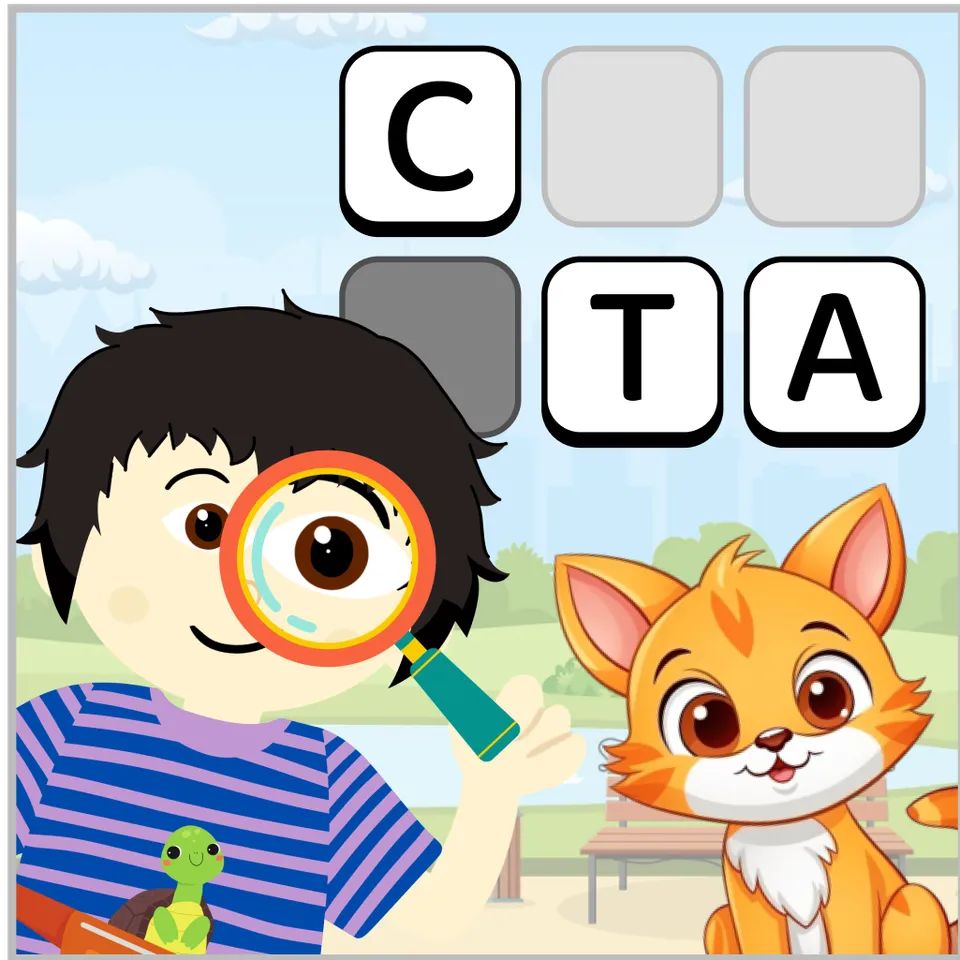
Help Sherlock Shirley solve word puzzles by unscrambling mixed up letters.
Help Sherlock Shirley solve word puzzles by unscrambling mixed up letters using picture clues.
Part of
Standards alignment
Common Core State Standards
- L.K.2.d — Spell simple words phonetically, drawing on knowledge of sound-letter relationships.
- RF.1.3.b — Decode regularly spelled one-syllable words.
- RF.K.1.b — Recognize that spoken words are represented in written language by specific sequences of letters.
Alabama
- ELA21.1.7 — Apply knowledge of phoneme-grapheme correspondences and word analysis skills to decode and encode words accurately both in isolation and within decodable, grade-appropriate texts.
- ELA21.K.10 — Apply knowledge of phoneme-grapheme correspondences and word-analysis skills to decode and encode (spell) words accurately in both isolation and in decodable, grade-appropriate text.
Alaska
- RF.K.1.b — Recognize that spoken words are represented in written language by specific sequences of letters.
- L.K.2.d — Spell simple words phonetically, drawing on knowledge of sound-letter relationships.
- RF.1.3.b — Decode regularly spelled one-syllable words.
Arizona
- 1.RF.3.b — Decode regularly spelled one-syllable words.
- 1.WF.3.e — Spell unfamiliar words phonetically, applying phonemic awareness and spelling conventions.
- K.RF.1.b — Recognize that spoken words are represented in written language by specific sequences of letters.
Arkansas
- 1.FR.20.PE — Encode words phonetically, drawing on knowledge of sound-letter relationships.
- K.FR.16.PE — Encode words phonetically, drawing on knowledge of sound-letter relationships.
- K.FR.2.CP — Recognize that spoken words are represented in written language by specific sequences of letters and that print carries meaning (e.g., the spoken word “dog” is represented in print by d-o-g).
California
- L.K.2.d — Spell simple words phonetically, drawing on knowledge of sound-letter relationships.
- RF.1.3.b — Decode regularly spelled one-syllable words.
- RF.K.1.b — Recognize that spoken words are represented in written language by specific sequences of letters.
Colorado
- RWC20-GR.1-S.2-GLE.3-EO.c — Know and apply grade-level phonics and word analysis skills in decoding words.
- RWC20-GR.1-S.2-GLE.3-EO.c.ii — Decode regularly spelled one-syllable words.
- RWC20-GR.K-S.2-GLE.3-EO.a.ii — Recognize that spoken words are represented in written language by specific sequences of letters.
Connecticut
- L.K.2.d — Spell simple words phonetically, drawing on knowledge of sound-letter relationships.
- RF.1.3.b — Decode regularly spelled one-syllable words.
- RF.K.1.b — Recognize that spoken words are represented in written language by specific sequences of letters.
Delaware
- L.K.2.d — Spell simple words phonetically, drawing on knowledge of sound-letter relationships.
- RF.1.3.b — Decode regularly spelled one-syllable words.
- RF.K.1.b — Recognize that spoken words are represented in written language by specific sequences of letters.
Florida
- ELA.1.F.1.3 — Use knowledge of grade-appropriate phonics and word-analysis skills to decode words accurately. • Decode words using knowledge of spelling-sound correspondences for common consonant digraphs, trigraphs, and blends. • Decode simple words with r-controlled vowels. • Decode and encode regularly spelled one-syllable words. • Decode words with inflectional endings. • Decode two-syllable words with regular patterns by breaking the words into syllables. • Decode words that use final –e and vowel teams to make long-vowel sound.
- ELA.K.F.1.3 — Use knowledge of grade-appropriate phonics and word-analysis skills to decode words accurately. • Demonstrate knowledge of the most frequent sound for each consonant. • Demonstrate knowledge of the short and long sounds for the five major vowels. • Decode consonant-vowel-consonant (CVC) words. • Encode consonant-vowel-consonant (CVC) words.
- ELA.1.V.1.3 — Identify and use picture clues, context clues, word relationships, reference materials, and/or background knowledge to determine the meaning of unknown words.
Georgia
- ELAGSEKL2.d — Spell simple words phonetically, drawing on knowledge of sound-letter relationships.
- ELAGSEKRF1.b — Recognize that spoken words are represented in written language by specific sequences of letters.
- ELAGSE1RF3.b — Decode regularly spelled one-syllable words.
Hawaii
- 1.RF.3b — Decode regularly spelled one-syllable words.
- K.L.2d — Spell simple words phonetically, drawing on knowledge of sound-letter relationships.
- K.RF.1b — Recognize that spoken words are represented in written language by specific sequences of letters.
Idaho
- 1.FR.PH.3 — Use knowledge of grade-level phonics and word analysis skills in decoding words.
- 1.FR.PH.3b — Decode regularly spelled one-syllable words.
- K.GC.M.3 — Spell words phonetically, drawing on knowledge of sound-letter relationships.
Illinois
- L.K.2.d — Spell simple words phonetically, drawing on knowledge of sound-letter relationships.
- RF.1.3.b — Decode regularly spelled one-syllable words.
- RF.K.1.b — Recognize that spoken words are represented in written language by specific sequences of letters.
Indiana
- K.RF.2 — Recognize that written words are made up of sequences of letters.
- 1.RC.9 — Demonstrate comprehension that context clues (e.g., words and sentence clues) and text features (e.g., glossaries, illustrations) may be used to help understand unknown words.
- 1.RF.2 — Blend sounds, including consonant blends, to produce single- and multi-syllable words. (E)
Iowa
- RF.1.3 — Know and apply grade-level phonics, which includes word analysis skills to support decoding and encoding words.
- RF.1.3.b — Decode and encode regularly spelled one-syllable words with closed syllables and consonant blends.
- RF.K.1.b — Recognize that spoken words are represented in written language by specific sequences of letters.
Kansas
- RF.K.1.b — Recognize that spoken words are represented in written language by specific sequences of letters.
- RF.1.3.b — Decode regularly spelled one-syllable words.
- W.1.11.e — Spell untaught words phonetically, drawing on phonemic awareness and spelling conventions.
Kentucky
- RF.K.1.b — Recognize that spoken words are represented in written language by specific sequences of letters.
- L.K.2.d — Spell simple words phonetically, drawing on knowledge of sound-letter relationships.
- RF.1.3.b — Decode regularly spelled one-syllable words.
Louisiana
- L.K.2.d — Spell simple words phonetically, drawing on knowledge of sound-letter relationships.
- RF.1.3.b — Decode regularly spelled one-syllable words.
- RF.K.1.b — Recognize that spoken words are represented in written language by specific sequences of letters.
Maine
- L.2.K.d — Spell simple words phonetically, drawing on knowledge of sound-letter relationships.
- R.1.K.b — Recognize that spoken words are represented in written language by specific sequences of letters.
- L.2.1.e — Spell untaught words phonetically, drawing on phonemic awareness and spelling conventions.
- R.3.1.b — Decode regularly spelled one-syllable words.
Maryland
- L.K.2.d — Spell simple words phonetically, drawing on knowledge of sound-letter relationships.
- RF.1.3.b — Decode regularly spelled one-syllable words.
- RF.K.1.b — Recognize that spoken words are represented in written language by specific sequences of letters.
- L.1.2.e — Spell untaught words phonetically, drawing on phonemic awareness and spelling conventions.
Massachusetts
- L.K.2.e — Spell simple words phonetically, drawing on knowledge of sound-letter relationships.
- RF.1.3.b — Decode regularly spelled one-syllable words.
- RF.K.1.b — Recognize that spoken words are represented in written language by specific sequences of letters.
Michigan
- L.K.2.d — Spell simple words phonetically, drawing on knowledge of sound-letter relationships.
- RF.1.3.b — Decode regularly spelled one-syllable words.
Minnesota
- 0.1.1.2.a — Know and apply grade-level phonics and word analysis skills in decoding words: decode words using one-to-one letter sound correspondences in three-phoneme CVC words and knowledge of word families, demonstrating both accuracy and automaticity.
- 0.2.1.1 — Recognize that words are represented in written language by specific sequences of letters, which are separated by spaces, and put in a specific order to create a sentence.
- 1.2.1.2 — Accurately spell words in common word families and high-frequency words; use phonetic spelling for other words.
Mississippi
- L.1.2.e — Spell untaught words phonetically, drawing on phonemic awareness and spelling conventions.
- L.K.2.d — Spell simple words phonetically, drawing on knowledge of sound-letter relationships.
- RF.1.3.b — Decode regularly spelled one-syllable words.
Missouri
- 1.L.1.B.f — spell words phonetically using phonemic awareness and spelling knowledge
- 1.RF.3.A.e — combining sounds from letters and common spelling patterns to create and decode recognizable words
- 1.L.1.B.e — spell words using regular spelling patterns
- K.RF.1.A.d — demonstrating that written words are made up of different letters
Montana
- L.K.2.d — Spell simple words phonetically, drawing on knowledge of sound-letter relationships.
- RF.1.3.b — Decode regularly spelled one-syllable words.
- RF.K.1.b — Recognize that spoken words are represented in written language by specific sequences of letters.
Nebraska
- LA.1.F.3 — Know and apply phonics and word analysis skills in decoding and encoding (spelling) words.
- LA.1.F.3.c — Decode and encode regularly spelled one-syllable words.
- LA.K.F.1.b — Recognize that spoken words are represented in written language by specific sequences of letters, and that print carries meaning.
Nevada
- L.K.2.d — Spell simple words phonetically, drawing on knowledge of sound-letter relationships.
- RF.1.3.b — Decode regularly spelled one-syllable words.
- RF.K.1.b — Recognize that spoken words are represented in written language by specific sequences of letters.
New Hampshire
- L.K.2.d — Spell simple words phonetically, drawing on knowledge of sound-letter relationships.
- RF.K.1.b — Recognize that spoken words are represented in written language by specific sequences of letters.
- RF.1.3.b — Decode regularly spelled one-syllable words.
New Jersey
- L.K.2.d — Spell simple words phonetically, drawing on knowledge of sound-letter relationships.
- RF.K.1.b — Recognize that spoken words are represented in written language by specific sequences of letters.
- RF.1.3.b — Decode regularly spelled one-syllable words.
New Mexico
- L.K.2.d — Spell simple words phonetically, drawing on knowledge of sound-letter relationships.
- RF.1.3.b — Decode regularly spelled one-syllable words.
- RF.K.1.b — Recognize that spoken words are represented in written language by specific sequences of letters.
New York
- 1RF3c — Decode regularly spelled one-syllable words.
- KRF1b — Recognize that spoken words are represented in written language by specific sequences of letters.
- KRF3c — Decode some regularly spelled one-syllable words.
North Carolina
- RF.1.4 — Know and apply grade-level phonics and word analysis skills in decoding words.
- RF.1.4.b — Decode regularly spelled one-syllable words.
- RF.K.1.b — Recognize that spoken words are represented in written language by specific sequences of letters.
North Dakota
- 1.F.9 — Encode words with phoneme-grapheme correspondences:
- K.F.8 — Decode words with phoneme-grapheme correspondences:
- K.F.9 — Encode words with phoneme-grapheme correspondences:
Ohio
- L.K.2.d — Spell simple words phonetically, drawing on knowledge of sound-letter relationships.
- RF.1.3.b — Decode regularly spelled one-syllable words.
- RF.K.1.b — Recognize that spoken words are represented in written language by specific sequences of letters.
Oklahoma
- 2.2.W.4 — Students will correctly spell grade-level words while editing using resources as needed.
- K.2.PWS.4 — Students will blend letter sounds to decode simple Vowel/Consonant (VC) and Consonant/Vowel/Consonant (CVC) words (e.g., VC words = at, in, up; CVC words = pat, hen, lot).
Oregon
- 1.RF.3b — Decode regularly spelled one-syllable words.
- K.L.2d — Spell simple words phonetically.
- K.RF.1b — Recognize that spoken words are represented in written language by specific sequences of letters.
- K.RF.3e — Decode cvc words.
Pennsylvania
- CC.1.1.K.B — Demonstrate understanding of the organization and basic features of print. • Follow words left to right, top to bottom, and page by page. • Recognize that spoken words are represented in written language by specific sequences of letters. • Understand that words are separated by spaces in print. • Recognize and name all uppercase and lowercase letters of the alphabet.
- CC.1.1.K.D — Know and apply grade-level phonics and word analysis skills in decoding words. • Demonstrate basic knowledge of one-to-one letter-sound correspondence. • Associate the long and short sounds with common spellings for the five major vowels. • Read grade-level high-frequency sight words with automaticity. • Distinguish between similarly spelled words by identifying the sounds of the letters that differ.
- CC.1.1.1.D — Know and apply grade-level phonics and word analysis skills in decoding words. • Identify common consonant diagraphs, final-e, and common vowel teams. • Decode one- and two-syllable words with common patterns. • Read grade-level words with inflectional endings. • Read grade- appropriate irregularly spelled words.
Rhode Island
- L.K.2.e — Spell simple words phonetically, drawing on knowledge of sound-letter relationships.
- RF.K.1.b — Recognize that spoken words are represented in written language by specific sequences of letters.
- RF.1.3.b — Decode regularly spelled one-syllable words.
South Carolina
- ELA.K.F.3.5 — Blend letter sounds to decode vowel-consonant (VC) and consonant-vowel-consonant (CVC) words in isolation and in text.
- ELA.K.F.3.8 — Decode and encode words using: a. VC; b. CV; c. CVC; d. consonant digraphs (i.e., ch, sh, th, wh); and e. combination (i.e., qu).
South Dakota
- K.L.2.d — Spell simple words phonetically, drawing on knowledge of sound-letter relationships.
- K.RF.1.b — Recognize that spoken words are represented in written language by specific sequences of letters.
- 1.L.2.e — Spell grade-appropriate high-frequency words.
- 1.RF.3.b — Decode regularly spelled one-syllable words.
Tennessee
- 1.FL.PWR.3.b — Decode regularly spelled one-syllable words.
- K.FL.PC.1.b — Recognize that spoken words are represented in written language by specific sequences of letters.
- K.FL.PWR.3.d — Decode regularly spelled CVC words.
Texas
- 1.2C.iii — spelling words using sound-spelling patterns; and
- K.2B.iii — recognizing that new words are created when letters are changed, added, or deleted such as it - pit - tip - tap; and
- K.2C.i — spelling words with VC, CVC, and CCVC;
- K.3B — use illustrations and texts the student is able to read or hear to learn or clarify word meanings; and
Vermont
- RF.1.3.b — Decode regularly spelled one-syllable words.
- RF.K.1.b — Recognize that spoken words are represented in written language by specific sequences of letters.
- L.1.2.e — Spell untaught words phonetically, drawing on phonemic awareness and spelling conventions.
Virginia
- 1.FFW.2.A — Use phoneme-grapheme (sound/symbol) correspondence to encode (spell) single-syllable words containing closed syllables (cvc, ccvc, cvcc, and ccvcc), open syllables (cv, ccv), vowel-consonant-e (cvce, ccvce).
- 1.FFW.2.C — Encode (spell) unfamiliar words by recognizing and applying taught word patterns.
- K.FFW.2.A — Encode (spell) one syllable words with short vowels and one syllable words beginning or ending in a digraph (e.g., ch, sh, th, wh).
Washington
- L.1.2.e — Spell untaught words phonetically, drawing on phonemic awareness and spelling conventions.
- RF.1.3.b — Decode regularly spelled one-syllable words.
- RF.K.1.b — Recognize that spoken words are represented in written language by specific sequences of letters.
Washington, D.C.
- L.K.2.d — Spell simple words phonetically, drawing on knowledge of sound-letter relationships.
- RF.K.1.b — Recognize that spoken words are represented in written language by specific sequences of letters.
- RF.1.3.b — Decode regularly spelled one-syllable words.
West Virginia
- ELA.1.II — Know and apply grade-level phonics and word analysis skills in decoding words.
- ELA.1.II.b — Decode regularly spelled one-syllable words.
- ELA.K.37.d — Spell simple words phonetically, drawing on knowledge of sound-letter relationships
Wisconsin
- ELA.1.RF.3.b — Decode and encode regularly spelled one-syllable words (e.g., cat, fox, bet, cup, fit, etc.).
- ELA.K.L.6.c — Phonetically spell simple words drawing on knowledge of letter-sound relationships. Related to Reading Foundational standards (RF.K.3).
- ELA.K.RF.1.b — Recognize spoken words are represented in written language by specific sequences of letters.
- ELA.2.RF.3.c — Decode and encode regularly spelled one, two, and some three syllable CVC pattern words (e.g., 1 syllable: mat, 2 syllable: picnic, 3 syllable: fantastic, etc.).
Wyoming
- L.1.2.e — Spell untaught words phonetically, drawing on phonemic awareness and spelling conventions.
- RF.1.3.b — Decode regularly spelled one-syllable words.
- RF.1.3 — Know and apply grade-level phonics and word analysis skills in decoding words.
- RF.K.1.b — Recognize that spoken words are represented in written language by specific sequences of letters.