Mermaid Subtraction: Level 3
Ages 4–6 · 1 minute · Math
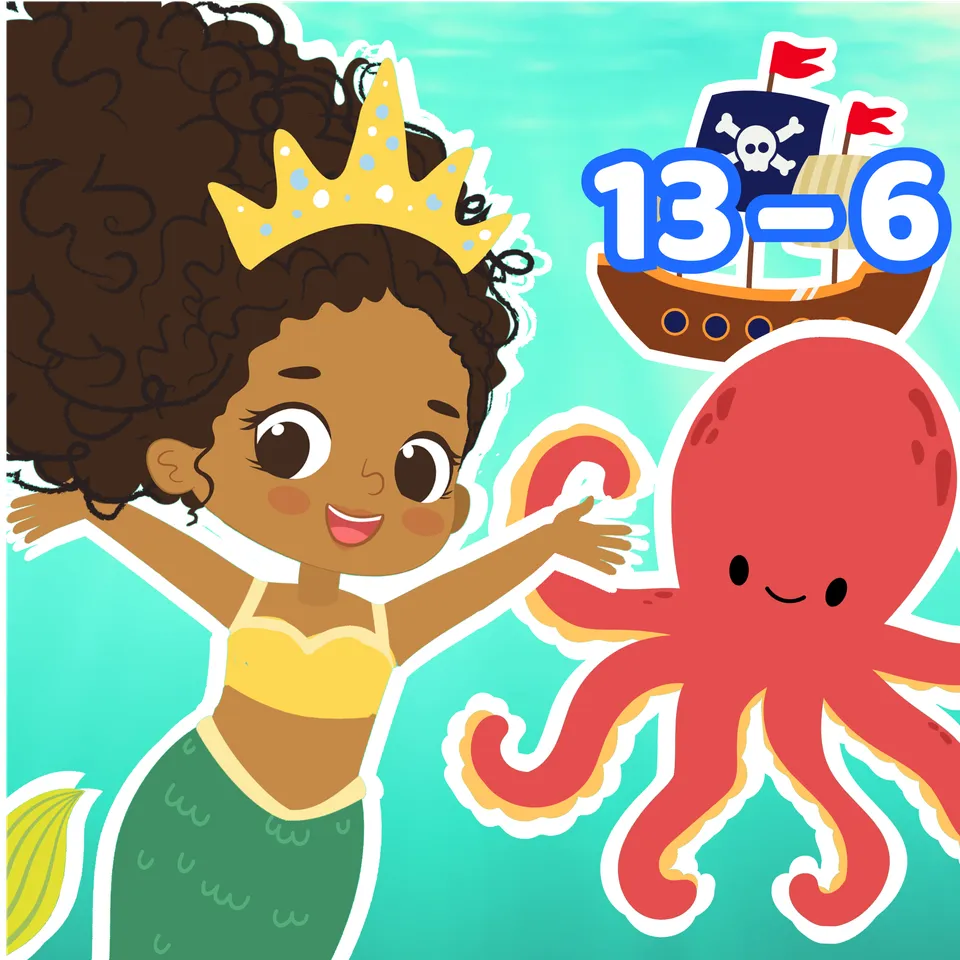
Help the Little Mermaid solve subtraction problems up to 20 and find the Pirate Treasure!
Help the Little Mermaid find the Pirate Treasure by solving subtraction problems with numbers up to 20! Try to complete all the rounds without making too many mistakes. Then keep playing to beat the high score by solving problems faster!
Material corresponds to the “Advanced Subtraction 1” flashpack from the “Learn to Subtract” course.
Part of
Standards alignment
Common Core State Standards
- 1.OA.C.6 — Add and subtract within 20, demonstrating fluency for addition and subtraction within 10. Use strategies such as counting on; making ten (e.g., 8 + 6 = 8 + 2 + 4 = 10 + 4 = 14); decomposing a number leading to a ten (e.g., 13 - 4 = 13 - 3 - 1 = 10 - 1 = 9); using the relationship between addition and subtraction (e.g., knowing that 8 + 4 = 12, one knows 12 - 8 = 4); and creating equivalent but easier or known sums (e.g., adding 6 + 7 by creating the known equivalent 6 + 6 + 1 = 12 + 1 = 13).
- 1.OA.C.5 — Relate counting to addition and subtraction (e.g., by counting on 2 to add 2).
Alabama
- MA19.1.6 — Add and subtract within 20.
- MA19.2.2 — Fluently add and subtract within 20 using mental strategies such as counting on, making ten, decomposing a number leading to ten, using the relationship between addition and subtraction, and creating equivalent but easier or known sums.
Alaska
- 1.OA.6 — Add and subtract using numbers up to 20, demonstrating fluency for addition and subtraction up to 10. Use strategies such as • counting on • making ten (8 + 6 = 8 + 2 + 4 = 10 + 4 = 14) • decomposing a number leading to a ten (13 - 4 = 13 - 3 - 1 = 10 - 1 = 9) • using the relationship between addition and subtraction, such as fact families, (8 + 4 = 12 and 12 - 8 = 4) • creating equivalent but easier or known sums (e.g., adding 6 + 7 by creating the known equivalent 6 + 6 + 1 = 12 + 1 = 13).
Arizona
- 1.OA.C.6 — Fluently add and subtract within 10.
- 2.OA.B.2 — Fluently add and subtract within 20. By end of Grade 2, know from memory all sums of two one-digit numbers.
Arkansas
- 1.CAR.2 — Use computational fluency to add and subtract within 20 using manipulatives and/or a variety of strategies.
- 2.CAR.1 — Use mental strategies to fluently add and subtract within 20 with mastery by the end of second grade.
California
- 1.OA.C.6 — Add and subtract within 20, demonstrating fluency for addition and subtraction within 10. Use strategies such as counting on; making ten (e.g., 8 + 6 = 8 + 2 + 4 = 10 + 4 = 14); decomposing a number leading to a ten (e.g., 13 - 4 = 13 - 3 - 1 = 10 - 1 = 9); using the relationship between addition and subtraction (e.g., knowing that 8 + 4 = 12, one knows 12 - 8 = 4); and creating equivalent but easier or known sums (e.g., adding 6 + 7 by creating the known equivalent 6 + 6 + 1 = 12 + 1 = 13).
Colorado
- 1.OA.C.6 — Add and subtract within 20, demonstrating fluency for addition and subtraction within 10. Use strategies such as counting on; making ten (e.g., 8 + 6 = 8 + 2 + 4 = 10 + 4 = 14); decomposing a number leading to a ten (e.g., 13 − 4 = 13 − 3 − 1 = 10 − 1 = 9); using the relationship between addition and subtraction (e.g., knowing that 8 + 4 = 12, one knows 12 − 8 = 4); and creating equivalent but easier or known sums (e.g., adding 6 + 7 by creating the known equivalent 6 + 6 + 1 = 12 + 1 = 13).
Connecticut
- 1.OA.C.6 — Add and subtract within 20, demonstrating fluency for addition and subtraction within 10. Use strategies such as counting on; making ten (e.g., 8 + 6 = 8 + 2 + 4 = 10 + 4 = 14); decomposing a number leading to a ten (e.g., 13 - 4 = 13 - 3 - 1 = 10 - 1 = 9); using the relationship between addition and subtraction (e.g., knowing that 8 + 4 = 12, one knows 12 - 8 = 4); and creating equivalent but easier or known sums (e.g., adding 6 + 7 by creating the known equivalent 6 + 6 + 1 = 12 + 1 = 13).
- 2.OA.B.2 — Fluently add and subtract within 20 using mental strategies. By end of Grade 2, know from memory all sums of two one-digit numbers.
Delaware
- 1.OA.C.6 — Add and subtract within 20, demonstrating fluency for addition and subtraction within 10. Use strategies such as counting on; making ten (e.g., 8 + 6 = 8 + 2 + 4 = 10 + 4 = 14); decomposing a number leading to a ten (e.g., 13 - 4 = 13 - 3 - 1 = 10 - 1 = 9); using the relationship between addition and subtraction (e.g., knowing that 8 + 4 = 12, one knows 12 - 8 = 4); and creating equivalent but easier or known sums (e.g., adding 6 + 7 by creating the known equivalent 6 + 6 + 1 = 12 + 1 = 13).
Florida
- MA.1.NSO.2.2 — Add two whole numbers with sums from 0 to 20, and subtract using related facts with procedural reliability.
- MA.K12.MTR.3.1 — Complete tasks with mathematical fluency. Mathematicians who complete tasks with mathematical fluency: • Select efficient and appropriate methods for solving problems within the given context. • Maintain flexibility and accuracy while performing procedures and mental calculations. • Complete tasks accurately and with confidence. • Adapt procedures to apply them to a new context. • Use feedback to improve efficiency when performing calculations.
Georgia
- 1.NR.2.1 — Use a variety of strategies to solve addition and subtraction problems within 20.
- 2.NR.2.1 — Fluently add and subtract within 20 using a variety of mental, part-whole strategies.
Hawaii
- 1.OA.C.6 — Add and subtract within 20, demonstrating fluency for addition and subtraction within 10. Use strategies such as counting on; making ten (e.g., 8 + 6 = 8 + 2 + 4 = 10 + 4 = 14); decomposing a number leading to a ten (e.g., 13 - 4 = 13 - 3 - 1 = 10 - 1 = 9); using the relationship between addition and subtraction (e.g., knowing that 8 + 4 = 12, one knows 12 - 8 = 4); and creating equivalent but easier or known sums (e.g., adding 6 + 7 by creating the known equivalent 6 + 6 + 1 = 12 + 1 = 13).
Idaho
- 1.OA.C.6 — Demonstrate fluency for addition and subtraction within ten, use strategies to add and subtract within 20.
- 2.OA.B.2 — Demonstrate fluency for addition and subtraction within 20 using mental strategies. By the end of grade two, recall basic facts to add and subtract within 20 with automaticity.
Illinois
- 1.OA.C.6 — Add and subtract within 20, demonstrating fluency for addition and subtraction within 10. Use strategies such as counting on; making ten (e.g., 8 + 6 = 8 + 2 + 4 = 10 + 4 = 14); decomposing a number leading to a ten (e.g., 13 - 4 = 13 - 3 - 1 = 10 - 1 = 9); using the relationship between addition and subtraction (e.g., knowing that 8 + 4 = 12, one knows 12 - 8 = 4); and creating equivalent but easier or known sums (e.g., adding 6 + 7 by creating the known equivalent 6 + 6 + 1 = 12 + 1 = 13).
- MP.1 — Make sense of problems and persevere in solving them.
Indiana
- 1.CA.1 — Demonstrate fluency with addition facts and the corresponding subtraction facts within 20. Use strategies such as counting on; making ten (e.g., 8 + 6 = 8 + 2 + 4 = 10 + 4 = 14); decomposing a number leading to a 10 (e.g., 13 – 4 = 13 – 3 – 1 = 10 – 1 = 9); using the relationship between addition and subtraction (e.g., knowing that 8 + 4 = 12, one knows 12 – 8 = 4); and creating equivalent but easier or known sums (e.g., adding 6 + 7 by creating the known equivalent 6 + 6 + 1 = 12 + 1 = 13). Model the role of 0 and the equal sign in addition and subtraction using objects or drawings. (E)
Iowa
- 1.OA.C.6 — Add and subtract within 20, using strategies such as: • Counting on. • Making ten (for example, 8 + 6 = 8 + 2 + 4 = 10 + 4 = 14). • Decomposing a number leading to a ten (for example, $13 − 4 = 13 − 3 − 1 = 10 − 1 = 9)$. • Using the relationship between addition and subtraction (for example, knowing that 8 + 4 = 12, one knows 12 − 8 = 4). • Creating equivalent but easier or known sums (for example, adding 6 + 7 by creating the known equivalent $6 + 6 + 1 = 12 + 1 = 13)$. • Counting up to subtract.
- 2.OA.B.2 — Fluently add and subtract within 20 using efficient mental strategies listed below. • Counting on. • Counting back. • Making ten. • Decomposing a number leading to a ten. • Using the relationship between addition and subtraction. • Creating equivalent, but easier or known sums. • Adding up to subtract. By the end of Grade 2, flexibly, efficiently and accurately find all sums of two one-digit numbers. Note: Fluency of this standard is critical by the end of grade.
Kansas
- 1.OA.6 — Add and subtract within 20, demonstrating fluency (efficiently, accurately, and flexibly) for addition and subtraction within 10. Use mental strategies such as counting on; making ten (e.g. 8 + 6 = 8 + 2 + 4 = 10 + 4 = 14); decomposing a number leading to a ten (e.g. 13 − 4 = 13 − 3 − 1 = 10 − 1 = 9); using the relationship between addition and subtraction (e.g. knowing that 8 + 4 = 12, one knows 12 − 8 = 4); and creating equivalent but easier or known sums (e.g. adding 6 + 7 by creating the known equivalent 6 + 6 + 1 = 12 + 1 = 13).
- 1.OA.5 — Relate counting to addition and subtraction (e.g. by counting on 2 to add 2, counting back 1 to subtract 1).
Kentucky
- KY.1.OA.6 — Add and subtract within 20.
- KY.1.OA.6.b — Add and subtract within 20, demonstrating fluency for addition and subtraction within 10. Use strategies such as counting on; making 10; decomposing a number leading to a 10; using the relationship between addition and subtraction; creating equivalent but easier or known sums.
Louisiana
- 1.OA.C.6 — Add and subtract within 20, demonstrating fluency for addition and subtraction within 10. Use mental strategies such as counting on; making ten (e.g., 8 + 6 = 8 + 2 + 4 = 10 + 4 = 14); decomposing a number leading to a ten (e.g., 13 - 4 = 13 - 3 - 1 = 10 - 1 = 9); using the relationship between addition and subtraction (e.g., knowing that 8 + 4 = 12, one knows 12 - 8 = 4); and creating equivalent but easier or known sums (e.g., adding 6 + 7 by creating the known equivalent 6 + 6 + 1 = 12 + 1 = 13).
- 1.OA.C.5 — Relate counting to addition and subtraction (e.g., by counting on 2 to add 2).
Maine
- 1.OA.C.6 — Add and subtract within 20, demonstrating fluency for addition and subtraction within 10. Use strategies such as counting on; making ten (e.g., 8 + 6 = 8 + 2 + 4 = 10 + 4 = 14); decomposing a number leading to a ten (e.g., 13 - 4 = 13 - 3 - 1 = 10 - 1 = 9); using the relationship between addition and subtraction (e.g., knowing that 8 + 4 = 12, one knows 12 - 8 = 4); and creating equivalent but easier or known sums (e.g., adding 6 + 7 by creating the known equivalent 6 + 6 + 1 = 12 + 1 = 13).
- 2.OA.B.2 — Fluently add and subtract within 20 using mental strategies. By end of Grade 2, know from memory all sums of two one-digit numbers.
Maryland
- 1.OA.C.6 — Add and subtract within 20, demonstrating fluency for addition and subtraction within 10. Use strategies such as counting on; making ten (e.g., 8 + 6 = 8 + 2 + 4 = 10 + 4 = 14); decomposing a number leading to a ten (e.g., 13 - 4 = 13 - 3 - 1 = 10 - 1 = 9); using the relationship between addition and subtraction (e.g., knowing that 8 + 4 = 12, one knows 12 - 8 = 4); and creating equivalent but easier or known sums (e.g., adding 6 + 7 by creating the known equivalent 6 + 6 + 1 = 12 + 1 = 13).
Massachusetts
- 1.OA.C.6 — Add and subtract within 20, demonstrating fluency for addition and subtraction within 10. Use mental strategies such as counting on; making 10 (e.g., 8 + 6 = 8 + 2 + 4 = 10 + 4 = 14); decomposing a number leading to a 10 (e.g., 13 – 4 = 13 – 3 – 1 = 10 – 1 = 9); using the relationship between addition and subtraction (e.g., knowing that 8 + 4 = 12, one knows 12 – 8 = 4); and creating equivalent but easier or known sums (e.g., adding 6 + 7 by creating the known equivalent 6 + 6 + 1 = 12 + 1 = 13).
- 2.OA.B.2 — Fluently add and subtract within 20 using mental strategies. By end of grade 2, know from memory all sums of two single-digit numbers and related differences. For example, the sum 6 + 5 = 11 has related differences of 11 – 5 = 6 and 11 – 6 = 5.
Michigan
- 1.OA.C.6 — Add and subtract within 20, demonstrating fluency for addition and subtraction within 10. Use strategies such as counting on; making ten (e.g., 8 + 6 = 8 + 2 + 4 = 10 + 4 = 14); decomposing a number leading to a ten (e.g., 13 - 4 = 13 - 3 - 1 = 10 - 1 = 9); using the relationship between addition and subtraction (e.g., knowing that 8 + 4 = 12, one knows 12 - 8 = 4); and creating equivalent but easier or known sums (e.g., adding 6 + 7 by creating the known equivalent 6 + 6 + 1 = 12 + 1 = 13).
- 2.OA.B.2 — Fluently add and subtract within 20 using mental strategies. By end of Grade 2, know from memory all sums of two one-digit numbers.
Minnesota
- 1.1.2.1 — Use words, pictures, objects, length-based models (connecting cubes), numerals and number lines to model and solve addition and subtraction problems in part-part-total, adding to, taking away from and comparing situations.
- 2.1.2.2 — Demonstrate fluency with basic addition facts and related subtraction facts.
Mississippi
- 1.OA.6 — Add and subtract within 20, demonstrating fluency for addition and subtraction within 10. Use strategies such as counting on; making ten (e.g., 8 + 6 = 8 + 2 + 4 = 10 + 4 = 14); decomposing a number leading to a ten (e.g., 13 – 4 = 13 – 3 – 1 = 10 – 1 = 9); using the relationship between addition and subtraction (e.g., knowing that 8 + 4 = 12, one knows 12 – 8 = 4); and creating equivalent but easier or known sums (e.g., adding 6 + 7 by creating the known equivalent 6 + 6 + 1 = 12 + 1 = 13).
Missouri
- 1.RA.C.7 — Add and subtract within 20.
- 2.RA.A.1 — Demonstrate fluency with addition and subtraction within 20.
Montana
- 1.OA.C.6 — Add and subtract within 20, demonstrating fluency for addition and subtraction within 10. Use strategies such as counting on; making ten (e.g., 8 + 6 = 8 + 2 + 4 = 10 + 4 = 14); decomposing a number leading to a ten (e.g., 13 - 4 = 13 - 3 - 1 = 10 - 1 = 9); using the relationship between addition and subtraction (e.g., knowing that 8 + 4 = 12, one knows 12 - 8 = 4); and creating equivalent but easier or known sums (e.g., adding 6 + 7 by creating the known equivalent 6 + 6 + 1 = 12 + 1 = 13).
Nebraska
- 1.N.4.a — Add and subtract within 20, using flexible strategies such as counting on or counting back, making ten, using ten, and using doubles and near doubles.
- 1.N.4 — Number and Operations: Students will compute using addition and subtraction.
- 2.N.4.a — Fluently add and subtract within 20.
Nevada
- 1.OA.C.6 — Add and subtract within 20, demonstrating fluency for addition and subtraction within 10. Use strategies such as counting on; making ten (e.g., 8 + 6 = 8 + 2 + 4 = 10 + 4 = 14); decomposing a number leading to a ten (e.g., 13 - 4 = 13 - 3 - 1 = 10 - 1 = 9); using the relationship between addition and subtraction (e.g., knowing that 8 + 4 = 12, one knows 12 - 8 = 4); and creating equivalent but easier or known sums (e.g., adding 6 + 7 by creating the known equivalent 6 + 6 + 1 = 12 + 1 = 13).
- 2.OA.B.2 — Fluently add and subtract within 20 using mental strategies. By end of Grade 2, know from memory all sums of two one-digit numbers.
New Hampshire
- 1.OA.C.6 — Add and subtract within 20, demonstrating fluency for addition and subtraction within 10. Use strategies such as counting on; making ten (e.g., 8 + 6 = 8 + 2 + 4 = 10 + 4 = 14); decomposing a number leading to a ten (e.g., 13 - 4 = 13 - 3 - 1 = 10 - 1 = 9); using the relationship between addition and subtraction (e.g., knowing that 8 + 4 = 12, one knows 12 - 8 = 4); and creating equivalent but easier or known sums (e.g., adding 6 + 7 by creating the known equivalent 6 + 6 + 1 = 12 + 1 = 13).
New Jersey
- 1.OA.C.6 — Add and subtract within 20, demonstrating fluency for addition and subtraction within 10. Use strategies such as counting on; making ten (e.g., 8 + 6 = 8 + 2 + 4 = 10 + 4 = 14); decomposing a number leading to a ten (e.g., 13 – 4 = 13 – 3 – 1 = 10 – 1 = 9); using the relationship between addition and subtraction (e.g., knowing that 8 + 4 = 12, one knows $12 – 8 = 4); and creating equivalent but easier or known sums (e.g., adding 6 + 7 by creating the known equivalent 6 + 6 + 1 = 12 + 1 = 13$).
New Mexico
- 1.OA.C.6 — Add and subtract within 20, demonstrating fluency for addition and subtraction within 10. Use strategies such as counting on; making ten (e.g., 8 + 6 = 8 + 2 + 4 = 10 + 4 = 14); decomposing a number leading to a ten (e.g., 13 - 4 = 13 - 3 - 1 = 10 - 1 = 9); using the relationship between addition and subtraction (e.g., knowing that 8 + 4 = 12, one knows 12 - 8 = 4); and creating equivalent but easier or known sums (e.g., adding 6 + 7 by creating the known equivalent 6 + 6 + 1 = 12 + 1 = 13).
New York
- NY-1.OA.6.a — Add and subtract within 20. Use strategies such as: • counting on; • making ten; • decomposing a number leading to a ten; • using the relationship between addition and subtraction; and • creating equivalent but easier or known sums.
- NY-1.OA.6.b — Fluently add and subtract within 10.
North Carolina
- NC.1.OA.6 — Add and subtract, within 20, using strategies such as: • Counting on • Making ten • Decomposing a number leading to a ten • Using the relationship between addition and subtraction • Using a number line • Creating equivalent but simpler or known sums
- NC.2.OA.2 — Demonstrate fluency with addition and subtraction, within 20, using mental strategies.
North Dakota
- 2.AR.OA.1 — Automatically add and subtract within 20.
- 1.AR.OA.1 — Automatically add and subtract within 10.
Ohio
- 1.OA.6 — Add and subtract within 20, demonstrating fluency with various strategies for addition and subtraction within 10. Strategies may include counting on; making ten, e.g., 8 + 6 = 8 + 2 + 4 = 10 + 4 = 14; decomposing a number leading to a ten, e.g., 13 − 4 = 13 − 3 − 1 = 10 − 1 = 9; using the relationship between addition and subtraction, e.g., knowing that 8 + 4 = 12, one knows 12 − 8 = 4; and creating equivalent but easier or known sums, e.g., adding 6 + 7 by creating the known equivalent 6 + 6 + 1 = 12 + 1 = 13.
Oklahoma
- 2.N.2.2 — Demonstrate fluency with basic facts of addition and subtraction with sums and minuends of up to 20.
- MAP2 — Develop Accurate and Appropriate Procedural Fluency
Oregon
- 1.OA.C.6 — Add and subtract within 20, demonstrating fluency for addition and subtraction within 10 with accurate, efficient, and flexible strategies.
- 2.OA.B.2 — Fluently add and subtract within 20 using accurate, efficient, and flexible strategies and algorithms based on place value and properties of operations.
Pennsylvania
- CC.2.2.1.A.1 — Represent and solve problems involving addition and subtraction within 20.
- CC.2.2.2.A.2 — Use mental strategies to add and subtract within 20.
Rhode Island
- 1.OA.C.6 — Add and subtract within 20, demonstrating fluency for addition and subtraction within 10. Use mental strategies such as counting on; making 10 (e.g., 8 + 6 = 8 + 2 + 4 = 10 + 4 = 14); decomposing a number leading to a 10 (e.g., 13 – 4 = 13 – 3 – 1 = 10 – 1 = 9); using the relationship between addition and subtraction (e.g., knowing that 8 + 4 = 12, one knows 12 – 8 = 4); and creating equivalent but easier or known sums (e.g., adding 6 + 7 by creating the known equivalent 6 + 6 + 1 = 12 + 1 = 13).
- 2.OA.B.2 — Fluently add and subtract within 20 using mental strategies. By end of grade 2, know from memory all sums of two single-digit numbers and related differences. For example, the sum 6 + 5 = 11 has related differences of 11 – 5 = 6 and 11 – 6 = 5.
South Carolina
- 1.ATO.6a — Demonstrate addition and subtraction through 20.
- 2.ATO.2 — Demonstrate fluency with addition and related subtraction facts through 20.
South Dakota
- 1.OA.C.6 — Add and subtract within 20, demonstrating fluency for addition and subtraction within 10. Use strategies such as counting on; making ten (e.g., 8 + 6 = 8 + 2 + 4 = 10 + 4 = 14); decomposing a number leading to a ten (e.g., 13 – 4 = 13 – 3 – 1 = 10 – 1 = 9); using the relationship between addition and subtraction (e.g., knowing that 8 + 4 = 12, one knows 12 – 8 = 4); and creating equivalent but easier or known sums (e.g., adding 6 + 7 by creating the known equivalent 6 + 6 + 1 = 12 + 1 = 13).
- 1.OA.C.5 — Understand counting on as addition and counting back as subtraction e.g. 5, (6,7,8) means 5 + 3 and 5, (4,3,2) means 5-3.
Tennessee
- 1.OA.C.6 — Use mental strategies flexibly and efficiently to develop fluency in addition and subtraction within 20. By the end of grade 1, know all sums and differences up to 10.
- 1.OA.C.5 — Add and subtract within 20 using strategies such as counting on, counting back, making 10, related known facts, and composing/decomposing numbers with an emphasis on making ten (e.g., 13 – 4 = 13 – 3 – 1 = 10 – 1 = 9 or adding 6 + 7 by creating the known equivalent 6 + 4 + 3 = 10 + 3 = 13 OR 6 + 6 + 1 = 12 + 1).
Texas
- 1.3D — apply basic fact strategies to add and subtract within 20, including making 10 and decomposing a number leading to a 10;
- 1.3F — generate and solve problem situations when given a number sentence involving addition or subtraction of numbers within 20.
- 2.4A — recall basic facts to add and subtract within 20 with automaticity;
Utah
- 1.OA.6 — Add and subtract within 20.
- 1.OA.6.a — Use strategies such as counting on; making ten (for example, 8 + 6 = 8 + 2 + 4 = 10 + 4 = 14); decomposing a number leading to a ten (for example, 13 - 4 = 13 – 3 – 1 = 10 – 1 = 9); using the relationship between addition and subtraction (for example, knowing that 8 + 4 = 12, one knows 12 – 8 = 4); and creating equivalent but easier or known sums (for example, adding 6 + 7 by creating the known equivalent 6 + 6 + 1 = 12 + 1 = 13).
Vermont
- 1.OA.C.6 — Add and subtract within 20, demonstrating fluency for addition and subtraction within 10. Use strategies such as counting on; making ten (e.g., 8 + 6 = 8 + 2 + 4 = 10 + 4 = 14); decomposing a number leading to a ten (e.g., 13 - 4 = 13 - 3 - 1 = 10 - 1 = 9); using the relationship between addition and subtraction (e.g., knowing that 8 + 4 = 12, one knows 12 - 8 = 4); and creating equivalent but easier or known sums (e.g., adding 6 + 7 by creating the known equivalent 6 + 6 + 1 = 12 + 1 = 13).
Virginia
- 1.CE.1 — The student will recall with automaticity addition and subtraction facts within 10 and represent, solve, and justify solutions to single-step problems, including those in context, using addition and subtraction with whole numbers within 20. Students will demonstrate the following Knowledge and Skills:
- 1.CE.1e — Solve addition and subtraction problems within 20 using various strategies (e.g., inverse relationships: if 9 + 3 = 12 then 12 - 3 = 9; decomposition using known sums/differences: 9 + 7 can be thought of as 9 decomposed into 2 and 7, then use doubles, 7 + 7 = 14; 14 + 2 = 16 or decompose the 7 into 1 and 6; make a ten: 1 + 9 = 10; 10 + 6 = 16).
- 2.CE.1e — Recall with automaticity addition and subtraction facts within 20.
Washington
- 1.OA.C.6 — Add and subtract within 20, demonstrating fluency for addition and subtraction within 10. Use strategies such as counting on; making ten (e.g., 8 + 6 = 8 + 2 + 4 = 10 + 4 = 14); decomposing a number leading to a ten (e.g., 13 - 4 = 13 - 3 - 1 = 10 - 1 = 9); using the relationship between addition and subtraction (e.g., knowing that 8 + 4 = 12, one knows 12 - 8 = 4); and creating equivalent but easier or known sums (e.g., adding 6 + 7 by creating the known equivalent 6 + 6 + 1 = 12 + 1 = 13).
Washington, D.C.
- 1.OA.C.6 — Add and subtract within 20, demonstrating fluency for addition and subtraction within 10. Use strategies such as counting on; making ten (e.g., 8 + 6 = 8 + 2 + 4 = 10 + 4 = 14); decomposing a number leading to a ten (e.g., 13 - 4 = 13 - 3 - 1 = 10 - 1 = 9); using the relationship between addition and subtraction (e.g., knowing that 8 + 4 = 12, one knows 12 - 8 = 4); and creating equivalent but easier or known sums (e.g., adding 6 + 7 by creating the known equivalent 6 + 6 + 1 = 12 + 1 = 13).
West Virginia
- M.1.6 — Add and subtract within 20, demonstrating fluency for addition and subtraction within 10 and use strategies such as· counting on; • making ten (e.g., 8 + 6 = 8 + 2 + 4 = 10 + 4 = 14); • decomposing a number leading to a ten (e.g., 13 - 4 = 13 - 3 -1 = 10 -1 = 9); • using the relationship between addition and subtraction (e.g., knowing that 8 + 4 = 12, one knows 12 - 8= 4); and • creating equivalent but easier or known sums (e.g., adding 6+7 by creating the known equivalent 6 + 6 + 1 = 12 + 1 = 13).
Wisconsin
- M.1.OA.C.6 — Use multiple strategies to add and subtract within 20. a. Flexibly and efficiently add and subtract within 10 using strategies that may include mental images and composing and decomposing up to 10. b. Add and subtract within 20 using objects, drawings, or equations. Use multiple strategies that may include counting on; making a ten (e.g., 8 + 6 = 8 + 2 + 4 = 10 + 4 = 14); decomposing a number leading to a ten (e.g., 13 - 4 = 13 - 3 - 1 = 10 - 1 = 9); using the relationship between addition and subtraction (e.g., knowing that 8 + 4 = 12, one knows 12 - 8 = 4); and creating equivalent but easier or known sums (e.g., adding 6 + 7 by creating the known equivalent 6 + 6 + 1 = 12 + 1 = 13).
Wyoming
- 1.OA.C.6 — Add and subtract within 20, demonstrating fluency in addition and subtraction within 10. Use strategies such as counting on; making ten using the relationship between addition and subtraction.
- 1.OA.C — Add and subtract within 20.