Mermaid Subtraction: Level 2
Ages 4–6 · 15 minutes · Math
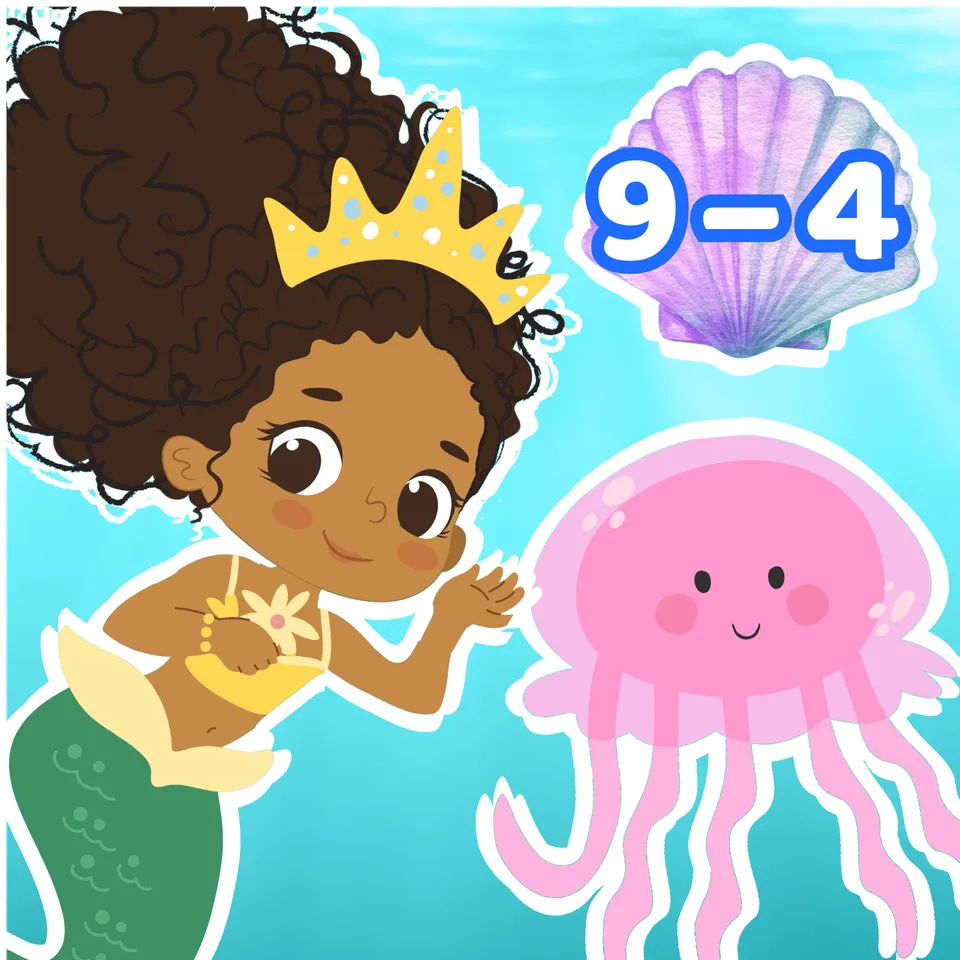
Help the Little Mermaid solve subtraction problems up to 10 and find the Mystic Seashells!
Help the Little Mermaid find the Mystic Seahsells by solving subtraction problems with numbers up to 10! Try to complete all the rounds without making too many mistakes. Then keep playing to beat the high score by solving problems faster!
Material corresponds to the “Subtraction Up to 10” flashpack from the “Learn to Subtract” course.
Part of
Standards alignment
Common Core State Standards
- K.OA.A.2 — Solve addition and subtraction word problems, and add and subtract within 10, e.g., by using objects or drawings to represent the problem.
- K.OA.A.5 — Fluently add and subtract within 5.
Alabama
- MA19.K.9 — Solve addition and subtraction word problems, and add and subtract within 10, by using concrete objects or drawings to represent the problem.
- MA19.K.12 — Fluently add and subtract within 5.
- MA19.K.8 — Represent addition and subtraction up to 10 with concrete objects, fingers, pennies, mental images, drawings, claps or other sounds, acting out situations, verbal explanations, expressions, or equations.
Alaska
- K.OA.2 — Add or subtract whole numbers to 10 (e.g., by using objects or drawings to solve word problems).
- 1.OA.6 — Add and subtract using numbers up to 20, demonstrating fluency for addition and subtraction up to 10. Use strategies such as • counting on • making ten (8 + 6 = 8 + 2 + 4 = 10 + 4 = 14) • decomposing a number leading to a ten (13 - 4 = 13 - 3 - 1 = 10 - 1 = 9) • using the relationship between addition and subtraction, such as fact families, (8 + 4 = 12 and 12 - 8 = 4) • creating equivalent but easier or known sums (e.g., adding 6 + 7 by creating the known equivalent 6 + 6 + 1 = 12 + 1 = 13).
- K.OA.5 — Fluently add and subtract numbers up to 5.
Arizona
- K.OA.A.2 — Solve addition and subtraction word problems and add and subtract within 10. See Table 1.
- 1.OA.C.6 — Fluently add and subtract within 10.
Arkansas
- K.CAR.4 — Use manipulatives and various strategies to fluently add and subtract within 10.
- 1.CAR.1 — Add and subtract fluently within 10 with mastery by the end of first grade.
California
- K.OA.A.2 — Solve addition and subtraction word problems, and add and subtract within 10, e.g., by using objects or drawings to represent the problem.
- 1.OA.C.6 — Add and subtract within 20, demonstrating fluency for addition and subtraction within 10. Use strategies such as counting on; making ten (e.g., 8 + 6 = 8 + 2 + 4 = 10 + 4 = 14); decomposing a number leading to a ten (e.g., 13 - 4 = 13 - 3 - 1 = 10 - 1 = 9); using the relationship between addition and subtraction (e.g., knowing that 8 + 4 = 12, one knows 12 - 8 = 4); and creating equivalent but easier or known sums (e.g., adding 6 + 7 by creating the known equivalent 6 + 6 + 1 = 12 + 1 = 13).
- K.OA.A.5 — Fluently add and subtract within 5.
Colorado
- K.OA.A.2 — Solve addition and subtraction word problems, and add and subtract within 10, e.g., by using objects or drawings to represent the problem.
- P.OA.A.2 — Solve addition and subtraction problems set in simple contexts. Add and subtract up to at least five to or from a given number to find a sum or difference up to 10.
- K.OA.A.5 — Fluently add and subtract within 5.
Connecticut
- K.OA.A.2 — Solve addition and subtraction word problems, and add and subtract within 10, e.g., by using objects or drawings to represent the problem.
- 1.OA.C.6 — Add and subtract within 20, demonstrating fluency for addition and subtraction within 10. Use strategies such as counting on; making ten (e.g., 8 + 6 = 8 + 2 + 4 = 10 + 4 = 14); decomposing a number leading to a ten (e.g., 13 - 4 = 13 - 3 - 1 = 10 - 1 = 9); using the relationship between addition and subtraction (e.g., knowing that 8 + 4 = 12, one knows 12 - 8 = 4); and creating equivalent but easier or known sums (e.g., adding 6 + 7 by creating the known equivalent 6 + 6 + 1 = 12 + 1 = 13).
- K.OA.A.5 — Fluently add and subtract within 5.
Delaware
- K.OA.A.2 — Solve addition and subtraction word problems, and add and subtract within 10, e.g., by using objects or drawings to represent the problem.
- 1.OA.C.6 — Add and subtract within 20, demonstrating fluency for addition and subtraction within 10. Use strategies such as counting on; making ten (e.g., 8 + 6 = 8 + 2 + 4 = 10 + 4 = 14); decomposing a number leading to a ten (e.g., 13 - 4 = 13 - 3 - 1 = 10 - 1 = 9); using the relationship between addition and subtraction (e.g., knowing that 8 + 4 = 12, one knows 12 - 8 = 4); and creating equivalent but easier or known sums (e.g., adding 6 + 7 by creating the known equivalent 6 + 6 + 1 = 12 + 1 = 13).
Florida
- MA.K.NSO.3.1 — Explore addition of two whole numbers from 0 to 10, and related subtraction facts.
- MA.K.NSO.3.2 — Add two one-digit whole numbers with sums from 0 to 10 and subtract using related facts with procedural reliability.
- MA.1.NSO.2.1 — Recall addition facts with sums to 10 and related subtraction facts with automaticity.
Georgia
- K.NR.5.3 — Use a variety of strategies to solve addition and subtraction problems within 10.
- K.NR.5 — Explain the concepts of addition, subtraction, and equality and use these concepts to solve real-life problems within 10.
- 1.NR.2.4 — Fluently add and subtract within 10 using a variety of strategies.
Hawaii
- K.OA.A.2 — Solve addition and subtraction word problems, and add and subtract within 10, e.g., by using objects or drawings to represent the problem.
- K.OA.A.5 — Fluently add and subtract within 5.
- 1.OA.C.6 — Add and subtract within 20, demonstrating fluency for addition and subtraction within 10. Use strategies such as counting on; making ten (e.g., 8 + 6 = 8 + 2 + 4 = 10 + 4 = 14); decomposing a number leading to a ten (e.g., 13 - 4 = 13 - 3 - 1 = 10 - 1 = 9); using the relationship between addition and subtraction (e.g., knowing that 8 + 4 = 12, one knows 12 - 8 = 4); and creating equivalent but easier or known sums (e.g., adding 6 + 7 by creating the known equivalent 6 + 6 + 1 = 12 + 1 = 13).
Idaho
- 1.OA.C.6 — Demonstrate fluency for addition and subtraction within ten, use strategies to add and subtract within 20.
- K.OA.A.1 — Represent addition and subtraction of two whole numbers within ten. Use objects, fingers, mental images, drawings, sounds (e.g., claps), acting out situations, verbal explanations, expressions, or equations.
- K.OA.A.5 — Fluently add and subtract within five, including zero.
Illinois
- K.OA.A.2 — Solve addition and subtraction word problems, and add and subtract within 10, e.g., by using objects or drawings to represent the problem.
- K.OA.A.5 — Fluently add and subtract within 5.
Indiana
- K.CA.1 — Solve real-world problems that involve addition and subtraction within 10 using modeling with objects or drawings. (E)
Iowa
- K.OA.A.2 — Add and subtract within 10 and solve word problems involving the different problem types listed below. For example, by using objects or drawings to represent the problem. • Add-to with result unknown. • Take-from with result unknown. • Put-together/take-apart with total unknown. • Put-together with both addends unknown. (See Problem Types Table 1 in Appendix A)
- 1.OA.IA.C.2 — Fluently add and subtract within 10 using efficient mental strategies. • Counting on. • Making ten. • Decomposing a number leading to a ten. • Using the relationship between addition and subtraction. • Creating equivalent, but easier or known sums. • Counting up to subtract. By the end of Grade 1, flexibly, efficiently, and accurately find all sums within 10.
Kansas
- K.OA.2 — Solve addition and subtraction word problems, and add and subtract within 10, (e.g. by using objects or drawings to represent the problem.)
- K.OA.5 — Fluently (efficiently, accurately, and flexibly) add and subtract within 5.
- 1.OA.6 — Add and subtract within 20, demonstrating fluency (efficiently, accurately, and flexibly) for addition and subtraction within 10. Use mental strategies such as counting on; making ten (e.g. 8 + 6 = 8 + 2 + 4 = 10 + 4 = 14); decomposing a number leading to a ten (e.g. 13 − 4 = 13 − 3 − 1 = 10 − 1 = 9); using the relationship between addition and subtraction (e.g. knowing that 8 + 4 = 12, one knows 12 − 8 = 4); and creating equivalent but easier or known sums (e.g. adding 6 + 7 by creating the known equivalent 6 + 6 + 1 = 12 + 1 = 13).
Kentucky
- KY.1.OA.6.a — Fluently add and subtract within 10.
- KY.K.OA.2 — Solve addition and subtraction word problems and add and subtract within 10 by using objects or drawings to represent the problem.
Louisiana
- K.OA.A.2 — Solve addition and subtraction word problems, and add and subtract within 10, e.g., by using objects or drawings to represent the problem.
- K.OA.A.5 — Fluently add and subtract within 5.
- 1.OA.C.6 — Add and subtract within 20, demonstrating fluency for addition and subtraction within 10. Use mental strategies such as counting on; making ten (e.g., 8 + 6 = 8 + 2 + 4 = 10 + 4 = 14); decomposing a number leading to a ten (e.g., 13 - 4 = 13 - 3 - 1 = 10 - 1 = 9); using the relationship between addition and subtraction (e.g., knowing that 8 + 4 = 12, one knows 12 - 8 = 4); and creating equivalent but easier or known sums (e.g., adding 6 + 7 by creating the known equivalent 6 + 6 + 1 = 12 + 1 = 13).
Maine
- K.OA.A.2 — Solve addition and subtraction word problems, and add and subtract within 10, (e.g., by using objects or drawings to represent the problem).
- 1.OA.C.6 — Add and subtract within 20, demonstrating fluency for addition and subtraction within 10. Use strategies such as counting on; making ten (e.g., 8 + 6 = 8 + 2 + 4 = 10 + 4 = 14); decomposing a number leading to a ten (e.g., 13 - 4 = 13 - 3 - 1 = 10 - 1 = 9); using the relationship between addition and subtraction (e.g., knowing that 8 + 4 = 12, one knows 12 - 8 = 4); and creating equivalent but easier or known sums (e.g., adding 6 + 7 by creating the known equivalent 6 + 6 + 1 = 12 + 1 = 13).
Maryland
- K.OA.A.2 — Solve addition and subtraction word problems, and add and subtract within 10, e.g., by using objects or drawings to represent the problem.
- K.OA.A.5 — Fluently add and subtract within 5.
- 1.OA.C.6 — Add and subtract within 20, demonstrating fluency for addition and subtraction within 10. Use strategies such as counting on; making ten (e.g., 8 + 6 = 8 + 2 + 4 = 10 + 4 = 14); decomposing a number leading to a ten (e.g., 13 - 4 = 13 - 3 - 1 = 10 - 1 = 9); using the relationship between addition and subtraction (e.g., knowing that 8 + 4 = 12, one knows 12 - 8 = 4); and creating equivalent but easier or known sums (e.g., adding 6 + 7 by creating the known equivalent 6 + 6 + 1 = 12 + 1 = 13).
Massachusetts
- K.OA.A.2 — Solve addition and subtraction word problems, and add and subtract within 10, e.g., by using objects or drawings to represent the problem.
- K.OA.A.5 — Fluently add and subtract within 5, including zero.
- 1.OA.C.6 — Add and subtract within 20, demonstrating fluency for addition and subtraction within 10. Use mental strategies such as counting on; making 10 (e.g., 8 + 6 = 8 + 2 + 4 = 10 + 4 = 14); decomposing a number leading to a 10 (e.g., 13 – 4 = 13 – 3 – 1 = 10 – 1 = 9); using the relationship between addition and subtraction (e.g., knowing that 8 + 4 = 12, one knows 12 – 8 = 4); and creating equivalent but easier or known sums (e.g., adding 6 + 7 by creating the known equivalent 6 + 6 + 1 = 12 + 1 = 13).
Michigan
- K.OA.A.2 — Solve addition and subtraction word problems, and add and subtract within 10, e.g., by using objects or drawings to represent the problem.
- K.OA.A.5 — Fluently add and subtract within 5.
- 1.OA.C.6 — Add and subtract within 20, demonstrating fluency for addition and subtraction within 10. Use strategies such as counting on; making ten (e.g., 8 + 6 = 8 + 2 + 4 = 10 + 4 = 14); decomposing a number leading to a ten (e.g., 13 - 4 = 13 - 3 - 1 = 10 - 1 = 9); using the relationship between addition and subtraction (e.g., knowing that 8 + 4 = 12, one knows 12 - 8 = 4); and creating equivalent but easier or known sums (e.g., adding 6 + 7 by creating the known equivalent 6 + 6 + 1 = 12 + 1 = 13).
Minnesota
- K.1.2.1 — Use objects and draw pictures to find the sums and differences of numbers between 0 and 10.
- K.1.2.2 — Compose and decompose numbers up to 10 with objects and pictures. For example: A group of 7 objects can be decomposed as 5 and 2 objects, or 2 and 3 and 2, or 6 and 1.
Mississippi
- 1.OA.6 — Add and subtract within 20, demonstrating fluency for addition and subtraction within 10. Use strategies such as counting on; making ten (e.g., 8 + 6 = 8 + 2 + 4 = 10 + 4 = 14); decomposing a number leading to a ten (e.g., 13 – 4 = 13 – 3 – 1 = 10 – 1 = 9); using the relationship between addition and subtraction (e.g., knowing that 8 + 4 = 12, one knows 12 – 8 = 4); and creating equivalent but easier or known sums (e.g., adding 6 + 7 by creating the known equivalent 6 + 6 + 1 = 12 + 1 = 13).
- K.OA.5 — Fluently add and subtract within 5.
- K.OA.1 — Represent addition and subtraction, in which all parts and whole of the problem are within 10, with objects, fingers, mental images, drawings, sounds (e.g., claps), acting out situations,verbal explanations, expressions, or equations.
Missouri
- 1.RA.C.8 — Demonstrate fluency with addition and subtraction within 10.
- K.RA.A.1 — Represent addition and subtraction within 10.
Montana
- K.OA.A.2 — Solve addition and subtraction word problems from a variety of cultural contexts, including those of Montana American Indians, and add and subtract within 10, e.g., by using objects or drawings to represent the problem.
- 1.OA.C.6 — Add and subtract within 20, demonstrating fluency for addition and subtraction within 10. Use strategies such as counting on; making ten (e.g., 8 + 6 = 8 + 2 + 4 = 10 + 4 = 14); decomposing a number leading to a ten (e.g., 13 - 4 = 13 - 3 - 1 = 10 - 1 = 9); using the relationship between addition and subtraction (e.g., knowing that 8 + 4 = 12, one knows 12 - 8 = 4); and creating equivalent but easier or known sums (e.g., adding 6 + 7 by creating the known equivalent 6 + 6 + 1 = 12 + 1 = 13).
- K.OA.A.5 — Fluently add and subtract within 5.
Nebraska
- 1.N.4.b — Efficiently, flexibly, and accurately add and subtract within 10.
- K.N.4.e — Solve authentic problems that involve addition and subtraction within 10 (e.g., by using objects, drawings, and equations to represent the problem).
Nevada
- K.OA.A.2 — Solve addition and subtraction word problems, and add and subtract within 10, e.g., by using objects or drawings to represent the problem.
- K.OA.A.5 — Fluently add and subtract within 5.
- 1.OA.C.6 — Add and subtract within 20, demonstrating fluency for addition and subtraction within 10. Use strategies such as counting on; making ten (e.g., 8 + 6 = 8 + 2 + 4 = 10 + 4 = 14); decomposing a number leading to a ten (e.g., 13 - 4 = 13 - 3 - 1 = 10 - 1 = 9); using the relationship between addition and subtraction (e.g., knowing that 8 + 4 = 12, one knows 12 - 8 = 4); and creating equivalent but easier or known sums (e.g., adding 6 + 7 by creating the known equivalent 6 + 6 + 1 = 12 + 1 = 13).
New Hampshire
- K.OA.A.2 — Solve addition and subtraction word problems, and add and subtract within 10, e.g., by using objects or drawings to represent the problem.
- K.OA.A.5 — Fluently add and subtract within 5.
- 1.OA.C.6 — Add and subtract within 20, demonstrating fluency for addition and subtraction within 10. Use strategies such as counting on; making ten (e.g., 8 + 6 = 8 + 2 + 4 = 10 + 4 = 14); decomposing a number leading to a ten (e.g., 13 - 4 = 13 - 3 - 1 = 10 - 1 = 9); using the relationship between addition and subtraction (e.g., knowing that 8 + 4 = 12, one knows 12 - 8 = 4); and creating equivalent but easier or known sums (e.g., adding 6 + 7 by creating the known equivalent 6 + 6 + 1 = 12 + 1 = 13).
New Jersey
- K.OA.A.2 — Solve addition and subtraction word problems, and add and subtract within 10, e.g., by using objects or drawings to represent the problem.
- 1.OA.C.6 — Add and subtract within 20, demonstrating fluency for addition and subtraction within 10. Use strategies such as counting on; making ten (e.g., 8 + 6 = 8 + 2 + 4 = 10 + 4 = 14); decomposing a number leading to a ten (e.g., 13 – 4 = 13 – 3 – 1 = 10 – 1 = 9); using the relationship between addition and subtraction (e.g., knowing that 8 + 4 = 12, one knows $12 – 8 = 4); and creating equivalent but easier or known sums (e.g., adding 6 + 7 by creating the known equivalent 6 + 6 + 1 = 12 + 1 = 13$).
- K.OA.A.5 — Demonstrate fluency for addition and subtraction within 5.
New Mexico
- K.OA.A.2 — Solve addition and subtraction word problems, and add and subtract within 10, e.g., by using objects or drawings to represent the problem.
- K.OA.A.5 — Fluently add and subtract within 5.
New York
- NY-K.OA.2.a — Add and subtract within 10.
- NY-1.OA.6.b — Fluently add and subtract within 10.
North Carolina
- NC.1.OA.9 — Demonstrate fluency with addition and subtraction within 10.
- NC.K.OA.1 — Represent addition and subtraction, within 10: • Use a variety of representations such as objects, fingers, mental images, drawings, sounds, acting out situations, verbal explanations, or expressions. • Demonstrate understanding of addition and subtraction by making connections among representations.
- NC.K.OA.5 — Demonstrate fluency with addition and subtraction within 5.
North Dakota
- 1.AR.OA.1 — Automatically add and subtract within 10.
- K.AR.OA.1 — Automatically add and subtract within 5.
Ohio
- K.OA.2 — Solve addition and subtraction problems (written or oral), and add and subtract within 10 by using objects or drawings to represent the problem.
- K.OA.5 — Fluently add and subtract within 5.
Oklahoma
- 1.N.2.1 — Represent and solve problems using addition and subtraction with sums and minuends of up to 10.
- 1.N.2.3 — Demonstrate fluency with basic facts of addition and subtraction with sums and minuends of up to 10.
- K.N.2 — Develop conceptual understanding with addition and subtraction (up to 10) using objects and pictures.
Oregon
- K.OA.A.2 — Add and subtract within 10. Model authentic contexts and solve problems that use addition and subtraction within 10.
- K.OA.A.5 — Fluently add and subtract within 5 with accurate, efficient, and flexible strategies.
Pennsylvania
- CC.2.2.K.A.1 — Extend the concepts of putting together and taking apart to add and subtract within 10.
- CC.2.2.PreK.A.1 — Understand addition as putting together and adding to, and understand subtraction as taking apart and taking from.
Rhode Island
- K.OA.A.2 — Solve addition and subtraction word problems, and add and subtract within 10, e.g., by using objects or drawings to represent the problem.
- 1.OA.C.6 — Add and subtract within 20, demonstrating fluency for addition and subtraction within 10. Use mental strategies such as counting on; making 10 (e.g., 8 + 6 = 8 + 2 + 4 = 10 + 4 = 14); decomposing a number leading to a 10 (e.g., 13 – 4 = 13 – 3 – 1 = 10 – 1 = 9); using the relationship between addition and subtraction (e.g., knowing that 8 + 4 = 12, one knows 12 – 8 = 4); and creating equivalent but easier or known sums (e.g., adding 6 + 7 by creating the known equivalent 6 + 6 + 1 = 12 + 1 = 13).
South Carolina
- 1.ATO.6b — Demonstrate fluency with addition and related subtraction facts through 10.
- K.ATO.1 — Model situations that involve addition and subtraction within 10 using objects, fingers, mental images, drawings, acting out situations, verbal explanations, expressions, and equations.
- K.ATO.5 — Add and subtract fluently within 5.
South Dakota
- K.OA.A.2.b — Add and subtract within 10, eg., by using objects or drawings to represent the problem.
- 1.OA.C.6 — Add and subtract within 20, demonstrating fluency for addition and subtraction within 10. Use strategies such as counting on; making ten (e.g., 8 + 6 = 8 + 2 + 4 = 10 + 4 = 14); decomposing a number leading to a ten (e.g., 13 – 4 = 13 – 3 – 1 = 10 – 1 = 9); using the relationship between addition and subtraction (e.g., knowing that 8 + 4 = 12, one knows 12 – 8 = 4); and creating equivalent but easier or known sums (e.g., adding 6 + 7 by creating the known equivalent 6 + 6 + 1 = 12 + 1 = 13).
- K.OA.A.5 — Fluently add and subtract within 5. (See strategies chart on page 9.)
Tennessee
- K.OA.A.5 — Use mental strategies flexibly to develop fluency in addition and subtraction within 10.
- 1.OA.C.6 — Use mental strategies flexibly and efficiently to develop fluency in addition and subtraction within 20. By the end of grade 1, know all sums and differences up to 10.
Texas
- K.3B — solve word problems using objects and drawings to find sums up to 10 and differences within 10; and
- K.3A — model the action of joining to represent addition and the action of separating to represent subtraction;
Utah
- 1.OA.6.b — By the end of Grade 1, demonstrate fluency for addition and subtraction within 10.
- K.OA.5 — Fluently add and subtract using numbers within 5.
Vermont
- K.OA.A.2 — Solve addition and subtraction word problems, and add and subtract within 10, e.g., by using objects or drawings to represent the problem.
- K.OA.A.5 — Fluently add and subtract within 5.
Virginia
- 1.CE.1c — Recall with automaticity addition and subtraction facts within 10.
- 1.CE.1b — Demonstrate fluency with addition and subtraction within 10 by applying reasoning strategies (e.g., count on/count back, one more/one less, doubles, make ten).
- 1.CE.1 — The student will recall with automaticity addition and subtraction facts within 10 and represent, solve, and justify solutions to single-step problems, including those in context, using addition and subtraction with whole numbers within 20. Students will demonstrate the following Knowledge and Skills:
Washington
- K.OA.A.2 — Solve addition and subtraction word problems, and add and subtract within 10, e.g., by using objects or drawings to represent the problem.
- K.OA.A.5 — Fluently add and subtract within 5.
- 1.OA.C.6 — Add and subtract within 20, demonstrating fluency for addition and subtraction within 10. Use strategies such as counting on; making ten (e.g., 8 + 6 = 8 + 2 + 4 = 10 + 4 = 14); decomposing a number leading to a ten (e.g., 13 - 4 = 13 - 3 - 1 = 10 - 1 = 9); using the relationship between addition and subtraction (e.g., knowing that 8 + 4 = 12, one knows 12 - 8 = 4); and creating equivalent but easier or known sums (e.g., adding 6 + 7 by creating the known equivalent 6 + 6 + 1 = 12 + 1 = 13).
Washington, D.C.
- K.OA.A.2 — Solve addition and subtraction word problems, and add and subtract within 10, e.g., by using objects or drawings to represent the problem.
- 1.OA.C.6 — Add and subtract within 20, demonstrating fluency for addition and subtraction within 10. Use strategies such as counting on; making ten (e.g., 8 + 6 = 8 + 2 + 4 = 10 + 4 = 14); decomposing a number leading to a ten (e.g., 13 - 4 = 13 - 3 - 1 = 10 - 1 = 9); using the relationship between addition and subtraction (e.g., knowing that 8 + 4 = 12, one knows 12 - 8 = 4); and creating equivalent but easier or known sums (e.g., adding 6 + 7 by creating the known equivalent 6 + 6 + 1 = 12 + 1 = 13).
- K.OA.A.5 — Fluently add and subtract within 5.
West Virginia
- M.K.9 — Solve addition and subtraction word problems and add and subtract within 10 by using objects or drawings to represent the problem.
- M.1.6 — Add and subtract within 20, demonstrating fluency for addition and subtraction within 10 and use strategies such as· counting on; • making ten (e.g., 8 + 6 = 8 + 2 + 4 = 10 + 4 = 14); • decomposing a number leading to a ten (e.g., 13 - 4 = 13 - 3 -1 = 10 -1 = 9); • using the relationship between addition and subtraction (e.g., knowing that 8 + 4 = 12, one knows 12 - 8= 4); and • creating equivalent but easier or known sums (e.g., adding 6+7 by creating the known equivalent 6 + 6 + 1 = 12 + 1 = 13).
Wisconsin
- M.K.OA.A.2 — Solve addition and subtraction word problems, and add and subtract within 10, e.g., by using objects or drawings to represent the problem.
- M.1.OA.C.6 — Use multiple strategies to add and subtract within 20. a. Flexibly and efficiently add and subtract within 10 using strategies that may include mental images and composing and decomposing up to 10. b. Add and subtract within 20 using objects, drawings, or equations. Use multiple strategies that may include counting on; making a ten (e.g., 8 + 6 = 8 + 2 + 4 = 10 + 4 = 14); decomposing a number leading to a ten (e.g., 13 - 4 = 13 - 3 - 1 = 10 - 1 = 9); using the relationship between addition and subtraction (e.g., knowing that 8 + 4 = 12, one knows 12 - 8 = 4); and creating equivalent but easier or known sums (e.g., adding 6 + 7 by creating the known equivalent 6 + 6 + 1 = 12 + 1 = 13).
Wyoming
- 1.OA.C.6 — Add and subtract within 20, demonstrating fluency in addition and subtraction within 10. Use strategies such as counting on; making ten using the relationship between addition and subtraction.
- K.OA.D.5 — Fluently add and subtract within 5.
- K.OA.D — Understand addition as putting together and adding to, and understand subtraction as taking apart and taking from.