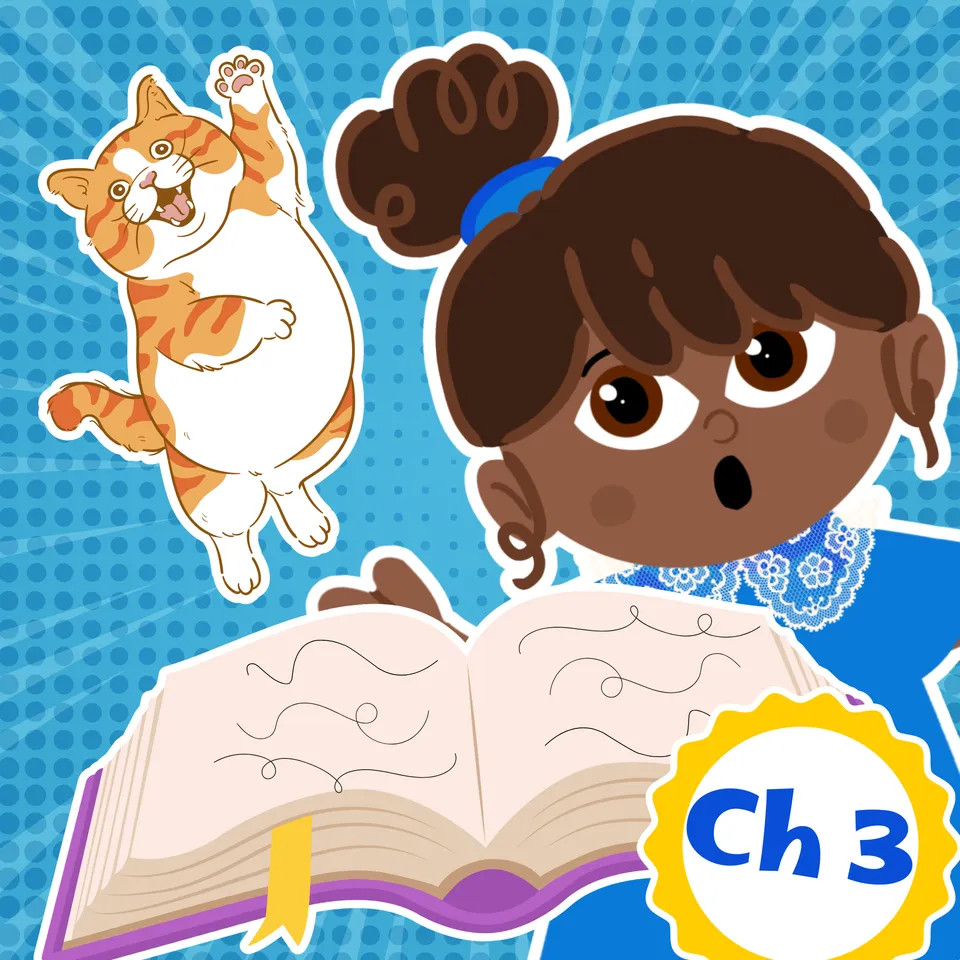
Read-Along! Alice in Wonderland Chapter 3
Ages 6–9 · 8 minutes · English, Stories
Alice finds BIG trouble in the garden!
Big bees, colossal caterpillars and corpulent cats make for giant trouble in the garden! Practice reading aloud and find out what Chapter Three holds in store for our adventuring Alice!
Part of
Standards alignment
Common Core State Standards
- CCRA.R.10 — Read and comprehend complex literary and informational texts independently and proficiently.
Alabama
- ELA21.2.30 — Read and comprehend literary and informational texts.
- ELA21.2.30a — State and confirm predictions about a text.
Alaska
- RF.1.4.b — Read on-level text orally with accuracy, appropriate rate, and expression on successive readings.
- RF.1.4.a — Read on-level text with purpose and understanding.
- RF.1.4.c — Use context to confirm or self-correct word recognition and understanding, rereading as necessary.
- RF.K.3.c — Read common high-frequency words by sight. (e.g., the, of, to, you, she, my, is, are, do, does).
Arizona
- 1.RL.10 — With prompting and support, read stories, drama, and poetry of appropriate complexity for grade 1.
- K.RL.10 — With prompting and support, actively engage in group reading activities with purpose and understanding.
Arkansas
- 1.RC.5.RF — Use background knowledge and details, including illustrations, charts, and graphs, to make predictions and inferences about what happens in a text.
California
- RF.1.4.a — Read on-level text with purpose and understanding.
- RF.1.4.b — Read on-level text orally with accuracy, appropriate rate, and expression on successive readings.
- RF.2.4.a — Read on-level text with purpose and understanding.
- RF.2.4.b — Read on-level text orally with accuracy, appropriate rate, and expression on successive readings.
- RL.1.10.b — Confirm predictions about what will happen next in a text.
Colorado
- RWC20-GR.1-S.2-GLE.3-EO.d.ii — Read grade-level text orally with accuracy, appropriate rate, and expression.
- RWC20-GR.2-S.2-GLE.3-EO.a.vii — Read grade-appropriate irregularly spelled words.
- RWC20-GR.2-S.2-GLE.3-EO.b.ii — Read grade-level text orally with accuracy, appropriate rate, and expression.
- RWC20-GR.2-S.2-GLE.1-EO.d.i — By the end of the year, read and comprehend literature, including stories and poetry, in the grades 2-3 text complexity band proficiently, with scaffolding as needed at the high end of the range.
Connecticut
- RF.1.4.a — Read on-level text with purpose and understanding.
- RF.1.4.b — Read on-level text orally with accuracy, appropriate rate, and expression on successive readings.
- RF.K.3.c — Read common high-frequency words by sight (e.g., the, of, to, you, she, my, is, are, do, does).
Delaware
- RF.1.4.b — Read on-level text orally with accuracy, appropriate rate, and expression on successive readings.
- RF.1.4.a — Read on-level text with purpose and understanding.
- RF.K.3.c — Read common high-frequency words by sight (e.g., the, of, to, you, she, my, is, are, do, does).
Florida
- ELA.1.F.1.4 — Read grade-level texts with accuracy, automaticity, and appropriate prosody or expression. • Recognize and read with automaticity the grade-level sight words.
- ELA.1.F.1.3 — Use knowledge of grade-appropriate phonics and word-analysis skills to decode words accurately. • Decode words using knowledge of spelling-sound correspondences for common consonant digraphs, trigraphs, and blends. • Decode simple words with r-controlled vowels. • Decode and encode regularly spelled one-syllable words. • Decode words with inflectional endings. • Decode two-syllable words with regular patterns by breaking the words into syllables. • Decode words that use final –e and vowel teams to make long-vowel sound.
- ELA.2.F.1.4 — Read grade-level texts with accuracy, automaticity, and appropriate prosody or expression.
Georgia
- ELAGSE1RL10 — With prompting and support, read prose and poetry of appropriate complexity for grade 1.
- ELAGSEKRL10 — Actively engage in group reading activities with purpose and understanding.
- ELAGSE1RL1 — Ask and answer questions about key details in a text.
Hawaii
- K.RL.10 — Actively engage in group reading activities with purpose and understanding.
- K-12.R.R.10 — Read and comprehend complex literary and informational texts independently and proficiently.
Idaho
- 1.RC.RF.4 — Read grade-level text with accuracy, appropriate rate, and expression to support comprehension in successive readings (see the 2017 Hasbrouck and Tindal norms listed in the Resource Reference).
- K.RC.RF.4 — Read emergent-reader texts (e.g., rhymes, songs, simple poems) with purpose and understanding.
- 1.RC.V.2 — Regularly engage in reading and listening to a series of texts related to the topics and themes being studied to build knowledge and vocabulary.
Illinois
- RF.1.4.a — Read on-level text with purpose and understanding.
- RF.1.4.b — Read on-level text orally with accuracy, appropriate rate, and expression on successive readings.
- RF.K.3.c — Read common high-frequency words by sight (e.g., the, of, to, you, she, my, is, are, do, does).
- RF.2.4.a — Read on-level text with purpose and understanding.
Indiana
- 1.RF.8 — Orally read decodable texts with appropriate fluency (rate, accuracy, and prosody) while reading.
- 1.RC.4 — Make and confirm predictions about what will happen next in a story.
- 2.RF.3 — Decode multisyllabic words composed of base, prefixes, and suffixes; read contractions, possessives (e.g., kitten’s, sisters’), and compound words. (E)
Iowa
- RF.1.3.g — Read grade-appropriate high frequency words with accuracy and automaticity.
- RF.1.4.a — Read grade-level text with purpose and understanding.
- RL.1.10 — With prompting and support, read stories and poetry of appropriate complexity for grade 1.
- RL.K.10 — Actively engage in group reading activities with purpose and understanding.
Kansas
- RL.2.13 — Read and comprehend high quality dramas, prose and poetry of appropriate quantitative and qualitative complexity for Grade 2.
Kentucky
- RF.3.4 — Read fluently (accuracy, speed and prosody) on grade-level to support comprehension.
- RF.3.4.a — Read grade-level text with purpose and understanding.
- RF.3.4.b — Fluently read grade-level prose and poetry orally on successive readings.
Louisiana
- RF.1.4.b — Read on-level text orally with accuracy, appropriate rate, and expression on successive readings.
- RF.1.4.a — Read on-level text with purpose and understanding.
- RL.1.10 — With prompting and support, read prose and poetry of appropriate complexity for grade 1.
Maine
- R.12.1.b — Read various on-level text with accuracy, appropriate rate, and expression on successive readings.
- R.12.1.a — Read various on-level text with purpose and understanding.
- R.3.K.c — Read common high-frequency words by sight (e.g., the, of, to, you, she, my, is, are, do, does).
Maryland
- RF.1.4.a — Read on-level text with purpose and understanding.
- RF.1.4.b — Read on-level text orally with accuracy, appropriate rate, and expression on successive readings.
- RF.2.4.a — Read on-level text with purpose and understanding.
- RF.2.4.b — Read on-level text orally with accuracy, appropriate rate, and expression on successive readings.
Massachusetts
- RL.K.10 — Actively engage in group reading activities with purpose and understanding.
- RF.3.3.d — Read grade-appropriate irregularly spelled words.
Michigan
- CCRA.R.10 — Read and comprehend complex literary and informational texts independently and proficiently.
- RF.1.3.f — Read words with inflectional endings.
Minnesota
- 1.1.1.3 — Read decodable texts accurately and with automaticity.
- 1.1.1.2 — Know and apply grade-level phonics and word analysis skills in decoding words:
- 1.1.4.1 — Ask and answer questions including who, what and where to demonstrate understanding of key details in a text; retell key details.
Mississippi
- RL.1.10 — With prompting and support, read prose and poetry of appropriate complexity for grade 1.
- RL.K.10 — Actively engage in group reading activities with purpose and understanding.
Missouri
- 1.R.1.D.a — engaging with and reading text that is developmentally appropriate
- 2.R.1.A.a — using text features to make and confirm predictions, explain why not confirmed
- 2.R.1.D.a — reading text that is developmentally appropriate
Montana
- RL.1.10 — With prompting and support, read prose and poetry of appropriate complexity for grade 1.
- RL.K.10 — Actively engage in group reading activities with purpose and understanding.
Nebraska
- LA.1.F.3.c — Decode and encode regularly spelled one-syllable words.
- LA.1.F.4 — Develop accuracy, phrasing, and expression/prosody while reading a variety of grade-level texts to support comprehension.
- LA.1.RP.8 — With prompting and support, read and comprehend a wide range of literary texts of appropriate complexity for Grade 1.
- LA.2.F.4 — Develop accuracy, phrasing, and expression/prosody while reading a variety of grade-level texts to support comprehension.
- LA.1.RP.6 — Ask and answer questions about key details in a literary text.
Nevada
- RF.1.4.a — Read on-level text with purpose and understanding.
- RF.1.4.b — Read on-level text orally with accuracy, appropriate rate, and expression on successive readings.
- RF.K.3.c — Read common high-frequency words by sight (e.g., the, of, to, you, she, my, is, are, do, does).
New Hampshire
- RF.1.4.a — Read on-level text with purpose and understanding.
- RF.1.4.b — Read on-level text orally with accuracy, appropriate rate, and expression on successive readings.
- RF.K.3.c — Read common high-frequency words by sight (e.g., the, of, to, you, she, my, is, are, do, does).
- RL.K.10 — Actively engage in group reading activities with purpose and understanding.
New Jersey
- RF.1.4.b — Read grade-level text orally with accuracy, appropriate rate, and expression.
- RF.1.4.a — Read grade-level text with purpose and understanding.
- RL.1.10 — With prompting and support, read and comprehend stories and poetry at grade level text complexity or above.
- RF.2.4.b — Read grade-level text orally with accuracy, appropriate rate, and expression on successive readings.
New Mexico
- RF.1.4.a — Read on-level text with purpose and understanding.
- RF.1.4.b — Read on-level text orally with accuracy, appropriate rate, and expression on successive readings.
- RF.2.4.b — Read on-level text orally with accuracy, appropriate rate, and expression on successive readings.
- RL.K.10 — Actively engage in group reading activities with purpose and understanding.
- RL.1.NM.1 — Identify the main topic, retell key details of a text, and make predictions;
New York
- 1RF3g — Read most common high-frequency words by sight
- 1RF4a — Read beginning reader texts, appropriate to individual student ability, orally with accuracy, appropriate rate, and expression on successive readings.
- 1RF4b — Use context to confirm or self-correct word recognition and understanding, rereading as necessary.
- 2RF4a — Read grade-level text orally with accuracy, appropriate rate, and expression on successive readings.
North Dakota
- 3.F.12 — Read accurately and automatically a variety of third-grade texts with expression, phrasing, purpose, and understanding.
- 3.R.2 — Ask and answer questions about key details before, during, and after reading a variety of genres, literary, and informational texts using text evidence to compare, contrast, predict, and infer.
Ohio
- RL.1.10 — With prompting and support, read prose and poetry of appropriate complexity for grade 1. Activate prior knowledge and draw on previous experiences in order to make text-to-self or text-to-text connections and comparisons.
- RL.2.10 — By the end of the year, read and comprehend literature, including stories and poetry, in the grades 2–3 text complexity band proficiently, with scaffolding as needed at the high end of the range. Activate prior knowledge and draw on previous experiences in order to make text-to-self or text-to-text connections and comparisons.
- RF.1.3.f — Read words with inflectional endings.
Oklahoma
- 3.2.F.2 — Students will orally and accurately read grade-level text at a smooth rate with expression that connotes comprehension.
- 3.2.F.1 — Students will expand their sight word vocabulary by reading regularly- and irregularly-spelled words in isolation and context with increasing automaticity.
- 3.2.PWS.3 — Students will use decoding skills and semantics in context when reading new words in a text, including multisyllabic words.
- K.8.R — Students will listen and respond to read-alouds, participate in shared reading, and interact independently with texts.
Oregon
- 1.RL.10 — With prompting and support, read prose and poetry of appropriate complexity for grade 1.
- K.RL.10 — Actively engage in group reading activities with purpose and understanding.
Pennsylvania
- CC.1.3.K.K — Actively engage in group reading activities with purpose and understanding.
Rhode Island
- RF.K.4 — Read early-emergent-reader texts with purpose and understanding.
- RL.K.10 — Actively engage in group reading activities with purpose and understanding.
South Carolina
- ELA.K.F.4.2 — Read texts orally with accuracy and expression.
- ELA.1.F.3.8 — Decode and encode words using: a. onset/rime; b. consonant blends (i.e., initial and final); c. consonant digraphs (i.e., ch, sh, th, wh, ph, ck); d. trigraphs (e.g., -tch, -dge)*; e. combination (i.e., qu); f. VCe; g. vowel r (e.g., ar, er, ir, or, ur); h. common inflectional endings that do not change the base word (e.g., -s, -ed); i. contractions with am, is, has, and not; j. hard and soft sounds of c and g (c=/k/ before a, o, u, or any consonant and c= /s/ before i, e, or y; g=/g/ before a, o, u, or any consonant and g=/j/ before i, e, or y) *; k. vowel y in the final position of one- and two-syllable words, distinguishing the difference between the long /ī/ sound in one-syllable words and the long /ē/ sound in two-syllable words, and words with vowel y in medial position, producing the short /ĭ/ sound (e.g., fly-my; baby-happy, myth-gym) *; l. words that follow the -ild, -ost, -old, -olt, and -ind patterns (e.g., mild, host, fold, jolt, kind); m. silent letter combinations (e.g., kn, wr, mb, gh, gn) *; n. words with final /f/, /l/, and /s/ sounds in one-syllable base words by doubling the final consonant when it follows a short vowel sound (e.g., cliff, hill, pass); and o. words with final /v/ sound, using knowledge that no English word ends with a v. (e.g. have, give, save).
- ELA.2.F.4.1 — Read high-frequency words commonly found in grade-appropriate text with accuracy and automaticity.
South Dakota
- 1.RF.4.a — Read grade-level text with purpose and understanding.
- 1.RF.4.b — Read grade-level text orally with accuracy, appropriate rate, and prosody (stress, phrasing, intonation, and expression) on consecutive readings.
- 1.RL.10 — By the end of the year, read and comprehend a variety of literary text.
- 2.RF.4.b — Read grade-level text orally with accuracy, appropriate rate, and prosody (stress, phrasing, intonation, and expression) on consecutive readings.
Tennessee
- 1.RL.RRTC.10 — With prompting and support, read stories and poems of appropriate complexity for grade 1.
- 2.RL.RRTC.10 — Read and comprehend stories and poems throughout the grades 2-3 text complexity band proficiently, with scaffolding at the high end as needed.
Texas
- 3.2A.vii — identifying and reading high-frequency words from a research-based list;
- 3.2A.ii — decoding multisyllabic words with closed syllables; open syllables; VCe syllables; vowel teams, including digraphs and diphthongs; r-controlled syllables; and final stable syllables;
- 3.2A.iii — decoding compound words, contractions, and abbreviations;
Utah
- 1.R.3.i — Read and spell common irregular words.
- 1.R.3.h — Read words with inflectional endings (i.e., -s, -ed, -ing, -er, -est).
Vermont
- CCRA.R.10 — Read and comprehend complex literary and informational texts independently and proficiently.
- CCRA.R.1 — Read closely to determine what the text says explicitly and to make logical inferences from it; cite specific textual evidence when writing or speaking to support conclusions drawn from the text.
Virginia
- 1.RL.1.D — Generate predictions about story characters and events using the text.
- 2.RV.1.G — Develop breadth of vocabulary knowledge by listening to and reading high quality, complex text.
Washington
- RF.1.4.a — Read on-level text with purpose and understanding.
- RF.1.4.b — Read on-level text orally with accuracy, appropriate rate, and expression on successive readings.
- RF.K.3.c — Read common high-frequency words by sight (e.g., the, of, to, you, she, my, is, are, do, does).
Washington, D.C.
- RF.1.4.a — Read on-level text with purpose and understanding.
- RF.1.4.b — Read on-level text orally with accuracy, appropriate rate, and expression on successive readings.
- RL.K.10 — Actively engage in group reading activities with purpose and understanding.
West Virginia
- ELA.1.18 — With prompting and support, read prose and poetry of appropriate complexity for grade 1 in literary texts.
- ELA.K.18 — Actively engage in group reading activities of literary texts with purpose and understanding.
Wisconsin
- ELA.1.RF.3.b — Decode and encode regularly spelled one-syllable words (e.g., cat, fox, bet, cup, fit, etc.).
- ELA.2.RF.4.b — Read grade-level text orally with accuracy, appropriate rate, and expression on successive readings.
Wyoming
- RF.1.4.a — Read on-level text with purpose and understanding.
- RF.1.4.b — Read on-level text orally with accuracy, appropriate rate, and expression on successive readings.
- RF.2.4.b — Read on-level text orally with accuracy, appropriate rate, and expression on successive readings.