Learn to Spell: Animals 1 🐸
Ages 5–7 · 7 minutes · English
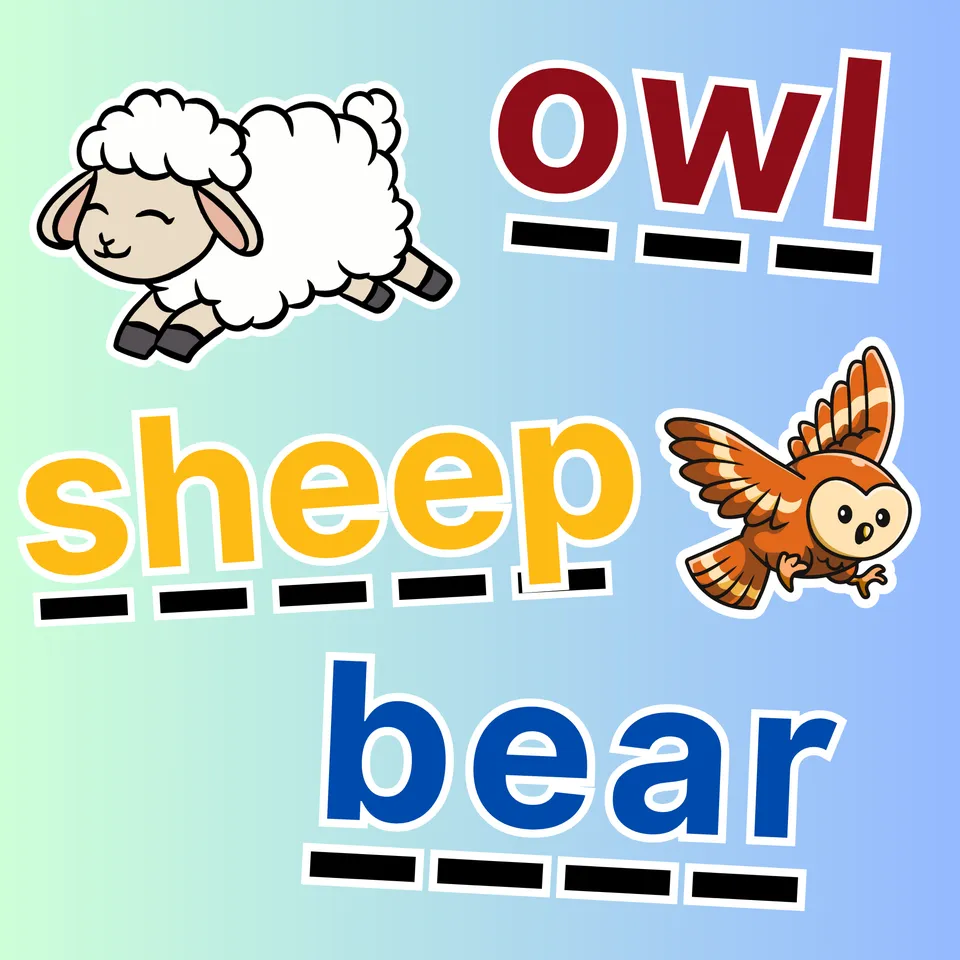
Practice spelling animal words like sheep, owl and bear!
Students can build their intermediate spelling skills by practicing spelling animal words such as sheep, owl, duck, snake, frog, bear and ape.
Prior experience with basic spelling is recommended.
Part of
Standards alignment
Common Core State Standards
- L.1.2.d — Use conventional spelling for words with common spelling patterns and for frequently occurring irregular words.
- RF.K.3.d — Distinguish between similarly spelled words by identifying the sounds of the letters that differ.
- RF.1.3.b — Decode regularly spelled one-syllable words.
- RF.1.3.c — Know final -e and common vowel team conventions for representing long vowel sounds.
Alabama
- ELA21.1.31 — Apply knowledge of grade-appropriate phoneme-grapheme correspondences and spelling rules (or generalizations) to encode words accurately.
- ELA21.1.7b — Decode and encode regularly-spelled, one-syllable words with closed syllables, open syllables, and vowel-consonant-_e_ syllables, including words with blends in initial and final position.
- ELA21.1.31d — Encode words with consonant digraphs using knowledge that one sound may be spelled with two letters.
- ELA21.1.31f — With prompting and support, encode words with the common vowel teams and diphthongs.
Alaska
- L.1.2.d — Use conventional spelling for words with common spelling patterns and for frequently occurring irregular words.
- RF.K.3.d — Distinguish between similarly spelled words by identifying the sounds of the letters that differ.
- RF.1.3.b — Decode regularly spelled one-syllable words.
- RF.1.3.c — Know final -e and common vowel team conventions for representing long vowel sounds.
Arizona
- 1.WF.3.a — Spell common, regular, single-syllable words using:
- 1.WF.3.a.4 — Long vowel patterns spelled correctly, including VCe (Vowel-Consonant-silent e) (e.g., came, like), common vowel teams (e.g., boat, play, wait, see, team, right), and open syllables (e.g., go, cry).
- 1.WF.3.a.2 — Consonant graphemes including qu, x, and -ck; digraphs (e.g., thin, shop, when, much, sing); and doubled letters (e.g., off, will, mess).
- 1.WF.3.a.3 — Initial and final consonant blends (e.g., must, slab, plump).
- K.RF.3.d — Distinguish between similarly spelled words by identifying the sounds of the letters that differ.
Arkansas
- 1.FR.12.PE — Encode one-syllable words with consonant clusters and short vowel patterns (e.g., flat, drift, quit, stand, frost, sprint, strap).
- 1.FR.17.PE — Encode one-syllable words with initial or medial VCe patterns (e.g., use, lake, slime, choke, these).
- 1.FR.20.PE — Encode words phonetically, drawing on knowledge of sound-letter relationships.
- 1.FR.15.PE — Encode one-syllable words containing single consonants with multiple spellings for /z/ and /k/ (e.g., is, nose, zip; kite, cat, luck).
- 1.FR.5.PD — Decode one-syllable words with consonant digraphs (e.g., sh, th, ch, wh, ng, ck) and trigraphs (e.g., tch, dge) with predictable vowel patterns (e.g., shy, chart, shave, thick, white, bring, catch, fudge).
- 2.FR.13.PE — Encode one-syllable words with common vowel teams (e.g., rain, pay; beach; high, pie; boat, snow, toe; book; new, moon).
California
- L.1.2.d — Use conventional spelling for words with common spelling patterns and for frequently occurring irregular words.
- RF.K.3.d — Distinguish between similarly spelled words by identifying the sounds of the letters that differ.
- L.1.2.e — Spell untaught words phonetically, drawing on phonemic awareness and spelling conventions.
- RF.1.3.b — Decode regularly spelled one-syllable words.
- RF.1.3.c — Know final -e and common vowel team conventions for representing long vowel sounds.
Colorado
- RWC20-GR.1-S.3-GLE.4-EO.b.v — Use conventional spelling for words with common spelling patterns and for frequently occurring irregular words.
- RWC20-GR.2-S.2-GLE.3-EO.a.i — Distinguish long and short vowels when reading regularly spelled one- syllable words.
- RWC20-GR.K-S.2-GLE.3-EO.c.iv — Distinguish between similarly spelled words by identifying the sounds of the letters that differ.
- RWC20-GR.1-S.3-GLE.4-EO.b.vi — Spell untaught words phonetically, drawing on phonemic awareness and spelling conventions.
Connecticut
- L.1.2.d — Use conventional spelling for words with common spelling patterns and for frequently occurring irregular words.
- RF.K.3.d — Distinguish between similarly spelled words by identifying the sounds of the letters that differ.
- RF.1.3.b — Decode regularly spelled one-syllable words.
- RF.1.3.c — Know final -e and common vowel team conventions for representing long vowel sounds.
Delaware
- L.1.2.d — Use conventional spelling for words with common spelling patterns and for frequently occurring irregular words.
- RF.K.3.d — Distinguish between similarly spelled words by identifying the sounds of the letters that differ.
- RF.1.3.b — Decode regularly spelled one-syllable words.
- RF.1.3.c — Know final -e and common vowel team conventions for representing long vowel sounds.
Florida
- ELA.1.F.1.3 — Use knowledge of grade-appropriate phonics and word-analysis skills to decode words accurately. • Decode words using knowledge of spelling-sound correspondences for common consonant digraphs, trigraphs, and blends. • Decode simple words with r-controlled vowels. • Decode and encode regularly spelled one-syllable words. • Decode words with inflectional endings. • Decode two-syllable words with regular patterns by breaking the words into syllables. • Decode words that use final –e and vowel teams to make long-vowel sound.
Georgia
- ELAGSE1L2.d — Use conventional spelling for words with common spelling patterns and for frequently occurring irregular words.
- ELAGSEKRF3.c — Distinguish between similarly spelled words by identifying the sounds of the letters that differ.
- ELAGSE1RF3.b — Decode regularly spelled one-syllable words.
- ELAGSE1RF3.c — Know final -e and common vowel team conventions for representing long vowel sounds.
Hawaii
- 1.L.2d — Use conventional spelling for words with common spelling patterns and for frequently occurring irregular words.
- 1.RF.3c — Know final -e and common vowel team conventions for representing long vowel sounds.
- 1.RF.3b — Decode regularly spelled one-syllable words.
- K.RF.3d — Distinguish between similarly spelled words by identifying the sounds of the letters that differ.
- 1.RF.3a — Know the spelling-sound correspondences for common consonant digraphs.
Idaho
- 1.GC.M.3a — Use conventional spelling for words with common, taught spelling patterns and frequently occurring irregular words.
- 1.FR.PH.3 — Use knowledge of grade-level phonics and word analysis skills in decoding words.
- 1.FR.PH.3c — Know final -e and common vowel team conventions for representing long vowel sounds (e.g., ai, ay, ee, ea, oa, and oe).
- 1.GC.M.3 — Use knowledge of spelling in writing.
Illinois
- L.1.2.d — Use conventional spelling for words with common spelling patterns and for frequently occurring irregular words.
- RF.1.3.c — Know final -e and common vowel team conventions for representing long vowel sounds.
- RF.1.3.b — Decode regularly spelled one-syllable words.
- RF.K.3.d — Distinguish between similarly spelled words by identifying the sounds of the letters that differ.
- L.1.2.e — Spell untaught words phonetically, drawing on phonemic awareness and spelling conventions.
Indiana
- 1.RF.5 — Use letter-sound knowledge of single consonants (hard and soft sounds), short and long vowels, consonant blends and digraphs, vowel teams (e.g., ai) and digraphs, and r-controlled vowels to decode phonetically regular words (e.g., cat, go, black, boat, her), independent of context. (E)
- 1.W.8 — Demonstrate command of capitalization, punctuation, and spelling, focusing on: a. Capitalization – Capitalizing the first word of a sentence, dates, names of people, and the pronoun I. b. Punctuation – I. Correctly using a period, question mark, and exclamation mark at the end of a sentence. II. Using commas in dates and to separate items in a series. c. Encoding – I. Spelling unknown words phonetically, drawing on phonemic awareness and spelling conventions. II. Correctly spelling words with common spelling patterns. III. Correctly spelling common irregularly-spelled, grade-appropriate words (e.g., said, does, gone). (E) Communication and Collaboration
- 1.RF.6 — Decode one-syllable words in the major syllable types (CVC, CVr, V, VV, VCe), independent of context. (E)
- 2.RF.2 — Apply knowledge of short and long vowels (including vowel teams) when reading regularly-spelled, one-syllable words.
- 2.W.8 — Demonstrate command of capitalization, punctuation, and spelling, focusing on: a. Capitalization – Capitalizing greetings, months and days of the week, titles and initials in names, and proper nouns, including holidays and geographic names. b. Punctuation – I. Correctly using a period, question mark, or exclamation mark at the end of a sentence. II. Using an apostrophe to form contractions and singular possessive nouns. III. Using commas in greetings and closings of letters, dates, and to separate items in a series. c. Encoding – I. Correctly spelling words with short and long vowel sounds, r-controlled vowels, and consonant-blend patterns. II. Generalizing learned spelling patterns (e.g., word families) when writing words. III. Correctly spelling common irregularly-spelled, grade-appropriate words (e.g., said, does, gone). (E) Communication and Collaboration
Iowa
- L.1.2.d — Use conventional spelling for words with common spelling patterns and for frequently occurring irregular words.
- RF.1.3.b — Decode and encode regularly spelled one-syllable words with closed syllables and consonant blends.
- RF.1.3.c — Decode and encode regularly spelled one-syllable words with final-e (VCe) patterns. Decode regularly spelled one-syllable words with common vowel team patterns that represent long vowel sounds.
- RF.1.3.a — Decode and encode one-syllable words with common consonant digraphs.
- RF.K.3.d — Distinguish between similarly spelled words by identifying the sounds of the letters that differ.
Kansas
- RF.1.3.c — Know final -e and common vowel team patterns for representing long vowel sounds.
- W.1.11.d — Use conventional spelling for words with common spelling patterns and for frequently-occurring irregular words.
- RF.1.3.b — Decode regularly spelled one-syllable words.
- RF.K.3.d — Distinguish between similarly spelled words by identifying the sounds of the letters that differ (e.g., bat/cat, bat/bit/, bat/bad).
Kentucky
- L.1.2.d — Use conventional spelling for words with common spelling patterns and for frequently occurring irregular words.
Louisiana
- L.1.2.d — Use conventional spelling for words with common spelling patterns and for frequently occurring irregular words.
- RF.1.3.c — Know final -e and common vowel team conventions for representing long vowel sounds.
- RF.K.3.d — Distinguish between similarly spelled words by identifying the sounds of the letters that differ.
- RF.1.3.b — Decode regularly spelled one-syllable words.
Maine
- L.2.1.d — Use conventional spelling for words with common spelling patterns and for frequently occurring irregular words.
- R.3.K.d — Distinguish between similarly spelled words by identifying the sounds of the letters that differ.
- R.3.1.b — Decode regularly spelled one-syllable words.
- R.3.1.c — Know final -e and common vowel team conventions for representing long vowel sounds.
Maryland
- L.1.2.d — Use conventional spelling for words with common spelling patterns and for frequently occurring irregular words.
- RF.1.3.c — Know final -e and common vowel team conventions for representing long vowel sounds.
- RF.K.3.d — Distinguish between similarly spelled words by identifying the sounds of the letters that differ.
- RF.1.3.b — Decode regularly spelled one-syllable words.
Massachusetts
- L.1.2.e — Use conventional spelling for words with common spelling patterns and for frequently occurring irregular words.
- RF.K.3.d — Distinguish between similarly spelled words by identifying the sounds of the letters that differ.
- RF.1.3.b — Decode regularly spelled one-syllable words.
- RF.1.3.c — Know final -e and common vowel team conventions for representing long vowel sounds.
Michigan
- L.1.2.d — Use conventional spelling for words with common spelling patterns and for frequently occurring irregular words.
- RF.K.3.d — Distinguish between similarly spelled words by identifying the sounds of the letters that differ.
- RF.1.3.b — Decode regularly spelled one-syllable words.
- RF.1.3.c — Know final -e and common vowel team conventions for representing long vowel sounds.
Minnesota
- 1.2.1.2 — Accurately spell words in common word families and high-frequency words; use phonetic spelling for other words.
- 1.1.1.2.b — Know and apply grade-level phonics and word analysis skills in decoding words: decode regularly spelled one-syllable words including final e and vowel teams, consonant digraphs and diphthongs, and inflectional suffixes and two-syllable words that follow six-syllable types, demonstrating both accuracy and automaticity.
- 1.1.1.2.a — Know and apply grade-level phonics and word analysis skills in decoding words: know the spelling-sound correspondences for the common consonant digraphs and blends.
Mississippi
- L.1.2.d — Use conventional spelling for words with common spelling patterns and for frequently occurring irregular words.
- RF.K.3.d — Distinguish between similarly spelled words by identifying the sounds of the letters that differ.
- RF.1.3.b — Decode regularly spelled one-syllable words.
- RF.1.3.c — Know final -e and common vowel team conventions for representing long vowel sounds.
Missouri
- 1.L.1.B.e — spell words using regular spelling patterns
- 1.L.1.B.f — spell words phonetically using phonemic awareness and spelling knowledge
- 1.RF.3.A.b — identifying letters for the spelling of short and long vowels
- 1.RF.3.A.e — combining sounds from letters and common spelling patterns to create and decode recognizable words
Montana
- L.1.2.d — Use conventional spelling for words with common spelling patterns and for frequently occurring irregular words.
- RF.K.3.d — Distinguish between similarly spelled words by identifying the sounds of the letters that differ.
- RF.1.3.b — Decode regularly spelled one-syllable words.
- RF.1.3.c — Know final -e and common vowel team conventions for representing long vowel sounds.
Nebraska
- LA.1.F.3 — Know and apply phonics and word analysis skills in decoding and encoding (spelling) words.
- LA.1.F.3.c — Decode and encode regularly spelled one-syllable words.
- LA.1.F.3.a — Decode and encode words using knowledge of sound-spelling correspondence for common consonant digraphs, tri-graphs, and blends.
- LA.1.FW.2 — Demonstrate sound-letter concepts when writing.
- LA.K.F.3.e — Distinguish between similarly spelled words by identifying the sounds of the letters that differ.
Nevada
- L.1.2.d — Use conventional spelling for words with common spelling patterns and for frequently occurring irregular words.
- RF.K.3.d — Distinguish between similarly spelled words by identifying the sounds of the letters that differ.
- RF.1.3.b — Decode regularly spelled one-syllable words.
- RF.1.3.c — Know final -e and common vowel team conventions for representing long vowel sounds.
New Hampshire
- L.1.2.d — Use conventional spelling for words with common spelling patterns and for frequently occurring irregular words.
- RF.K.3.d — Distinguish between similarly spelled words by identifying the sounds of the letters that differ.
- RF.1.3.b — Decode regularly spelled one-syllable words.
- RF.1.3.c — Know final -e and common vowel team conventions for representing long vowel sounds.
New Jersey
- L.1.2.d — Use conventional spelling for words with common spelling patterns and for frequently occurring irregular words.
- RF.K.3.d — Distinguish between similarly spelled words by identifying the sounds of the letters that differ (e.g., nap and tap; cat and cot).
- RF.1.3.b — Decode regularly spelled one-syllable words.
- RF.1.3.c — Know final -e and common vowel team conventions for representing long vowel sounds.
- L.K.2.d — Spell simple words phonetically, drawing on knowledge of sound-letter relationships.
New Mexico
- L.1.2.d — Use conventional spelling for words with common spelling patterns and for frequently occurring irregular words.
- RF.K.3.d — Distinguish between similarly spelled words by identifying the sounds of the letters that differ.
- RF.1.3.b — Decode regularly spelled one-syllable words.
- RF.1.3.c — Know final -e and common vowel team conventions for representing long vowel sounds.
- L.1.2.e — Spell untaught words phonetically, drawing on phonemic awareness and spelling conventions.
New York
- 1L2 — Demonstrate command of the conventions of academic English capitalization, punctuation, and spelling when writing. (See Notes for grade-band conventions.)
- 1RF3b — Decode long vowel sounds in regularly spelled one-syllable words (e.g., final –e conventions and common vowel teams).
- 1RF3c — Decode regularly spelled one-syllable words.
- 1RF3a — Know the letter-sound correspondences for common blends and consonant digraphs (e.g. sh, ch, th).
- 2RF3a — Distinguish long and short vowels when reading regularly spelled one-syllable words (including common vowel teams).
North Carolina
- L.1.2 — Demonstrate command of the conventions of standard English capitalization, punctuation, and spelling when writing; demonstrate proficiency within the K-1 conventions continuum.
- RF.1.4.c — Know final -e and common vowel team conventions for representing long vowel sounds.
- RF.K.4.d — Distinguish between similarly spelled words by identifying the sounds of the letters that differ.
- RF.1.4.b — Decode regularly spelled one-syllable words.
North Dakota
- 1.F.9 — Encode words with phoneme-grapheme correspondences:
- 1.F.9c — silent e
- 1.F.8f — silent e in single-syllable words
- 1.F.9a — digraphs
- 1.F.9b — two consonant blends
Ohio
- L.1.2.d — Use conventional spelling for words with common spelling patterns and for frequently occurring irregular words.
- RF.K.3.d — Distinguish between similarly spelled words by identifying the sounds of the letters that differ.
- RF.1.3.b — Decode regularly spelled one-syllable words.
- RF.1.3.c — Know final -e and common vowel team conventions for representing long vowel sounds.
Oklahoma
- 1.2.SE.1 — Students will use correct spelling when writing the following sounds in words: a. consonants b. short vowels c. digraphs d. consonant blends e. vowel-consonant-silent e
- 1.2.W.4 — Students will correctly spell grade-level, highly decodable words (e.g., cup, like, cart) and common, irregularly spelled sight words (e.g., the) while editing using resources as needed.
- 1.2.PWS.1 — Students will decode one-syllable phonetically-regular words by using their knowledge of the following phonics skills: a. single consonants (e.g., b = /b/, f = /f/, t = /t/) b. short vowel sounds (i.e., ă, ĕ, ĭ, ŏ, ŭ) c. consonant blends (e.g., bl, br, cr) d. consonant digraphs and trigraphs (e.g., sh, tch) e. vowel-consonant-silent e (e.g., lake) f. r-controlled vowels (i.e., ar, er, ir, or, ur) g. vowel digraphs (e.g., ea, oa, ee)
- 2.2.SE.1 — Students will use correct spelling when writing the following sounds in words: a. digraphs b. trigraphs c. vowel digraphs d. r-controlled *sequential skills
Oregon
- 1.L.2d — Use conventional spelling for words with common spelling patterns and for frequently occurring irregular words.
- 1.RF.3c — Know final -e and common vowel team conventions for representing long vowel sounds.
- 1.RF.3b — Decode regularly spelled one-syllable words.
- K.RF.3d — Distinguish between similarly spelled words by identifying the sounds of the letters that differ.
- 1.RF.3a — Know the spelling-sound correspondences for common consonant digraphs.
Pennsylvania
- CC.1.1.1.D — Know and apply grade-level phonics and word analysis skills in decoding words. • Identify common consonant diagraphs, final-e, and common vowel teams. • Decode one- and two-syllable words with common patterns. • Read grade-level words with inflectional endings. • Read grade- appropriate irregularly spelled words.
- CC.1.4.1.F — Demonstrate a grade- appropriate command of the conventions of standard English grammar, usage, capitalization, punctuation, and spelling. • Capitalize dates and names of people. • Use end punctuation; use commas in dates and words in series. • Spell words drawing on common spelling patterns, phonemic awareness, and spelling conventions.
- CC.1.1.K.D — Know and apply grade-level phonics and word analysis skills in decoding words. • Demonstrate basic knowledge of one-to-one letter-sound correspondence. • Associate the long and short sounds with common spellings for the five major vowels. • Read grade-level high-frequency sight words with automaticity. • Distinguish between similarly spelled words by identifying the sounds of the letters that differ.
- CC.1.4.1.L — Demonstrate a grade- appropriate command of the conventions of standard English grammar, usage, capitalization, punctuation, and spelling. • Capitalize dates and names of people. • Use end punctuation; use commas in dates and words in series. • Spell words drawing on common spelling patterns, phonemic awareness, and spelling conventions.
Rhode Island
- L.1.2.e — Use conventional spelling for words with common spelling patterns and for frequently occurring irregular words.
- RF.1.3.c — Know final -e and common vowel team conventions for representing long vowel sounds.
- RF.1.3.b — Decode regularly spelled one-syllable words.
- RF.K.3.d — Distinguish between similarly spelled words by identifying the sounds of the letters that differ.
South Carolina
- ELA.1.F.3.8 — Decode and encode words using: a. onset/rime; b. consonant blends (i.e., initial and final); c. consonant digraphs (i.e., ch, sh, th, wh, ph, ck); d. trigraphs (e.g., -tch, -dge)*; e. combination (i.e., qu); f. VCe; g. vowel r (e.g., ar, er, ir, or, ur); h. common inflectional endings that do not change the base word (e.g., -s, -ed); i. contractions with am, is, has, and not; j. hard and soft sounds of c and g (c=/k/ before a, o, u, or any consonant and c= /s/ before i, e, or y; g=/g/ before a, o, u, or any consonant and g=/j/ before i, e, or y) *; k. vowel y in the final position of one- and two-syllable words, distinguishing the difference between the long /ī/ sound in one-syllable words and the long /ē/ sound in two-syllable words, and words with vowel y in medial position, producing the short /ĭ/ sound (e.g., fly-my; baby-happy, myth-gym) *; l. words that follow the -ild, -ost, -old, -olt, and -ind patterns (e.g., mild, host, fold, jolt, kind); m. silent letter combinations (e.g., kn, wr, mb, gh, gn) *; n. words with final /f/, /l/, and /s/ sounds in one-syllable base words by doubling the final consonant when it follows a short vowel sound (e.g., cliff, hill, pass); and o. words with final /v/ sound, using knowledge that no English word ends with a v. (e.g. have, give, save).
- ELA.1.F.3 — Know and apply phonics and word analysis skills in decoding and encoding words. (FK -1.3-2.18 LF BR-430)
- ELA.1.F.3.4 — Identify the vowel and produce the vowel sound in a printed syllable or word to: a. decode regularly spelled one-syllable words (syllables include: closed, open, and vowel-consonant-e) including words with blends in initial and final position; b. decode regularly spelled one-syllable words with vowel-r syllables (i.e., ar, er, ir, or, and ur); and c. decode two-syllable words using knowledge of syllables (i.e., closed, open, vowel-consonant-e, vowel-r, common vowel teams, and consonant-le), including compound words that fit multiple syllable types. *
South Dakota
- 1.L.2.d — Use conventional spelling for words with common spelling patterns and for frequently occurring irregular words.
- 1.RF.3.c — Know final -e and common vowel team conventions for representing long vowel sounds.
- 1.L.2.f — Spell untaught words phonetically, drawing on phonemic awareness and spelling conventions
- 1.RF.3.b — Decode regularly spelled one-syllable words.
Tennessee
- 1.FL.WC.4.a — Use conventional spelling for one-syllable words with common consonant spelling patterns, including consonant diagraphs, double letters, and initial and final consonant blends.
- 1.FL.WC.4.b — Use conventional spelling for one-syllable words with common vowel spelling patterns including CVCe, common vowel teams, final -y, and r-controlled vowels.
- K.FL.PWR.3.e — Distinguish between similarly spelled words by identifying the letters that differ.
- 1.FL.WC.4 — Know and apply grade-level phonics and word analysis skills when encoding words; write legibly.
Texas
- 1.2C.i — spelling words with closed syllables, open syllables, VCe syllables, vowel teams, and r-controlled syllables;
- 1.2C.ii — spelling words with initial and final consonant blends, digraphs, and trigraphs;
- 1.2B.iii — decoding words with closed syllables; open syllables; VCe syllables; vowel teams, including vowel digraphs and diphthongs; and r-controlled syllables;
- 1.2C.iii — spelling words using sound-spelling patterns; and
Utah
- 1.R.3 — Demonstrate mastery of age-appropriate phonics skills.
- 1.R.3.b — With prompting and support, identify and begin reading and spelling words with all six syllable types (i.e., open, closed, CVCe, vowel team, vowel-r, consonant -le).
- 1.R.3.f — Read and spell words with common consonant digraphs (i.e., sh, ch, wh, th, ng).
- 2.R.3.i — Read and spell words with the following diphthongs and vowels (i.e., oi, oy; ou, ow; au, aw; oo, u).
Vermont
- L.1.2.d — Use conventional spelling for words with common spelling patterns and for frequently occurring irregular words.
- RF.K.3.d — Distinguish between similarly spelled words by identifying the sounds of the letters that differ.
- RF.1.3.b — Decode regularly spelled one-syllable words.
- RF.1.3.c — Know final -e and common vowel team conventions for representing long vowel sounds.
- L.K.2.d — Spell simple words phonetically, drawing on knowledge of sound-letter relationships.
Virginia
- 1.FFR.3.A — Decode and encode words with short vowels to include blends with digraphs, closed syllables (CVC, CCVC, CVCC, CCVCC).
- 1.FFR.3.B — Decode and encode words with long vowels, open syllables, (CV, CCV) and vowel consonant-e (CVCE, CCVCE).
- 1.FFW.2.A — Use phoneme-grapheme (sound/symbol) correspondence to encode (spell) single-syllable words containing closed syllables (cvc, ccvc, cvcc, and ccvcc), open syllables (cv, ccv), vowel-consonant-e (cvce, ccvce).
- 1.FFR.3.C — Use letter-sound correspondences to decode words containing common vowel teams and rcontrolled vowels.
- 1.FFW.2.C — Encode (spell) unfamiliar words by recognizing and applying taught word patterns.
Washington
- L.1.2.d — Use conventional spelling for words with common spelling patterns and for frequently occurring irregular words.
- RF.1.3.c — Know final -e and common vowel team conventions for representing long vowel sounds.
- RF.K.3.d — Distinguish between similarly spelled words by identifying the sounds of the letters that differ.
- RF.1.3.b — Decode regularly spelled one-syllable words.
Washington, D.C.
- L.1.2.d — Use conventional spelling for words with common spelling patterns and for frequently occurring irregular words.
- RF.1.3.c — Know final -e and common vowel team conventions for representing long vowel sounds.
- RF.K.3.d — Distinguish between similarly spelled words by identifying the sounds of the letters that differ.
- RF.1.3.b — Decode regularly spelled one-syllable words.
West Virginia
- ELA.1.37.d — Use conventional spelling for words with common spelling patterns and for frequently occurring irregular words. Spell untaught words phonetically, drawing on phonemic awareness and spelling conventions.
- ELA.1.II.b — Decode regularly spelled one-syllable words.
- ELA.1.II.c — Know final -e and common vowel team conventions for representing long vowel sounds.
- ELA.K.II.d — Distinguish between similarly spelled words by identifying the sounds of the letters that differ.
Wisconsin
- ELA.1.L.6.d — Use conventional spelling for words with common spelling patterns and draw on phonological awareness and spelling conventions to spell other words phonetically. Related to Reading Foundational standards (RF.1.3).
- ELA.1.RF.3.b — Decode and encode regularly spelled one-syllable words (e.g., cat, fox, bet, cup, fit, etc.).
- ELA.1.RF.3.c — Know final -e and common vowel team conventions for representing long vowel sounds (Examples include but are not limited to: ai, ay, oa, ea, ee, ie, ue, ow).
- ELA.K.RF.3.d — Distinguish between similarly spelled words by identifying the sounds of the letters that differ.
Wyoming
- L.1.2.d — Use conventional spelling for words with common spelling patterns and for frequently occurring irregular words.
- RF.K.3.d — Distinguish between similarly spelled words by identifying the sounds of the letters that differ.
- RF.1.3.b — Decode regularly spelled one-syllable words.
- RF.1.3.c — Know final -e and common vowel team conventions for representing long vowel sounds.
- RF.1.3.a — Know the spelling-sound correspondences for common consonant digraphs.