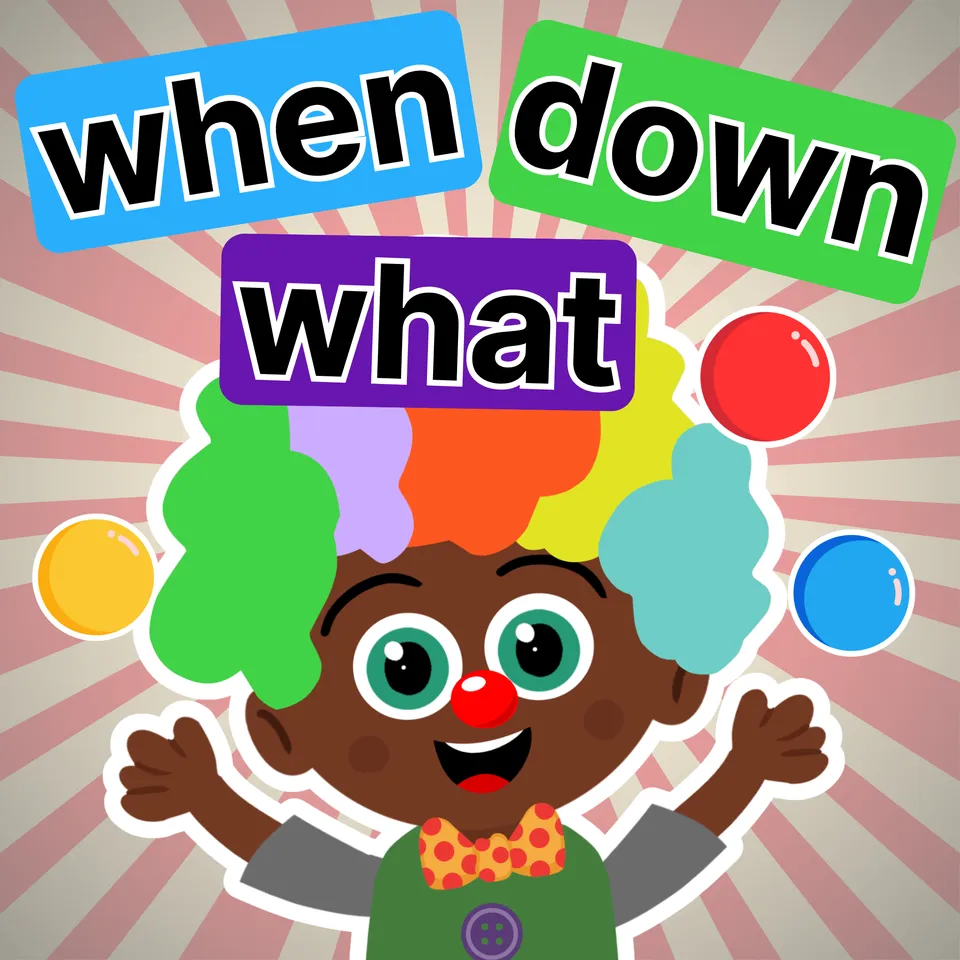
Sight Words: when, what, down
Ages 4–6 · 4 minutes · English
Learn and practice the sight words: when, what, down
Get fast and fluent at reading by learning sight words! Practice with fun games and activities to learn new words.
Part of
Standards alignment
Common Core State Standards
- RF.K.3.c — Read common high-frequency words by sight (e.g., the, of, to, you, she, my, is, are, do, does).
- RF.K.3 — Know and apply grade-level phonics and word analysis skills in decoding words.
Alabama
- ELA21.K.16 — Recognize and read grade-appropriate high-frequency words with accuracy and automaticity.
- ELA21.K.10i — Decode grade-appropriate high frequency words that are spelled using predictable, decodable phoneme-grapheme correspondences.
- ELA21.K.35c — With prompting and support, encode grade-appropriate high frequency words that follow regular phoneme-grapheme correspondences.
Alaska
- RF.K.3.c — Read common high-frequency words by sight. (e.g., the, of, to, you, she, my, is, are, do, does).
- RF.K.1.b — Recognize that spoken words are represented in written language by specific sequences of letters.
Arizona
- K.RF.3.c — Read 50 common high-frequency words by sight from a research-based word list.
- K.RF.1.b — Recognize that spoken words are represented in written language by specific sequences of letters.
- K.WF.3.d — Accurately write grade-level appropriate words, as found in a research-based word list.
Arkansas
- K.FR.12.PD — Read high-frequency words.
- K.FR.2.CP — Recognize that spoken words are represented in written language by specific sequences of letters and that print carries meaning (e.g., the spoken word “dog” is represented in print by d-o-g).
- K.FR.16.PE — Encode words phonetically, drawing on knowledge of sound-letter relationships.
California
- RF.K.3.c — Read common high-frequency words by sight (e.g., the, of, to, you, she, my, is, are, do, does).
- RF.K.1.b — Recognize that spoken words are represented in written language by specific sequences of letters.
- RF.K.1.d — Recognize and name all upper- and lowercase letters of the alphabet.
Colorado
- RWC20-GR.K-S.2-GLE.3-EO.c.iii — Read common high-frequency words by sight (for example: the, of, to, you, she, my, is, are, do, does).
- RWC20-GR.K-S.2-GLE.3-EO.c — Know and apply grade-level phonics and word analysis skills in decoding words.
Connecticut
- RF.K.3.c — Read common high-frequency words by sight (e.g., the, of, to, you, she, my, is, are, do, does).
- RF.K.1.b — Recognize that spoken words are represented in written language by specific sequences of letters.
- RF.K.3 — Know and apply grade-level phonics and word analysis skills in decoding words.
Delaware
- RF.K.3.c — Read common high-frequency words by sight (e.g., the, of, to, you, she, my, is, are, do, does).
- RF.K.1.b — Recognize that spoken words are represented in written language by specific sequences of letters.
- L.K.2.d — Spell simple words phonetically, drawing on knowledge of sound-letter relationships.
Florida
- ELA.K.F.1.4 — Recognize and read with automaticity grade-level high frequency words.
- ELA.K.F.1.1 — Demonstrate knowledge of the basic concepts of print. • Locate a printed word on a page. • Distinguish letters from words within sentences. • Match print to speech to demonstrate that language is represented by print. • Identify parts of a book (front cover, back cover, title page). • Move top to bottom and left to right on the printed page; returning to the beginning of the next line. • Identify all upper- and lowercase letters of the alphabet. • Recognize that print conveys specific meaning and pictures may support meaning.
Georgia
- ELAGSEKRF4 — Read common high-frequency words by sight. (e.g., the, of, to, you, she, my, is, are, do, does); read emergent-reader texts with purpose and understanding.
- ELAGSEKRF1.b — Recognize that spoken words are represented in written language by specific sequences of letters.
- ELAGSEKL2.d — Spell simple words phonetically, drawing on knowledge of sound-letter relationships.
Hawaii
- K.RF.3c — Read common high-frequency words by sight (e.g., the, of, to, you, she, my, is, are, do, does).
- K.RF.1b — Recognize that spoken words are represented in written language by specific sequences of letters.
- 1.RF.3g — Recognize and read grade-appropriate irregularly spelled words.
Idaho
- K.FR.PH.3c — Read common high-frequency words with automaticity by sight (e.g., the, of, to, you, she, my, is, are, do, does).
- 1.FR.PH.3h — Recognize and read grade-appropriate irregularly spelled words (e.g., what, said, have).
- K.FR.PC.1b — Recognize that spoken words are represented in written language by specific sequences of letters.
Illinois
- RF.K.3.c — Read common high-frequency words by sight (e.g., the, of, to, you, she, my, is, are, do, does).
- RF.K.1.b — Recognize that spoken words are represented in written language by specific sequences of letters.
- RF.K.3 — Know and apply grade-level phonics and word analysis skills in decoding words.
Indiana
- K.RF.2 — Recognize that written words are made up of sequences of letters.
- K.RF.3 — Identify and name all uppercase (capital) and lowercase letters of the alphabet. (E)
Iowa
- RF.K.3.c — Read common high-frequency words with accuracy and automaticity (e.g., the, of, to, you, she, my, is, are, do, does).
- RF.K.3 — Know and apply grade-level phonics, which includes word analysis skills to support decoding and encoding words.
- RF.K.3.d — Distinguish between similarly spelled words by identifying the sounds of the letters that differ.
Kansas
- RF.K.3.c — Read common high-frequency words by sight (e.g., the, of, to, you, she, my, is, are, do, does).
- RF.K.1.b — Recognize that spoken words are represented in written language by specific sequences of letters.
- RF.K.3 — Know and apply grade-level phonics and word analysis skills in decoding words.
Kentucky
- RF.K.3.c — Read common high-frequency words by sight.
- RF.K.1.b — Recognize that spoken words are represented in written language by specific sequences of letters.
- RF.1.3.g — Recognize and read grade-appropriate irregularly spelled words.
Louisiana
- RF.K.3.c — Read common high-frequency words by sight (e.g., the, of, to, you, she, my, is, are, do, does).
- L.K.2.d — Spell simple words phonetically, drawing on knowledge of sound-letter relationships.
Maine
- R.3.K.c — Read common high-frequency words by sight (e.g., the, of, to, you, she, my, is, are, do, does).
- R.1.K.b — Recognize that spoken words are represented in written language by specific sequences of letters.
Maryland
- RF.K.3.c — Read common high-frequency words by sight (e.g., the, of, to, you, she, my, is, are, do, does).
- RF.K.1.b — Recognize that spoken words are represented in written language by specific sequences of letters.
- RF.K.1.d — Recognize and name all upper- and lowercase letters of the alphabet.
Massachusetts
- RF.K.3.c — Read common high-frequency words by sight (e.g., the, of, to, you, she, my, is, are, do, does).
- RF.K.3 — Know and apply grade-level phonics and word analysis skills in decoding words.
Michigan
- RF.K.3.c — Read common high-frequency words by sight (e.g., the, of, to, you, she, my, is, are, do, does).
- RF.K.1.b — Recognize that spoken words are represented in written language by specific sequences of letters.
- L.K.2.d — Spell simple words phonetically, drawing on knowledge of sound-letter relationships.
Minnesota
- 0.1.1.2.b — Know and apply grade-level phonics and word analysis skills in decoding words: read high-frequency words, in and out of context, demonstrating both accuracy and automaticity.
- 0.2.1.1 — Recognize that words are represented in written language by specific sequences of letters, which are separated by spaces, and put in a specific order to create a sentence.
- 0.1.1.0.b — Demonstrate understanding of the basic features of print: Recognize and name all uppercase and lowercase letters of the alphabet.
Mississippi
- RF.K.3.c — Read common high-frequency words by sight (e.g., the, of, to, you, she, my, is, are, do, does).
- RF.K.1.b — Recognize that spoken words are represented in written language by specific sequences of letters.
- RF.K.3 — Know and apply grade-level phonics and word analysis skills in decoding words.
Missouri
- K.RF.3.A.b — reading high-frequency words
- 1.RF.3.A.j — reading high-frequency words
- K.RF.1.A.d — demonstrating that written words are made up of different letters
Montana
- RF.K.3.c — Read common high-frequency words by sight (e.g., the, of, to, you, she, my, is, are, do, does).
- RF.K.1.b — Recognize that spoken words are represented in written language by specific sequences of letters.
Nebraska
- LA.K.F.4.c — Read grade level high-frequency words with automaticity and accuracy (e.g. Fry or Dolch words or those included in instructional materials).
- LA.K.F.1.b — Recognize that spoken words are represented in written language by specific sequences of letters, and that print carries meaning.
- LA.1.F.4.b — Read grade level high-frequency words with automaticity and accuracy (e.g., Fry or Dolch words or those included in instructional materials).
Nevada
- RF.K.3.c — Read common high-frequency words by sight (e.g., the, of, to, you, she, my, is, are, do, does).
- RF.K.1.b — Recognize that spoken words are represented in written language by specific sequences of letters.
- RF.K.1.d — Recognize and name all upper- and lowercase letters of the alphabet.
- RF.K.3 — Know and apply grade-level phonics and word analysis skills in decoding words.
New Hampshire
- RF.K.3.c — Read common high-frequency words by sight (e.g., the, of, to, you, she, my, is, are, do, does).
- RF.K.1.b — Recognize that spoken words are represented in written language by specific sequences of letters.
- RF.1.3.g — Recognize and read grade-appropriate irregularly spelled words.
New Jersey
- RF.K.3.c — Read high-frequency and sight words with automaticity.
- RF.K.3 — Know and apply grade-level phonics and word analysis skills in decoding and encoding words.
- RF.K.1.b — Recognize that spoken words are represented in written language by specific sequences of letters.
New Mexico
- RF.K.3.c — Read common high-frequency words by sight (e.g., the, of, to, you, she, my, is, are, do, does).
- RF.K.1.b — Recognize that spoken words are represented in written language by specific sequences of letters.
- RF.K.3 — Know and apply grade-level phonics and word analysis skills in decoding words.
New York
- KRF3d — Read common high-frequency words by sight.
- KRF1b — Recognize that spoken words are represented in written language by specific sequences of letters.
- KRF3 — Know and apply grade-level phonics and word analysis skills in decoding words.
North Carolina
- RF.K.4.c — Read common high-frequency words by sight.
- RF.K.1.b — Recognize that spoken words are represented in written language by specific sequences of letters.
- RF.1.4.g — Recognize and read grade-appropriate irregularly spelled words.
North Dakota
- K.F.8d — irregularly spelled high-frequency words.
- K.F.9d — irregularly spelled high-frequency words.
- K.F.8 — Decode words with phoneme-grapheme correspondences:
- K.F.9 — Encode words with phoneme-grapheme correspondences:
Ohio
- RF.K.3.c — Read common high-frequency words by sight (e.g., the, of, to, you, she, my, is, are, do, does).
- RF.K.1.b — Recognize that spoken words are represented in written language by specific sequences of letters.
Oklahoma
- K.2.F.3 — Students will begin to develop a sight word vocabulary by decoding and reading regularly- and irregularly-spelled words in isolation and context with increasing automaticity.
- 1.2.F.1 — Students will expand their sight word vocabulary by reading regularly- and irregularly-spelled words in isolation and context with increasing automaticity.
Oregon
- K.RF.3c — Read common grade-appropriate high-frequency words by sight.
- K.RF.1b — Recognize that spoken words are represented in written language by specific sequences of letters.
Pennsylvania
- CC.1.1.K.D — Know and apply grade-level phonics and word analysis skills in decoding words. • Demonstrate basic knowledge of one-to-one letter-sound correspondence. • Associate the long and short sounds with common spellings for the five major vowels. • Read grade-level high-frequency sight words with automaticity. • Distinguish between similarly spelled words by identifying the sounds of the letters that differ.
- CC.1.1.K.B — Demonstrate understanding of the organization and basic features of print. • Follow words left to right, top to bottom, and page by page. • Recognize that spoken words are represented in written language by specific sequences of letters. • Understand that words are separated by spaces in print. • Recognize and name all uppercase and lowercase letters of the alphabet.
- CC.1.1.PK.D — Develop beginning phonics and word skills. • Associate some letters with their names and sounds. • Identify familiar words and environmental print.
Rhode Island
- RF.K.3.c — Read common high-frequency words by sight (e.g., the, of, to, you, she, my, is, are, do, does).
- RF.K.1.b — Recognize that spoken words are represented in written language by specific sequences of letters.
- RF.K.3 — Know and apply grade-level phonics and word analysis skills in decoding words.
- RF.1.3.g — Recognize and read grade-appropriate irregularly spelled words.
South Carolina
- ELA.K.F.4.1 — Read high-frequency words commonly found in grade-appropriate text with accuracy and automaticity.
- ELA.K.F.4.1.INIS — Indicator Insights: High-frequency words are words that statistically show up with a high percentage rate in common texts. Words should be read in and out of context.
South Dakota
- K.RF.3.c — Read grade-level appropriate high-frequency words by sight.
- K.RF.1.b — Recognize that spoken words are represented in written language by specific sequences of letters.
- K.RF.3 — Know and apply grade-level phonics and word analysis skills in decoding words.
Tennessee
- K.FL.PWR.3.c — Read common high-frequency words by sight.
- K.FL.WC.4.f — Write some common, frequently used words (am, and, like, the).
- K.FL.PWR.3.e — Distinguish between similarly spelled words by identifying the letters that differ.
Texas
- K.2B.iv — identifying and reading at least 25 high-frequency words from a research-based list;
- K.2C.iii — spelling high-frequency words from a research-based list;
- 1.2B.vi — identifying and reading at least 100 high-frequency words from a research-based list;
Utah
- K.R.3.e — Read and spell common irregular words.
- K.R.3 — Demonstrate mastery of age-appropriate phonics skills.
- P4.R.1.b — Begin to identify frequently seen letters and words, recognizing that words are made up of letters.
Vermont
- RF.K.3.c — Read common high-frequency words by sight (e.g., the, of, to, you, she, my, is, are, do, does).
- RF.K.3 — Know and apply grade-level phonics and word analysis skills in decoding words.
Virginia
- K.FFR.3.H — Use letter-sound correspondences to read grade-level high frequency words, including decodable and irregular words, with automaticity and accuracy.
- K.FFW.2.C — With prompting and support, use phoneme/grapheme (sound/symbol) correspondences to spell grade-level high-frequency words with accuracy.
- K.FFR.3.A — Identify capital and lowercase letters of the alphabet.
Washington
- RF.K.3.c — Read common high-frequency words by sight (e.g., the, of, to, you, she, my, is, are, do, does).
- RF.K.1.b — Recognize that spoken words are represented in written language by specific sequences of letters.
- RF.K.1.d — Recognize and name all upper- and lowercase letters of the alphabet.
Washington, D.C.
- RF.K.3.c — Read common high-frequency words by sight (e.g., the, of, to, you, she, my, is, are, do, does).
- RF.K.1.b — Recognize that spoken words are represented in written language by specific sequences of letters.
- L.K.2.d — Spell simple words phonetically, drawing on knowledge of sound-letter relationships.
West Virginia
- ELA.K.II.c — Read common high-frequency words by sight (e.g., the, of, to, you, she, my, is, are, do, or does).
- ELA.K.V.b — Recognize that spoken words are represented in written language by specific sequences of letters.
Wisconsin
- ELA.K.RF.3.c — Read common high-frequency words by sight (e.g., the, of, to, you, she, my, is, are, do, does).
- ELA.K.RF.1.b — Recognize spoken words are represented in written language by specific sequences of letters.
- ELA.K.RF.3 — Know and apply grade-level phonics and word analysis skills in decoding words.
Wyoming
- RF.K.3.c — Read common high-frequency words by sight (e.g., the, of, to, you, she, my, is, are, do, does).
- RF.K.1.b — Recognize that spoken words are represented in written language by specific sequences of letters.
- RF.K.3 — Know and apply grade-level phonics and word analysis skills in decoding words.