Learn to Spell: -oa words
Ages 5–7 · 7 minutes · English
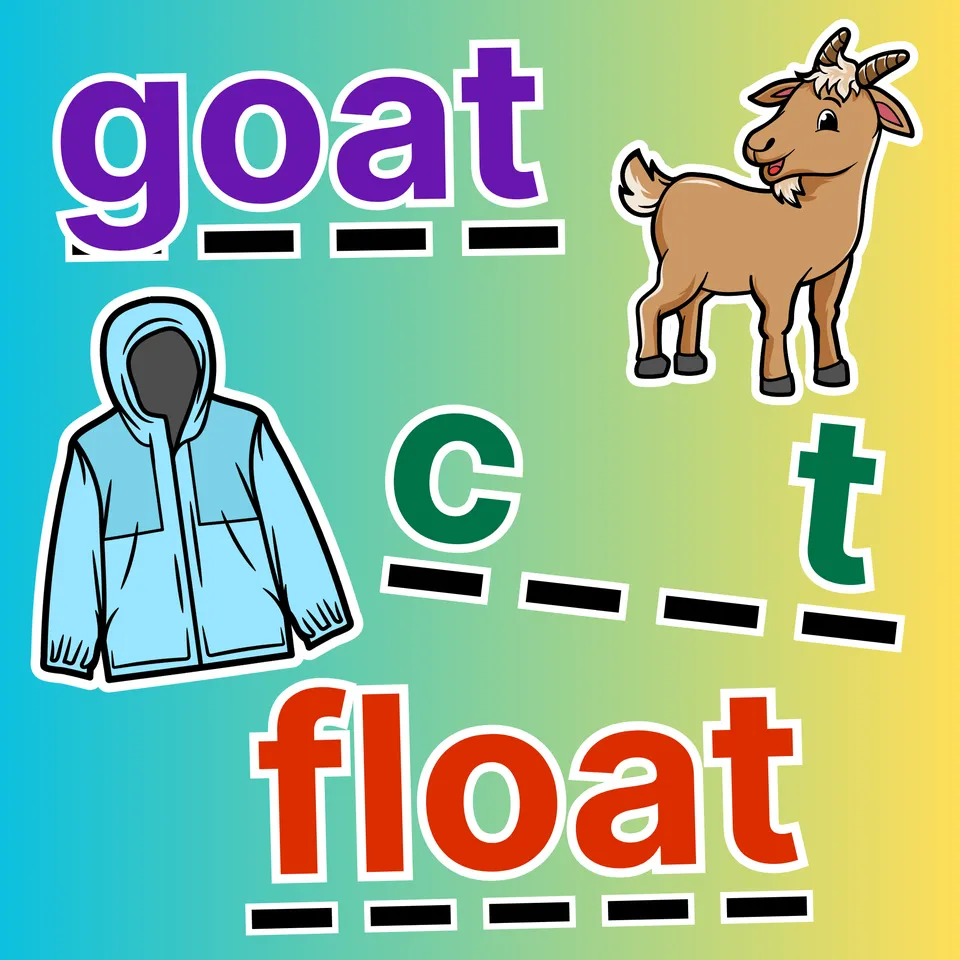
Practice spelling -oa words like boat, soap and float!
Students can build their intermediate spelling skills by practicing spelling words with the -oa pattern such as coat, soak, boat, soap, road, goat, and float.
Prior experience with basic spelling is recommended.
Part of
Standards alignment
Common Core State Standards
- L.1.2.d — Use conventional spelling for words with common spelling patterns and for frequently occurring irregular words.
- RF.1.3.c — Know final -e and common vowel team conventions for representing long vowel sounds.
- RF.1.3.b — Decode regularly spelled one-syllable words.
- RF.2.3.b — Know spelling-sound correspondences for additional common vowel teams.
- L.2.2.d — Generalize learned spelling patterns when writing words (e.g., cage → badge; boy → boil).
Alabama
- ELA21.1.31f — With prompting and support, encode words with the common vowel teams and diphthongs.
- ELA21.1.7h — With prompting and support, decode words with common vowel team syllables, including _ai, ay, ee, ea, igh, ie, oa, ou, ow, au, aw, oe, oo, ew, oi, oy,_ and _ue._
- ELA21.1.31 — Apply knowledge of grade-appropriate phoneme-grapheme correspondences and spelling rules (or generalizations) to encode words accurately.
- ELA21.1.7 — Apply knowledge of phoneme-grapheme correspondences and word analysis skills to decode and encode words accurately both in isolation and within decodable, grade-appropriate texts.
Alaska
- L.1.2.d — Use conventional spelling for words with common spelling patterns and for frequently occurring irregular words.
- RF.1.3.c — Know final -e and common vowel team conventions for representing long vowel sounds.
- RF.1.3.b — Decode regularly spelled one-syllable words.
- RF.2.3.b — Know spelling-sound correspondences for additional common vowel teams.
- RF.K.3.d — Distinguish between similarly spelled words by identifying the sounds of the letters that differ.
Arizona
- 1.WF.3.a — Spell common, regular, single-syllable words using:
- 1.WF.3.a.4 — Long vowel patterns spelled correctly, including VCe (Vowel-Consonant-silent e) (e.g., came, like), common vowel teams (e.g., boat, play, wait, see, team, right), and open syllables (e.g., go, cry).
- 1.RF.3.b — Decode regularly spelled one-syllable words.
- 2.RF.3.b — Know spelling‐sound correspondences for additional common vowel teams.
- 2.WF.2.a.2 — Vowels: /o/ = o, o_e, oa, ow (long o) /a/ = a, a_e, ai, ay, eigh (long a)
Arkansas
- 2.FR.13.PE — Encode one-syllable words with common vowel teams (e.g., rain, pay; beach; high, pie; boat, snow, toe; book; new, moon).
- 1.FR.6.PD — Decode one-syllable words with common vowel teams (e.g., rain, play; seed, beach; high, pie; boat, snow, toe; book; new, moon).
California
- L.1.2.d — Use conventional spelling for words with common spelling patterns and for frequently occurring irregular words.
- RF.1.3.c — Know final -e and common vowel team conventions for representing long vowel sounds.
- RF.1.3.b — Decode regularly spelled one-syllable words.
- RF.2.3.b — Know spelling-sound correspondences for additional common vowel teams.
Colorado
- RWC20-GR.1-S.2-GLE.3-EO.c.iii — Know final -e and common vowel team conventions for representing long vowel sounds.
- RWC20-GR.1-S.3-GLE.4-EO.b.v — Use conventional spelling for words with common spelling patterns and for frequently occurring irregular words.
- RWC20-GR.2-S.2-GLE.3-EO.a.ii — Know spelling-sound correspondences for additional common vowel teams.
- RWC20-GR.K-S.2-GLE.3-EO.c.iv — Distinguish between similarly spelled words by identifying the sounds of the letters that differ.
- RWC20-GR.2-S.3-GLE.4-EO.b.iv — Generalize learned spelling patterns when writing words (for example: cage → badge; boy → boil).
Connecticut
- L.1.2.d — Use conventional spelling for words with common spelling patterns and for frequently occurring irregular words.
- RF.1.3.c — Know final -e and common vowel team conventions for representing long vowel sounds.
- RF.1.3.b — Decode regularly spelled one-syllable words.
- RF.K.3.d — Distinguish between similarly spelled words by identifying the sounds of the letters that differ.
Delaware
- L.1.2.d — Use conventional spelling for words with common spelling patterns and for frequently occurring irregular words.
- RF.1.3.c — Know final -e and common vowel team conventions for representing long vowel sounds.
- RF.2.3.b — Know spelling-sound correspondences for additional common vowel teams.
- L.2.2.d — Generalize learned spelling patterns when writing words (e.g., cage → badge; boy → boil).
Florida
- ELA.1.F.1.3 — Use knowledge of grade-appropriate phonics and word-analysis skills to decode words accurately. • Decode words using knowledge of spelling-sound correspondences for common consonant digraphs, trigraphs, and blends. • Decode simple words with r-controlled vowels. • Decode and encode regularly spelled one-syllable words. • Decode words with inflectional endings. • Decode two-syllable words with regular patterns by breaking the words into syllables. • Decode words that use final –e and vowel teams to make long-vowel sound.
- ELA.1.C.3.1 — Follow the rules of standard English grammar, punctuation, capitalization, and spelling appropriate to grade level.
Georgia
- ELAGSE1L2.d — Use conventional spelling for words with common spelling patterns and for frequently occurring irregular words.
- ELAGSE1RF3.c — Know final -e and common vowel team conventions for representing long vowel sounds.
- ELAGSE1RF3.b — Decode regularly spelled one-syllable words.
- ELAGSEKRF3.c — Distinguish between similarly spelled words by identifying the sounds of the letters that differ.
Hawaii
- 1.L.2d — Use conventional spelling for words with common spelling patterns and for frequently occurring irregular words.
- 1.RF.3c — Know final -e and common vowel team conventions for representing long vowel sounds.
- 1.RF.3b — Decode regularly spelled one-syllable words.
- 2.RF.3b — Know spelling-sound correspondences for additional common vowel teams.
- 2.L.2d — Generalize learned spelling patterns when writing words (e.g., cage → badge; boy → boil).
Idaho
- 1.FR.PH.3c — Know final -e and common vowel team conventions for representing long vowel sounds (e.g., ai, ay, ee, ea, oa, and oe).
- 1.GC.M.3a — Use conventional spelling for words with common, taught spelling patterns and frequently occurring irregular words.
- 2.FR.PH.3a — Know spelling-sound correspondences for common short and long vowel teams (e.g., head, hook, boat, weigh) including diphthongs (e.g., toil, cloud).
- 1.FR.PH.3b — Decode regularly spelled one-syllable words.
Illinois
- L.1.2.d — Use conventional spelling for words with common spelling patterns and for frequently occurring irregular words.
- RF.1.3.c — Know final -e and common vowel team conventions for representing long vowel sounds.
- RF.1.3.b — Decode regularly spelled one-syllable words.
- RF.2.3.b — Know spelling-sound correspondences for additional common vowel teams.
Indiana
- 1.RF.5 — Use letter-sound knowledge of single consonants (hard and soft sounds), short and long vowels, consonant blends and digraphs, vowel teams (e.g., ai) and digraphs, and r-controlled vowels to decode phonetically regular words (e.g., cat, go, black, boat, her), independent of context. (E)
- 1.W.8 — Demonstrate command of capitalization, punctuation, and spelling, focusing on: a. Capitalization – Capitalizing the first word of a sentence, dates, names of people, and the pronoun I. b. Punctuation – I. Correctly using a period, question mark, and exclamation mark at the end of a sentence. II. Using commas in dates and to separate items in a series. c. Encoding – I. Spelling unknown words phonetically, drawing on phonemic awareness and spelling conventions. II. Correctly spelling words with common spelling patterns. III. Correctly spelling common irregularly-spelled, grade-appropriate words (e.g., said, does, gone). (E) Communication and Collaboration
- 1.RF.6 — Decode one-syllable words in the major syllable types (CVC, CVr, V, VV, VCe), independent of context. (E)
- 2.RF.2 — Apply knowledge of short and long vowels (including vowel teams) when reading regularly-spelled, one-syllable words.
Iowa
- L.1.2.d — Use conventional spelling for words with common spelling patterns and for frequently occurring irregular words.
- RF.1.3.c — Decode and encode regularly spelled one-syllable words with final-e (VCe) patterns. Decode regularly spelled one-syllable words with common vowel team patterns that represent long vowel sounds.
- RF.2.3.b — Decode and encode common vowel teams. With prompting and support, decode and encode additional vowel teams.
- RF.2.3.a — Decode and encode long and short vowels in regularly-spelled one-syllable words.
- RF.K.3.d — Distinguish between similarly spelled words by identifying the sounds of the letters that differ.
Kansas
- RF.1.3.c — Know final -e and common vowel team patterns for representing long vowel sounds.
- W.1.11.d — Use conventional spelling for words with common spelling patterns and for frequently-occurring irregular words.
- RF.1.3.b — Decode regularly spelled one-syllable words.
- W.2.11.d — Generalize learned spelling patterns when writing words.
Kentucky
- L.1.2.d — Use conventional spelling for words with common spelling patterns and for frequently occurring irregular words.
- RF.1.3.c — Know final –e and common vowel team conventions for representing long vowel sounds.
- RF.1.3.b — Decode regularly spelled one-syllable words.
- RF.2.3.b — Know spelling-sound correspondences for additional common vowel teams.
Louisiana
- L.1.2.d — Use conventional spelling for words with common spelling patterns and for frequently occurring irregular words.
- RF.1.3.c — Know final -e and common vowel team conventions for representing long vowel sounds.
- RF.1.3.b — Decode regularly spelled one-syllable words.
- RF.2.3.b — Know spelling-sound correspondences for additional common vowel teams.
- RF.K.3.d — Distinguish between similarly spelled words by identifying the sounds of the letters that differ.
Maine
- L.2.1.d — Use conventional spelling for words with common spelling patterns and for frequently occurring irregular words.
- R.3.1.c — Know final -e and common vowel team conventions for representing long vowel sounds.
- R.3.1.b — Decode regularly spelled one-syllable words.
- R.3.2.b — Know spelling-sound correspondences for additional common vowel teams.
- R.3.K.d — Distinguish between similarly spelled words by identifying the sounds of the letters that differ.
Maryland
- L.1.2.d — Use conventional spelling for words with common spelling patterns and for frequently occurring irregular words.
- RF.1.3.c — Know final -e and common vowel team conventions for representing long vowel sounds.
- RF.1.3.b — Decode regularly spelled one-syllable words.
- RF.2.3.b — Know spelling-sound correspondences for additional common vowel teams.
Massachusetts
- L.1.2.e — Use conventional spelling for words with common spelling patterns and for frequently occurring irregular words.
- RF.1.3.c — Know final -e and common vowel team conventions for representing long vowel sounds.
- RF.1.3.b — Decode regularly spelled one-syllable words.
- RF.2.3.b — Know spelling-sound correspondences for additional common vowel teams.
- RF.K.3.d — Distinguish between similarly spelled words by identifying the sounds of the letters that differ.
Michigan
- L.1.2.d — Use conventional spelling for words with common spelling patterns and for frequently occurring irregular words.
- RF.1.3.c — Know final -e and common vowel team conventions for representing long vowel sounds.
- RF.1.3.b — Decode regularly spelled one-syllable words.
- RF.2.3.b — Know spelling-sound correspondences for additional common vowel teams.
- L.2.2.d — Generalize learned spelling patterns when writing words (e.g., cage → badge; boy → boil).
Minnesota
- 1.1.1.2.b — Know and apply grade-level phonics and word analysis skills in decoding words: decode regularly spelled one-syllable words including final e and vowel teams, consonant digraphs and diphthongs, and inflectional suffixes and two-syllable words that follow six-syllable types, demonstrating both accuracy and automaticity.
- 1.2.1.2 — Accurately spell words in common word families and high-frequency words; use phonetic spelling for other words.
- 2.1.1.2.a — Know and apply grade-level phonics and word analysis skills in decoding words: know the spelling-sound correspondences for the common vowel graphemes.
Mississippi
- L.1.2.d — Use conventional spelling for words with common spelling patterns and for frequently occurring irregular words.
- RF.1.3.c — Know final -e and common vowel team conventions for representing long vowel sounds.
- RF.1.3.b — Decode regularly spelled one-syllable words.
- RF.2.3.b — Know spelling-sound correspondences for additional common vowel teams.
Missouri
- 1.L.1.B.e — spell words using regular spelling patterns
- 1.RF.3.A.e — combining sounds from letters and common spelling patterns to create and decode recognizable words
- 1.RF.3.A.b — identifying letters for the spelling of short and long vowels
- 2.RF.3.A.e — decoding words with vowel digraphs
Montana
- L.1.2.d — Use conventional spelling for words with common spelling patterns and for frequently occurring irregular words.
- RF.1.3.c — Know final -e and common vowel team conventions for representing long vowel sounds.
- RF.1.3.b — Decode regularly spelled one-syllable words.
- RF.K.3.d — Distinguish between similarly spelled words by identifying the sounds of the letters that differ.
Nebraska
- LA.1.F.3.c — Decode and encode regularly spelled one-syllable words.
- LA.1.F.3.d — Decode and encode final -e and common vowel team conventions for representing long vowel sounds.
- LA.1.F.3 — Know and apply phonics and word analysis skills in decoding and encoding (spelling) words.
- LA.1.FW.2 — Demonstrate sound-letter concepts when writing.
Nevada
- L.1.2.d — Use conventional spelling for words with common spelling patterns and for frequently occurring irregular words.
- RF.1.3.c — Know final -e and common vowel team conventions for representing long vowel sounds.
- RF.1.3.b — Decode regularly spelled one-syllable words.
- RF.2.3.b — Know spelling-sound correspondences for additional common vowel teams.
- RF.K.3.d — Distinguish between similarly spelled words by identifying the sounds of the letters that differ.
New Hampshire
- L.1.2.d — Use conventional spelling for words with common spelling patterns and for frequently occurring irregular words.
- RF.1.3.c — Know final -e and common vowel team conventions for representing long vowel sounds.
- RF.2.3.b — Know spelling-sound correspondences for additional common vowel teams.
- RF.K.3.d — Distinguish between similarly spelled words by identifying the sounds of the letters that differ.
New Jersey
- L.1.2.d — Use conventional spelling for words with common spelling patterns and for frequently occurring irregular words.
- RF.1.3.c — Know final -e and common vowel team conventions for representing long vowel sounds.
- RF.1.3.b — Decode regularly spelled one-syllable words.
- RF.2.3.a — Know spelling-sound correspondences for common vowel teams.
New Mexico
- L.1.2.d — Use conventional spelling for words with common spelling patterns and for frequently occurring irregular words.
- RF.1.3.c — Know final -e and common vowel team conventions for representing long vowel sounds.
- RF.2.3.b — Know spelling-sound correspondences for additional common vowel teams.
- RF.K.3.d — Distinguish between similarly spelled words by identifying the sounds of the letters that differ.
New York
- 1RF3b — Decode long vowel sounds in regularly spelled one-syllable words (e.g., final –e conventions and common vowel teams).
- 1RF3 — Know and apply phonics and word analysis skills in decoding words.
- 1RF3c — Decode regularly spelled one-syllable words.
- 2RF3a — Distinguish long and short vowels when reading regularly spelled one-syllable words (including common vowel teams).
North Carolina
- RF.1.4.c — Know final -e and common vowel team conventions for representing long vowel sounds.
- CCR Anchor Standard L.2 — Demonstrate command of the conventions of standard English capitalization, punctuation, and spelling when writing; demonstrate proficiency within the appropriate grade band conventions continuum.
- RF.1.4.b — Decode regularly spelled one-syllable words.
- RF.2.4.b — Know spelling-sound correspondences for additional common vowel teams.
- RF.K.4.d — Distinguish between similarly spelled words by identifying the sounds of the letters that differ.
North Dakota
- 1.F.8g — vowel teams
- 2.F.9b — vowel teams
- 1.F.8 — Decode words with phoneme-grapheme correspondences:
Ohio
- L.1.2.d — Use conventional spelling for words with common spelling patterns and for frequently occurring irregular words.
- RF.1.3.c — Know final -e and common vowel team conventions for representing long vowel sounds.
- RF.1.3.b — Decode regularly spelled one-syllable words.
- RF.2.3.b — Know spelling-sound correspondences for additional common vowel teams.
- RF.K.3.d — Distinguish between similarly spelled words by identifying the sounds of the letters that differ.
Oklahoma
- 2.2.SE.1 — Students will use correct spelling when writing the following sounds in words: a. digraphs b. trigraphs c. vowel digraphs d. r-controlled *sequential skills
- 1.2.PWS.1 — Students will decode one-syllable phonetically-regular words by using their knowledge of the following phonics skills: a. single consonants (e.g., b = /b/, f = /f/, t = /t/) b. short vowel sounds (i.e., ă, ĕ, ĭ, ŏ, ŭ) c. consonant blends (e.g., bl, br, cr) d. consonant digraphs and trigraphs (e.g., sh, tch) e. vowel-consonant-silent e (e.g., lake) f. r-controlled vowels (i.e., ar, er, ir, or, ur) g. vowel digraphs (e.g., ea, oa, ee)
- 1.2.W.4 — Students will correctly spell grade-level, highly decodable words (e.g., cup, like, cart) and common, irregularly spelled sight words (e.g., the) while editing using resources as needed.
Oregon
- 1.L.2d — Use conventional spelling for words with common spelling patterns and for frequently occurring irregular words.
- 1.RF.3c — Know final -e and common vowel team conventions for representing long vowel sounds.
- 1.RF.3b — Decode regularly spelled one-syllable words.
- 2.RF.3b — Know spelling-sound correspondences for additional common vowel teams.
Pennsylvania
- CC.1.1.1.D — Know and apply grade-level phonics and word analysis skills in decoding words. • Identify common consonant diagraphs, final-e, and common vowel teams. • Decode one- and two-syllable words with common patterns. • Read grade-level words with inflectional endings. • Read grade- appropriate irregularly spelled words.
- CC.1.4.1.F — Demonstrate a grade- appropriate command of the conventions of standard English grammar, usage, capitalization, punctuation, and spelling. • Capitalize dates and names of people. • Use end punctuation; use commas in dates and words in series. • Spell words drawing on common spelling patterns, phonemic awareness, and spelling conventions.
- CC.1.4.1.L — Demonstrate a grade- appropriate command of the conventions of standard English grammar, usage, capitalization, punctuation, and spelling. • Capitalize dates and names of people. • Use end punctuation; use commas in dates and words in series. • Spell words drawing on common spelling patterns, phonemic awareness, and spelling conventions.
- CC.1.4.1.R — Demonstrate a grade- appropriate command of the conventions of standard English grammar, usage, capitalization, punctuation, and spelling. • Capitalize dates and names of people. • Use end punctuation; use commas in dates and words in series. • Spell words drawing on common spelling patterns, phonemic awareness, and spelling conventions.
Rhode Island
- L.1.2.e — Use conventional spelling for words with common spelling patterns and for frequently occurring irregular words.
- RF.1.3.c — Know final -e and common vowel team conventions for representing long vowel sounds.
- RF.1.3.b — Decode regularly spelled one-syllable words.
- RF.2.3.b — Know spelling-sound correspondences for additional common vowel teams.
South Carolina
- ELA.1.F.3 — Know and apply phonics and word analysis skills in decoding and encoding words. (FK -1.3-2.18 LF BR-430)
- ELA.2.F.3.8 — Decode and encode multisyllabic words using: a. consonant digraphs (i.e., sh, th, ch, wh, ph, ck); b. combination (e.g., qu); c. three-consonant blends (e.g., str-, scr-); d. blends containing digraphs (e.g., thr-, -nch); e. trigraphs (e.g., -tch, -dge); f. variable vowel teams and vowel diphthongs (i.e., oi, oy; ou, ow; au, aw; oo, ew, ue; ee, ea; igh, ie; ai, ay); g. vowel-r combinations (i.e., ar, air, are, ear, eer, er, ere, eir, ir, or, oar, ore, our, ur); h. common inflectional endings that may change the base word (e.g., -ed, -ing, -s, -es); i. words with a after w read /ä/ and a before l read /â/ (e.g., wash, water, wasp; tall, all, talk, small, fall); j. words with the hard and soft sounds of c and g, in context and in isolation. (c=/k/ before a, o, u, or any consonant and c= /s/ before i, e, or y g=/g/ before a, o, u, or any consonant and g=/j/ before i, e, or y); k. words with vowel y in the final position of one- and two-syllable words, distinguishing the difference between the long /ī/ sound in one-syllable words and the long /ē/ sound in two-syllable words; l. words with vowel y in medial position, producing the short /ĭ/ sound for these words (e.g., fly-my; baby-happy; myth-gym); m. words with silent letter combinations. (e.g., kn, wr, gn, mb, gh); and n. contractions with am, is, has, not, have, would, and will.
- ELA.1.AOR.9.1 — Identify and use phonic patterns and inflectional morphemes that do not change the spelling of the base word.
South Dakota
- 1.L.2.d — Use conventional spelling for words with common spelling patterns and for frequently occurring irregular words.
- 1.RF.3.c — Know final -e and common vowel team conventions for representing long vowel sounds.
- 1.RF.3.b — Decode regularly spelled one-syllable words.
- 2.RF.3.b — Know spelling-sound correspondences for additional common vowel teams.
Tennessee
- 1.FL.PWR.3.c — Know the final –e and common vowel team conventions for representing long vowel sounds, including r controlled vowels.
- 1.FL.WC.4.b — Use conventional spelling for one-syllable words with common vowel spelling patterns including CVCe, common vowel teams, final -y, and r-controlled vowels.
- K.FL.PWR.3.e — Distinguish between similarly spelled words by identifying the letters that differ.
Texas
- 1.2C.i — spelling words with closed syllables, open syllables, VCe syllables, vowel teams, and r-controlled syllables;
- 1.2C.iii — spelling words using sound-spelling patterns; and
- 1.11D.x — correct spelling of words with grade-appropriate orthographic patterns and rules and high-frequency words with adult assistance; and
- 1.2B.iii — decoding words with closed syllables; open syllables; VCe syllables; vowel teams, including vowel digraphs and diphthongs; and r-controlled syllables;
Utah
- 1.R.3.b — With prompting and support, identify and begin reading and spelling words with all six syllable types (i.e., open, closed, CVCe, vowel team, vowel-r, consonant -le).
- 1.R.3 — Demonstrate mastery of age-appropriate phonics skills.
Vermont
- L.1.2.d — Use conventional spelling for words with common spelling patterns and for frequently occurring irregular words.
- RF.1.3.c — Know final -e and common vowel team conventions for representing long vowel sounds.
- RF.1.3.b — Decode regularly spelled one-syllable words.
- RF.2.3.b — Know spelling-sound correspondences for additional common vowel teams.
Virginia
- 2.FFR.3.B — Decode and encode words with vowel teams and r-controlled vowels.
- 2.FFW.2.A — Use phoneme-grapheme (sound/symbol correspondence to encode (spell) single-syllable words containing closed syllables (cvc, ccvc, cvcc, and ccvcc), open syllables (cv, ccv), vowel-consonant-e (cvce, ccvce), vowel teams, and r-controlled vowels.
- 1.FFR.3.C — Use letter-sound correspondences to decode words containing common vowel teams and rcontrolled vowels.
- 1.FFW.2.C — Encode (spell) unfamiliar words by recognizing and applying taught word patterns.
- 1.LU.2.C — Use conventional spelling of words with commonly taught spelling patterns and for frequently occurring irregular words.
Washington
- L.1.2.d — Use conventional spelling for words with common spelling patterns and for frequently occurring irregular words.
- RF.1.3.c — Know final -e and common vowel team conventions for representing long vowel sounds.
- RF.1.3.b — Decode regularly spelled one-syllable words.
- RF.2.3.b — Know spelling-sound correspondences for additional common vowel teams.
Washington, D.C.
- L.1.2.d — Use conventional spelling for words with common spelling patterns and for frequently occurring irregular words.
- RF.1.3.c — Know final -e and common vowel team conventions for representing long vowel sounds.
- RF.1.3.b — Decode regularly spelled one-syllable words.
- RF.2.3.b — Know spelling-sound correspondences for additional common vowel teams.
- RF.K.3.d — Distinguish between similarly spelled words by identifying the sounds of the letters that differ.
West Virginia
- ELA.1.37.d — Use conventional spelling for words with common spelling patterns and for frequently occurring irregular words. Spell untaught words phonetically, drawing on phonemic awareness and spelling conventions.
- ELA.1.II.c — Know final -e and common vowel team conventions for representing long vowel sounds.
- ELA.1.II.b — Decode regularly spelled one-syllable words.
- ELA.2.II.b — Know spelling-sound correspondences for additional common vowel teams.
- ELA.K.II.d — Distinguish between similarly spelled words by identifying the sounds of the letters that differ.
Wisconsin
- ELA.1.L.6.d — Use conventional spelling for words with common spelling patterns and draw on phonological awareness and spelling conventions to spell other words phonetically. Related to Reading Foundational standards (RF.1.3).
- ELA.1.RF.3.c — Know final -e and common vowel team conventions for representing long vowel sounds (Examples include but are not limited to: ai, ay, oa, ea, ee, ie, ue, ow).
- ELA.2.RF.3.b — Know spelling-sound correspondences for additional common vowel teams.
Wyoming
- L.1.2.d — Use conventional spelling for words with common spelling patterns and for frequently occurring irregular words.
- RF.1.3.c — Know final -e and common vowel team conventions for representing long vowel sounds.
- RF.2.3.b — Know spelling-sound correspondences for additional common vowel teams.
- RF.K.3.d — Distinguish between similarly spelled words by identifying the sounds of the letters that differ.