Theseus and the Minotaur
Ages 6–10 · 12 minutes · English, Stories
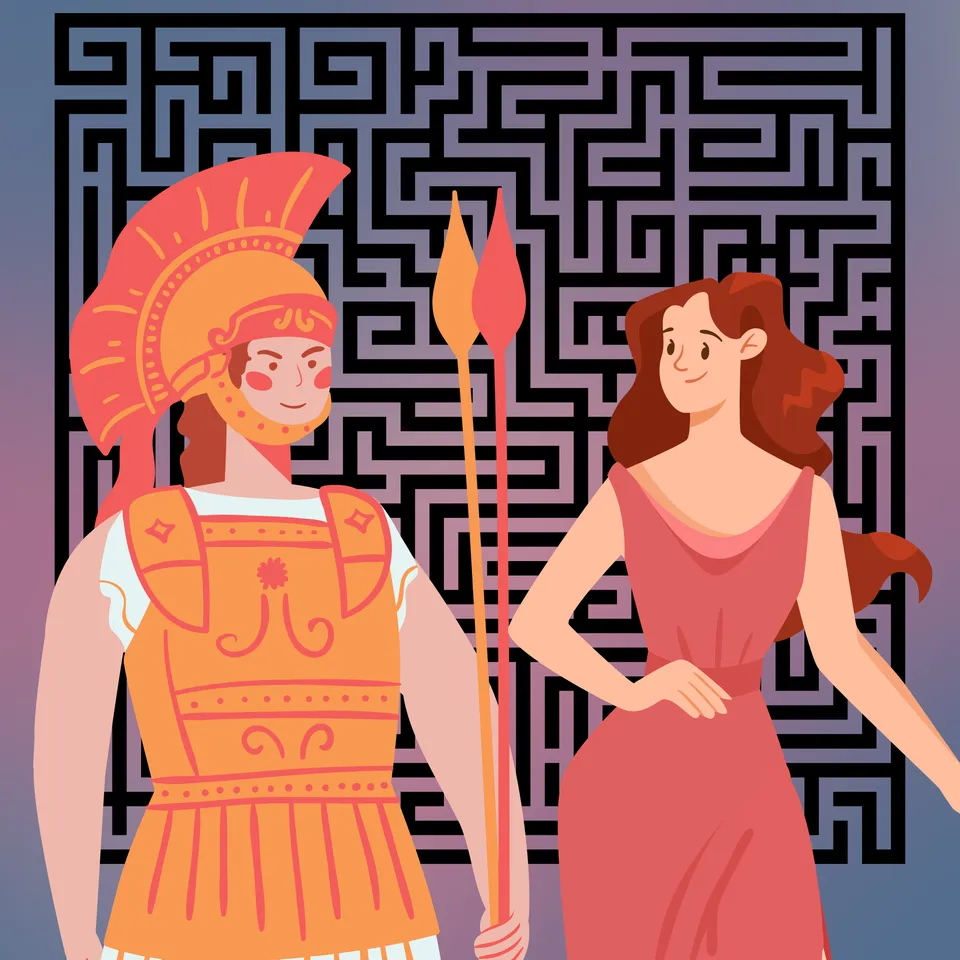
The Minotaur is causing some problems. Can Theseus and Ariadne save the day?
Theseus and Ariadne must use some wise tricks if they have any chance of defeating the troublesome Minotaur. Kids learn about the importance of problem-solving and persistence in this interactive story.
Part of
Standards alignment
Common Core State Standards
- RL.3.2 — Recount stories, including fables, folktales, and myths from diverse cultures; determine the central message, lesson, or moral and explain how it is conveyed through key details in the text.
- ELD-SI.K-3.Narrate — Multilingual learners will… • Share ideas about one's own and others' lived experiences and previous learning • Connect stories with images and representations to add meaning • Ask questions about what others have shared • Recount and restate ideas • Discuss how stories might end or next steps
- RL.2.3 — Describe how characters in a story respond to major events and challenges.
- RL.4.4 — Determine the meaning of words and phrases as they are used in a text, including those that allude to significant characters found in mythology (e.g., Herculean).
Alabama
- ELA21.1.27 — Make predictions using information found within a literary text.
- ELA21.3.22c — Identify the central message, theme, or moral in a story, including myths, fables, and folktales, and explain the meaning conveyed in the passage.
- ELA21.1.25 — Describe connections between two individuals, events, ideas, or pieces of information, including cause and effect, sequence, and problem and solution, in a literary text.
- ELA21.3.22 — Describe literary elements within a story, including setting, plot, characters, and themes.
- ELA21.3.22a — Describe in detail the characters' behavior, emotions, and traits and explain how their actions influence events in the story.
Alaska
- RL.3.3 — Describe characters in a story (e.g., their traits, motivations, or feelings) and explain how their actions contribute to the sequence of events (e.g., creating or solving a problem).
- RL.2.3 — Describe how characters in a story, play or poem respond to major events, problems, and challenges.
- RL.3.2 — Determine the author's purpose, message, lesson, or moral and explain how it is conveyed through key details in the text; summarize stories in correct sequence, including fables and folktales from diverse cultures.
- RL.3.4 — Determine the meaning of words and phrases as they are used in a text, distinguishing literal meanings from use of figurative language (e.g., exaggeration in tall tales).
Arizona
- 2.RL.3 — Describe how characters in a story respond to major events and challenges.
- 3.RL.2 * — Recount and paraphrase stories, including fables, folktales, and myths from diverse cultures; determine the central message, lesson, or moral and explain how it is conveyed through key details in text.
- 2.RL.2 — Recount stories, including fables and folktales from diverse cultures, and determine their central message, lesson, or moral.
- 3.RL.4 * — Determine the meaning of words and phrases as they are used in a text, distinguishing literal from nonliteral language.
Arkansas
- 2.RC.4.RF — Build general and academic vocabulary and background knowledge of age and grade-appropriate topics through discussion, reading, and writing.
- 2.RC.5.RF — Use background knowledge and details, including illustrations, charts, and graphs, to make predictions and inferences about what happens in a text.
- 2.RC.8.RL — Identify the main story elements (characters, settings, events, problem, and solution) in a text.
- 2.RC.2.RF — Answer questions about key details in a text.
- 3.RC.8.RL — Describe the main story elements (plot), including characters, setting, events, problem, and solution.
California
- RL.2.3 — Describe how characters in a story respond to major events and challenges.
- RL.3.2 — Recount stories, including fables, folktales, and myths from diverse cultures; determine the central message, lesson, or moral and explain how it is conveyed through key details in the text.
- RL.1.10.b — Confirm predictions about what will happen next in a text.
- RL.K.4 — Ask and answer questions about unknown words in a text. (See grade K Language standards 4–6 for additional expectations.)
Colorado
- RWC20-GR.2-S.2-GLE.1-EO.a.iv — Describe how characters in a story respond to major events and challenges.
- RWC20-GR.3-S.2-GLE.1-EO.a.iii — Recount stories, including fables, folktales, and myths from diverse cultures; determine the central message, lesson, or moral and explain how it is conveyed through key details in the text.
- RWC20-GR.1-S.2-GLE.1-EO.a.iii — Describe characters, settings, and major events in a story, using key details.
Connecticut
- RL.2.3 — Describe how characters in a story respond to major events and challenges.
- RL.3.2 — Recount stories, including fables, folktales, and myths from diverse cultures; determine the central message, lesson, or moral and explain how it is conveyed through key details in the text.
- RL.2.2 — Recount stories, including fables and folktales from diverse cultures, and determine their central message, lesson, or moral.
- RL.3.4 — Determine the meaning of words and phrases as they are used in a text, distinguishing literal from nonliteral language.
- RL.1.3 — Describe characters, settings, and major events in a story, using key details.
Delaware
- RL.2.3 — Describe how characters in a story respond to major events and challenges.
- RL.3.2 — Recount stories, including fables, folktales, and myths from diverse cultures; determine the central message, lesson, or moral and explain how it is conveyed through key details in the text.
- RL.2.2 — Recount stories, including fables and folktales from diverse cultures, and determine their central message, lesson, or moral.
- RL.4.4 — Determine the meaning of words and phrases as they are used in a text, including those that allude to significant characters found in mythology (e.g., Herculean).
Florida
- ELA.1.R.1.1 — Identify and describe the main story elements in a story.
- ELA.1.R.1.2 — Identify and explain the moral of a story.
- ELA.2.R.1.2 — Identify and explain a theme of a literary text.
- ELA.2.R.1.1 — Identify plot structure and describe main story elements in a literary text.
Georgia
- ELAGSE2RL3 — Describe how characters in a story respond to major events and challenges.
- ELAGSE3RL2 — Recount stories, including fables, folktales, and myths from diverse cultures; determine the central message, lesson, or moral and explain how it is conveyed through key details in the text.
- ELAGSE3RL4 — Determine the meaning of words and phrases both literal and non-literal language as they are used in the text.
Hawaii
- 3.RL.2 — Recount stories, including fables, folktales, and myths from diverse cultures; determine the central message, lesson, or moral and explain how it is conveyed through key details in the text.
- 2.RL.3 — Describe how characters in a story respond to major events and challenges.
- 3.RL.4 — Determine the meaning of words and phrases as they are used in a text, distinguishing literal from nonliteral language.
Idaho
- 2.RC.L.5a — Identify the central message, lesson, or moral of stories (including fables and folktales) from diverse cultures heard or read.
- 2.RC.L.5b — Describe how characters in stories heard or read respond to major events and challenges.
- 3.RC.L.5a — Describe key details from stories (including folktales, fables, and tall tales) from diverse cultures and explain how they support the central lesson, moral, or theme.
- 3.RC.TE.3 — Ask and answer questions to demonstrate understanding of grade-level texts, referring explicitly to textual evidence as the basis for the answers.
Illinois
- RL.3.2 — Recount stories, including fables, folktales, and myths from diverse cultures; determine the central message, lesson, or moral and explain how it is conveyed through key details in the text.
- RL.2.3 — Describe how characters in a story respond to major events and challenges.
- RL.1.3 — Describe characters, settings, and major events in a story, using key details.
Indiana
- 3.RC.1 — Ask and answer questions to demonstrate comprehension of a text, referring explicitly to the text as the basis for the answers. (E)
- 1.RC.4 — Make and confirm predictions about what will happen next in a story.
- 3.RC.2 — Recount folktales, fables, and tall tales from diverse cultures; identify the themes in these works. (E)
- 3.RC.3 — Describe characters in a story (e.g., their traits, motivations, or feelings), and explain how their actions contribute to the plot.
Iowa
- RL.2.3 — Describe how characters in a story respond to major events and challenges, drawing on key details.
- RL.3.2 — Recount and determine the central message, lesson, or moral of fables, folktales, and myths from diverse cultures and explain how it is conveyed through key details in the text.
- RL.2.2 — Recount and determine the central message, lesson or moral of stories, including but not limited to fables and folktales from diverse cultures.
- RL.K.4 — Ask and answer questions about unknown words in a text.
Kansas
- RL.3.2 — Recount stories, including fables, folktales, and myths from diverse cultures; determine the central message, lesson, or moral and explain how it is conveyed through key details in the text.
- RL.3.3 — Describe characters in a story (e.g., their traits, motivations, or feelings) and explain how their actions contribute to the sequence of events.
- RL.1.1 — Ask and answer questions about key details in a text.
- RL.2.3 — Describe how characters in a story respond to major events and challenges.
Kentucky
- RL.3.2 — Identify and cite relevant implicit and explicit information from a summary to determine the theme, lesson learned and/or moral, including but not limited to fables, folktales and myths from diverse cultures.
- RL.2.2 — Identify implicit and explicit information from a summary to determine the author’s message, lesson learned and/or moral, including but not limited to fables and folktales from diverse cultures.
- RL.2.3 — Describe how characters in a story respond to major events and challenges in order to make meaning of the story development.
- GP.R.4 — Students will interpret words and phrases as they are used in a text, including determining technical, connotative and figurative meanings, and analyze how specific word choices shape meaning or tone.
Louisiana
- RL.2.3 — Describe how characters in a story respond to major events and challenges.
- RL.3.2 — Recount stories, including fables, folktales, and myths from diverse cultures; determine the central message, lesson, or moral and explain how it is conveyed through key details in the text.
- RL.2.4 — Describe how words and phrase supply rhythm and meaning in a poem or song; determine the meaning of words and phrases as they are used in text.
Maine
- R.6.2.a — Describe how characters in a story respond to major events and challenges.
- R.7.1.b — Ask and answer questions to help determine or clarify the meaning of words and phrases in a text.
- R.4.1.a — Ask and answer questions about who, what, when, where, and how.
- R.6.1.a — Describe characters, settings, and major events in a story, including details about who, what, when, where, and how.
Maryland
- RL.2.3 — Describe how characters in a story respond to major events and challenges.
- RL.3.2 — Recount stories, including fables, folktales, and myths from diverse cultures; determine the central message, lesson, or moral and explain how it is conveyed through key details in the text.
- RL.2.2 — Recount stories, including fables and folktales from diverse cultures, and determine their central message, lesson, or moral.
- RL.K.4 — Ask and answer questions about unknown words in a text.
Massachusetts
- RL.3.2 — Retell stories, including fables, folktales, and myths from diverse cultures; determine the central message, lesson, or moral and explain how it is conveyed through key details in the text.
- RL.2.3 — Describe how characters in a story respond to major events and challenges.
- RL.3.5 — Identify common structural elements of fiction (e.g., problem, solution); describe how each successive part of a text builds on earlier sections.
- RL.2.2 — Retell stories, including fables and folktales from diverse cultures, and determine their central message, lesson, or moral.
Michigan
- RL.2.3 — Describe how characters in a story respond to major events and challenges.
- RL.3.2 — Recount stories, including fables, folktales, and myths from diverse cultures; determine the central message, lesson, or moral and explain how it is conveyed through key details in the text.
- RL.2.2 — Recount stories, including fables and folktales from diverse cultures, and determine their central message, lesson, or moral.
- RL.K.4 — Ask and answer questions about unknown words in a text.
Minnesota
- 2.1.4.1 — Ask and answer questions including who, what, where, when, why and how to demonstrate understanding of key details in a text; recount the
- 2.1.4.2 — Identify the central idea, message, or moral of a text and one or two supporting details.
- 2.1.4.3 — Identify characters, setting, conflict, resolution and events in literary text.
- 3.1.4.2 — Identify the central idea or argument in fables, folktales, and myths, explain how it is supported by key details, and describe the connection between details.
Mississippi
- RL.2.3 — Describe how characters in a story respond to major events and challenges.
- RL.3.2 — Recount stories, including fables, folktales, and myths from diverse cultures; determine the central message, lesson, or moral and explain how it is conveyed through key details in the text.
- RL.3.4 — Determine the meaning of words and phrases as they are used in a text, distinguishing literal from nonliteral language.
Missouri
- 2.R.2.A.a — describe the setting, problems, solutions, sequence of events (plot), and big idea or moral lesson
- K.R.2.A.g — ask and answer questions about unknown words in text
- 3.R.1.A.c — summarizing a story’s beginning, middle, and end determining its central message, lesson, or moral
Montana
- RL.2.3 — Describe how characters in a story respond to major events and challenges.
- RL.3.2 — Recount stories, including fables, folktales, and myths from diverse cultures, including those by and about American Indians; determine the central message, lesson, or moral; and explain how it is conveyed through key details in the text.
- RL.2.2 — Recount stories, including fables and folktales from diverse cultures, including American Indian stories, and determine their central message, lesson, or moral.
- RL.K.4 — Ask and answer questions about unknown words in a text.
Nebraska
- LA.3.RP.2 — Explain how characters respond to major events and challenges in a literary text.
- LA.3.RP.6 — Explain what the text says explicitly and draw inferences when asking and answering questions.
- LA.2.RP.6 — Ask and answer literal (e.g., recall/details) and simple inferential (e.g., why or how) questions about key details in a literary text.
- LA.3.RP.1 — Identify the central message or lesson in a literary text and explain how key details support that idea.
Nevada
- RL.3.2 — Recount stories, including fables, folktales, and myths from diverse cultures; determine the central message, lesson, or moral and explain how it is conveyed through key details in the text.
- RL.2.3 — Describe how characters in a story respond to major events and challenges.
- RL.1.3 — Describe characters, settings, and major events in a story, using key details.
- RL.4.4 — Determine the meaning of words and phrases as they are used in a text, including those that allude to significant characters found in mythology (e.g., Herculean).
New Hampshire
- RL.2.3 — Describe how characters in a story respond to major events and challenges.
- RL.3.2 — Recount stories, including fables, folktales, and myths from diverse cultures; determine the central message, lesson, or moral and explain how it is conveyed through key details in the text.
- RL.1.3 — Describe characters, settings, and major events in a story, using key details.
New Jersey
- RL.3.2 — Recount stories, including fables, folktales, and myths from diverse cultures; determine the central message/theme, lesson, or moral and explain how it is revealed through key details in the text.
- RL.2.3 — Describe how characters in a story respond to major events and challenges using key details.
- RL.3.3 — Describe the characters in a story (e.g., their traits, motivations, or feelings) and explain how their actions contribute to the plot.
- 6.1.2.CivicsCM.2 — Use examples from a variety of sources to describe how certain characteristics can help individuals collaborate and solve problems (e.g., open-mindedness, compassion, civility, persistence).
- RL.3.4 — Determine the meaning of words and phrases as they are used in a text, distinguishing literal from nonliteral language.
New Mexico
- RL.2.3 — Describe how characters in a story respond to major events and challenges.
- RL.3.2 — Recount stories, including fables, folktales, and myths from diverse cultures; determine the central message, lesson, or moral and explain how it is conveyed through key details in the text.
- RL.1.NM.2 — Identify characters and simple story lines from selected myths and stories from around the world.
- RL.2.NM.1 — Identify the main topic, retell key details of a text, and make predictions;
New York
- 3R4 — Determine the meaning of words, phrases, figurative language, and academic and content-specific words. (RI&RL)
- 2R3 — In literary texts, describe how characters respond to major events and challenges. (RL) In informational texts, describe the connections between ideas, concepts, or a series of events. (RI)
- 3.4a — People in world communities use legends, folktales, oral histories, biographies, and historical narratives to transmit cultural histories from one generation to the next.
North Carolina
- RL.3.1 — Ask and answer questions to demonstrate understanding of a text, referring explicitly to the text as the basis for the answers.
- RL.3.2 — Recount stories, including fables, folktales, and myths from diverse cultures; determine the central message, lesson, or moral and explain how it is conveyed through key details in the text.
- RL.3.3 — Describe characters in a story and explain how their actions contribute to the sequence of events.
- RL.2.3 — Describe how characters in a story respond to major events and challenges.
- RL.3.4 — Determine the meaning of words and phrases as they are used in a text, identifying words that impact the meaning in a text.
North Dakota
- 2.R.8a — Describe characters' feelings or traits during or after listening to a story.
- 3.R.8a — Describe characters' feelings, traits, motivations, and actions after reading a story.
Ohio
- RL.2.3 — Describe how characters in a story respond to major events and challenges.
- RL.1.3 — Describe characters, settings, and major events in a story, using key details.
Oklahoma
- 2.3.R.5 — Students will use details from the literary or informational text to draw conclusions and make predictions.
- 1.3.R.5 — Students will begin to use details from a text to draw conclusions and make predictions.
- 2.3.R.3 — Students will find examples of literary elements: • setting (i.e., time and place) • plot (i.e., beginning, middle, end) • characters and their traits
Oregon
- 2.RL.3 — Describe how characters in a story respond to major events and challenges, including identifying the characters' feelings, the plot or problem, and how it is resolved.
- 3.RL.2 — Recount and summarize stories, including fables, folktales, and myths from diverse cultures; determine the central message, lesson, or moral, and explain how it is conveyed through key details in the text.
- 3.RL.3 — Describe characters in a story and explain how their actions contribute to the sequence of events.
- 3.RL.4 — Determine the meaning of words and phrases as they are used in a text, distinguishing literal from nonliteral language.
Pennsylvania
- CC.1.3.2.C — Describe how characters in a story respond to major events and challenges.
- CC.1.3.2.A — Recount stories and determine their central message, lesson, or moral.
- CC.1.3.3.A — Determine the central message, lesson, or moral in literary text; explain how it is conveyed in text.
- CC.1.3.3.C — Describe characters in a story and explain how their actions contribute to the sequence of events.
- CC.1.3.K.B — Answer questions about key details in a text.
Rhode Island
- RL.2.3 — Describe how characters in a story respond to major events and challenges.
- RL.3.2 — Retell stories, including fables, folktales, and myths from diverse cultures, determine the central message, lesson, or moral and explain how it is conveyed through key details in a text.
- RL.3.5 — Identify common structural elements of fiction (e.g., problem, solution); describe how each successive part of a text builds on earlier sections.
South Carolina
- ELA.2.AOR.2.1 — Identify and explain an explicit theme in a literary text.
- ELA.2.AOR.1.1 — Describe the main story elements and sequence the important events.
- ELA.3.AOR.2.1 — Identify and explain an explicit theme in a literary text and how it is developed by key details.
South Dakota
- 2.RL.3 — Describe how characters in a story respond to major events and challenges.
- 3.RL.2 — Retell stories, including those from diverse cultures; determine the central message/theme, lesson, or moral and explain how it is revealed through key details in the text.
- 3.RL.3 — Describe characters in a story and explain how their actions contribute to the plot.
- 2.RL.2 — Retell stories, those from diverse cultures, and determine their central message/theme, lesson, or moral
Tennessee
- 3.RL.KID.2 — Recount stories, including fables, folktales, and myths from diverse cultures; determine the central message, lesson, or moral and explain how it is conveyed through key details in the text.
- 2.RL.KID.2 — Recount stories, including fables and folktales from diverse cultures, and determine their central message, lesson, or moral.
- 4.RL.CS.4 — Determine the meaning of words and phrases as they are used in a text, including those that refer to significant characters and situations found in literature and history.
Texas
- 2.8C — describe and understand plot elements, including the main events, the conflict, and the resolution, for texts read aloud and independently; and
- 2.8B — describe the main character's (characters') internal and external traits;
- 3.8C — analyze plot elements, including the sequence of events, the conflict, and the resolution; and
Utah
- 2.R.5 — Ask and answer questions such as who, what, where, when, why, and how to demonstrate understanding of key details in a text. (RL & RI)
- 2.R.7 — Describe how characters respond to major events and challenges. (RL). Describe the connection between a series of historical events, scientific ideas or concepts, or steps in technical procedures in a text. (RI)
- 2.R.9 — Determine or clarify the meaning of unknown and multiplemeaning words and phrases, choosing flexibly from a range of strategies. (RL & RI)
- 3.R.7 — Describe characters in a story and explain how their actions contribute to the sequence of events. (RL)
Vermont
- RL.2.3 — Describe how characters in a story respond to major events and challenges.
- RL.3.2 — Recount stories, including fables, folktales, and myths from diverse cultures; determine the central message, lesson, or moral and explain how it is conveyed through key details in the text.
- RL.1.3 — Describe characters, settings, and major events in a story, using key details.
- RL.4.4 — Determine the meaning of words and phrases as they are used in a text, including those that allude to significant characters found in mythology (e.g., Herculean).
Virginia
- 2.RL.1.D — Generate predictions about story characters and events using the text.
- 1.RL.1.C — Ask and answer literal (who, what, when, where) or inferential (how, why) questions about what is read.
- 2.RL.1.C — Describe character’s attributes (e.g., traits, motivations, or feelings) and how they respond to major events and challenges.
- 3.RL.1.A — Identify thematic topics of stories (e.g. friendship, survival, determination) and the lessons learned.
Washington
- RL.2.3 — Describe how characters in a story respond to major events and challenges.
- RL.3.2 — Recount stories, including fables, folktales, and myths from diverse cultures; determine the central message, lesson, or moral and explain how it is conveyed through key details in the text.
- RL.2.2 — Recount stories, including fables and folktales from diverse cultures, and determine their central message, lesson, or moral.
- RL.K.4 — Ask and answer questions about unknown words in a text.
Washington, D.C.
- RL.2.3 — Describe how characters in a story respond to major events and challenges.
- RL.3.2 — Recount stories, including fables, folktales, and myths from diverse cultures; determine the central message, lesson, or moral and explain how it is conveyed through key details in the text.
- RL.1.3 — Describe characters, settings, and major events in a story, using key details.
- RL.2.2 — Recount stories, including fables and folktales from diverse cultures, and determine their central message, lesson, or moral.
West Virginia
- ELA.3.2 — Recount stories, including fables, folktales, and myths from diverse cultures; determine the central message, lesson, or moral and explain how it is conveyed through key details in the literary text.
- ELA.2.3 — Describe how characters in a story respond to major events and challenges in literary text.
- ELA.4.1 — Refer to details and examples in a literary text when explaining what the text says explicitly and when drawing inferences from the text.
Wisconsin
- ELA.2.R.3 — Describe how characters respond to major events and challenges. (RL) Describe the connections between ideas, concepts, or a series of events. (RI)
- ELA.3.R.4 — Determine the meaning of words, phrases, figurative language, and academic and content-specific words within a text. (RI&RL)
- ELA.5.R.1 — Locate and refer to relevant details and evidence when explaining what a text says explicitly/implicitly and make logical inferences. (RI&RL)
Wyoming
- RL.3.2 — Recount stories, including fables, folktales, and myths from diverse cultures; determine the central message, lesson, or moral and explain how it is conveyed through key details in the text.
- RL.1.3 — Describe characters, settings, and major events in a story, using key details.
- RL.2.2 — Recount stories, including fables and folktales from diverse cultures, and determine their central message, lesson, or moral.
- RL.2.3 — Describe how characters in a story respond to major events and challenges.