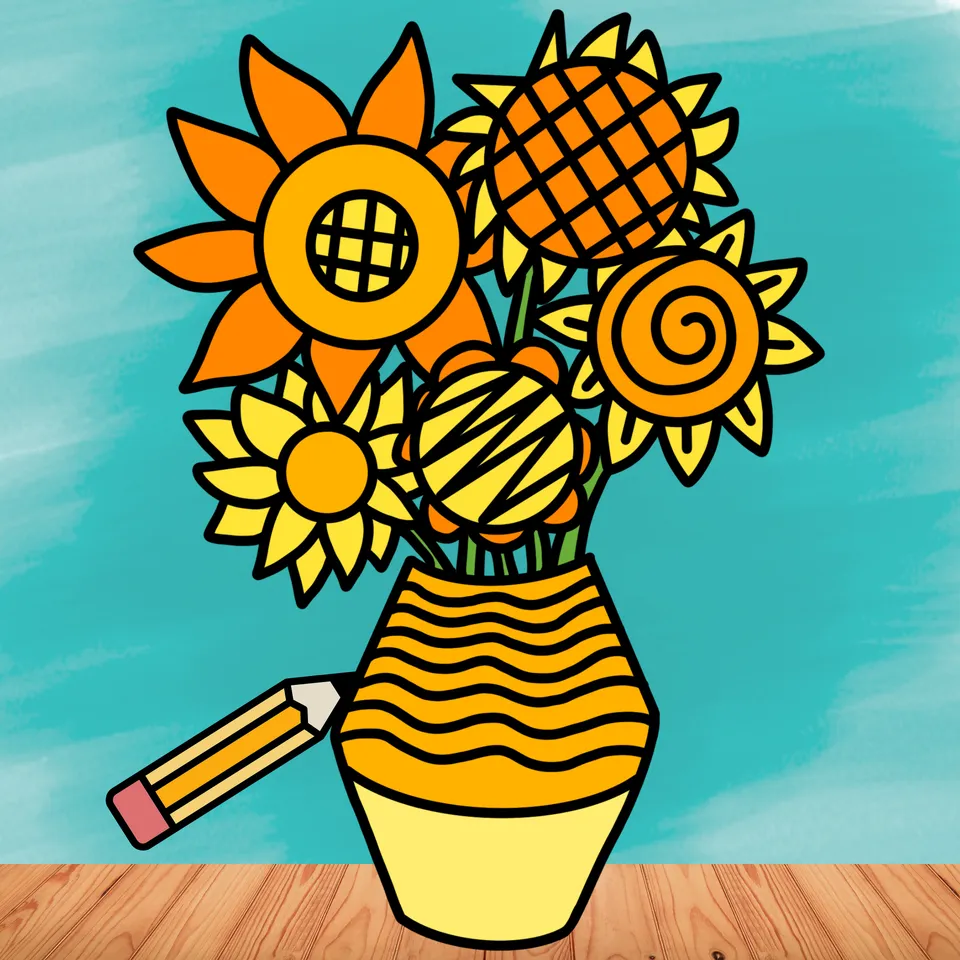
How to Draw: Sunflowers
Ages 5–10 · 6 minutes · Art
Inspired by Van Gogh!
Required materials: pencil, paper, coloring utensils
In this step-by-step directed drawing, students will be guided through a sunflower drawing inspired by Van Gogh's famous piece!
Part of
Standards alignment
Alabama
- MA19.K.22 — Model shapes in the world by building them from sticks, clay balls, or other components and by drawing them.
- MA19.1.22 — Compose two-dimensional shapes (rectangles, squares, trapezoids, triangles, half-circles, and quarter-circles) or three-dimensional shapes (cubes, right rectangular prisms, right circular cones, and right circular cylinders) to create a composite shape, and compose new shapes from the composite shape.
Alaska
- K.G.5 — Build shapes (e.g., using sticks and clay) and draw shapes.
Arizona
- K.G.B.5 — Model shapes in the world by building shapes from components (e.g., sticks and clay balls) and drawing shapes.
Arkansas
- K.GM.5 — Compose and draw shapes found in the world using objects (e.g., straws, toothpicks, clay balls).
California
- K.G.B.5 — Model shapes in the world by building shapes from components (e.g., sticks and clay balls) and drawing shapes.
Colorado
- K.G.B.5 — Model shapes in the world by building shapes from components (e.g., sticks and clay balls) and drawing shapes.
- RWC20-GR.1-S.1-GLE.2-EO.d — Give and follow simple two-step directions.
Connecticut
- K.G.B.5 — Model shapes in the world by building shapes from components (e.g., sticks and clay balls) and drawing shapes.
- 1.G.A.2 — Compose two-dimensional shapes (rectangles, squares, trapezoids, triangles, half-circles, and quarter-circles) or three-dimensional shapes (cubes, right rectangular prisms, right circular cones, and right circular cylinders) to create a composite shape, and compose new shapes from the composite shape.
Delaware
- K.G.B.5 — Model shapes in the world by building shapes from components (e.g., sticks and clay balls) and drawing shapes.
- 1.G.A.2 — Compose two-dimensional shapes (rectangles, squares, trapezoids, triangles, half-circles, and quarter-circles) or three-dimensional shapes (cubes, right rectangular prisms, right circular cones, and right circular cylinders) to create a composite shape, and compose new shapes from the composite shape.
Florida
- MA.1.GR.1.4 — Given a real-world object, identify parts that are modeled by two- and three-dimensional figures. Figures are limited to semi-circles, triangles, rectangles, squares and hexagons, spheres, cubes, rectangular prisms, cones and cylinders.
Georgia
- K.GSR.8.3 — Use basic shapes to represent specific shapes found in the environment by creating models and drawings.
- 1.GSR.4 — Compose shapes, analyze the attributes of shapes, and relate their parts to the whole.
Hawaii
- K.G.B.5 — Model shapes in the world by building shapes from components (e.g., sticks and clay balls) and drawing shapes.
Idaho
- K.G.B.5 — Model shapes in the world by building shapes from components/materials and drawing shapes.
Illinois
- K.G.B.5 — Model shapes in the world by building shapes from components (e.g., sticks and clay balls) and drawing shapes.
Indiana
- 2.CC.6 — Give and follow oral directions with three or more steps.
- 1.CC.7 — Give and follow oral directions with two or three steps.
Iowa
- K.G.B.5 — Model shapes in the world by building shapes from components and drawing shapes. For example, sticks and clay balls.
Kansas
- K.G.5 — Model shapes in the world by building shapes from components (e.g. sticks and clay balls) and drawing shapes.
Louisiana
- K.G.B.5 — Model shapes in the world by building shapes from components (e.g., sticks and clay balls) and drawing shapes.
Maine
- K.G.B.5 — Model shapes in the world by building shapes from components (e.g., sticks and clay balls) and drawing shapes.
Maryland
- K.G.B.5 — Model shapes in the world by building shapes from components (e.g., sticks and clay balls) and drawing shapes.
Massachusetts
- K.G.B.5 — Model shapes in the world by building shapes from components (e.g., sticks and clay balls) and drawing shapes.
Michigan
- K.G.B.5 — Model shapes in the world by building shapes from components (e.g., sticks and clay balls) and drawing shapes.
Minnesota
- K.3.1.3 — Use basic shapes and spatial reasoning to model objects in the real-world. For example: A cylinder can be used to model a can of soup. Another example: Find as many rectangles as you can in your classroom. Record the rectangles you found by making drawings.
- K.2.1.1 — Identify, create, complete, and extend simple patterns using shape, color, size, number, sounds and movements. Patterns may be repeating, growing or shrinking such as ABB, ABB, ABB or ●,●●,●●●.
Missouri
- 1.SL.1.A.c — following two-step instructions, according to classroom expectations
- 2.SL.1.A.b — following three-step instructions, according to classroom expectations
- K.GM.C.9 — Draw or model simple two-dimensional shapes.
Montana
- K.G.B.5 — Model shapes in the world from a variety of cultural contexts, including those of Montana American Indians, by building shapes from components (e.g., sticks and clay balls) and drawing shapes.
Nebraska
- LA.2.SL.1.e — Complete a task following multi-step directions.
- LA.3.SL.1.e — Complete a task following multi-step directions.
- LA.1.SL.1.e — Complete a task following one/two-step directions.
Nevada
- K.G.B.5 — Model shapes in the world by building shapes from components (e.g., sticks and clay balls) and drawing shapes.
- 1.G.A.2 — Compose two-dimensional shapes (rectangles, squares, trapezoids, triangles, half-circles, and quarter-circles) or three-dimensional shapes (cubes, right rectangular prisms, right circular cones, and right circular cylinders) to create a composite shape, and compose new shapes from the composite shape.
New Hampshire
- SS.HI.2.3.2 — Explore art, music and literature of various time periods, e.g., spirituals or Native American Art. (Themes: J: Human Expression and Communication)
New Jersey
- K.G.B.5 — Model shapes in the world by building shapes from components (e.g., sticks and clay balls) and drawing shapes.
New Mexico
- K.G.B.5 — Model shapes in the world by building shapes from components (e.g., sticks and clay balls) and drawing shapes.
New York
- NY-K.G.5 — Model objects in their environment by building and/or drawing shapes.
- NY-K.G.6 — Compose larger shapes from simple shapes.
North Carolina
- NC.K.G.5 — Model shapes in the world by: • Building and drawing triangles, rectangles, squares, hexagons, circles. • Building cubes, cones, spheres, and cylinders.
- NC.K.G.6 — Compose larger shapes from simple shapes.
Ohio
- K.G.5 — Model shapes in the world by building shapes from components, e.g., sticks and clay balls, and drawing shapes.
- 1.G.2 — Compose two-dimensional shapes (rectangles, squares, trapezoids, triangles, half-circles, and quarter-circles) or three-dimensional shapes (cubes, right rectangular prisms, right circular cones, and right circular cylinders) to create a composite shape, and compose new shapes from the composite shape. Students do not need to learn formal names such as "right rectangular prism."
Oklahoma
- 1.1.L.2 — Students will follow simple two- and three-step oral directions.
- 2.1.L.2 — Students will follow multi-step oral directions.
- K.GM.1.6 — Use basic shapes and spatial reasoning to represent objects in the real world.
Oregon
- K.GM.B.5 — Represent shapes in the world by building shapes from components and drawing shapes.
- K.GM.B.6 — Compose common shapes to form larger shapes.
Pennsylvania
- 3.5.3-5.T — Apply universal principles and elements of design.
- 3.5.K-2.P — Discuss that all designs have different characteristics that can be described.
Rhode Island
- K.G.B.5 — Model shapes in the world by building shapes from components (e.g., sticks and clay balls) and drawing shapes.
South Carolina
- K.G.5 — Draw two-dimensional shapes (i.e., square, rectangle, triangle, hexagon, and circle) and create models of three-dimensional shapes (i.e., cone, cube, cylinder, and sphere).
South Dakota
- K.G.B.5 — Model shapes in the world by building shapes from components (e.g., sticks and clay balls) and drawing shapes.
Tennessee
- K.G.B.5 — Model shapes/solids in the world by building or drawing them.
- K.G.B.6 — Compose a figure using simple shapes/solids and identify smaller shapes/solids within the figure.
Texas
- K.6F — create two-dimensional shapes using a variety of materials and drawings.
Virginia
- 1.MG.2 — The student will describe, sort, draw, and name plane figures (circles, triangles, squares, and rectangles), and compose larger plane figures by combining simple plane figures. Students will demonstrate the following Knowledge and Skills:
Washington
- K.G.B.5 — Model shapes in the world by building shapes from components (e.g., sticks and clay balls) and drawing shapes.
- K.G.B.6 — Compose simple shapes to form larger shapes. For example, "Can you join these two triangles with full sides touching to make a rectangle?"
Washington, D.C.
- K.G.B.5 — Model shapes in the world by building shapes from components (e.g., sticks and clay balls) and drawing shapes.
West Virginia
- M.K.24 — Model shapes in the world by building shapes from components (e.g., sticks and clay balls) and drawing shapes.
- ELA.PK.WR.EW.1 — Use scribbles, shapes, pictures, and letters to represent objects, stories, experiences, or ideas.
- M.K.13 — Recognize and create recognizable patterns using colors, shapes, sizes, and sounds with support and guidance.
Wisconsin
- M.K.G.B.5 — Model shapes in the world by building shapes from components (e.g., sticks and clay balls) and drawing shapes.
Wyoming
- K.G.I.5 — Model shapes in the world by building shapes from components (e.g., sticks and clay balls) and drawing shapes.