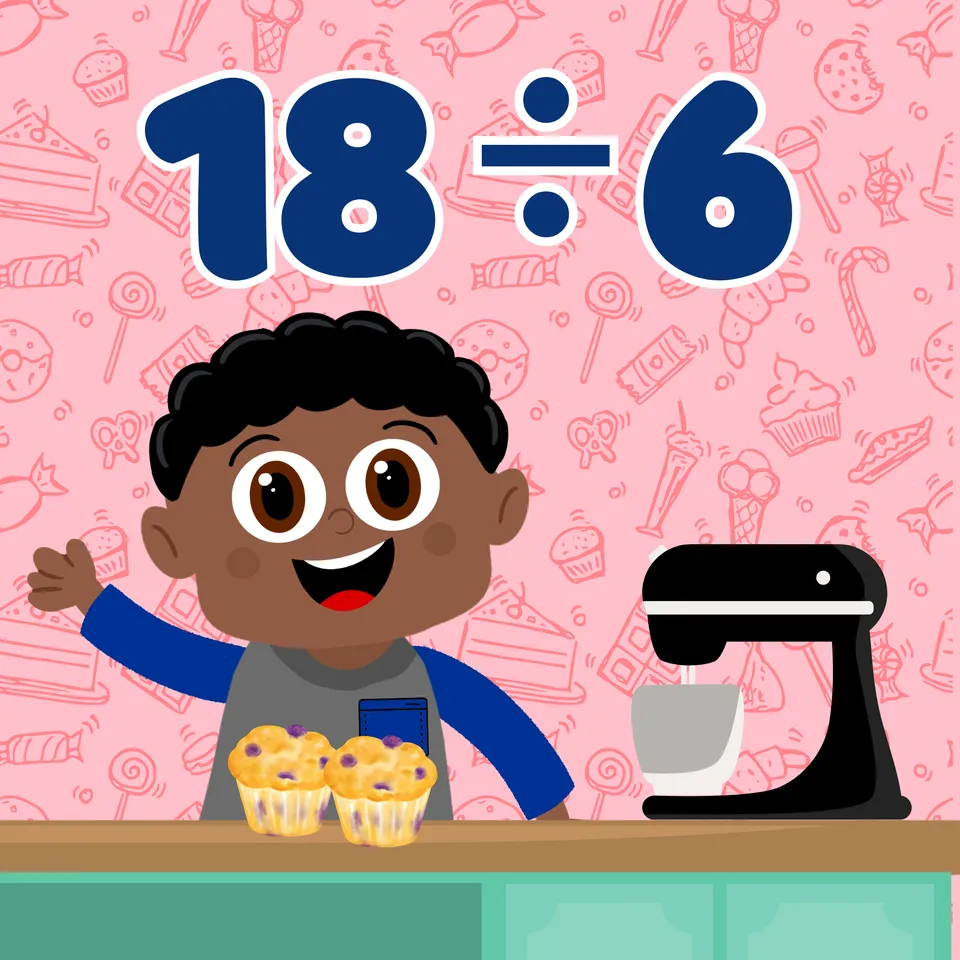
Baker's Division
Ages 8–10 · 7 minutes · Math
Practice division at the bakery!
In this division lesson, students will learn and practice:
- Dividing by 3 and 6
- Using skip counting and equal groups to solve division problems
- Choosing strategies for solving division problems
Part of
Standards alignment
Common Core State Standards
- 3.OA.A.3 — Use multiplication and division within 100 to solve word problems in situations involving equal groups, arrays, and measurement quantities, e.g., by using drawings and equations with a symbol for the unknown number to represent the problem.
- 3.OA.B.6 — Understand division as an unknown-factor problem. For example, find 32 ÷ 8 by finding the number that makes 32 when multiplied by 8.
- 3.OA.C.7 — Fluently multiply and divide within 100, using strategies such as the relationship between multiplication and division (e.g., knowing that 8 × 5 = 40, one knows 40 ÷ 5 = 8) or properties of operations. By the end of Grade 3, know from memory all products of two one-digit numbers.
- 3.OA.A.2 — Interpret whole-number quotients of whole numbers, e.g., interpret 56 ÷ 8 as the number of objects in each share when 56 objects are partitioned equally into 8 shares, or as a number of shares when 56 objects are partitioned into equal shares of 8 objects each. For example, describe a context in which a number of shares or a number of groups can be expressed as 56 ÷ 8.
Alabama
- MA19.3.2 — Illustrate and interpret the quotient of two whole numbers as the number of objects in each group or the number of groups when the whole is partitioned into equal shares.
- MA19.3.3 — Solve word situations using multiplication and division within 100 involving equal groups, arrays, and measurement quantities; represent the situation using models, drawings, and equations with a symbol for the unknown number.
- MA19.3.6 — Use the relationship between multiplication and division to represent division as an equation with an unknown factor.
- MA19.3.7 — Use strategies based on properties and patterns of multiplication to demonstrate fluency with multiplication and division within 100.
Alaska
- 3.OA.2 — Interpret whole-number quotients of whole numbers (e.g., interpret 56 ÷ 8 as the number of objects in each share when 56 objects are partitioned equally into 8 shares, or as a number of shares when 56 objects are partitioned into equal shares of 8 objects each). For example, deconstruct rectangular arrays or describe a context in which a number of shares or a number of groups can be expressed as 56 ÷ 8.
- 3.OA.3 — Use multiplication and division numbers up to 100 to solve word problems in situations involving equal groups, arrays, and measurement quantities (e.g., by using drawings and equations with a symbol for the unknown number to represent the problem).
- 3.OA.6 — Understand division as an unknown-factor problem. For example, find 32 ÷ 8 by finding the number that makes 32 when multiplied by 8.
- 3.OA.7 — Fluently multiply and divide numbers up to 100, using strategies such as the relationship between multiplication and division (e.g., knowing that 8 ×5 = 40, one knows 40 ÷ 5 = 8) or properties of operations. By the end of Grade 3, know from memory all products of two one-digit numbers.
Arizona
- 3.OA.A.2 — Interpret whole number quotients of whole numbers (e.g., interpret 56 ÷ 8 as the number of objects in each group when 56 objects are partitioned equally into 8 groups, or as a number of groups when 56 objects are partitioned into equal groups of 8 objects each). See Table 2.
- 3.OA.A.3 * — Use multiplication and division within 100 to solve word problems in situations involving equal groups, arrays, and measurement quantities. See Table 2.
- 3.OA.B.6 — Understand division as an unknown-factor problem. For example, find 32 ÷ 8 by finding the number that makes 32 when multiplied by 8.
- 3.OA.C.7 * — Fluently multiply and divide within 100. By the end of Grade 3, know from memory all multiplication products through 10 x 10 and division quotients when both the quotient and divisor are less than or equal to 10.
- MP8 — Look for and express regularity in repeated reasoning.
Arkansas
- 3.CAR.2 — Use basic fact fluency to multiply and divide whole numbers with mastery by the end of third grade. • Knowing all products with factors up to and including 12 and the corresponding division facts from the products with factors up to and including 12. • Using strategies such as the relationship between multiplication and division (e.g., Knowing that 8 ∙ 5 = 40, one knows 40 ÷ 5 = 8) or properties of operations.
- 3.CAR.6 — Solve real-world problems using multiplication and division within 100 involving equal groups, arrays, partitive and measurement division.
- 3.CAR.9 — Understand division as an unknown-factor problem.
California
- 3.OA.A.2 — Interpret whole-number quotients of whole numbers, e.g., interpret 56 ÷ 8 as the number of objects in each share when 56 objects are partitioned equally into 8 shares, or as a number of shares when 56 objects are partitioned into equal shares of 8 objects each. For example, describe a context in which a number of shares or a number of groups can be expressed as 56 ÷ 8.
- 3.OA.A.3 — Use multiplication and division within 100 to solve word problems in situations involving equal groups, arrays, and measurement quantities, e.g., by using drawings and equations with a symbol for the unknown number to represent the problem.
- 3.OA.B.6 — Understand division as an unknown-factor problem. For example, find 32 ÷ 8 by finding the number that makes 32 when multiplied by 8.
- 3.OA.C.7 — Fluently multiply and divide within 100, using strategies such as the relationship between multiplication and division (e.g., knowing that 8 × 5 = 40, one knows 40 ÷ 5 = 8) or properties of operations. By the end of Grade 3, know from memory all products of two one-digit numbers.
Colorado
- 3.OA.A.2 — Interpret whole-number quotients of whole numbers, e.g., interpret 56 ÷ 8 as the number of objects in each share when 56 objects are partitioned equally into 8 shares, or as a number of shares when 56 objects are partitioned into equal shares of 8 objects each. For example, describe a context in which a number of shares or a number of groups can be expressed as 56 ÷ 8.
- 3.OA.A.3 — Use multiplication and division within 100 to solve word problems in situations involving equal groups, arrays, and measurement quantities, e.g., by using drawings and equations with a symbol for the unknown number to represent the problem. (see Appendix, Table 2)
- 3.OA.B.6 — Interpret division as an unknown-factor problem. For example, find 32 ÷ 8 by finding the number that makes 32 when multiplied by 8.
- 3.OA.C.7 — Fluently multiply and divide within 100, using strategies such as the relationship between multiplication and division (e.g., knowing that 8 × 5 = 40, one knows 40 ÷ 5 = 8) or properties of operations. By the end of Grade 3, know from memory all products of two one-digit numbers.
- 3.OA.A.4 — Determine the unknown whole number in a multiplication or division equation relating three whole numbers. For example, determine the unknown number that makes the equation true in each of the equations 8 × ? = 48, 5 = ÷ 3, 6 × 6 =?
Connecticut
- 3.OA.A.2 — Interpret whole-number quotients of whole numbers, e.g., interpret 56 ÷ 8 as the number of objects in each share when 56 objects are partitioned equally into 8 shares, or as a number of shares when 56 objects are partitioned into equal shares of 8 objects each. For example, describe a context in which a number of shares or a number of groups can be expressed as 56 ÷ 8.
- 3.OA.A.3 — Use multiplication and division within 100 to solve word problems in situations involving equal groups, arrays, and measurement quantities, e.g., by using drawings and equations with a symbol for the unknown number to represent the problem.
- 3.OA.B.6 — Understand division as an unknown-factor problem. For example, find 32 ÷ 8 by finding the number that makes 32 when multiplied by 8.
- 3.OA.C.7 — Fluently multiply and divide within 100, using strategies such as the relationship between multiplication and division (e.g., knowing that 8 × 5 = 40, one knows 40 ÷ 5 = 8) or properties of operations. By the end of Grade 3, know from memory all products of two one-digit numbers.
Delaware
- 3.OA.A.2 — Interpret whole-number quotients of whole numbers, e.g., interpret 56 ÷ 8 as the number of objects in each share when 56 objects are partitioned equally into 8 shares, or as a number of shares when 56 objects are partitioned into equal shares of 8 objects each. For example, describe a context in which a number of shares or a number of groups can be expressed as 56 ÷ 8.
- 3.OA.A.3 — Use multiplication and division within 100 to solve word problems in situations involving equal groups, arrays, and measurement quantities, e.g., by using drawings and equations with a symbol for the unknown number to represent the problem.
- 3.OA.B.6 — Understand division as an unknown-factor problem. For example, find 32 ÷ 8 by finding the number that makes 32 when multiplied by 8.
- 3.OA.C.7 — Fluently multiply and divide within 100, using strategies such as the relationship between multiplication and division (e.g., knowing that 8 × 5 = 40, one knows 40 ÷ 5 = 8) or properties of operations. By the end of Grade 3, know from memory all products of two one-digit numbers.
Florida
- MA.3.AR.1.2 — Solve one- and two-step real-world problems involving any of four operations with whole numbers.
- MA.3.NSO.2.4 — Multiply two whole numbers from 0 to 12 and divide using related facts with procedural reliability.
- MA.3.AR.2.1 — Restate a division problem as a missing factor problem using the relationship between multiplication and division.
- MA.3.NSO.2.2 — Explore multiplication of two whole numbers with products from 0 to 144, and related division facts.
Georgia
- 3.PAR.3.2 — Represent single digit multiplication and division facts using a variety of strategies. Explain the relationship between multiplication and division.
- 3.PAR.3.6 — Solve practical, relevant problems involving multiplication and division within 100 using part-whole strategies, visual representations, and/or concrete models.
- 3.PAR.3 — Use part-whole strategies to solve real-life, mathematical problems involving multiplication and division with whole numbers within 100.
Hawaii
- 3.OA.A.2 — Interpret whole-number quotients of whole numbers, e.g., interpret 56 ÷ 8 as the number of objects in each share when 56 objects are partitioned equally into 8 shares, or as a number of shares when 56 objects are partitioned into equal shares of 8 objects each.
- 3.OA.A.3 — Use multiplication and division within 100 to solve word problems in situations involving equal groups, arrays, and measurement quantities, e.g., by using drawings and equations with a symbol for the unknown number to represent the problem.
- 3.OA.C.7 — Fluently multiply and divide within 100, using strategies such as the relationship between multiplication and division (e.g., knowing that 8 × 5 = 40, one knows 40 ÷ 5 = 8) or properties of operations. By the end of Grade 3, know from memory all products of two one-digit numbers.
- 3.OA.B.6 — Understand division as an unknown-factor problem.
Idaho
- 3.OA.A.2 — Interpret a quotient of whole numbers as equal sharing, e.g., 56 ÷ 8 as the number in each share when 56 objects are split into 8 equal shares, or as the number of shares when 56 objects are split into equal shares of 8 objects each.
- 3.OA.A.3 — Use multiplication and division within 100 to solve word problems involving equal groups, arrays, and measurements by using visual and symbolic representations, with a symbol for an unknown number.
- 3.OA.B.6 — Understand division as determining an unknown factor in a multiplication problem.
- 3.OA.C.7.a — Demonstrate understanding of strategies that make use of the relationship between multiplication and division or properties of operations.
- 3.OA.C.7.b — Know from memory all products of two single-digit numbers and related division facts.
Illinois
- 3.OA.A.2 — Interpret whole-number quotients of whole numbers, e.g., interpret 56 ÷ 8 as the number of objects in each share when 56 objects are partitioned equally into 8 shares, or as a number of shares when 56 objects are partitioned into equal shares of 8 objects each. For example, describe a context in which a number of shares or a number of groups can be expressed as 56 ÷ 8.
- 3.OA.A.3 — Use multiplication and division within 100 to solve word problems in situations involving equal groups, arrays, and measurement quantities, e.g., by using drawings and equations with a symbol for the unknown number to represent the problem.
- 3.OA.B.6 — Understand division as an unknown-factor problem. For example, find 32 ÷ 8 by finding the number that makes 32 when multiplied by 8.
- 3.OA.C.7 — Fluently multiply and divide within 100, using strategies such as the relationship between multiplication and division (e.g., knowing that 8 × 5 = 40, one knows 40 ÷ 5 = 8) or properties of operations. By the end of Grade 3, know from memory all products of two one-digit numbers.
Indiana
- 3.CA.5 — Multiply and divide within 100 using strategies such as the relationship between multiplication and division (e.g., knowing that 8 x 5 = 40, one knows 40 ÷ 5 = 8) or properties of operations. (E)
- 3.CA.7 — Solve real-world problems involving whole number multiplication and division within 100 in situations involving equal groups, arrays, and measurement quantities (e.g., by using drawings and equations with a symbol for the unknown number to represent the problem). (E)
- 3.CA.4 — Model the concept of division of whole numbers with the following models: partitioning, sharing, and an inverse of multiplication. Model the properties of 0 and 1 in division using objects or drawings. (E)
- 3.CA.6 — Demonstrate fluency with mastery of multiplication facts and corresponding division facts of 0 to 10.
Iowa
- 3.OA.A.2 — Interpret whole-number quotients of whole numbers as the number of groups or the number in each group in situations of equal groups. For example, describe a context involving equal groups of objects in which the number of groups or the number in each group can be expressed as 56 ÷ 8. (See Problem Types Table 2 in Appendix A)
- 3.OA.A.3 — Use multiplication and division within 100 to solve word problems in situations involving equal groups, arrays, and measurement quantities, with unknowns in all positions. For example, by using drawings and equations with a symbol for the unknown number to represent the problem. (See Problem Types Table 2 in Appendix A)
- 3.OA.B.6 — Understand division as an unknown-factor problem. For example, find 32 ÷ 8 by finding (or remembering) the number that makes 32 when multiplied by 8 (▯ × 8 = 32).
- 3.OA.C.7 — Fluently multiply and divide within 100, using strategies such as the relationship between multiplication and division or properties of operations. For example, knowing that 8 × 5 = 40, one knows 40 ÷ 5 = 8. By the end of Grade 3, flexibly, efficiently, and accurately find all products of two one-digit numbers. Note: Fluency of this standard is critical by the end of grade level.
- SMP7 — Look for and make use of structure.
Kansas
- 3.OA.2 — Interpret whole-number quotients of whole numbers, (e.g. interpret 56 ÷ 8 as the number of objects in each share when 56 objects are partitioned equally into 8 shares, or as a number of shares when 56 objects are partitioned into equal shares of 8 objects each.)
- 3.OA.3 — Use multiplication and division within 100 to solve word problems in situations involving equal groups, arrays, and measurement quantities, (e.g. by using drawings and equations with a symbol for the unknown number to represent the problem.)
- 3.OA.6 — Understand division as an unknown-factor problem. For example, find 32 ÷ 8 by finding the number that makes 32 when multiplied by 8.
- 3.OA.7 — Fluently (efficiently, accurately, and flexibly) multiply and divide with single digit multiplications and related divisions using strategies (e.g. relationship between multiplication and division, doubles, double and double again, half and then double, etc.) or properties of operations.
Kentucky
- KY.3.OA.2 — Interpret and demonstrate whole-number quotients of whole numbers, where objects are partitioned into equal shares.
- KY.3.OA.3 — Use multiplication and division within 100 to solve word problems in situations involving equal groups, arrays and measurement quantities, by using drawings and equations with a symbol for the unknown number to represent the problem.
- KY.3.OA.7 — Fluently multiply and divide within 100, using strategies such as the relationship between multiplication and division or properties of operations.
- KY.3.OA.6 — Understand division as an unknown-factor problem.
Louisiana
- 3.OA.A.2 — Interpret whole-number quotients of whole numbers, e.g., interpret 56 ÷ 8 as the number of objects in each share when 56 objects are partitioned equally into 8 shares, or as a number of shares when 56 objects are partitioned into equal shares of 8 objects each. For example, describe a context in which a number of shares or a number of groups can be expressed as 56 ÷ 8.
- 3.OA.A.3 — Use multiplication and division within 100 to solve word problems in situations involving equal groups, arrays, and measurement quantities, e.g., by using drawings and equations with a symbol for the unknown number to represent the problem.
- 3.OA.B.6 — Understand division as an unknown-factor problem. For example, find 32 ÷ 8 by finding the number that makes 32 when multiplied by 8.
- 3.OA.C.7 — Fluently multiply and divide within 100, using strategies such as the relationship between multiplication and division (e.g., knowing that 8 × 5 = 40, one knows 40 ÷ 5 = 8) or properties of operations. By the end of Grade 3, know from memory all products of two one-digit numbers.
Maine
- 3.OA.A.2 — Interpret whole-number quotients of whole numbers, e.g., interpret 56 ÷ 8 as the number of objects in each share when 56 objects are partitioned equally into 8 shares, or as a number of shares when 56 objects are partitioned into equal shares of 8 objects each. For example, describe a context in which a number of shares or a number of groups can be expressed as 56 ÷ 8.
- 3.OA.A.3 — Use multiplication and division within 100 to solve word problems in situations involving equal groups, arrays, and measurement quantities, e.g., by using drawings and equations with a symbol for the unknown number to represent the problem.
- 3.OA.B.6 — Understand division as an unknown-factor problem. For example, find 32 ÷ 8 by finding the number that makes 32 when multiplied by 8.
- 3.OA.C.7 — Fluently multiply and divide within 100, using strategies such as the relationship between multiplication and division (e.g., knowing that 8 × 5 = 40, one knows 40 ÷ 5 = 8) or properties of operations. By the end of Grade 3, know from memory all products of two one-digit numbers.
Maryland
- 3.OA.A.2 — Interpret whole-number quotients of whole numbers, e.g., interpret 56 ÷ 8 as the number of objects in each share when 56 objects are partitioned equally into 8 shares, or as a number of shares when 56 objects are partitioned into equal shares of 8 objects each. For example, describe a context in which a number of shares or a number of groups can be expressed as 56 ÷ 8.
- 3.OA.A.3 — Use multiplication and division within 100 to solve word problems in situations involving equal groups, arrays, and measurement quantities, e.g., by using drawings and equations with a symbol for the unknown number to represent the problem.
- 3.OA.B.6 — Understand division as an unknown-factor problem. For example, find 32 ÷ 8 by finding the number that makes 32 when multiplied by 8.
- 3.OA.C.7 — Fluently multiply and divide within 100, using strategies such as the relationship between multiplication and division (e.g., knowing that 8 × 5 = 40, one knows 40 ÷ 5 = 8) or properties of operations. By the end of Grade 3, know from memory all products of two one-digit numbers.
Massachusetts
- 3.OA.A.2 — Interpret whole-number quotients of whole numbers, e.g., interpret 56 ÷ 8 as the number of objects in each share when 56 objects are partitioned equally into 8 shares, or as a number of shares when 56 objects are partitioned into equal shares of 8 objects each. For example, describe a context in which a number of shares or a number of groups can be expressed as 56 ÷ 8.
- 3.OA.A.3 — Use multiplication and division within 100 to solve word problems in situations involving equal groups, arrays, and measurement quantities, e.g., by using drawings and equations with a symbol for the unknown number to represent the problem.
- 3.OA.B.6 — Understand division as an unknown-factor problem. For example, find 32 8 by finding the number that makes 32 when multiplied by 8.
- 3.OA.C.7 — Fluently multiply and divide within 100, using strategies such as the relationship between multiplication and division (e.g., knowing that 8 × 5 = 40, one knows 40 × 5 = 8) or properties of operations. By the end of grade 3, know from memory all products of two single-digit numbers and related division facts. For example, the product 4 x 7 = 28 has related division facts 28 ÷ 7 = 4 and 28 ÷ 4 = 7.
Michigan
- 3.OA.A.2 — Interpret whole-number quotients of whole numbers, e.g., interpret 56 ÷ 8 as the number of objects in each share when 56 objects are partitioned equally into 8 shares, or as a number of shares when 56 objects are partitioned into equal shares of 8 objects each. For example, describe a context in which a number of shares or a number of groups can be expressed as 56 ÷ 8.
- 3.OA.A.3 — Use multiplication and division within 100 to solve word problems in situations involving equal groups, arrays, and measurement quantities, e.g., by using drawings and equations with a symbol for the unknown number to represent the problem.
- 3.OA.B.6 — Understand division as an unknown-factor problem. For example, find 32 ÷ 8 by finding the number that makes 32 when multiplied by 8.
- 3.OA.C.7 — Fluently multiply and divide within 100, using strategies such as the relationship between multiplication and division (e.g., knowing that 8 × 5 = 40, one knows 40 ÷ 5 = 8) or properties of operations. By the end of Grade 3, know from memory all products of two one-digit numbers.
Minnesota
- 3.1.2.3 — Represent multiplication facts by using a variety of approaches, such as repeated addition, equal-sized groups, arrays, area models, equal jumps on a number line and skip counting. Represent division facts by using a variety of approaches, such as repeated subtraction, equal sharing and forming equal groups. Recognize the relationship between multiplication and division.
- 3.1.2.4 — Solve real-world and mathematical problems involving multiplication and division, including both "how many in each group" and "how many groups" division problems. For example: You have 27 people and 9 tables. If each table seats the same number of people, how many people will you put at each table? Another example: If you have 27 people and tables that will hold 9 people, how many tables will you need?
- 3.2.2.2 — Use multiplication and division basic facts to represent a given problem situation using a number sentence. Use number sense and multiplication and division basic facts to find values for the unknowns that make the number sentences true. For example: Find values of the unknowns that make each number sentence true 6 = p ÷ 9 24 = a × b 5 × 8 = 4 × t. Another example: How many math teams are competing if there is a total of 45 students with 5 students on each team? This situation can be represented by 5 × n = 45 or 45/5 = n or 45/n = 5.
Mississippi
- 3.OA.2 — Interpret whole-number quotients of whole numbers, e.g., interpret 56 ÷ 8 as the number of objects in each share when 56 objects are partitioned equally into 8 shares, or as a number of shares when 56 objects are partitioned into equal shares of 8 objects each. For example, describe a context in which a number of shares or a number of groups can be expressed as 56 ÷ 8.
- 3.OA.3 — Use multiplication and division within 100 to solve word problems in situations involving equal groups, arrays, and measurement quantities, e.g., by using drawings and equations with a symbol for the unknown number to represent the problem.
- 3.OA.6 — Understand division as an unknown-factor problem, where a remainder does not exist. For example, find 32 ÷ 8 by finding the number that makes 32 when multiplied by 8 with no remainder.
- 3.OA.7 — Fluently multiply and divide within 100, using strategies such as the relationship between multiplication and division (e.g., knowing that 8 × 5 = 40, one knows 40 ÷ 5 = 8) or properties of operations. Know from memory all products of two one-digit numbers; and fully understand the concept when a remainder does not exist under division.
Missouri
- 3.RA.A.2 — Interpret quotients of whole numbers.
- 3.RA.A.4 — Use multiplication and division within 100 to solve problems.
- 3.RA.C.7 — Multiply and divide with numbers and results within 100 using strategies such as the relationship between multiplication and division or properties of operations. Know all products of two one-digit numbers.
- 3.RA.A.5 — Determine the unknown number in a multiplication or division equation relating three whole numbers.
Montana
- 3.OA.A.3 — Use multiplication and division within 100 to solve word problems in situations involving equal groups, arrays, and measurement quantities, e.g., by using drawings and equations with a symbol for the unknown number to represent the problem.
- 3.OA.B.6 — Understand division as an unknown-factor problem. For example, find 32 ÷ 8 by finding the number that makes 32 when multiplied by 8.
- 3.OA.A.2 — Interpret whole-number quotients of whole numbers, e.g., interpret 56 ÷ 8 as the number of objects in each share when 56 objects are partitioned equally into 8 shares, or as a number of shares when 56 objects are partitioned into equal shares of 8 objects each. For example, describe a context in which a number of shares or a number of groups can be expressed as 56 ÷ 8.
- 3.OA.C.7 — Fluently multiply and divide within 100, using strategies such as the relationship between multiplication and division (e.g., knowing that 8 × 5 = 40, one knows 40 ÷ 5 = 8) or properties of operations. By the end of Grade 3, know from memory all products of two one-digit numbers.
Nebraska
- 3.A.1.f — Use drawings, words, arrays, symbols, repeated addition, equal groups, and number lines to interpret and explain the meaning of multiplication and division and their relationship.
- 3.A.1.g — Fluently multiply and divide within 100 using strategies based on understanding and properties of operations.
- 3.A.1 — Operations and Algebraic Thinking: Students will extend understanding of multiplication and apply operational properties to solve problems.
- 3.A.1.c — Solve and write one-step whole number equations to represent authentic problems using the four operations including equations with an unknown start, unknown change, or unknown result.
Nevada
- 3.OA.A.2 — Interpret whole-number quotients of whole numbers, e.g., interpret 56 ÷ 8 as the number of objects in each share when 56 objects are partitioned equally into 8 shares, or as a number of shares when 56 objects are partitioned into equal shares of 8 objects each. For example, describe a context in which a number of shares or a number of groups can be expressed as 56 ÷ 8.
- 3.OA.A.3 — Use multiplication and division within 100 to solve word problems in situations involving equal groups, arrays, and measurement quantities, e.g., by using drawings and equations with a symbol for the unknown number to represent the problem.
- 3.OA.B.6 — Understand division as an unknown-factor problem. For example, find 32 ÷ 8 by finding the number that makes 32 when multiplied by 8.
- 3.OA.C.7 — Fluently multiply and divide within 100, using strategies such as the relationship between multiplication and division (e.g., knowing that 8 × 5 = 40, one knows 40 ÷ 5 = 8) or properties of operations. By the end of Grade 3, know from memory all products of two one-digit numbers.
New Hampshire
- 3.OA.A.2 — Interpret whole-number quotients of whole numbers, e.g., interpret 56 ÷ 8 as the number of objects in each share when 56 objects are partitioned equally into 8 shares, or as a number of shares when 56 objects are partitioned into equal shares of 8 objects each. For example, describe a context in which a number of shares or a number of groups can be expressed as 56 ÷ 8.
- 3.OA.A.3 — Use multiplication and division within 100 to solve word problems in situations involving equal groups, arrays, and measurement quantities, e.g., by using drawings and equations with a symbol for the unknown number to represent the problem.
- 3.OA.B.6 — Understand division as an unknown-factor problem. For example, find 32 ÷ 8 by finding the number that makes 32 when multiplied by 8.
- 3.OA.C.7 — Fluently multiply and divide within 100, using strategies such as the relationship between multiplication and division (e.g., knowing that 8 × 5 = 40, one knows 40 ÷ 5 = 8) or properties of operations. By the end of Grade 3, know from memory all products of two one-digit numbers.
New Jersey
- 3.OA.A.2 — Interpret whole-number quotients of whole numbers, e.g., interpret 56 ÷ 8 as the number of objects in each share when 56 objects are partitioned equally into 8 shares, or as a number of shares when 56 objects are partitioned into equal shares of 8 objects each. For example, describe and/or represent a context in which a number of shares or a number of groups can be expressed as 56 ÷ 8.
- 3.OA.A.3 — Use multiplication and division within 100 to solve word problems in situations involving equal groups, arrays, and measurement quantities, e.g., by using drawings and equations with a symbol for the unknown number to represent the problem.
- 3.OA.B.6 — Understand division as an unknown-factor problem. For example, find 32 ÷ 8 by finding the number that makes 32 when multiplied by 8.
- 3.OA.C.7 — Fluently multiply and divide within 100, using strategies such as the relationship between multiplication and division (e.g., knowing that 8 × 5 = 40, one knows 40 ÷ 5 = 8) or properties of operations. By the end of Grade 3, know from memory all products of two one-digit numbers.
New Mexico
- 3.OA.A.2 — Interpret whole-number quotients of whole numbers, e.g., interpret 56 ÷ 8 as the number of objects in each share when 56 objects are partitioned equally into 8 shares, or as a number of shares when 56 objects are partitioned into equal shares of 8 objects each. For example, describe a context in which a number of shares or a number of groups can be expressed as 56 ÷ 8.
- 3.OA.A.3 — Use multiplication and division within 100 to solve word problems in situations involving equal groups, arrays, and measurement quantities, e.g., by using drawings and equations with a symbol for the unknown number to represent the problem.
- 3.OA.C.7 — Fluently multiply and divide within 100, using strategies such as the relationship between multiplication and division (e.g., knowing that 8 × 5 = 40, one knows 40 ÷ 5 = 8) or properties of operations. By the end of Grade 3, know from memory all products of two one-digit numbers.
- 3.OA.B.6 — Understand division as an unknown-factor problem. For example, find 32 ÷ 8 by finding the number that makes 32 when multiplied by 8.
New York
- NY-3.OA.2 — Interpret whole-number quotients of whole numbers.
- NY-3.OA.3 — Use multiplication and division within 100 to solve word problems in situations involving equal groups, arrays, and measurement quantities.
- NY-3.OA.6 — Understand division as an unknown-factor problem.
- NY-3.OA.7.a — Fluently solve single-digit multiplication and related divisions, using strategies such as the relationship between multiplication and division or properties of operations.
North Carolina
- NC.3.OA.2 — For whole-number quotients of whole numbers with a one-digit divisor and a one-digit quotient: • Interpret the divisor and quotient in a division equation as representing the number of equal groups and the number of objects in each group. • Illustrate and explain strategies including arrays, repeated addition or subtraction, and decomposing a factor.
- NC.3.OA.3 — Represent, interpret, and solve one-step problems involving multiplication and division. • Solve multiplication word problems with factors up to and including 10. Represent the problem using arrays, pictures, and/or equations with a symbol for the unknown number to represent the problem. • Solve division word problems with a divisor and quotient up to and including 10. Represent the problem using arrays, pictures, repeated subtraction and/or equations with a symbol for the unknown number to represent the problem.
- NC.3.OA.6 — Solve an unknown-factor problem, by using division strategies and/or changing it to a multiplication problem.
- NC.3.OA.7 — Demonstrate fluency with multiplication and division with factors, quotients and divisors up to and including 10. • Know from memory all products with factors up to and including 10. • Illustrate and explain using the relationship between multiplication and division. • Determine the unknown whole number in a multiplication or division equation relating three whole numbers.
North Dakota
- 3.AR.OA.1 — Using mental strategies, multiply and divide basic facts within 100. Automatically multiply and divide up to 5x5 and 10s facts.
- 3.AR.OA.5 — Use strategies and visual models to solve authentic word problems with division within 100, including unknowns, using grouping models and equations.
- 3.AR.OA.2 — Apply the properties of operations to solve multiplication and division equations and justify thinking.
Ohio
- 3.OA.2 — Interpret whole number quotients of whole numbers, e.g., interpret 56 ÷ 8 as the number of objects in each share when 56 objects are partitioned equally into 8 shares, or as a number of shares when 56 objects are partitioned into equal shares of 8 objects each. For example, describe a context in which a number of shares or a number of groups can be expressed as 56 ÷ 8.
- 3.OA.3 — Use multiplication and division within 100 to solve word problems in situations involving equal groups, arrays, and measurement quantities, e.g., by using drawings and equations with a symbol for the unknown number to represent the problem. Drawings need not show details, but should show the mathematics in the problem.
- 3.OA.6 — Understand division as an unknown-factor problem. For example, find 32 ÷ 8 by finding the number that makes 32 when multiplied by 8.
- 3.OA.7 — Fluently multiply and divide within 100, using strategies such as the relationship between multiplication and division, e.g., knowing that 8 × 5 = 40, one knows 40 ÷ 5 = 8, or properties of operations. Limit to division without remainders. By the end of Grade 3, know from memory all products of two one-digit numbers.
Oklahoma
- 3.N.2.6 — Represent division facts and divisibility by modeling a variety of approaches (e.g., repeated subtraction, equal sharing, forming equal groups) to show the relationship between multiplication and division.
- 3.N.2.7 — Apply the relationship between multiplication and division to represent and solve problems.
- 3.N.2 — Solve real-world and mathematical problems using addition, subtraction, multiplication, and division.
Oregon
- 3.OA.A.2 — Represent and interpret whole-number quotients as dividing an amount into equal sized groups.
- 3.OA.A.3 — Use multiplication and division within 100 to solve problems in authentic contexts involving equal groups, arrays, and/or measurement quantities.
- 3.OA.B.6 — Understand division as an unknown-factor in a multiplication problem.
- 3.OA.C.7 — Fluently multiply and divide within 100 using accurate, efficient, and flexible strategies and algorithms based on place value and properties of operations.
Pennsylvania
- CC.2.2.3.A.1 — Represent and solve problems involving multiplication and division.
- CC.2.2.3.A.3 — Demonstrate multiplication and division fluency.
- CC.2.2.3.A.2 — Understand properties of multiplication and the relationship between multiplication and division.
Rhode Island
- 3.OA.A.2 — Interpret whole-number quotients of whole numbers, e.g., interpret 56 ÷ 8 as the number of objects in each share when 56 objects are partitioned equally into 8 shares, or as a number of shares when 56 objects are partitioned into equal shares of 8 objects each. For example, describe a context in which a number of shares or a number of groups can be expressed as 56 ÷ 8.
- 3.OA.A.3 — Use multiplication and division within 100 to solve word problems in situations involving equal groups, arrays, and measurement quantities, e.g., by using drawings and equations with a symbol for the unknown number to represent the problem.
- 3.OA.B.6 — Understand division as an unknown-factor problem. For example, find 32 ÷ 8 by finding the number that makes 32 when multiplied by 8.
- 3.OA.C.7 — Fluently multiply and divide within 100, using strategies such as the relationship between multiplication and division (e.g., knowing that 8 x 5 = 40, one knows 40 ÷ 5 = 8) or properties of operations. By the end of grade 3, know from memory all products of two single- digit numbers and related division facts. For example, the product 4 x 7 = 28 has related division facts 28 ÷ 7 = 4 and 28 ÷ 4 = 7.
South Carolina
- 3.ATO.2 — Use concrete objects, drawings and symbols to represent division without remainders and explain the relationship among the whole number quotient (i.e., 0 - 10), divisor (i.e., 0 - 10), and dividend.
- 3.ATO.3 — Solve real-world problems involving equal groups, area/array, and number line models using basic multiplication and related division facts. Represent the problem situation using an equation with a symbol for the unknown.
- 3.ATO.6 — Understand division as a missing factor problem.
- 3.ATO.7 — Demonstrate fluency with basic multiplication and related division facts of products and dividends through 100.
South Dakota
- 3.OA.A.2 — Interpret whole-number quotients of whole numbers, e.g., interpret 56 ÷ 8 as the number of objects in each share when 56 objects are partitioned equally into 8 shares, or as a number of shares when 56 objects are partitioned into equal shares of 8 objects each. For example, describe a context in which a number of shares or a number of groups can be expressed as 56 ÷ 8.
- 3.OA.A.3 — Use multiplication and division within 100 to solve word problems in situations involving equal groups, arrays, and measurement quantities, e.g., by using drawings and equations with a symbol for the unknown number to represent the problem.
- 3.OA.B.6 — Understand division as an unknown-factor problem. For example, find 32 ÷ 8 by finding the number that makes 32 when multiplied by 8.
- 3.OA.C.7.a — Fluently multiply and divide within 100, using strategies such as the relationship between multiplication and division (e.g., knowing that 8 × 5 = 40, one knows 40 ÷ 5 = 8) or properties of operations.
Tennessee
- 3.OA.A.3 — Multiply and divide within 100 to solve contextual problems, with the unknown in any positions, in situations involving equal groups, arrays/area, and measurement quantities using strategies based on place value, the properties of operations, and the relationship between multiplication and division (e.g., contexts including computations such as 3 x ? = 24, 6 x 16 = ?, ? ÷ 8 = 3, or 96 ÷ 6 = ?).
- 3.OA.B.6 — Understand division as an unknown-factor problem. For example, find 32 ÷ 8 by finding the number that makes 32 when multiplied by 8.
- 3.OA.C.7 — Fluently multiply and divide within 100, using strategies such as the properties of operations or the relationship between multiplication and division (e.g., knowing that 8 x 5 = 40, one knows 40 ÷ 5 = 8). By the end of 3rd grade, know all products of two one-digit numbers and related division facts.
- 3.OA.A.2 — Interpret the dividend, divisor, and quotient in whole number division equations (e.g., 28 ÷ 7 can be interpreted as 28 objects divided into 7 equal groups with 4 objects in each group or 28 objects divided so there are 7 objects in each of the 4 equal groups).
Texas
- 3.4H — determine the number of objects in each group when a set of objects is partitioned into equal shares or a set of objects is shared equally;
- 3.4K — solve one-step and two-step problems involving multiplication and division within 100 using strategies based on objects; pictorial models, including arrays, area models, and equal groups; properties of operations; or recall of facts.
- 3.4J — determine a quotient using the relationship between multiplication and division; and
- 3.5B — represent and solve one- and two-step multiplication and division problems within 100 using arrays, strip diagrams, and equations;
Utah
- 3.OA.2 — Interpret whole-number quotients of whole numbers. For example, interpret 56 ÷ 8 as the number of objects in each share when 56 objects are partitioned equally into eight shares (partitive), or as a number of shares when 56 objects are partitioned into equal shares of eight objects each (quotative).
- 3.OA.3 — Use multiplication and division within 100 to solve word problems in situations involving equal groups, arrays, and measurement quantities. For example, use drawings and equations with a symbol for the unknown number to represent the problem.
- 3.OA.6 — Understand division as an unknown-factor problem. Understand the relationship between multiplication and division (multiplication and division are inverse operations). For example, find 32 ÷ 8 by finding the number that makes 32 when multiplied by 8.
- 3.OA.7.a — Fluently multiply and divide within 100, using strategies such as the relationship between multiplication and division or properties of operations. (For example, knowing that 8 x 5 = 40, one knows 40 ÷ 5 = 8).
Vermont
- 3.OA.A.2 — Interpret whole-number quotients of whole numbers, e.g., interpret 56 ÷ 8 as the number of objects in each share when 56 objects are partitioned equally into 8 shares, or as a number of shares when 56 objects are partitioned into equal shares of 8 objects each. For example, describe a context in which a number of shares or a number of groups can be expressed as 56 ÷ 8.
- 3.OA.A.3 — Use multiplication and division within 100 to solve word problems in situations involving equal groups, arrays, and measurement quantities, e.g., by using drawings and equations with a symbol for the unknown number to represent the problem.
- 3.OA.B.6 — Understand division as an unknown-factor problem. For example, find 32 ÷ 8 by finding the number that makes 32 when multiplied by 8.
- 3.OA.C.7 — Fluently multiply and divide within 100, using strategies such as the relationship between multiplication and division (e.g., knowing that 8 × 5 = 40, one knows 40 ÷ 5 = 8) or properties of operations. By the end of Grade 3, know from memory all products of two one-digit numbers.
Virginia
- 3.CE.2a — Represent multiplication and division of whole numbers through 10 × 10, including in a contextual situation, using a variety of approaches and models (e.g., repeated addition/subtraction, equal-sized groups/sharing, arrays, equal jumps on a number line, using multiples to skip count).
- 3.CE.2e — Represent, solve, and justify solutions to single-step contextual problems that involve multiplication and division of whole numbers through 10 × 10.
- 3.CE.2 — The student will recall with automaticity multiplication and division facts through 10 × 10; and represent, solve, and justify solutions to single-step contextual problems using multiplication and division with whole numbers. Students will demonstrate the following Knowledge and Skills:
- 3.CE.2c — Apply strategies (e.g., place value, the properties of multiplication and/or addition) when multiplying and dividing whole numbers.
- 3.CE.2b — Use inverse relationships to write the related facts connected to a given model for multiplication and division of whole numbers through 10 × 10.
Washington
- 3.OA.A.2 — Interpret whole-number quotients of whole numbers, e.g., interpret 56 ÷ 8 as the number of objects in each share when 56 objects are partitioned equally into 8 shares, or as a number of shares when 56 objects are partitioned into equal shares of 8 objects each. For example, describe a context in which a number of shares or a number of groups can be expressed as 56 ÷ 8.
- 3.OA.A.3 — Use multiplication and division within 100 to solve word problems in situations involving equal groups, arrays, and measurement quantities, e.g., by using drawings and equations with a symbol for the unknown number to represent the problem.
- 3.OA.B.6 — Understand division as an unknown-factor problem. For example, find 32 ÷ 8 by finding the number that makes 32 when multiplied by 8.
- 3.OA.C.7 — Fluently multiply and divide within 100, using strategies such as the relationship between multiplication and division (e.g., knowing that 8 × 5 = 40, one knows 40 ÷ 5 = 8) or properties of operations. By the end of Grade 3, know from memory all products of two one-digit numbers.
Washington, D.C.
- 3.OA.A.2 — Interpret whole-number quotients of whole numbers, e.g., interpret 56 ÷ 8 as the number of objects in each share when 56 objects are partitioned equally into 8 shares, or as a number of shares when 56 objects are partitioned into equal shares of 8 objects each. For example, describe a context in which a number of shares or a number of groups can be expressed as 56 ÷ 8.
- 3.OA.A.3 — Use multiplication and division within 100 to solve word problems in situations involving equal groups, arrays, and measurement quantities, e.g., by using drawings and equations with a symbol for the unknown number to represent the problem.
- 3.OA.B.6 — Understand division as an unknown-factor problem. For example, find 32 ÷ 8 by finding the number that makes 32 when multiplied by 8.
- 3.OA.C.7 — Fluently multiply and divide within 100, using strategies such as the relationship between multiplication and division (e.g., knowing that 8 × 5 = 40, one knows 40 ÷ 5 = 8) or properties of operations. By the end of Grade 3, know from memory all products of two one-digit numbers.
West Virginia
- M.3.2 — Interpret whole-number quotients of whole numbers, e.g., interpret 56 + 8 as the number of objects in each share when 56 objects are partitioned equally into 8 shares, or as a number of shares when 56 objects are partitioned into equal shares of 8 objects each (e.g., describe a context in which a number of shares or a number of groups can be expressed as 56 + 8).
- M.3.3 — Use multiplication and division within 100 to solve word problems in situations involving equal groups, arrays, and measurement quantities (e.g., by using drawings and equations with a symbol for the unknown number to represent the problem).
- M.3.6 — Understand division as an unknown-factor problem (e.g., find 32 + 8 by finding the number that makes 32 when multiplied by 8).
- M.3.7 — Fluently (efficiently, flexibly, and accurately) multiply and divide within 100 using strategies such as the relationship between multiplication and division and the properties of operations. By the end of Grade 3, know the multiplication table (facts) within 100 (Os10s) efficiently.
Wisconsin
- M.3.OA.A.2 — Interpret whole-number quotients of whole numbers, e.g., interpret 56 ÷ 8 as the number of objects in each share when 56 objects are partitioned equally into 8 shares, or as a number of shares when 56 objects are partitioned into equal shares of 8 objects each.
- M.3.OA.A.3 — Use multiplication and division within 100 to solve word problems in situations involving equal groups, arrays, and measurement quantities, e.g., by using drawings and equations with a symbol for the unknown number to represent the problem.
- M.3.OA.B.5 — Understand division as an unknown-factor problem.
- M.3.OA.C.6 — Use multiplicative thinking to multiply and divide within 100. a. Use the meanings of multiplication and division, the relationship between the operations (e.g., knowing that 8 x 5 = 40, one could reason that 40 ÷ 5 = 8), and properties of operations (e.g., the distributive property) to develop and understand strategies to multiply and divide within 100. b. Flexibly and efficiently use strategies, the relationship between the operations, and properties of operations to find products and quotients with multiples of 0, 1, 2, 5, & 10 within 100.
Wyoming
- 3.OA.A.2 — Represent the concept of division of whole numbers (resulting in whole number quotients) using models including, but not limited to, partitioning, repeated subtraction, sharing, and inverse of multiplication.
- 3.OA.A.3 — Solve multiplication and division word problems within 100 using appropriate modeling strategies and equations.
- 3.OA.B.6 — Understand division as an unknown-factor problem.
- 3.OA.C — Multiply and divide within 100.
- 3.OA.C.7 — Fluently multiply and divide with factors 1 - 10 using mental strategies. By end of Grade 3, know automatically all products of one-digit factors based on strategies.