How to Draw: Mondrian
Ages 5–10 · 4 minutes · Art
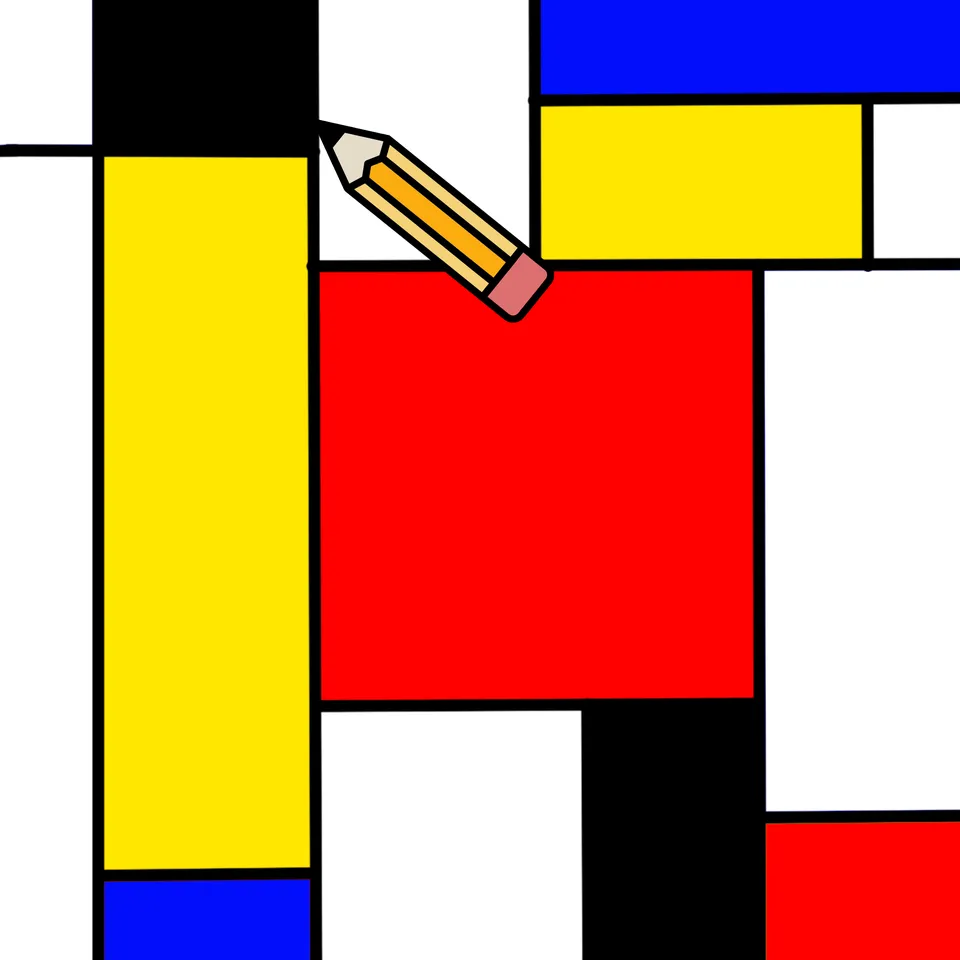
Learn about famous artist Piet Mondrian and draw a piece inspired by his work!
Required materials: pencil, paper, coloring utensils
In this step-by-step directed drawing, students will be guided through a Mondrian-inspired drawing.
Part of
Standards alignment
Common Core State Standards
- K.G.B.5 — Model shapes in the world by building shapes from components (e.g., sticks and clay balls) and drawing shapes.
Alabama
- MA19.K.22 — Model shapes in the world by building them from sticks, clay balls, or other components and by drawing them.
Alaska
- K.G.5 — Build shapes (e.g., using sticks and clay) and draw shapes.
Arizona
- K.G.B.5 — Model shapes in the world by building shapes from components (e.g., sticks and clay balls) and drawing shapes.
Arkansas
- K.GM.1 — Describe the positions of objects and geometric shapes in the environment. • Terms include: inside, outside, between, above, below, near, far, under, over, up, down, behind, in front of, next to, to the left of, and to the right of
- K.GM.5 — Compose and draw shapes found in the world using objects (e.g., straws, toothpicks, clay balls).
California
- K.G.B.5 — Model shapes in the world by building shapes from components (e.g., sticks and clay balls) and drawing shapes.
Colorado
- K.G.B.5 — Model shapes in the world by building shapes from components (e.g., sticks and clay balls) and drawing shapes.
Connecticut
- K.G.B.5 — Model shapes in the world by building shapes from components (e.g., sticks and clay balls) and drawing shapes.
- 1.G.A.2 — Compose two-dimensional shapes (rectangles, squares, trapezoids, triangles, half-circles, and quarter-circles) or three-dimensional shapes (cubes, right rectangular prisms, right circular cones, and right circular cylinders) to create a composite shape, and compose new shapes from the composite shape.
Delaware
- K.G.B.5 — Model shapes in the world by building shapes from components (e.g., sticks and clay balls) and drawing shapes.
Georgia
- K.GSR.8.2 — Describe the relative location of an object using positional words.
Hawaii
- K.G.B.5 — Model shapes in the world by building shapes from components (e.g., sticks and clay balls) and drawing shapes.
Idaho
- Designs can be conveyed through sketches, drawings, or physical models. These representations are useful in communicating ideas for a problem’s solutions to other people. (K-ESS-2.3, 2-LS-1.2)
- K.G.B.5 — Model shapes in the world by building shapes from components/materials and drawing shapes.
Indiana
- K.CC.5 — Follow simple two or three-step oral directions.
Iowa
- K.G.B.5 — Model shapes in the world by building shapes from components and drawing shapes. For example, sticks and clay balls.
Kansas
- K.G.5 — Model shapes in the world by building shapes from components (e.g. sticks and clay balls) and drawing shapes.
Louisiana
- K.G.B.5 — Model shapes in the world by building shapes from components (e.g., sticks and clay balls) and drawing shapes.
Maryland
- K.G.B.5 — Model shapes in the world by building shapes from components (e.g., sticks and clay balls) and drawing shapes.
Massachusetts
- K.G.B.5 — Model shapes in the world by building shapes from components (e.g., sticks and clay balls) and drawing shapes.
Minnesota
- K.3.2.1 — Use words to compare objects according to length, size, weight and position. For example: Use same, lighter, longer, above, between and next to. Another example: Identify objects that are near your desk and objects that are in front of it. Explain why there may be some objects in both groups.
Mississippi
- K.G.5 — Model objects in the world by drawing two-dimensional shapes and building three-dimensional shapes.
- K.G.1 — Describe objects in the environment using names of shapes, and describe the relative positions of these objects using terms such as above, below, beside, in front of, behind, and next to.
Missouri
- 2.SL.1.A.b — following three-step instructions, according to classroom expectations
- K.GM.C.9 — Draw or model simple two-dimensional shapes.
- K.GM.C.7 — Describe the relative positions of objects in space.
Montana
- K.G.B.5 — Model shapes in the world from a variety of cultural contexts, including those of Montana American Indians, by building shapes from components (e.g., sticks and clay balls) and drawing shapes.
Nebraska
- LA.2.SL.1.e — Complete a task following multi-step directions.
- LA.1.SL.1.e — Complete a task following one/two-step directions.
- LA.3.SL.1.e — Complete a task following multi-step directions.
Nevada
- K.G.B.5 — Model shapes in the world by building shapes from components (e.g., sticks and clay balls) and drawing shapes.
New Hampshire
- SS.HI.2.3.2 — Explore art, music and literature of various time periods, e.g., spirituals or Native American Art. (Themes: J: Human Expression and Communication)
- K.G.B.5 — Model shapes in the world by building shapes from components (e.g., sticks and clay balls) and drawing shapes.
New Jersey
- K.G.A.1 — Describe objects in the environment using names of shapes, and describe the relative positions of these objects using terms such as above, below, beside, in front of, behind, and next to.
- K.G.B.5 — Model shapes in the world by building shapes from components (e.g., sticks and clay balls) and drawing shapes.
New Mexico
- K.G.B.5 — Model shapes in the world by building shapes from components (e.g., sticks and clay balls) and drawing shapes.
New York
- NY-K.G.5 — Model objects in their environment by building and/or drawing shapes.
- NY-K.G.1 — Describe objects in the environment using names of shapes, and describe the relative positions of these objects using terms such as above, below, beside, in front of, behind, and next to.
North Carolina
- NC.K.G.5 — Model shapes in the world by: • Building and drawing triangles, rectangles, squares, hexagons, circles. • Building cubes, cones, spheres, and cylinders.
Ohio
- K.G.5 — Model shapes in the world by building shapes from components, e.g., sticks and clay balls, and drawing shapes.
- K.G.1 — Describe objects in the environment using names of shapes, and describe the relative positions of these objects using terms such as above, below, beside, in front of, behind, and next to.
Oklahoma
- 2.1.L.2 — Students will follow multi-step oral directions.
- PK.1.L.2 — Students will follow simple one-step oral directions.
Oregon
- K.GM.B.5 — Represent shapes in the world by building shapes from components and drawing shapes.
- 4.GM.A.1 — Explore, investigate, and draw points, lines, line segments, rays, angles, and perpendicular and parallel lines. Identify these in two-dimensional figures.
Pennsylvania
- 3.5.K-2.P — Discuss that all designs have different characteristics that can be described.
- 3.5.K-2.Q — Apply skills necessary for making in design.
- 3.5.K-2.S — Apply design concepts, principles, and processes through play and exploration
Rhode Island
- K.G.B.5 — Model shapes in the world by building shapes from components (e.g., sticks and clay balls) and drawing shapes.
South Carolina
- K.G.5 — Draw two-dimensional shapes (i.e., square, rectangle, triangle, hexagon, and circle) and create models of three-dimensional shapes (i.e., cone, cube, cylinder, and sphere).
South Dakota
- K.G.B.5 — Model shapes in the world by building shapes from components (e.g., sticks and clay balls) and drawing shapes.
Tennessee
- K.G.B.5 — Model shapes/solids in the world by building or drawing them.
Texas
- 1.6C — create two-dimensional figures, including circles, triangles, rectangles, and squares, as special rectangles, rhombuses, and hexagons;
- K.6F — create two-dimensional shapes using a variety of materials and drawings.
Vermont
- K.G.B.5 — Model shapes in the world by building shapes from components (e.g., sticks and clay balls) and drawing shapes.
Virginia
- K.MG.2f — Construct plane figures (circles, triangles, squares, and rectangles) using a variety of materials (e.g., straws, sticks, pipe cleaners).
Washington
- K.G.B.5 — Model shapes in the world by building shapes from components (e.g., sticks and clay balls) and drawing shapes.
Washington, D.C.
- K.G.B.5 — Model shapes in the world by building shapes from components (e.g., sticks and clay balls) and drawing shapes.
- K.G.A.1 — Describe objects in the environment using names of shapes, and describe the relative positions of these objects using terms such as above, below, beside, in front of, behind, and next to.
West Virginia
- M.K.20 — Describe objects in the environment using names of shapes and describe the relative positions of these objects using terms such as above, below, beside, in front of, behind and next to.
- M.K.24 — Model shapes in the world by building shapes from components (e.g., sticks and clay balls) and drawing shapes.
Wisconsin
- M.K.G.B.5 — Model shapes in the world by building shapes from components (e.g., sticks and clay balls) and drawing shapes.
Wyoming
- K.G.I.5 — Model shapes in the world by building shapes from components (e.g., sticks and clay balls) and drawing shapes.