Fraction Fundraiser
Ages 7–9 · 9 minutes · Math
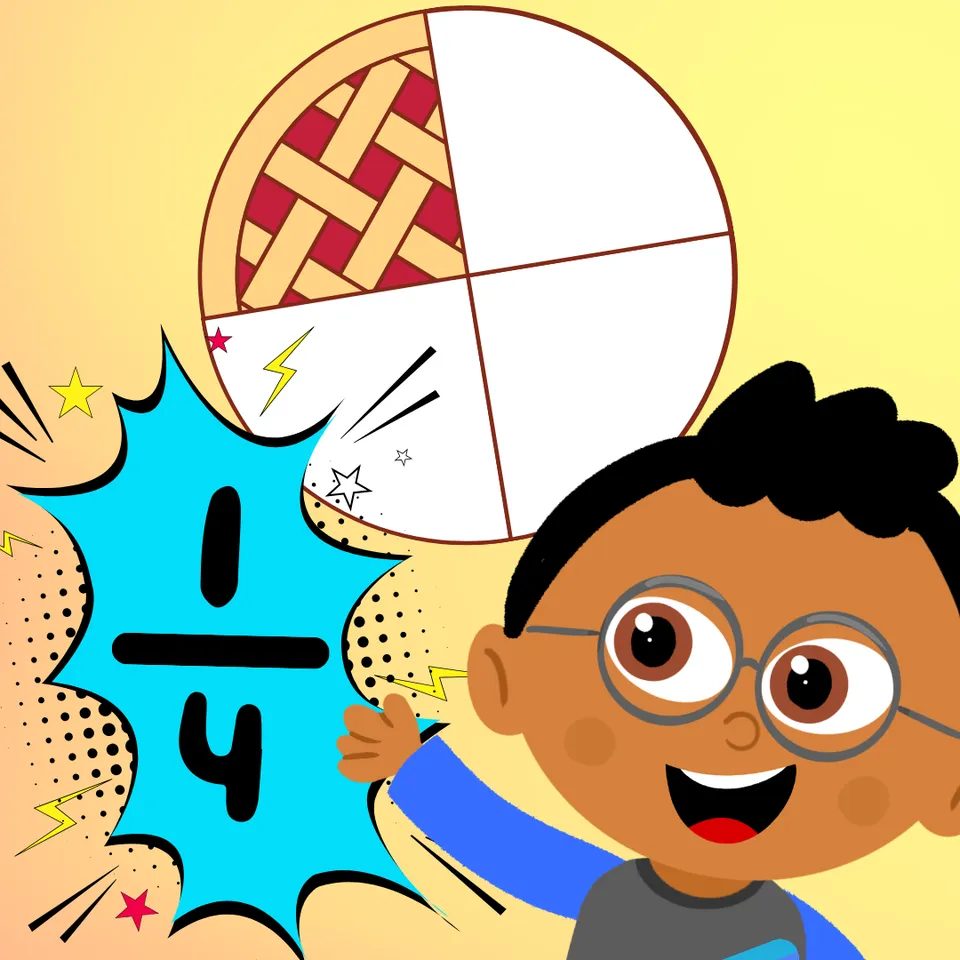
Dish up a slice of pie and learn when fractions are whole numbers!
In this fractions lesson, students will learn and practice:
- Deciding when fractions such as 3/3 are equal to 1
- Expressing whole numbers as fractions such as 4/1
- Identifying sixths and eighths
Part of
Standards alignment
Common Core State Standards
- 3.NF.A.1 — Understand a fraction 1/b as the quantity formed by 1 part when a whole is partitioned into b equal parts; understand a fraction a/b as the quantity formed by a parts of size 1/b.
- 3.NF.A.3.c — Express whole numbers as fractions, and recognize fractions that are equivalent to whole numbers.
- 3.NF.A.3 — Explain equivalence of fractions in special cases, and compare fractions by reasoning about their size.
Alabama
- MA19.3.15a — Express whole numbers as fractions and recognize fractions that are equivalent to whole numbers.
Alaska
- 3.NF.1 — Understand a fraction 1/b (e.g., 1/4) as the quantity formed by 1 part when a whole is partitioned into b (e.g., 4) equal parts; understand a fraction a/b (e.g., 2/4) as the quantity formed by a (e.g., 2) parts of size 1/b. (e.g., 1/4)
- 3.NF.3.c — Express and model whole numbers as fractions, and recognize and construct fractions that are equivalent to whole numbers. For example: Express 3 in the form 3 = 3/1; recognize that 6/1 = 6; locate 4/4 and 1 at the same point of a number line diagram.
- 3.NF.3 — Explain equivalence of fractions in special cases, and compare fractions by reasoning about their size.
- 2.G.3 — Partition circles and rectangles into shares, describe the shares using the words halves, thirds, half of, a third of, etc., and describe the whole as two halves, three thirds, four fourths. Recognize that equal shares of identical wholes need not have the same shape.
Arizona
- 3.NF.A.3.c — Express whole numbers as fractions, and recognize fractions that are equivalent to whole numbers.
- 3.NF.A.1 — Understand a fraction 1/b as the quantity formed by 1 part when a whole is partitioned into b equal parts; understand a fraction a/b as the quantity formed by a parts of size 1/b.
- 3.NF.A.3 * — Explain equivalence of fractions in special cases, and compare fractions by reasoning about their size.
Arkansas
- 3.NPV.6 — Identify fractions as parts of a whole and parts of a collection or set. • Fractions include: denominators 2, 3, 4, 6, and 8
- 3.NPV.11 — Use number lines and visual models to recognize and generate equivalent fractions, explaining how they are equivalent in real-world and mathematical situations. • Fractions include: denominators 2, 3, 4, 6, and 8
California
- 3.NF.A.1 — Understand a fraction 1/b as the quantity formed by 1 part when a whole is partitioned into b equal parts; understand a fraction a/b as the quantity formed by a parts of size 1/b.
- 3.NF.A.3.c — Express whole numbers as fractions, and recognize fractions that are equivalent to whole numbers.
- 3.NF.A.3 — Explain equivalence of fractions in special cases, and compare fractions by reasoning about their size.
Colorado
- 3.NF.A.3.c — Express whole numbers as fractions, and recognize fractions that are equivalent to whole numbers. Examples: express 3 in the form 3 = 3/1; recognize that 6/1 = 6; locate 4/4 and 1 at the same point of a number line diagram.
- 3.NF.A.1 — Describe a fraction 1/b as the quantity formed by 1 part when a whole is partitioned into b equal parts; understand a fraction a/b as the quantity formed by a parts of size 1/b.
- 3.NF.A.3 — Explain equivalence of fractions in special cases, and compare fractions by reasoning about their size.
Connecticut
- 3.NF.A.1 — Understand a fraction 1/b as the quantity formed by 1 part when a whole is partitioned into b equal parts; understand a fraction a/b as the quantity formed by a parts of size 1/b.
- 3.NF.A.3.c — Express whole numbers as fractions, and recognize fractions that are equivalent to whole numbers.
- 3.NF.A.3 — Explain equivalence of fractions in special cases, and compare fractions by reasoning about their size.
Delaware
- 3.NF.A.1 — Understand a fraction 1/b as the quantity formed by 1 part when a whole is partitioned into b equal parts; understand a fraction a/b as the quantity formed by a parts of size 1/b.
- 3.NF.A.3.c — Express whole numbers as fractions, and recognize fractions that are equivalent to whole numbers.
- 3.NF.A.3 — Explain equivalence of fractions in special cases, and compare fractions by reasoning about their size.
Florida
- MA.3.FR.1.2 — Represent and interpret fractions, including fractions greater than one, in the form of <math xmlns="http://www.w3.org/1998/Math/MathML"><mstyle mathsize="10px"><mfrac><mi>m</mi><mi>n</mi></mfrac></mstyle></math> as the result of adding the unit fraction <math xmlns="http://www.w3.org/1998/Math/MathML"><mstyle mathsize="10px"><mfrac><mn>1</mn><mi>n</mi></mfrac></mstyle></math> to itself m times.
- MA.3.FR.2.2 — Identify equivalent fractions and explain why they are equivalent.
- MA.3.FR.1.1 — Represent and interpret unit fractions in the form 1/n as the quantity formed by one part when a whole is partitioned into n equal parts.
- MA.3.FR.1.3 — Read and write fractions, including fractions greater than one, using standard form, numeral-word form and word form.
Georgia
- 3.NR.4 — Represent fractions with denominators of 2, 3, 4, 6 and 8 in multiple ways within a framework using visual models.
- 3.NR.4.3 — Represent fractions, including fractions greater than one, in multiple ways.
- 3.NR.4.4 — Recognize and generate simple equivalent fractions.
- 3.MP.8 — Look for and express regularity in repeated reasoning.
- 3.NR.4.1 — Describe a unit fraction and explain how multiple copies of a unit fraction form a non-unit fraction. Use parts of a whole, parts of a set, points on a number line, distances on a number line and area models.
Hawaii
- 3.NF.A.1 — Understand a fraction 1/b as the quantity formed by 1 part when a whole is partitioned into b equal parts; understand a fraction a/b as the quantity formed by a parts of size 1/b.
- 3.NF.A.3c — Express whole numbers as fractions, and recognize fractions that are equivalent to whole numbers.
- 3.NF.A.3 — Explain equivalence of fractions in special cases, and compare fractions by reasoning about their size.
Idaho
- 3.NF.A.3.c — Express whole numbers as fractions, and recognize fractions that are equivalent to whole numbers.
- 3.NF.A.1 — Understand a fraction 1/b as the quantity formed by one part when a whole (a single unit) is partitioned into 𝑏 equal parts; understand a/b as the quantity formed by a parts of size 1/b
- 3.NF.A.3 — Explain equivalence of fractions and compare fractions by reasoning about their size, in limited cases.
Illinois
- 3.NF.A.3.c — Express whole numbers as fractions, and recognize fractions that are equivalent to whole numbers.
- 3.NF.A.1 — Understand a fraction 1/b as the quantity formed by 1 part when a whole is partitioned into b equal parts; understand a fraction a/b as the quantity formed by a parts of size 1/b.
Indiana
- 4.NS.2 — Model mixed numbers and improper fractions using visual fraction models such as number lines and area models. Use a visual fraction model to show the equivalency between whole numbers and whole numbers as fractions.
- 3.NS.2 — Model unit fractions as the quantity formed by 1 part when a whole is partitioned into equal parts; model non-unit fractions as the quantity formed by iterations of unit fractions. [In grade 3, limit denominators of fractions to 2, 3, 4, 6, 8.] (E)
- 3.G.3 — Partition shapes into parts with equal areas. Express the area of each part as a unit fraction of the whole (i.e., 1/2, 1/3, 1/4, 1/6, 1/8).
Iowa
- 3.NF.A.3.c — Express whole numbers as fractions and recognize fractions that are equivalent to whole numbers. For example, express 3 in the form 3 = 3/1 ; recognize that 6/1 = 6; locate 4/4 and 1 at the same point of a number line diagram.
- 3.NF.A.1 — Understand a fraction 1/b as the quantity formed by 1 part when a whole is partitioned into 𝑏𝑏 equal parts; understand a fraction a/b as the quantity formed by a part of size 1/b .
- 3.NF.A.3 — Explain equivalence of fractions in special cases and compare fractions by reasoning about their size.
Kansas
- 3.NF.1 — Understand a fraction 1/b as the quantity formed by 1 part when a whole is partitioned into b equal parts; understand a fraction a/b as the quantity formed by a parts of size 1/b.
- 3.NF.3.c — Express whole numbers as fractions, and recognize fractions that are equivalent to whole numbers. Examples: Express 3 in the form 3 = 3/1; recognize that 6/1 = 6; locate 4/4 and 1 at the same point of a number line diagram.
- 3.NF.3 — Explain equivalence of fractions, and compare fractions by reasoning about their size (it is a mathematical convention that when comparing fractions, the whole is the same size).
Kentucky
- KY.3.NF.1 — Understand a fraction 1/b as the quantity formed by 1 part when a whole is partitioned into b equal parts; understand a fraction a/b as the quantity formed by a parts of size 1/b.
- KY.3.NF.3.c — Express whole numbers as fractions and recognize fractions that are equivalent to whole numbers.
- KY.3.NF.3 — Explain equivalence of fractions in special cases and compare fractions by reasoning about their size.
Louisiana
- 3.NF.A.1 — Understand a fraction 1/b, with denominators 2, 3, 4, 6, and 8, as the quantity formed by 1 part when a whole is partitioned into b equal parts; understand a fraction a/b as the quantity formed by a parts of size 1/b.
- 3.NF.A.3.c — Express whole numbers as fractions, and recognize fractions that are equivalent to whole numbers.
- 3.NF.A.3 — Explain equivalence of fractions with denominators 2, 3, 4, 6, and 8 in special cases, and compare fractions by reasoning about their size.
Maine
- 3.NF.A.3c — Express whole numbers as fractions and recognize fractions that are equivalent to whole numbers. Examples: Express 3 in the form 3 = 3/1; recognize that 6/1 = 6; locate 4/4 and 1 at the same point of a number line diagram.
- 3.NF.A.1 — Understand a unit fraction 1/b as the quantity formed by 1 part when a whole is partitioned into b equal parts; understand a fraction a/b as the quantity formed by a parts of size 1/b.
- 3.NF.A.3 — Explain equivalence of fractions in special cases, and compare fractions by reasoning about their size.
Maryland
- 3.NF.A.1 — Understand a fraction (1/b) as the quantity formed by 1 part when a whole is partitioned into b equal parts; understand a fraction (a/b) as the quantity formed by a parts of size (1/b).
- 3.NF.A.3.c — Express whole numbers as fractions, and recognize fractions that are equivalent to whole numbers.
- 3.NF.A.3 — Explain equivalence of fractions in special cases, and compare fractions by reasoning about their size.
Massachusetts
- 3.NF.A.3.c — Express whole numbers as fractions, and recognize fractions that are equivalent to whole numbers. For example, express 3 in the form 3 = 3/1; recognize that 6 /1 = 6; locate 4 /4 and 1 at the same point of a number line diagram.
- 3.NF.A.1 — Understand a fraction 1/b as the quantity formed by 1 part when a whole (a single unit) is partitioned into b equal parts; understand a fraction a/b as the quantity formed by a parts of size 1/b.
Michigan
- 3.NF.A.3.c — Express whole numbers as fractions, and recognize fractions that are equivalent to whole numbers.
- 3.NF.A.1 — Understand a fraction 1/b as the quantity formed by 1 part when a whole is partitioned into b equal parts; understand a fraction a/b as the quantity formed by a parts of size 1/b.
- 3.NF.A.3 — Explain equivalence of fractions in special cases, and compare fractions by reasoning about their size.
Minnesota
- 3.1.3.1 — Read and write fractions with words and symbols. Recognize that fractions can be used to represent parts of a whole, parts of a set, points on a number line, or distances on a number line. For example: Parts of a shape (3/4 of a pie), parts of a set (3 out of 4 people), and measurements (3/4 of an inch).
- 4.1.2.1 — Represent equivalent fractions using fraction models such as parts of a set, fraction circles, fraction strips, number lines and other manipulatives. Use the models to determine equivalent fractions.
Mississippi
- 3.NF.1 — Understand a fraction 1/b as the quantity formed by 1 part when a whole is partitioned into b equal parts; understand a fraction a/b as the quantity formed by a parts of size 1/b.
- 3.NF.3.c — Express whole numbers as fractions, and recognize fractions that are equivalent to whole numbers. Examples: Express 3 in the form 3 = 3/1; recognize that 6/1 = 6; locate 4/4 and 1 at the same point of a number line diagram.
- 3.NF.3 — Explain equivalence of fractions in special cases, and compare fractions by reasoning about their size.
Missouri
- 3.NF.A.2 — Understand that when a whole is partitioned equally, a fraction can be used to represent a portion of the whole.
- 3.NF.A.2.a — Describe the numerator as representing the number of pieces being considered.
- 3.NF.A.2.b — Describe the denominator as the number of pieces that make the whole.
- 3.NF.A.5 — Recognize and generate equivalent fractions using visual models, and justify why the fractions are equivalent.
- 3.NF.A.1 — Understand a unit fraction as the quantity formed by one part when a whole is partitioned into equal parts.
Montana
- 3.NF.A.1 — Understand a fraction 1/b as the quantity formed by 1 part when a whole is partitioned into b equal parts; understand a fraction a/b as the quantity formed by a parts of size 1/b.
- 3.NF.A.3.c — Express whole numbers as fractions, and recognize fractions that are equivalent to whole numbers.
- 3.NF.A.3 — Explain equivalence of fractions in special cases, and compare fractions by reasoning about their size.
Nebraska
- 3.N.2.e — Justify whole numbers as fractions and identify fractions that are equivalent to whole numbers.
- 3.N.2 — Fractions: Students will develop understanding of fractions as numbers.
- 3.N.2.b — Find parts of a whole using visual fraction models.
Nevada
- 3.NF.A.3.c — Express whole numbers as fractions, and recognize fractions that are equivalent to whole numbers.
- 3.NF.A.1 — Understand a fraction 1/b as the quantity formed by 1 part when a whole is partitioned into b equal parts; understand a fraction a/b as the quantity formed by a parts of size 1/b.
- 3.NF.A.3 — Explain equivalence of fractions in special cases, and compare fractions by reasoning about their size.
New Hampshire
- 3.NF.A.3.c — Express whole numbers as fractions, and recognize fractions that are equivalent to whole numbers.
- 3.NF.A.1 — Understand a fraction 1/b as the quantity formed by 1 part when a whole is partitioned into b equal parts; understand a fraction a/b as the quantity formed by a parts of size 1/b.
- 3.NF.A.3 — Explain equivalence of fractions in special cases, and compare fractions by reasoning about their size.
New Jersey
- 3.NF.A.3c — Express whole numbers as fractions, and recognize fractions that are equivalent to whole numbers. Examples: Express 3 in the form 3 = 3/1; recognize that 6/1 = 6; locate 4/4 and 1 at the same point of a number line diagram.
- 3.NF.A.1 — Understand a fraction 1/b as the quantity formed by 1 part when a whole is partitioned into b equal parts; understand a fraction a/b as the quantity formed by a parts of size 1/b.
- 3.NF.A.3 — Explain equivalence of fractions in special cases, and compare fractions by reasoning about their size.
New Mexico
- 3.NF.A.1 — Understand a fraction 1/b as the quantity formed by 1 part when a whole is partitioned into b equal parts; understand a fraction a/b as the quantity formed by a parts of size 1/b.
- 3.NF.A.3.c — Express whole numbers as fractions, and recognize fractions that are equivalent to whole numbers.
- 3.NF.A.3 — Explain equivalence of fractions in special cases, and compare fractions by reasoning about their size.
New York
- NY-3.NF.1 — Understand a unit fraction, 1/b, is the quantity formed by 1 part when a whole is partitioned into b equal parts. Understand a fraction a/b as the quantity formed by a parts of size 1/b.
- NY-3.NF.3.c — Express whole numbers as fractions, and recognize fractions that are equivalent to whole numbers.
- NY-3.G.2 — Partition shapes into parts with equal areas. Express the area of each part as a unit fraction of the whole.
North Carolina
- NC.3.NF.3 — Represent equivalent fractions with area and length models by: • Composing and decomposing fractions into equivalent fractions using related fractions: halves, fourths and eighths; thirds and sixths. • Explaining that a fraction with the same numerator and denominator equals one whole. • Expressing whole numbers as fractions, and recognize fractions that are equivalent to whole numbers.
- MP.8 — Look for and express regularity in repeated reasoning.
- NC.3.NF.2 — Interpret fractions with denominators of 2, 3, 4, 6, and 8 using area and length models. • Using an area model, explain that the numerator of a fraction represents the number of equal parts of the unit fraction. • Using a number line, explain that the numerator of a fraction represents the number of lengths of the unit fraction from 0.
- NC.3.NF.1 — Interpret unit fractions with denominators of 2, 3, 4, 6, and 8 as quantities formed when a whole is partitioned into equal parts; • Explain that a unit fraction is one of those parts. • Represent and identify unit fractions using area and length models.
North Dakota
- 3.NO.NF.4 — Recognize whole numbers as fractions and express fractions that are equivalent to whole numbers.
- 3.NO.NF.1 — Partition two-dimensional figures into equal areas and express the area of each part as a unit fraction of the whole. Describe using the language of sixths, eighths, a sixth of, and an eighth of.
Ohio
- 3.NF.3.c — Express whole numbers as fractions, and recognize fractions that are equivalent to whole numbers.Examples: Express 3 in the form 3 = 3/1; recognize that 6/1 = 6; locate 4/4 and 1 at the same point of a number line diagram.
- 3.NF.1 — Understand a fraction 1/b as the quantity formed by 1 part when a whole is partitioned into b equal parts; understand a fraction a/b as the quantity formed by a parts of size 1/b.
- 3.NF.3 — Explain equivalence of fractions in special cases, and compare fractions by reasoning about their size.
Oklahoma
- 3.N.3.2 — Model fractions using length, set, and area for halves, thirds, fourths, sixths, and eighths.
- 3.N.3 — Use and justify fractional representations in real-world and mathematical problems.
- 3.N.3.3 — Apply understanding of unit fractions and use this understanding to compose and decompose fractions related to the same whole.
Oregon
- 3.NF.A.3 — Explain equivalence of fractions in special cases, and compare fractions by reasoning about their size.
- 3.NF.A.1 — Understand the concept of a unit fraction and explain how multiple copies of a unit fraction form a non-unit fraction.
- MP8 — Look for and express regularity in repeated reasoning
- 3.GM.A.2 — Partition shapes into parts with equal areas and express the area of each part as a unit fraction of the whole.
Pennsylvania
- CC.2.1.3.C.1 — Explore and develop an understanding of fractions as numbers.
- CC.2.3.3.A.2 — Use the understanding of fractions to partition shapes into parts with equal areas and express the area of each part as a unit fraction of the whole.
Rhode Island
- 3.NF.A.1 — Understand a fraction 1/b as the quantity formed by 1 part when a whole (a single unit) is partitioned into b equal parts; understand a fraction a/b as the quantity formed by a parts of size 1/b.
- 3.NF.A.3.c — Express whole numbers as fractions, and recognize fractions that are equivalent to whole numbers. For example, express 3 in the form 3 = 3/1; recognize that 6/1 = 6; locate 4/4 and 1 at the same point of a number line diagram.
- 3.NF.A.3 — Explain equivalence of fractions in special cases, and compare fractions by reasoning about their size.
- 3.G.A.2 — Partition shapes into parts with equal areas. Express the area of each part as a unit fraction of the whole. For example, partition a shape into four parts with equal area, and describe the area of each part as 1/4 of the area of the shape.
South Carolina
- 3.G.2 — Partition two-dimensional shapes into 2, 3, 4, 6, or 8 parts with equal areas and express the area of each part using the same unit fraction. Recognize that equal parts of identical wholes need not have the same shape.
South Dakota
- 3.NF.A.1 — Understand a fraction 1/b as the quantity formed by 1 part when a whole is partitioned into b equal parts (example: 1 part out of 4 equal parts is the same as 1/4); understand a fraction a/b as the quantity formed by a parts of size 1/b. (example:3/4 is the same as 3 one-fourths (1/4, 1/4, 1/4).
- 3.NF.A.3.c — Express whole numbers as fractions, and recognize fractions that are equivalent to whole numbers.
- 3.NF.A.3 — Explain equivalence of fractions in special cases, and compare fractions by reasoning about their size.
- 3.G.A.2 — Partition shapes into parts with equal areas. Express the area of each part as a unit fraction of the whole. For example, partition a shape into 4 parts with equal area, and describe the area of each part as 1/4 of the area of the shape.
Tennessee
- 3.NF.A.3.c — Express whole numbers as fractions and recognize fractions that are equivalent to whole numbers. For example, express 3 in the form 3 = 3/1; recognize that 6/1= 6; locate 4/4 and 1 at the same point on a number line diagram.
- 3.NF.A.1 — Understand a unit fraction, 1/b, as the quantity formed by 1 part when a whole is partitioned into b equal parts; understand a non-unit fraction, n/b, as the quantity formed by n parts of size 1/b. For example, 3/4 represents a quantity formed by 3 parts of size 1/4.
Texas
- 2.3C — use concrete models to count fractional parts beyond one whole using words and recognize how many parts it takes to equal one whole; and
- 3.3A — represent fractions greater than zero and less than or equal to one with denominators of 2, 3, 4, 6, and 8 using concrete objects and pictorial models, including strip diagrams and number lines;
- 2.3D — identify examples and non-examples of halves, fourths, and eighths.
- 3.3C — explain that the unit fraction 1/b represents the quantity formed by one part of a whole that has been partitioned into b equal parts where b is a non-zero whole number;
Utah
- 3.NF.3.c — Express whole numbers as fractions, and recognize fractions that are equivalent to whole numbers. For example, express 3 in the form 3 = 3/1; recognize that 6/1 = 6; locate 4/4 and 1 at the same point of a number line diagram.
- 3.NF.1.a — Understand a fraction 1/b as the quantity formed by one part when a whole is partitioned into b equal parts.
- 3.NF.1.b — Understand a fraction a/b as the quantity formed by a parts of size 1/b. For example: 1/4 + 1/4 + 1/4 = 3/4.
- 3.NF.3 — Explain equivalence of fractions in special cases, and compare fractions by reasoning about their size.
Vermont
- 3.NF.A.3.c — Express whole numbers as fractions, and recognize fractions that are equivalent to whole numbers.
- 3.NF.A.1 — Understand a fraction 1/b as the quantity formed by 1 part when a whole is partitioned into b equal parts; understand a fraction a/b as the quantity formed by a parts of size 1/b.
- 3.NF.A.3 — Explain equivalence of fractions in special cases, and compare fractions by reasoning about their size.
Virginia
- 3.NS.3a — Represent, name, and write a given fraction (proper or improper) or mixed number with denominators of 2, 3, 4, 5, 6, 8, and 10 using:
- 2.NS.3c — Compose the whole for a given fractional part and its value (in context) for halves, fourths, eighths, thirds, and sixths (e.g., when given 1/4, determine how many pieces would be needed to make 4/4).
- 3.NS.3 — The student will use mathematical reasoning and justification to represent and compare fractions (proper and improper) and mixed numbers with denominators of 2, 3, 4, 5, 6, 8, and 10), including those in context. Students will demonstrate the following Knowledge and Skills:
- 3.NS.3e — Compare a fraction, less than or equal to one, to the benchmarks of 0, 1 2 , and 1 using area/region models, length models, and without models.
Washington
- 3.NF.A.1 — Understand a fraction 1/b as the quantity formed by 1 part when a whole is partitioned into b equal parts; understand a fraction a/b as the quantity formed by a parts of size 1/b.
- 3.NF.A.3.c — Express whole numbers as fractions, and recognize fractions that are equivalent to whole numbers.
- 3.NF.A.3 — Explain equivalence of fractions in special cases, and compare fractions by reasoning about their size.
Washington, D.C.
- 3.NF.A.1 — Understand a fraction 1/b as the quantity formed by 1 part when a whole is partitioned into b equal parts; understand a fraction a/b as the quantity formed by a parts of size 1/b.
- 3.NF.A.3.c — Express whole numbers as fractions, and recognize fractions that are equivalent to whole numbers.
- 3.NF.A.3 — Explain equivalence of fractions in special cases, and compare fractions by reasoning about their size.
West Virginia
- M.3.17 — Explain equivalence of fractions in special cases and compare fractions by reasoning about their size. a. Understand two fractions as equivalent ( equal) if they are the same size or the same point on a number line. b. Recognize and generate simple equivalent fractions (e.g., 1/2 = 2/4, 4/6 = 2/3). Explain why the fractions are equivalent (e.g., by using a visual fraction model). c. Express whole numbers as fractions and recognize fractions that are equivalent to whole numbers (e.g., express 3 in the form 3 = 3/1; recognize that 6/1 = 6; locate 4/4 and 1 at the same point of a number line diagram). d. Compare two fractions with the same numerator or the same denominator by reasoning about their size. Recognize that comparisons are valid only when the two fractions refer to the same whole. Record the results of comparisons with the symbols>,= or< and justify the conclusions (e.g., by using a visual fraction model). Instructional Note: Fractions in this standard am limited to de~nominators of 2, 3, 4, 6, and 8.
- M.3.15 — Understand a fraction 1/b as the quantity formed by 1 part when a whole is partitioned into b equal parts; understand a fraction a/bas the quantity formed by a parts of size 1/b. Instructional Note: Fractions in this standard are limited to denominators of 2, 3, 4, 6, and 8.
- MHM8 — Look for and express regularity in repeated reasoning.
Wisconsin
- M.3.NF.A.3 — Explain equivalence of fractions and compare fractions by reasoning about their size. a. Understand two fractions as equivalent (equal) if they are the same size or name the same point on a number line. b. Recognize and generate simple equivalent fractions, e.g., 1/2 = 2/4, 4/6 = 2/3) and explain why the fractions are equivalent by using a visual fraction model (e.g., tape diagram or number line). c. Express whole numbers as fractions (3 = 3/1), and recognize fractions that are equivalent to whole numbers (4/4 = 1). d. Compare two fractions with the same numerator or the same denominator by reasoning about their size. Recognize that comparisons are valid only when the two fractions refer to the same whole. Justify the conclusions by using a visual fraction model (e.g., tape diagram or number line) and describe the result of the comparison using words and symbols ( >, =, and < ).
- M.3.NF.A.1 — Understand a unit fraction as the quantity formed when a whole is partitioned into equal parts and explain that a unit fraction is one of those parts (e.g., 1/4). Understand fractions are composed of unit fractions.
Wyoming
- 3.NF.F.3.C — Express whole numbers as fractions, and recognize fractions that are equivalent to whole numbers.
- 3.NF.F — Develop understanding of fractions as numbers. (Limited to denominators 2, 3, 4, 6, and 8) * use horizontal fractions.
- 3.NF.F.1 — Understand a fraction 1/b as the quantity formed by 1 part when a whole is partitioned into b equal parts; understand a fraction a/b as the quantity formed by a parts of size 1/b.
- 3.NF.F.3 — Explain equivalence of fractions in special cases, and compare fractions by reasoning about their size.