Rainy Day Riddles
Ages 3–5 · 9 minutes · Math, Stories
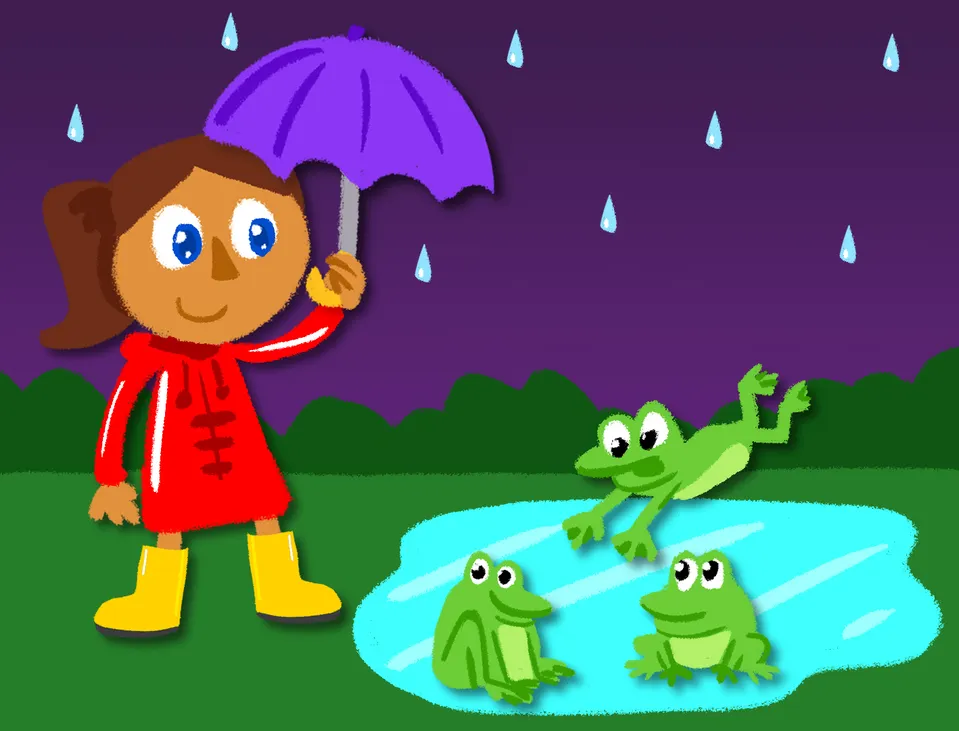
It's raining, it's pouring, and Lucy needs your help to have a fun day!
Help Lucy get dressed to go out in the rain, find her umbrella, count the frogs, and more. In this interactive story, students will practice these skills:
- Recognizing colors
- Understanding what clothes are weather-appropriate
- Counting up to 5
- Finding hidden objects
- Comparing patterns and sizes
Some friendly counting questions develop an understanding of addition and subtraction without needing to know any math. If your child can count to 5 and recognize colors, they are ready for this interactive story.
Part of
Standards alignment
Common Core State Standards
- K.CC.B.5 — Count to answer "how many?" questions about as many as 20 things arranged in a line, a rectangular array, or a circle, or as many as 10 things in a scattered configuration; given a number from 1—20, count out that many objects.
- D2.Geo.4.K-2 — Individually and with others, students… Explain how weather, climate, and other environmental characteristics affect people’s lives in a place or region.
- K.OA.A.5 — Fluently add and subtract within 5.
- ELD-SI.K-3.Inform — Multilingual learners will… • Define and classify objects or concepts • Describe characteristics, patterns, or behavior • Describe parts and wholes • Sort, clarify, and summarize ideas • Summarize information from interaction with others and from learning experiences
Alabama
- MA19.K.5 — Count to answer "how many?" questions.
- MA19.K.9 — Solve addition and subtraction word problems, and add and subtract within 10, by using concrete objects or drawings to represent the problem.
- MA19.K.4 — Connect counting to cardinality using a variety of concrete objects.
- MA19.K.4a — Say the number names in consecutive order when counting objects.
- ELA21.K.20 — Name and sort pictures of objects into categories based on common attributes while relating vocabulary to prior knowledge and building background knowledge.
Alaska
- K.CC.5 — Count to answer "how many?" questions about as many as 20 things arranged in a line, a rectangular array or a circle, or as many as 10 things in a scattered configuration; given a number from 1-20, count out that many objects.
- K.OA.1 — Represent addition and subtraction with objects, fingers, mental images, drawings, sounds (e.g., claps) acting out situations, verbal explanations, expressions, or equations.
- K.OA.6 — Recognize, identify and continue simple patterns of color, shape, and size.
- K.MD.2 — Make comparisons between two objects with a measurable attribute in common, to see which object has “more of”/“less of” the attribute, and describe the difference. For example, directly compare the heights of two children and describe one child as taller/shorter.
Arizona
- K.CC.B.4.a — When counting objects, say the number names in the standard order, pairing each object with one and only one number name and each number name with one and only one object.
- K.CC.B.5 — Count to answer "how many?" questions about as many as 20 things arranged in a line, a rectangular array, or a circle, or as many as 10 things in a scattered configuration; given a number from 1—20, count out that many objects.
- K.OA.A.1 — Represent addition and subtraction concretely. See Table 1.
- K.RL.1 — With prompting and support, ask and answer questions about key details in a text.
- K.SL.2 — Confirm understanding of a text read aloud or information presented orally or through other media by asking and answering questions about key details and requesting clarification if something is not understood.
Arkansas
- G.1.K.6 — Identify the influence of weather and climate on people’s daily lives.
- K.NPV.2 — Count a set of objects up to 20 using one-to-one correspondence, demonstrating that the last number stated indicates the number of objects in the set regardless of the arrangement.
- K.CAR.1. — Use objects, fingers, mental images, drawings, sounds, acting out situations, or verbal explanations to represent addition and subtraction from 0 to 10.
- K.RC.2.RF — Answer questions about key details in a text.
- K.V.3 — Sort and categorize objects and images by concepts.
California
- K.CC.B.4.a — When counting objects, say the number names in the standard order, pairing each object with one and only one number name and each number name with one and only one object.
- K.CC.B.5 — Count to answer "how many?" questions about as many as 20 things arranged in a line, a rectangular array, or a circle, or as many as 10 things in a scattered configuration; given a number from 1—20, count out that many objects.
- K.CC.A.2 — Count forward beginning from a given number within the known sequence (instead of having to begin at 1).
- K.OA.A.1 — Represent addition and subtraction with objects, fingers, mental images, drawings, sounds (e.g., claps), acting out situations, verbal explanations, expressions, or equations.
- 1.2.4 — Describe how location, weather, and physical environment affect the way people live, including the effects on their food, clothing, shelter, transportation, and recreation.
Colorado
- P.CC.C.4 — Use the number name of the last object counted to answer “How many?” questions for up to approximately 10 objects.
- P.CC.C.5 — Accurately count as many as five objects in a scattered configuration or out of a collection of more than five objects.
- P.MD.A.2 — Compare or order up to five objects based on their measurable attributes, such as height or weight.
- P.OA.A.2 — Solve addition and subtraction problems set in simple contexts. Add and subtract up to at least five to or from a given number to find a sum or difference up to 10.
Connecticut
- K.CC.B.4.a — When counting objects, say the number names in the standard order, pairing each object with one and only one number name and each number name with one and only one object.
- K.CC.B.5 — Count to answer "how many?" questions about as many as 20 things arranged in a line, a rectangular array, or a circle, or as many as 10 things in a scattered configuration; given a number from 1—20, count out that many objects.
- GEO.K.4 — Explain how weather, climate, and other environmental characteristics affect people’s lives in places or regions.
- K.MD.A.2 — Directly compare two objects with a measurable attribute in common, to see which object has "more of"/"less of" the attribute, and describe the difference. For example, directly compare the heights of two children and describe one child as taller/shorter.
- K.OA.A.5 — Fluently add and subtract within 5.
Delaware
- K.CC.B.4.a — When counting objects, say the number names in the standard order, pairing each object with one and only one number name and each number name with one and only one object.
- K.CC.B.5 — Count to answer "how many?" questions about as many as 20 things arranged in a line, a rectangular array, or a circle, or as many as 10 things in a scattered configuration; given a number from 1—20, count out that many objects.
- K.MD.A.2 — Directly compare two objects with a measurable attribute in common, to see which object has "more of"/"less of" the attribute, and describe the difference. For example, directly compare the heights of two children and describe one child as taller/shorter.
- K.OA.A.1 — Represent addition and subtraction with objects, fingers, mental images, drawings, sounds (e.g., claps), acting out situations, verbal explanations, expressions, or equations.
- RL.K.1 — With prompting and support, ask and answer questions about key details in a text.
Georgia
- K.NR.1.1 — Count up to 20 objects in a variety of structured arrangements and up to 10 objects in a scattered arrangement.
- K.NR.1.3 — Given a number from 1-20, identify the number that is one more or one less.
- K.MDR.7.1 — Directly compare, describe, and order common objects, using measurable attributes (length, height, width, or weight) and describe the difference.
- K.NR.1.2 — When counting objects, explain that the last number counted represents the total quantity in a set (cardinality), regardless of the arrangement and order.
- K.NR.5.2 — Represent addition and subtraction within 10 from a given authentic situation using a variety of representations and strategies.
- K.GSR.8.2 — Describe the relative location of an object using positional words.
Hawaii
- K.CC.B.5 — Count to answer "how many?" questions about as many as 20 things arranged in a line, a rectangular array, or a circle, or as many as 10 things in a scattered configuration; given a number from 1—20, count out that many objects.
- K.MD.A.2 — Directly compare two objects with a measurable attribute in common, to see which object has "more of"/"less of" the attribute, and describe the difference.
- K.OA.A.1 — Represent addition and subtraction with objects, fingers, mental images, drawings, sounds (e.g., claps), acting out situations, verbal explanations, expressions, or equations.
- K.OA.A.5 — Fluently add and subtract within 5.
- K.RL.1 — With prompting and support, ask and answer questions about key details in a text.
Idaho
- K.CC.B.5 — Given a group of up to 20 objects, count the number of objects in that group and state the number of objects in a rearrangement of that group without recounting. Given a verbal or written number from zero to 20, count out that many objects.
- K.OA.A.1 — Represent addition and subtraction of two whole numbers within ten. Use objects, fingers, mental images, drawings, sounds (e.g., claps), acting out situations, verbal explanations, expressions, or equations.
- K.CC.B.4.c — Understand that each successive number name refers to a quantity that is one larger. Recognize the “one more” pattern of counting using objects.
- K.OA.A.2 — Solve addition and subtraction word problems within ten by using physical, visual, and symbolic representations.
- K-ESS-2.2 — Students who demonstrate understanding can: Ask questions to obtain information about the purpose of weather forecasting to prepare for, and respond to, local weather.
- K.MD.A.2 — Directly compare two objects with a measurable attribute in common, to see which object has “more of”/ “less of” the attribute, and describe the difference.
Illinois
- K.CC.B.5 — Count to answer "how many?" questions about as many as 20 things arranged in a line, a rectangular array, or a circle, or as many as 10 things in a scattered configuration; given a number from 1—20, count out that many objects.
- K.OA.A.2 — Solve addition and subtraction word problems, and add and subtract within 10, e.g., by using objects or drawings to represent the problem.
- K.CC.A.2 — Count forward beginning from a given number within the known sequence (instead of having to begin at 1).
- K.OA.A.1 — Represent addition and subtraction with objects, fingers, mental images, drawings, sounds (e.g., claps), acting out situations, verbal explanations, expressions, or equations.
Indiana
- K.NS.3 — Say the number names in standard order when counting objects, pairing each object with one and only one number name and each number name with one and only one object. Understand that the last number name said describes the number of objects counted and that the number of objects is the same regardless of their arrangement or the order in which they were counted. Count out the number of objects, given a number from 1 to 20. (E)
- K.RC.7 — Identify and sort pictures of objects into categories (e.g., colors, shapes, opposites) through oral discussions. (E)
- K.CA.1 — Solve real-world problems that involve addition and subtraction within 10 using modeling with objects or drawings. (E)
- K.M.1 — Make direct comparisons of the length, capacity, weight, and temperature of objects, and identify which object is shorter, longer, taller, lighter, heavier, warmer, cooler, or holds more. (E)
- K.PS.2 — Identify and explain possible uses for an object based on its properties and compare these uses with other students’ ideas.
Iowa
- K.CC.B.5 — Count to answer "how many?" questions about as many as 20 things arranged in a line, a rectangular array, or a circle, or as many as 10 things in a scattered configuration. Given a number from 1–20, count out that many objects.
- K.OA.A.2 — Add and subtract within 10 and solve word problems involving the different problem types listed below. For example, by using objects or drawings to represent the problem. • Add-to with result unknown. • Take-from with result unknown. • Put-together/take-apart with total unknown. • Put-together with both addends unknown. (See Problem Types Table 1 in Appendix A)
- K.OA.A.5 — Fluently add and subtract within 5 using efficient mental strategies. • Counting on. • Counting back. • Using the relationship between addition and subtraction. • Creating equivalent, but easier or known sums. By the end of kindergarten, flexibly, efficiently and accurately find all sums within 5.
- RL.K.10 — Actively engage in group reading activities with purpose and understanding.
Kansas
- K.CC.4.a — When counting objects, say each number’s name in sequential order, pairing each object with one and only one number name and each number name with one and only one object.
- K.CC.5 — Count to answer “how many?” up to 20 concrete or pictorial objects arranged in a line, a rectangular array, or a circle, or as many as 10 objects in a scattered configuration; given a number from 1 to 20, count out that many objects.
- K.OA.2 — Solve addition and subtraction word problems, and add and subtract within 10, (e.g. by using objects or drawings to represent the problem.)
- RL.K.1 — With prompting and support, ask and answer questions about key details in a text.
- K.MD.2 — Directly compare two objects, with a measurable attribute in common, to see which object has “more of”/”less of” the attribute, and describe the difference. For example, directly compare the heights of two children and describe one child as taller/shorter.
Kentucky
- KY.K.OA.5 — Fluently add and subtract within 5.
- L.K.5.a — Sort common objects into categories (e.g., shapes, foods) to gain a sense of the concepts the categories represent.
- RL.K.1 — With prompting and support, ask and answer explicit questions about key ideas and details, and make logical inferences to construct meaning from the text.
- RL.K.7 — With prompting and support, describe the relationship between illustrations and the story in which they appear.
Louisiana
- K.22 — Explain how weather impacts daily life and choices.
- K.CC.B.5 — Count to answer "how many?" questions.
- K.OA.A.1 — Represent addition and subtraction with objects, fingers, mental images, drawings, sounds (e.g., claps), acting out situations, verbal explanations, expressions, or equations.
- K.OA.A.2 — Solve addition and subtraction word problems, and add and subtract within 10, e.g., by using objects or drawings to represent the problem.
- K.CC.B.4.a — When counting objects in standard order, say the number names as they relate to each object in the group, demonstrating one-to-one correspondence.
Maine
- K.CC.B.5 — Count to answer “how many?” questions about as many as 20 things arranged in a line, a rectangular array, or a circle, or as many as 10 things in a scattered configuration; given a number from 1-20, count out that many objects.
- K.CC.B.4a — When counting objects, say the number names in the standard order, pairing each object with one and only one number name and each number name with one and only one object.
- K.OA.A.2 — Solve addition and subtraction word problems, and add and subtract within 10, (e.g., by using objects or drawings to represent the problem).
- R.4.K.a — Ask and answer questions with prompting and support about who, what, when, where, and how.
- K.CC.B.4c — Understand that each successive number name refers to a quantity that is one larger. Recognize the one more pattern of counting using objects.
Maryland
- PK.CC.B.4 — Understand the relationship between numbers and quantities to 5, then to 10; connect counting to cardinality.
- PK.CC.B.4.a — When counting objects 1-10, say the number names in standard order, pairing each object with one and only one number name.
- PK.OA.A.1 — Represent simple addition and subtraction problems with objects, fingers, mental images, drawings, sounds (e.g., claps), acting out situations, or verbal explanations, up to 5
- PK.CC.A.2 — Identify which number comes just after or just before a given number in the counting sequence to 10 with visual supports and manipulatives.
- PK.MD.A.2 — Directly compare two objects with a measurable attribute in common, using words such as “bigger/smaller,” “longer/shorter,” “lighter/heavier,” or “taller/shorter”. . Order up to 3 objects by a measureable attribute (e.g., biggest to smallest)
Massachusetts
- PK.CC.C.4 — Count many kinds of concrete objects and actions up to ten, using one-to-one correspondence, and accurately count as many as seven things in a scattered configuration. Recognize the "one more," "one less" patterns.
- PK.OA.A.1 — Use concrete objects to model real-world addition (putting together) and subtraction (taking away) problems up through five.
- PreK-ESS2-6(MA) — Provide examples of the impact of weather on living things.
- PK.CC.A.1 — Listen to and say the names of numbers in meaningful contexts.
Michigan
- K.CC.B.4.a — When counting objects, say the number names in the standard order, pairing each object with one and only one number name and each number name with one and only one object.
- K.CC.B.5 — Count to answer "how many?" questions about as many as 20 things arranged in a line, a rectangular array, or a circle, or as many as 10 things in a scattered configuration; given a number from 1—20, count out that many objects.
- K.OA.A.2 — Solve addition and subtraction word problems, and add and subtract within 10, e.g., by using objects or drawings to represent the problem.
- 1–G5.0.2 — Describe ways in which the physical environment in a place or region affects people’s lives.
- K.OA.A.1 — Represent addition and subtraction with objects, fingers, mental images, drawings, sounds (e.g., claps), acting out situations, verbal explanations, expressions, or equations.
Minnesota
- K.1.1.1 — Recognize that a number can be used to represent how many objects are in a set or to represent the position of an object in a sequence. For example: Count students standing in a circle and count the same students after they take their seats. Recognize that this rearrangement does not change the total number, but may change the order in which students are counted.
- K.1.2.1 — Use objects and draw pictures to find the sums and differences of numbers between 0 and 10.
- 0.1.4.1 — Ask and answer questions about key details in a text, with prompting and support.
- 0.3.1.1.1 — Describe spatial information depicted in simple drawings and pictures. For example: While looking at a picture, the student says, "The boy is in front of the house. The house is at the edge of the woods." Other words describing spatial information in a picture include up, down, left, right, near, far, back, in front of.
- K.3.2.1 — Use words to compare objects according to length, size, weight and position. For example: Use same, lighter, longer, above, between and next to. Another example: Identify objects that are near your desk and objects that are in front of it. Explain why there may be some objects in both groups.
Mississippi
- K.CC.4.a — When counting objects, say the number names in the standard order, pairing each object with one and only one number name and each number name with one and only one object.
- K.CC.5 — Count to answer “how many?” questions about as many as 20 things arranged in a line, a rectangular array, or a circle, or as many as 10 things in a scattered configuration; given a number from 1–20, count out that many objects.
- K.MD.2 — Directly compare two objects with a measurable attribute in common, to see which object has “more of”/“less of” the attribute, and describe the difference. For example, directly compare the heights of two children and describe one child as taller/shorter.
- K.OA.2 — Solve addition and subtraction word problems within 10 involving situations of adding to, taking from, putting together and taking apart with unknowns in all positions by using objects or drawings to represent the problem.
- K.OA.5 — Fluently add and subtract within 5.
Missouri
- K.NS.B.5 — Say the number names when counting objects, in the standard order, pairing each object with one and only one number name and each number name with one and only one object.
- K.NS.B.9 — Demonstrate that a number can be used to represent “how many” are in a set.
- K.NS.B.7 — Demonstrate that each successive number name refers to a quantity that is one larger than the previous number.
- K.R.1.A.b — asking and responding to questions about texts read aloud
Montana
- K.CC.B.5 — Count to answer "how many?" questions about as many as 20 things arranged in a line, a rectangular array, or a circle, or as many as 10 things in a scattered configuration; given a number from 1-20, count out that many objects from a variety of cultural contexts, including those of Montana American Indians.
- K.CC.B.4.c — Understand that each successive number name refers to a quantity that is one larger.
- K.MD.A.2 — Directly compare two objects with a measurable attribute in common, to see which object has "more of"/"less of" the attribute, and describe the difference. For example, directly compare the heights of two children and describe one child as taller/shorter.
- K.OA.A.1 — Represent addition and subtraction with objects, fingers, mental images, drawings, sounds (e.g., claps), acting out situations, verbal explanations, expressions, or equations.
- L.K.5.a — Sort common objects into categories (e.g., shapes, foods) to gain a sense of the concepts the categories represent.
- RL.K.1 — With prompting and support, ask and answer questions about key details in a text.
Nebraska
- K.D.1.a — Identify, sort, and classify objects by size, shape, color, and other attributes.
- SS K.3.3.a — Identify types of weather and the impact of weather on everyday life.
- K.N.2.d — Count up to 20 objects arranged in a line, a rectangular array, or a circle, and count up to 10 objects in a scattered configuration.
- K.N.4.d — Efficiently, flexibly, and accurately add and subtract within 5.
- K.N.4.e — Solve authentic problems that involve addition and subtraction within 10 (e.g., by using objects, drawings, and equations to represent the problem).
Nevada
- K.CC.B.5 — Count to answer "how many?" questions about as many as 20 things arranged in a line, a rectangular array, or a circle, or as many as 10 things in a scattered configuration; given a number from 1—20, count out that many objects.
- K.OA.A.2 — Solve addition and subtraction word problems, and add and subtract within 10, e.g., by using objects or drawings to represent the problem.
- K.CC.B.4.a — When counting objects, say the number names in the standard order, pairing each object with one and only one number name and each number name with one and only one object.
- K.MD.A.2 — Directly compare two objects with a measurable attribute in common, to see which object has "more of"/"less of" the attribute, and describe the difference. For example, directly compare the heights of two children and describe one child as taller/shorter.
- K.OA.A.5 — Fluently add and subtract within 5.
- L.K.5.a — Sort common objects into categories (e.g., shapes, foods) to gain a sense of the concepts the categories represent.
New Hampshire
- K.CC.B.5 — Count to answer "how many?" questions about as many as 20 things arranged in a line, a rectangular array, or a circle, or as many as 10 things in a scattered configuration; given a number from 1—20, count out that many objects.
- K.CC.B.4.a — When counting objects, say the number names in the standard order, pairing each object with one and only one number name and each number name with one and only one object.
- K.OA.A.1 — Represent addition and subtraction with objects, fingers, mental images, drawings, sounds (e.g., claps), acting out situations, verbal explanations, expressions, or equations.
- K.OA.A.5 — Fluently add and subtract within 5.
New Jersey
- K.CC.B.4a — When counting objects, say the number names in the standard order, pairing each object with one and only one number name and each number name with one and only one object.
- K.CC.B.5 — Count to answer “how many?” questions about as many as 20 things arranged in a line, a rectangular array, or a circle, or as many as 10 things in a scattered configuration; given a number from 1–20, count out that many objects.
- K.CC.A.2 — Count forward beginning from a given number within the known sequence (instead of having to begin at 1).
- K.OA.A.2 — Solve addition and subtraction word problems, and add and subtract within 10, e.g., by using objects or drawings to represent the problem.
New Mexico
- K.CC.B.4.a — When counting objects, say the number names in the standard order, pairing each object with one and only one number name and each number name with one and only one object.
- K.CC.B.5 — Count to answer "how many?" questions about as many as 20 things arranged in a line, a rectangular array, or a circle, or as many as 10 things in a scattered configuration; given a number from 1—20, count out that many objects.
- K.OA.A.1 — Represent addition and subtraction with objects, fingers, mental images, drawings, sounds (e.g., claps), acting out situations, verbal explanations, expressions, or equations.
- K.OA.A.5 — Fluently add and subtract within 5.
- K.CC.A.2 — Count forward beginning from a given number within the known sequence (instead of having to begin at 1).
New York
- NY-PK.CC.4.a — Answer counting questions using as many as 10 objects arranged in a line, a rectangular array, and a circle. Answer counting questions using as many as 5 objects in a scattered configuration.
- NY-PK.OA.1 — Explore addition and subtraction by using objects, fingers, and responding to real world situations.
- NY-PK.CC.3.a — When counting objects, say the number names in the standard order, pairing each object with one and only one number name and each number name with one and only one object. (1:1 correspondence)
- NY-PK.MD.1 — Identify measurable attributes of objects, such as length or weight, and describe them using appropriate vocabulary.
- P-ESS2-1 — Ask questions, make observations, and collect and record data using simple instruments to recognize patterns about how local weather conditions change daily and seasonally.
North Carolina
- NC.K.CC.4 — Understand the relationship between numbers and quantities. • When counting objects, say the number names in the standard order, pairing each object with one and only one number name and each number name with one and only one object (one-to-one correspondence). • Recognize that the last number named tells the number of objects counted regardless of their arrangement (cardinality). • State the number of objects in a group, of up to 5 objects, without counting the objects (perceptual subitizing).
- NC.K.CC.5 — Count to answer “How many?” in the following situations: • Given a number from 1–20, count out that many objects. • Given up to 20 objects, name the next successive number when an object is added, recognizing the quantity is one more/greater. • Given 20 objects arranged in a line, a rectangular array, and a circle, identify how many. • Given 10 objects in a scattered arrangement, identify how many.
- NC.K.OA.2 — Solve addition and subtraction word problems, within 10, using objects or drawings to represent the problem, when solving: • Add to/Take From-Result Unknown • Put Together/ Take Apart (Total Unknown and Two Addends Unknown)
- PS.K.1.1 — Analyze and interpret data to classify objects by physical properties (size, color, shape, texture, weight and flexibility).
North Dakota
- K.AR.OA.1 — Automatically add and subtract within 5.
- K.NO.CC.5 — Count and tell how many objects up to 20 are in an arranged pattern or up to 10 objects in a scattered configuration. Represent a quantity of up to 20 with a numeral.
- K.AR.OA.4 — Solve authentic word problems with addition by putting together or adding to within 10.
- K-ESS3-2 — Ask questions to obtain information about the purpose of weather forecasting to prepare for and respond to weather.
Ohio
- K.CC.5 — Count to answer “how many?” questions about as many as 20 things arranged in a line, a rectangular array, or a circle, or as many as 10 things in a scattered configuration; given a number from 1-20, count out that many objects.
- K.CC.4.a — When counting objects, establish a one-to-one relationship by saying the number names in the standard order, pairing each object with one and only one number name and each number name with one and only one object.
- K.CC.4.c — Understand that each successive number name refers to a quantity that is one larger.
- K.MD.2 — Directly compare two objects with a measurable attribute in common to see which object has “more of” or “less of” the attribute, and describe the difference. For example, directly compare the heights of two children, and describe one child as taller/shorter.
- K.OA.1 — Represent addition and subtraction with objects, fingers, mental images, drawings, sounds such as claps, acting out situations, verbal explanations, expressions, or equations. Drawings need not show details, but should show the mathematics in the problem.
- K.PS.1 — Objects and materials can be sorted and described by their properties.
Oklahoma
- PK.3.R.2 — Students will answer basic questions (e.g., who, what, where, and when) about texts, photographs, or illustrations during shared reading or other text experiences with prompting.
- PK.5.R.2 — Students will hear different parts of speech through conversations, read-alouds, and interactive reading: • concrete objects as persons, places, or things (i.e., nouns) • words as actions (i.e., verbs) • color adjectives • spatial and time relationships such as up, down, before, and after
- K.N.2 — Develop conceptual understanding with addition and subtraction (up to 10) using objects and pictures.
- PK.GM.2.1 — Identify measurable attributes of objects. Describe them using age-appropriate vocabulary (i.e., little, big, long, short, tall, heavy, light).
Oregon
- K.NCC.B.5 — Count to answer “how many?” questions using up to 20 objects arranged in a variety of configurations or as 10 objects in a scattered configuration. Given a number from 1-20, count out that many objects.
- K.NCC.B.4 — Understand the relationship between numbers and quantities; connect counting to cardinality.
- K.OA.A.1 — Represent addition as putting together and adding to and subtraction as taking apart and taking from using objects, drawings, physical expressions, numbers or equations.
- K.OA.A.5 — Fluently add and subtract within 5 with accurate, efficient, and flexible strategies.
Pennsylvania
- CC.2.1.PreK.A.1 — Know number names and the count sequence.
- CC.1.3.PK.C — With prompting and support, answer questions to identify characters, settings, and major events in a story.
- CC.1.4.PK.T — With guidance and support from adults and peers, respond to questions and suggestions, add details as needed.
- CC.2.2.K.A.1 — Extend the concepts of putting together and taking apart to add and subtract within 10.
Rhode Island
- K.CC.B.5 — Count to answer "how many?" questions about as many as 20 things arranged in a line, a rectangular array, or a circle, or as many as 10 things in a scattered configuration; given a number from 1—20, count out that many objects.
- K.OA.A.5 — Fluently add and subtract within 5 including zero.
- K.CC.B.4.a — When counting objects, say the number names in the standard order, pairing each object with one and only one number name and each number name with one and only one object.
- K.OA.A.1 — Represent addition and subtraction with objects, fingers, mental images, drawings, sounds (e.g., claps), acting out situations, verbal explanations, expressions, or equations.
- L.K.5.c — Identify real-life connections between words and their use (e.g., note places at school that are colorful).
South Carolina
- K.ATO.1 — Model situations that involve addition and subtraction within 10 using objects, fingers, mental images, drawings, acting out situations, verbal explanations, expressions, and equations.
- K.NS.4c — Understand the relationship between number and quantity. Connect counting to cardinality by demonstrating an understanding that each successive number name refers to a quantity that is one more and each previous number name refers to a quantity that is one less.
- K.NS.5 — Count a given number of objects from 1 – 20 and connect this sequence in a one-to-one manner.
- K.ATO.2 — Solve real-world/story problems using objects and drawings to find sums up to 10 and differences within 10.
- K.NS.4a — Understand the relationship between number and quantity. Connect counting to cardinality by demonstrating an understanding that the last number said tells the number of objects in the set (cardinality).
South Dakota
- K.CC.B.5.a — When counting, answer questions about as many as 20 things arranged in a line, a rectangular array, or a circle, or and as many as 10 things in a scattered configuration.
- K.CC.B.4.a — When counting objects, say the number names in the standard order, pairing each object with one and only one number name and each number name with one and only one object. (one-to-one correspondence).
- K.MD.A.2 — Directly compare two objects with a measurable attribute in common, to see which object has "more of"/"less of" the attribute, and describe the difference. For example, directly compare the heights of two children and describe one child as taller/shorter.
- K.OA.A.2.a — Solve addition and subtraction word problems (within 10), involving result unknown problems, put together/take apart total unknown, and put together/take apart addend unknown, e.g., using objects or drawings to represent the problem. (see appendix for K-2 Common Addition and Subtraction Situations).
- K.RL.1 — With prompting and support, ask and answer questions about key details in a text.
Tennessee
- K.CC.B.5.a — When counting objects 1-20, say the number names in the standard order, using one-to-one correspondence.
- K.CC.B.6 — Count to answer “how many?” questions about as many as 20 things arranged in a line, a rectangular array, a circle, or as many as 10 things in a scattered configuration. Given a number from 1-20, count out that many objects.
- K.CC.B.5.c — Recognize that each successive number name refers to a quantity that is one greater and each previous number is one less.
- K.MD.A.2 — Directly compare two objects with a measurable attribute in common, to describe which object has more of/less of the attribute. For example, directly compare the heights of two children and describe one child as taller/shorter.
- K.OA.A.2 — Add and subtract within 10 to solve contextual problems with result/total unknown involving situations of add to, take from, and put together/take apart. Use objects, drawings, or equations to represent the problem.
Texas
- K.2C — count a set of objects up to at least 20 and demonstrate that the last number said tells the number of objects in the set regardless of their arrangement or order;
- K.3A — model the action of joining to represent addition and the action of separating to represent subtraction;
- K.3C — identify and use words that name actions; directions; positions; sequences; categories such as colors, shapes, and textures; and locations.
- K.5A — observe and record properties of objects, including bigger or smaller, heavier or lighter, shape, color, and texture; and
- 1.10D — describe and record observable characteristics of weather, including hot or cold, clear or cloudy, calm or windy, and rainy or icy, and explain the impact of weather on daily choices.
Utah
- K.CC.5 — Use counting to answer questions about "how many." For example, 20 or fewer objects arranged in a line, a rectangular array, or circle; 10 or fewer objects in a scattered configuration. Using a number from 1–20, count out that many objects.
- K.OA.5 — Fluently add and subtract using numbers within 5.
- K.CC.4.c — Understand that each successive number refers to a quantity that is one greater than the previous number.
- K.OA.2 — Solve addition and subtraction word problems within 10. Use objects or drawings to represent the problem.
- P3.R.5 — With prompting and support, ask and answer simple questions about a text. (RL & RI)
Vermont
- K.CC.B.5 — Count to answer "how many?" questions about as many as 20 things arranged in a line, a rectangular array, or a circle, or as many as 10 things in a scattered configuration; given a number from 1—20, count out that many objects.
- D2.Geo.4.K-2 — Individually and with others, students… Explain how weather, climate, and other environmental characteristics affect people’s lives in a place or region.
- K.OA.A.5 — Fluently add and subtract within 5.
Virginia
- K.CE.1f — Model and solve single-step contextual problems (join, separate, and part-part-whole) using 10 or fewer concrete objects.
- K.NS.1a — Use one-to-one correspondence to determine how many are in a given set containing 30 or fewer concrete objects (e.g., cubes, pennies, balls), and describe the last number named as the total number of objects counted.
- K.PS.1b — Describe and label attributes (e.g., size, color, shape) of a set of objects (e.g., coins, counters, buttons) that has been sorted.
- K.MG.1 — The student will reason mathematically by making direct comparisons between two objects or events using the attributes of length, height, weight, volume, and time. Students will demonstrate the following Knowledge and Skills:
Washington
- K.CC.B.5 — Count to answer "how many?" questions about as many as 20 things arranged in a line, a rectangular array, or a circle, or as many as 10 things in a scattered configuration; given a number from 1—20, count out that many objects.
- K.MD.A.2 — Directly compare two objects with a measurable attribute in common, to see which object has "more of"/"less of" the attribute, and describe the difference. For example, directly compare the heights of two children and describe one child as taller/shorter.
- K.OA.A.1 — Represent addition and subtraction with objects, fingers, mental images, drawings, sounds (e.g., claps), acting out situations, verbal explanations, expressions, or equations.
- K.OA.A.2 — Solve addition and subtraction word problems, and add and subtract within 10, e.g., by using objects or drawings to represent the problem.
- K.OA.A.5 — Fluently add and subtract within 5.
- L.K.5.a — Sort common objects into categories (e.g., shapes, foods) to gain a sense of the concepts the categories represent.
Washington, D.C.
- K.CC.B.5 — Count to answer "how many?" questions about as many as 20 things arranged in a line, a rectangular array, or a circle, or as many as 10 things in a scattered configuration; given a number from 1—20, count out that many objects.
- K.CC.B.4.a — When counting objects, say the number names in the standard order, pairing each object with one and only one number name and each number name with one and only one object.
- K.MD.A.2 — Directly compare two objects with a measurable attribute in common, to see which object has "more of"/"less of" the attribute, and describe the difference. For example, directly compare the heights of two children and describe one child as taller/shorter.
- K.OA.A.2 — Solve addition and subtraction word problems, and add and subtract within 10, e.g., by using objects or drawings to represent the problem.
- RL.K.1 — With prompting and support, ask and answer questions about key details in a text.
West Virginia
- M.K.5 — Count to answer questions (e.g., "How many?") about as many as 20 things arranged in a line, a rectangular array, a circle, or as many as 10 things in a scattered configuration; given a number from 1-20, count out that many objects.
- M.K.13 — Recognize and create recognizable patterns using colors, shapes, sizes, and sounds with support and guidance.
- M.K.9 — Solve addition and subtraction word problems and add and subtract within 10 by using objects or drawings to represent the problem.
- ELA.PK.SL.EL.3 — Describe familiar people, places, things, and events through a variety of verbal and symbolic forms.
- M.K.12 — Fluently (efficiently, flexibly, and accurately) add and subtract within 5 using various strategies.
Wisconsin
- M.K.CC.B.6 — Count to answer "how many?" questions about as many as 20 things arranged in a line, a rectangular array, or a circle, or as many as 10 things in a scattered configuration; given a number from 1-20, count out that many objects.
- M.K.MD.A.2 — Directly compare two objects with a measurable attribute in common, to see which object has "more of" / "less of" the attribute, and describe the difference.
- M.K.OA.A.2 — Solve addition and subtraction word problems, and add and subtract within 10, e.g., by using objects or drawings to represent the problem.
- M.K.OA.A.5 — Flexibly and efficiently add and subtract within 5 using mental images and composing or decomposing numbers up to 5.
- ELA.K.R.1 — With prompting and support, develop and answer questions about a text. (RI&RL)
Wyoming
- K.CC.B.5.A — Answer the question "how many?" by counting up to 20 objects arranged in a line, a rectangular array, a circle, or as many as 10 objects in a scattered configuration.
- K.OA.D.1 — Model situations that involve representing addition and subtraction with objects, fingers, mental images, drawings, sounds (e.g., claps), acting out situations, verbal explanations, expressions, or equations.
- K.OA.D.5 — Fluently add and subtract within 5.
- RL.K.1 — With prompting and support, ask and answer questions about key details in a text.
- K.MD.F.2 — Make direct comparisons of the length, capacity, weight, and temperature of objects, and recognize which object is shorter/longer, taller, lighter/ heavier, warmer/cooler, and which holds more/less.