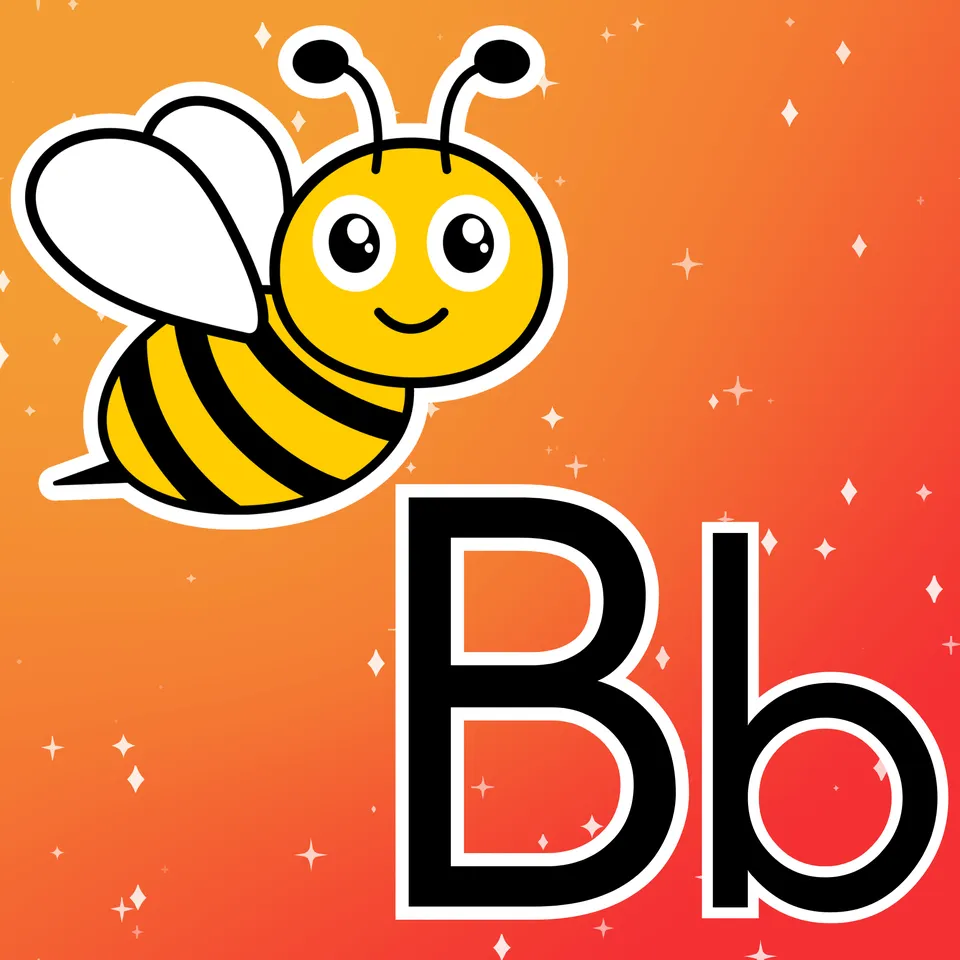
Letter B
Ages 3–5 · 5 minutes · English
Learn all about letter B!
Practice letter sounds. Play alphabet games that build upon each other throughout the course. Become familiar and build confidence using the alphabet!
Part of
Standards alignment
Common Core State Standards
- RF.K.1.d — Recognize and name all upper- and lowercase letters of the alphabet.
- ELD-SI.K-3.Narrate — Multilingual learners will… • Share ideas about one's own and others' lived experiences and previous learning • Connect stories with images and representations to add meaning • Ask questions about what others have shared • Recount and restate ideas • Discuss how stories might end or next steps
Alabama
- ELA21.K.10a — Produce the most frequent sound(s) for each consonant, including _x_ and _q_, which have two phonemes (sounds).
- ELA21.K.9f — Identify the initial, final, and medial sounds of spoken words.
- ELA21.K.11 — Recognize and name all upper and lower case letters in non-sequential order with accuracy and automaticity.
- ELA21.K.9 — Demonstrate early phonological awareness to basic phonemic awareness skills in spoken words.
Alaska
- RF.K.1.d — Recognize and name all upper- and lowercase letters of the alphabet.
- RF.K.3.a — Demonstrate basic knowledge of one-to-one letter-sound correspondences by producing the primary sound or many of the most frequent sounds for each consonant.
- RF.K.2 — Demonstrate understanding of spoken words, syllables, and sounds (phonemes).
- RF.K.3 — Know and apply grade-level phonics and word analysis skills in decoding words.
Arizona
- K.RF.1.f — Recognize and name all upper and lowercase letters of the alphabet.
- K.RF.3.a — Demonstrate basic knowledge of one‐to‐one letter‐sound correspondence by producing the primary or most frequent sound(s) for each consonant and the five major vowels.
- K.RF.2.a — Identify and produce sounds (phonemes) in a spoken word.
Arkansas
- K.FR.21.F — Produce the most common sound for each letter of the alphabet with accuracy and automaticity.
- K.FR.4.CP — Name all upper and lowercase letters of the alphabet in print.
- K.FR.5.PA — Isolate and pronounce the initial, medial vowel, and final sounds in three sound words.
California
- RF.K.1.d — Recognize and name all upper- and lowercase letters of the alphabet.
- RF.K.3.a — Demonstrate basic knowledge of one-to-one letter-sound correspondences by producing the primary or many of the most frequent sound for each consonant.
- RF.K.2.d — Isolate and pronounce the initial, medial vowel, and final sounds (phonemes) in three-phoneme (consonant-vowel-consonant, or CVC) words. (This does not include CVCs ending with /l/, /r/, or /x/.)
Colorado
- RWC20-GR.PS-S.2-GLE.2-EO.c — Identify and discriminate between sounds and phonemes in language, such as attention to beginning and ending sounds of words and recognition that different words begin or end with the same sound.
- RWC20-GR.PS-S.2-GLE.4.b — Recognize that letters of the alphabet have distinct sound(s) associated with them.
- RWC20-GR.PS-S.2-GLE.4.c — Attend to the beginning letters and sounds in familiar words.
- RWC20-GR.PS-S.2-GLE.4.a — Recognize that the letters of the alphabet are a special category of visual graphics that can be individually named.
- RWC20-GR.PS-S.2-GLE.4.d — Identify letters and associate correct sounds with letters, including a minimum of ten letters, preferably including letters in the child’s name.
Connecticut
- RF.K.1.d — Recognize and name all upper- and lowercase letters of the alphabet.
- RF.K.3.a — Demonstrate basic knowledge of one-to-one letter-sound correspondences by producing the primary or many of the most frequent sound for each consonant.
- RF.K.2 — Demonstrate understanding of spoken words, syllables, and sounds (phonemes).
Delaware
- RF.K.1.d — Recognize and name all upper- and lowercase letters of the alphabet.
- RF.K.3.a — Demonstrate basic knowledge of one-to-one letter-sound correspondences by producing the primary or many of the most frequent sound for each consonant.
- RF.K.2 — Demonstrate understanding of spoken words, syllables, and sounds (phonemes).
Florida
- ELA.K.F.1.3 — Use knowledge of grade-appropriate phonics and word-analysis skills to decode words accurately. • Demonstrate knowledge of the most frequent sound for each consonant. • Demonstrate knowledge of the short and long sounds for the five major vowels. • Decode consonant-vowel-consonant (CVC) words. • Encode consonant-vowel-consonant (CVC) words.
- ELA.K.F.1.1 — Demonstrate knowledge of the basic concepts of print. • Locate a printed word on a page. • Distinguish letters from words within sentences. • Match print to speech to demonstrate that language is represented by print. • Identify parts of a book (front cover, back cover, title page). • Move top to bottom and left to right on the printed page; returning to the beginning of the next line. • Identify all upper- and lowercase letters of the alphabet. • Recognize that print conveys specific meaning and pictures may support meaning.
- ELA.K.F.1.2 — Demonstrate phonological awareness. • Blend and segment syllables in spoken words. • Identify and produce alliterative and rhyming words. • Blend and segment onset and rimes of single-syllable words. • Identify the initial, medial, and final sound of spoken words. • Add or delete phonemes at the beginning or end of a spoken word and say the resulting word. • Segment and blend phonemes in single-syllable spoken words.
Georgia
- ELAGSEKRF1.d — Recognize and name all upper- and lowercase letters of the alphabet.
- ELAGSEKRF3.a — Demonstrate basic knowledge of one to one letter-sound correspondences for each consonant.
- ELAGSEKRF3 — Know and apply grade-level phonics and word analysis skills in decoding words.
Hawaii
- K.RF.1d — Recognize and name all upper- and lowercase letters of the alphabet.
- K.RF.3a — Demonstrate basic knowledge of one-to-one letter-sound correspondences by producing the primary or many of the most frequent sound for each consonant.
- K.RF.2d — Isolate and pronounce the initial, medial vowel, and final sounds (phonemes) in three-phoneme (consonant-vowel-consonant, or CVC) words. (This does not include CVCs ending with /l/, /r/, or /x/.)
Idaho
- K.FR.PC.1h — Identify and name all upper- and lowercase letters of the alphabet.
- K.FR.PH.3a — Demonstrate knowledge of one-to-one letter-sound correspondences by producing the most frequent sound for each consonant letter.
- K.FR.PA.2d — Isolate and pronounce the initial, medial vowel, and final sounds (phonemes) in spoken three-phoneme (consonant-vowel-consonant, or CVC) words and say the resulting word (Note: This does not include CVCs ending with /l/, /r/, or /x/.)
- K.FR.PA.2 — Demonstrate understanding of spoken words, syllables, and sounds.
Illinois
- RF.K.1.d — Recognize and name all upper- and lowercase letters of the alphabet.
- RF.K.3.a — Demonstrate basic knowledge of one-to-one letter-sound correspondences by producing the primary or many of the most frequent sound for each consonant.
- RF.K.2.d — Isolate and pronounce the initial, medial vowel, and final sounds (phonemes) in three-phoneme (consonant-vowel-consonant, or CVC) words. (This does not include CVCs ending with /l/, /r/, or /x/.)
- RF.K.2 — Demonstrate understanding of spoken words, syllables, and sounds (phonemes).
Indiana
- K.RF.3 — Identify and name all uppercase (capital) and lowercase letters of the alphabet. (E)
- K.RF.7 — Use letter-sound knowledge to decode the sound of each consonant. (E)
- K.RF.6 — Identify and produce the beginning, middle (medial), and final sounds in three and four phoneme words. (E)
Iowa
- RF.K.1.d — Recognize and name all upper- and lowercase letters of the alphabet.
- RF.K.3.a — Demonstrate basic knowledge of phoneme-grapheme (one-to-one, letter-sound) correspondences by producing the primary and most frequent sounds for each consonant.
- RF.K.2 — Demonstrate understanding of spoken words, syllables, and phonemes (sounds).
- RF.K.3 — Know and apply grade-level phonics, which includes word analysis skills to support decoding and encoding words.
Kansas
- RF.K.1.d — Recognize and name all upper- and lowercase letters of the alphabet.
- RF.K.3.a — Demonstrate basic knowledge of one-to-one letter-sound correspondences by producing the primary or many of the most frequent sounds for each consonant.
- RF.K.3.d — Distinguish between similarly spelled words by identifying the sounds of the letters that differ (e.g., bat/cat, bat/bit/, bat/bad).
- RF.K.2.d — Isolate and pronounce the initial, medial vowel, and final sounds (phonemes) in three-phoneme (consonant-vowel-consonant, or CVC) words. (This does not include CVC ending with /l/, /r/, or /x/.)
Kentucky
- RF.K.1.d — Recognize and name all upper- and lowercase letters of the alphabet.
- RF.K.3.a — Demonstrate basic knowledge of one-to-one letter-sound correspondences by producing the primary or many of the most frequent sounds for each consonant.
- RF.K.2.d — Isolate and pronounce the initial, medial vowel and final sounds (phonemes) in three-phoneme words.
Louisiana
- RF.K.1.d — Recognize and name all upper- and lowercase letters of the alphabet.
- RF.K.3.a — Demonstrate basic knowledge of one-to-one letter-sound correspondences by producing the primary or many of the most frequent sounds for each consonant.
- RF.K.2.d — Isolate and pronounce the initial, medial vowel, and final sounds (phonemes) in three-phoneme (consonant-vowel-consonant, or CVC) words. (This does not include CVCs ending with /l/, /r/, or /x/.)
Maine
- R.1.K.d — Recognize and name all upper- and lowercase letters of the alphabet.
- R.3.K.a — Demonstrate basic knowledge of one-to-one letter-sound correspondences by producing the primary or many of the most frequent sound for each consonant.
- R.2.K.d — Isolate and pronounce the initial, medial vowel, and final sounds (phonemes) in three-phoneme (consonant-vowel-consonant, or CVC) words.* (This does not include CVCs ending with /l/, /r/, or /x/.)
Maryland
- RF.PK.1.d — Recognize and name some upper- and lowercase letters of the alphabet.
- RF.PK.2.e — Isolate and pronounce the initial sound in spoken words
- RF.PK.3.b — Demonstrate basic knowledge of one-to-one letter sound correspondences by producing the most frequent sound for some consonants.
- RF.PK.3.a — Recognize that words are made up of letters and their sounds.
Massachusetts
- RF.PK.3.a — Link an initial sound to a picture of an object that begins with that sound and, with guidance and support, to the corresponding printed letter (e.g., link the initial sound /b/ to a picture of a ball and, with support, to a printed or written “B”).
- RF.PK.1 — With guidance and support, demonstrate understanding of the organization and basic features of printed and written text: books, words, letters, and the alphabet.
- RF.PK.3 — Demonstrate beginning understanding of phonics and word analysis skills.
Michigan
- RF.K.1.d — Recognize and name all upper- and lowercase letters of the alphabet.
- RF.K.3.a — Demonstrate basic knowledge of one-to-one letter-sound correspondences by producing the primary or many of the most frequent sound for each consonant.
- RF.K.2.d — Isolate and pronounce the initial, medial vowel, and final sounds (phonemes) in three-phoneme (consonent-vowel-consonent, or CVC) words. (This does not include CVCs ending with /l/, /r/, or /x/.)
- RF.K.3 — Know and apply grade-level phonics and word analysis skills in decoding words.
- RF.K.2 — Demonstrate understanding of spoken words, syllables, and sounds (phonemes).
Minnesota
- 0.1.1.0.b — Demonstrate understanding of the basic features of print: Recognize and name all uppercase and lowercase letters of the alphabet.
- 0.2.1.2 — Demonstrate one-to-one letter-sound correspondence.
- 0.1.1.1.c — Demonstrate understanding of spoken words, syllables and sounds (phonemes): isolate, pronounce and manipulate sounds in three-phoneme CVC words.
- 0.1.1.1.a — Demonstrate understanding of spoken words, syllables and sounds (phonemes): identify and orally produce rhyming words, onset-rime and alliteration.
Mississippi
- RF.K.1.d — Recognize and name all upper- and lowercase letters of the alphabet.
- RF.K.3.a — Demonstrate basic knowledge of one-to-one letter-sound correspondences by producing the primary sound or many of the most frequent sounds for each consonant.
- RF.K.2 — Demonstrate understanding of spoken words, syllables, and sounds (phonemes).
Missouri
- K.RF.1.A.a — identifying all upper- and lower-case letters
- K.RF.2.A.g — isolating the initial, medial, and final sounds in spoken words
- K.RF.2.A.a — identifying sounds in spoken words
- K.RF.3.A.a — producing and writing letter(s) for most short vowel and consonant sounds
- K.RF.2.A.d — recognizing spoken alliteration or groups of words that begin with the same onset or initial sound
Montana
- RF.K.1.d — Recognize and name all upper- and lowercase letters of the alphabet.
- RF.K.3.a — Demonstrate basic knowledge of one-to-one letter-sound correspondences by producing the primary or many of the most frequent sound for each consonant.
- RF.K.3 — Know and apply grade-level phonics and word analysis skills in decoding words.
Nebraska
- LA.K.F.1.a — Identify all upper and lowercase letters of the alphabet in isolation and in connected text.
- LA.K.F.3.a — Demonstrate basic knowledge of one-to-one sound to letter correspondences by producing the primary or many of the most frequent sounds for each consonant.
- LA.K.F.2.f — Isolate and pronounce the initial, medial vowel, and final sounds (phonemes) in two- and three-phoneme (VC or CVC) words, excluding CVC words ending with /l/, /r/, or /x/.
Nevada
- RF.K.1.d — Recognize and name all upper- and lowercase letters of the alphabet.
- RF.K.3.a — Demonstrate basic knowledge of one-to-one letter-sound correspondences by producing the primary or many of the most frequent sound for each consonant.
- RF.K.3 — Know and apply grade-level phonics and word analysis skills in decoding words.
- RF.K.2.d — Isolate and pronounce the initial, medial vowel, and final sounds (phonemes) in three-phoneme (consonant-vowel-consonant, or CVC) words. (This does not include CVCs ending with /l/, /r/, or /x/.)
New Hampshire
- RF.K.1.d — Recognize and name all upper- and lowercase letters of the alphabet.
- RF.K.3.a — Demonstrate basic knowledge of one-to-one letter-sound correspondences by producing the primary or many of the most frequent sound for each consonant.
- RF.K.2 — Demonstrate understanding of spoken words, syllables, and sounds (phonemes).
New Jersey
- RF.K.1.d — Recognize and name all upper- and lowercase letters of the alphabet.
- RF.K.3.a — Demonstrate basic knowledge of one-to-one letter-sound correspondences by producing many of the most frequently used sounds of each consonant.
- RF.K.3 — Know and apply grade-level phonics and word analysis skills in decoding and encoding words.
New Mexico
- RF.K.1.d — Recognize and name all upper- and lowercase letters of the alphabet.
- RF.K.3.a — Demonstrate basic knowledge of one-to-one letter-sound correspondences by producing the primary or many of the most frequent sound for each consonant.
- RF.K.2 — Demonstrate understanding of spoken words, syllables, and sounds (phonemes).
New York
- PKRF1d — Recognize and name some upper/lowercase letters of the alphabet, especially those in own name.
- PKRF3a — Demonstrate one-to-one letter-sound correspondence by producing the primary sound of some consonants.
North Carolina
- RF.K.1.d — Recognize and name all upper- and lower-case letters of the alphabet.
- RF.K.4.a — Demonstrate basic knowledge of one-to-one letter-sound correspondences by producing the primary sound or many of the most frequent sounds for each consonant.
- RF.K.3.d — Isolate and pronounce the initial, medial vowel, and final sounds (phonemes) in three-phoneme (consonant-vowel-consonant, or CVC) words. (This does not include CVCs ending with /l/, /r/, or /x/.)
North Dakota
- K.F.12a — Accurately and automatically recognize and name all uppercase and lowercase letters of the alphabet in non-sequential order.
- K.F.12b — Accurately and automatically produce the predictable consonant and short vowel sounds associated with uppercase and lowercase letters in non-sequential order.
- K.F.7 — Isolate and pronounce the initial, medial vowel, and final phonemes in three-phoneme words.
- K.F.12 — Demonstrate fluency through the application of phonemic and phonological skills.
Ohio
- RF.K.1.d — Recognize and name all upper- and lowercase letters of the alphabet.
- RF.K.3.a — Demonstrate basic knowledge of one-to-one grapheme (letter)-sound correspondences by producing the primary sound or many of the most frequent sounds for each consonant.
- RF.K.3 — Know and apply grade-level phonics and word analysis skills in decoding words.
- RF.K.2.d — Isolate and pronounce the initial, medial vowel, and final phonemes (sounds) in three-phoneme (consonant-vowel consonant, or CVC) words. (This does not include CVCs ending with /l/, /r/, or /x/.).
Oklahoma
- PK.2.PWS.2 — Students will name a majority of uppercase and lowercase letters.
- PK.2.PWS.3 — Students will produce some sounds represented by letters.
- PK.2.PA.4 — Students will isolate the common initial sound when given a set of alliterative spoken words (e.g., the puppy pounces).
Oregon
- K.RF.1d — Recognize and name all upper- and lowercase letters of the alphabet.
- K.RF.3a — Demonstrate basic knowledge of one-to-one letter-sound correspondences by producing the primary or many of the most frequent sound for each consonant.
- K.RF.3 — Know and apply grade-level phonics and word analysis skills in decoding words.
Pennsylvania
- CC.1.1.PK.B — Identify basic features of print. • Differentiate between numbers and letters and letters and words. • Recognize and name some uppercase and lowercase letters of the alphabet.
- CC.1.1.PK.D — Develop beginning phonics and word skills. • Associate some letters with their names and sounds. • Identify familiar words and environmental print.
- CC.1.1.PK.C — Demonstrate understanding of spoken words, syllables, and sounds (phonemes). • Recognize rhyming words and when two or more words begin with the same sound (alliteration). • Count syllables in spoken words. • Segment single-syllable spoken words. • Segment single-syllable spoken words.
Rhode Island
- RF.K.1.d — Recognize and name all upper- and lowercase letters of the alphabet.
- RF.K.3.a — Demonstrate basic knowledge of one-to-one letter-sound correspondences by producing the primary or many of the most frequent sound for each consonant.
- RF.K.3 — Know and apply grade-level phonics and word analysis skills in decoding words.
South Carolina
- ELA.K.F.3.1 — Identify, name, and form all upper and lowercase letters with automaticity.
- ELA.K.F.3.3 — Produce one-to-one letter-sound correspondences for each consonant with automaticity.
- ELA.K.F.1.6 — Orally identify initial, medial, and final phonemes in two- and three-phoneme (i.e., VC and CVC) words, excluding CVC words ending with /l/, /r/, or /x/.
- ELA.K.F.3 — Know and apply phonics and word analysis skills in decoding and encoding words. (FK -1.3-2.18 LF BR-430)
South Dakota
- K.RF.1.d — Recognize and name all upper- and lowercase letters of the alphabet.
- K.RF.3.a — Demonstrate one-to-one letter-sound correspondences by producing the primary sound for each consonant.
- K.RF.2.d — Isolate and pronounce the initial, medial vowel, and final sounds (phonemes) in three-phoneme (consonant-vowel-consonant, or CVC) words. (This does not include CVCs ending with /l/, /r/, or /x/.)
- K.RF.3 — Know and apply grade-level phonics and word analysis skills in decoding words.
Tennessee
- K.FL.PC.1.d — Recognize and name all upper and lowercase letters of the alphabet in isolation and in connected text.
- K.FL.PWR.3.a — Demonstrate knowledge of one-to-one letter sound correspondence by producing the most frequent sound for each consonant.
- K.FL.PA.2.d — Isolate and pronounce the initial, medial vowel, and final sounds (phonemes) in two- and three-phoneme (VC or CVC) words, excluding CVC words ending with /l/, /r/, or /x/.
- K.FL.PWR.3 — Know and apply grade-level phonics and word analysis skills when decoding isolated words and in connected text.
Texas
- K.2B.i — identifying and matching the common sounds that letters represent;
- K.2D.v — identifying all uppercase and lowercase letters; and
- K.2A.ii — recognizing spoken alliteration or groups of words that begin with the same spoken onset or initial sound;
Utah
- P3.R.2.c — With prompting and support, identify initial sounds in spoken language.
- P3.R.3.a — With prompting and support, begin to identify seven or more consonant names and sounds using one-to-one letter-sound correspondence (alphabetic principle).
- P4.R.2.c — Identify initial sounds in spoken language.
- P4.R.3.a — Identify 13 or more of the consonant names and sounds using one-to-one letter-sound correspondence (alphabetic principle).
- P3.R.1.b — With prompting and support, begin to recognize frequently seen letters and words, and recognize own name in print.
Vermont
- RF.K.1.d — Recognize and name all upper- and lowercase letters of the alphabet.
- RF.K.3.a — Demonstrate basic knowledge of one-to-one letter-sound correspondences by producing the primary or many of the most frequent sound for each consonant.
Virginia
- K.FFR.3.A — Identify capital and lowercase letters of the alphabet.
- K.FFR.3.B — Identify common letter-sound correspondences.
- K.FFR.2.C — Isolate the initial, medial, and final sounds in three phoneme (individual sound) words (excluding words ending with /l/, /r/, or /x/).
Washington
- RF.K.1.d — Recognize and name all upper- and lowercase letters of the alphabet.
- RF.K.3.a — Demonstrate basic knowledge of one-to-one letter-sound correspondences by producing the primary or many of the most frequent sound for each consonant.
- RF.K.2.d — Isolate and pronounce the initial, medial vowel, and final sounds (phonemes) in three-phoneme (consonent-vowel-consonent, or CVC) words. (This does not include CVCs ending with /l/, /r/, or /x/.)
Washington, D.C.
- RF.K.3.a — Demonstrate basic knowledge of one-to-one letter-sound correspondences by producing the primary or many of the most frequent sound for each consonant.
- RF.K.1.d — Recognize and name all upper- and lowercase letters of the alphabet.
- RF.K.2 — Demonstrate understanding of spoken words, syllables, and sounds (phonemes).
West Virginia
- ELA.K.II.a — Demonstrate basic knowledge of one-to-one letter-sound correspondences by producing the primary or many of the most frequent sounds for each consonant.
- ELA.K.V.d — Recognize and name upper- and lowercase letters of the alphabet.
- ELA.K.IV.d — Isolate and pronounce the initial, medial vowel, and final sounds (phonemes) in three-phoneme words (i.e., consonant-vowel-consonant, hereinafter CVC). This does not include CVCs ending with /l/, /r/ or /x/.
Wisconsin
- ELA.K.RF.1.d — Recognize and name all upper- and lowercase letters of the alphabet.
- ELA.K.RF.3.a — Demonstrate basic knowledge of one-to-one letter-sound correspondences by producing the primary or many of the most frequent sounds for each consonant.
- ELA.K.RF.2.d — Isolate and pronounce the initial, medial vowel, and final sounds (phonemes) in three-phoneme (consonant-vowel-consonant, or CVC) words. (This does not include CVCs ending with /l/, /r/, or /x/.)
- ELA.K.RF.3 — Know and apply grade-level phonics and word analysis skills in decoding words.
Wyoming
- RF.K.1.d — Recognize and name all upper- and lowercase letters of the alphabet.
- RF.K.3.a — Demonstrate basic knowledge of one-to-one letter-sound correspondences by producing the primary or many of the most frequent sound for each consonant.
- RF.K.2.d — Isolate and pronounce the initial, medial vowel, and final sounds (phonemes) in three-phoneme (consonant-vowel-consonant, or CVC) words. (This does not include CVCs ending with /l/, /r/, or /x/.)
- RF.K.3 — Know and apply grade-level phonics and word analysis skills in decoding words.