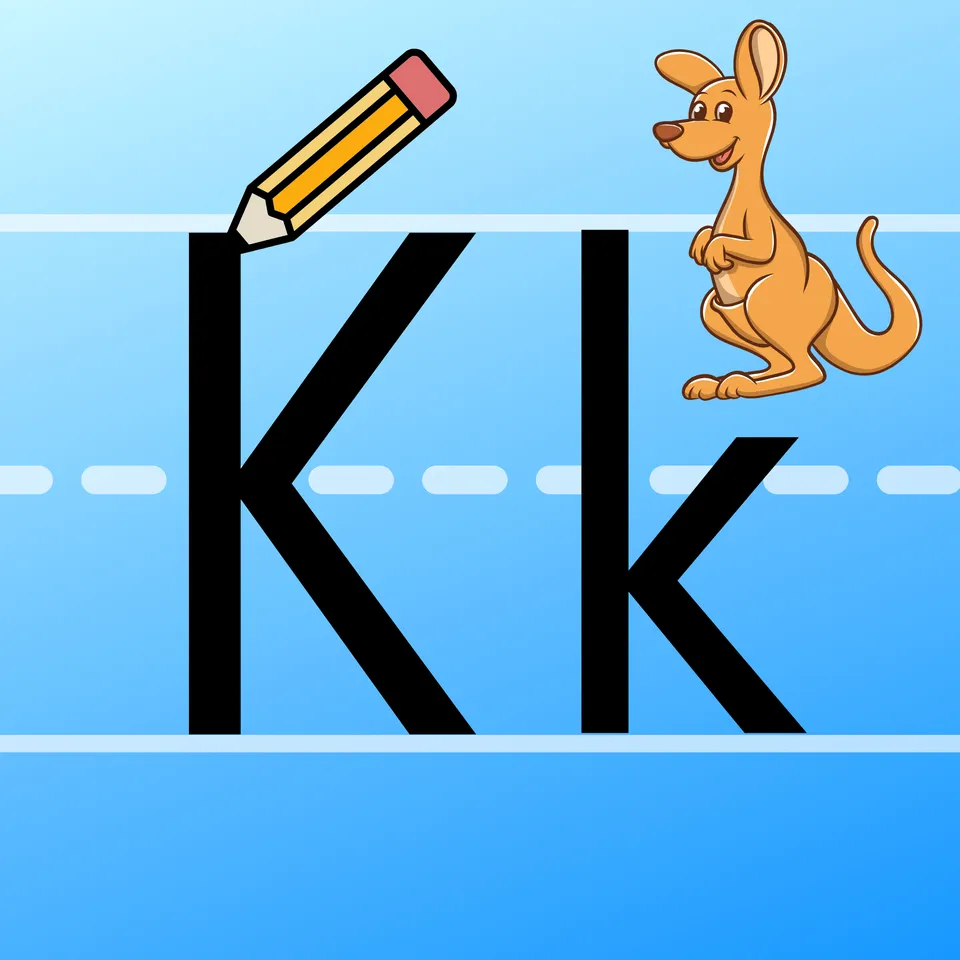
Write Letter K
Ages 3–5 · 5 minutes · English
Learn how to write letter K
Practice letter formation to accurately write uppercase and lowercase alphabet letters. Learn how to hold a pencil. Also, try silly writing styles that help build fine motor skills and practice letter formation in fun new ways!
Materials required:
- Pencil with paper OR dry erase board with marker
Part of
Standards alignment
Common Core State Standards
- L.K.2.c — Write a letter or letters for most consonant and short-vowel sounds (phonemes).
- RF.K.1.d — Recognize and name all upper- and lowercase letters of the alphabet.
Alabama
- ELA21.K.34 — Print legibly, using proper pencil grip.
- ELA21.K.34a — Print upper and lower case letters using proper approach strokes, letter formation, and line placement.
Alaska
- L.K.1.a — Print many upper- and lowercase letters.
- RF.K.1.d — Recognize and name all upper- and lowercase letters of the alphabet.
- RF.K.3.a — Demonstrate basic knowledge of one-to-one letter-sound correspondences by producing the primary sound or many of the most frequent sounds for each consonant.
Arizona
- K.WF.1 — Demonstrate and apply handwriting skills.
- K.WF.1.b — Write upper and lower manuscript letters, with reference to a model.
Arkansas
- K.FR.18.H — Demonstrate proper pencil grip.
- K.FR.19.H — Form upper and lowercase letters and numerals correctly, using a common path of movement.
- K.FR.21.F — Produce the most common sound for each letter of the alphabet with accuracy and automaticity.
California
- L.K.1.a — Print many upper- and lowercase letters.
- RF.K.1.d — Recognize and name all upper- and lowercase letters of the alphabet.
- RF.K.3.a — Demonstrate basic knowledge of one-to-one letter-sound correspondences by producing the primary or many of the most frequent sound for each consonant.
Colorado
- RWC20-GR.PS-S.3-GLE.1-EO.a — Experiment with writing tools and materials.
- RWC20-GR.PS-S.3-GLE.1-EO.d — Copy, trace, or independently write letters or words.
- RWC20-GR.K-S.3-GLE.4-EO.a.i — Print many upper- and lowercase letters.
- RWC20-GR.PS-S.2-GLE.4.b — Recognize that letters of the alphabet have distinct sound(s) associated with them.
Connecticut
- L.K.1.a — Print many upper- and lowercase letters.
- RF.K.1.d — Recognize and name all upper- and lowercase letters of the alphabet.
- RF.K.3.a — Demonstrate basic knowledge of one-to-one letter-sound correspondences by producing the primary or many of the most frequent sound for each consonant.
Delaware
- L.K.1.a — Print many upper- and lowercase letters.
- RF.K.1.d — Recognize and name all upper- and lowercase letters of the alphabet.
- RF.K.3.a — Demonstrate basic knowledge of one-to-one letter-sound correspondences by producing the primary or many of the most frequent sound for each consonant.
Florida
- ELA.K.C.1.1 — Print many upper- and lowercase letters.
Georgia
- ELAGSEKL1.a — Print many upper- and lowercase letters.
- ELAGSEKRF1.d — Recognize and name all upper- and lowercase letters of the alphabet.
- ELAGSEKRF3.a — Demonstrate basic knowledge of one to one letter-sound correspondences for each consonant.
Hawaii
- K.L.1a — Print many upper- and lowercase letters.
- K.RF.1d — Recognize and name all upper- and lowercase letters of the alphabet.
- K.RF.3a — Demonstrate basic knowledge of one-to-one letter-sound correspondences by producing the primary or many of the most frequent sound for each consonant.
Idaho
- K.W.HWK.2 — Print all uppercase and lowercase letters of the alphabet. Write left to right and top to bottom with appropriate spaces between letters.
- K.FR.PH.3a — Demonstrate knowledge of one-to-one letter-sound correspondences by producing the most frequent sound for each consonant letter.
Illinois
- L.K.1.a — Print many upper- and lowercase letters.
- RF.K.1.d — Recognize and name all upper- and lowercase letters of the alphabet.
- RF.K.3.a — Demonstrate basic knowledge of one-to-one letter-sound correspondences by producing the primary or many of the most frequent sound for each consonant.
Indiana
- K.W.1 — Write most uppercase (capital) and lowercase letters of the alphabet, correctly shaping and spacing the letters of the words.
- K.RF.3 — Identify and name all uppercase (capital) and lowercase letters of the alphabet. (E)
Iowa
- WF.K.1 — Print with scaffolding and support for a variety of tasks and purposes.
- WF.K.1.a — Form many upper and lowercase manuscript letters and numerals correctly with proportion, line awareness, and spacing (between words and letters).
- WF.K.1.b — Begin to produce manuscript writing.
- RF.K.1.d — Recognize and name all upper- and lowercase letters of the alphabet.
Kansas
- W.K.10.a — Print many upper and lowercase letters.
- RF.K.1.d — Recognize and name all upper- and lowercase letters of the alphabet.
- RF.K.3.a — Demonstrate basic knowledge of one-to-one letter-sound correspondences by producing the primary or many of the most frequent sounds for each consonant.
Kentucky
- HW.K.1 — Print all upper and lowercase letters and numerals.
- RF.K.1.d — Recognize and name all upper- and lowercase letters of the alphabet.
- RF.K.3.a — Demonstrate basic knowledge of one-to-one letter-sound correspondences by producing the primary or many of the most frequent sounds for each consonant.
Louisiana
- L.K.1.a — Print many upper- and lowercase letters.
- RF.K.1.d — Recognize and name all upper- and lowercase letters of the alphabet.
- RF.K.3.a — Demonstrate basic knowledge of one-to-one letter-sound correspondences by producing the primary or many of the most frequent sounds for each consonant.
Maine
- W.3.K.a — Print many upper- and lowercase letters.
- R.1.K.d — Recognize and name all upper- and lowercase letters of the alphabet.
- R.3.K.a — Demonstrate basic knowledge of one-to-one letter-sound correspondences by producing the primary or many of the most frequent sound for each consonant.
Maryland
- L.K.1.a — Print many upper- and lowercase letters.
- L.PK.2.d — Develop fine motor skills necessary to control and sustain handwriting.
- RF.PK.1.d — Recognize and name some upper- and lowercase letters of the alphabet.
- RF.PK.3.b — Demonstrate basic knowledge of one-to-one letter sound correspondences by producing the most frequent sound for some consonants.
Massachusetts
- L.K.2.a — Print upper- and lowercase letters.
- RF.PK.3.a — Link an initial sound to a picture of an object that begins with that sound and, with guidance and support, to the corresponding printed letter (e.g., link the initial sound /b/ to a picture of a ball and, with support, to a printed or written “B”).
- RF.K.1.d — Recognize and name all upper- and lowercase letters of the alphabet.
- RF.K.3.a — Demonstrate basic knowledge of one-to-one letter-sound correspondences by producing the primary sound or many of the most frequent sounds for each consonant.
Michigan
- L.K.1.a — Print many upper- and lowercase letters.
- RF.K.3.a — Demonstrate basic knowledge of one-to-one letter-sound correspondences by producing the primary or many of the most frequent sound for each consonant.
- RF.K.1.d — Recognize and name all upper- and lowercase letters of the alphabet.
Minnesota
- 0.2.1.0 — Print many uppercase and lowercase letters.
- 0.1.1.0.b — Demonstrate understanding of the basic features of print: Recognize and name all uppercase and lowercase letters of the alphabet.
- 0.2.1 — Foundations of Writing Demonstrate knowledge of oral language, orthography, grammar and mechanics to express ideas in writing.
- 0.2.1.2 — Demonstrate one-to-one letter-sound correspondence.
Mississippi
- L.K.1.a — Print many upper- and lowercase letters.
- RF.K.1.d — Recognize and name all upper- and lowercase letters of the alphabet.
- RF.K.3.a — Demonstrate basic knowledge of one-to-one letter-sound correspondences by producing the primary sound or many of the most frequent sounds for each consonant.
Missouri
- K.L.1.B.a — print in upper- and lowercase letters
- K.L.1.B.f — write and name the printed letters that match the sound
- K.L.1.B.h — write and name letters for consonant and vowel sounds
- K.RF.1.A.a — identifying all upper- and lower-case letters
Montana
- L.K.1.a — Print many upper- and lowercase letters.
- RF.K.1.d — Recognize and name all upper- and lowercase letters of the alphabet.
- RF.K.3.a — Demonstrate basic knowledge of one-to-one letter-sound correspondences by producing the primary or many of the most frequent sound for each consonant.
Nebraska
- LA.K.FW.1 — Demonstrate basic handwriting skills.
- LA.K.FW.1.b — Print many upper and lowercase manuscript letters using reference materials and classroom resources.
- LA.K.F.3.a — Demonstrate basic knowledge of one-to-one sound to letter correspondences by producing the primary or many of the most frequent sounds for each consonant.
Nevada
- L.K.1.a — Print many upper- and lowercase letters.
- RF.K.1.d — Recognize and name all upper- and lowercase letters of the alphabet.
- RF.K.3.a — Demonstrate basic knowledge of one-to-one letter-sound correspondences by producing the primary or many of the most frequent sound for each consonant.
New Hampshire
- L.K.1.a — Print many upper- and lowercase letters.
- RF.K.1.d — Recognize and name all upper- and lowercase letters of the alphabet.
- RF.K.3.a — Demonstrate basic knowledge of one-to-one letter-sound correspondences by producing the primary or many of the most frequent sound for each consonant.
New Jersey
- L.K.1.a — Print many upper- and lowercase letters.
- RF.K.1.d — Recognize and name all upper- and lowercase letters of the alphabet.
- RF.K.3.a — Demonstrate basic knowledge of one-to-one letter-sound correspondences by producing many of the most frequently used sounds of each consonant.
New Mexico
- L.K.1.a — Print many upper- and lowercase letters.
- RF.K.1.d — Recognize and name all upper- and lowercase letters of the alphabet.
- RF.K.3.a — Demonstrate basic knowledge of one-to-one letter-sound correspondences by producing the primary or many of the most frequent sound for each consonant.
New York
- PKL1 — Demonstrate command of the conventions of academic English grammar and usage when writing or speaking. (See Notes for grade-band conventions.)
- KL1 — Demonstrate command of the conventions of academic English grammar and usage when writing or speaking. (See Notes for grade-band conventions.)
- PKRF1d — Recognize and name some upper/lowercase letters of the alphabet, especially those in own name.
- PKRF3a — Demonstrate one-to-one letter-sound correspondence by producing the primary sound of some consonants.
North Carolina
- RF.K.2 — Print upper- and lower-case letters.
- RF.K.1.d — Recognize and name all upper- and lower-case letters of the alphabet.
- RF.K.4.a — Demonstrate basic knowledge of one-to-one letter-sound correspondences by producing the primary sound or many of the most frequent sounds for each consonant.
North Dakota
- K.F.13 — Write uppercase and lowercase letters accurately.
- K.F.12b — Accurately and automatically produce the predictable consonant and short vowel sounds associated with uppercase and lowercase letters in non-sequential order.
Ohio
- L.K.1.a — Print many upper- and lowercase letters.
- RF.K.1.d — Recognize and name all upper- and lowercase letters of the alphabet.
- RF.K.3.a — Demonstrate basic knowledge of one-to-one grapheme (letter)-sound correspondences by producing the primary sound or many of the most frequent sounds for each consonant.
Oklahoma
- PK.2.PC.6 — Students will begin to write some uppercase and lowercase letters including the majority of the letters in their first name with prompting.
- K.2.PC.6 — Students will correctly form letters to write their first and last name and most uppercase and lowercase letters correctly.
- PK.2.PWS.3 — Students will produce some sounds represented by letters.
Oregon
- K.L.1a — Print all upper- and lowercase letters.
- K.RF.1d — Recognize and name all upper- and lowercase letters of the alphabet.
- K.RF.3a — Demonstrate basic knowledge of one-to-one letter-sound correspondences by producing the primary or many of the most frequent sound for each consonant.
Pennsylvania
- CC.1.1.PK.B — Identify basic features of print. • Differentiate between numbers and letters and letters and words. • Recognize and name some uppercase and lowercase letters of the alphabet.
- CC.1.1.PK.D — Develop beginning phonics and word skills. • Associate some letters with their names and sounds. • Identify familiar words and environmental print.
Rhode Island
- L.K.2.a — Print upper- and lowercase letters.
- RF.K.1.d — Recognize and name all upper- and lowercase letters of the alphabet.
- RF.K.3.a — Demonstrate basic knowledge of one-to-one letter-sound correspondences by producing the primary or many of the most frequent sound for each consonant.
South Carolina
- ELA.K.C.6.1 — Print all uppercase and lowercase letters, focusing on pencil grasp, letter formation, legibility, and pacing; use appropriate spacing for letters, words, and sentences.
- ELA.K.F.3.1 — Identify, name, and form all upper and lowercase letters with automaticity.
- ELA.K.C.6 — Write independently and legibly for a variety of tasks and purposes. (FK -1.3-2.18 LF BR-430)
South Dakota
- K.L.1.a — Print all uppercase (capital) and lowercase letters of the alphabet using correct formation.
- K.RF.1.d — Recognize and name all upper- and lowercase letters of the alphabet.
- K.RF.3.a — Demonstrate one-to-one letter-sound correspondences by producing the primary sound for each consonant.
Tennessee
- K.FL.WC.4.g — Print many upper and lowercase letters.
- K.FL.WC.4 — Know and apply grade-level phonics and word analysis skills when encoding words; write legibly.
- K.FL.WC.4.a — Write uppercase and lowercase manuscript letters from memory.
- K.FL.PWR.3.a — Demonstrate knowledge of one-to-one letter sound correspondence by producing the most frequent sound for each consonant.
Texas
- K.2E — develop handwriting by accurately forming all uppercase and lowercase letters using appropriate directionality.
- K.2B.i — identifying and matching the common sounds that letters represent;
Utah
- K.W.5 — Legibly write all upper- and lowercase manuscript letters.
- P4.W.5 — Print some mock letters, scribbles, or manuscript letters, including those in own name.
- P3.W.5 — With prompting and support, print some age-appropriate prewriting strokes.
Vermont
- L.K.2.c — Write a letter or letters for most consonant and short-vowel sounds (phonemes).
- RF.K.1.d — Recognize and name all upper- and lowercase letters of the alphabet.
Virginia
- K.FFW.1.A — Use functional pencil grasp for letter formation.
- K.FFW.1.B — Accurately and automatically print capital and lowercase letters of the alphabet independently.
- K.FFR.3.A — Identify capital and lowercase letters of the alphabet.
- K.FFR.3.B — Identify common letter-sound correspondences.
Washington
- L.K.1.a — Print many upper- and lowercase letters.
- RF.K.1.d — Recognize and name all upper- and lowercase letters of the alphabet.
- RF.K.3.a — Demonstrate basic knowledge of one-to-one letter-sound correspondences by producing the primary or many of the most frequent sound for each consonant.
Washington, D.C.
- RF.K.1.d — Recognize and name all upper- and lowercase letters of the alphabet.
- L.K.2.c — Write a letter or letters for most consonant and short-vowel sounds (phonemes).
West Virginia
- ELA.K.III — Print upper- and lowercase letters.
- ELA.PK.WR.EW.5 — Experiment with a variety of writing tools and materials (ex: pencils, chalk, markers, sand, developmentally appropriate technology)
- ELA.PK.FR.PC.3 — Recognize that letters of the alphabet are a special category of visual graphics that can be individually named.
Wisconsin
- ELA.K.W.6 — With guidance and support from adults, explore a variety of digital tools to produce and publish writing, including in collaboration with peers. Learn to produce writing through printing (including forming most printed upper and lower case letters), cursive, and/or typing.
- ELA.K.RF.1.d — Recognize and name all upper- and lowercase letters of the alphabet.
- ELA.K.RF.3.a — Demonstrate basic knowledge of one-to-one letter-sound correspondences by producing the primary or many of the most frequent sounds for each consonant.
Wyoming
- L.K.1.a — Print many upper- and lowercase letters.
- RF.K.1.d — Recognize and name all upper- and lowercase letters of the alphabet.
- RF.K.3.a — Demonstrate basic knowledge of one-to-one letter-sound correspondences by producing the primary or many of the most frequent sound for each consonant.