More Addition With Carrying
Ages 6–8 · 12 minutes · Math
Use carrying the one with larger numbers
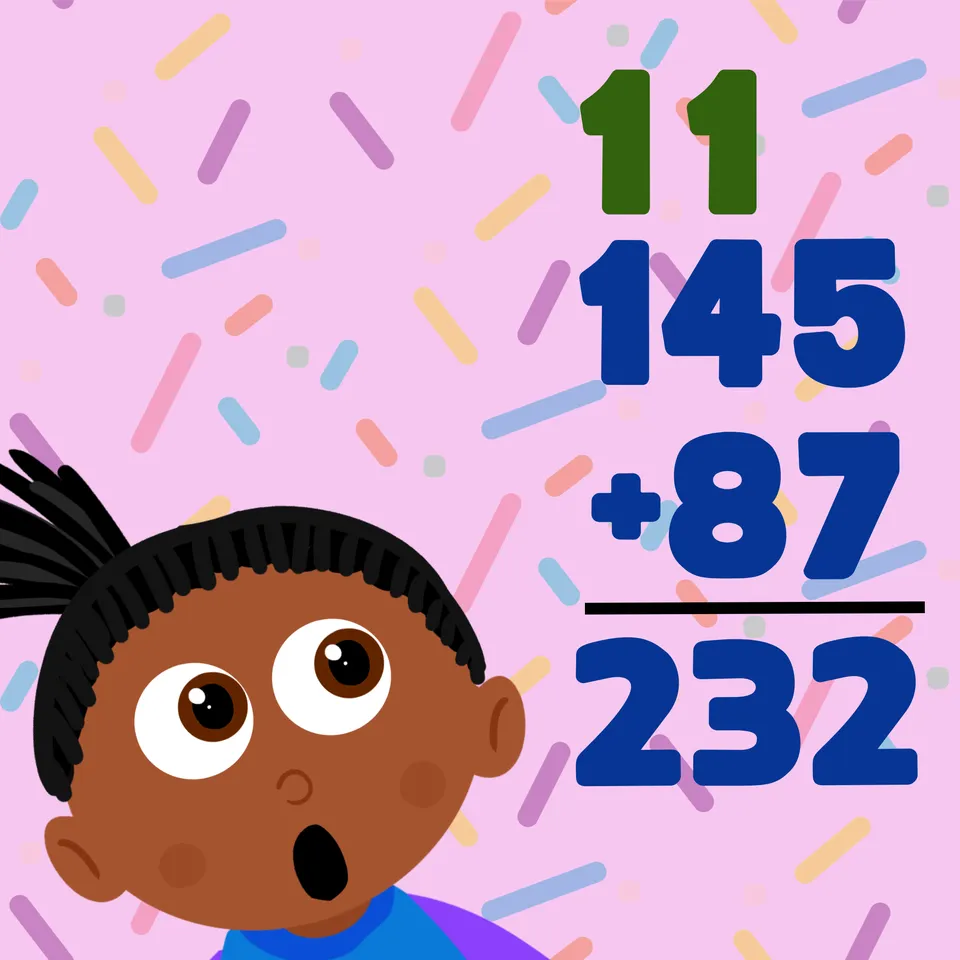
More addition with carrying, this time going into 3-digit numbers. If a student already knows how to "carry the 1," they are ready for this lesson.
Part of
Standards alignment
Common Core State Standards
- 2.NBT.B.5 — Fluently add and subtract within 100 using strategies based on place value, properties of operations, and/or the relationship between addition and subtraction.
- 2.NBT.B.7 — Add and subtract within 1000, using concrete models or drawings and strategies based on place value, properties of operations, and/or the relationship between addition and subtraction; relate the strategy to a written method. Understand that in adding or subtracting three-digit numbers, one adds or subtracts hundreds and hundreds, tens and tens, ones and ones; and sometimes it is necessary to compose or decompose tens or hundreds.
- 2.NBT.A.3 — Read and write numbers to 1000 using base-ten numerals, number names, and expanded form.
- 2.NBT.B.9 — Explain why addition and subtraction strategies work, using place value and the properties of operations.
Alabama
- MA19.2.12 — Add and subtract within 1000 using concrete models or drawings and strategies based on place value, properties of operations, and/or the relationship between addition and subtraction; relate the strategy to a written method.
- MA19.2.12a — Explain that in adding or subtracting three-digit numbers, one adds or subtracts hundreds and hundreds, tens and tens, ones and ones; and sometimes it is necessary to compose or decompose tens or hundreds.
- MA19.2.10 — Fluently add and subtract within 100, using strategies based on place value, properties of operations, and/or the relationship between addition and subtraction.
- MA19.2.14 — Explain why addition and subtraction strategies work, using place value and the properties of operations.
- MA19.2.8 — Read and write numbers to 1000 using base-ten numerals, number names, and expanded form.
Alaska
- 2.NBT.5 — Fluently add and subtract using numbers up to 100. Use: • strategies based on place value • properties of operations • and/or the relationship between addition and subtraction.
- 2.NBT.7 — Add and subtract using numbers up to 1000. Use: • concrete models or drawings and strategies based on place value • properties of operations • and/or relationship between addition and subtraction. Relate the strategy to a written method and explain the reasoning used. Demonstrate in adding or subtracting three-digit numbers, hundreds and hundreds are added or subtracted, tens and tens are added or subtracted, ones and ones are added or subtracted and sometimes it is necessary to compose a ten from ten ones or a hundred from ten tens.
- 2.NBT.3 — Read, write, order up to 1000 using base-ten numerals, number names and expanded form.
- 2.NBT.9 — Explain or illustrate the processes of addition or subtraction and their relationship using place value and the properties of operations.
Arizona
- 2.NBT.B.5 — Fluently add and subtract within 100 using strategies based on place value, properties of operations, and/or the relationship between addition and subtraction.
- 2.NBT.B.7 — Demonstrate understanding of addition and subtraction within 1000, connecting objects or drawings to strategies based on place value (including multiples of 10), properties of operations, and/or the relationship between addition and subtraction. Relate the strategy to a written form. See Table 1.
- 2.NBT.A.3 — Read and write numbers to 1000 using base-ten numerals, number names, and expanded form.
- 2.NBT.B.6 — Add up to three two-digit numbers using strategies based on place value and properties of operations.
- 2.NBT.B.9 — Explain why addition and subtraction strategies work, using place value and the properties of operations.
- 2.OA.B.2 — Fluently add and subtract within 20. By end of Grade 2, know from memory all sums of two one-digit numbers.
Arkansas
- 2.CAR.6 — Use concrete models, drawings, or equations to solve addition and subtraction problems within 1000.
- 2.NPV.3 — Read, write, and represent whole numbers up to 1,000 using concrete models or drawings, number names, and a variety of expanded forms.
- 3.CAR.1 — Use computational fluency to add and subtract three-digit whole numbers, using strategies and algorithms based on place value, properties of operations, and/or the relationship between addition and subtraction.
- 2.NPV.2 — Identify the value of hundreds, tens, and ones place in a three-digit number.
California
- 2.NBT.B.7 — Add and subtract within 1000, using concrete models or drawings and strategies based on place value, properties of operations, and/or the relationship between addition and subtraction; relate the strategy to a written method. Understand that in adding or subtracting three-digit numbers, one adds or subtracts hundreds and hundreds, tens and tens, ones and ones; and sometimes it is necessary to compose or decompose tens or hundreds.
- 2.NBT.A.3 — Read and write numbers to 1000 using base-ten numerals, number names, and expanded form.
- 2.NBT.B.5 — Fluently add and subtract within 100 using strategies based on place value, properties of operations, and/or the relationship between addition and subtraction.
- 2.NBT.B.9 — Explain why addition and subtraction strategies work, using place value and the properties of operations.
- 2.OA.B.2 — Fluently add and subtract within 20 using mental strategies. By end of Grade 2, know from memory all sums of two one-digit numbers.
Colorado
- 2.NBT.B.7 — Add and subtract within 1000, using concrete models or drawings and strategies based on place value, properties of operations, and/or the relationship between addition and subtraction; relate the strategy to a written method. Understand that in adding or subtracting three-digit numbers, one adds or subtracts hundreds and hundreds, tens and tens, ones and ones; and sometimes it is necessary to compose or decompose tens or hundreds.
- 2.NBT.A.3 — Read and write numbers to 1000 using base-ten numerals, number names, and expanded form.
- 2.NBT.B.5 — Fluently add and subtract within 100 using strategies based on place value, properties of operations, and/or the relationship between addition and subtraction.
- 2.NBT.B.9 — Explain why addition and subtraction strategies work, using place value and the properties of operations. (Explanations may be supported by drawings or objects.)
Connecticut
- 2.NBT.B.7 — Add and subtract within 1000, using concrete models or drawings and strategies based on place value, properties of operations, and/or the relationship between addition and subtraction; relate the strategy to a written method. Understand that in adding or subtracting three-digit numbers, one adds or subtracts hundreds and hundreds, tens and tens, ones and ones; and sometimes it is necessary to compose or decompose tens or hundreds.
- 2.NBT.A.3 — Read and write numbers to 1000 using base-ten numerals, number names, and expanded form.
- 2.NBT.B.9 — Explain why addition and subtraction strategies work, using place value and the properties of operations.
- 2.OA.B.2 — Fluently add and subtract within 20 using mental strategies. By end of Grade 2, know from memory all sums of two one-digit numbers.
Delaware
- 2.NBT.B.7 — Add and subtract within 1000, using concrete models or drawings and strategies based on place value, properties of operations, and/or the relationship between addition and subtraction; relate the strategy to a written method. Understand that in adding or subtracting three-digit numbers, one adds or subtracts hundreds and hundreds, tens and tens, ones and ones; and sometimes it is necessary to compose or decompose tens or hundreds.
- 2.NBT.A.3 — Read and write numbers to 1000 using base-ten numerals, number names, and expanded form.
- 2.NBT.B.5 — Fluently add and subtract within 100 using strategies based on place value, properties of operations, and/or the relationship between addition and subtraction.
- 2.NBT.B.9 — Explain why addition and subtraction strategies work, using place value and the properties of operations.
- 2.OA.B.2 — Fluently add and subtract within 20 using mental strategies. By end of Grade 2, know from memory all sums of two one-digit numbers.
Florida
- MA.2.NSO.2.3 — Add two whole numbers with sums up to 100 with procedural reliability. Subtract a whole number from a whole number, each no larger than 100, with procedural reliability.
- MA.2.NSO.2.4 — Explore the addition of two whole numbers with sums up to 1,000. Explore the subtraction of a whole number from a whole number, each no larger than 1,000.
- MA.2.AR.1.1 — Solve one- and two-step addition and subtraction real-world problems.
- MA.2.NSO.1.1 — Read and write numbers from 0 to 1,000 using standard form, expanded form and word form.
- MA.2.NSO.2.1 — Recall addition facts with sums to 20 and related subtraction facts with automaticity.
Georgia
- 2.NR.2 — Apply multiple part-whole strategies, properties of operations and place value understanding to solve real-life, mathematical problems involving addition and subtraction within 1,000.
- 2.NR.2.3 — Solve problems involving the addition and subtraction of two-digit numbers using part-whole strategies.
- 2.NR.1.1 — Explain the value of a three-digit number using hundreds, tens, and ones in a variety of ways.
- 2.NR.2.4 — Fluently add and subtract within 100 using strategies based on place value, properties of operations, and/or the relationship between addition and subtraction.
Hawaii
- 2.NBT.B.5 — Fluently add and subtract within 100 using strategies based on place value, properties of operations, and/or the relationship between addition and subtraction.
- 2.NBT.B.7 — Add and subtract within 1000, using concrete models or drawings and strategies based on place value, properties of operations, and/or the relationship between addition and subtraction; relate the strategy to a written method. Understand that in adding or subtracting three-digit numbers, one adds or subtracts hundreds and hundreds, tens and tens, ones and ones; and sometimes it is necessary to compose or decompose tens or hundreds.
- 2.NBT.A.3 — Read and write numbers to 1000 using base-ten numerals, number names, and expanded form.
- 2.NBT.B.9 — Explain why addition and subtraction strategies work, using place value and the properties of operations.
Idaho
- 2.NBT.B.7 — Add and subtract whole numbers within 1,000, by using physical, visual, and symbolic representations, with an emphasis on place value, properties of operations, and/or the relationships between addition and subtraction.
- 2.NBT.B.7.a — Understand that in adding or subtracting three-digit numbers, one adds or subtracts hundreds and hundreds, tens and tens, ones and ones.
- 2.NBT.B.7.b — Understand that sometimes it is necessary to compose or decompose tens or hundreds.
- 2.NBT.A.1 — Understand that the three digits of a three-digit number represent amounts of hundreds, tens, and ones. Understand:
- 2.NBT.A.3 — Read and write numbers from 0 to 1,000 using standard form, expanded form, and word form. Example: The number two-hundred forty-one written in standard form is 241 and in expanded form is 200 + 40 + 1.
Illinois
- 2.NBT.B.7 — Add and subtract within 1000, using concrete models or drawings and strategies based on place value, properties of operations, and/or the relationship between addition and subtraction; relate the strategy to a written method. Understand that in adding or subtracting three-digit numbers, one adds or subtracts hundreds and hundreds, tens and tens, ones and ones; and sometimes it is necessary to compose or decompose tens or hundreds.
- 2.NBT.A.3 — Read and write numbers to 1000 using base-ten numerals, number names, and expanded form.
- 2.NBT.B.5 — Fluently add and subtract within 100 using strategies based on place value, properties of operations, and/or the relationship between addition and subtraction.
- 2.NBT.B.9 — Explain why addition and subtraction strategies work, using place value and the properties of operations.
- 2.OA.B.2 — Fluently add and subtract within 20 using mental strategies. By end of Grade 2, know from memory all sums of two one-digit numbers.
Indiana
- 2.CA.2 — Using number sense and place value strategies, add and subtract within 1,000, including composing and decomposing tens and hundreds. Use models, drawings, and strategies based on place value, properties of operations, and/or the relationship between addition and subtraction; describe the strategy and explain the reasoning used.
- 2.NS.2 — Read and write whole numbers up to 1,000. Use words, models, standard form, and expanded form to represent and show equivalent forms of whole numbers up to 1,000. (E)
- 3.CA.2 — Solve real-world problems involving addition and subtraction of multi-digit whole numbers (e.g., by using drawings and equations with a symbol for the unknown number to represent the problem). (E)
Iowa
- 2.NBT.B.7 — Add and subtract within 1,000, using concrete models or drawings and strategies based on place value, properties of operations, and/or the relationship between addition and subtraction; relate the strategy to a written method. Understand that in adding or subtracting three-digit numbers, one adds or subtracts hundreds and hundreds, tens and tens, ones and ones; and sometimes it is necessary to compose or decompose tens or hundreds.
- 2.NBT.A.3 — Read and write numbers to 1,000 using base-ten numerals, number names, and expanded form.
- 2.NBT.B.5 — Fluently add and subtract within 100 using strategies based on place value, properties of operations, and/or the relationship between addition and subtraction. Note: Fluency of this standard is critical by the end of grade level.
- 2.NBT.B.9 — Explain why addition and subtraction strategies work, using place value and the properties of operations. Explanations may be supported by drawings or objects.
Kansas
- 2.NBT.7 — Add and subtract within 1000, using concrete models or drawings and strategies based on place value, properties of operations, and/or the relationship between addition and subtraction; relate the strategy to a written method. Understand that in adding or subtracting three-digit numbers, like base-ten units such as hundreds and hundreds, tens and tens, ones and ones are used; and sometimes it is necessary to compose or decompose tens or hundreds.
- 2.NBT.5 — Fluently (efficiently, accurately, and flexibly) add and subtract within 100 using strategies based on place value, properties of operations, and/or the relationship between addition and subtraction (e.g. composing/decomposing by like base-10 units, using friendly or benchmark numbers, using related equations, compensation, number line, etc.).
- 2.NBT.9 — Explain why addition and subtraction strategies work using place value and the properties of operations. The explanations given may be supported by drawings or objects.
- 2.NBT.3 — Read and write numbers within 1000 using base-ten numerals, number names, expanded form, and unit form.
Kentucky
- KY.2.NBT.7 — Add and subtract within 1000.
- KY.2.NBT.7.b — Understand that in adding or subtracting three-digit numbers, one adds or subtracts hundreds and hundreds, tens and tens, ones and ones; and sometimes it is necessary to compose or decompose tens or hundreds.
- KY.2.NBT.5 — Fluently add and subtract within 100 using strategies based on place value, properties of operations and/or the relationship between addition and subtraction.
- KY.2.NBT.7.a — Represent and solve addition and subtraction problems using… • concrete models or drawings; • strategies based on place value; • properties of operations; • the relationship between addition and subtraction and; • relate drawings and strategies to expressions or equations.
- KY.2.NBT.9 — Explain why addition and subtraction strategies work, using place value and the properties of operations.
- KY.2.NBT.3 — Read and write numbers to 1000 using base-ten numerals, number names and expanded form.
Louisiana
- 2.NBT.B.7 — Add and subtract within 1000 using concrete models or drawings and strategies based on place value, properties of operations, and/or the relationship between addition and subtraction; justify the reasoning used with a written explanation. Understand that in adding or subtracting three-digit numbers, one adds or subtracts hundreds and hundreds, tens and tens, ones and ones; and sometimes it is necessary to compose or decompose tens or hundreds.
- 2.NBT.A.3 — Read and write numbers to 1000 using base-ten numerals, number names, and expanded form.
- 2.NBT.B.9 — Explain why addition and subtraction strategies work, using place value and the properties of operations.
- 2.NBT.B.5 — Fluently add and subtract within 100 using strategies based on place value, properties of operations, and/or the relationship between addition and subtraction.
Maine
- 2.NBT.B.7 — Add and subtract within 1000, using concrete models or drawings and strategies based on place value, properties of operations, and/or the relationship between addition and subtraction; relate the strategy to a written method. Understand that in adding or subtracting three-digit numbers, one adds or subtracts hundreds and hundreds, tens and tens, ones and ones; and sometimes it is necessary to compose or decompose tens or hundreds.
- 2.NBT.A.3 — Read and write numbers to 1000 using base-ten numerals, number names, and expanded form.
- 2.NBT.B.9 — Explain why addition and subtraction strategies work, using place value and the properties of operations. Explanations may be supported by drawings or objects.
- 2.NBT.B.5 — Fluently add and subtract within 100 using strategies based on place value, properties of operations, and/or the relationship between addition and subtraction.
Maryland
- 2.NBT.B.7 — Add and subtract within 1000, using concrete models or drawings and strategies based on place value, properties of operations, and/or the relationship between addition and subtraction; relate the strategy to a written method. Understand that in adding or subtracting three-digit numbers, one adds or subtracts hundreds and hundreds, tens and tens, ones and ones; and sometimes it is necessary to compose or decompose tens or hundreds.
- 2.NBT.A.3 — Read and write numbers to 1000 using base-ten numerals, number names, and expanded form.
- 2.NBT.B.9 — Explain why addition and subtraction strategies work, using place value and the properties of operations.
- 2.OA.B.2 — Fluently add and subtract within 20 using mental strategies. By end of Grade 2, know from memory all sums of two one-digit numbers.
Massachusetts
- 2.NBT.B.7 — Add and subtract within 1,000, using concrete models or drawings and strategies based on place value, properties of operations, and/or the relationship between addition and subtraction; relate the strategy to a written method. Understand that in adding or subtracting three-digit numbers, one adds or subtracts hundreds and hundreds, tens and tens, ones and ones; and sometimes it is necessary to compose or decompose tens or hundreds.
- 2.NBT.A.3 — Read and write numbers to 1,000 using base-ten numerals, number names, and expanded form.
- 2.NBT.B.5 — Fluently add and subtract within 100 using strategies based on place value, properties of operations, and/or the relationship between addition and subtraction.
- 2.NBT.B.9 — Explain why addition and subtraction strategies work, using place value and the properties of operations.
Michigan
- 2.NBT.B.7 — Add and subtract within 1000, using concrete models or drawings and strategies based on place value, properties of operations, and/or the relationship between addition and subtraction; relate the strategy to a written method. Understand that in adding or subtracting three-digit numbers, one adds or subtracts hundreds and hundreds, tens and tens, ones and ones; and sometimes it is necessary to compose or decompose tens or hundreds.
- 2.NBT.A.3 — Read and write numbers to 1000 using base-ten numerals, number names, and expanded form.
- 2.NBT.B.9 — Explain why addition and subtraction strategies work, using place value and the properties of operations.
- 2.NBT.B.5 — Fluently add and subtract within 100 using strategies based on place value, properties of operations, and/or the relationship between addition and subtraction.
Minnesota
- 2.1.2.4 — Use mental strategies and algorithms based on knowledge of place value and equality to add and subtract two-digit numbers. Strategies may include decomposition, expanded notation, and partial sums and differences. For example: Using decomposition, 78 + 42, can be thought of as: 78 + 2 + 20 + 20 = 80 + 20 + 20 = 100 + 20 = 120 and using expanded notation, 34 - 21 can be thought of as: 30 + 4 – 20 – 1 = 30 – 20 + 4 – 1 = 10 + 3 = 13.
- 3.1.2.1 — Add and subtract multi-digit numbers, using efficient and generalizable procedures based on knowledge of place value, including standard algorithms.
- 2.1.1.1 — Read, write and represent whole numbers up to 1000. Representations may include numerals, addition, subtraction, multiplication, words, pictures, tally marks, number lines and manipulatives, such as bundles of sticks and base 10 blocks.
- 2.1.1.2 — Use place value to describe whole numbers between 10 and 1000 in terms of hundreds, tens and ones. Know that 100 is 10 tens, and 1000 is 10 hundreds. For example: Writing 853 is a shorter way of writing 8 hundreds + 5 tens + 3 ones.
- 3.1.2.2 — Use addition and subtraction to solve real-world and mathematical problems involving whole numbers. Use various strategies, including the relationship between addition and subtraction, the use of technology, and the context of the problem to assess the reasonableness of results. For example: The calculation 117 – 83 = 34 can be checked by adding 83 and 34.
Mississippi
- 2.NBT.7 — Add and subtract within 1000, using concrete models or drawings and strategies based on place value, properties of operations, and/or the relationship between addition and subtraction; relate the strategy to a written method. Understand that in adding or subtracting three-digit numbers, one adds or subtracts hundreds and hundreds, tens and tens, ones and ones; and sometimes it is necessary to compose or decompose tens or hundreds.
- 2.NBT.9 — Explain why addition and subtraction strategies work, using place value and the properties of operations.
- 2.NBT.3 — Read and write numbers to 1000 using base-ten numerals, number names, and expanded form.
- 2.NBT.5 — Fluently add and subtract within 100 using strategies based on place value, properties of operations, and/or the relationship between addition and subtraction.
Missouri
- 2.NBT.B.8 — Add or subtract within 1000, and justify the solution.
- 1.NBT.A.1 — Understand that 10 can be thought of as a bundle of 10 ones – called a “ten”.
- 1.RA.A.2 — Solve problems that call for addition of three whole numbers whose sum is within 20.
- 2.NBT.A.1 — Understand three-digit numbers are composed of hundreds, tens and ones.
- 2.NBT.A.4 — Read and write numbers to 1000 using number names, base-ten numerals and expanded form.
Montana
- 2.NBT.B.7 — Add and subtract within 1000, using concrete models or drawings and strategies based on place value, properties of operations, and/or the relationship between addition and subtraction; relate the strategy to a written method. Understand that in adding or subtracting three-digit numbers, one adds or subtracts hundreds and hundreds, tens and tens, ones and ones; and sometimes it is necessary to compose or decompose tens or hundreds.
- 2.NBT.A.3 — Read and write numbers to 1000 using base-ten numerals, number names, and expanded form.
- 2.NBT.B.5 — Fluently add and subtract within 100 using strategies based on place value, properties of operations, and/or the relationship between addition and subtraction.
- 2.NBT.B.9 — Explain why addition and subtraction strategies work, using place value and the properties of operations.
Nebraska
- 2.N.4.d — Add up to three two-digit numbers using strategies based on place value and understanding of properties.
- 2.N.4.e — Add and subtract within 1,000 using concrete models, drawings, and strategies that reflect an understanding of place value and the properties of operations.
- 2.N.3.b — Understand 100 as a bundle, collection, or (more abstractly) composition of ten tens and that the three digits of a three- digit number represent a composition of some hundreds, some tens, and some ones.
- 2.N.4.a — Fluently add and subtract within 20.
- 2.N.5.a — Solve authentic problems involving addition and subtraction within 100 in situations of addition and subtraction, including adding to, subtracting from, joining and separating, and comparing situations with unknowns in all positions using objects, models, drawings, verbal explanations, expressions, and equations.
Nevada
- 2.NBT.B.7 — Add and subtract within 1000, using concrete models or drawings and strategies based on place value, properties of operations, and/or the relationship between addition and subtraction; relate the strategy to a written method. Understand that in adding or subtracting three-digit numbers, one adds or subtracts hundreds and hundreds, tens and tens, ones and ones; and sometimes it is necessary to compose or decompose tens or hundreds.
- 2.NBT.A.3 — Read and write numbers to 1000 using base-ten numerals, number names, and expanded form.
- 2.NBT.B.9 — Explain why addition and subtraction strategies work, using place value and the properties of operations.
- 2.OA.B.2 — Fluently add and subtract within 20 using mental strategies. By end of Grade 2, know from memory all sums of two one-digit numbers.
New Hampshire
- 2.NBT.B.7 — Add and subtract within 1000, using concrete models or drawings and strategies based on place value, properties of operations, and/or the relationship between addition and subtraction; relate the strategy to a written method. Understand that in adding or subtracting three-digit numbers, one adds or subtracts hundreds and hundreds, tens and tens, ones and ones; and sometimes it is necessary to compose or decompose tens or hundreds.
- 2.NBT.A.3 — Read and write numbers to 1000 using base-ten numerals, number names, and expanded form.
- 2.NBT.B.5 — Fluently add and subtract within 100 using strategies based on place value, properties of operations, and/or the relationship between addition and subtraction.
- 2.NBT.B.9 — Explain why addition and subtraction strategies work, using place value and the properties of operations.
- 2.OA.A.1 — Use addition and subtraction within 100 to solve one- and two-step word problems involving situations of adding to, taking from, putting together, taking apart, and comparing, with unknowns in all positions, e.g., by using drawings and equations with a symbol for the unknown number to represent the problem.
New Jersey
- 2.NBT.B.7 — Add and subtract within 1000, using concrete models or drawings and strategies based on place value, properties of operations, and/or the relationship between addition and subtraction; relate the strategy to a written method. Understand that in adding or subtracting three-digit numbers, one adds or subtracts hundreds and hundreds, tens and tens, ones and ones; and sometimes it is necessary to compose or decompose tens or hundreds.
- 2.NBT.A.3 — Read and write numbers to 1000 using base-ten numerals, number names, and expanded form.
- 2.NBT.B.5 — Fluently add and subtract within 100 using strategies based on place value, properties of operations, and/or the relationship between addition and subtraction.
- 2.NBT.B.9 — Explain why addition and subtraction strategies work, using place value and the properties of operations.
New Mexico
- 2.NBT.B.7 — Add and subtract within 1000, using concrete models or drawings and strategies based on place value, properties of operations, and/or the relationship between addition and subtraction; relate the strategy to a written method. Understand that in adding or subtracting three-digit numbers, one adds or subtracts hundreds and hundreds, tens and tens, ones and ones; and sometimes it is necessary to compose or decompose tens or hundreds.
- 2.NBT.A.3 — Read and write numbers to 1000 using base-ten numerals, number names, and expanded form.
- 2.NBT.B.5 — Fluently add and subtract within 100 using strategies based on place value, properties of operations, and/or the relationship between addition and subtraction.
- 2.NBT.B.9 — Explain why addition and subtraction strategies work, using place value and the properties of operations.
- 2.OA.B.2 — Fluently add and subtract within 20 using mental strategies. By end of Grade 2, know from memory all sums of two one-digit numbers.
New York
- NY-2.NBT.7.a — Add and subtract within 1000, using • concrete models or drawings, and strategies based on place value, properties of operations, and/or the relationship between addition and subtraction. Relate the strategy to a written representation.
- NY-2.NBT.7.b — Understand that in adding or subtracting up to three-digit numbers, one adds or subtracts hundreds and hundreds, tens and tens, ones and ones, and sometimes it is necessary to compose or decompose tens or hundreds.
- NY-2.NBT.3 — Read and write numbers to 1000 using base-ten numerals, number names, and expanded form.
- NY-2.NBT.9 — Explain why addition and subtraction strategies work, using place value and the properties of operations.
North Carolina
- NC.2.NBT.7 — Add and subtract, within 1,000, relating the strategy to a written method, using: • Concrete models or drawings • Strategies based on place value • Properties of operations • Relationship between addition and subtraction
- NC.2.NBT.3 — Read and write numbers, within 1,000, using base-ten numerals, number names, and expanded form.
- NC.2.OA.2 — Demonstrate fluency with addition and subtraction, within 20, using mental strategies.
North Dakota
- 3.NO.NBT.3 — Add and subtract within 1000 using place value strategies, algorithms, and/or the relationship between addition and subtraction.
- 2.AR.OA.1 — Automatically add and subtract within 20.
- 2.NO.CC.3 — Read and write numbers up to 1000 using standard, word, and expanded forms.
- 2.NO.NBT.1 — Understand that the three digits of a three-digit number represent a composition of some hundreds, some tens, and some ones.
- 2.NO.NBT.3 — Add within 100 using place value strategies and/or the relationship between addition and subtraction.
Ohio
- 2.NBT.7 — Add and subtract within 1,000, using concrete models or drawings and strategies based on place value, properties of operations, and/or the relationship between addition and subtraction; record the strategy with a written numerical method (drawings and, when appropriate, equations) and explain the reasoning used. Understand that in adding or subtracting three-digit numbers, hundreds are added or subtracted from hundreds, tens are added or subtracted from tens, ones are added or subtracted from ones; and sometimes it is necessary to compose or decompose tens or hundreds.
- 2.NBT.3 — Read and write numbers to 1,000 using base-ten numerals, number names, expanded form, and equivalent representations, e.g., 716 is 700 + 10 + 6, or 6 + 700 + 10, or 6 ones and 71 tens, etc.
Oklahoma
- 2.N.2 — Add and subtract one- and two- digit numbers in real-world and mathematical problems.
- 2.N.2.4 — Use strategies and algorithms based on knowledge of place value and equality to add and subtract two-digit numbers.
- 2.N.1.1 — Read, write, discuss, and represent whole numbers up to 1,000. Representations should include, but are not limited to, numerals, words, pictures, tally marks, number lines, and manipulatives.
- 2.N.1.3 — Use place value to describe whole numbers between 10 and 1,000 in terms of hundreds, tens, and ones, including written, standard, and expanded forms. Know that 10 is equivalent to 10 ones and 100 is equivalent to 10 tens.
- 3.N.2.3 — Use strategies and algorithms based on knowledge of place value and equality to fluently add and subtract up to five-digit numbers (answer not to exceed 100,000).
Oregon
- 2.NBT.B.7 — Add and subtract within 1000 using concrete or visual representations and strategies based on place value, properties of operations, and/or the relationship between addition and subtraction. Relate the strategy to a written method and explain why sometimes it is necessary to compose or decompose tens or hundreds.
Pennsylvania
- CC.2.1.2.B.3 — Use place-value understanding and properties of operations to add and subtract within 1000.
- CC.2.1.2.B.2 — Use place-value concepts to read, write, and skip count to 1000.
- CC.2.2.2.A.2 — Use mental strategies to add and subtract within 20.
Rhode Island
- 2.NBT.B.7 — Add and subtract within 1000, using concrete models or drawings and strategies based on place value, properties of operations, and/or the relationship between addition and subtraction; relate the strategy to a written method. Understand that in adding or subtracting three-digit numbers, one adds or subtracts hundreds and hundreds, tens and tens, ones and ones; and sometimes it is necessary to compose or decompose tens or hundreds.
- 2.NBT.A.3 — Read and write numbers to 1000 using base-ten numerals, number names, and expanded form.
- 2.NBT.B.9 — Explain why addition and subtraction strategies work, using place value and the properties of operations.
- 2.OA.B.2 — Fluently add and subtract within 20 using mental strategies. By end of grade 2, know from memory all sums of two single-digit numbers and related differences. For example, the sum 6 + 5 = 11 has related differences of 11 – 5 = 6 and 11 – 6 = 5.
South Carolina
- 2.NSBT.7 — Add and subtract through 999 using concrete models, drawings, and symbols which convey strategies connected to place value understanding.
- 2.NSBT.3 — Read, write and represent numbers through 999 using concrete models, standard form, and equations in expanded form.
- 3.NSBT.2 — Add and subtract whole numbers fluently to 1,000 using knowledge of place value and properties of operations.
- 2.NSBT.5 — Add and subtract fluently through 99 using knowledge of place value and properties of operations.
South Dakota
- 2.NBT.B.7 — Add and subtract within 1000, using concrete models or drawings and strategies based on place value, properties of operations, and/or the relationship between addition and subtraction; relate the strategy to a written method. Understand that in adding or subtracting three-digit numbers, one adds or subtracts hundreds and hundreds, tens and tens, ones and ones; and sometimes it is necessary to compose or decompose tens or hundreds.
- 2.NBT.B.5 — Fluently add and subtract within 100 using strategies based on place value, properties of operations, and/or the relationship between addition and subtraction.
- 2.NBT.B.9 — Explain why addition and subtraction strategies work, using place value and the properties of operations. (Explanations may be supported by words, drawings or objects.)
- 2.OA.A.1 — Use addition and subtraction within 100 to solve one- and two-step word problems involving situations of adding to, taking from, putting together, taking apart, and comparing, with unknowns in all positions, e.g., by using drawings and equations with a symbol for the unknown number to represent the problem.
- 2.OA.B.2.a — Fluently add and subtract within 20 using mental strategies. (See standard 1.OA.6 for a list of mental strategies.)
Tennessee
- 2.NBT.C.7 — Add and subtract within 1000 using concrete models, drawings, strategies based on place value, properties of operations, and/or the relationship between addition and subtraction to explain the reasoning used. (Explanations may include words, drawing, or objects.)
- 2.NBT.A.1 — Know that the three digits of a three-digit number represent amounts of hundreds, tens, and ones (e.g., 706 can be represented in multiple ways as 7 hundreds, 0 tens, and 6 ones; 706 ones; or 70 tens and 6 ones).
- 2.NBT.A.3 — Read and write numbers to 1000 using standard form, word form, and expanded form. For example, write 234 as 200 + 30 + 4.
- 2.NBT.B.5 — Fluently add and subtract within 100 using properties of operations, strategies based on place value, and/or the relationship between addition and subtraction.
Texas
- 2.4B — add up to four two-digit numbers and subtract two-digit numbers using mental strategies and algorithms based on knowledge of place value and properties of operations;
- 2.4C — solve one-step and multi-step word problems involving addition and subtraction within 1,000 using a variety of strategies based on place value, including algorithms; and
- 2.4A — recall basic facts to add and subtract within 20 with automaticity;
- 2.2A — use concrete and pictorial models to compose and decompose numbers up to 1,200 in more than one way as a sum of so many thousands, hundreds, tens, and ones;
Utah
- 2.NBT.5 — Fluently add and subtract within 100 using strategies based on place value, properties of operations, and/or the relationship between addition and subtraction.
- 2.NBT.7 — Add and subtract within 1,000 using concrete models or drawings and strategies based on place value, properties of operations, and/or the relationship between addition and subtraction; relate the strategy to a written method. Understand that in adding or subtracting three-digit numbers, one adds or subtracts hundreds and hundreds, tens and tens, and ones and ones, and that it is sometimes necessary to compose or decompose tens or hundreds.
- 2.NBT.3 — Read and write numbers to 1,000 using base-ten numerals, number names, and expanded form.
- 2.NBT.9 — Explain why addition and subtraction strategies work, using place value and the properties of operations. Explanations may be supported by drawings or objects
- 2.OA.2 — Fluently add and subtract within 20.
Vermont
- 2.NBT.B.7 — Add and subtract within 1000, using concrete models or drawings and strategies based on place value, properties of operations, and/or the relationship between addition and subtraction; relate the strategy to a written method. Understand that in adding or subtracting three-digit numbers, one adds or subtracts hundreds and hundreds, tens and tens, ones and ones; and sometimes it is necessary to compose or decompose tens or hundreds.
- 2.NBT.B.9 — Explain why addition and subtraction strategies work, using place value and the properties of operations.
- 2.NBT.A.3 — Read and write numbers to 1000 using base-ten numerals, number names, and expanded form.
- 2.OA.B.2 — Fluently add and subtract within 20 using mental strategies. By end of Grade 2, know from memory all sums of two one-digit numbers.
- 2.NBT.B.5 — Fluently add and subtract within 100 using strategies based on place value, properties of operations, and/or the relationship between addition and subtraction.
Virginia
- 3.CE.1c — Apply strategies (e.g., place value, properties of addition, other number relationships) and algorithms, including the standard algorithm, to determine the sum or difference of two whole numbers where addends and minuends do not exceed 1,000.
- 2.CE.1b — Apply strategies (e.g., the use of concrete and pictorial models, place value, properties of addition, the relationship between addition and subtraction) to determine the sum or difference of two whole numbers where addends or minuends do not exceed 100.
- 2.NS.2d — Investigate and explain the ten-to-one relationships among ones, tens, and hundreds, using models.
- 2.NS.2b — Read, write, and represent three-digit numbers in standard form, expanded form, and word form, using concrete or pictorial representations.
Washington
- 2.NBT.B.7 — Add and subtract within 1000, using concrete models or drawings and strategies based on place value, properties of operations, and/or the relationship between addition and subtraction; relate the strategy to a written method. Understand that in adding or subtracting three-digit numbers, one adds or subtracts hundreds and hundreds, tens and tens, ones and ones; and sometimes it is necessary to compose or decompose tens or hundreds.
- 2.NBT.B.5 — Fluently add and subtract within 100 using strategies based on place value, properties of operations, and/or the relationship between addition and subtraction.
- 2.NBT.B.9 — Explain why addition and subtraction strategies work, using place value and the properties of operations.
- 2.NBT.A.3 — Read and write numbers to 1000 using base-ten numerals, number names, and expanded form.
Washington, D.C.
- 2.NBT.B.7 — Add and subtract within 1000, using concrete models or drawings and strategies based on place value, properties of operations, and/or the relationship between addition and subtraction; relate the strategy to a written method. Understand that in adding or subtracting three-digit numbers, one adds or subtracts hundreds and hundreds, tens and tens, ones and ones; and sometimes it is necessary to compose or decompose tens or hundreds.
- 2.NBT.A.3 — Read and write numbers to 1000 using base-ten numerals, number names, and expanded form.
- 2.NBT.B.9 — Explain why addition and subtraction strategies work, using place value and the properties of operations.
- 2.NBT.B.5 — Fluently add and subtract within 100 using strategies based on place value, properties of operations, and/or the relationship between addition and subtraction.
West Virginia
- M.2.12 — Add and subtract within 1000, using concrete models or drawings and strategies based on place value, properties of operations and/or the relationship between addition and subtraction; relate the strategy to a written method. Understand that in adding or subtracting three-digit numbers, one adds or subtracts hundreds and hundreds, tens and tens, ones and ones and sometimes it is necessary to compose or decompose tens or hundreds.
- M.2.10 — Fluently add and subtract within 100 using strategies based on place value, properties of operations and/or the relationship between addition and subtraction.
- M.2.14 — Explain why addition and subtraction strategies work, using place value and the properties of operations. Instructional Note: Explanations may be supported by drawing or objects.
- M.2.8 — Read and write numbers to 1000 using base-ten numerals, number names and expanded form.
Wisconsin
- M.2.NBT.B.7 — Add and subtract within 1,000, using concrete models or drawings and strategies based on place value, properties of operations, and/or the relationship between addition and subtraction; relate the strategy to a written method. Understand that in adding or subtracting three digit numbers, one adds or subtracts hundreds and hundreds, tens and tens, ones and ones; and sometimes it is necessary to compose or decompose tens or hundreds.
- M.2.NBT.A.3 — Read and write numbers to 1,000 using base-ten numerals, number names, and expanded form.
- M.2.NBT.B.9 — Explain why addition and subtraction strategies work, using place value and the properties of operations. These explanations may be supported by drawings or objects.
- M.2.NBT.A.1 — Understand that the three digits of a three-digit number represent amounts of hundreds, tens, and ones; e.g., 706 equals 7 hundreds, 0 tens, and 6 ones. Understand the following as special cases: a. 100 can be thought of as a bundle of ten tens -- called a "hundred". b. The numbers 100,200,300,400,500,600,700,800, 900 refer to one, two, three, four, five, six, seven, eight, or nine hundreds (and 0 tens and 0 ones).
Wyoming
- 2.NBT.E.7 — Add and subtract within 1000, using concrete models or drawings and strategies based on place value, properties of addition, and/or the relationship between addition and subtraction:
- 2.NBT.E.7.B — Understand that in adding or subtracting three-digit numbers, add or subtract hundreds and hundreds, tens and tens, ones and ones.
- 2.NBT.E.7.C — Understand that sometimes it is necessary to compose or decompose tens or hundreds.
- 2.NBT.D.3 — Read and write numbers to 1000 using base-ten numerals, number names, and expanded form.
- 2.NBT.E.7.A — Relate the strategy to a written method and explain the reasoning used.