Addition With Carrying
Ages 6–8 · 12 minutes · Math
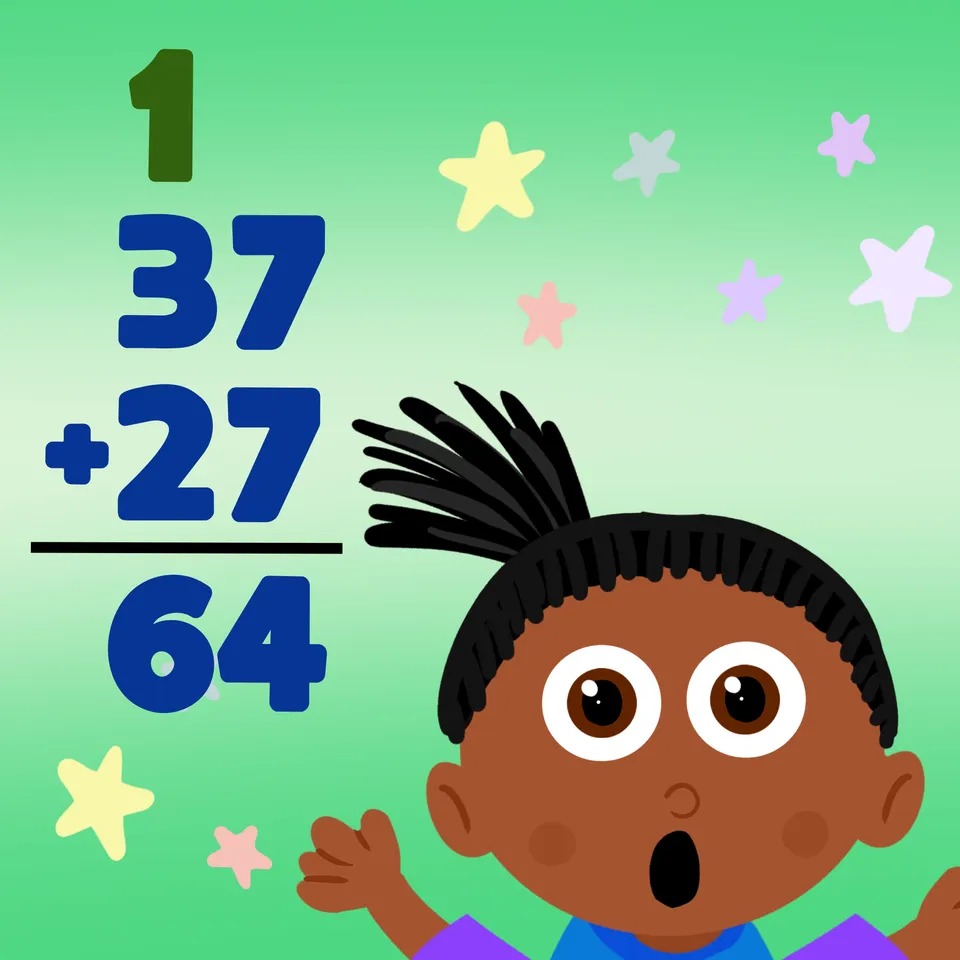
Learn how to carry the 1 in two-digit addition problems
An introduction to the "carry the 1" method. The teacher walks through a handful of examples of adding two-digit numbers that illustrate, motivate and explain the reasoning behind the "carry the 1" method. Students should know how to add two-digit numbers without carrying the one before taking this lesson, although the lesson does do a quick review of this.
Part of
Standards alignment
Common Core State Standards
- 2.NBT.B.5 — Fluently add and subtract within 100 using strategies based on place value, properties of operations, and/or the relationship between addition and subtraction.
- 2.NBT.B.9 — Explain why addition and subtraction strategies work, using place value and the properties of operations.
- 2.OA.A.1 — Use addition and subtraction within 100 to solve one- and two-step word problems involving situations of adding to, taking from, putting together, taking apart, and comparing, with unknowns in all positions, e.g., by using drawings and equations with a symbol for the unknown number to represent the problem.
- 1.NBT.B.2.a — Understand that the two digits of a two-digit number represent amounts of tens and ones. Understand the following as special cases: 10 can be thought of as a bundle of ten ones — called a "ten."
Alabama
- MA19.1.13 — Add within 100, using concrete models or drawings and strategies based on place value.
- MA19.1.13c — Demonstrate that in adding two-digit numbers, tens are added to tens, ones are added to ones, and sometimes it is necessary to compose a ten.
- MA19.2.10 — Fluently add and subtract within 100, using strategies based on place value, properties of operations, and/or the relationship between addition and subtraction.
- MA19.2.14 — Explain why addition and subtraction strategies work, using place value and the properties of operations.
- MA19.2.1 — Use addition and subtraction within 100 to solve one- and two-step word problems by using drawings and equations with a symbol for the unknown number to represent the problem.
Alaska
- 2.NBT.5 — Fluently add and subtract using numbers up to 100. Use: • strategies based on place value • properties of operations • and/or the relationship between addition and subtraction.
- 2.NBT.9 — Explain or illustrate the processes of addition or subtraction and their relationship using place value and the properties of operations.
- 2.OA.2 — Fluently add and subtract using numbers up to 20 using mental strategies. Know from memory all sums of two one-digit numbers.
- 2.OA.1 — Use addition and subtraction strategies to estimate, then solve one- and two-step word problems (using numbers up to 100) involving situations of adding to, taking from, putting together, taking apart and comparing, with unknowns in all positions (e.g., by using objects, drawings and equations). Record and explain using equation symbols and a symbol for the unknown number to represent the problem.
Arizona
- 2.NBT.B.5 — Fluently add and subtract within 100 using strategies based on place value, properties of operations, and/or the relationship between addition and subtraction.
- 2.NBT.B.9 — Explain why addition and subtraction strategies work, using place value and the properties of operations.
- 2.OA.A.1 — Use addition and subtraction within 100 to solve one- and two-step word problems. Represent a word problem as an equation with a symbol for the unknown. See Table 1.
- 2.OA.B.2 — Fluently add and subtract within 20. By end of Grade 2, know from memory all sums of two one-digit numbers.
Arkansas
- 2.CAR.2 — Use computational fluency to add and subtract within 100 using strategies based on place value, properties of operations, or the relationship between addition and subtraction.
- 2.CAR.7 — Solve one and two-step real-world problems involving addition and subtraction within 100 in situations of adding to, taking from, putting together, taking apart, and comparing unknowns in all positions.
- 2.CAR.6 — Use concrete models, drawings, or equations to solve addition and subtraction problems within 1000.
- 2.CAR.1 — Use mental strategies to fluently add and subtract within 20 with mastery by the end of second grade.
California
- 2.NBT.B.5 — Fluently add and subtract within 100 using strategies based on place value, properties of operations, and/or the relationship between addition and subtraction.
- 2.NBT.B.9 — Explain why addition and subtraction strategies work, using place value and the properties of operations.
- 2.OA.A.1 — Use addition and subtraction within 100 to solve one- and two-step word problems involving situations of adding to, taking from, putting together, taking apart, and comparing, with unknowns in all positions, e.g., by using drawings and equations with a symbol for the unknown number to represent the problem.
- 2.OA.B.2 — Fluently add and subtract within 20 using mental strategies. By end of Grade 2, know from memory all sums of two one-digit numbers.
Colorado
- 2.NBT.B.5 — Fluently add and subtract within 100 using strategies based on place value, properties of operations, and/or the relationship between addition and subtraction.
- 2.NBT.B.9 — Explain why addition and subtraction strategies work, using place value and the properties of operations. (Explanations may be supported by drawings or objects.)
- 2.OA.A.1 — Use addition and subtraction within 100 to solve one- and two-step word problems involving situations of adding to, taking from, putting together, taking apart, and comparing, with unknowns in all positions, e.g., by using drawings and equations with a symbol for the unknown number to represent the problem.
- 2.OA.B.2 — Fluently add and subtract within 20 using mental strategies. (See 1.OA.C.6 for a list of strategies.) By end of Grade 2, know from memory all sums of two one-digit numbers.
Connecticut
- 2.NBT.B.5 — Fluently add and subtract within 100 using strategies based on place value, properties of operations, and/or the relationship between addition and subtraction.
- 2.NBT.B.9 — Explain why addition and subtraction strategies work, using place value and the properties of operations.
- 2.OA.A.1 — Use addition and subtraction within 100 to solve one- and two-step word problems involving situations of adding to, taking from, putting together, taking apart, and comparing, with unknowns in all positions, e.g., by using drawings and equations with a symbol for the unknown number to represent the problem.
Delaware
- 2.NBT.B.5 — Fluently add and subtract within 100 using strategies based on place value, properties of operations, and/or the relationship between addition and subtraction.
- 2.NBT.B.9 — Explain why addition and subtraction strategies work, using place value and the properties of operations.
- 2.OA.A.1 — Use addition and subtraction within 100 to solve one- and two-step word problems involving situations of adding to, taking from, putting together, taking apart, and comparing, with unknowns in all positions, e.g., by using drawings and equations with a symbol for the unknown number to represent the problem.
- 2.OA.B.2 — Fluently add and subtract within 20 using mental strategies. By end of Grade 2, know from memory all sums of two one-digit numbers.
Florida
- MA.2.NSO.2.3 — Add two whole numbers with sums up to 100 with procedural reliability. Subtract a whole number from a whole number, each no larger than 100, with procedural reliability.
- MA.2.AR.1.1 — Solve one- and two-step addition and subtraction real-world problems.
- MA.2.NSO.2.1 — Recall addition facts with sums to 20 and related subtraction facts with automaticity.
Georgia
- 2.NR.2.3 — Solve problems involving the addition and subtraction of two-digit numbers using part-whole strategies.
- 2.NR.2.4 — Fluently add and subtract within 100 using strategies based on place value, properties of operations, and/or the relationship between addition and subtraction.
- 1.NR.5 — Use concrete models, the base ten structure, and properties of operations to add and subtract within 100.
- 2.NR.2 — Apply multiple part-whole strategies, properties of operations and place value understanding to solve real-life, mathematical problems involving addition and subtraction within 1,000.
Hawaii
- 2.NBT.B.5 — Fluently add and subtract within 100 using strategies based on place value, properties of operations, and/or the relationship between addition and subtraction.
- 2.NBT.B.9 — Explain why addition and subtraction strategies work, using place value and the properties of operations.
- 2.OA.A.1 — Use addition and subtraction within 100 to solve one- and two-step word problems involving situations of adding to, taking from, putting together, taking apart, and comparing, with unknowns in all positions, e.g., by using drawings and equations with a symbol for the unknown number to represent the problem.
- 2.OA.B.2 — Fluently add and subtract within 20 using mental strategies. By end of Grade 2, know from memory all sums of two one-digit numbers.
Idaho
- 2.NBT.B.5 — Fluently add and subtract whole numbers within 100 using understanding of place value and properties of operations.
- 2.NBT.B.9 — Explain why addition and subtraction strategies work, using place value and the properties of operations.
- 2.OA.A.1 — Use addition and subtraction within 100 to solve one- and two-step word problems involving situations of adding to, taking from, putting together, taking apart, and comparing, with unknowns in all positions, by using physical, visual, and symbolic representations.
- 2.OA.B.2 — Demonstrate fluency for addition and subtraction within 20 using mental strategies. By the end of grade two, recall basic facts to add and subtract within 20 with automaticity.
Illinois
- 2.NBT.B.5 — Fluently add and subtract within 100 using strategies based on place value, properties of operations, and/or the relationship between addition and subtraction.
- 2.NBT.B.9 — Explain why addition and subtraction strategies work, using place value and the properties of operations.
- 2.OA.A.1 — Use addition and subtraction within 100 to solve one- and two-step word problems involving situations of adding to, taking from, putting together, taking apart, and comparing, with unknowns in all positions, e.g., by using drawings and equations with a symbol for the unknown number to represent the problem.
Indiana
- 2.CA.2 — Using number sense and place value strategies, add and subtract within 1,000, including composing and decomposing tens and hundreds. Use models, drawings, and strategies based on place value, properties of operations, and/or the relationship between addition and subtraction; describe the strategy and explain the reasoning used.
- 2.CA.1 — Solve real-world problems involving addition and subtraction within 100 in situations of adding to, taking from, putting together, taking apart, and comparing, with unknowns in all parts of the addition or subtraction problem (e.g., by using drawings and equations with a symbol for the unknown number to represent the problem). Use estimation to decide whether answers are reasonable in addition problems. (E)
- 1.CA.1 — Demonstrate fluency with addition facts and the corresponding subtraction facts within 20. Use strategies such as counting on; making ten (e.g., 8 + 6 = 8 + 2 + 4 = 10 + 4 = 14); decomposing a number leading to a 10 (e.g., 13 – 4 = 13 – 3 – 1 = 10 – 1 = 9); using the relationship between addition and subtraction (e.g., knowing that 8 + 4 = 12, one knows 12 – 8 = 4); and creating equivalent but easier or known sums (e.g., adding 6 + 7 by creating the known equivalent 6 + 6 + 1 = 12 + 1 = 13). Model the role of 0 and the equal sign in addition and subtraction using objects or drawings. (E)
Iowa
- 2.NBT.B.5 — Fluently add and subtract within 100 using strategies based on place value, properties of operations, and/or the relationship between addition and subtraction. Note: Fluency of this standard is critical by the end of grade level.
- 2.NBT.B.9 — Explain why addition and subtraction strategies work, using place value and the properties of operations. Explanations may be supported by drawings or objects.
- 2.OA.A.1 — Use addition and subtraction within 100 to solve one- and twostep word problems involving the problem types listed below, with unknowns in all positions, by using objects, drawings, and equations with a symbol for the unknown number to represent the problem. • Adding to. • Taking from. • Putting together. • Taking apart. • Comparing. (See Problem Types Table 1 in Appendix A)
Kansas
- 2.NBT.5 — Fluently (efficiently, accurately, and flexibly) add and subtract within 100 using strategies based on place value, properties of operations, and/or the relationship between addition and subtraction (e.g. composing/decomposing by like base-10 units, using friendly or benchmark numbers, using related equations, compensation, number line, etc.).
- 2.NBT.9 — Explain why addition and subtraction strategies work using place value and the properties of operations. The explanations given may be supported by drawings or objects.
- 2.OA.1 — Use addition and subtraction within 100 to solve one- and two-step word problems involving situations of adding to, taking from, putting together, taking apart, and comparing, with unknowns in all positions, (e.g. by using drawings and situation equations and/or solution equations with a symbol for the unknown number to represent the problem.)
- 1.NBT.4.c — Understanding that when adding two-digit numbers, combine like base-ten units such as tens and tens, ones and ones; and sometimes it is necessary to compose a ten.
Kentucky
- KY.2.NBT.5 — Fluently add and subtract within 100 using strategies based on place value, properties of operations and/or the relationship between addition and subtraction.
- KY.2.NBT.9 — Explain why addition and subtraction strategies work, using place value and the properties of operations.
- KY.2.OA.1 — Use addition and subtraction within 100 to solve one- and two-step word problems involving situations of adding to, taking from, putting together, taking apart and comparing, with unknowns in all positions, by using drawings and equations with a symbol for the unknown number to represent the problem.
Louisiana
- 2.NBT.B.5 — Fluently add and subtract within 100 using strategies based on place value, properties of operations, and/or the relationship between addition and subtraction.
- 2.NBT.B.9 — Explain why addition and subtraction strategies work, using place value and the properties of operations.
- 2.OA.A.1 — Use addition and subtraction within 100 to solve one- and two-step word problems involving situations of adding to, taking from, putting together, taking apart, and comparing, with unknowns in all positions, e.g., by using drawings and equations with a symbol for the unknown number to represent the problem.
Maine
- 2.NBT.B.5 — Fluently add and subtract within 100 using strategies based on place value, properties of operations, and/or the relationship between addition and subtraction.
- 2.NBT.B.9 — Explain why addition and subtraction strategies work, using place value and the properties of operations. Explanations may be supported by drawings or objects.
- 2.OA.A.1 — Use addition and subtraction within 100 to solve one- and two-step word problems involving situations of adding to, taking from, putting together, taking apart, and comparing, with unknowns in all positions, e.g., by using drawings and equations with a symbol for the unknown number to represent the problem.
- 2.OA.B.2 — Fluently add and subtract within 20 using mental strategies. By end of Grade 2, know from memory all sums of two one-digit numbers.
Maryland
- 2.NBT.B.5 — Fluently add and subtract within 100 using strategies based on place value, properties of operations, and/or the relationship between addition and subtraction.
- 2.NBT.B.9 — Explain why addition and subtraction strategies work, using place value and the properties of operations.
- 2.OA.A.1 — Use addition and subtraction within 100 to solve one- and two-step word problems involving situations of adding to, taking from, putting together, taking apart, and comparing, with unknowns in all positions, e.g., by using drawings and equations with a symbol for the unknown number to represent the problem.
- 1.NBT.C.4 — Add within 100, including adding a two-digit number and a one-digit number, and adding a two-digit number and a multiple of 10, using concrete models or drawings and strategies based on place value, properties of operations, and/or the relationship between addition and subtraction; relate the strategy to a written method and explain the reasoning used. Understand that in adding two-digit numbers, one adds tens and tens, ones and ones; and sometimes it is necessary to compose a ten.
Massachusetts
- 1.NBT.C.4 — Add within 100, including adding a two-digit number and a one-digit number, and adding a two-digit number and a multiple of 10, using concrete models or drawings, and strategies based on place value, properties of operations, and/or the relationship between addition and subtraction; relate the strategy to a written method and explain the reasoning used. Understand that in adding two-digit numbers, one adds tens and tens, ones and ones; and sometimes it is necessary to compose a ten.
- 2.NBT.B.5 — Fluently add and subtract within 100 using strategies based on place value, properties of operations, and/or the relationship between addition and subtraction.
- 2.NBT.B.6 — Add up to four two-digit numbers using strategies based on place value and properties of operations.
- 2.NBT.B.9 — Explain why addition and subtraction strategies work, using place value and the properties of operations.
- 2.OA.A.1 — Use addition and subtraction within 100 to solve one- and two-step word problems involving situations of adding to, taking from, putting together, taking apart, and comparing, with unknowns in all positions, e.g., by using drawings and equations with a symbol for the unknown number to represent the problem.
- 2.OA.B.2 — Fluently add and subtract within 20 using mental strategies. By end of grade 2, know from memory all sums of two single-digit numbers and related differences. For example, the sum 6 + 5 = 11 has related differences of 11 – 5 = 6 and 11 – 6 = 5.
Michigan
- 2.NBT.B.5 — Fluently add and subtract within 100 using strategies based on place value, properties of operations, and/or the relationship between addition and subtraction.
- 2.NBT.B.9 — Explain why addition and subtraction strategies work, using place value and the properties of operations.
- 2.OA.A.1 — Use addition and subtraction within 100 to solve one- and two-step word problems involving situations of adding to, taking from, putting together, taking apart, and comparing, with unknowns in all positions, e.g., by using drawings and equations with a symbol for the unknown number to represent the problem.
- 2.OA.B.2 — Fluently add and subtract within 20 using mental strategies. By end of Grade 2, know from memory all sums of two one-digit numbers.
Minnesota
- 2.1.2.4 — Use mental strategies and algorithms based on knowledge of place value and equality to add and subtract two-digit numbers. Strategies may include decomposition, expanded notation, and partial sums and differences. For example: Using decomposition, 78 + 42, can be thought of as: 78 + 2 + 20 + 20 = 80 + 20 + 20 = 100 + 20 = 120 and using expanded notation, 34 - 21 can be thought of as: 30 + 4 – 20 – 1 = 30 – 20 + 4 – 1 = 10 + 3 = 13.
- 2.1.2.5 — Solve real-world and mathematical addition and subtraction problems involving whole numbers with up to 2 digits.
- 2.1.1.2 — Use place value to describe whole numbers between 10 and 1000 in terms of hundreds, tens and ones. Know that 100 is 10 tens, and 1000 is 10 hundreds. For example: Writing 853 is a shorter way of writing 8 hundreds + 5 tens + 3 ones.
Mississippi
- 2.NBT.5 — Fluently add and subtract within 100 using strategies based on place value, properties of operations, and/or the relationship between addition and subtraction.
- 2.NBT.9 — Explain why addition and subtraction strategies work, using place value and the properties of operations.
- 2.OA.1 — Use addition and subtraction within 100 to solve one- and two-step word problems involving situations of adding to, taking from, putting together, taking apart, and comparing, with unknowns in all positions, e.g., by using drawings and equations with a symbol for the unknown number to represent the problem.
- 2.OA.2 — Fluently add and subtract within 20 using mental strategies. By end of Grade 2, know from memory all sums of two one-digit numbers.
Missouri
- 2.NBT.B.6 — Demonstrate fluency with addition and subtraction within 100.
- 1.NBT.A.1 — Understand that 10 can be thought of as a bundle of 10 ones – called a “ten”.
- 1.NBT.B.5 — Add within 100.
- 2.NBT.C.11 — Write and solve problems involving addition and subtraction within 100.
- 1.RA.A.2 — Solve problems that call for addition of three whole numbers whose sum is within 20.
Montana
- 2.NBT.B.5 — Fluently add and subtract within 100 using strategies based on place value, properties of operations, and/or the relationship between addition and subtraction.
- 2.NBT.B.9 — Explain why addition and subtraction strategies work, using place value and the properties of operations.
- 2.OA.A.1 — Use addition and subtraction within 100 to solve one- and two-step word problems involving situations within a cultural context, including those of Montana American Indians, of adding to, taking from, putting together, taking apart, and comparing, with unknowns in all positions, e.g., by using drawings and equations with a symbol for the unknown number to represent the problem.
Nebraska
- 2.N.4.b — Add and subtract within 100 strategies based on place value including properties of operations, relationships between addition and subtraction, and algorithms.
- 1.N.4.f — Understand that in adding two-digit numbers, one adds tens and tens, ones and ones; sometimes it is necessary to compose a ten.
- 2.N.4.a — Fluently add and subtract within 20.
- 2.N.4.d — Add up to three two-digit numbers using strategies based on place value and understanding of properties.
- 2.N.5.a — Solve authentic problems involving addition and subtraction within 100 in situations of addition and subtraction, including adding to, subtracting from, joining and separating, and comparing situations with unknowns in all positions using objects, models, drawings, verbal explanations, expressions, and equations.
Nevada
- 2.NBT.B.5 — Fluently add and subtract within 100 using strategies based on place value, properties of operations, and/or the relationship between addition and subtraction.
- 2.NBT.B.9 — Explain why addition and subtraction strategies work, using place value and the properties of operations.
- 2.OA.A.1 — Use addition and subtraction within 100 to solve one- and two-step word problems involving situations of adding to, taking from, putting together, taking apart, and comparing, with unknowns in all positions, e.g., by using drawings and equations with a symbol for the unknown number to represent the problem.
- 2.OA.B.2 — Fluently add and subtract within 20 using mental strategies. By end of Grade 2, know from memory all sums of two one-digit numbers.
New Hampshire
- 2.NBT.B.5 — Fluently add and subtract within 100 using strategies based on place value, properties of operations, and/or the relationship between addition and subtraction.
- 2.NBT.B.9 — Explain why addition and subtraction strategies work, using place value and the properties of operations.
- 2.OA.A.1 — Use addition and subtraction within 100 to solve one- and two-step word problems involving situations of adding to, taking from, putting together, taking apart, and comparing, with unknowns in all positions, e.g., by using drawings and equations with a symbol for the unknown number to represent the problem.
- 2.OA.B.2 — Fluently add and subtract within 20 using mental strategies. By end of Grade 2, know from memory all sums of two one-digit numbers.
New Jersey
- 2.NBT.B.5 — Fluently add and subtract within 100 using strategies based on place value, properties of operations, and/or the relationship between addition and subtraction.
- 2.NBT.B.9 — Explain why addition and subtraction strategies work, using place value and the properties of operations.
- 1.NBT.C.4 — Add within 100, including adding a two-digit number and a one-digit number, and adding a two-digit number and a multiple of 10, using concrete models (e.g., base ten blocks) or drawings and strategies based on place value, properties of operations, and/or the relationship between addition and subtraction; relate the strategy to a written method and explain the reasoning used. Understand that in adding two-digit numbers, one adds tens and tens, ones and ones; and sometimes it is necessary to compose a ten.
- 2.OA.A.1 — Use addition and subtraction within 100 to solve one- and two-step word problems involving situations of adding to, taking from, putting together, taking apart, and comparing, with unknowns in all positions, e.g., by using drawings and equations with a symbol for the unknown number to represent the problem.
New Mexico
- 2.NBT.B.5 — Fluently add and subtract within 100 using strategies based on place value, properties of operations, and/or the relationship between addition and subtraction.
- 2.NBT.B.9 — Explain why addition and subtraction strategies work, using place value and the properties of operations.
- 2.OA.A.1 — Use addition and subtraction within 100 to solve one- and two-step word problems involving situations of adding to, taking from, putting together, taking apart, and comparing, with unknowns in all positions, e.g., by using drawings and equations with a symbol for the unknown number to represent the problem.
- 2.OA.B.2 — Fluently add and subtract within 20 using mental strategies. By end of Grade 2, know from memory all sums of two one-digit numbers.
New York
- NY-2.NBT.5 — Fluently add and subtract within 100 using strategies based on place value, properties of operations, and/or the relationship between addition and subtraction.
- NY-2.NBT.7.b — Understand that in adding or subtracting up to three-digit numbers, one adds or subtracts hundreds and hundreds, tens and tens, ones and ones, and sometimes it is necessary to compose or decompose tens or hundreds.
- NY-2.NBT.9 — Explain why addition and subtraction strategies work, using place value and the properties of operations.
- NY-2.OA.1.a — Use addition and subtraction within 100 to solve one-step word problems involving situations of adding to, taking from, putting together, taking apart, and comparing, with unknowns in all positions.
North Carolina
- NC.2.NBT.7 — Add and subtract, within 1,000, relating the strategy to a written method, using: • Concrete models or drawings • Strategies based on place value • Properties of operations • Relationship between addition and subtraction
- NC.1.NBT.2 — Understand that the two digits of a two-digit number represent amounts of tens and ones. • Unitize by making a ten from a collection of ten ones. • Model the numbers from 11 to 19 as composed of a ten and one, two, three, four, five, six, seven, eight, or nine ones. • Demonstrate that the numbers 10, 20, 30, 40, 50, 60, 70, 80, 90 refer to one, two, three, four, five, six, seven, eight, or nine tens, with 0 ones.
- NC.2.NBT.5 — Demonstrate fluency with addition and subtraction, within 100, by: • Flexibly using strategies based on place value, properties of operations, and/or the relationship between addition and subtraction. • Comparing addition and subtraction strategies, and explaining why they work. • Selecting an appropriate strategy in order to efficiently compute sums and differences.
- NC.2.OA.2 — Demonstrate fluency with addition and subtraction, within 20, using mental strategies.
North Dakota
- 2.NO.NBT.3 — Add within 100 using place value strategies and/or the relationship between addition and subtraction.
- 2.AR.OA.3 — Solve one- and two-step authentic word problems with addition within 100, including use of unknowns.
- 2.AR.OA.1 — Automatically add and subtract within 20.
Ohio
- 2.NBT.5 — Fluently add and subtract within 100 using strategies based on place value, properties of operations, and/or the relationship between addition and subtraction.
- 2.NBT.9 — Explain why addition and subtraction strategies work, using place value and the properties of operations. Explanations may be supported by drawings or objects.
- 1.NBT.4 — Add within 100, including adding a two-digit number and a one-digit number and adding a two-digit number and a multiple of 10, using concrete models or drawings and strategies based on place value, properties of operations, and/or the relationship between addition and subtraction; record the strategy with a written numerical method (drawings and, when appropriate, equations) and explain the reasoning used. Understand that when adding two-digit numbers, tens are added to tens; ones are added to ones; and sometimes it is necessary to compose a ten.
- 2.OA.1 — Use addition and subtraction within 100 to solve one- and two- step word problems involving situations of adding to, taking from, putting together, taking apart, and comparing, with unknowns in all positions, e.g., by using drawings and equations with a symbol for the unknown number to represent the problem.
Oklahoma
- 2.N.2.4 — Use strategies and algorithms based on knowledge of place value and equality to add and subtract two-digit numbers.
- 2.N.2.5 — Solve addition and subtraction problems involving whole numbers up to two digits.
- 2.N.2 — Add and subtract one- and two- digit numbers in real-world and mathematical problems.
- 2.N.2.2 — Demonstrate fluency with basic facts of addition and subtraction with sums and minuends of up to 20.
Oregon
- 1.NBT.C.4 — Add within 100 using concrete or visual representations and strategies based on place value, properties of operations, and/or the relationship between addition and subtraction. Relate the strategy to a written method and explain why sometimes it is necessary to compose a ten.
- 2.NBT.B.5 — Fluently add & subtract within 100 using accurate, efficient, & flexible strategies based on place value, properties of operations, and/or the relationship between addition and subtraction.
- 2.NBT.B.9 — Explain why strategies to add and subtract work using properties of operations and the relationship between addition and subtraction.
- 2.OA.A.1 — Use addition and subtraction within 100 to solve one- and two-step problems in authentic contexts by using drawings and equations with a symbol for the unknown.
Pennsylvania
- CC.2.1.2.B.3 — Use place-value understanding and properties of operations to add and subtract within 1000.
- CC.2.2.2.A.1 — Represent and solve problems involving addition and subtraction within 100.
- CC.2.2.2.A.2 — Use mental strategies to add and subtract within 20.
Rhode Island
- 2.NBT.B.5 — Fluently add and subtract within 100 using strategies based on place value, properties of operations, and/or the relationship between addition and subtraction.
- 2.NBT.B.9 — Explain why addition and subtraction strategies work, using place value and the properties of operations.
- 2.OA.A.1 — Use addition and subtraction within 100 to solve one- and two-step word problems involving situations of adding to, taking from, putting together, taking apart, and comparing, with unknowns in all positions, e.g., by using drawings and equations with a symbol for the unknown number to represent the problem.
South Carolina
- 2.NSBT.5 — Add and subtract fluently through 99 using knowledge of place value and properties of operations.
- 2.ATO.1 — Solve one- and two-step real-world/story problems using addition (as a joining action and as a part-part-whole action) and subtraction (as a separation action, finding parts of the whole, and as a comparison) through 99 with unknowns in all positions.
- 2.NSBT.7 — Add and subtract through 999 using concrete models, drawings, and symbols which convey strategies connected to place value understanding.
- 2.PS.2d — Connect the meaning of mathematical operations to the context of a given situation.
South Dakota
- 1.NBT.C.4.b — Understand that in adding two-digit numbers (sums within 100) add tens and tens, ones and ones; and sometimes it is necessary to compose a ten.
- 2.NBT.B.5 — Fluently add and subtract within 100 using strategies based on place value, properties of operations, and/or the relationship between addition and subtraction.
- 2.NBT.B.9 — Explain why addition and subtraction strategies work, using place value and the properties of operations. (Explanations may be supported by words, drawings or objects.)
- 2.OA.A.1 — Use addition and subtraction within 100 to solve one- and two-step word problems involving situations of adding to, taking from, putting together, taking apart, and comparing, with unknowns in all positions, e.g., by using drawings and equations with a symbol for the unknown number to represent the problem.
Tennessee
- 2.NBT.B.5 — Fluently add and subtract within 100 using properties of operations, strategies based on place value, and/or the relationship between addition and subtraction.
- 2.NBT.B.6 — Add up to four two-digit numbers using properties of operations and strategies based on place value.
- 2.NBT.C.7 — Add and subtract within 1000 using concrete models, drawings, strategies based on place value, properties of operations, and/or the relationship between addition and subtraction to explain the reasoning used. (Explanations may include words, drawing, or objects.)
- 2.OA.A.1 — Add and subtract within 100 to solve one- and two-step contextual problems, with unknowns in all positions, involving situations of add to, take from, put together/take apart, and compare. Use objects, drawings, and equations with a symbol for the unknown number to represent the problem.
Texas
- 2.4B — add up to four two-digit numbers and subtract two-digit numbers using mental strategies and algorithms based on knowledge of place value and properties of operations;
- 2.4A — recall basic facts to add and subtract within 20 with automaticity;
- 2.4C — solve one-step and multi-step word problems involving addition and subtraction within 1,000 using a variety of strategies based on place value, including algorithms; and
- 2.2A — use concrete and pictorial models to compose and decompose numbers up to 1,200 in more than one way as a sum of so many thousands, hundreds, tens, and ones;
Utah
- 2.NBT.5 — Fluently add and subtract within 100 using strategies based on place value, properties of operations, and/or the relationship between addition and subtraction.
- 2.NBT.9 — Explain why addition and subtraction strategies work, using place value and the properties of operations. Explanations may be supported by drawings or objects
- 1.NBT.4 — Add within 100, including adding a two-digit number and a one-digit number, and adding a two-digit number and a multiple of 10, using concrete models or drawings and strategies based on place value, properties of operations, and/or the relationship between addition and subtraction; relate the strategy to a written method and explain the reasoning used. Understand that in adding two-digit numbers, one adds tens to tens and ones to ones, and that it is sometimes necessary to compose a ten.
- 2.OA.1 — Use addition and subtraction within 100 to solve one- and two-step word problems involving situations of adding to, taking from, putting together, taking apart, and comparing with unknowns in all positions, for example, by using drawings and equations with a symbol for the unknown number to represent the problem.
Vermont
- 2.NBT.B.5 — Fluently add and subtract within 100 using strategies based on place value, properties of operations, and/or the relationship between addition and subtraction.
- 2.NBT.B.9 — Explain why addition and subtraction strategies work, using place value and the properties of operations.
- 2.OA.A.1 — Use addition and subtraction within 100 to solve one- and two-step word problems involving situations of adding to, taking from, putting together, taking apart, and comparing, with unknowns in all positions, e.g., by using drawings and equations with a symbol for the unknown number to represent the problem.
Virginia
- 2.CE.1b — Apply strategies (e.g., the use of concrete and pictorial models, place value, properties of addition, the relationship between addition and subtraction) to determine the sum or difference of two whole numbers where addends or minuends do not exceed 100.
- 2.CE.1c — Represent, solve, and justify solutions to single-step and multistep contextual problems (e.g., join, separate, part-part-whole, comparison) involving addition or subtraction of whole numbers where addends or minuends do not exceed 100.
- 2.NS.2d — Investigate and explain the ten-to-one relationships among ones, tens, and hundreds, using models.
Washington
- 2.NBT.B.5 — Fluently add and subtract within 100 using strategies based on place value, properties of operations, and/or the relationship between addition and subtraction.
- 2.NBT.B.9 — Explain why addition and subtraction strategies work, using place value and the properties of operations.
- 2.OA.A.1 — Use addition and subtraction within 100 to solve one- and two-step word problems involving situations of adding to, taking from, putting together, taking apart, and comparing, with unknowns in all positions, e.g., by using drawings and equations with a symbol for the unknown number to represent the problem.
- 2.OA.B.2 — Fluently add and subtract within 20 using mental strategies. By end of Grade 2, know from memory all sums of two one-digit numbers.
Washington, D.C.
- 2.NBT.B.5 — Fluently add and subtract within 100 using strategies based on place value, properties of operations, and/or the relationship between addition and subtraction.
- 2.NBT.B.9 — Explain why addition and subtraction strategies work, using place value and the properties of operations.
- 2.OA.A.1 — Use addition and subtraction within 100 to solve one- and two-step word problems involving situations of adding to, taking from, putting together, taking apart, and comparing, with unknowns in all positions, e.g., by using drawings and equations with a symbol for the unknown number to represent the problem.
West Virginia
- M.2.10 — Fluently add and subtract within 100 using strategies based on place value, properties of operations and/or the relationship between addition and subtraction.
- M.2.14 — Explain why addition and subtraction strategies work, using place value and the properties of operations. Instructional Note: Explanations may be supported by drawing or objects.
- M.2.1 — Use addition and subtraction within 100 to solve one- and two-step word problems involving situations of adding to, taking from, putting together, taking apart, and comparing, with unknowns in all positions (e.g., by using drawings and equations with a symbol for the unknown number to represent the problem).
- M.1.10 — Understand the two digits of a two-digit number represent amounts of tens and ones. Understand the following as special cases: a. 10 can be thought of as a bundle of ten ones - called a "ten." (e.g., A group of ten pennies is equivalent to a dime.) b. The numbers from 11 to 19 are composed of a ten and one, two, three, four, five, six, seven, eight or nine ones. c. The numbers 10, 20, 30, 40, SO, 60, 70, 80, 90 refer to one, two, three, four, five, six, seven, eight or nine tens (and 0 ones).
Wisconsin
- M.2.NBT.B.5 — Flexibly and efficiently add and subtract within 100 using strategies based on place value, properties of operations, and/or the relationship between addition and subtraction. In Grade 2, subtraction with decomposition is an exception and may include drawings or representations.
- M.2.NBT.B.9 — Explain why addition and subtraction strategies work, using place value and the properties of operations. These explanations may be supported by drawings or objects.
- M.1.NBT.C.4 — Add within 100, including adding a two-digit number and a one-digit number, and adding a two-digit number and a multiple of 10, using concrete models or drawings and strategies based on place value, properties of operations, and/or the relationship between addition and subtraction; relate the strategy to a written method and explain the reasoning used. Understand that in adding two-digit numbers, one adds tens and tens, ones and ones; and sometimes it is necessary to compose a ten.
- M.2.OA.A.1 — Use addition and subtraction within 100 to solve one- and two-step word problems involving situations of adding to, taking from, putting together, taking apart, and comparing, with unknowns in all positions, e.g., by using drawings and equations with a symbol for the unknown number to represent the problem.
- M.2.NBT.B.6 — Add up to four two-digit numbers using strategies based on place value and properties of operations.
Wyoming
- 2.NBT.E.5 — Add and subtract within 100 using strategies based on place value, properties of addition, and/or the relationship between addition and subtraction.
- 2.NBT.E.9 — Explain why addition and subtraction strategies work, using place value and the properties of addition. (Explanations may be supported by drawings, objects, or written form.)
- 2.OA.A.1 — Use addition and subtraction within 100 to solve one- and two-step word problems involving situations of adding to, taking from, putting together, taking apart, and comparing, with unknowns in all positions, by using drawings and equations with a symbol for the unknown number to represent the problem.
- 2.OA.B.2 — Fluently add and subtract within 20 using mental strategies. By end of Grade 2, know automatically all sums of two one-digit numbers based on strategies.