Winnie-the-Pooh Gets Stuck
Ages 4–8 · 9 minutes · English, Stories
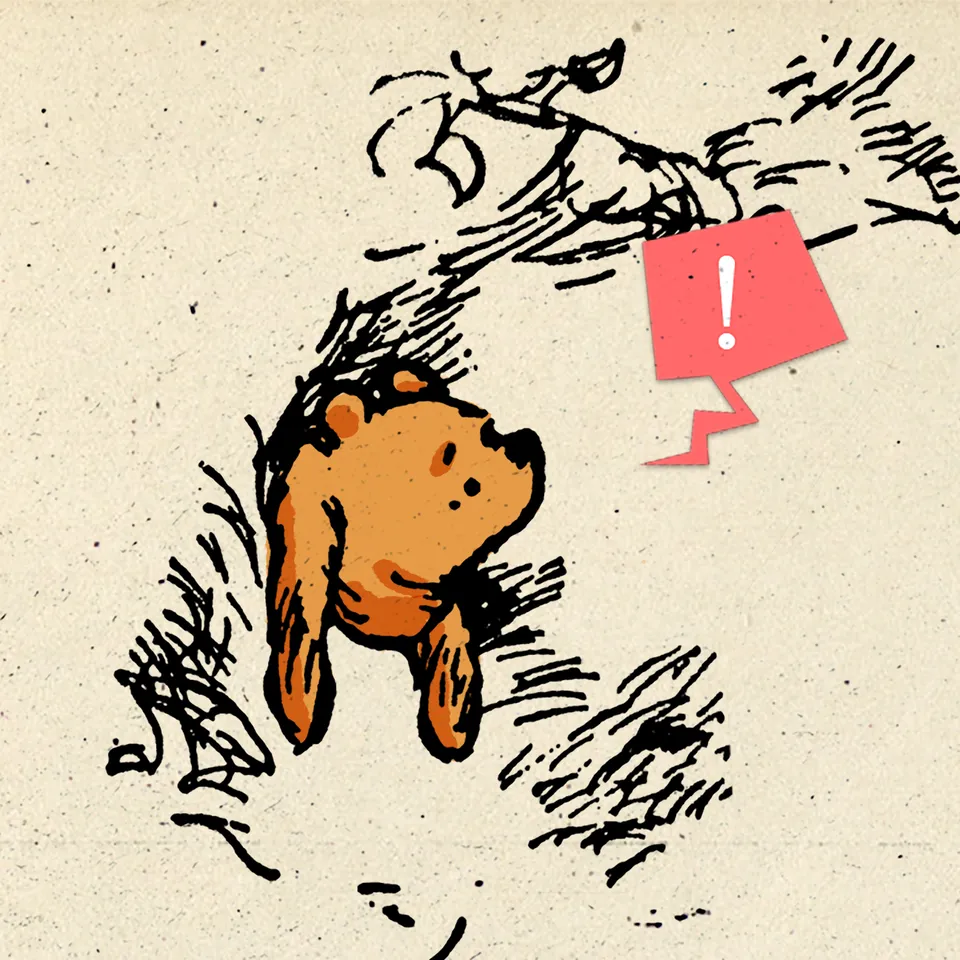
Winnie-the-Pooh is stuck in a hole. Can you help get him out?
When Winnie-the-Pooh goes to visit a friend for a snack, he has a hard time getting back through the door. Help Pooh and his friends come up with a plan to get him unstuck! This adaptation of A.A. Milne's classic Winnie-the-Pooh tale uses the original text and images from the 1926 story collection.
Part of
Standards alignment
Common Core State Standards
- RL.K.1 — With prompting and support, ask and answer questions about key details in a text.
- SL.K.2 — Confirm understanding of a text read aloud or information presented orally or through other media by asking and answering questions about key details and requesting clarification if something is not understood.
- RL.1.1 — Ask and answer questions about key details in a text.
- SL.K.1 — Participate in collaborative conversations with diverse partners about kindergarten topics and texts with peers and adults in small and larger groups.
- Pushes and pulls can have different strengths and directions.
Alabama
- ELA21.2.30a — State and confirm predictions about a text.
- ELA21.2.35 — Demonstrate listening skills and build background knowledge by asking and answering questions about texts read aloud.
- ELA21.2.30c — Draw conclusions based on the text.
- ELA21.K.3 — Actively participate in teacher-led choral and shared reading experiences.
Alaska
- RL.K.1 — With prompting and support, ask and answer questions about a literary text using key details from the text.
- Pushes and pulls can have different strengths and directions.
- RL.K.3 — With prompting and support, identify characters, settings, major events, and problem-solution in a story, song, or poem.
- SL.K.2 — Confirm understanding of a text read aloud or information presented orally or through other media by asking and answering questions about key details and requesting clarification if something is not understood.
Arizona
- K.RL.1 — With prompting and support, ask and answer questions about key details in a text.
- K.RL.10 — With prompting and support, actively engage in group reading activities with purpose and understanding.
- K.SL.1 — Participate in collaborative conversations with diverse partners about kindergarten topics and texts with peers and adults in small and larger groups.
- K.SL.2 — Confirm understanding of a text read aloud or information presented orally or through other media by asking and answering questions about key details and requesting clarification if something is not understood.
- 1.P3U1.3 — Plan and carry out investigations which demonstrate how equal forces can balance objects and how unequal forces can push, pull, or twist objects, making them change their speed, direction, or shape.
- K.SL.1.b — Continue a conversation through multiple exchanges.
Arkansas
- K.RC.2.RF — Answer questions about key details in a text.
- K.RC.6.RF — Use background knowledge and details, including illustrations, charts, and graphs, to make predictions and inferences about what happens in a text.
- K.RC.7.RF — Demonstrate comprehension of age and grade-appropriate texts by speaking or writing.
- Pushes and pulls can have different strengths and directions.
California
- RL.K.1 — With prompting and support, ask and answer questions about key details in a text.
- RL.1.1 — Ask and answer questions about key details in a text.
- SL.K.1.b — Continue a conversation through multiple exchanges.
- SL.K.2 — Confirm understanding of a text read aloud or information presented orally or through other media by asking and answering questions about key details and requesting clarification if something is not understood.
- Pushes and pulls can have different strengths and directions.
Colorado
- RWC20-GR.K-S.1-GLE.1-EO.b — Confirm understanding of a text read aloud or information presented orally or through other media by asking and answering questions about key details and requesting clarification if something is not understood.
- RWC20-GR.K-S.2-GLE.1-EO.a.i — With prompting and support, ask and answer questions about key details in a text.
- RWC20-GR.K-S.1-GLE.1-EO.a — Participate in collaborative conversations with diverse partners about kindergarten topics and texts with peers and adults in small and larger groups.
- SC.K.1.1 — Pushes and pulls can have different strengths and directions, and can change the speed or direction of an object’s motion or start or stop it.
Connecticut
- RL.K.1 — With prompting and support, ask and answer questions about key details in a text.
- SL.K.2 — Confirm understanding of a text read aloud or information presented orally or through other media by asking and answering questions about key details and requesting clarification if something is not understood.
- Pushes and pulls can have different strengths and directions.
- SL.K.1 — Participate in collaborative conversations with diverse partners about kindergarten topics and texts with peers and adults in small and larger groups.
Delaware
- RL.K.1 — With prompting and support, ask and answer questions about key details in a text.
- SL.K.2 — Confirm understanding of a text read aloud or information presented orally or through other media by asking and answering questions about key details and requesting clarification if something is not understood.
- Pushes and pulls can have different strengths and directions.
- SL.K.1.b — Continue a conversation through multiple exchanges.
- RL.K.2 — With prompting and support, retell familiar stories, including key details.
Florida
- ELA.K.R.1.1 — Describe the main character(s), setting, and important events in a story.
- SC.K.P.13.1 — Observe that a push or a pull can change the way an object is moving.
Georgia
- ELAGSEKRL1 — With prompting and support, ask and answer questions about key details in a text.
- ELAGSEKSL2 — Confirm understanding of written texts read aloud or information presented orally or through media by asking and answering questions about key details and requesting clarification if something is not understood.
- ELAGSEKSL1 — Participate in collaborative conversations with diverse partners about kindergarten topics and texts with peers and adults in small and larger groups.
- ELAGSEKSL1.b — Continue a conversation through multiple exchanges.
- ELAGSEKSL6 — Speak audibly and express thoughts, feelings, and ideas clearly.
Hawaii
- K.RL.1 — With prompting and support, ask and answer questions about key details in a text.
- K.SL.2 — Confirm understanding of a text read aloud or information presented orally or through other media by asking and answering questions about key details and requesting clarification if something is not understood.
- Pushes and pulls can have different strengths and directions.
- K.SL.1b — Continue a conversation through multiple exchanges.
Idaho
- K.ODC.OC.2 — With support, confirm understanding of a text read aloud or information presented orally by asking and answering questions.
- K.RC.TE.3 — Ask and answer questions about key details in texts heard.
- Pushes and pulls can have different strengths and directions. (K-PS-1.1, K-PS-1.2)
- K.RC.L.5 — With support, use evidence from literature read aloud to demonstrate understanding of grade-level texts.
Illinois
- RL.K.1 — With prompting and support, ask and answer questions about key details in a text.
- PS2.A-P2 — Pushing or pulling on an object can change the speed or direction of its motion and can start or stop it.
- SL.K.1 — Participate in collaborative conversations with diverse partners about kindergarten topics and texts with peers and adults in small and larger groups.
- PS2.A-P1 — Pushes and pulls can have different strengths and directions.
Indiana
- K.CC.3 — Ask and answer questions about key details in a text read aloud or information presented orally or through other media. (E)
- K.RC.1 — With support, ask and answer questions about main topics and key details in a text heard or read. (E)
- K.CC.5 — Follow simple two or three-step oral directions.
- K.RC.3 — Identify important elements within a text (e.g., characters, settings, or events). (E)
- K.RC.4 — With support, make predictions about what will happen in a text.
Iowa
- RL.K.1 — With prompting and support, ask and answer questions about key details in a text.
- SL.K.2 — Confirm understanding of a text read aloud or information presented orally or through other media by asking and answering questions about key details and requesting clarification if something is not understood.
- RL.1.1 — Ask and answer questions about key details in a text.
- SL.K.1 — Participate in collaborative conversations with diverse partners about kindergarten topics and texts with peers and adults in small and larger groups.
- SL.K.1.b — Continue a conversation through multiple exchanges.
- Pushing or pulling on an object can change the speed or direction of its motion and can start or stop it.
Kansas
- RL.K.1 — With prompting and support, ask and answer questions about key details in a text.
- SL.K.2 — Confirm understanding of a text read aloud or information presented orally or through other media by asking and answering questions about key details and requesting clarification if something is not understood.
- Pushes and pulls can have different strengths and directions.
- RL.K.13 — Listen to high quality prose and poetry of appropriate complexity for Kindergarten.
- RL.K.3 — With prompting and support, identify characters, settings, and major events in a story.
Kentucky
- RL.K.1 — With prompting and support, ask and answer explicit questions about key ideas and details, and make logical inferences to construct meaning from the text.
- Pushes and pulls can have different strengths and directions.
- RL.K.10 — With prompting and support, flexibly use a variety of comprehension strategies (i.e., questioning, monitoring, visualizing, inferencing, summarizing, using prior knowledge, determining importance) to make sense of grade-level appropriate, complex literary texts.
- RL.K.3 — With prompting and support, identify characters, settings and major events in a story in order to make meaning of the story development.
Louisiana
- RL.K.1 — With prompting and support, ask and answer questions about key details in a text.
- SL.K.2 — Confirm understanding of a text read aloud or information presented orally or through other media by asking and answering questions about key details and requesting clarification if something is not understood.
- RL.K.7 — With prompting and support, make connections between the illustrations in the story and the text.
- SL.K.1.b — Continue a conversation through multiple exchanges.
- K-PS2-1 — Plan and conduct an investigation to compare the effects of different strengths or different directions of pushes and pulls on the motion of an object.
Maine
- SL.2.1.a — Ask and answer questions about key details in a text read aloud or information presented orally or through other media.
- SL.2.K.a — Confirm understanding of a text read aloud or information presented orally or through other media by asking and answering questions about key details to seek help if something is not understood.
- R.4.K.a — Ask and answer questions with prompting and support about who, what, when, where, and how.
- R.6.K.a — With prompting and support, identify characters, settings, and major events in a story.
- R.6.2.a — Describe how characters in a story respond to major events and challenges.
Maryland
- RL.K.1 — With prompting and support, ask and answer questions about key details in a text.
- SL.K.2 — Confirm understanding of a text read aloud or information presented orally or through other media by asking and answering questions about key details and requesting clarification if something is not understood.
- SL.K.1 — Participate in collaborative conversations with diverse partners about kindergarten topics and texts with peers and adults in small and larger groups.
- DCI.PS2.A.K-2.2 — Pushing or pulling on an object can change the speed or direction of its motion and can start or stop it.
Massachusetts
- RL.K.1 — With prompting and support, ask and answer questions about key details in a text.
- RL.PK.1 — With prompting and support, ask and answer questions about a story or poem read aloud.
- K-PS2-1 — Compare the effects of different strengths or different directions of pushes and pulls on the motion of an object.
- RL.PK.3 — With prompting and support, act out characters and events from a story or poem read aloud.
- RL.PK.7 — With prompting and support, make predictions about what happens next in a picture book after examining and discussing the illustrations.
Michigan
- RL.K.1 — With prompting and support, ask and answer questions about key details in a text.
- SL.K.2 — Confirm understanding of a text read aloud or information presented orally or through other media by asking and answering questions about key details and requesting clarification if something is not understood.
- RL.K.7 — With prompting and support, describe the relationship between illustrations and the story in which they appear (e.g., what moment in a story an illustration depicts).
- SL.K.1.b — Continue a conversation through multiple exchanges.
- K-PS2-1 — Plan and conduct an investigation to compare the effects of different strengths or different directions of pushes and pulls on the motion of an object.
Minnesota
- 0.1.4.1 — Ask and answer questions about key details in a text, with prompting and support.
- 0.2.5.2 — Verbally or visually respond to a story, with support and guidance.
- 0.3.1.2 — Confirm understanding of a text read aloud or information presented orally or through other media (e.g., poems, rhymes, songs) by asking and answering questions about key details and requesting clarification if something is not understood.
- 0.1.4.3 — Identify characters and setting, in a literary text, with prompting and support.
Mississippi
- RL.K.1 — With prompting and support, ask and answer questions about key details in a text.
- SL.K.2 — Confirm understanding of a text read aloud or information presented orally or through other media by asking and answering questions about key details and requesting clarification if something is not understood.
- RL.1.1 — Ask and answer questions about key details in a text.
- SL.K.1 — Participate in collaborative conversations with diverse partners about kindergarten topics and texts with peers and adults in small and larger groups.
- RL.K.7 — With prompting and support, describe the relationship between illustrations and the story in which they appear (e.g., what moment in a story an illustration depicts).
Missouri
- K.R.1.A.b — asking and responding to questions about texts read aloud
- Pushes and pulls can have different strengths and directions.
- 1.R.1.A.b — asking and responding to relevant questions
- 1.R.2.A.e — explain the actions of the main character and the reasons for those actions
Montana
- RL.K.1 — With prompting and support, ask and answer questions about key details in a text.
- SL.K.2 — Confirm understanding of a text read aloud or information presented orally or through other media by asking and answering questions about key details and requesting clarification if something is not understood.
- RL.1.1 — Ask and answer questions about key details in a text.
- SL.K.1.b — Continue a conversation through multiple exchanges.
Nebraska
- LA.K.RP.6 — With prompting and support, ask and answer questions about key details in a literary text.
- LA.K.RP.8 — Actively engage in group reading activities with purpose and understanding.
- Pushes and pulls can have different strengths and directions.
- LA.K.SL.1 — With prompting and support, participate with peers and adults in structured discussions and routines about Kindergarten topics and texts.
- LA.K.SL.1.e — Complete a task following one/two-step directions.
- SC.K.1.1.A — Plan and conduct an investigation to compare the effects of different strengths or different directions of pushes and pulls on the motion of an object.
Nevada
- RL.K.1 — With prompting and support, ask and answer questions about key details in a text.
- SL.K.2 — Confirm understanding of a text read aloud or information presented orally or through other media by asking and answering questions about key details and requesting clarification if something is not understood.
- Pushes and pulls can have different strengths and directions.
- SL.K.1 — Participate in collaborative conversations with diverse partners about kindergarten topics and texts with peers and adults in small and larger groups.
New Hampshire
- RL.K.1 — With prompting and support, ask and answer questions about key details in a text.
- SL.K.2 — Confirm understanding of a text read aloud or information presented orally or through other media by asking and answering questions about key details and requesting clarification if something is not understood.
- SL.K.1.b — Continue a conversation through multiple exchanges.
- Pushes and pulls can have different strengths and directions.
- RL.K.7 — With prompting and support, describe the relationship between illustrations and the story in which they appear (e.g., what moment in a story an illustration depicts).
New Jersey
- RL.K.1 — With prompting and support, ask and answer questions about key details in a text (e.g., who, what, where, when, why, how).
- SL.K.2 — Confirm understanding of a text read aloud or information presented orally or through other media by asking and answering questions about key details and requesting clarification if something is not understood.
- Pushes and pulls can have different strengths and directions.
- RL.K.7 — With prompting and support, describe the relationship between illustrations and the story in which they appear (e.g., what moment in a story an illustration depicts).
New Mexico
- RL.K.1 — With prompting and support, ask and answer questions about key details in a text.
- SL.K.2 — Confirm understanding of a text read aloud or information presented orally or through other media by asking and answering questions about key details and requesting clarification if something is not understood.
- Pushes and pulls can have different strengths and directions.
- RL.K.NM.1 — Identify the main topic, retell key details of a text, and make predictions.
- SL.K.1 — Participate in collaborative conversations with diverse partners about kindergarten topics and texts with peers and adults in small and larger groups.
New York
- KSL1 — Participate in collaborative conversations with diverse peers and adults in small and large groups and during play.
- KSL1b — Participate in conversations through multiple exchanges.
- KSL2 — Participate in a conversation about features of diverse texts and formats.
- KSL6 — Express thoughts, feelings, and ideas.
- Pushes and pulls can have different strengths and directions.
North Carolina
- RL.K.1 — With prompting and support, ask and answer questions about key details in a text.
- SL.K.2 — Confirm understanding of a text read aloud or information presented orally or through other media by asking and answering questions about key details and requesting clarification if something is not understood.
- RL.K.7 — With prompting and support, describe how the words and illustrations work together to tell a story.
- SL.K.1.b — Continue a conversation through multiple exchanges.
- RL.K.4 — With prompting and support, ask and answer questions about words in a text that suggest feelings or appeal to the senses.
North Dakota
- K.R.2 — Respond to a variety of texts, photographs, or illustrations before, during, and after shared reading or other text-listening experiences to compare, contrast, predict, or infer.
- K.C.6 — Participate in conversations by listening to others and taking turns speaking.
- K.R.3.b — Tell about characters and setting in a literary text during or after a shared reading or other text-listening experience.
- K.R.8a — Respond to or reenact characters' feelings in a story, poem,or nursery rhyme during or after a shared reading or other text-listening experience.
- Pushes and pulls can have different strengths and directions.
- K.R.8 — Use a variety of fiction texts.
Ohio
- RL.K.1 — With prompting and support, ask and answer questions about key details in a text.
- SL.K.2 — Confirm understanding of a text read aloud or information presented in various media and other formats (e.g., orally) by asking and answering questions about key details and requesting clarification if something is not understood.
- SL.K.1 — Participate in collaborative conversations about kindergarten topics and texts with diverse partners in small and larger groups.
- SL.K.1.b — Continue a conversation through multiple exchanges.
- RL.K.7 — With prompting and support, describe the relationship between illustrations and the story in which they appear (e.g., what moment in a story an illustration depicts).
Oklahoma
- K.3.R.2 — Students will ask and answer basic questions (e.g., who, what, where, and when) about texts, photographs, or illustrations during shared reading or other text experiences with prompting.
- K.8.R — Students will listen and respond to read-alouds, participate in shared reading, and interact independently with texts.
- K.3.R.3 — Students will describe characters and setting in a story with prompting.
- Pushing and pulling on an object can change the speed or directions of its motion and can start or stop it. (K.PS2.1, K.PS2.2)
- K.1.S.3 — Students will ask and answer relevant questions with prompting.
Oregon
- K.RL.1 — With prompting and support, ask and answer questions about key details in a text.
- K.SL.2 — Confirm understanding of a text read aloud or information presented orally or through other media by asking and answering questions about key details and requesting clarification if something is not understood.
- K.RL.3 — With prompting and support, identify characters, settings, and major events in a story. Identify beginning/middle/end.
- K.SL.1 — Participate in collaborative conversations with diverse partners about kindergarten topics and texts with peers and adults in small and larger groups.
- K.SL.6 — Speak audibly and express thoughts, feelings, and ideas clearly.
Pennsylvania
- CC.1.3.K.B — Answer questions about key details in a text.
- CC.1.5.K.B — Ask and answer questions about key details in a text read aloud or information presented orally or through other media.
- Pushing or pulling on an object can change the speed or direction of its motion and can start or stop it.
- CC.1.3.1.B — Ask and answer questions about key details in a text.
- Pushes and pulls can have different strengths and directions.
Rhode Island
- RL.K.1 — With prompting and support, ask and answer questions about key details in a text.
- SL.K.2 — Confirm understanding of a text read aloud or information presented orally or through other media by asking and answering questions about key details and requesting clarification if something is not understood.
- SL.K.1.b — Continue a conversation through multiple exchanges.
- Pushes and pulls can have different strengths and directions.
South Carolina
- ELA.K.C.9.1 — Ask and answer questions in conversation on a topic.
- ELA.K.AOR.1.1 — Identify and describe the main character(s), setting, and events that move the plot forward.
- ELA.K.AOR.1.2 — Identify forms of figurative language to include alliteration and onomatopoeia, as well as descriptive words and rhyme in text.
- ELA.K.C.8.1 — Participate with peers and adults in structured discussions and routines about grade-appropriate topics and texts: a. enter a conversation by greeting, taking turns, and responding to others with statements, phrases, and/or questions; and b. consider the ideas of others while engaging in conversations.
- K-PS2-1.DCI.A: — Forces and Motion Pushes and pulls can have different strengths and directions. Pushing or pulling on an object can change the speed or direction of its motion and can start or stop it. NRC Framework Link
South Dakota
- K.RL.1 — With prompting and support, ask and answer questions about key details in a text.
- 1.SL.2 — Ask and answer questions about key details in a text read aloud, information presented orally, or through other media.
- K.SL.1 — Participate in collaborative conversations about kindergarten topics and texts with peers and adults in small and larger groups.
- K.SL.1.b — Continue a conversation through multiple exchanges.
- K-PS2-1 — Plan and carry out an investigation to compare the effects of different strengths or different directions of pushes and pulls on the motion of an object.
Tennessee
- K.RL.KID.1 — With prompting and support, ask and answer questions about key details in a text.
- K.SL.CC.2 — Confirm understanding of a text read aloud or information presented orally or through other media by asking and answering questions about key details and requesting clarification if something is not understood.
- K.RL.KID.3 — With prompting and support, orally identify characters, setting, and major events in a story.
- K.RL.RRTC.10 — With prompting and support, read stories and poems of appropriate complexity for Kindergarten.
- 2.PS2.3 — Recognize the effect of multiple pushes and pulls on an object's movement or non-movement.
- K.SL.CC.1 — Participate with varied peers and adults in collaborative conversations in small or large groups about appropriate Kindergarten topics.
Texas
- K.1A — listen actively and ask questions to understand information and answer questions using multi-word responses;
- K.5C — make and confirm predictions using text features and structures with adult assistance;
- K.7C — describe the elements of plot development, including the main events, the problem, and the resolution for texts read aloud with adult assistance; and
- 1.7A — explain how pushes and pulls can start, stop, or change the speed or direction of an object's motion; and
- K.5I — monitor comprehension and make adjustments such as re-reading, using background knowledge, checking for visual cues, and asking questions when understanding breaks down with adult assistance.
Utah
- K.R.5 — With prompting and support, ask and answer questions about key details in a text. (RL & RI)
- 1.R.5 — Ask and answer questions about key details in a text. (RL & RI)
- K.3.1 — Plan and conduct an investigation to compare the effects of different strengths or different directions of forces on the motion of an object. Emphasize forces as a push and pull on an object. The idea of strength should be kept separate from the idea of direction. Non-contact forces, such as magnets and static electricity, will be taught in Grades 3 through 5. (PS2.A, PS2.B, PS2.C, PS3.C)
Vermont
- RL.K.1 — With prompting and support, ask and answer questions about key details in a text.
- SL.K.2 — Confirm understanding of a text read aloud or information presented orally or through other media by asking and answering questions about key details and requesting clarification if something is not understood.
- SL.K.1 — Participate in collaborative conversations with diverse partners about kindergarten topics and texts with peers and adults in small and larger groups.
- Pushes and pulls can have different strengths and directions.
Virginia
- K.RL.1.D — With prompting and support, generate predictions about story characters and events using the text.
- 1.RL.1.C — Ask and answer literal (who, what, when, where) or inferential (how, why) questions about what is read.
- K.C.2.C — Participate in a variety of oral language activities, including choral speaking and recitation of short poems, rhymes, songs, and stories with repeated patterns and refrains.
- K.RL.3.C — With prompting and support, monitor listening comprehension.
- K.2.a — Pushes and pulls can cause an object to move.
Washington
- RL.K.1 — With prompting and support, ask and answer questions about key details in a text.
- Pushes and pulls can have different strengths and directions.
- RL.K.7 — With prompting and support, describe the relationship between illustrations and the story in which they appear (e.g., what moment in a story an illustration depicts).
- SL.K.2 — Confirm understanding of a text read aloud or information presented orally or through other media by asking and answering questions about key details and requesting clarification if something is not understood.
Washington, D.C.
- RL.K.1 — With prompting and support, ask and answer questions about key details in a text.
- SL.K.2 — Confirm understanding of a text read aloud or information presented orally or through other media by asking and answering questions about key details and requesting clarification if something is not understood.
- SL.K.1 — Participate in collaborative conversations with diverse partners about kindergarten topics and texts with peers and adults in small and larger groups.
- SL.K.1.b — Continue a conversation through multiple exchanges.
- K-PS2-1 — Plan and conduct an investigation to compare the effects of different strengths or different directions of pushes and pulls on the motion of an object.
- RL.K.7 — With prompting and support, describe the relationship between illustrations and the story in which they appear (e.g., what moment in a story an illustration depicts).
West Virginia
- ELA.K.1 — With prompting and support, ask and answer questions about key details in a literary text.
- ELA.K.18 — Actively engage in group reading activities of literary texts with purpose and understanding.
- ELA.K.3 — With prompting and support, identify characters, settings, and major events in a literary text.
- ELA.K.31 — Confirm understanding of a text read aloud or information presented orally or through other media by asking and answering questions about key details and requesting clarification if something is not understood.
Wisconsin
- ELA.K.R.1 — With prompting and support, develop and answer questions about a text. (RI&RL)
- ELA.K.SL.2 — With guidance and support, ask and answer questions about key details in a text read aloud or information presented orally or through other media.
- ELA.K.R.3 — With prompting and support, identify characters, settings, and important events in a story or pieces of information in a text. (RI&RL)
- ELA.K.SL.1.b — Participate in a conversation through multiple exchanges.
- Pushes and pulls can have different strengths and directions, and can change the speed or direction of an object’s motion, or start or stop it. A bigger push or pull makes things speed up or slow down more quickly.
Wyoming
- RL.K.1 — With prompting and support, ask and answer questions about key details in a text.
- SL.K.2 — Confirm understanding of a text read aloud or information presented orally or through other media by asking and answering questions about key details and requesting clarification if something is not understood.
- Pushes and pulls can have different strengths and directions, and can change the speed or direction of its motion or start or stop it.
- SL.K.1 — Participate in collaborative conversations with diverse partners about kindergarten topics and texts with peers and adults in small and larger groups.
- SL.K.1.b — Continue a conversation through multiple exchanges.