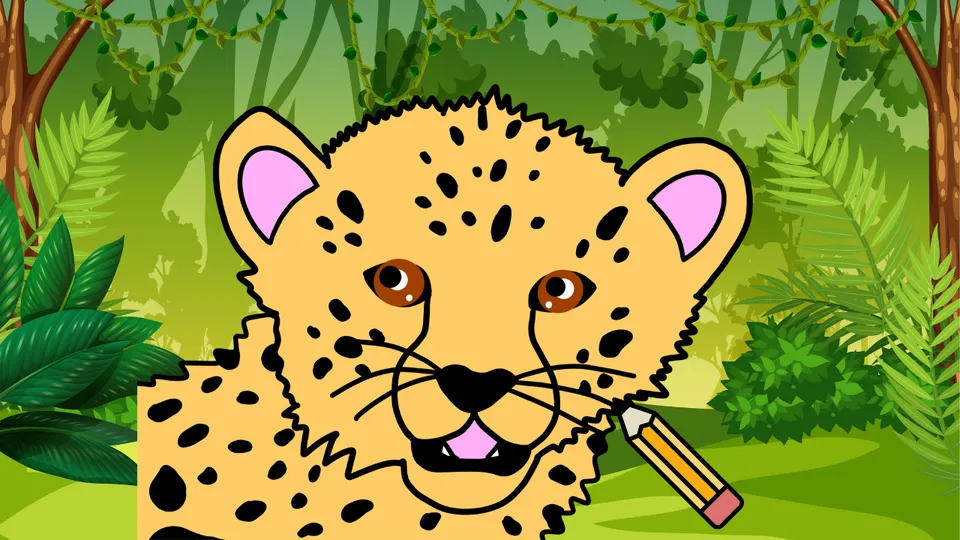
How to Draw: Cheetah Cub
Ages 5–10 · 6 minutes · Art
The purr-fect advanced drawing lesson
Required materials: pencil, paper, coloring utensils
In this step-by-step directed drawing, students will be guided through an advanced, realistic cheetah cub drawing.
Part of
Standards alignment
Alabama
- MA19.K.22 — Model shapes in the world by building them from sticks, clay balls, or other components and by drawing them.
Alaska
- K.G.5 — Build shapes (e.g., using sticks and clay) and draw shapes.
Arkansas
- K.GM.5 — Compose and draw shapes found in the world using objects (e.g., straws, toothpicks, clay balls).
California
- K.G.B.5 — Model shapes in the world by building shapes from components (e.g., sticks and clay balls) and drawing shapes.
Colorado
- RWC20-GR.PS-S.3-GLE.1-EO.c — Use scribbles, shapes, pictures, and letters to represent objects, stories, experiences, or ideas.
Connecticut
- K.G.B.5 — Model shapes in the world by building shapes from components (e.g., sticks and clay balls) and drawing shapes.
Delaware
- K.G.B.5 — Model shapes in the world by building shapes from components (e.g., sticks and clay balls) and drawing shapes.
- 1.G.A.2 — Compose two-dimensional shapes (rectangles, squares, trapezoids, triangles, half-circles, and quarter-circles) or three-dimensional shapes (cubes, right rectangular prisms, right circular cones, and right circular cylinders) to create a composite shape, and compose new shapes from the composite shape.
Florida
- SC.K.N.1.4 — Observe and create a visual representation of an object which includes its major features.
- SC.K2.CS-CS.2.6 (Discontinued after 2024-2025) — Illustrate thoughts, ideas, and stories in a step-by-step manner using writing tools, digital cameras, and drawing tools.
Georgia
- K.GSR.8.3 — Use basic shapes to represent specific shapes found in the environment by creating models and drawings.
- K.GSR.8.2 — Describe the relative location of an object using positional words.
- K.GSR.8.4 — Use two or more basic shapes to form larger shapes.
Hawaii
- K.G.B.5 — Model shapes in the world by building shapes from components (e.g., sticks and clay balls) and drawing shapes.
Idaho
- K.G.B.5 — Model shapes in the world by building shapes from components/materials and drawing shapes.
Iowa
- 1.G.A.2 — Compose two-dimensional shapes (rectangles, squares, trapezoids, triangles, half-circles, and quarter-circles) or threedimensional shapes (cubes, rectangular prisms, cones and cylinders) to create a composite shape, and compose new shapes from the composite shape. Students do not need to learn formal names for these shapes.
Kansas
- K.G.5 — Model shapes in the world by building shapes from components (e.g. sticks and clay balls) and drawing shapes.
Louisiana
- K.G.B.5 — Model shapes in the world by building shapes from components (e.g., sticks and clay balls) and drawing shapes.
Maine
- K.G.B.5 — Model shapes in the world by building shapes from components (e.g., sticks and clay balls) and drawing shapes.
Maryland
- L.PK.2.d — Develop fine motor skills necessary to control and sustain handwriting.
Minnesota
- K.3.1.3 — Use basic shapes and spatial reasoning to model objects in the real-world. For example: A cylinder can be used to model a can of soup. Another example: Find as many rectangles as you can in your classroom. Record the rectangles you found by making drawings.
Missouri
- 1.SL.1.A.c — following two-step instructions, according to classroom expectations
- 2.SL.1.A.b — following three-step instructions, according to classroom expectations
- K.GM.C.9 — Draw or model simple two-dimensional shapes.
Nebraska
- LA.2.SL.1.e — Complete a task following multi-step directions.
- LA.1.SL.1.e — Complete a task following one/two-step directions.
- LA.3.SL.1.e — Complete a task following multi-step directions.
Nevada
- K.G.B.5 — Model shapes in the world by building shapes from components (e.g., sticks and clay balls) and drawing shapes.
New Jersey
- K.G.B.5 — Model shapes in the world by building shapes from components (e.g., sticks and clay balls) and drawing shapes.
New Mexico
- 2.G.A.1 — Recognize and draw shapes having specified attributes, such as a given number of angles or a given number of equal faces. Identify triangles, quadrilaterals, pentagons, hexagons, and cubes.
Ohio
- 1.G.2 — Compose two-dimensional shapes (rectangles, squares, trapezoids, triangles, half-circles, and quarter-circles) or three-dimensional shapes (cubes, right rectangular prisms, right circular cones, and right circular cylinders) to create a composite shape, and compose new shapes from the composite shape. Students do not need to learn formal names such as "right rectangular prism."
Oklahoma
- 2.1.L.2 — Students will follow multi-step oral directions.
- K.2.W.1 — Students will express themselves through drawing and emergent writing.
Pennsylvania
- 3.5.3-5.C — Follow directions to complete a technological task.
- 3.5.K-2.Q — Apply skills necessary for making in design.
- 3.5.K-2.P — Discuss that all designs have different characteristics that can be described.
Rhode Island
- K.G.B.5 — Model shapes in the world by building shapes from components (e.g., sticks and clay balls) and drawing shapes.
South Carolina
- K.G.5 — Draw two-dimensional shapes (i.e., square, rectangle, triangle, hexagon, and circle) and create models of three-dimensional shapes (i.e., cone, cube, cylinder, and sphere).
Tennessee
- K.ETS1.2 — Describe objects accurately by drawing and/or labeling pictures.
Texas
- K.6F — create two-dimensional shapes using a variety of materials and drawings.
Washington
- K.G.B.5 — Model shapes in the world by building shapes from components (e.g., sticks and clay balls) and drawing shapes.
Washington, D.C.
- K.G.B.5 — Model shapes in the world by building shapes from components (e.g., sticks and clay balls) and drawing shapes.
West Virginia
- ELA.PK.WR.EW.1 — Use scribbles, shapes, pictures, and letters to represent objects, stories, experiences, or ideas.
- ELA.PK.WR.EW.5 — Experiment with a variety of writing tools and materials (ex: pencils, chalk, markers, sand, developmentally appropriate technology)