Numbers at the Library
Ages 3–5 · 9 minutes · Math
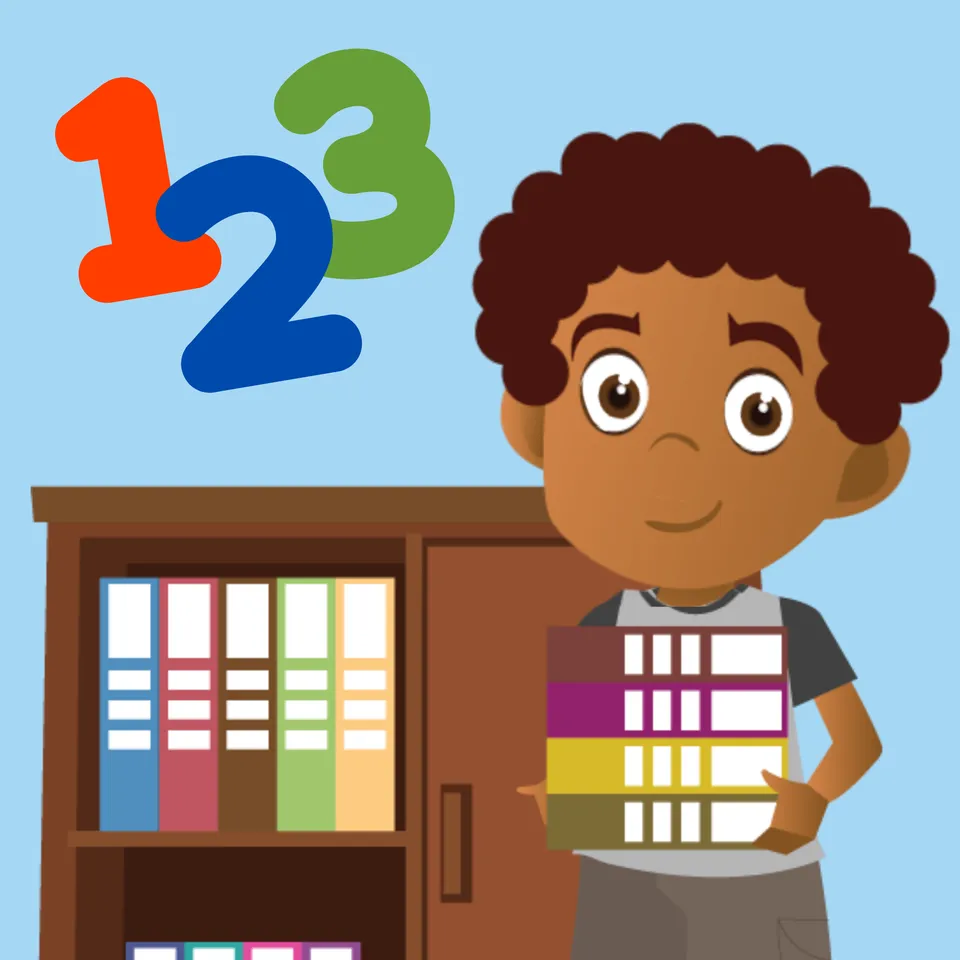
Grab a favorite book with Marcus at the library and practice some numbers along the way
Reading and numbers go hand in hand in this next adventure with Marcus. Students will count books, recognize missing numbers, and even make their own library card at the end of the lesson! Numbers focus mainly on 1-8, with some small addition as well.
Part of
Standards alignment
Common Core State Standards
- K.CC.B.4.c — Understand that each successive number name refers to a quantity that is one larger.
- K.CC.B.5 — Count to answer "how many?" questions about as many as 20 things arranged in a line, a rectangular array, or a circle, or as many as 10 things in a scattered configuration; given a number from 1—20, count out that many objects.
- K.CC.C.7 — Compare two numbers between 1 and 10 presented as written numerals.
- K.CC.A.2 — Count forward beginning from a given number within the known sequence (instead of having to begin at 1).
- K.CC.B.4.a — When counting objects, say the number names in the standard order, pairing each object with one and only one number name and each number name with one and only one object.
Alabama
- MA19.K.5 — Count to answer "how many?" questions.
- MA19.K.7 — Compare two numbers between 0 and 10 presented as written numerals (without using inequality symbols).
- MA19.K.9 — Solve addition and subtraction word problems, and add and subtract within 10, by using concrete objects or drawings to represent the problem.
- MA19.K.4b — Indicate that the last number name said tells the number of objects counted in a set.
Alaska
- K.CC.5 — Count to answer "how many?" questions about as many as 20 things arranged in a line, a rectangular array or a circle, or as many as 10 things in a scattered configuration; given a number from 1-20, count out that many objects.
- K.OA.2 — Add or subtract whole numbers to 10 (e.g., by using objects or drawings to solve word problems).
- K.CC.4.c — Understand that each successive number name refers to a quantity that is one larger.
- K.CC.7 — Compare and order two numbers between 1 and 10 presented as written numerals.
- K.CC.2 — Count forward beginning from a given number within the known sequence.
Arizona
- K.CC.B.5 — Count to answer "how many?" questions about as many as 20 things arranged in a line, a rectangular array, or a circle, or as many as 10 things in a scattered configuration; given a number from 1—20, count out that many objects.
- K.OA.A.2 — Solve addition and subtraction word problems and add and subtract within 10. See Table 1.
- K.CC.A.2 — Count forward from a given number other than one, within the known sequence (e.g., "Starting at the number 5, count up to 11.").
- K.CC.C.7 — Compare two numbers between 0 and 10 presented as written numerals.
- K.CC.B.4.c — Understand that each successive number name refers to a quantity that is one larger.
Arkansas
- K.CAR.5 — Solve real-world problems involving addition and subtraction within 10, using objects, drawings, or equations to represent the problem.
- K.NPV.2 — Count a set of objects up to 20 using one-to-one correspondence, demonstrating that the last number stated indicates the number of objects in the set regardless of the arrangement.
- K.GM.1 — Describe the positions of objects and geometric shapes in the environment. • Terms include: inside, outside, between, above, below, near, far, under, over, up, down, behind, in front of, next to, to the left of, and to the right of
- K.GM.7 — Understand concepts of time, recognizing that clocks and calendars are tools that measure time. • Concepts of time include: morning, afternoon, evening, today, yesterday, tomorrow, day, week, month, and year
- K.NPV.8 — Compare two whole numbers, using the terms greater than, less than, or equal.
California
- K.CC.B.5 — Count to answer "how many?" questions about as many as 20 things arranged in a line, a rectangular array, or a circle, or as many as 10 things in a scattered configuration; given a number from 1—20, count out that many objects.
- K.CC.C.7 — Compare two numbers between 1 and 10 presented as written numerals.
- K.OA.A.2 — Solve addition and subtraction word problems, and add and subtract within 10, e.g., by using objects or drawings to represent the problem.
- K.CC.B.4.c — Understand that each successive number name refers to a quantity that is one larger.
- K.CC.A.2 — Count forward beginning from a given number within the known sequence (instead of having to begin at 1).
Colorado
- P.CC.C.3 — Say or sign the number names in order when counting, pairing one number word that corresponds with one object, up to at least 10.
- P.CC.C.4 — Use the number name of the last object counted to answer “How many?” questions for up to approximately 10 objects.
- P.OA.A.2 — Solve addition and subtraction problems set in simple contexts. Add and subtract up to at least five to or from a given number to find a sum or difference up to 10.
- K.CC.C.7 — Compare two numbers between 1 and 10 presented as written numerals.
- P.OA.A.3 — With adult assistance, begin to use counting on (adding 1 or 2, for example) from the larger number for addition.
Connecticut
- K.CC.B.5 — Count to answer "how many?" questions about as many as 20 things arranged in a line, a rectangular array, or a circle, or as many as 10 things in a scattered configuration; given a number from 1—20, count out that many objects.
- K.OA.A.2 — Solve addition and subtraction word problems, and add and subtract within 10, e.g., by using objects or drawings to represent the problem.
- K.CC.B.4.c — Understand that each successive number name refers to a quantity that is one larger.
- K.CC.C.7 — Compare two numbers between 1 and 10 presented as written numerals.
- K.CC.A.2 — Count forward beginning from a given number within the known sequence (instead of having to begin at 1).
Delaware
- K.CC.B.5 — Count to answer "how many?" questions about as many as 20 things arranged in a line, a rectangular array, or a circle, or as many as 10 things in a scattered configuration; given a number from 1—20, count out that many objects.
- K.OA.A.2 — Solve addition and subtraction word problems, and add and subtract within 10, e.g., by using objects or drawings to represent the problem.
- K.CC.B.4.c — Understand that each successive number name refers to a quantity that is one larger.
- K.CC.C.7 — Compare two numbers between 1 and 10 presented as written numerals.
- K.CC.A.2 — Count forward beginning from a given number within the known sequence (instead of having to begin at 1).
Florida
- MA.K.NSO.1.1 — Given a group of up to 20 objects, count the number of objects in that group and represent the number of objects with a written numeral. State the number of objects in a rearrangement of that group without recounting.
- MA.K.NSO.3.1 — Explore addition of two whole numbers from 0 to 10, and related subtraction facts.
- MA.K.AR.1.3 — Solve addition and subtraction real-world problems using objects, drawings or equations to represent the problem.
- MA.K.NSO.2.3 — Locate, order and compare numbers from 0 to 20 using the number line and terms less than, equal to or greater than.
- MA.1.FR.1.1 — Partition circles and rectangles into two and four equal-sized parts. Name the parts of the whole using appropriate language including halves or fourths.
Georgia
- K.NR.1.1 — Count up to 20 objects in a variety of structured arrangements and up to 10 objects in a scattered arrangement.
- K.NR.5.3 — Use a variety of strategies to solve addition and subtraction problems within 10.
- K.GSR.8.2 — Describe the relative location of an object using positional words.
- K.NR.1.2 — When counting objects, explain that the last number counted represents the total quantity in a set (cardinality), regardless of the arrangement and order.
- K.NR.1.3 — Given a number from 1-20, identify the number that is one more or one less.
- K.NR.4.2 — Compare two sets of up to 10 objects and identify whether the number of objects in one group is more or less than the other group, using the words “greater than,” “less than,” or “the same as”.
Hawaii
- K.CC.B.5 — Count to answer "how many?" questions about as many as 20 things arranged in a line, a rectangular array, or a circle, or as many as 10 things in a scattered configuration; given a number from 1—20, count out that many objects.
- K.OA.A.2 — Solve addition and subtraction word problems, and add and subtract within 10, e.g., by using objects or drawings to represent the problem.
- K.CC.A.2 — Count forward beginning from a given number within the known sequence (instead of having to begin at 1).
- K.CC.C.7 — Compare two numbers between 1 and 10 presented as written numerals.
- K.CC.B.4c — Understand that each successive number name refers to a quantity that is one larger.
Idaho
- K.CC.B.5 — Given a group of up to 20 objects, count the number of objects in that group and state the number of objects in a rearrangement of that group without recounting. Given a verbal or written number from zero to 20, count out that many objects.
- K.CC.C.7 — Compare two numbers between one and ten presented as written numerals.
- K.OA.A.2 — Solve addition and subtraction word problems within ten by using physical, visual, and symbolic representations.
- K.CC.A.2 — Starting at a given number, count forward within 100 and backward within 20.
- K.CC.B.4.c — Understand that each successive number name refers to a quantity that is one larger. Recognize the “one more” pattern of counting using objects.
Illinois
- K.CC.B.5 — Count to answer "how many?" questions about as many as 20 things arranged in a line, a rectangular array, or a circle, or as many as 10 things in a scattered configuration; given a number from 1—20, count out that many objects.
- K.CC.C.7 — Compare two numbers between 1 and 10 presented as written numerals.
- K.CC.B.4.c — Understand that each successive number name refers to a quantity that is one larger.
- K.OA.A.2 — Solve addition and subtraction word problems, and add and subtract within 10, e.g., by using objects or drawings to represent the problem.
- K.CC.A.2 — Count forward beginning from a given number within the known sequence (instead of having to begin at 1).
Indiana
- K.CA.1 — Solve real-world problems that involve addition and subtraction within 10 using modeling with objects or drawings. (E)
- K.NS.3 — Say the number names in standard order when counting objects, pairing each object with one and only one number name and each number name with one and only one object. Understand that the last number name said describes the number of objects counted and that the number of objects is the same regardless of their arrangement or the order in which they were counted. Count out the number of objects, given a number from 1 to 20. (E)
- K.NS.1 — Count to at least 100 by ones and tens. Count by one from any given number. (E)
- K.NS.6 — Compare the values of two numbers from 1 to 20 presented as written numerals.
- K.G.1 — Use words related to location, direction, and distance, including here/there, over/under, left/right, above/below, forward/backward, and between. (E)
Iowa
- K.CC.B.5 — Count to answer "how many?" questions about as many as 20 things arranged in a line, a rectangular array, or a circle, or as many as 10 things in a scattered configuration. Given a number from 1–20, count out that many objects.
- K.OA.A.2 — Add and subtract within 10 and solve word problems involving the different problem types listed below. For example, by using objects or drawings to represent the problem. • Add-to with result unknown. • Take-from with result unknown. • Put-together/take-apart with total unknown. • Put-together with both addends unknown. (See Problem Types Table 1 in Appendix A)
- K.CC.B.4.e — Each successive number name refers to a quantity that is one larger.
- K.CC.C.7 — Compare two numbers between 1 and 10 presented as written numerals.
Kansas
- K.CC.4.a — When counting objects, say each number’s name in sequential order, pairing each object with one and only one number name and each number name with one and only one object.
- K.CC.5 — Count to answer “how many?” up to 20 concrete or pictorial objects arranged in a line, a rectangular array, or a circle, or as many as 10 objects in a scattered configuration; given a number from 1 to 20, count out that many objects.
- K.OA.2 — Solve addition and subtraction word problems, and add and subtract within 10, (e.g. by using objects or drawings to represent the problem.)
- K.CC.4.c — Understand that each successive number name refers to a quantity that is one larger.
- K.CC.7 — Compare two numbers between 1 and 10 presented as written numerals.
Kentucky
- KY.K.CC.4 — Understand the relationship between numbers and quantities; connect counting to cardinality.
- KY.K.CC.4.a — When counting objects, say the number names in the standard order, pairing each object with one and only one number name and each number name with one and only one object.
- KY.K.CC.2 — Count forward beginning from a given number within the known sequence within 100 (instead of having to begin at 1).
- L.K.4.b — Identify common affixes and how they change the meaning of a word.
Louisiana
- K.CC.B.5 — Count to answer "how many?" questions.
- K.OA.A.2 — Solve addition and subtraction word problems, and add and subtract within 10, e.g., by using objects or drawings to represent the problem.
- K.CC.B.4.c — Understand that each successive number name refers to a quantity that is one larger.
- K.CC.B.5.b — Count objects up to 10 in a scattered configuration.
- K.CC.C.7 — Compare two numbers between 1 and 10 presented as written numerals.
Maine
- K.CC.B.5 — Count to answer “how many?” questions about as many as 20 things arranged in a line, a rectangular array, or a circle, or as many as 10 things in a scattered configuration; given a number from 1-20, count out that many objects.
- K.CC.B.4a — When counting objects, say the number names in the standard order, pairing each object with one and only one number name and each number name with one and only one object.
- K.CC.B.4c — Understand that each successive number name refers to a quantity that is one larger. Recognize the one more pattern of counting using objects.
- K.CC.C.7 — Compare two numbers between 1 and 10 presented as written numerals.
- K.OA.A.2 — Solve addition and subtraction word problems, and add and subtract within 10, (e.g., by using objects or drawings to represent the problem).
Maryland
- PK.CC.A.2 — Identify which number comes just after or just before a given number in the counting sequence to 10 with visual supports and manipulatives.
- PK.CC.B.4.a — When counting objects 1-10, say the number names in standard order, pairing each object with one and only one number name.
- K.CC.C.7 — Compare two numbers between 1 and 10 presented as written numerals.
- K.OA.A.2 — Solve addition and subtraction word problems, and add and subtract within 10, e.g., by using objects or drawings to represent the problem.
- PK.CC.B.4.c — Begin to recognize that each successive number name refers to a quantity that is one larger.
Massachusetts
- PK.CC.C.4 — Count many kinds of concrete objects and actions up to ten, using one-to-one correspondence, and accurately count as many as seven things in a scattered configuration. Recognize the "one more," "one less" patterns.
- PK.CC.C.5 — Use comparative language, such as more/less than, equal to, to compare and describe collections of objects.
- PK.CC.A.2 — Recognize and name written numerals 0–10.
- PK.CC.B.3 — Understand the relationships between numerals and quantities up to 10.
- PK.OA.A.1 — Use concrete objects to model real-world addition (putting together) and subtraction (taking away) problems up through five.
Michigan
- K.CC.B.5 — Count to answer "how many?" questions about as many as 20 things arranged in a line, a rectangular array, or a circle, or as many as 10 things in a scattered configuration; given a number from 1—20, count out that many objects.
- K.CC.A.2 — Count forward beginning from a given number within the known sequence (instead of having to begin at 1).
- K.CC.B.4.a — When counting objects, say the number names in the standard order, pairing each object with one and only one number name and each number name with one and only one object.
- K.CC.B.4.b — Understand that the last number name said tells the number of objects counted. The number of objects is the same regardless of their arrangement or the order in which they were counted.
- K.CC.C.7 — Compare two numbers between 1 and 10 presented as written numerals.
- K.OA.A.2 — Solve addition and subtraction word problems, and add and subtract within 10, e.g., by using objects or drawings to represent the problem.
Minnesota
- K.1.1.3 — Count, with and without objects, forward and backward to at least 20.
- K.1.1.5 — Compare and order whole numbers, with and without objects, from 0 to 20. For example: Put the number cards 7, 3, 19 and 12 in numerical order.
- K.1.2.1 — Use objects and draw pictures to find the sums and differences of numbers between 0 and 10.
- K.1.1.1 — Recognize that a number can be used to represent how many objects are in a set or to represent the position of an object in a sequence. For example: Count students standing in a circle and count the same students after they take their seats. Recognize that this rearrangement does not change the total number, but may change the order in which students are counted.
- K.1.1.4 — Find a number that is 1 more or 1 less than a given number.
Mississippi
- K.CC.5 — Count to answer “how many?” questions about as many as 20 things arranged in a line, a rectangular array, or a circle, or as many as 10 things in a scattered configuration; given a number from 1–20, count out that many objects.
- K.OA.2 — Solve addition and subtraction word problems within 10 involving situations of adding to, taking from, putting together and taking apart with unknowns in all positions by using objects or drawings to represent the problem.
- K.CC.2 — Count forward beginning from a given number within the known sequence (instead of having to begin at 1).
- K.CC.7 — Compare two numbers between 1 and 20 presented as written numerals.
- K.CC.4.c — Understand that each successive number name refers to a quantity that is one larger.
Missouri
- K.NS.B.5 — Say the number names when counting objects, in the standard order, pairing each object with one and only one number name and each number name with one and only one object.
- K.NS.B.6 — Demonstrate that the last number name said tells the number of objects counted and the number of objects is the same regardless of their arrangement or the order in which they were counted.
- K.NS.C.11 — Compare two numerals, between 1 and 10, and determine which is more than or less than the other.
- K.NS.B.7 — Demonstrate that each successive number name refers to a quantity that is one larger than the previous number.
- K.RA.A.1 — Represent addition and subtraction within 10.
- 1.GM.A.4 — Partition circles and rectangles into two or four equal shares, and describe the shares and the wholes verbally.
Montana
- K.CC.B.5 — Count to answer "how many?" questions about as many as 20 things arranged in a line, a rectangular array, or a circle, or as many as 10 things in a scattered configuration; given a number from 1-20, count out that many objects from a variety of cultural contexts, including those of Montana American Indians.
- K.OA.A.2 — Solve addition and subtraction word problems from a variety of cultural contexts, including those of Montana American Indians, and add and subtract within 10, e.g., by using objects or drawings to represent the problem.
- K.CC.A.2 — Count forward beginning from a given number within the known sequence (instead of having to begin at 1).
- K.CC.C.7 — Compare two numbers between 1 and 10 presented as written numerals.
- K.CC.B.4.c — Understand that each successive number name refers to a quantity that is one larger.
Nebraska
- 1.G.1.d — Partition circles and rectangles into two and four equal parts using the language halves and fourths.
Nevada
- K.CC.B.5 — Count to answer "how many?" questions about as many as 20 things arranged in a line, a rectangular array, or a circle, or as many as 10 things in a scattered configuration; given a number from 1—20, count out that many objects.
- K.OA.A.2 — Solve addition and subtraction word problems, and add and subtract within 10, e.g., by using objects or drawings to represent the problem.
- K.CC.B.4.c — Understand that each successive number name refers to a quantity that is one larger.
- K.CC.C.7 — Compare two numbers between 1 and 10 presented as written numerals.
- K.CC.A.2 — Count forward beginning from a given number within the known sequence (instead of having to begin at 1).
New Hampshire
- K.CC.B.5 — Count to answer "how many?" questions about as many as 20 things arranged in a line, a rectangular array, or a circle, or as many as 10 things in a scattered configuration; given a number from 1—20, count out that many objects.
- K.OA.A.2 — Solve addition and subtraction word problems, and add and subtract within 10, e.g., by using objects or drawings to represent the problem.
- K.CC.B.4.c — Understand that each successive number name refers to a quantity that is one larger.
- K.CC.C.7 — Compare two numbers between 1 and 10 presented as written numerals.
New Jersey
- K.CC.B.5 — Count to answer “how many?” questions about as many as 20 things arranged in a line, a rectangular array, or a circle, or as many as 10 things in a scattered configuration; given a number from 1–20, count out that many objects.
- K.CC.C.7 — Compare two numbers between 1 and 10 presented as written numerals.
- K.OA.A.2 — Solve addition and subtraction word problems, and add and subtract within 10, e.g., by using objects or drawings to represent the problem.
- K.CC.B.4a — When counting objects, say the number names in the standard order, pairing each object with one and only one number name and each number name with one and only one object.
- K.CC.B.4c — Understand that each successive number name refers to a quantity that is one larger.
New Mexico
- K.CC.B.5 — Count to answer "how many?" questions about as many as 20 things arranged in a line, a rectangular array, or a circle, or as many as 10 things in a scattered configuration; given a number from 1—20, count out that many objects.
- K.OA.A.2 — Solve addition and subtraction word problems, and add and subtract within 10, e.g., by using objects or drawings to represent the problem.
- K.CC.B.4.c — Understand that each successive number name refers to a quantity that is one larger.
- K.CC.C.7 — Compare two numbers between 1 and 10 presented as written numerals.
- K.CC.A.2 — Count forward beginning from a given number within the known sequence (instead of having to begin at 1).
New York
- NY-PK.CC.4.a — Answer counting questions using as many as 10 objects arranged in a line, a rectangular array, and a circle. Answer counting questions using as many as 5 objects in a scattered configuration.
- NY-PK.OA.1 — Explore addition and subtraction by using objects, fingers, and responding to real world situations.
- NY-K.CC.7 — Compare two numbers between 1 and 10 presented as written numerals.
- NY-PK.CC.3.b — Explore and develop the concept that the last number name said tells the number of objects counted, (cardinality). The number of objects is the same regardless of their arrangement or the order in which they were counted.
- NY-PK.CC.3.a — When counting objects, say the number names in the standard order, pairing each object with one and only one number name and each number name with one and only one object. (1:1 correspondence)
North Carolina
- NC.K.CC.4 — Understand the relationship between numbers and quantities. • When counting objects, say the number names in the standard order, pairing each object with one and only one number name and each number name with one and only one object (one-to-one correspondence). • Recognize that the last number named tells the number of objects counted regardless of their arrangement (cardinality). • State the number of objects in a group, of up to 5 objects, without counting the objects (perceptual subitizing).
- NC.K.CC.5 — Count to answer “How many?” in the following situations: • Given a number from 1–20, count out that many objects. • Given up to 20 objects, name the next successive number when an object is added, recognizing the quantity is one more/greater. • Given 20 objects arranged in a line, a rectangular array, and a circle, identify how many. • Given 10 objects in a scattered arrangement, identify how many.
- NC.K.OA.2 — Solve addition and subtraction word problems, within 10, using objects or drawings to represent the problem, when solving: • Add to/Take From-Result Unknown • Put Together/ Take Apart (Total Unknown and Two Addends Unknown)
- NC.K.CC.7 — Compare two numbers, within 10, presented as written numerals.
- NC.K.CC.2 — Count forward beginning from a given number within the known sequence, instead of having to begin at 1.
North Dakota
- K.NO.CC.5 — Count and tell how many objects up to 20 are in an arranged pattern or up to 10 objects in a scattered configuration. Represent a quantity of up to 20 with a numeral.
- K.NO.NBT.2 — Compare two numbers between 1 and 20 using words greater than, less than, or equal to.
- K.NO.CC.3 — Identify and write any given numeral within 20.
- 1.NO.NF.1 — Partition circles and rectangles into two and four equal shares using the language halves and fourths.
Ohio
- K.CC.5 — Count to answer “how many?” questions about as many as 20 things arranged in a line, a rectangular array, or a circle, or as many as 10 things in a scattered configuration; given a number from 1-20, count out that many objects.
- K.OA.2 — Solve addition and subtraction problems (written or oral), and add and subtract within 10 by using objects or drawings to represent the problem.
- K.CC.4.c — Understand that each successive number name refers to a quantity that is one larger.
- K.CC.7 — Compare (without using inequality symbols) two numbers between 0 and 10 when presented as written numerals.
- K.CC.4.b — Understand that the last number name said tells the number of objects counted and that the number of objects is the same regardless of their arrangement or the order in which they were counted.
Oklahoma
- K.N.1.8 — Compare and order whole numbers from 0 to 10 with and without objects, using the vocabulary "more than,” “less than,” or “equal to.”
- PK.N.1.1 — Count aloud forward in sequence by 1s to 20.
- PK.N.2.3 — Understand the last numeral spoken when counting aloud tells how many total objects are in a set up to 10.
- K.N.1.7 — Find a number that is 1 more or 1 less than a given number up to 10.
- K.N.2.1 — Compose and decompose numbers up to 10 using objects and pictures.
- PK.N.1.2 — Recognize and name written numerals 0-10.
Oregon
- K.NCC.B.5 — Count to answer “how many?” questions using up to 20 objects arranged in a variety of configurations or as 10 objects in a scattered configuration. Given a number from 1-20, count out that many objects.
- K.OA.A.2 — Add and subtract within 10. Model authentic contexts and solve problems that use addition and subtraction within 10.
- K.7 — Identify examples of ownership of different items, recognizing the difference between private and public ownership, the responsibility for stewardship and guardianship, (such as classroom, playground, library, community, the environment, etc.) and the opportunity for borrowing and sharing.
- K.NCC.A.3 — Identify number names, write numbers, and the count sequence from 0-20. Represent a number of objects with a written number 0-20.
- K.NCC.C.7 — Compare two numbers between 1 and 10 presented as written numerals.
- 1.GM.A.3 — Partition circles and rectangles into two and four equal shares. Describe the equal shares and understand that partitioning into more equal shares creates smaller shares.
Pennsylvania
- CC.2.1.PreK.A.2 — Count to tell the number of objects.
- CC.2.1.PreK.A.3 — Compare numbers.
- CC.2.1.PreK.A.1 — Know number names and the count sequence.
- CC.2.2.PreK.A.1 — Understand addition as putting together and adding to, and understand subtraction as taking apart and taking from.
South Carolina
- K.ATO.2 — Solve real-world/story problems using objects and drawings to find sums up to 10 and differences within 10.
- K.NS.5 — Count a given number of objects from 1 – 20 and connect this sequence in a one-to-one manner.
- K.NS.4a — Understand the relationship between number and quantity. Connect counting to cardinality by demonstrating an understanding that the last number said tells the number of objects in the set (cardinality).
- K.NS.4c — Understand the relationship between number and quantity. Connect counting to cardinality by demonstrating an understanding that each successive number name refers to a quantity that is one more and each previous number name refers to a quantity that is one less.
- K.NS.8 — Compare two written numerals up to 10 using more than, less than or equal to.
South Dakota
- K.CC.B.4.a — When counting objects, say the number names in the standard order, pairing each object with one and only one number name and each number name with one and only one object. (one-to-one correspondence).
- K.CC.B.4.b — Understand that the last number name said tells the number of objects counted. (cardinality) The number of objects is the same regardless of their arrangement or the order in which they were counted.
- K.CC.B.5 — Count to answer "how many?"
- K.CC.C.7 — Compare two numbers between 1 and 10 presented as written numerals.
- K.OA.A.2.a — Solve addition and subtraction word problems (within 10), involving result unknown problems, put together/take apart total unknown, and put together/take apart addend unknown, e.g., using objects or drawings to represent the problem. (see appendix for K-2 Common Addition and Subtraction Situations).
Tennessee
- K.CC.B.6 — Count to answer “how many?” questions about as many as 20 things arranged in a line, a rectangular array, a circle, or as many as 10 things in a scattered configuration. Given a number from 1-20, count out that many objects.
- K.CC.C.8 — Compare two given numbers up to 10, when written as numerals, using the terms greater than, less than, or equal to. (Students need not use comparison symbols here.)
- K.OA.A.2 — Add and subtract within 10 to solve contextual problems with result/total unknown involving situations of add to, take from, and put together/take apart. Use objects, drawings, or equations to represent the problem.
- K.CC.B.5.a — When counting objects 1-20, say the number names in the standard order, using one-to-one correspondence.
- K.CC.B.5.c — Recognize that each successive number name refers to a quantity that is one greater and each previous number is one less.
Texas
- K.2C — count a set of objects up to at least 20 and demonstrate that the last number said tells the number of objects in the set regardless of their arrangement or order;
- K.3B — solve word problems using objects and drawings to find sums up to 10 and differences within 10; and
- K.2F — generate a number that is one more than or one less than another number up to at least 20;
- K.2H — use comparative language to describe two numbers up to 20 presented as written numerals; and
- K.2A — count forward and backward to at least 20 with and without objects;
Utah
- K.CC.5 — Use counting to answer questions about "how many." For example, 20 or fewer objects arranged in a line, a rectangular array, or circle; 10 or fewer objects in a scattered configuration. Using a number from 1–20, count out that many objects.
- K.OA.2 — Solve addition and subtraction word problems within 10. Use objects or drawings to represent the problem.
- K.CC.4.c — Understand that each successive number refers to a quantity that is one greater than the previous number.
- K.CC.7 — Compare two numbers between 1 and 10 presented as written numerals using "greater than," "less than," or "equal to."
Vermont
- K.CC.B.4.a — When counting objects, say the number names in the standard order, pairing each object with one and only one number name and each number name with one and only one object.
- K.CC.B.5 — Count to answer "how many?" questions about as many as 20 things arranged in a line, a rectangular array, or a circle, or as many as 10 things in a scattered configuration; given a number from 1—20, count out that many objects.
- K.CC.C.7 — Compare two numbers between 1 and 10 presented as written numerals.
- K.CC.B.4.c — Understand that each successive number name refers to a quantity that is one larger.
- K.CC.A.2 — Count forward beginning from a given number within the known sequence (instead of having to begin at 1).
Virginia
- K.CE.1f — Model and solve single-step contextual problems (join, separate, and part-part-whole) using 10 or fewer concrete objects.
- K.NS.1a — Use one-to-one correspondence to determine how many are in a given set containing 30 or fewer concrete objects (e.g., cubes, pennies, balls), and describe the last number named as the total number of objects counted.
- K.MG.3b — Name the days of the week and state that there are seven days in one week.
- K.NS.1g — State the number after, without counting, when given any number between 0 and 30.
Washington
- K.CC.B.5 — Count to answer "how many?" questions about as many as 20 things arranged in a line, a rectangular array, or a circle, or as many as 10 things in a scattered configuration; given a number from 1—20, count out that many objects.
- K.CC.B.4.a — When counting objects, say the number names in the standard order, pairing each object with one and only one number name and each number name with one and only one object.
- K.CC.C.7 — Compare two numbers between 1 and 10 presented as written numerals.
- K.OA.A.2 — Solve addition and subtraction word problems, and add and subtract within 10, e.g., by using objects or drawings to represent the problem.
- K.CC.B.4.c — Understand that each successive number name refers to a quantity that is one larger.
Washington, D.C.
- K.CC.B.5 — Count to answer "how many?" questions about as many as 20 things arranged in a line, a rectangular array, or a circle, or as many as 10 things in a scattered configuration; given a number from 1—20, count out that many objects.
- K.OA.A.2 — Solve addition and subtraction word problems, and add and subtract within 10, e.g., by using objects or drawings to represent the problem.
- K.CC.A.2 — Count forward beginning from a given number within the known sequence (instead of having to begin at 1).
- K.CC.B.4.c — Understand that each successive number name refers to a quantity that is one larger.
- K.CC.C.7 — Compare two numbers between 1 and 10 presented as written numerals.
West Virginia
- M.K.4 — Understand the relationship between numbers and quantities; connect counting to cardinality. a. When counting objects, say the number names in the standard order, pairing each object with one and only one number name and each number name with one and only one object. b. Understand that the last number name said tells the number of objects counted and the number of objects is the same regardless of their arrangement or the order in which they were counted. c. Understand that each successive number name refers to a quantity that is one larger.
- M.K.5 — Count to answer questions (e.g., "How many?") about as many as 20 things arranged in a line, a rectangular array, a circle, or as many as 10 things in a scattered configuration; given a number from 1-20, count out that many objects.
- M.K.7 — Compare and order two numbers between 0-20 presented as written numerals.
- M.K.9 — Solve addition and subtraction word problems and add and subtract within 10 by using objects or drawings to represent the problem.
- M.K.2 — Count forward beginning from a given number within the known sequence (instead of having to begin at 1).
Wisconsin
- M.K.CC.B.4 — Understand the relationship between numbers and quantities; connect counting to cardinality. a. When counting objects, say the number names in the standard order, pairing each object with one and only one number name and each number name with one and only one object (one to one correspondence). b. When counting objects, say the number names in the standard order, pairing each object with one and only one number name and each number name with one and only one object (one to one correspondence). c. Understand that each successive number name refers to a quantity that is one larger and the previous number is one smaller (hierarchical inclusion).
- M.K.CC.B.6 — Count to answer "how many?" questions about as many as 20 things arranged in a line, a rectangular array, or a circle, or as many as 10 things in a scattered configuration; given a number from 1-20, count out that many objects.
- M.K.OA.A.2 — Solve addition and subtraction word problems, and add and subtract within 10, e.g., by using objects or drawings to represent the problem.
- M.K.CC.C.8 — Compare two numbers between 1 and 10 presented as written numerals using student-generated ways to record the comparison.
- M.K.G.A.1 — Describe objects in the environment using names of shapes, and describe the relative positions of these objects using terms such as above, below, beside, in front of, behind, and next to.
Wyoming
- K.CC.B.5.A — Answer the question "how many?" by counting up to 20 objects arranged in a line, a rectangular array, a circle, or as many as 10 objects in a scattered configuration.
- K.CC.C.7 — Compare two numbers between 1 and 10 presented as written numerals.
- K.OA.D.2 — Solve word problems using objects and drawings to find sums up to 10 and differences within 10.
- K.CC.B.4.C — Understand that each successive number name refers to a quantity that is one more, and each previous number name refers to a quantity that is one less.
- 1.G.K.3.A — Describe the shares using the words halves, fourths, and quarters, and use the phrases half of, fourth of, and quarter of.