Number Sense: 20
Ages 4–6 · 14 minutes · Math
Build number sense for the number 20.
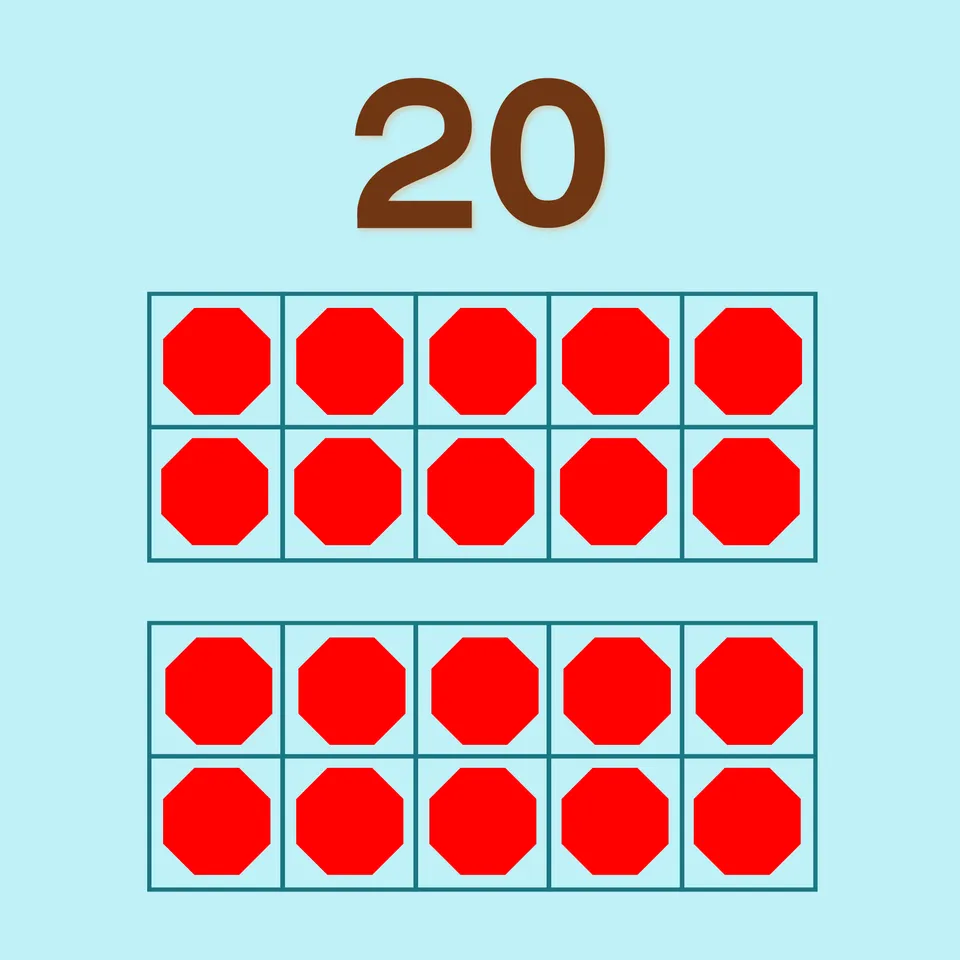
In this lesson, students will learn about the number 20. They will get practice counting up to 20 using planes, trains, and automobiles. They will explore representations of 20 using ten rods and ten frames, and they will explore the concept of place value as we increase from 19 to 20.
Part of
Standards alignment
Common Core State Standards
- K.CC.B.5 — Count to answer "how many?" questions about as many as 20 things arranged in a line, a rectangular array, or a circle, or as many as 10 things in a scattered configuration; given a number from 1—20, count out that many objects.
- K.NBT.A.1 — Compose and decompose numbers from 11 to 19 into ten ones and some further ones, e.g., by using objects or drawings, and record each composition or decomposition by a drawing or equation (e.g., 18 = 10 + 8); understand that these numbers are composed of ten ones and one, two, three, four, five, six, seven, eight, or nine ones.
- 1.NBT.B.2.c — Understand that the two digits of a two-digit number represent amounts of tens and ones. Understand the following as special cases: the numbers 10, 20, 30, 40, 50, 60, 70, 80, 90 refer to one, two, three, four, five, six, seven, eight, or nine tens (and 0 ones).
- K.CC.A.2 — Count forward beginning from a given number within the known sequence (instead of having to begin at 1).
- K.CC.A.3 — Write numbers from 0 to 20. Represent a number of objects with a written numeral 0-20 (with 0 representing a count of no objects).
Alabama
- MA19.1.11 — Explain that the two digits of a two-digit number represent amounts of tens and ones.
- MA19.K.14 — Compose and decompose numbers from 11 to 19 by using concrete objects or drawings to demonstrate understanding that these numbers are composed of ten ones and one, two, three, four, five, six, seven, eight, or nine ones.
- MA19.K.5a — Count using no more than 20 concrete objects arranged in a line, a rectangular array, or a circle.
- MA19.1.11a — Identify a bundle of ten ones as a "ten."
- MA19.1.11c — Identify the numbers 10, 20, 30, 40, 50, 60, 70, 80, 90 as one, two, three, four, five, six, seven, eight, or nine tens (and 0 ones).
Alaska
- K.CC.5 — Count to answer "how many?" questions about as many as 20 things arranged in a line, a rectangular array or a circle, or as many as 10 things in a scattered configuration; given a number from 1-20, count out that many objects.
- K.NBT.1 — Compose and decompose numbers from 11 to 19 into ten ones and some further ones (e.g., by using objects or drawings) and record each composition and decomposition by a drawing or equation (e.g., 18 = 10 + 8); understand that these numbers are composed of ten ones and one, two, three, four, five, six, seven, eight or nine ones.
- 1.CC.1 — Skip count by 2s and 5s.
- 1.NBT.2 — Model and identify place value positions of two digit numbers. Include:
- 1.NBT.2.c — The numbers 10, 20, 30, 40, 50, 60, 70, 80, 90, refer to one, two, three, four, five, six, seven, eight or nine tens (and 0 ones).
Arizona
- K.CC.B.5 — Count to answer "how many?" questions about as many as 20 things arranged in a line, a rectangular array, or a circle, or as many as 10 things in a scattered configuration; given a number from 1—20, count out that many objects.
- K.NBT.A.1 — Compose and decompose numbers from 11 to 19 into ten ones and some further ones, e.g., by using objects or drawings, and record each composition or decomposition by a drawing or equation (e.g., 18 = 10 + 8); understand that these numbers are composed of ten ones and one, two, three, four, five, six, seven, eight, or nine ones.
- 1.NBT.B.2.c — The numbers 10, 20, 30, 40, 50, 60, 70, 80, 90 refer to one, two, three, four, five, six, seven, eight, or nine tens (and 0 ones).
- K.CC.A.2 — Count forward from a given number other than one, within the known sequence (e.g., "Starting at the number 5, count up to 11.").
Arkansas
- K.NPV.2 — Count a set of objects up to 20 using one-to-one correspondence, demonstrating that the last number stated indicates the number of objects in the set regardless of the arrangement.
- K.NPV.6 — Show equivalent forms of whole numbers up to 20 as groups of tens and ones, using manipulatives and drawings.
- 1.NPV.3 — Explain the place value of ones and tens in two-digit numbers, using concrete models, diagrams, numbers, or words.
- K.NPV.5 — Read, write, and represent whole numbers from 0 to 20.
California
- K.CC.B.5 — Count to answer "how many?" questions about as many as 20 things arranged in a line, a rectangular array, or a circle, or as many as 10 things in a scattered configuration; given a number from 1—20, count out that many objects.
- K.NBT.A.1 — Compose and decompose numbers from 11 to 19 into ten ones and some further ones, e.g., by using objects or drawings, and record each composition or decomposition by a drawing or equation (e.g., 18 = 10 + 8); understand that these numbers are composed of ten ones and one, two, three, four, five, six, seven, eight, or nine ones.
- 1.NBT.B.2.c — The numbers 10, 20, 30, 40, 50, 60, 70, 80, 90 refer to one, two, three, four, five, six, seven, eight, or nine tens (and 0 ones).
- K.CC.A.2 — Count forward beginning from a given number within the known sequence (instead of having to begin at 1).
- K.CC.B.4.c — Understand that each successive number name refers to a quantity that is one larger.
Colorado
- K.CC.B.5 — Count to answer “how many?” questions about as many as 20 things arranged in a line, a rectangular array, or a circle, or as many as 10 things in a scattered configuration; given a number from 1–20, count out that many objects.
- K.NBT.A.1 — Compose and decompose numbers from 11 to 19 into ten ones and some further ones, e.g., by using objects or drawings, and record each composition or decomposition by a drawing or equation (such as 18 = 10 + 8); understand that these numbers are composed of ten ones and one, two, three, four, five, six, seven, eight, or nine ones.
- K.CC.A.2 — Count forward beginning from a given number within the known sequence (instead of having to begin at 1).
- K.CC.B.4.c — Understand that each successive number name refers to a quantity that is one larger.
- 1.NBT.B.2.c — The numbers 10, 20, 30, 40, 50, 60, 70, 80, 90 refer to one, two, three, four, five, six, seven, eight, or nine tens (and 0 ones).
Connecticut
- 1.NBT.B.2 — Understand that the two digits of a two-digit number represent amounts of tens and ones. Understand the following as special cases:
- K.CC.B.5 — Count to answer "how many?" questions about as many as 20 things arranged in a line, a rectangular array, or a circle, or as many as 10 things in a scattered configuration; given a number from 1—20, count out that many objects.
- K.NBT.A.1 — Compose and decompose numbers from 11 to 19 into ten ones and some further ones, e.g., by using objects or drawings, and record each composition or decomposition by a drawing or equation (e.g., 18 = 10 + 8); understand that these numbers are composed of ten ones and one, two, three, four, five, six, seven, eight, or nine ones.
- 1.NBT.B.2.c — The numbers 10, 20, 30, 40, 50, 60, 70, 80, 90 refer to one, two, three, four, five, six, seven, eight, or nine tens (and 0 ones).
- K.CC.A.2 — Count forward beginning from a given number within the known sequence (instead of having to begin at 1).
Delaware
- K.CC.B.5 — Count to answer "how many?" questions about as many as 20 things arranged in a line, a rectangular array, or a circle, or as many as 10 things in a scattered configuration; given a number from 1—20, count out that many objects.
- K.NBT.A.1 — Compose and decompose numbers from 11 to 19 into ten ones and some further ones, e.g., by using objects or drawings, and record each composition or decomposition by a drawing or equation (e.g., 18 = 10 + 8); understand that these numbers are composed of ten ones and one, two, three, four, five, six, seven, eight, or nine ones.
- 1.NBT.B.2.c — The numbers 10, 20, 30, 40, 50, 60, 70, 80, 90 refer to one, two, three, four, five, six, seven, eight, or nine tens (and 0 ones).
- K.CC.A.2 — Count forward beginning from a given number within the known sequence (instead of having to begin at 1).
- K.CC.B.4.c — Understand that each successive number name refers to a quantity that is one larger.
Florida
- MA.K.NSO.1.1 — Given a group of up to 20 objects, count the number of objects in that group and represent the number of objects with a written numeral. State the number of objects in a rearrangement of that group without recounting.
- MA.K.NSO.2.2 — Represent whole numbers from 10 to 20, using a unit of ten and a group of ones, with objects, drawings and expressions or equations.
- MA.K.NSO.2.1 — Recite the number names to 100 by ones and by tens. Starting at a given number, count forward within 100 and backward within 20.
Georgia
- K.NR.1.1 — Count up to 20 objects in a variety of structured arrangements and up to 10 objects in a scattered arrangement.
- K.NR.3.1 — Describe numbers from 11 to 19 by composing (putting together) and decomposing (breaking apart) the numbers into ten ones and some more ones.
- K.NR.1.3 — Given a number from 1-20, identify the number that is one more or one less.
- K.NR.3 — Use place value understanding to compose and decompose numbers from 11–19.
- K.NR.4.1 — Identify written numerals 0- 20 and represent a number of objects with a written numeral 0-20 (with 0 representing a count of no objects).
Hawaii
- K.CC.B.5 — Count to answer "how many?" questions about as many as 20 things arranged in a line, a rectangular array, or a circle, or as many as 10 things in a scattered configuration; given a number from 1—20, count out that many objects.
- K.NBT.A.1 — Compose and decompose numbers from 11 to 19 into ten ones and some further ones, e.g., by using objects or drawings, and record each composition or decomposition by a drawing or equation (e.g., 18 = 10 + 8); understand that these numbers are composed of ten ones and one, two, three, four, five, six, seven, eight, or nine ones.
- 1.NBT.B.2c — The numbers 10, 20, 30, 40, 50, 60, 70, 80, 90 refer to one, two, three, four, five, six, seven, eight, or nine tens (and 0 ones).
- K.CC.A.2 — Count forward beginning from a given number within the known sequence (instead of having to begin at 1).
Idaho
- K.CC.B.5 — Given a group of up to 20 objects, count the number of objects in that group and state the number of objects in a rearrangement of that group without recounting. Given a verbal or written number from zero to 20, count out that many objects.
- K.NBT.A.1 — Compose (put together) and decompose (break apart) numbers from 11 to 19 into ten ones and some further ones, and record each composition or decomposition by using physical, visual, or symbolic representations; understand that these numbers are composed of ten ones and one, two, three, four, five, six, seven, eight, or nine ones.
- 1.NBT.B.2 — Understand that the two digits of a two-digit number represent amounts of tens and ones.
- 1.NBT.B.2.c — The numbers 10, 20, 30, 40, 50, 60, 70, 80, 90 refer to one, two, three, four, five, six, seven, eight, or nine tens (and zero ones).
- K.CC.A.2 — Starting at a given number, count forward within 100 and backward within 20.
Illinois
- K.CC.B.5 — Count to answer "how many?" questions about as many as 20 things arranged in a line, a rectangular array, or a circle, or as many as 10 things in a scattered configuration; given a number from 1—20, count out that many objects.
- K.NBT.A.1 — Compose and decompose numbers from 11 to 19 into ten ones and some further ones, e.g., by using objects or drawings, and record each composition or decomposition by a drawing or equation (e.g., 18 = 10 + 8); understand that these numbers are composed of ten ones and one, two, three, four, five, six, seven, eight, or nine ones.
- 1.NBT.B.2.c — The numbers 10, 20, 30, 40, 50, 60, 70, 80, 90 refer to one, two, three, four, five, six, seven, eight, or nine tens (and 0 ones).
- K.CC.A.2 — Count forward beginning from a given number within the known sequence (instead of having to begin at 1).
- K.CC.B.4.c — Understand that each successive number name refers to a quantity that is one larger.
Indiana
- K.NS.3 — Say the number names in standard order when counting objects, pairing each object with one and only one number name and each number name with one and only one object. Understand that the last number name said describes the number of objects counted and that the number of objects is the same regardless of their arrangement or the order in which they were counted. Count out the number of objects, given a number from 1 to 20. (E)
- K.NS.7 — Define and model a "ten" as a group of ten ones. Model equivalent forms of whole numbers from 10 to 20 as groups of tens and ones using objects and drawings. (E)
- K.NS.1 — Count to at least 100 by ones and tens. Count by one from any given number. (E)
- K.NS.2 — Write whole numbers from 0 to 20 and identify number words from 0 to 10. Represent a number of objects with a written numeral 0-20 (with 0 representing a count of no objects). (E)
- 1.NS.1 — Count to at least 120 by ones, fives, and tens from any given number. In this range, read and write numerals and represent a number of objects with a written numeral. (E)
Iowa
- K.CC.B.5 — Count to answer "how many?" questions about as many as 20 things arranged in a line, a rectangular array, or a circle, or as many as 10 things in a scattered configuration. Given a number from 1–20, count out that many objects.
- K.NBT.A.1 — Compose and decompose numbers from 11 to 19 into ten ones and some further ones, by using objects or drawings, and record each composition or decomposition by a drawing or equation. For example, 18 = 10 + 8; understand that these numbers are composed of ten ones and one, two, three, four, five, six, seven, eight, or nine ones.
- 1.NBT.B.2 — Understand that the two digits of a two-digit number represent amounts of tens and ones. Understand the following as special cases.
- 1.NBT.B.2.c — The numbers 10, 20, 30, 40, 50, 60, 70, 80, 90 refer to one, two, three, four, five, six, seven, eight, or nine tens (and 0 ones).
Kansas
- K.CC.5 — Count to answer “how many?” up to 20 concrete or pictorial objects arranged in a line, a rectangular array, or a circle, or as many as 10 objects in a scattered configuration; given a number from 1 to 20, count out that many objects.
- K.NBT.1 — Compose and decompose numbers from 11 to 19 into ten ones and some further ones, (e.g. by using objects or drawings, and record each composition or decomposition by a drawing or equation (e.g. 10 + 8 = 18 and 19 = 10 + 9); understand that these numbers are composed of ten ones and one, two, three, four, five, six, seven, eight, or nine ones.
- 1.NBT.2.d — Show flexibility in composing and decomposing tens and ones (e.g. 20 can be composed from 2 tens or 1 ten and 10 ones, or 20 ones.)
- K.CC.2 — Count forward beginning from a given number within the known sequence (instead of having to begin at 1).
- K.CC.4.c — Understand that each successive number name refers to a quantity that is one larger.
Kentucky
- KY.K.CC.5.a — Count to answer “how many?” questions with as many as 20 things arranged in a line, a rectangular array, or a circle.
- KY.K.NBT.1 — Compose and decompose numbers from 11 to 19 using quantities (numbers with units) of ten ones and some further ones. Understand that these numbers are composed of ten ones and one, two, three, four, five, six, seven, eight, or nine ones.
- KY.1.NBT.2.b — The numbers from 11 to 19 are composed of a ten and one, two, three, four, five, six, seven, eight or nine ones.
- KY.1.NBT.2.c — The numbers 10, 20, 30, 40, 50, 60, 70, 80, 90 refer to one, two, three, four, five, six, seven, eight or nine tens (and 0 ones).
- KY.K.CC.2 — Count forward beginning from a given number within the known sequence within 100 (instead of having to begin at 1).
Louisiana
- K.CC.B.5.a — Count objects up to 20, arranged in a line, a rectangular array, or a circle.
- K.NBT.A.1.a — Understand that the numbers 11–19 are composed of ten ones and one, two, three, four, five, six, seven, eight, or nine ones.
- K.NBT.A.1.b — Compose and decompose numbers 11 to 19 using place value (e.g., by using objects or drawings).
- K.CC.A.2 — Count forward beginning from a given number within the known sequence (instead of having to begin at 1).
- K.NBT.A.1 — Gain understanding of place value.
Maine
- K.CC.B.5 — Count to answer “how many?” questions about as many as 20 things arranged in a line, a rectangular array, or a circle, or as many as 10 things in a scattered configuration; given a number from 1-20, count out that many objects.
- K.NBT.A.1 — Compose and decompose numbers from 11 to 19 into ten ones and some further ones, e.g., by using objects or drawings, and record each composition or decomposition by a drawing or equation (e.g., 18 = 10 + 8 and 10+8=18); understand that these numbers are composed of ten ones and one, two, three, four, five, six, seven, eight, or nine ones.
- 1.NBT.B.2c — The numbers 10, 20, 30, 40, 50, 60, 70, 80, 90 refer to one, two, three, four, five, six, seven, eight, or nine tens (and 0 ones).
- K.CC.B.4c — Understand that each successive number name refers to a quantity that is one larger. Recognize the one more pattern of counting using objects.
Maryland
- K.CC.B.5 — Count to answer "how many?" questions about as many as 20 things arranged in a line, a rectangular array, or a circle, or as many as 10 things in a scattered configuration; given a number from 1—20, count out that many objects.
- K.NBT.A.1 — Compose and decompose numbers from 11 to 19 into ten ones and some further ones, e.g., by using objects or drawings, and record each composition or decomposition by a drawing or equation (e.g., 18 = 10 + 8); understand that these numbers are composed of ten ones and one, two, three, four, five, six, seven, eight, or nine ones.
- 1.NBT.B.2.c — The numbers 10, 20, 30, 40, 50, 60, 70, 80, 90 refer to one, two, three, four, five, six, seven, eight, or nine tens (and 0 ones).
- K.CC.A.2 — Count forward beginning from a given number within the known sequence (instead of having to begin at 1).
Massachusetts
- K.CC.B.5 — Count to answer "how many?" questions about as many as 20 things arranged in a line, a rectangular array, or a circle, or as many as 10 things in a scattered configuration; given a number from 1–20, count out that many objects.
- K.NBT.A.1 — Compose and decompose numbers from 11 to 19 into ten ones and some further ones, e.g., by using objects or drawings, and record each composition or decomposition by a drawing or equation (e.g., 18 = 10 + 8); understand that these numbers are composed of ten ones and one, two, three, four, five, six, seven, eight, or nine ones.
- 1.NBT.B.2.c — The numbers 10, 20, 30, 40, 50, 60, 70, 80, 90 refer to one, two, three, four, five, six, seven, eight, or nine tens (and 0 ones).
- K.CC.A.2 — Count forward beginning from a given number within the known sequence (instead of having to begin at one).
- K.CC.B.4.c — Understand that each successive number name refers to a quantity that is one larger. Recognize the one more pattern of counting using objects.
Michigan
- K.CC.B.5 — Count to answer "how many?" questions about as many as 20 things arranged in a line, a rectangular array, or a circle, or as many as 10 things in a scattered configuration; given a number from 1—20, count out that many objects.
- K.NBT.A.1 — Compose and decompose numbers from 11 to 19 into ten ones and some further ones, e.g., by using objects or drawings, and record each composition or decomposition by a drawing or equation (e.g., 18 = 10 + 8); understand that these numbers are composed of ten ones and one, two, three, four, five, six, seven, eight, or nine ones.
- 1.NBT.B.2 — Understand that the two digits of a two-digit number represent amounts of tens and ones. Understand the following as special cases:
- K.CC.A.2 — Count forward beginning from a given number within the known sequence (instead of having to begin at 1).
- K.CC.B.4.c — Understand that each successive number name refers to a quantity that is one larger.
Minnesota
- K.1.1.2 — Read, write, and represent whole numbers from 0 to at least 31. Representations may include numerals, pictures, real objects and picture graphs, spoken words, and manipulatives such as connecting cubes. For example: Represent the number of students taking hot lunch with tally marks.
- K.1.1.3 — Count, with and without objects, forward and backward to at least 20.
- 1.1.1.1 — Use place value to describe whole numbers between 10 and 100 in terms of tens and ones. For example: Recognize the numbers 21 to 29 as 2 tens and a particular number of ones.
- 1.1.2.3 — Recognize the relationship between counting and addition and subtraction. Skip count by 2s, 5s, and 10s.
Mississippi
- K.CC.5 — Count to answer “how many?” questions about as many as 20 things arranged in a line, a rectangular array, or a circle, or as many as 10 things in a scattered configuration; given a number from 1–20, count out that many objects.
- K.NBT.1 — Compose and decompose numbers from 11 to 19 into ten ones and some further ones to understand that these numbers are composed of ten ones and one, two, three, four, five, six, seven, eight, or nine ones, e.g., by using objects or drawings, and record each composition or decomposition by a drawing or equation (e.g., 18 = 10 + 8).
- 1.NBT.2.c — The numbers 10, 20, 30, 40, 50, 60, 70, 80, 90 refer to one, two, three, four, five, six, seven, eight, or nine tens (and 0 ones).
- K.CC.2 — Count forward beginning from a given number within the known sequence (instead of having to begin at 1).
- K.CC.4.c — Understand that each successive number name refers to a quantity that is one larger.
Missouri
- K.NBT.A.1 — Compose and decompose numbers from 11 to 19 into sets of tens with additional ones.
- K.NS.A.4 — Read and write numerals and represent a number of objects from 0 to 20.
- 1.NBT.A.2 — Understand two-digit numbers are composed of ten(s) and one(s).
- K.NS.A.2 — Count forward beginning from a given number between 1 and 20.
- K.NS.B.7 — Demonstrate that each successive number name refers to a quantity that is one larger than the previous number.
Montana
- K.CC.B.5 — Count to answer "how many?" questions about as many as 20 things arranged in a line, a rectangular array, or a circle, or as many as 10 things in a scattered configuration; given a number from 1-20, count out that many objects from a variety of cultural contexts, including those of Montana American Indians.
- K.NBT.A.1 — Compose and decompose numbers from 11 to 19 into ten ones and some further ones, e.g., by using objects or drawings, and record each composition or decomposition by a drawing or equation (e.g., 18 = 10 + 8); understand that these numbers are composed of ten ones and one, two, three, four, five, six, seven, eight, or nine ones.
- 1.NBT.B.2 — Understand that the two digits of a two-digit number represent amounts of tens and ones. Understand the following as special cases:
- K.CC.A.2 — Count forward beginning from a given number within the known sequence (instead of having to begin at 1).
Nebraska
- K.N.2.d — Count up to 20 objects arranged in a line, a rectangular array, or a circle, and count up to 10 objects in a scattered configuration.
- K.N.3 — Base Ten: Students will work with numbers 11 to 19 to gain a foundation for place value.
- K.N.3.a — Compose and decompose numbers from 11 to 19 into a group of ten ones and some more ones using a model, drawing, or equation.
- K.N.2.e — Count verbally forward and backward from any given number within 20.
- 1.N.2.d — Understand patterns of skip counting by 2s, 5s, and 10s.
Nevada
- K.CC.B.5 — Count to answer "how many?" questions about as many as 20 things arranged in a line, a rectangular array, or a circle, or as many as 10 things in a scattered configuration; given a number from 1—20, count out that many objects.
- K.NBT.A.1 — Compose and decompose numbers from 11 to 19 into ten ones and some further ones, e.g., by using objects or drawings, and record each composition or decomposition by a drawing or equation (e.g., 18 = 10 + 8); understand that these numbers are composed of ten ones and one, two, three, four, five, six, seven, eight, or nine ones.
- 1.NBT.B.2 — Understand that the two digits of a two-digit number represent amounts of tens and ones. Understand the following as special cases:
- 1.NBT.B.2.c — The numbers 10, 20, 30, 40, 50, 60, 70, 80, 90 refer to one, two, three, four, five, six, seven, eight, or nine tens (and 0 ones).
- K.CC.A.2 — Count forward beginning from a given number within the known sequence (instead of having to begin at 1).
New Hampshire
- K.CC.B.5 — Count to answer "how many?" questions about as many as 20 things arranged in a line, a rectangular array, or a circle, or as many as 10 things in a scattered configuration; given a number from 1—20, count out that many objects.
- K.NBT.A.1 — Compose and decompose numbers from 11 to 19 into ten ones and some further ones, e.g., by using objects or drawings, and record each composition or decomposition by a drawing or equation (e.g., 18 = 10 + 8); understand that these numbers are composed of ten ones and one, two, three, four, five, six, seven, eight, or nine ones.
- 1.NBT.B.2.c — The numbers 10, 20, 30, 40, 50, 60, 70, 80, 90 refer to one, two, three, four, five, six, seven, eight, or nine tens (and 0 ones).
- K.CC.A.2 — Count forward beginning from a given number within the known sequence (instead of having to begin at 1).
- K.CC.B.4.c — Understand that each successive number name refers to a quantity that is one larger.
New Jersey
- K.CC.B.5 — Count to answer “how many?” questions about as many as 20 things arranged in a line, a rectangular array, or a circle, or as many as 10 things in a scattered configuration; given a number from 1–20, count out that many objects.
- K.NBT.A.1 — Compose and decompose numbers from 11 to 19 into ten ones and some further ones, e.g., by using objects or drawings, and record each composition or decomposition by a drawing or equation (e.g., 18 = 10 + 8); understand that these numbers are composed of ten ones and one, two, three, four, five, six, seven, eight, or nine ones.
- 1.NBT.B.2 — Understand that the two digits of a two-digit number represent amounts of tens and ones. Understand the following as special cases: a. 10 can be thought of as a bundle of ten ones — called a “ten.” b. The numbers from 11 to 19 are composed of a ten and one, two, three, four, five, six, seven, eight, or nine ones. c. The numbers 10, 20, 30, 40, 50, 60, 70, 80, 90 refer to one, two, three, four, five, six, seven, eight, or nine tens (and 0 ones).
- K.CC.A.2 — Count forward beginning from a given number within the known sequence (instead of having to begin at 1).
- K.CC.B.4c — Understand that each successive number name refers to a quantity that is one larger.
New Mexico
- K.CC.B.5 — Count to answer "how many?" questions about as many as 20 things arranged in a line, a rectangular array, or a circle, or as many as 10 things in a scattered configuration; given a number from 1—20, count out that many objects.
- K.NBT.A.1 — Compose and decompose numbers from 11 to 19 into ten ones and some further ones, e.g., by using objects or drawings, and record each composition or decomposition by a drawing or equation (e.g., 18 = 10 + 8); understand that these numbers are composed of ten ones and one, two, three, four, five, six, seven, eight, or nine ones.
- 1.NBT.B.2 — Understand that the two digits of a two-digit number represent amounts of tens and ones. Understand the following as special cases:
- K.CC.A.2 — Count forward beginning from a given number within the known sequence (instead of having to begin at 1).
New York
- NY-K.CC.4 — Understand the relationship between numbers and quantities up to 20; connect counting to cardinality.
- NY-K.CC.5.a — Answer counting questions using as many as 20 objects arranged in a line, a rectangular array, and a circle. Answer counting questions using as many as 10 objects in a scattered configuration.
- NY-K.NBT.1 — Compose and decompose the numbers from 11 to 19 into ten ones and one, two, three, four, five, six, seven, eight, or nine ones.
- NY-1.NBT.2.c — Understand the numbers 10, 20, 30, 40, 50, 60, 70, 80, 90 refer to one, two, three, four, five, six, seven, eight, or nine tens (and 0 ones).
- NY-K.CC.4.c — Understand the concept that each successive number name refers to a quantity that is one larger.
North Carolina
- NC.K.CC.5 — Count to answer “How many?” in the following situations: • Given a number from 1–20, count out that many objects. • Given up to 20 objects, name the next successive number when an object is added, recognizing the quantity is one more/greater. • Given 20 objects arranged in a line, a rectangular array, and a circle, identify how many. • Given 10 objects in a scattered arrangement, identify how many.
- NC.K.NBT.1 — Compose and decompose numbers from 11 to 19 into ten ones and some further ones by: • Using objects or drawings. • Recording each composition or decomposition by a drawing or expression. • Understanding that these numbers are composed of ten ones and one, two, three, four, five, six, seven, eight, or nine ones.
- NC.1.NBT.2 — Understand that the two digits of a two-digit number represent amounts of tens and ones. • Unitize by making a ten from a collection of ten ones. • Model the numbers from 11 to 19 as composed of a ten and one, two, three, four, five, six, seven, eight, or nine ones. • Demonstrate that the numbers 10, 20, 30, 40, 50, 60, 70, 80, 90 refer to one, two, three, four, five, six, seven, eight, or nine tens, with 0 ones.
- NC.K.CC.2 — Count forward beginning from a given number within the known sequence, instead of having to begin at 1.
- NC.K.CC.3 — Write numbers from 0 to 20. Represent a number of objects with a written numeral 0-20, with 0 representing a count of no objects.
North Dakota
- K.NO.CC.5 — Count and tell how many objects up to 20 are in an arranged pattern or up to 10 objects in a scattered configuration. Represent a quantity of up to 20 with a numeral.
- K.NO.NBT.1 — Compose and decompose numbers from 11 to 19 using a group of ten ones and some more ones using a model, drawing, or equation.
- 1.NO.NBT.1 — Demonstrate that the two digits of a two-digit number represent a composition of some tens and some ones.
- K.NO.CC.3 — Identify and write any given numeral within 20.
Ohio
- K.CC.5 — Count to answer “how many?” questions about as many as 20 things arranged in a line, a rectangular array, or a circle, or as many as 10 things in a scattered configuration; given a number from 1-20, count out that many objects.
- K.NBT.1 — Compose and decompose numbers from 11 to 19 into a group of ten ones and some further ones by using objects and, when appropriate, drawings or equations; understand that these numbers are composed of a group of ten ones and one, two, three, four, five, six, seven, eight, or nine ones.
- 1.NBT.2 — Understand that the two digits of a two-digit number represent amounts of tens and ones. Understand the following as special cases: 10 can be thought of as a bundle of ten ones — called a “ten;” the numbers from 11 to 19 are composed of a ten and one, two, three, four, five, six, seven, eight, or nine ones; and the numbers 10, 20, 30, 40, 50, 60, 70, 80, 90 refer to one, two, three, four, five, six, seven, eight, or nine tens (and 0 ones).
- K.CC.4.c — Understand that each successive number name refers to a quantity that is one larger.
Oklahoma
- 1.N.1.2 — Use concrete representations to describe whole numbers between 10 and 100 in terms of tens and ones. Know that 10 is equivalent to 10 ones and 100 is equivalent to 10 tens.
- K.N.1.6 — Read, write, discuss, and represent whole numbers from 0 to at least 20. Representations may include numerals, pictures, real-object and pictographs, spoken words, and manipulatives.
- PK.N.1.1 — Count aloud forward in sequence by 1s to 20.
- 1.N.1.4 — Count forward, with objects, from any given number up to 100 by 1s, 2s, 5s and 10s.
- K.N.1.5 — Count forward, with and without objects, from any given number up to 20.
Oregon
- K.NBT.A.1 — Compose and decompose from 11 to 19 into groups of ten ones and some further ones using objects, drawings, or equations.
- K.NCC.A.3 — Identify number names, write numbers, and the count sequence from 0-20. Represent a number of objects with a written number 0-20.
- K.NCC.B.5 — Count to answer “how many?” questions using up to 20 objects arranged in a variety of configurations or as 10 objects in a scattered configuration. Given a number from 1-20, count out that many objects.
- 1.NBT.B.2 — Understand 10 as a bundle of ten ones and that the two digits of a two-digit number represent amounts of tens and ones.
- K.NCC.A.2 — Count forward beginning from a given number within 100 of a known sequence.
Pennsylvania
- CC.2.1.K.A.1 — Know number names and write and recite the count sequence.
- CC.2.1.K.A.2 — Apply one-to-one correspondence to count the number of objects.
- CC.2.1.K.B.1 — Use place value to compose and decompose numbers within 19.
Rhode Island
- K.CC.B.5 — Count to answer "how many?" questions about as many as 20 things arranged in a line, a rectangular array, or a circle, or as many as 10 things in a scattered configuration; given a number from 1—20, count out that many objects.
- K.NBT.A.1 — Compose and decompose numbers from 11 to 19 into ten ones and some further ones, e.g., by using objects or drawings, and record each composition or decomposition by a drawing or equation (e.g., 18 = 10 + 8); understand that these numbers are composed of ten ones and one, two, three, four, five, six, seven, eight, or nine ones.
- K.CC.A.2 — Count forward beginning from a given number within the known sequence (instead of having to begin at one).
- K.CC.B.4.c — Understand that each successive number name refers to a quantity that is one larger. Recognize the one more pattern of counting using objects
- 1.NBT.B.2.c — The numbers 10, 20, 30, 40, 50, 60, 70, 80, 90 refer to one, two, three, four, five, six, seven, eight, or nine tens (and 0 ones).
South Carolina
- K.NS.5 — Count a given number of objects from 1 – 20 and connect this sequence in a one-to-one manner.
- K.NSBT.1 — Compose and decompose numbers from 11 – 19 separating ten ones from the remaining ones using objects and drawings.
- 1.NSBT.1b — Extend the number sequence to count by fives and tens to 100, starting at any number.
- 1.NSBT.2b — Understand place value through 99 by demonstrating that the tens digit in a two-digit number represents the number of tens and the ones digit represents the number of ones.
- K.NS.3 — Read numbers from 0 – 20 and represent a number of objects 0 – 20 with a written numeral.
South Dakota
- K.CC.B.5.a — When counting, answer questions about as many as 20 things arranged in a line, a rectangular array, or a circle, or and as many as 10 things in a scattered configuration.
- K.NBT.A.1 — Compose and decompose numbers from 11 to 19 into ten ones and some further ones, e.g., by using objects or drawings, and record each composition or decomposition by a drawing or equation (e.g., 18 = 10 + 8); understand that these numbers are composed of ten ones and one, two, three, four, five, six, seven, eight, or nine ones.
- 1.NBT.B.2.c — The numbers 10, 20, 30, 40, 50, 60, 70, 80, 90 refer to one, two, three, four, five, six, seven, eight, or nine tens (and 0 ones).
- K.CC.B.4.c — Understand that each successive number name refers to a quantity that is one larger.
- K.CC.A.2 — Count forward beginning from any given number within 100 (instead of having to begin at 1). Count backwards beginning from any given number within 20.
Tennessee
- K.CC.B.6 — Count to answer “how many?” questions about as many as 20 things arranged in a line, a rectangular array, a circle, or as many as 10 things in a scattered configuration. Given a number from 1-20, count out that many objects.
- K.NBT.A.1 — Compose and decompose numbers from 11 to 19 into a group of ten ones and some more ones by using objects or drawings (e.g., 18 equals 10 + 8). Record the composition or decomposition using a drawing or by writing an equation.
- K.CC.A.2 — Count forward by ones beginning from any given number within the known sequence (instead of having to begin at 1).
- K.CC.B.5.a — When counting objects 1-20, say the number names in the standard order, using one-to-one correspondence.
- K.CC.B.5.c — Recognize that each successive number name refers to a quantity that is one greater and each previous number is one less.
Texas
- K.2B — read, write, and represent whole numbers from 0 to at least 20 with and without objects or pictures;
- K.2C — count a set of objects up to at least 20 and demonstrate that the last number said tells the number of objects in the set regardless of their arrangement or order;
- 1.2B — use concrete and pictorial models to compose and decompose numbers up to 120 in more than one way as so many hundreds, so many tens, and so many ones;
- 1.5B — skip count by twos, fives, and tens to determine the total number of objects up to 120 in a set;
- K.2A — count forward and backward to at least 20 with and without objects;
- K.2F — generate a number that is one more than or one less than another number up to at least 20;
Utah
- K.CC.5 — Use counting to answer questions about "how many." For example, 20 or fewer objects arranged in a line, a rectangular array, or circle; 10 or fewer objects in a scattered configuration. Using a number from 1–20, count out that many objects.
- K.NBT.1 — Compose and decompose numbers from 11–19 into ten ones and some further ones. Use objects or drawings and record each composition or decomposition by a drawing or equation. For example, 18 = 10 + 8. Understand that these numbers are composed of ten ones and one, two, three, four, five, six, seven, eight, or nine ones.
- 1.NBT.2.b — The numbers from 11 to 19 are composed of a ten and one, two, three, four, five, six, seven, eight, or nine ones.
- 1.MP.7 — Look for and make use of structure.
Vermont
- K.CC.B.5 — Count to answer "how many?" questions about as many as 20 things arranged in a line, a rectangular array, or a circle, or as many as 10 things in a scattered configuration; given a number from 1—20, count out that many objects.
- K.NBT.A.1 — Compose and decompose numbers from 11 to 19 into ten ones and some further ones, e.g., by using objects or drawings, and record each composition or decomposition by a drawing or equation (e.g., 18 = 10 + 8); understand that these numbers are composed of ten ones and one, two, three, four, five, six, seven, eight, or nine ones.
- 1.NBT.B.2.c — The numbers 10, 20, 30, 40, 50, 60, 70, 80, 90 refer to one, two, three, four, five, six, seven, eight, or nine tens (and 0 ones).
- K.CC.A.2 — Count forward beginning from a given number within the known sequence (instead of having to begin at 1).
Virginia
- K.NS.1c — Represent forward counting by ones using a variety of tools, including five-frames, ten frames, and number paths (a prelude to number lines).
- K.NS.1g — State the number after, without counting, when given any number between 0 and 30.
- K.NS.1i — Use objects, drawings, words, or numbers to compose and decompose numbers 11-19 into a ten and some ones.
- K.NS.1a — Use one-to-one correspondence to determine how many are in a given set containing 30 or fewer concrete objects (e.g., cubes, pennies, balls), and describe the last number named as the total number of objects counted.
- 1.NS.1c — Represent forward counting patterns when counting by groups of 5 and groups of 10 up to 120 using a variety of tools (e.g., objects, coins, 120 chart).
- K.NS.1j — Group a collection of up to 100 objects (e.g., counters, pennies, cubes) into sets of ten and count by tens to determine the total (e.g., there are 3 groups of ten and 6 leftovers, 36 total objects).
Washington
- K.CC.B.5 — Count to answer "how many?" questions about as many as 20 things arranged in a line, a rectangular array, or a circle, or as many as 10 things in a scattered configuration; given a number from 1—20, count out that many objects.
- K.NBT.A.1 — Compose and decompose numbers from 11 to 19 into ten ones and some further ones, e.g., by using objects or drawings, and record each composition or decomposition by a drawing or equation (e.g., 18 = 10 + 8); understand that these numbers are composed of ten ones and one, two, three, four, five, six, seven, eight, or nine ones.
- 1.NBT.B.2 — Understand that the two digits of a two-digit number represent amounts of tens and ones. Understand the following as special cases:
- 1.NBT.B.2.c — The numbers 10, 20, 30, 40, 50, 60, 70, 80, 90 refer to one, two, three, four, five, six, seven, eight, or nine tens (and 0 ones).
- K.CC.A.2 — Count forward beginning from a given number within the known sequence (instead of having to begin at 1).
Washington, D.C.
- K.CC.B.5 — Count to answer "how many?" questions about as many as 20 things arranged in a line, a rectangular array, or a circle, or as many as 10 things in a scattered configuration; given a number from 1—20, count out that many objects.
- K.NBT.A.1 — Compose and decompose numbers from 11 to 19 into ten ones and some further ones, e.g., by using objects or drawings, and record each composition or decomposition by a drawing or equation (e.g., 18 = 10 + 8); understand that these numbers are composed of ten ones and one, two, three, four, five, six, seven, eight, or nine ones.
- 1.NBT.B.2.c — The numbers 10, 20, 30, 40, 50, 60, 70, 80, 90 refer to one, two, three, four, five, six, seven, eight, or nine tens (and 0 ones).
- K.CC.A.2 — Count forward beginning from a given number within the known sequence (instead of having to begin at 1).
- K.CC.B.4.c — Understand that each successive number name refers to a quantity that is one larger.
West Virginia
- M.K.14 — Compose and decompose numbers from 11 to 19 into ten ones and larger two-digit numbers by using objects or drawings and record each composition or decomposition by a drawing or equation (e.g., 18 = 10 + 8); understand that these numbers are composed of ten ones (one ten) and one, two, three, four, five, six, seven, eight, or nine ones.
- M.K.5 — Count to answer questions (e.g., "How many?") about as many as 20 things arranged in a line, a rectangular array, a circle, or as many as 10 things in a scattered configuration; given a number from 1-20, count out that many objects.
- M.1.10 — Understand the two digits of a two-digit number represent amounts of tens and ones. Understand the following as special cases: a. 10 can be thought of as a bundle of ten ones - called a "ten." (e.g., A group of ten pennies is equivalent to a dime.) b. The numbers from 11 to 19 are composed of a ten and one, two, three, four, five, six, seven, eight or nine ones. c. The numbers 10, 20, 30, 40, SO, 60, 70, 80, 90 refer to one, two, three, four, five, six, seven, eight or nine tens (and 0 ones).
- M.K.2 — Count forward beginning from a given number within the known sequence (instead of having to begin at 1).
- M.K.4 — Understand the relationship between numbers and quantities; connect counting to cardinality. a. When counting objects, say the number names in the standard order, pairing each object with one and only one number name and each number name with one and only one object. b. Understand that the last number name said tells the number of objects counted and the number of objects is the same regardless of their arrangement or the order in which they were counted. c. Understand that each successive number name refers to a quantity that is one larger.
Wisconsin
- M.K.CC.B.6 — Count to answer "how many?" questions about as many as 20 things arranged in a line, a rectangular array, or a circle, or as many as 10 things in a scattered configuration; given a number from 1-20, count out that many objects.
- M.K.NBT.A.1 — Compose and decompose numbers from 11 to 19 into 10 ones and some further ones, e.g., by using objects or drawings, and record each composition or decomposition by a drawing or numbers; understand that these numbers are composed of 10 ones and one, two, three, four, five, six, seven, eight, or nine ones.
- M.1.NBT.B.2 — Understand that the two digits of a two-digit number represent amounts of tens and ones. Understand the following as special cases: a. 10 can be thought of as a bundle of ten ones-called a "ten." b. The numbers from 11 to 19 are composed of a ten and one, two, three, four, five, six, seven, eight, or nine ones. c. The numbers 10, 20, 30, 40, 50, 60, 70, 80, 90 refer to one, two, three, four, five, six, seven, eight, or nine tens (and 0 ones).
- M.K.CC.A.2 — Count forward beginning from a given number within the known sequence (instead of having to begin at 1).
Wyoming
- K.CC.B.5.A — Answer the question "how many?" by counting up to 20 objects arranged in a line, a rectangular array, a circle, or as many as 10 objects in a scattered configuration.
- K.NBT.E.1 — Describe, explore, and explain how the counting numbers 11 to 19 is:
- 1.NBT.F.2.C — The numbers 10, 20, 30, 40, 50, 60, 70, 80, 90 refer to one, two, three, four, five, six, seven, eight, or nine tens (and 0 ones).
- K.NBT.E.1.A — Composed of ten ones and more ones.