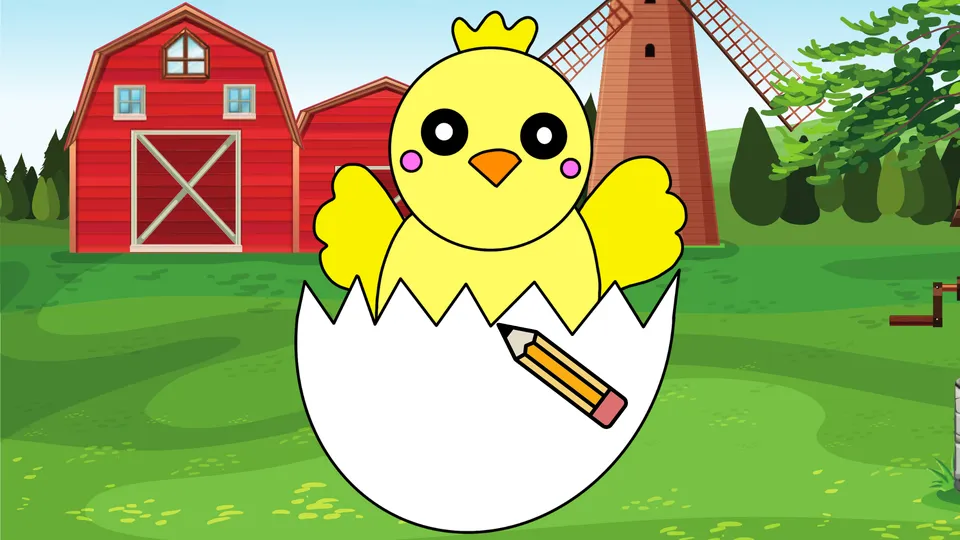
How to Draw: Baby Chick
Ages 5–10 · 5 minutes · Art
An egg-cellent beginner drawing lesson
Required materials: pencil, paper, coloring utensils (optional)
In this step-by-step directed drawing, students will be guided through a baby chicken drawing.
Part of
Standards alignment
Alabama
- ELA21.K.33 — Express ideas orally and connect these ideas through drawing and emergent writing.
- MA19.K.22 — Model shapes in the world by building them from sticks, clay balls, or other components and by drawing them.
- MA19.K.23 — Use simple shapes to compose larger shapes.
Alaska
- K.G.5 — Build shapes (e.g., using sticks and clay) and draw shapes.
Arizona
- K.G.B.5 — Model shapes in the world by building shapes from components (e.g., sticks and clay balls) and drawing shapes.
- K.SL.5 — Add drawings or other visual displays to descriptions as desired to provide additional detail.
Arkansas
- K.GM.1 — Describe the positions of objects and geometric shapes in the environment. • Terms include: inside, outside, between, above, below, near, far, under, over, up, down, behind, in front of, next to, to the left of, and to the right of
- K.GM.5 — Compose and draw shapes found in the world using objects (e.g., straws, toothpicks, clay balls).
California
- K.G.B.5 — Model shapes in the world by building shapes from components (e.g., sticks and clay balls) and drawing shapes.
Colorado
- RWC20-GR.PS-S.1-GLE.1-EO.c — Follow two- to three-step directions.
- RWC20-GR.PS-S.3-GLE.1-EO.c — Use scribbles, shapes, pictures, and letters to represent objects, stories, experiences, or ideas.
- P.G.A.4 — Compose simple shapes to form larger shapes.
Connecticut
- K.G.B.5 — Model shapes in the world by building shapes from components (e.g., sticks and clay balls) and drawing shapes.
Delaware
- K.G.B.5 — Model shapes in the world by building shapes from components (e.g., sticks and clay balls) and drawing shapes.
- K.G.B.6 — Compose simple shapes to form larger shapes. For example, "Can you join these two triangles with full sides touching to make a rectangle?"
Florida
- SC.K.N.1.4 — Observe and create a visual representation of an object which includes its major features.
- SC.K2.CS-CS.2.6 (Discontinued after 2024-2025) — Illustrate thoughts, ideas, and stories in a step-by-step manner using writing tools, digital cameras, and drawing tools.
Georgia
- K.GSR.8.3 — Use basic shapes to represent specific shapes found in the environment by creating models and drawings.
Hawaii
- K.G.B.5 — Model shapes in the world by building shapes from components (e.g., sticks and clay balls) and drawing shapes.
- K.G.B.6 — Compose simple shapes to form larger shapes.
Idaho
- K.G.B.5 — Model shapes in the world by building shapes from components/materials and drawing shapes.
Illinois
- K.G.B.5 — Model shapes in the world by building shapes from components (e.g., sticks and clay balls) and drawing shapes.
- K.G.B.6 — Compose simple shapes to form larger shapes. For example, "Can you join these two triangles with full sides touching to make a rectangle?"
Indiana
- K.CC.5 — Follow simple two or three-step oral directions.
Iowa
- 1.G.A.2 — Compose two-dimensional shapes (rectangles, squares, trapezoids, triangles, half-circles, and quarter-circles) or threedimensional shapes (cubes, rectangular prisms, cones and cylinders) to create a composite shape, and compose new shapes from the composite shape. Students do not need to learn formal names for these shapes.
- K.G.B.5 — Model shapes in the world by building shapes from components and drawing shapes. For example, sticks and clay balls.
Kansas
- K.G.5 — Model shapes in the world by building shapes from components (e.g. sticks and clay balls) and drawing shapes.
- K.G.6 — Compose simple shapes to form larger shapes.* For example, "Can you join these two triangles with full sides touching to make a rectangle?” *
Kentucky
- KY.K.G.6 — Compose simple shapes to form larger shapes.
Louisiana
- K.G.B.5 — Model shapes in the world by building shapes from components (e.g., sticks and clay balls) and drawing shapes.
Maine
- K.G.B.5 — Model shapes in the world by building shapes from components (e.g., sticks and clay balls) and drawing shapes.
Maryland
- K.G.B.5 — Model shapes in the world by building shapes from components (e.g., sticks and clay balls) and drawing shapes.
- K.G.B.6 — Compose simple shapes to form larger shapes. For example, "Can you join these two triangles with full sides touching to make a rectangle?"
Massachusetts
- K.G.B.5 — Model shapes in the world by building shapes from components (e.g., sticks and clay balls) and drawing shapes.
- SL.PK.5 — Create representations of experiences or stories (e.g., drawings, constructions with blocks or other materials, clay models) and explain them to others.
Michigan
- K.G.B.5 — Model shapes in the world by building shapes from components (e.g., sticks and clay balls) and drawing shapes.
Minnesota
- K.3.1.3 — Use basic shapes and spatial reasoning to model objects in the real-world. For example: A cylinder can be used to model a can of soup. Another example: Find as many rectangles as you can in your classroom. Record the rectangles you found by making drawings.
- K.3.2.1 — Use words to compare objects according to length, size, weight and position. For example: Use same, lighter, longer, above, between and next to. Another example: Identify objects that are near your desk and objects that are in front of it. Explain why there may be some objects in both groups.
Missouri
- 1.SL.1.A.c — following two-step instructions, according to classroom expectations
- 2.SL.1.A.b — following three-step instructions, according to classroom expectations
- K.GM.C.9 — Draw or model simple two-dimensional shapes.
Montana
- K.G.B.5 — Model shapes in the world from a variety of cultural contexts, including those of Montana American Indians, by building shapes from components (e.g., sticks and clay balls) and drawing shapes.
Nebraska
- LA.2.SL.1.e — Complete a task following multi-step directions.
- LA.1.SL.1.e — Complete a task following one/two-step directions.
Nevada
- K.G.B.5 — Model shapes in the world by building shapes from components (e.g., sticks and clay balls) and drawing shapes.
New Hampshire
- K.G.B.5 — Model shapes in the world by building shapes from components (e.g., sticks and clay balls) and drawing shapes.
New Jersey
- K.G.B.5 — Model shapes in the world by building shapes from components (e.g., sticks and clay balls) and drawing shapes.
New Mexico
- K.G.B.5 — Model shapes in the world by building shapes from components (e.g., sticks and clay balls) and drawing shapes.
- K.G.B.6 — Compose simple shapes to form larger shapes. For example, "Can you join these two triangles with full sides touching to make a rectangle?"
New York
- Use and share pictures, drawings, and/or writings of observations.
North Carolina
- NC.K.G.5 — Model shapes in the world by: • Building and drawing triangles, rectangles, squares, hexagons, circles. • Building cubes, cones, spheres, and cylinders.
- NC.K.G.6 — Compose larger shapes from simple shapes.
North Dakota
- 1.C.7 — Work collaboratively by following agreed-upon rules and simple two- and three-step oral directions and offering one- and two-step verbal directions.
Ohio
- K.G.5 — Model shapes in the world by building shapes from components, e.g., sticks and clay balls, and drawing shapes.
Oklahoma
- K.1.L.2 — Students will follow simple one- and two-step oral directions.
- K.2.W.1 — Students will express themselves through drawing and emergent writing.
- K.2.W.4 — Students will add to their drawing and emergent writing.
Oregon
- K.GM.B.5 — Represent shapes in the world by building shapes from components and drawing shapes.
- K.SL.6 — Speak audibly and express thoughts, feelings, and ideas clearly.
Pennsylvania
- 3.5.3-5.C — Follow directions to complete a technological task.
- 3.5.K-2.P — Discuss that all designs have different characteristics that can be described.
- 3.5.K-2.Q — Apply skills necessary for making in design.
- 3.5.K-2.S — Apply design concepts, principles, and processes through play and exploration
Rhode Island
- K.G.B.5 — Model shapes in the world by building shapes from components (e.g., sticks and clay balls) and drawing shapes.
South Carolina
- K.G.5 — Draw two-dimensional shapes (i.e., square, rectangle, triangle, hexagon, and circle) and create models of three-dimensional shapes (i.e., cone, cube, cylinder, and sphere).
- ELA.K.C.9.1 — Ask and answer questions in conversation on a topic.
South Dakota
- 1.SL.5 — Create drawings or other visual displays when appropriate to clarify ideas, thoughts, and feelings
- K.G.B.5 — Model shapes in the world by building shapes from components (e.g., sticks and clay balls) and drawing shapes.
Tennessee
- K.G.B.5 — Model shapes/solids in the world by building or drawing them.
Texas
- K.6F — create two-dimensional shapes using a variety of materials and drawings.
Utah
- P3.W.5 — With prompting and support, print some age-appropriate prewriting strokes.
- P4.SL.1.b — Follow two-step directions.
Washington
- K.G.B.5 — Model shapes in the world by building shapes from components (e.g., sticks and clay balls) and drawing shapes.
- 1.G.A.2 — Compose two-dimensional shapes (rectangles, squares, trapezoids, triangles, half-circles, and quarter-circles) or three-dimensional shapes (cubes, right rectangular prisms, right circular cones, and right circular cylinders) to create a composite shape, and compose new shapes from the composite shape.
Washington, D.C.
- K.G.B.5 — Model shapes in the world by building shapes from components (e.g., sticks and clay balls) and drawing shapes.
- K.G.A.1 — Describe objects in the environment using names of shapes, and describe the relative positions of these objects using terms such as above, below, beside, in front of, behind, and next to.
West Virginia
- ELA.PK.WR.EW.1 — Use scribbles, shapes, pictures, and letters to represent objects, stories, experiences, or ideas.
- ELA.PK.WR.EW.5 — Experiment with a variety of writing tools and materials (ex: pencils, chalk, markers, sand, developmentally appropriate technology)
Wisconsin
- M.K.G.B.5 — Model shapes in the world by building shapes from components (e.g., sticks and clay balls) and drawing shapes.
Wyoming
- K.G.I.5 — Model shapes in the world by building shapes from components (e.g., sticks and clay balls) and drawing shapes.