Sequences and Triangle Numbers
Ages 6–10 · 9 minutes · Math
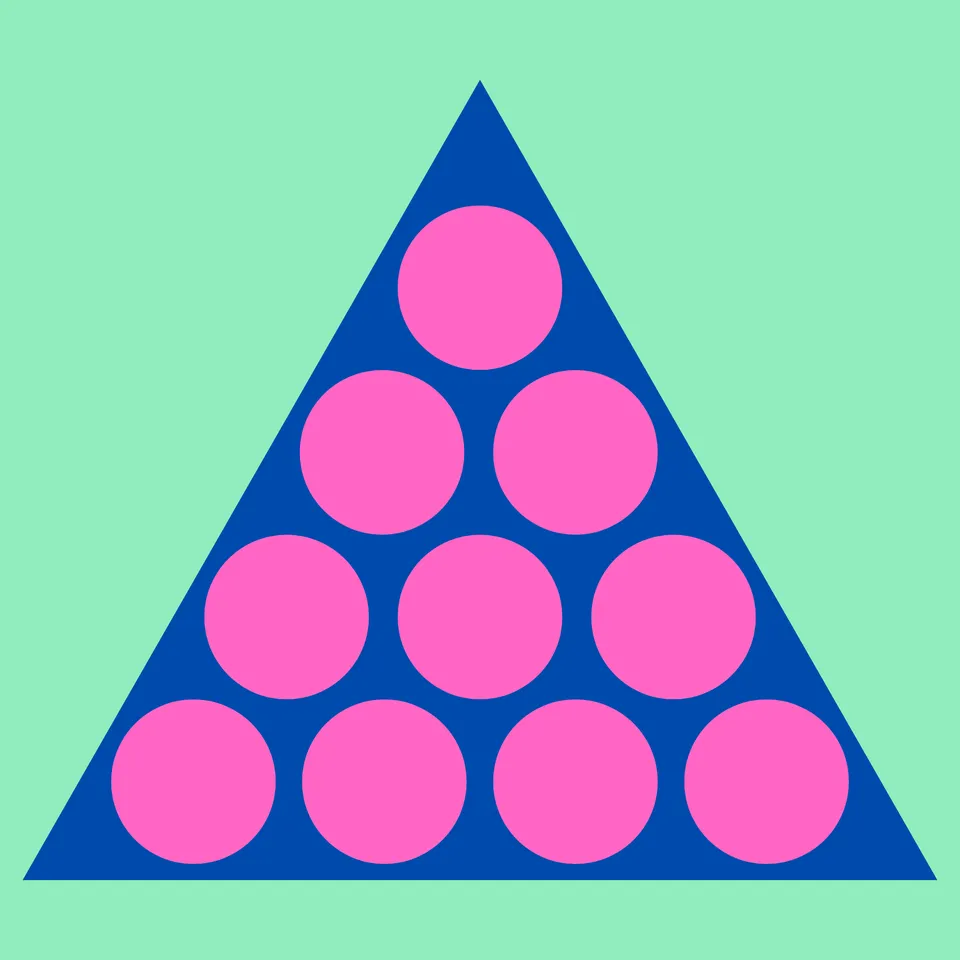
What do the numbers 1, 3, 6, and 10 have in common? And what comes next?
The numbers 1, 3, 6, and 10 form the start of a mathematical pattern. Students explore where this pattern comes from, where it goes next, and how it is tied to a very familiar shape. No background knowledge is required.
There is even a bonus challenge at the end with a follow up lesson!
Part of
Standards alignment
Common Core State Standards
- 4.OA.C.5 — Generate a number or shape pattern that follows a given rule. Identify apparent features of the pattern that were not explicit in the rule itself. For example, given the rule "Add 3" and the starting number 1, generate terms in the resulting sequence and observe that the terms appear to alternate between odd and even numbers. Explain informally why the numbers will continue to alternate in this way.
- 3.OA.D.9 — Identify arithmetic patterns (including patterns in the addition table or multiplication table), and explain them using properties of operations. For example, observe that 4 times a number is always even, and explain why 4 times a number can be decomposed into two equal addends.
- MP7 — Look for and make use of structure.
- 1.G.A.1 — Distinguish between defining attributes (e.g., triangles are closed and three-sided) versus non-defining attributes (e.g., color, orientation, overall size); build and draw shapes to possess defining attributes.
Alabama
- MA19.1.9 — Reproduce, extend, and create patterns and sequences of numbers using a variety of materials.
- MA19.2.5 — Reproduce, extend, create, and describe patterns and sequences using a variety of materials.
- MA19.4.5 — Generate and analyze a number or shape pattern that follows a given rule.
- MA19.1.21a — Distinguish between defining attributes and non-defining attributes.
Alaska
- 2.OA.5 — Identify, continue and label number patterns (e.g., aabb, abab). Describe a rule that determines and continues a sequence or pattern.
- 1.OA.9 — Identify, continue and label patterns (e.g., aabb, abab). Create patterns using number, shape, size, rhythm or color.
- 4.OA.6 — Extend patterns that use addition, subtraction, multiplication, division or symbols, up to 10 terms, represented by models (function machines), tables, sequences, or in problem situations.
- 7. — Look for and make use of structure.
- 1.G.1 — Distinguish between defining attributes (e.g., triangles are closed and three-sided) versus non-defining attributes. Identify shapes that have non-defining attributes (e.g., color, orientation, overall size). Build and draw shapes given specified attributes.
Arizona
- 4.OA.C.5 — Generate a number pattern that follows a given rule. Identify apparent features of the pattern that were not explicit in the rule itself and explain the pattern informally (e.g., given the rule “add 3” and the starting number 1, generate terms in the resulting sequence and observe that the terms appear to alternate between odd and even numbers).
- MP7 — Look for and make use of structure.
- 3.OA.D.9 — Identify arithmetic patterns (including patterns in the addition table or multiplication table), and explain them using properties of operations. For example, observe that 4 times a number is always even, and explain why 4 times a number can be decomposed into two equal addends.
- MP8 — Look for and express regularity in repeated reasoning.
- 1.G.A.1 — Distinguish between defining attributes (triangles are closed and 3 sided) versus non-defining attributes (color, orientation, overall size) for two-dimensional shapes; build and draw shapes that possess defining attributes.
Arkansas
- 4.CAR.11 — Generate a number or shape pattern that follows a given rule, identifying apparent features of the pattern that are not explicit in the rule itself.
- 3.CAR.5 — Identify arithmetic patterns including, but not limited to, patterns in an addition or multiplication table, explaining use of properties of operations appropriate to the pattern.
- 1.GM.1 — Understand the difference between defining attributes (e.g., triangles are closed and three-sided shapes) and non-defining attributes (e.g., color, orientation, overall size), using that understanding to build and draw shapes that exhibit defining attributes.
California
- 4.OA.C.5 — Generate a number or shape pattern that follows a given rule. Identify apparent features of the pattern that were not explicit in the rule itself. For example, given the rule "Add 3" and the starting number 1, generate terms in the resulting sequence and observe that the terms appear to alternate between odd and even numbers. Explain informally why the numbers will continue to alternate in this way.
- MP7 — Look for and make use of structure.
- MP8 — Look for and express regularity in repeated reasoning.
- 1.G.A.1 — Distinguish between defining attributes (e.g., triangles are closed and three-sided) versus non-defining attributes (e.g., color, orientation, overall size); build and draw shapes to possess defining attributes.
Colorado
- 4.OA.C.5 — Generate a number or shape pattern that follows a given rule. Identify apparent features of the pattern that were not explicit in the rule itself. For example, given the rule “Add 3” and the starting number 1, generate terms in the resulting sequence and observe that the terms appear to alternate between odd and even numbers. Explain informally why the numbers will continue to alternate in this way.
- 3.OA.D.9 — Identify arithmetic patterns (including patterns in the addition table or multiplication table) and explain them using properties of operations. For example, observe that 4 times a number is always even, and explain why 4 times a number can be decomposed into two equal addends.
- 1.G.A.1 — Distinguish between defining attributes (e.g., triangles are closed and three- sided) versus non-defining attributes (e.g., color, orientation, overall size); build and draw shapes to possess defining attributes.
Connecticut
- MP7 — Look for and make use of structure.
- 3.OA.D.9 — Identify arithmetic patterns (including patterns in the addition table or multiplication table), and explain them using properties of operations. For example, observe that 4 times a number is always even, and explain why 4 times a number can be decomposed into two equal addends.
- 4.OA.C.5 — Generate a number or shape pattern that follows a given rule. Identify apparent features of the pattern that were not explicit in the rule itself. For example, given the rule "Add 3" and the starting number 1, generate terms in the resulting sequence and observe that the terms appear to alternate between odd and even numbers. Explain informally why the numbers will continue to alternate in this way.
- MP8 — Look for and express regularity in repeated reasoning.
Delaware
- 4.OA.C.5 — Generate a number or shape pattern that follows a given rule. Identify apparent features of the pattern that were not explicit in the rule itself. For example, given the rule "Add 3" and the starting number 1, generate terms in the resulting sequence and observe that the terms appear to alternate between odd and even numbers. Explain informally why the numbers will continue to alternate in this way.
- 3.OA.D.9 — Identify arithmetic patterns (including patterns in the addition table or multiplication table), and explain them using properties of operations. For example, observe that 4 times a number is always even, and explain why 4 times a number can be decomposed into two equal addends.
- MP7 — Look for and make use of structure.
- MP8 — Look for and express regularity in repeated reasoning.
- 1.G.A.1 — Distinguish between defining attributes (e.g., triangles are closed and three-sided) versus non-defining attributes (e.g., color, orientation, overall size); build and draw shapes to possess defining attributes.
Florida
- MA.3.AR.3.3 — Identify, create and extend numerical patterns.
- MA.4.AR.3.2 — Generate, describe and extend a numerical pattern that follows a given rule.
- MA.K12.MTR.2.1 — Demonstrate understanding by representing problems in multiple ways. Mathematicians who demonstrate understanding by representing problems in multiple ways: • Build understanding through modeling and using manipulatives. • Represent solutions to problems in multiple ways using objects, drawings, tables, graphs and equations. • Progress from modeling problems with objects and drawings to using algorithms and equations. • Express connections between concepts and representations. • Choose a representation based on the given context or purpose.
- MA.K12.MTR.5.1 — Use patterns and structure to help understand and connect mathematical concepts. Mathematicians who use patterns and structure to help understand and connect mathematical concepts: • Focus on relevant details within a problem. • Create plans and procedures to logically order events, steps or ideas to solve problems. • Decompose a complex problem into manageable parts. • Relate previously learned concepts to new concepts. • Look for similarities among problems. • Connect solutions of problems to more complicated large-scale situations.
Georgia
- 1.PAR.3.2 — Identify, describe, and create growing, shrinking, and repeating patterns based on the repeated addition or subtraction of 1s, 2s, 5s, and 10s.
- 2.PAR.4.2 — Identify, describe, and create growing patterns and shrinking patterns involving addition and subtraction up to 20.
- 1.PAR.3.1 — Investigate, create, and make predictions about repeating patterns with a core of up to 3 elements resulting from repeating an operation, as a series of shapes, or a number string.
- 2.PAR.4 — Identify, describe, extend, and create repeating patterns, growing patterns, and shrinking patterns.
Hawaii
- 4.OA.C.5 — Generate a number or shape pattern that follows a given rule. Identify apparent features of the pattern that were not explicit in the rule itself.
- 3.OA.D.9 — Identify arithmetic patterns (including patterns in the addition table or multiplication table), and explain them using properties of operations.
- MP7 — Look for and make use of structure.
- MP8 — Look for and express regularity in repeated reasoning.
Idaho
- 3.OA.D.9 — Identify arithmetic patterns (including patterns in the addition table or multiplication table) and explain them using properties of operations.
- 3.MP.7 — Look for and make use of structure.
- 4.OA.C.5 — Generate a number or shape pattern that follows a given rule. Identify and explain features of the pattern that were not explicit in the rule itself.
- 1.G.A.1 — Compare defining attributes and non-defining attributes of two- and three-dimensional shapes; build and draw shapes that possess defining attributes.
Illinois
- 4.OA.C.5 — Generate a number or shape pattern that follows a given rule. Identify apparent features of the pattern that were not explicit in the rule itself. For example, given the rule "Add 3" and the starting number 1, generate terms in the resulting sequence and observe that the terms appear to alternate between odd and even numbers. Explain informally why the numbers will continue to alternate in this way.
- MP.7 — Look for and make use of structure.
- 3.OA.D.9 — Identify arithmetic patterns (including patterns in the addition table or multiplication table), and explain them using properties of operations. For example, observe that 4 times a number is always even, and explain why 4 times a number can be decomposed into two equal addends.
- MP.8 — Look for and express regularity in repeated reasoning.
- 1.G.A.1 — Distinguish between defining attributes (e.g., triangles are closed and three-sided) versus non-defining attributes (e.g., color, orientation, overall size); build and draw shapes to possess defining attributes.
Indiana
- 1.CA.4 — Create, extend, and give an appropriate rule for number patterns using addition within 100.
- K.CA.4 — Create, extend, and give an appropriate rule for simple repeating and growing patterns with numbers and shapes.
- 3.CA.8 — Create, extend, and give an appropriate rule for number patterns within 100 (including patterns in the addition table or multiplication table).
- 2.G.1 — Identify, describe, and classify two- and three-dimensional shapes (i.e., triangle, square, rectangle, cube, right rectangular prism) according to the number and shape of faces and the number of sides and/or vertices. Draw two-dimensional shapes.
- PS.8 — Look for and express regularity in repeated reasoning.
Iowa
- 3.OA.D.9 — Identify arithmetic patterns (including patterns in the addition table or multiplication table), and explain them using properties of operations. For example, observe that 4 times a number is always even, and explain why 4 times a number can be decomposed into two equal addends.
- 4.OA.C.5 — Given the rule for a sequence of numbers, identify apparent features of the sequence that were not explicit in the rule itself; explain informally why the numbers will continue to alternate in this way. For example, given the rule "Add 3" and the number sequence 1, 4, 7, 10, 13 observe that the terms appear to alternate between odd and even numbers;
- SMP7 — Look for and make use of structure.
- SMP8 — Look for and express regularity in repeated reasoning.
Kansas
- 4.OA.5 — Generate a number or shape pattern that follows a given rule. Identify apparent features of the pattern that were not explicit in the rule itself. For example, given the rule “Add 3” and the starting number 1, generate terms in the resulting sequence and observe that the terms appear to alternate between odd and even numbers. Explain informally why the numbers will continue to alternate in this way.
- 2.NBT.2 — Count within 1000; skip-count by 2s, 5s, 10s, and 100s; explain and generalize the patterns.
- 3.OA.9 — Identify arithmetic patterns (including patterns in the addition table or multiplication table), and explain them using properties of operations. For example, observe that 4 times a number is always even, and explain why 4 times a number can be decomposed into two equal addends.
- MP.7 — Look for and make use of structure.
- 1.G.1 — Distinguish between defining attributes (e.g. triangles are closed and three-sided) versus non-defining attributes (e.g. color, orientation, overall size); build and draw shapes that possess defining attributes.
Kentucky
- KY.4.OA.5 — Generate a number or shape pattern that follows a given rule. Identify apparent features of the pattern not explicit in the rule itself.
- MP8 — Look for and express regularity in repeated reasoning.
- KY.1.G.1 — Distinguish between defining attributes versus non-defining attributes; build and draw shapes to possess defining attributes.
Louisiana
- 4.OA.C.5 — Generate a number or shape pattern that follows a given rule. Identify apparent features of the pattern that were not explicit in the rule itself. For example, given the rule "Add 3" and the starting number 1, generate terms in the resulting sequence and observe that the terms appear to alternate between odd and even numbers. Explain informally why the numbers will continue to alternate in this way.
- MP7 — Look for and make use of structure.
- 3.OA.D.9 — Identify arithmetic patterns (including patterns in the addition table or multiplication table), and explain them using properties of operations. For example, observe that 4 times a number is always even, and explain why 4 times a number can be decomposed into two equal addends.
- MP8 — Look for and express regularity in repeated reasoning.
- 1.G.A.1 — Distinguish between defining attributes (e.g., triangles are closed and three-sided) versus non-defining attributes (e.g., color, orientation, overall size); build and draw shapes that possess defining attributes.
Maine
- 4.OA.C.5 — Generate a number or shape pattern that follows a given rule. Identify apparent features of the pattern that were not explicit in the rule itself. For example, given the rule "Add 3" and the starting number 1, generate terms in the resulting sequence and observe that the terms appear to alternate between odd and even numbers. Explain informally why the numbers will continue to alternate in this way.
- 3.OA.D.9 — Identify arithmetic patterns (including patterns in the addition table or multiplication table) and explain them using properties of operations. For example, observe that 4 times a number is always even, and explain why 4 times a number can be decomposed into two equal addends.
- 1.G.A.1 — Distinguish between defining attributes (e.g., triangles are closed and three-sided) versus non-defining attributes (e.g., color, orientation, overall size); build and draw shapes to possess defining attributes.
Maryland
- 4.OA.C.5 — Generate a number or shape pattern that follows a given rule. Identify apparent features of the pattern that were not explicit in the rule itself. For example, given the rule "Add 3" and the starting number 1, generate terms in the resulting sequence and observe that the terms appear to alternate between odd and even numbers. Explain informally why the numbers will continue to alternate in this way.
- 3.OA.D.9 — Identify arithmetic patterns (including patterns in the addition table or multiplication table), and explain them using properties of operations. For example, observe that 4 times a number is always even, and explain why 4 times a number can be decomposed into two equal addends.
- MP7 — Look for and make use of structure.
- 1.G.A.1 — Distinguish between defining attributes (e.g., triangles are closed and three-sided) versus non-defining attributes (e.g., color, orientation, overall size); build and draw shapes to possess defining attributes.
- MP8 — Look for and express regularity in repeated reasoning.
Massachusetts
- 4.OA.C.5 — Generate a number or shape pattern that follows a given rule. Identify apparent features of the pattern that were not explicit in the rule itself. For example, given the rule "Add 3" and the starting number 1, generate terms in the resulting sequence and observe that the terms appear to alternate between odd and even numbers. Explain informally why the numbers will continue to alternate in this way.
- 3.OA.D.9 — Identify arithmetic patterns (including patterns in the addition table or multiplication table) and explain them using properties of operations. For example, observe that 4 times a number is always even, and explain why 4 times a number can be decomposed into two equal addends.
- MP.8 — Look for and express regularity in repeated reasoning.
- 1.G.A.1 — Distinguish between defining attributes (e.g., triangles are closed and three-sided) versus non-defining attributes (e.g., color, orientation, overall size); build and draw shapes that possess defining attributes.
Michigan
- 4.OA.C.5 — Generate a number or shape pattern that follows a given rule. Identify apparent features of the pattern that were not explicit in the rule itself. For example, given the rule "Add 3" and the starting number 1, generate terms in the resulting sequence and observe that the terms appear to alternate between odd and even numbers. Explain informally why the numbers will continue to alternate in this way.
- MP7 — Look for and make use of structure.
- 3.OA.D.9 — Identify arithmetic patterns (including patterns in the addition table or multiplication table), and explain them using properties of operations. For example, observe that 4 times a number is always even, and explain why 4 times a number can be decomposed into two equal addends.
- MP8 — Look for and express regularity in repeated reasoning.
- 1.G.A.1 — Distinguish between defining attributes (e.g., triangles are closed and three-sided) versus non-defining attributes (e.g., color, orientation, overall size); build and draw shapes to possess defining attributes.
Minnesota
- 1.2.1.1 — Create simple patterns using objects, pictures, numbers and rules. Identify possible rules to complete or extend patterns. Patterns may be repeating, growing or shrinking. Calculators can be used to create and explore patterns. For example: Describe rules that can be used to extend the pattern 2, 4, 6, 8, □, □, □ and complete the pattern 33, 43, □, 63, □, 83 or 20, □, □, 17.
- 2.2.1.1 — Identify, create and describe simple number patterns involving repeated addition or subtraction, skip counting and arrays of objects such as counters or tiles. Use patterns to solve problems in various contexts. For example: Skip count by 5s beginning at 3 to create the pattern 3, 8, 13, 18, … . Another example: Collecting 7 empty milk cartons each day for 5 days will generate the pattern 7, 14, 21, 28, 35, resulting in a total of 35 milk cartons.
- K.2.1.1 — Identify, create, complete, and extend simple patterns using shape, color, size, number, sounds and movements. Patterns may be repeating, growing or shrinking such as ABB, ABB, ABB or ●,●●,●●●.
- 1.3.1.1 — Describe characteristics of two- and three-dimensional objects, such as triangles, squares, rectangles, circles, rectangular prisms, cylinders, cones and spheres.
Mississippi
- 4.OA.5 — Generate a number or shape pattern that follows a given rule. Identify apparent features of the pattern that were not explicit in the rule itself. For example, given the rule “Add 3” and the starting number 1, generate terms in the resulting sequence and observe that the terms appear to alternate between odd and even numbers. Explain informally why the numbers will continue to alternate in this way.
- 3.OA.9 — Identify arithmetic patterns (including patterns in the addition table or multiplication table), and explain them using properties of operations. For example, observe that 4 times a number is always even, and explain why 4 times a number can be decomposed into two equal addends.
- MP7 — Look for and make use of structure.
- 1.G.1 — Distinguish between defining attributes (e.g., triangles are closed and three-sided) versus non-defining attributes (e.g., color, orientation, overall size); build and draw shapes to possess defining attributes.
- MP8 — Look for and express regularity in repeated reasoning.
Missouri
- 3.RA.E.11 — Identify arithmetic patterns and explain the patterns using properties of operations.
- 4.RA.C.6 — Generate a number pattern that follows a given rule.
- 1.GM.A.1 — Distinguish between defining attributes versus non-defining attributes; build and draw shapes that possess defining attributes.
- 4.RA.C.7 — Use words or mathematical symbols to express a rule for a given pattern.
Montana
- 4.OA.C.5 — Generate a number or shape pattern that follows a given rule. Identify apparent features of the pattern that were not explicit in the rule itself. For example, given the rule "Add 3" and the starting number 1, generate terms in the resulting sequence and observe that the terms appear to alternate between odd and even numbers. Explain informally why the numbers will continue to alternate in this way.
- 3.OA.D.9 — Identify arithmetic patterns (including patterns in the addition table or multiplication table), and explain them using properties of operations. For example, observe that 4 times a number is always even, and explain why 4 times a number can be decomposed into two equal addends.
- MP7 — Look for and make use of structure.
- MP8 — Look for and express regularity in repeated reasoning.
Nebraska
- 1.N.2.d — Understand patterns of skip counting by 2s, 5s, and 10s.
- 1.N.4.a — Add and subtract within 20, using flexible strategies such as counting on or counting back, making ten, using ten, and using doubles and near doubles.
- 2.G.1.b — Recognize and draw two-dimensional shapes having a specific number of sides, angles, and vertices including triangles, quadrilaterals, pentagons, and hexagons.
Nevada
- 4.OA.C.5 — Generate a number or shape pattern that follows a given rule. Identify apparent features of the pattern that were not explicit in the rule itself. For example, given the rule "Add 3" and the starting number 1, generate terms in the resulting sequence and observe that the terms appear to alternate between odd and even numbers. Explain informally why the numbers will continue to alternate in this way.
- 3.OA.D.9 — Identify arithmetic patterns (including patterns in the addition table or multiplication table), and explain them using properties of operations. For example, observe that 4 times a number is always even, and explain why 4 times a number can be decomposed into two equal addends.
- MP7 — Look for and make use of structure.
- 1.G.A.1 — Distinguish between defining attributes (e.g., triangles are closed and three-sided) versus non-defining attributes (e.g., color, orientation, overall size); build and draw shapes to possess defining attributes.
New Hampshire
- 4.OA.C.5 — Generate a number or shape pattern that follows a given rule. Identify apparent features of the pattern that were not explicit in the rule itself. For example, given the rule "Add 3" and the starting number 1, generate terms in the resulting sequence and observe that the terms appear to alternate between odd and even numbers. Explain informally why the numbers will continue to alternate in this way.
- 3.OA.D.9 — Identify arithmetic patterns (including patterns in the addition table or multiplication table), and explain them using properties of operations. For example, observe that 4 times a number is always even, and explain why 4 times a number can be decomposed into two equal addends.
- MP7 — Look for and make use of structure.
- MP8 — Look for and express regularity in repeated reasoning.
New Jersey
- 4.OA.C.5 — Generate a number or shape pattern that follows a given rule. Identify apparent features of the pattern that were not explicit in the rule itself. For example, given the rule “Add 3” and the starting number 1, generate terms in the resulting sequence and observe that the terms appear to alternate between odd and even numbers. Explain informally why the numbers will continue to alternate in this way
- 7 — Look for and make use of structure.
- 3.OA.D.9 — Identify arithmetic patterns (including patterns in the addition table or multiplication table), and explain them using properties of operations. For example, observe that 4 times a number is always even, and explain why 4 times a number can be decomposed into two equal addends.
- 8 — Look for and express regularity in repeated reasoning.
- 1.G.A.1 — Distinguish between defining attributes (e.g., triangles are closed and three-sided) versus non-defining attributes (e.g., color, orientation, overall size); build and draw shapes to possess defining attributes.
New Mexico
- 4.OA.C.5 — Generate a number or shape pattern that follows a given rule. Identify apparent features of the pattern that were not explicit in the rule itself. For example, given the rule "Add 3" and the starting number 1, generate terms in the resulting sequence and observe that the terms appear to alternate between odd and even numbers. Explain informally why the numbers will continue to alternate in this way.
- 3.OA.D.9 — Identify arithmetic patterns (including patterns in the addition table or multiplication table), and explain them using properties of operations. For example, observe that 4 times a number is always even, and explain why 4 times a number can be decomposed into two equal addends.
- MP7 — Look for and make use of structure.
- MP8 — Look for and express regularity in repeated reasoning.
New York
- NY-4.OA.5 — Generate a number or shape pattern that follows a given rule. Identify and informally explain apparent features of the pattern that were not explicit in the rule itself.
- MP.7 — Look for and make use of structure.
- MP.8 — Look for and express regularity in repeated reasoning.
- NY-3.OA.9 — Identify and extend arithmetic patterns (including patterns in the addition table or multiplication table).
North Carolina
- NC.4.OA.5 — Generate and analyze a number or shape pattern that follows a given rule.
- MP.8 — Look for and express regularity in repeated reasoning.
- NC.1.G.1 — Distinguish between defining and non-defining attributes and create shapes with defining attributes by: • Building and drawing triangles, rectangles, squares, trapezoids, hexagons, circles. • Building cubes, rectangular prisms, cones, spheres, and cylinders.
North Dakota
- 1.AR.OA.7 — Identify, create, complete, and extend patterns that are repeating, increasing, and decreasing in a variety of contexts.
- 2.NO.CC.4 — Skip count forward and backward by 2s and 100s and recognize the patterns of skip counts.
- 4.AR.OA.6 — Generate a number or shape pattern that follows a given rule while identifying apparent features of the pattern that were not explicit in the rule itself.
Ohio
- 4.OA.5 — Generate a number or shape pattern that follows a given rule. Identify apparent features of the pattern that were not explicit in the rule itself. For example, given the rule “Add 3” and the starting number 1, generate terms in the resulting sequence and observe that the terms appear to alternate between odd and even numbers. Explain informally why the numbers will continue to alternate in this way.
- 3.OA.9 — Identify arithmetic patterns (including patterns in the addition table or multiplication table), and explain them using properties of operations. For example, observe that 4 times a number is always even, and explain why 4 times a number can be decomposed into two equal addends.
- MP.7 — Look for and make use of structure.
- MP.8 — Look for and express regularity in repeated reasoning.
- 1.G.1 — Distinguish between defining attributes, e.g., triangles are closed and three-sided, versus non-defining attributes, e.g., color, orientation, overall size; build and draw shapes that possess defining attributes.
Oklahoma
- 1.A.1.1 — Identify, create, complete, and extend repeating, increasing, and decreasing patterns in a variety of contexts (e.g., quantity, numbers, or shapes).
- 2.A.1.1 — Represent, create, describe, complete, and extend increasing and decreasing patterns with quantity and numbers in a variety of contexts.
- 3.A.1.3 — Explore and develop visual representations of increasing and decreasing geometric patterns and construct the next steps.
- 3.A.1.1 — Create, describe, and extend patterns involving addition, subtraction, or multiplication to solve problems in a variety of contexts.
Oregon
- 4.OA.C.5 — Analyze a number, visual, or contextual pattern that follows a given rule.
- 3.OA.D.9 — Identify and explain arithmetic patterns using properties of operations, including patterns in the addition table or multiplication table.
- MP7 — Look for and make use of structure.
- MP8 — Look for and express regularity in repeated reasoning
Pennsylvania
- CC.2.2.4.A.4 — Generate and analyze patterns using one rule.
- Look for and express regularity in repeated reasoning.
- CC.2.2.3.A.4 — Solve problems involving the four operations, and identify and explain patterns in arithmetic.
- CC.2.3.3.A.1 — Identify, compare, and classify shapes and their attributes.
Rhode Island
- 4.OA.C.5 — Generate a number or shape pattern that follows a given rule. Identify apparent features of the pattern that were not explicit in the rule itself. For example, given the rule "Add 3" and the starting number 1, generate terms in the resulting sequence and observe that the terms appear to alternate between odd and even numbers. Explain informally why the numbers will continue to alternate in this way.
- MP7 — Look for and make use of structure.
- 3.OA.D.9 — Identify arithmetic patterns (including patterns in the addition table or multiplication table), and explain them using properties of operations. For example, observe that 4 times a number is always even, and explain why 4 times a number can be decomposed into two equal addends.
- MP8 — Look for and express regularity in repeated reasoning.
- 1.G.A.1 — Distinguish between defining attributes (e.g., triangles are closed and three-sided) versus non-defining attributes (e.g., color, orientation, overall size); build and draw shapes to possess defining attributes.
South Carolina
- 1.ATO.9b — Create, extend and explain using pictures and words for growing patterns (between 2 and 4 terms/figures).
- 1.ATO.9a — Create, extend and explain using pictures and words for repeating patterns (e.g., AB, AAB, ABB, and ABC type patterns).
- 3.ATO.9 — Identify a rule for an arithmetic pattern (e.g., patterns in the addition table or multiplication table).
- 3.PS.7 — Identify and utilize structure and patterns.
- 4.ATO.5 — Generate a number or shape pattern that follows a given rule and determine a term that appears later in the sequence.
South Dakota
- 4.OA.C.5 — Generate a number or shape pattern that follows a given rule. Identify apparent features of the pattern that were not explicit in the rule itself. For example, given the rule "Add 3" and the starting number 1, generate terms in the resulting sequence and observe that the terms appear to alternate between odd and even numbers. Explain informally why the numbers will continue to alternate in this way.
- MP7 — Look for and make use of structure.
- 3.OA.D.9 — Identify arithmetic patterns (including patterns in the addition table or multiplication table), and explain them using properties of operations. For example, observe that 4 times a number is always even, and explain why 4 times a number can be decomposed into two equal addends.
- MP8 — Look for and express regularity in repeated reasoning.
Tennessee
- 4.OA.C.5 — Generate a number or shape pattern that follows a given rule. Identify apparent features of the pattern that were not explicit in the rule itself. For example, given the rule "Add 3" and the starting number 1, generate terms in the resulting sequence and observe that the terms appear to alternate between odd and even numbers. Explain informally why the numbers will continue to alternate in this way.
- 2.NBT.A.2 — Recognize, describe, extend, and create patterns when counting by ones, twos, fives, tens, and hundreds and use those patterns to predict the next number in the counting sequence up to 1000 through counting. For example: 111, 113, 115, ...; 82, 84, 86, ...; 370, 380, 390. ; 100, 200, 300,…; etc.
- 1.G.A.1 — Distinguish between attributes that define a shape (e.g., number of sides and vertices) versus attributes that do not define the shape (e.g., color, orientation, overall size); build and draw two-dimensional shapes to possess defining attributes.
- K.CC.A.4 — Recognize, describe, extend, and create patterns and explain a simple rule for a pattern using concrete materials. Analyze the structure of the repeating pattern by identifying the unit (core) of the pattern.
Texas
- 1.5B — skip count by twos, fives, and tens to determine the total number of objects up to 120 in a set;
- 1.6D — identify two-dimensional shapes, including circles, triangles, rectangles, and squares, as special rectangles, rhombuses, and hexagons and describe their attributes using formal geometric language;
- 2.4A — recall basic facts to add and subtract within 20 with automaticity;
Utah
- 4.OA.5 — Generate a number or shape pattern that follows a given rule. Identify apparent features of the pattern that were not explicit in the rule itself. For example, given the rule "add 3" and the starting number 1, generate terms in the resulting sequence and observe that the terms appear to alternate between odd and even numbers. Explain informally why the numbers will continue to alternate in this way.
- 3.OA.9 — Identify arithmetic patterns (including patterns in the addition table or multiplication table), and explain them using properties of operations. For example, observe that four times a number is always even, and explain why four times a number can be decomposed into two equal addends.
- 4.MP.7 — Look for and make use of structure.
- 4.MP.8 — Look for and express regularity in repeated reasoning.
- 1.G.1 — Distinguish between defining attributes (for example, triangles are closed and three-sided) versus non-defining attributes (for example, color, orientation, overall size); build and draw shapes that possess defining attributes.
Vermont
- 4.OA.C.5 — Generate a number or shape pattern that follows a given rule. Identify apparent features of the pattern that were not explicit in the rule itself. For example, given the rule "Add 3" and the starting number 1, generate terms in the resulting sequence and observe that the terms appear to alternate between odd and even numbers. Explain informally why the numbers will continue to alternate in this way.
- 3.OA.D.9 — Identify arithmetic patterns (including patterns in the addition table or multiplication table), and explain them using properties of operations. For example, observe that 4 times a number is always even, and explain why 4 times a number can be decomposed into two equal addends.
- MP7 — Look for and make use of structure.
- MP8 — Look for and express regularity in repeated reasoning.
- 1.G.A.1 — Distinguish between defining attributes (e.g., triangles are closed and three-sided) versus non-defining attributes (e.g., color, orientation, overall size); build and draw shapes to possess defining attributes.
Virginia
- 2.PFA.1a — Identify and describe repeating and increasing patterns.
- 2.PFA.1b — Analyze a repeating or increasing pattern and generalize the change to extend the pattern using objects, pictures, and numbers.
- 2.PFA.1d — Transfer a given repeating or increasing pattern from one form to another (e.g., objects, pictures, numbers) and explain the connection between the two patterns.
- 3.PFA.1b — Analyze an increasing or decreasing pattern and generalize the change to extend the pattern or identify missing terms using various representations.
- 1.MG.2a — Describe triangles, squares, and rectangles using the terms sides, vertices, and angles. Describe a circle using terms such as round and curved.
Washington
- 4.OA.C.5 — Generate a number or shape pattern that follows a given rule. Identify apparent features of the pattern that were not explicit in the rule itself. For example, given the rule "Add 3" and the starting number 1, generate terms in the resulting sequence and observe that the terms appear to alternate between odd and even numbers. Explain informally why the numbers will continue to alternate in this way.
- 3.OA.D.9 — Identify arithmetic patterns (including patterns in the addition table or multiplication table), and explain them using properties of operations. For example, observe that 4 times a number is always even, and explain why 4 times a number can be decomposed into two equal addends.
- MP7 — Look for and make use of structure.
- MP8 — Look for and express regularity in repeated reasoning.
- 1.G.A.1 — Distinguish between defining attributes (e.g., triangles are closed and three-sided) versus non-defining attributes (e.g., color, orientation, overall size); build and draw shapes to possess defining attributes.
Washington, D.C.
- 4.OA.C.5 — Generate a number or shape pattern that follows a given rule. Identify apparent features of the pattern that were not explicit in the rule itself. For example, given the rule "Add 3" and the starting number 1, generate terms in the resulting sequence and observe that the terms appear to alternate between odd and even numbers. Explain informally why the numbers will continue to alternate in this way.
- 3.OA.D.9 — Identify arithmetic patterns (including patterns in the addition table or multiplication table), and explain them using properties of operations. For example, observe that 4 times a number is always even, and explain why 4 times a number can be decomposed into two equal addends.
- MP7 — Look for and make use of structure.
- MP8 — Look for and express regularity in repeated reasoning.
West Virginia
- M.2.3 — Analyze a number pattern to determine the rule: add 2, add 3, add 5, or add 10.
- MHM7 — Look for and make use of structure.
- M.4.5 — Generate a number pattern that follows a given rule. Identify apparent features of the pattern that were not explicit in the rule itself (e.g., given the rule "Add 3" and the starting number 1, generate terms in the resulting sequence and observe that the terms appear to alternate between odd and even numbers; explain informally why the numbers will continue to alternate in this way).
- MHM8 — Look for and express regularity in repeated reasoning.
- M.1.20 — Distinguish between defining attributes (e.g., triangles are closed and three-sided) versus non-defining attributes (e.g., color, orientation, and/or overall size); build and draw shapes to possess defining attributes.
Wisconsin
- M.4.OA.C.5 — Generate a number or shape pattern that follows a given rule. Identify apparent features of the pattern that were not explicit in the rule itself.
- M.3.OA.D.8 — Identify arithmetic patterns (including patterns in the addition table or multiplication table) and explain them using properties of operations.
- M.1.G.A.1 — Distinguish between defining attributes (e.g., triangles are closed and three-sided) versus non-defining attributes (e.g., color, orientation, overall size); build and draw shapes to possess defining attributes.
Wyoming
- 4.OA.C.5 — Given a pattern, explain a rule that the pattern follows and extend the pattern. Generate a number or shape pattern that follows a given rule. Identify apparent features of the pattern that were not explicit in the rule itself.
- 3.OA.D.9 — Identify arithmetic patterns and explain the relationships using properties of operations.
- MP8 — Look for and express regularity in repeated reasoning.
- 1.G.K.1 — Distinguish between defining attributes (e.g., triangles are closed and three -sided) versus non-defining attributes (e.g., color, orientation, overall size); for a wide variety of shapes; build and draw shapes to possess defining attributes.