Learn to Read 21
Ages 4–6 · 16 minutes · English
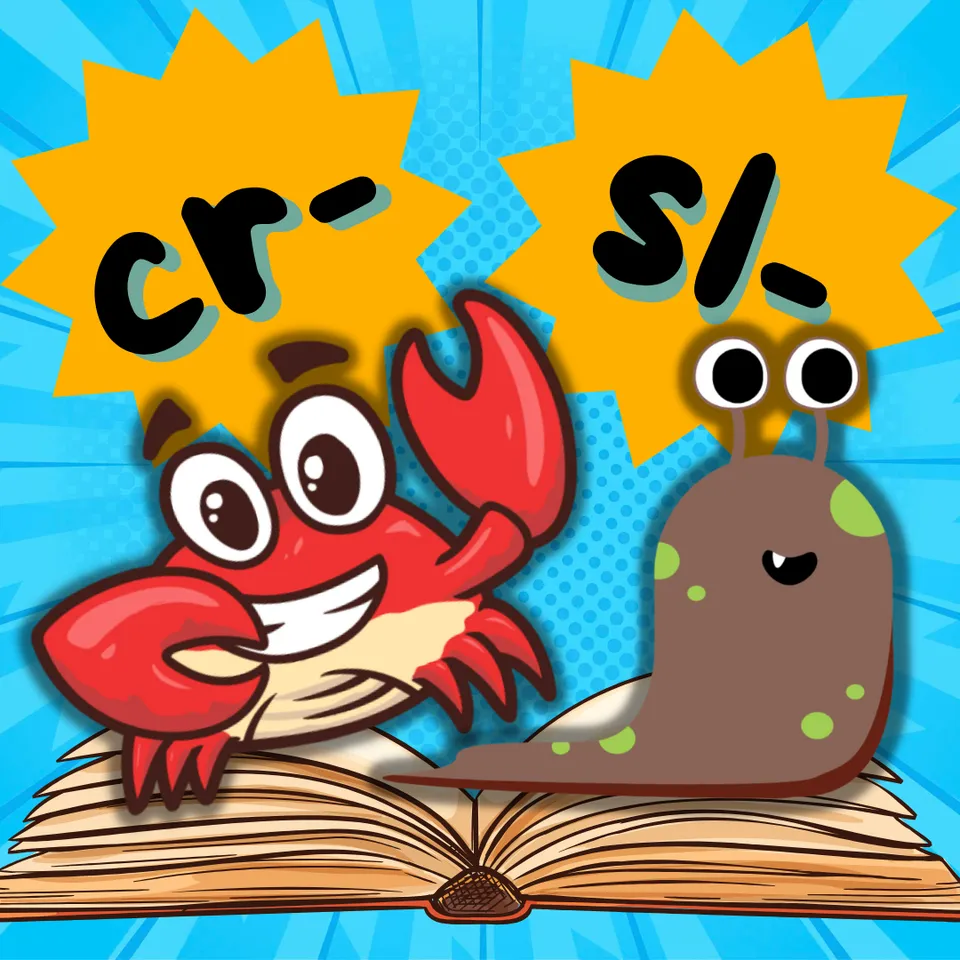
Learn to read with the cr- and sl- (crab, slug) sounds and listening comprehension
In this lesson, students will build confidence reading by practicing the following skills:
- Play a game with cr- and sl- words
- Listen to a story: answering comprehension questions
- Read sentences
- Pick a thinking cap!
- Collect a trophy!
Prior reading experience required.
Part of
Standards alignment
Common Core State Standards
- RF.K.3.a — Demonstrate basic knowledge of one-to-one letter-sound correspondences by producing the primary or many of the most frequent sound for each consonant.
- RF.1.2.b — Orally produce single-syllable words by blending sounds (phonemes), including consonant blends.
- RF.1.2.c — Isolate and pronounce initial, medial vowel, and final sounds (phonemes) in spoken single-syllable words.
- RF.K.4 — Read emergent-reader texts with purpose and understanding.
Alabama
- ELA21.K.30 — With prompting and support, ask and answer questions about key details in literary and informational texts.
- ELA21.1.7b — Decode and encode regularly-spelled, one-syllable words with closed syllables, open syllables, and vowel-consonant-_e_ syllables, including words with blends in initial and final position.
- ELA21.K.15 — Orally read and reread grade-appropriate decodable texts smoothly, accurately, and expressively, at an appropriate rate to support comprehension.
- ELA21.K.3 — Actively participate in teacher-led choral and shared reading experiences.
Alaska
- RF.1.2.b — Orally produce single-syllable words by blending sounds (phonemes), including consonant blends.
- SL.K.2 — Confirm understanding of a text read aloud or information presented orally or through other media by asking and answering questions about key details and requesting clarification if something is not understood.
- RF.1.2.c — Isolate and pronounce initial, medial vowel, and final sounds (phonemes) in spoken single-syllable words.
- RF.1.3.b — Decode regularly spelled one-syllable words.
- RF.K.4 — Read emergent-reader texts with purpose and understanding.
Arizona
- K.RF.2.a — Identify and produce sounds (phonemes) in a spoken word.
- K.RF.4 — Read emergent-reader texts with purpose and understanding.
- K.SL.2 — Confirm understanding of a text read aloud or information presented orally or through other media by asking and answering questions about key details and requesting clarification if something is not understood.
- 1.RF.2.b — Orally produce single‐syllable words by blending sounds (phonemes), including consonant blends.
- K.RF.3.b — Decode regularly spelled closed-syllable words.
Arkansas
- K.FR.22.F — Orally read texts consisting of previously taught grapheme-phoneme correspondences, self-correcting as necessary.
- K.RC.2.RF — Answer questions about key details in a text.
- 1.FR.4.PD — Decode one-syllable words with consonant clusters and predictable vowel patterns (e.g., blast, spell, dry, flake, star, swerve).
- K.RC.7.RF — Demonstrate comprehension of age and grade-appropriate texts by speaking or writing.
California
- RF.K.3.a — Demonstrate basic knowledge of one-to-one letter-sound correspondences by producing the primary or many of the most frequent sound for each consonant.
- RF.K.4 — Read emergent-reader texts with purpose and understanding.
- SL.K.2 — Confirm understanding of a text read aloud or information presented orally or through other media by asking and answering questions about key details and requesting clarification if something is not understood.
- RF.1.2.b — Orally produce single-syllable words by blending sounds (phonemes), including consonant blends.
- RF.1.3.b — Decode regularly spelled one-syllable words.
Colorado
- RWC20-GR.K-S.1-GLE.1-EO.b — Confirm understanding of a text read aloud or information presented orally or through other media by asking and answering questions about key details and requesting clarification if something is not understood.
- RWC20-GR.K-S.2-GLE.3-EO.b — Demonstrate understanding of spoken words, syllables, and sounds (phonemes).
- RWC20-GR.K-S.2-GLE.3-EO.b.vi — Read text consisting of short sentences comprised of learned sight words and consonant-vowel-consonant (CVC) words.
- RWC20-GR.K-S.2-GLE.3-EO.c — Know and apply grade-level phonics and word analysis skills in decoding words.
- RWC20-GR.1-S.2-GLE.3-EO.b.ii — Orally produce single-syllable words by blending sounds (phonemes), including consonant blends.
Connecticut
- RF.1.2.c — Isolate and pronounce initial, medial vowel, and final sounds (phonemes) in spoken single-syllable words.
- RF.K.4 — Read emergent-reader texts with purpose and understanding.
- SL.K.2 — Confirm understanding of a text read aloud or information presented orally or through other media by asking and answering questions about key details and requesting clarification if something is not understood.
- RF.1.2.b — Orally produce single-syllable words by blending sounds (phonemes), including consonant blends.
- RF.K.3 — Know and apply grade-level phonics and word analysis skills in decoding words.
Delaware
- RF.K.3 — Know and apply grade-level phonics and word analysis skills in decoding words.
- RF.K.4 — Read emergent-reader texts with purpose and understanding.
- SL.K.2 — Confirm understanding of a text read aloud or information presented orally or through other media by asking and answering questions about key details and requesting clarification if something is not understood.
- RF.1.2.c — Isolate and pronounce initial, medial vowel, and final sounds (phonemes) in spoken single-syllable words.
- RF.K.3.c — Read common high-frequency words by sight (e.g., the, of, to, you, she, my, is, are, do, does).
Florida
- ELA.1.F.1.3 — Use knowledge of grade-appropriate phonics and word-analysis skills to decode words accurately. • Decode words using knowledge of spelling-sound correspondences for common consonant digraphs, trigraphs, and blends. • Decode simple words with r-controlled vowels. • Decode and encode regularly spelled one-syllable words. • Decode words with inflectional endings. • Decode two-syllable words with regular patterns by breaking the words into syllables. • Decode words that use final –e and vowel teams to make long-vowel sound.
- ELA.K.F.1.2 — Demonstrate phonological awareness. • Blend and segment syllables in spoken words. • Identify and produce alliterative and rhyming words. • Blend and segment onset and rimes of single-syllable words. • Identify the initial, medial, and final sound of spoken words. • Add or delete phonemes at the beginning or end of a spoken word and say the resulting word. • Segment and blend phonemes in single-syllable spoken words.
- ELA.K.R.1.1 — Describe the main character(s), setting, and important events in a story.
- ELA.1.F.1.2 — Demonstrate phonological awareness. • Segment spoken words into initial, medial, and final phonemes, including words with digraphs, blends, and trigraphs. • Orally blend initial, medial, and final phonemes together to produce a single-syllable word that includes digraphs, blends, or trigraphs. • Blend single-syllable spoken words with at least five phonemes. • Segment single-syllable spoken words with at least five phonemes. • Segment and blend phonemes in multi-syllable spoken words.
Georgia
- ELAGSEKRF2 — Demonstrate understanding of spoken words, syllables, and sounds (phonemes).
- ELAGSEKRF3 — Know and apply grade-level phonics and word analysis skills in decoding words.
- ELAGSEKRF4 — Read common high-frequency words by sight. (e.g., the, of, to, you, she, my, is, are, do, does); read emergent-reader texts with purpose and understanding.
- ELAGSEKRF3.a — Demonstrate basic knowledge of one to one letter-sound correspondences for each consonant.
- ELAGSEKRL1 — With prompting and support, ask and answer questions about key details in a text.
- ELAGSEKSL2 — Confirm understanding of written texts read aloud or information presented orally or through media by asking and answering questions about key details and requesting clarification if something is not understood.
Hawaii
- K.RF.3a — Demonstrate basic knowledge of one-to-one letter-sound correspondences by producing the primary or many of the most frequent sound for each consonant.
- K.SL.2 — Confirm understanding of a text read aloud or information presented orally or through other media by asking and answering questions about key details and requesting clarification if something is not understood.
- 1.RF.2b — Orally produce single-syllable words by blending sounds (phonemes), including consonant blends.
- 1.RF.2c — Isolate and pronounce initial, medial vowel, and final sounds (phonemes) in spoken single-syllable words.
- K.RF.4 — Read emergent-reader texts with purpose and understanding.
Idaho
- 1.FR.PA.2b — Orally produce single-syllable words by blending sounds, including consonant blends.
- 1.FR.PH.3b — Decode regularly spelled one-syllable words.
- 1.ODC.OC.2 — Ask and answer questions about key details in a text read aloud or information presented orally or through other media.
- K.FR.PA.2 — Demonstrate understanding of spoken words, syllables, and sounds.
Illinois
- RF.K.3 — Know and apply grade-level phonics and word analysis skills in decoding words.
- RF.K.4 — Read emergent-reader texts with purpose and understanding.
- SL.K.2 — Confirm understanding of a text read aloud or information presented orally or through other media by asking and answering questions about key details and requesting clarification if something is not understood.
- RF.K.2 — Demonstrate understanding of spoken words, syllables, and sounds (phonemes).
- RF.K.3.a — Demonstrate basic knowledge of one-to-one letter-sound correspondences by producing the primary or many of the most frequent sound for each consonant.
Indiana
- K.RF.8 — Use letter-sound knowledge to decode words, including open and closed syllables, consonant digraphs, and blends. (E)
Iowa
- RF.1.3.b — Decode and encode regularly spelled one-syllable words with closed syllables and consonant blends.
- SL.K.2 — Confirm understanding of a text read aloud or information presented orally or through other media by asking and answering questions about key details and requesting clarification if something is not understood.
- RF.1.2.b — Orally produce single-syllable words by blending phonemes (sounds), including consonant blends.
- RF.K.4 — Orally read grade-appropriate text with purpose and understanding.
Kansas
- RF.K.2 — Demonstrate understanding of spoken words, syllables, and sounds (phonemes).
- RF.K.3 — Know and apply grade-level phonics and word analysis skills in decoding words.
- RF.K.4 — Read emergent-reader texts with purpose and understanding.
- SL.K.2 — Confirm understanding of a text read aloud or information presented orally or through other media by asking and answering questions about key details and requesting clarification if something is not understood.
- RF.K.3.a — Demonstrate basic knowledge of one-to-one letter-sound correspondences by producing the primary or many of the most frequent sounds for each consonant.
Kentucky
- RF.K.2.d — Isolate and pronounce the initial, medial vowel and final sounds (phonemes) in three-phoneme words.
- RF.K.3.a — Demonstrate basic knowledge of one-to-one letter-sound correspondences by producing the primary or many of the most frequent sounds for each consonant.
- RF.K.4.a — Read emergent-reader texts with purpose and understanding.
- RF.1.2.b — Orally produce single-syllable words by blending sounds (phonemes), including consonant blends.
Louisiana
- RF.K.3 — Know and apply grade-level phonics and word analysis skills in decoding words.
- RF.K.3.a — Demonstrate basic knowledge of one-to-one letter-sound correspondences by producing the primary or many of the most frequent sounds for each consonant.
- RF.K.4 — Read emergent-reader texts with purpose and understanding.
- SL.K.2 — Confirm understanding of a text read aloud or information presented orally or through other media by asking and answering questions about key details and requesting clarification if something is not understood.
- RF.K.3.c — Read common high-frequency words by sight (e.g., the, of, to, you, she, my, is, are, do, does).
Maine
- R.2.1.b — Produce single-syllable words by blending sounds (phonemes), including consonant blends.
- R.12.K.a — Read emergent-reader texts with purpose and understanding.
- R.2.1.c — Isolate and pronounce initial, medial vowel, and final sounds (phonemes) in spoken single-syllable words.
- R.3.1.b — Decode regularly spelled one-syllable words.
- R.3.K.c — Read common high-frequency words by sight (e.g., the, of, to, you, she, my, is, are, do, does).
Maryland
- RF.PK.2.e — Isolate and pronounce the initial sound in spoken words
- RF.1.2.b — Orally produce single-syllable words by blending sounds (phonemes), including consonant blends.
- RF.K.3.a — Demonstrate basic knowledge of one-to-one letter-sound correspondences by producing the primary or many of the most frequent sound for each consonant.
- RF.K.4 — Read emergent-reader texts with purpose and understanding.
- SL.PK 2 — Confirm understanding of a text read aloud or information presented orally or through other media by asking and answering questions about key details with modeling and support.
Massachusetts
- RF.K.3 — Know and apply grade-level phonics and word analysis skills in decoding words.
- RF.K.4 — Read early-emergent-reader texts with purpose and understanding.
- RF.PK.3.a — Link an initial sound to a picture of an object that begins with that sound and, with guidance and support, to the corresponding printed letter (e.g., link the initial sound /b/ to a picture of a ball and, with support, to a printed or written “B”).
- RF.1.3.b — Decode regularly spelled one-syllable words.
- SL.K.2 — Confirm understanding of a text read aloud or information presented orally or through other media by asking and answering questions about key details and requesting clarification if something is not understood.
Michigan
- RF.1.2.c — Isolate and pronounce initial, medial vowel, and final sounds (phonemes) in spoken single-syllable words.
- RF.K.4 — Read emergent-reader texts with purpose and understanding.
- SL.K.2 — Confirm understanding of a text read aloud or information presented orally or through other media by asking and answering questions about key details and requesting clarification if something is not understood.
- RF.1.2.b — Orally produce single-syllable words by blending sounds (phonemes), including consonant blends.
- RF.K.3.c — Read common high-frequency words by sight (e.g., the, of, to, you, she, my, is, are, do, does).
Minnesota
- 0.1.1.3 — Read decodable texts accurately, with guidance and support. (Decodable texts are those that include words taught in phonics lesson.)
- 1.1.1.2.a — Know and apply grade-level phonics and word analysis skills in decoding words: know the spelling-sound correspondences for the common consonant digraphs and blends.
- 0.1.1.1.a — Demonstrate understanding of spoken words, syllables and sounds (phonemes): identify and orally produce rhyming words, onset-rime and alliteration.
Mississippi
- RF.K.3 — Know and apply grade-level phonics and word analysis skills in decoding words.
- RF.K.3.a — Demonstrate basic knowledge of one-to-one letter-sound correspondences by producing the primary sound or many of the most frequent sounds for each consonant.
- RF.K.4 — Read emergent-reader texts with purpose and understanding.
- SL.K.2 — Confirm understanding of a text read aloud or information presented orally or through other media by asking and answering questions about key details and requesting clarification if something is not understood.
- RF.K.2 — Demonstrate understanding of spoken words, syllables, and sounds (phonemes).
- RF.K.3.c — Read common high-frequency words by sight (e.g., the, of, to, you, she, my, is, are, do, does).
Missouri
- 1.RF.3.A.c — producing consonant blends
- K.R.1.A.b — asking and responding to questions about texts read aloud
- K.RF.2.A.d — recognizing spoken alliteration or groups of words that begin with the same onset or initial sound
- K.RF.2.A.g — isolating the initial, medial, and final sounds in spoken words
- K.RF.4.A — Read, with support, appropriate texts with purpose and understanding
Montana
- RF.1.2.b — Orally produce single-syllable words by blending sounds (phonemes), including consonant blends.
- RF.1.3.b — Decode regularly spelled one-syllable words.
- SL.K.2 — Confirm understanding of a text read aloud or information presented orally or through other media by asking and answering questions about key details and requesting clarification if something is not understood.
- RF.K.4 — Read emergent-reader texts with purpose and understanding.
Nebraska
- LA.1.F.3.a — Decode and encode words using knowledge of sound-spelling correspondence for common consonant digraphs, tri-graphs, and blends.
- LA.K.F.2 — Demonstrate understanding of spoken words, syllables, and sounds (phonemes).
- LA.K.F.3 — Know and apply phonics and word analysis skills in decoding and encoding (spelling) words.
- LA.K.F.4 — Develop accuracy, phrasing, and expression/prosody while reading a variety of grade-level texts to support comprehension.
- LA.K.SL.1 — With prompting and support, participate with peers and adults in structured discussions and routines about Kindergarten topics and texts.
Nevada
- RF.K.4 — Read emergent-reader texts with purpose and understanding.
- SL.K.2 — Confirm understanding of a text read aloud or information presented orally or through other media by asking and answering questions about key details and requesting clarification if something is not understood.
- RF.K.2 — Demonstrate understanding of spoken words, syllables, and sounds (phonemes).
- RF.K.3 — Know and apply grade-level phonics and word analysis skills in decoding words.
- RF.K.3.a — Demonstrate basic knowledge of one-to-one letter-sound correspondences by producing the primary or many of the most frequent sound for each consonant.
- RF.K.3.c — Read common high-frequency words by sight (e.g., the, of, to, you, she, my, is, are, do, does).
New Hampshire
- RF.1.2.b — Orally produce single-syllable words by blending sounds (phonemes), including consonant blends.
- RF.K.3 — Know and apply grade-level phonics and word analysis skills in decoding words.
- RF.K.4 — Read emergent-reader texts with purpose and understanding.
- RF.1.3.b — Decode regularly spelled one-syllable words.
- RF.K.3.c — Read common high-frequency words by sight (e.g., the, of, to, you, she, my, is, are, do, does).
New Jersey
- RF.K.2 — Demonstrate understanding of spoken words, syllables, and sounds (phonemes).
- RF.K.3.a — Demonstrate basic knowledge of one-to-one letter-sound correspondences by producing many of the most frequently used sounds of each consonant.
- RF.K.4.a — Read emergent-readers with purpose and understanding.
- SL.K.2 — Confirm understanding of a text read aloud or information presented orally or through other media by asking and answering questions about key details and requesting clarification if something is not understood.
- RF.1.2.b — Orally produce single-syllable words by blending sounds (phonemes), including consonant blends.
New Mexico
- RF.K.2 — Demonstrate understanding of spoken words, syllables, and sounds (phonemes).
- RF.K.3 — Know and apply grade-level phonics and word analysis skills in decoding words.
- RF.K.4 — Read emergent-reader texts with purpose and understanding.
- SL.K.2 — Confirm understanding of a text read aloud or information presented orally or through other media by asking and answering questions about key details and requesting clarification if something is not understood.
- RF.1.2.b — Orally produce single-syllable words by blending sounds (phonemes), including consonant blends.
- RF.K.3.a — Demonstrate basic knowledge of one-to-one letter-sound correspondences by producing the primary or many of the most frequent sound for each consonant.
New York
- 1RF3a — Know the letter-sound correspondences for common blends and consonant digraphs (e.g. sh, ch, th).
- KRF3c — Decode some regularly spelled one-syllable words.
- KRF4 — Will engage with emergent level texts and read-alouds to demonstrate comprehension.
- PKRF2c — Isolate and pronounce the initial sounds (phonemes) in spoken one-syllable words (e.g. the /m/ in map).
- KRF3d — Read common high-frequency words by sight.
North Carolina
- RF.K.3 — Demonstrate understanding of spoken words, syllables, and sounds (phonemes).
- RF.K.4 — Know and apply grade-level phonics and word analysis skills in decoding words.
- RF.K.5 — Read emergent-reader texts with purpose and understanding.
- SL.K.2 — Confirm understanding of a text read aloud or information presented orally or through other media by asking and answering questions about key details and requesting clarification if something is not understood.
- RF.1.3.b — Orally produce single-syllable words by blending sounds (phonemes), including consonant blends.
North Dakota
- 1.F.8 — Decode words with phoneme-grapheme correspondences:
- 1.F.12a — Read accurately and automatically at the word level
- 1.F.12b — Read accurately and automatically at the sentence level
Ohio
- RF.K.2 — Demonstrate understanding of spoken words, syllables, and phonemes (sounds).
- RF.K.3 — Know and apply grade-level phonics and word analysis skills in decoding words.
- RF.K.4 — Read emergent-reader texts with purpose and understanding.
- SL.K.2 — Confirm understanding of a text read aloud or information presented in various media and other formats (e.g., orally) by asking and answering questions about key details and requesting clarification if something is not understood.
- RF.K.3.a — Demonstrate basic knowledge of one-to-one grapheme (letter)-sound correspondences by producing the primary sound or many of the most frequent sounds for each consonant.
Oklahoma
- 1.2.PWS.1 — Students will decode one-syllable phonetically-regular words by using their knowledge of the following phonics skills: a. single consonants (e.g., b = /b/, f = /f/, t = /t/) b. short vowel sounds (i.e., ă, ĕ, ĭ, ŏ, ŭ) c. consonant blends (e.g., bl, br, cr) d. consonant digraphs and trigraphs (e.g., sh, tch) e. vowel-consonant-silent e (e.g., lake) f. r-controlled vowels (i.e., ar, er, ir, or, ur) g. vowel digraphs (e.g., ea, oa, ee)
- K.2.PA.3 — Students will isolate and pronounce initial and final sounds in spoken words.
- K.2.F.3 — Students will begin to develop a sight word vocabulary by decoding and reading regularly- and irregularly-spelled words in isolation and context with increasing automaticity.
- PK.2.PA.4 — Students will isolate the common initial sound when given a set of alliterative spoken words (e.g., the puppy pounces).
Oregon
- 1.RF.2b — Orally produce single-syllable words by blending phonemes, including consonant blends.
- K.SL.2 — Confirm understanding of a text read aloud or information presented orally or through other media by asking and answering questions about key details and requesting clarification if something is not understood.
- K.RF.2 — Demonstrate understanding of spoken words, syllables, and phonemes.
- K.RF.3 — Know and apply grade-level phonics and word analysis skills in decoding words.
- K.RF.4a — Read emergent texts with one-to-one correspondence with purpose and understanding.
Pennsylvania
- CC.1.1.K.C — Demonstrate understanding of spoken words, syllables, and sounds (phonemes). • Recognize and produce rhyming words. • Count, pronounce, blend, and segment syllables in spoken words. • Blend and segment onsets and rimes of single-syllable spoken words. • Isolate and pronounce the initial, medial vowel, and final sound (phonemes) in the three-phoneme (CVC) words.
- CC.1.1.K.D — Know and apply grade-level phonics and word analysis skills in decoding words. • Demonstrate basic knowledge of one-to-one letter-sound correspondence. • Associate the long and short sounds with common spellings for the five major vowels. • Read grade-level high-frequency sight words with automaticity. • Distinguish between similarly spelled words by identifying the sounds of the letters that differ.
- CC.1.1.K.E — Read emergent-reader text with purpose and understanding.
- CC.1.5.K.B — Ask and answer questions about key details in a text read aloud or information presented orally or through other media.
- CC.1.1.1.C — Demonstrate understanding of spoken words, syllables, and sounds (phonemes). • Distinguish long from short vowel sounds in spoken single-syllable words. • Count, pronounce, blend, and segment syllables in spoken and written words. • Orally produce single-syllable words, including consonant blends and digraphs. • Isolate and pronounce initial, medial vowel, and final sounds (phonemes) in spoken single- syllable words. • Add or substitute individual sounds (phonemes) in one- syllable words to make new words.
Rhode Island
- RF.K.2 — Demonstrate understanding of spoken words, syllables, and sounds (phonemes).
- RF.K.3 — Know and apply grade-level phonics and word analysis skills in decoding words.
- RF.K.4 — Read early-emergent-reader texts with purpose and understanding.
- SL.K.2 — Confirm understanding of a text read aloud or information presented orally or through other media by asking and answering questions about key details and requesting clarification if something is not understood.
- RF.K.3.c — Read common high-frequency words by sight (e.g., the, of, to, you, she, my, is, are, do, does).
South Carolina
- ELA.K.F.1.2 — Recognize alliterative spoken words.
- ELA.1.F.3.8 — Decode and encode words using: a. onset/rime; b. consonant blends (i.e., initial and final); c. consonant digraphs (i.e., ch, sh, th, wh, ph, ck); d. trigraphs (e.g., -tch, -dge)*; e. combination (i.e., qu); f. VCe; g. vowel r (e.g., ar, er, ir, or, ur); h. common inflectional endings that do not change the base word (e.g., -s, -ed); i. contractions with am, is, has, and not; j. hard and soft sounds of c and g (c=/k/ before a, o, u, or any consonant and c= /s/ before i, e, or y; g=/g/ before a, o, u, or any consonant and g=/j/ before i, e, or y) *; k. vowel y in the final position of one- and two-syllable words, distinguishing the difference between the long /ī/ sound in one-syllable words and the long /ē/ sound in two-syllable words, and words with vowel y in medial position, producing the short /ĭ/ sound (e.g., fly-my; baby-happy, myth-gym) *; l. words that follow the -ild, -ost, -old, -olt, and -ind patterns (e.g., mild, host, fold, jolt, kind); m. silent letter combinations (e.g., kn, wr, mb, gh, gn) *; n. words with final /f/, /l/, and /s/ sounds in one-syllable base words by doubling the final consonant when it follows a short vowel sound (e.g., cliff, hill, pass); and o. words with final /v/ sound, using knowledge that no English word ends with a v. (e.g. have, give, save).
- ELA.K.F.1.6.INIS — Say ‘cat’. What sound do you hear at the beginning? In the middle? At the end? Students are not expected to identify /l/, /r/, /x/ because the /l/ in the final position is often not articulated clearly, /r/ in the final position is vowel controlled, and /x/ because it is made up of two phonemes (/k/ + /s/).”
- ELA.K.F.4.3 — Read texts by: a. using letter-sound knowledge to segment and blend sounds together; b. decoding the word by analogy; and c. using visuals from the text to support decoding and confirm recognition.
- ELA.K.F.4.2 — Read texts orally with accuracy and expression.
South Dakota
- 1.RF.3.a — Know the spelling-sound correspondences for common consonant blends and digraphs.
- K.RF.4 — Read emergent-reader texts with sufficient accuracy and fluency to support comprehension
- K.SL.2 — Confirm understanding from a source of information by asking and answering questions about key details and requesting clarification if something is not understood.
- 1.RF.2.b — Orally produce single-syllable words by blending sounds (phonemes), including consonant blends.
- K.RF.3 — Know and apply grade-level phonics and word analysis skills in decoding words.
Tennessee
- K.FL.PA.2 — Demonstrate understanding of spoken words, syllables, and sounds (phonemes).
- K.FL.PWR.3 — Know and apply grade-level phonics and word analysis skills when decoding isolated words and in connected text.
- K.SL.CC.2 — Confirm understanding of a text read aloud or information presented orally or through other media by asking and answering questions about key details and requesting clarification if something is not understood.
- K.FL.F.5.a — Read emergent-reader texts with purpose and understanding.
- K.FL.PWR.3.a — Demonstrate knowledge of one-to-one letter sound correspondence by producing the most frequent sound for each consonant.
Texas
- K.2A.ii — recognizing spoken alliteration or groups of words that begin with the same spoken onset or initial sound;
- K.2B.i — identifying and matching the common sounds that letters represent;
- K.2B.ii — using letter-sound relationships to decode, including VC, CVC, CCVC, and CVCC words;
- K.2B.iv — identifying and reading at least 25 high-frequency words from a research-based list;
Utah
- K.R.2 — Demonstrate mastery of age-appropriate phonological awareness skills.
- K.R.3 — Demonstrate mastery of age-appropriate phonics skills.
- K.R.4 — Read grade-level text* with accuracy and fluency to support comprehension. (RL & RI)
- P4.R.2.e — With prompting and support, blend and segment initial sounds of single-syllable spoken words.
Vermont
- RF.1.2.b — Orally produce single-syllable words by blending sounds (phonemes), including consonant blends.
- RF.1.2.c — Isolate and pronounce initial, medial vowel, and final sounds (phonemes) in spoken single-syllable words.
- RF.K.3.a — Demonstrate basic knowledge of one-to-one letter-sound correspondences by producing the primary or many of the most frequent sound for each consonant.
- RF.K.4 — Read emergent-reader texts with purpose and understanding.
- RF.K.3.c — Read common high-frequency words by sight (e.g., the, of, to, you, she, my, is, are, do, does).
Virginia
- K.DSR.1.A — Use knowledge of letter-sound correspondences to read and reread controlled decodable sentences and texts that include phonic elements and irregular words (Reading Fluency, K-12).
- K.FFR.3.B — Identify common letter-sound correspondences.
- K.RL.3.C — With prompting and support, monitor listening comprehension.
- K.FFR.2.C — Isolate the initial, medial, and final sounds in three phoneme (individual sound) words (excluding words ending with /l/, /r/, or /x/).
Washington
- RF.1.2.b — Orally produce single-syllable words by blending sounds (phonemes), including consonant blends.
- SL.K.2 — Confirm understanding of a text read aloud or information presented orally or through other media by asking and answering questions about key details and requesting clarification if something is not understood.
- RF.1.2.c — Isolate and pronounce initial, medial vowel, and final sounds (phonemes) in spoken single-syllable words.
- RF.1.3.b — Decode regularly spelled one-syllable words.
- RF.K.4 — Read emergent-reader texts with purpose and understanding.
Washington, D.C.
- RF.1.2.b — Orally produce single-syllable words by blending sounds (phonemes), including consonant blends.
- RF.K.4 — Read emergent-reader texts with purpose and understanding.
- SL.K.2 — Confirm understanding of a text read aloud or information presented orally or through other media by asking and answering questions about key details and requesting clarification if something is not understood.
- RF.1.2.c — Isolate and pronounce initial, medial vowel, and final sounds (phonemes) in spoken single-syllable words.
- RF.K.3.c — Read common high-frequency words by sight (e.g., the, of, to, you, she, my, is, are, do, does).
West Virginia
- ELA.K.I — Read emergent-reader texts with purpose and understanding.
- ELA.K.II — Know and apply grade-level phonics and word analysis skills in decoding words.
- ELA.K.II.a — Demonstrate basic knowledge of one-to-one letter-sound correspondences by producing the primary or many of the most frequent sounds for each consonant.
- ELA.K.IV — Demonstrate understanding of spoken words, syllables, and sounds (phonemes).
- ELA.K.31 — Confirm understanding of a text read aloud or information presented orally or through other media by asking and answering questions about key details and requesting clarification if something is not understood.
Wisconsin
- ELA.K.RF.2 — Demonstrate understanding of spoken words, syllables, and sounds (phonemes).
- ELA.K.RF.3 — Know and apply grade-level phonics and word analysis skills in decoding words.
- ELA.K.SL.2 — With guidance and support, ask and answer questions about key details in a text read aloud or information presented orally or through other media.
- ELA.K.RF.4 — Read emergent-reader texts with purpose and understanding.
- ELA.K.RF.3.a — Demonstrate basic knowledge of one-to-one letter-sound correspondences by producing the primary or many of the most frequent sounds for each consonant.
Wyoming
- RF.K.4 — Read emergent-reader texts with purpose and understanding.
- SL.K.2 — Confirm understanding of a text read aloud or information presented orally or through other media by asking and answering questions about key details and requesting clarification if something is not understood.
- RF.1.2.b — Orally produce single-syllable words by blending sounds (phonemes), including consonant blends.
- RF.1.2.c — Isolate and pronounce initial, medial vowel, and final sounds (phonemes) in spoken single-syllable words.
- RF.K.3.c — Read common high-frequency words by sight (e.g., the, of, to, you, she, my, is, are, do, does).