Tally Charts Card Game
Ages 5–8 · 5 minutes · Math
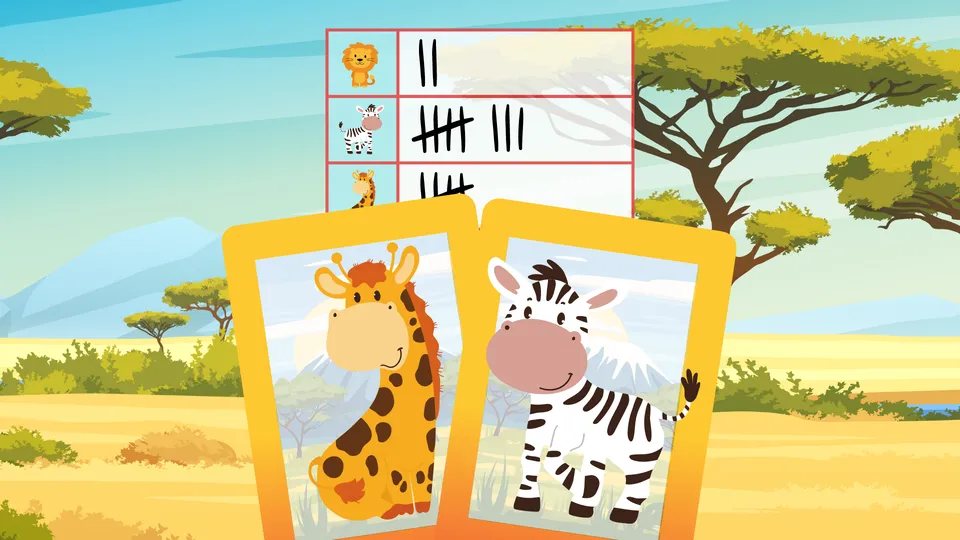
Zebra, giraffe or lion? Your choice! Collect animals in your tally chart.
Students can play this game to improve their understanding of tally charts.
Choose one out of two pairs of animal cards until you get the same number of zebras and giraffes in your tally chart. The tally chart gets updated automatically. The game ends if you collect ten animals of one kind before the game's goal is reached.
Part of
Standards alignment
Common Core State Standards
- 1.MD.C.4 — Organize, represent, and interpret data with up to three categories; ask and answer questions about the total number of data points, how many in each category, and how many more or less are in one category than in another.
- K.CC.C.6 — Identify whether the number of objects in one group is greater than, less than, or equal to the number of objects in another group, e.g., by using matching and counting strategies.
- K.MD.B.3 — Classify objects into given categories; count the numbers of objects in each category and sort the categories by count.
Alabama
- MA19.1.16 — Organize, represent, and interpret data with up to three categories.
- MA19.1.16c — Determine "how many" in each category using up to three categories of data.
- MA19.K.6 — Orally identify whether the number of objects in one group is _greater/more than, less/fewer than_, or _equal/the same as_ the number of objects in another group, in groups containing up to 10 objects, by using matching, counting, or other strategies.
- MA19.K.15 — Classify objects into given categories of 10 or fewer; count the number of objects in each category and sort the categories by count.
- MA19.K.15a — Categorize data on Venn diagrams, pictographs, and "yes-no" charts using real objects, symbolic representations, or pictorial representations.
Alaska
- 1.MD.7 — Organize, represent and interpret data with up to three categories. Ask and answer comparison and quantity questions about the data.
- K.CC.6 — Identify whether the number of objects in one group is greater than, less than, or equal to the number of objects in another group (e.g., by using matching, counting, or estimating strategies).
- K.MD.3 — Classify objects into given categories (attributes). Count the number of objects in each category (limit category counts to be less than or equal to 10).
- 2.MD.9 — Collect, record, interpret, represent, and describe data in a table, graph or line plot.
Arizona
- 1.MD.C.4 — Organize, represent, and interpret data with up to three categories; ask and answer questions about the total number of data points, how many in each category, and how many more or less are in one category than in another.
- K.CC.C.6 — Identify whether the number of objects in one group is greater than, less than, or equal to the number of objects in another group, e.g., by using matching and counting strategies.
- K.MD.B.3 — Classify objects into given categories; count the numbers of objects in each category and sort the categories by count.
Arkansas
- 1.DA.1 — Organize, represent, and interpret data with up to three categories (e.g., tally tables, picture graphs, bar graphs).
- 1.DA.2 — Ask and answer questions about the total number represented such as how many in each category and how many more or less in one category compared to another.
- K.NPV.7 — Use matching and counting strategies to compare the number of objects in one group to the number of objects in another group (0 to 10) using the terms greater than, less than, or equal.
California
- 1.MD.C.4 — Organize, represent, and interpret data with up to three categories; ask and answer questions about the total number of data points, how many in each category, and how many more or less are in one category than in another.
- K.CC.C.6 — Identify whether the number of objects in one group is greater than, less than, or equal to the number of objects in another group, e.g., by using matching and counting strategies.
Colorado
- 1.MD.C.4 — Organize, represent, and interpret data with up to three categories; ask and answer questions about the total number of data points, how many in each category, and how many more or less are in one category than in another.
- K.MD.B.3 — Classify objects into given categories; count the numbers of objects in each category and sort the categories by count. (Limit category counts to be less than or equal to 10.)
- K.CC.C.6 — Identify whether the number of objects in one group is greater than, less than, or equal to the number of objects in another group, e.g., by using matching and counting strategies. (Include groups with up to 10 objects.)
Connecticut
- 1.MD.C.4 — Organize, represent, and interpret data with up to three categories; ask and answer questions about the total number of data points, how many in each category, and how many more or less are in one category than in another.
- K.MD.B.3 — Classify objects into given categories; count the numbers of objects in each category and sort the categories by count.
- K.CC.C.6 — Identify whether the number of objects in one group is greater than, less than, or equal to the number of objects in another group, e.g., by using matching and counting strategies.
Delaware
- 1.MD.C.4 — Organize, represent, and interpret data with up to three categories; ask and answer questions about the total number of data points, how many in each category, and how many more or less are in one category than in another.
- K.MD.B.3 — Classify objects into given categories; count the numbers of objects in each category and sort the categories by count.
- K.CC.C.6 — Identify whether the number of objects in one group is greater than, less than, or equal to the number of objects in another group, e.g., by using matching and counting strategies.
Florida
- MA.1.DP.1.1 — Collect data into categories and represent the results using tally marks or pictographs.
- MA.1.DP.1.2 — Interpret data represented with tally marks or pictographs by calculating the total number of data points and comparing the totals of different categories.
Georgia
- K.MDR.7.2 — Classify and sort up to ten objects into categories by an attribute; count the number of objects in each category and sort the categories by count.
- K.NR.4.2 — Compare two sets of up to 10 objects and identify whether the number of objects in one group is more or less than the other group, using the words “greater than,” “less than,” or “the same as”.
- K.MDR.7.3 — Ask questions and answer them based on gathered information, observations, and appropriate graphical displays to solve problems relevant to everyday life.
- 1.MDR.6.4 — Ask questions and answer them based on gathered information, observations, and appropriate graphical displays to compare and order whole numbers.
Hawaii
- 1.MD.C.4 — Organize, represent, and interpret data with up to three categories; ask and answer questions about the total number of data points, how many in each category, and how many more or less are in one category than in another.
- K.CC.C.6 — Identify whether the number of objects in one group is greater than, less than, or equal to the number of objects in another group, e.g., by using matching and counting strategies.
- K.MD.B.3 — Classify objects into given categories; count the numbers of objects in each category and sort the categories by count.
Idaho
- 1.MD.C.4 — Organize, represent, and interpret data with up to three categories; ask and answer questions about the total number of data points, how many in each category, and how many more or less are in one category than in another.
- K.MD.B.3 — Classify objects into given categories; count the numbers of objects in each category (up to and including ten) and sort the categories by count.
- K.CC.C.6 — Identify whether the number of objects in one group is greater than, less than, or equal to the number of objects in another group for groups with up to ten objects.
Illinois
- 1.MD.C.4 — Organize, represent, and interpret data with up to three categories; ask and answer questions about the total number of data points, how many in each category, and how many more or less are in one category than in another.
- K.CC.C.6 — Identify whether the number of objects in one group is greater than, less than, or equal to the number of objects in another group, e.g., by using matching and counting strategies.
- K.MD.B.3 — Classify objects into given categories; count the numbers of objects in each category and sort the categories by count.
Indiana
- K.NS.5 — Identify whether the number of objects in one group is greater than, less than, or equal to the number of objects in another group (e.g., by using matching and counting strategies).
- 1.DA.1 — With guidance, collect data from a simple survey or collaborative investigation; organize data into appropriate single-unit bar graphs, pictographs, and/or tables and draw conclusions based on mathematical observations, comparisons, and grade-level computation strategies. (E)
- K.DA.1 — With guidance, collect and organize data into simple bar graphs, pictographs, and/or tables to identify patterns and make comparisons. (E)
Iowa
- 1.MD.C.4 — Organize, represent, and interpret data with up to three categories; ask and answer questions about the total number of data points, how many in each category, and how many more or less are in one category than in another.
- K.MD.B.3 — Classify objects into given categories; count the numbers of objects in each category and sort the categories by count. Limit category counts to be less than or equal to 10.
- K.CC.C.6 — Determine whether the number of objects in one group of 1– 10 objects is greater than, less than, or equal to the number of objects in another group of 1–10 objects. For example, using matching and counting strategies.
Kansas
- 1.MD.4 — Organize, represent, and interpret data with up to three categories; ask and answer questions about the total number of data points, how many in each category, and how many more or less are in one category than in another.
- K.CC.6 — Identify whether the number of objects in one group is greater than, less than, or equal to the number of objects in another group, (e.g. by using matching and counting strategies.) Include groups with up to ten objects.
- K.MD.3 — Classify objects into given categories; count the numbers of objects in each category and sort the categories by count (Limit category counts to be less than or equal to 10).
Kentucky
- KY.1.MD.4.c — Organize and represent data in a table/chart with up to three categories.
- KY.1.MD.4.d — Interpret data to answer questions about the table/chart that connects to the question posed, including total number of data points, how many in each category and how many more or less are in one category than in another.
- KY.K.CC.6 — Identify whether the number of objects in one group is greater than, less than, or equal to the number of objects in another group.
- KY.K.MD.3 — Classify and sort objects or people by attributes. Limit objects or people in each category to be less than or equal to 10.
Louisiana
- 1.MD.C.4 — Organize, represent, and interpret data with up to three categories; ask and answer questions about the total number of data points, how many in each category, and how many more or less are in one category than in another.
- K.MD.B.3 — Classify objects into given categories based on their attributes; count the numbers of objects in each category and sort the categories by count.
- K.CC.C.6 — Identify whether the number of objects in one group is greater than, less than, or equal to the number of objects in another group, e.g., by using matching and counting strategies.
Maine
- K.CC.C.6 — Identify whether the number of objects in one group is greater than, less than, or equal to the number of objects in another group, e.g., by using matching and counting strategies. Include groups with up to ten objects.
- 1.MD.C.4 — Organize, represent, and interpret data with up to three categories; ask and answer questions about the total number of data points, how many in each category, and how many more or less are in one category than in another.
- K.MD.B.3 — Classify objects into given categories; count the numbers of objects in each category and sort the categories by count. (Limit category counts to be less than or equal to 10.)
Maryland
- 1.MD.C.4 — Organize, represent, and interpret data with up to three categories; ask and answer questions about the total number of data points, how many in each category, and how many more or less are in one category than in another.
- K.CC.C.6 — Identify whether the number of objects in one group is greater than, less than, or equal to the number of objects in another group, e.g., by using matching and counting strategies.
- K.MD.B.3 — Classify objects into given categories; count the numbers of objects in each category and sort the categories by count.
Massachusetts
- 1.MD.C.4 — Organize, represent, and interpret data with up to three categories; ask and answer questions about the total number of data points, how many in each category, and how many more or less are in one category than in another.
- K.CC.C.6 — Identify whether the number of objects in one group is greater than, less than, or equal to the number of objects in another group for groups with up to 10 objects, e.g., by using matching and counting strategies.
- K.MD.B.3 — Classify objects into given categories; count the numbers of objects in each category (up to and including 10) and sort the categories by count.
Michigan
- 1.MD.C.4 — Organize, represent, and interpret data with up to three categories; ask and answer questions about the total number of data points, how many in each category, and how many more or less are in one category than in another.
- K.CC.C.6 — Identify whether the number of objects in one group is greater than, less than, or equal to the number of objects in another group, e.g., by using matching and counting strategies.
- K.MD.B.3 — Classify objects into given categories; count the numbers of objects in each category and sort the categories by count.
Minnesota
- 1.1.1.7 — Use counting and comparison skills to create and analyze bar graphs and tally charts. For example: Make a bar graph of students' birthday months and count to compare the number in each month.
- K.1.1.2 — Read, write, and represent whole numbers from 0 to at least 31. Representations may include numerals, pictures, real objects and picture graphs, spoken words, and manipulatives such as connecting cubes. For example: Represent the number of students taking hot lunch with tally marks.
- 1.1.1.6 — Use words to describe the relative size of numbers. For example: Use the words equal to, not equal to, more than, less than, fewer than, is about, and is nearly to describe numbers.
Mississippi
- 1.MD.4 — Organize, represent, and interpret data with up to three categories; ask and answer questions about the total number of data points, how many in each category, and how many more or less are in one category than in another.
- K.CC.6 — Identify whether the number of objects in one group is greater than, less than, or equal to the number of objects in another group, e.g., by using matching and counting strategies.
- K.MD.3 — Classify objects into given categories; count the numbers of objects in each category and sort the categories by count.
Missouri
- 1.DS.A.2 — Draw conclusions from object graphs, picture graphs, T-charts and tallies.
- K.DS.A.2 — Compare category counts using appropriate language.
- 1.DS.A.1 — Collect, organize and represent data with up to three categories.
- K.NS.C.10 — Compare two or more sets of objects and identify which set is equal to, more than or less than the other.
Montana
- 1.MD.C.4 — Organize, represent, and interpret data with up to three categories; ask and answer questions about the total number of data points, how many in each category, and how many more or less are in one category than in another.
- K.CC.C.6 — Identify whether the number of objects in one group is greater than, less than, or equal to the number of objects in another group, e.g., by using matching and counting strategies.
- K.MD.B.3 — Classify objects from a variety of cultural contexts, including those of Montana American Indians, into given categories; count the numbers of objects in each category, and sort the categories by count.
Nebraska
- 1.D.1.a — Collect, organize, and represent a data set with up to three categories using a picture graph.
- 1.D.2.a — Ask and answer questions about the total number of data points, how many in each category, and compare categories by identifying how many more or less are in a particular category using a picture graph.
- K.N.2.h — Compare the number of objects in two groups, up to 20, using the words fewer than, more than, the same as.
Nevada
- 1.MD.C.4 — Organize, represent, and interpret data with up to three categories; ask and answer questions about the total number of data points, how many in each category, and how many more or less are in one category than in another.
- K.CC.C.6 — Identify whether the number of objects in one group is greater than, less than, or equal to the number of objects in another group, e.g., by using matching and counting strategies.
- K.MD.B.3 — Classify objects into given categories; count the numbers of objects in each category and sort the categories by count.
New Hampshire
- 1.MD.C.4 — Organize, represent, and interpret data with up to three categories; ask and answer questions about the total number of data points, how many in each category, and how many more or less are in one category than in another.
- K.MD.B.3 — Classify objects into given categories; count the numbers of objects in each category and sort the categories by count.
- K.CC.C.6 — Identify whether the number of objects in one group is greater than, less than, or equal to the number of objects in another group, e.g., by using matching and counting strategies.
New Jersey
- 1.MD.C.4 — Organize, represent, and interpret data with up to three categories; ask and answer questions about the total number of data points, how many in each category, and how many more or less are in one category than in another.
- K.MD.B.3 — Classify objects into given categories; count the numbers of objects in each category and sort the categories by count.
- K.CC.C.6 — Identify whether the number of objects in one group is greater than, less than, or equal to the number of objects in another group, e.g., by using matching and counting strategies.
New Mexico
- 1.MD.C.4 — Organize, represent, and interpret data with up to three categories; ask and answer questions about the total number of data points, how many in each category, and how many more or less are in one category than in another.
- K.CC.C.6 — Identify whether the number of objects in one group is greater than, less than, or equal to the number of objects in another group, e.g., by using matching and counting strategies.
- K.MD.B.3 — Classify objects into given categories; count the numbers of objects in each category and sort the categories by count.
New York
- NY-1.MD.4 — Organize, represent, and interpret data with up to three categories; ask and answer questions about the total number of data points, how many in each category, and how many more or less are in one category than in another.
- NY-K.CC.6 — Identify whether the number of objects in one group is greater than (more than), less than (fewer than), or equal to (the same as) the number of objects in another group.
- NY-K.MD.3 — Classify objects into given categories; count the objects in each category and sort the categories by count.
North Carolina
- NC.1.MD.4 — Organize, represent, and interpret data with up to three categories. • Ask and answer questions about the total number of data points. • Ask and answer questions about how many in each category. • Ask and answer questions about how many more or less are in one category than in another.
- NC.K.MD.3 — Classify objects into given categories; count the numbers of objects in each category and sort the categories by count.
- NC.K.CC.6 — Identify whether the number of objects, within 10, in one group is greater than, less than, or equal to the number of objects in another group, by using matching and counting strategies.
North Dakota
- 1.DPS.D.1 — Collect, organize, and represent data with up to three categories using picture and bar graphs.
- 1.DPS.D.2 — Analyze data by answering descriptive questions.
- K.NO.NBT.2 — Compare two numbers between 1 and 20 using words greater than, less than, or equal to.
Ohio
- 1.MD.4 — Organize, represent, and interpret data with up to three categories; ask and answer questions about the total number of data points, how many in each category, and how many more or less are in one category than in another.
- K.CC.6 — Orally identify (without using inequality symbols) whether the number of objects in one group is greater/more than, less/fewer than, or the same as the number of objects in another group, not to exceed 10 objects in each group.
- K.MD.3 — Classify objects into given categories; count the numbers of objects in each category and sort the categories by count. The number of objects in each category should be less than or equal to ten. Counting and sorting coins should be limited to pennies.
Oklahoma
- 1.D.1.1 — Collect, sort, and organize data in up to three categories using representations (e.g., tally marks, tables, Venn diagrams).
- 1.D.1 — Collect, organize, and interpret categorical and numerical data.
- 1.N.1.3 — Read, write, discuss, and represent whole numbers up to 100. Representations may include numerals, words, addition and subtraction, pictures, tally marks, number lines, and manipulatives.
Oregon
- K.DR.B.2 — Analyze data sets by counting the number of objects in each category and interpret results by classifying and sorting objects by count.
- 1.DR.B.2 — Analyze data sets with up to three categories by representing data visually, such as with graphs and charts, and interpret information presented to answer investigative questions.
- K.NCC.C.6 — Identify whether the number of objects in one group is greater than, less than, or equal to the number of objects in another group.
Pennsylvania
- CC.2.4.1.A.4 — Represent and interpret data using tables/charts.
- CC.2.1.K.A.3 — Apply the concept of magnitude to compare numbers and quantities.
- CC.2.4.K.A.4 — Classify objects and count the number of objects in each category.
- CC.2.4.3.A.4 — Represent and interpret data using tally charts, tables, pictographs, line plots, and bar graphs.
Rhode Island
- 1.MD.C.4 — Organize, represent, and interpret data with up to three categories; ask and answer questions about the total number of data points, how many in each category, and how many more or less are in one category than in another.
- K.CC.C.6 — Identify whether the number of objects in one group is greater than, less than, or equal to the number of objects in another group for groups with up to 10 objects, e.g., by using matching and counting strategies.
- K.MD.B.3 — Classify objects into given categories; count the numbers of objects in each category (up to and including 10) and sort the categories by count.
South Carolina
- 1.MDA.5 — Draw conclusions from given object graphs, picture graphs, t-charts, tallies, and bar graphs.
- 1.MDA.4 — Collect, organize, and represent data with up to 3 categories using object graphs, picture graphs, t-charts and tallies.
- K.NS.7 — Determine whether the number of up to ten objects in one group is more than, less than, or equal to the number of up to ten objects in another group using matching and counting strategies.
- K.MDA.3 — Sort and classify data into 2 or 3 categories with data not to exceed 20 items in each category.
South Dakota
- 1.MD.C.4 — Organize, represent, and interpret data with up to three categories; ask and answer questions about the total number of data points, how many in each category, and how many more or less are in one category than in another.
- K.CC.C.6 — Identify whether the number of objects in one group is greater than, less than, or equal to the number of objects in another group. Include groups with up to ten objects.
- K.MD.B.3 — Classify objects into given categories; count the numbers of objects in each category and sort the categories by count.
Tennessee
- 1.MD.C.5 — Organize, represent, and interpret data with up to three categories using pictographs, bar graphs, and tally charts. Ask and answer questions about the total number of data points, how many in each category, and how many more or less are in one category than in another.
- K.CC.C.7 — Identify whether the number of objects in one group is greater than, less than, or equal to the number of objects in another group.
- K.MD.C.4 — Sort a collection of objects into a given category, with 10 or fewer in each category. Compare the categories by group size.
Texas
- 1.8A — collect, sort, and organize data in up to three categories using models/representations such as tally marks or T-charts;
- K.8A — collect, sort, and organize data into two or three categories;
- K.2G — compare sets of objects up to at least 20 in each set using comparative language;
Utah
- K.CC.6 — Use matching or counting strategies to identify whether the number of objects in one group is greater than, less than, or equal to the number of objects in another group. Include groups with up to ten objects.
- K.MD.3 — Classify objects into given categories; count the numbers of objects in each category and sort the categories by count. Limit the category counts to less than or equal to 10.
- 1.MD.4 — Organize, represent, and interpret data with up to three categories; ask and answer questions about the total number of data points, how many in each category, and how many more or less are in one category than in another.
Vermont
- 1.MD.C.4 — Organize, represent, and interpret data with up to three categories; ask and answer questions about the total number of data points, how many in each category, and how many more or less are in one category than in another.
- K.CC.C.6 — Identify whether the number of objects in one group is greater than, less than, or equal to the number of objects in another group, e.g., by using matching and counting strategies.
- K.MD.B.3 — Classify objects into given categories; count the numbers of objects in each category and sort the categories by count.
Virginia
- 1.PS.1e — Organize and represent a data set by sorting the collected data using various methods (e.g., tallying, T-charts).
- 1.NS.2e — Compare two numbers between 0 and 120 represented pictorially or with concrete objects using the terms greater than, less than, or equal to.
- 1.PS.1f — Represent a data set (vertically or horizontally) using object graphs, picture graphs, and tables.
- 1.PS.1g — Analyze data represented in object graphs, picture graphs, and tables and communicate results:
Washington
- 1.MD.C.4 — Organize, represent, and interpret data with up to three categories; ask and answer questions about the total number of data points, how many in each category, and how many more or less are in one category than in another.
- K.CC.C.6 — Identify whether the number of objects in one group is greater than, less than, or equal to the number of objects in another group, e.g., by using matching and counting strategies.
- K.MD.B.3 — Classify objects into given categories; count the numbers of objects in each category and sort the categories by count.
Washington, D.C.
- 1.MD.C.4 — Organize, represent, and interpret data with up to three categories; ask and answer questions about the total number of data points, how many in each category, and how many more or less are in one category than in another.
- K.CC.C.6 — Identify whether the number of objects in one group is greater than, less than, or equal to the number of objects in another group, e.g., by using matching and counting strategies.
- K.MD.B.3 — Classify objects into given categories; count the numbers of objects in each category and sort the categories by count.
West Virginia
- M.1.19 — Organize, represent, interpret data with up to three categories; ask and answer questions about the total number of data points, how many in each category and how many more or less are in one category than in another.
- M.K.17 — Classify objects into given categories, count the numbers of objects in each category, and sort the categories by count. Category counts should be limited to less than or equal to 10. (e.g., Identify coins and sort them into groups of Ss or 10s.)
- M.K.6 — Identify whether the number of objects in one group is greater than, less than, or equal to the number of objects in another group (e.g., by using matching and counting strategies).
Wisconsin
- M.1.MD.C.4 — Organize, represent, and interpret data with up to three categories; ask and answer questions about the total number of data points, how many in each category, and how many more or less are in one category than in another.
- M.K.CC.C.7 — Identify whether the number of objects (up to 10) in one group is greater than, less than, or equal to the number of objects in another group, e.g., by using matching and counting strategies.
- M.K.MD.B.3 — Classify objects into given categories; count the numbers of objects in each category and sort the categories by count. Limit category counts to be less than or equal to 10.
Wyoming
- 1.MD.J.4 — Organize, represent, and interpret data with up to three categories; ask and answer questions about the total number of data points, how many in each category, and how many more or less are in one category than in another.
- K.MD.G.3 — Classify objects into given categories; count the numbers of objects in each category and sort the categories by count. (Limit category counts to be less than or equal to 10.)
- K.CC.C.6 — Identify whether the number of objects in one group is greater than, less than, or equal to the number of objects in another group. (Include groups with up to ten objects.)