Let's Play: Veterinarian!
Ages 3–9 · 12 minutes · Stories
Let's Play Veterinarian! We'll help our animal friends, and of course have a dance party!
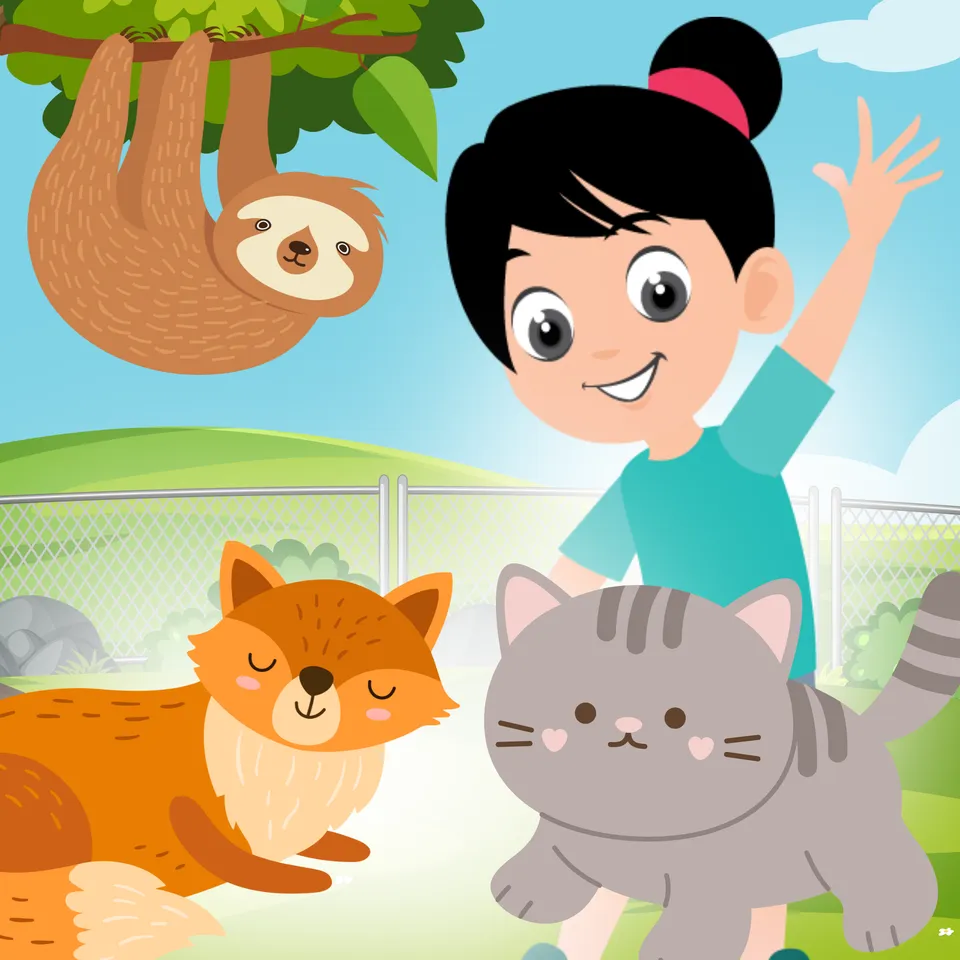
Let's Play and use our imagination! Today, we are Veterinarians! We'll help our animal friends a cat, a sloth and a fox, and of course have a dance party!
Part of
Standards alignment
Common Core State Standards
- SL.K.4 — Describe familiar people, places, things, and events and, with prompting and support, provide additional detail.
- ELD-SI.K-3.Narrate — Multilingual learners will… • Share ideas about one's own and others' lived experiences and previous learning • Connect stories with images and representations to add meaning • Ask questions about what others have shared • Recount and restate ideas • Discuss how stories might end or next steps
- L.K.1.d — Understand and use question words (interrogatives) (e.g., who, what, where, when, why, how).
- L.K.5.c — Identify real-life connections between words and their use (e.g., note places at school that are colorful).
Alabama
- ELA21.K.1d — Listen to others and take turns speaking, carrying on a conversation through multiple exchanges.
- ELA21.K.21 — Use new and previously-taught vocabulary to produce and expand complete sentences in shared language activities.
- ELA21.K.20 — Name and sort pictures of objects into categories based on common attributes while relating vocabulary to prior knowledge and building background knowledge.
Alaska
- SL.K.4 — Describe familiar people, places, things, and events, and with prompting and support, provide additional related details.
- L.K.1.d — Understand and use question words (interrogatives) (e.g., who, what, where, when, why, how).
- L.K.5.c — Identify real-life connections between words and their use (e.g., note places at school that are colorful).
Arizona
- K.SL.1 — Participate in collaborative conversations with diverse partners about kindergarten topics and texts with peers and adults in small and larger groups.
- K.SL.1.b — Continue a conversation through multiple exchanges.
- K.SL.3 — Ask and answer questions in order to seek help, get information, or clarify something that is not understood.
- K.SL.2 — Confirm understanding of a text read aloud or information presented orally or through other media by asking and answering questions about key details and requesting clarification if something is not understood.
- K.SL.4 — Describe familiar people, places, things, and events and, with prompting and support, provide additional detail.
Arkansas
- K.V.3 — Sort and categorize objects and images by concepts.
- C.1.K.7 — Discuss ways people improve communities which may include: • being a good neighbor • volunteering/helping • recycling • donating personal items/toys
California
- SL.K.1 — Participate in collaborative conversations with diverse partners about kindergarten topics and texts with peers and adults in small and larger groups.
- SL.K.4 — Describe familiar people, places, things, and events and, with prompting and support, provide additional detail.
- L.K.1.d — Understand and use question words (interrogatives) (e.g., who, what, where, when, why, how).
- L.K.5.c — Identify real-life connections between words and their use (e.g., note places at school that are colorful).
Colorado
- RWC20-GR.PS-S.1-GLE.2-EO.e — Practice asking questions and making statements.
- RWC20-GR.PS-S.4-GLE.1-EO.b — Identify problems and search for solutions by asking questions during collaborative explorations of the topic; begin to state facts about the topic.
- RWC20-GR.PS-S.2-GLE.1-EO.f — Retell stories or information from books through conversation, artistic works, creative movement, or drama.
- SC.P.2.1.a — Observe, describe and discuss living things.
Connecticut
- SL.K.1 — Participate in collaborative conversations with diverse partners about kindergarten topics and texts with peers and adults in small and larger groups.
- SL.K.4 — Describe familiar people, places, things, and events and, with prompting and support, provide additional detail.
- L.K.1.d — Understand and use question words (interrogatives) (e.g., who, what, where, when, why, how).
Delaware
- SL.K.1 — Participate in collaborative conversations with diverse partners about kindergarten topics and texts with peers and adults in small and larger groups.
- L.K.1.d — Understand and use question words (interrogatives) (e.g., who, what, where, when, why, how).
- SL.K.4 — Describe familiar people, places, things, and events and, with prompting and support, provide additional detail.
- L.K.5.c — Identify real-life connections between words and their use (e.g., note places at school that are colorful).
Florida
- SS.K.E.1.1 — Describe different kinds of jobs that people do and the tools or equipment used.
Georgia
- ELAGSEKSL4 — Describe familiar people, places, things, and events and, with prompting and support, provide additional detail.
Hawaii
- K.SL.4 — Describe familiar people, places, things, and events and, with prompting and support, provide additional detail.
- K.L.1d — Understand and use question words (interrogatives) (e.g., who, what, where, when, why, how).
- SS.K.1.7.3 — Compare roles and responsibilities of self and others at home, at school, and in neighborhood settings
- K.L.5c — Identify real-life connections between words and their use (e.g., note places at school that are colorful).
Idaho
- K.ODC.OC.4 — Describe familiar people, places, things, and events with support.
- K.SS.3.1.3 — Describe some jobs that people do to earn money/rewards.
- 1.VD.WB.2a — Sort words into categories (e.g., tools, pets) and define those words by one or more key attributes (e.g., *a saw is a tool that cuts; a goldfish is a pet that lives in water*).
Illinois
- SL.K.4 — Describe familiar people, places, things, and events and, with prompting and support, provide additional detail.
- L.K.1.d — Understand and use question words (interrogatives) (e.g., who, what, where, when, why, how).
- L.K.5.c — Identify real-life connections between words and their use (e.g., note places at school that are colorful).
Indiana
- K.CC.1 — Participate in collaborative conversations about grade-appropriate topics and texts with peers and adults in small and larger groups. (E)
- K.CC.2 — Ask questions to seek help, obtain information, or clarify something that is not understood.
- K.CC.3 — Ask and answer questions about key details in a text read aloud or information presented orally or through other media. (E)
- K.E.2 — Identify and describe different kinds of jobs that people do and the tools or equipment used in these jobs. (E)
- K.RC.7 — Identify and sort pictures of objects into categories (e.g., colors, shapes, opposites) through oral discussions. (E)
Iowa
- SL.K.1 — Participate in collaborative conversations with diverse partners about kindergarten topics and texts with peers and adults in small and larger groups.
- SL.K.1.b — Continue a conversation through multiple exchanges.
- L.K.1.c — Understand and use question words (interrogatives) (e.g., who, what, where, when, why, how).
- SL.K.4 — Describe familiar people, places, things, and events and, with prompting and support, provide additional detail.
Kansas
- SL.K.1 — Participate in collaborative conversations with diverse partners about Kindergarten topics and texts with peers and adults in small and larger groups.
- SL.K.7.c — Understand and use question words (interrogatives) (e.g., who, what, where, when, why, how).
- RL.K.12.c — Identify real-life connections between words and their use (e.g., note places at school that are colorful).
Kentucky
- K.E.KE.1 — Explain how various jobs affect communities.
- L.K.1.c — interrogative sentences using who, what, where, when, why and how.
- K.E.MA.1 — Identify places in communities that provide goods and services.
Louisiana
- SL.K.1 — Participate in collaborative conversations with diverse partners about kindergarten topics and texts with peers and adults in small and larger groups.
- SL.K.1.b — Continue a conversation through multiple exchanges.
- SL.K.3 — Ask and answer questions in order to seek help, get information, or clarify something that is not understood.
- SL.K.4 — Describe familiar people, places, things, and events and, with prompting and support, provide additional detail.
- SL.K.6 — Speak audibly and express thoughts, feelings, and ideas clearly.
- L.K.1.d — Understand and use question words (interrogatives) (e.g., who, what, where, when, why, how).
Maine
- Participate in collaborative conversations about kindergarten topics and texts with peers and adults in small and larger groups.
- SL.1.K.b — Continue a conversation through multiple exchanges.
- SL.2.K.b — Ask and answer questions in order to seek help, gather information, or clarify something that is not understood.
- SL.3.K.a — Describe familiar people, places, things, and events and, with prompting and support, provide additional detail.
- SL.4.K.a — Speak audibly and express thoughts, feelings, and ideas clearly.
Maryland
- SL.PK 1 — Participate in collaborative conversations with diverse partners about pre-kindergarten topics and texts with peers and adults in small and larger groups.
- SL.PK 1.b — During scaffolded conversations, continue a conversation through multiple exchanges.
- SL.PK 4 — Describe familiar people, places, things, and events with modeling and support.
- W.PK 8 — With modeling and support from adults, recall information from experiences or information from provided sources to answer a question.
- L.PK.5.c — Identify real-life connections between words and their use (e.g., note objects in the classroom that are small).
Massachusetts
- PreK.T4.1 — Working - With prompting and support, describe some things people do when they work inside and outside of the home, drawing on personal experience, literature, and informational texts
- SL.PK.1 — Participate in collaborative conversations with diverse partners during daily routines and play.
- SL.K.4 — Describe familiar people, places, things, and events and, with prompting and support, provide additional detail.
- SL.PK.2 — Recall information for short periods of time and retell, act out, or represent information from a text read aloud, a recording, or a video (e.g., watch a video about birds and their habitats and make drawings or constructions of birds and their nests).
Michigan
- SL.K.1 — Participate in collaborative conversations with diverse partners about kindergarten topics and texts with peers and adults in small and larger groups.
- SL.K.4 — Describe familiar people, places, things, and events and, with prompting and support, provide additional detail.
- L.K.1.d — Understand and use question words (interrogatives) (e.g., who, what, where, when, why, how).
Minnesota
- 0.3.1 — Exchange ideas in discussion and collaboration, as listener, speaker and participant, A) including the voices and perspectives of Dakota and Anishinaabe people as well other perspectives, identities and cultures like and unlike their own, and B) expressing one’s own ideas, stories and experiences.
- 0.2.2.2 — Share personal perspective, identity and voice, verbally or visually.
- 0.2.5.2 — Verbally or visually respond to a story, with support and guidance.
Mississippi
- K.E.1.1 — Identify different types of jobs and describe their work.
- SL.K.4 — Describe familiar people, places, things, and events and, with prompting and support, provide additional detail.
- L.K.1.d — Understand and use question words (interrogatives) (e.g., who, what, where, when, why, how).
Missouri
- K.L.1.A.e — use question words in sentences
- K.R.1.C.a — text to self (text ideas and own experiences)
- K.SL.2.A.a — demonstrating active listening, according to classroom expectations
- K.SL.3.A.a — taking turns speaking, according to classroom expectations
- 2.R.2.C.b — identify the elements of dialogue and use them in informal plays
Montana
- SL.K.1 — Participate in collaborative conversations with diverse partners about kindergarten topics and texts with peers and adults in small and larger groups.
- L.K.1.d — Understand and use question words (interrogatives) (e.g., who, what, where, when, why, how).
- SL.K.4 — Describe familiar people, places, things, and events and, with prompting and support, provide additional detail.
- SL.K.6 — Speak audibly and express thoughts, feelings, and ideas clearly.
- L.K.6 — Use words and phrases acquired through conversations, reading and being read to, and responding to texts.
Nebraska
- LA.K.SL.2 — With prompting and support, describe familiar people, places, things, and events, and provide additional detail.
- K.D.1.a — Identify, sort, and classify objects by size, shape, color, and other attributes.
- LA.K.SL.1.e — Complete a task following one/two-step directions.
Nevada
- SL.K.4 — Describe familiar people, places, things, and events and, with prompting and support, provide additional detail.
- L.K.1.d — Understand and use question words (interrogatives) (e.g., who, what, where, when, why, how).
New Hampshire
- SL.K.4 — Describe familiar people, places, things, and events and, with prompting and support, provide additional detail.
- L.K.1.d — Understand and use question words (interrogatives) (e.g., who, what, where, when, why, how).
- SS.CV.2.4.1 — Examine the responsibilities of individuals as members of a family, school and community, e.g., community helpers or chores at home and school. (Themes: B: Civic Ideals, Practices, and Engagement, C: People, Places and Environment)
New Jersey
- SL.K.1 — Participate in collaborative conversations with diverse partners about kindergarten topics and texts with peers and adults in small and larger groups.
- L.K.1.d — Understand and use question words (interrogatives) (e.g., who, what, where, when, why, how).
- SL.K.4 — Describe familiar people, places, things, and events and, with prompting and support, provide additional detail.
New Mexico
- SL.K.NM.4 — With prompting and support: role play; make predictions; and follow oral and graphic instructions.
- L.K.1.d — Understand and use question words (interrogatives) (e.g., who, what, where, when, why, how).
- SL.K.4 — Describe familiar people, places, things, and events and, with prompting and support, provide additional detail.
- 1.7 — Explain and provide examples of how people play important roles in society.
New York
- PKL4 — Explore and use new vocabulary in child-centered, authentic, play-based experiences.
- PKSL1 — Participate in collaborative conversations with diverse peers and adults in small and large groups and during play.
- KSL1 — Participate in collaborative conversations with diverse peers and adults in small and large groups and during play.
- PKSL4 — Describe familiar people, places, things, and events.
- KL5c — Use words to identify and describe the world, making connections between words and their use (e.g., places at home that are colorful).
North Carolina
- SL.K.1 — Participate in collaborative conversations with diverse partners about kindergarten topics and texts with peers and adults in small and larger groups.
North Dakota
- K.C.1 — Describe personal interests or tell stories orally to a targeted audience (e.g., peers and adults).
- K.C.2 — Speak audibly to express thoughts, feelings, and ideas.
- K.C.6 — Participate in conversations by listening to others and taking turns speaking.
- K.C.4 — Use grade-appropriate, conversational, general academic, and domain-specific words and phrases.
Ohio
- SL.K.1 — Participate in collaborative conversations about kindergarten topics and texts with diverse partners in small and larger groups.
- SL.K.4 — Describe familiar people, places, things, and events and, with prompting and support, provide additional detail.
- L.K.1.d — Understand and use interrogatives (question words) (e.g., who, what, where, when, why, how).
- L.K.6 — Use words and phrases acquired through conversations, reading and being read to, and responding to texts.
- W.K.8 — With guidance and support from adults, recall information from experiences or gather information from provided sources to answer a question.
Oklahoma
- K.4.4 — Explain how various community members including police officers, firefighters, soldiers, school personnel, business professionals, and medical personnel impact the student’s life.
- PK.5.R.2 — Students will hear different parts of speech through conversations, read-alouds, and interactive reading: • concrete objects as persons, places, or things (i.e., nouns) • words as actions (i.e., verbs) • color adjectives • spatial and time relationships such as up, down, before, and after
- PK.S.1 — Engage in play to explore the physical and natural world. Clarification Statement: Exploration-based play should include playing inside the classroom (e.g., building towers with blocks, interacting with a balloon, mixing water colors, placing different objects in water) and outside the classroom (e.g., swinging at different speeds, kicking a ball in different ways, rolling round objects down a hill, digging in the dirt). Emphasis is on basic play as a means of exploration.
Oregon
- K.SL.1 — Participate in collaborative conversations with diverse partners about kindergarten topics and texts with peers and adults in small and larger groups.
- K.SL.1b — Continue a conversation through multiple exchanges.
- K.6 — Give examples of different jobs performed in communities.
- K.SL.3 — Ask and answer questions in order to seek help, get information, or clarify something that is not understood.
- K.SL.4 — Describe familiar people, places, things, and events and, with prompting and support, provide additional detail.
- K.SL.6 — Speak audibly and express thoughts, feelings, and ideas clearly.
Pennsylvania
- CC.1.5.PK.A — Participate in collaborative conversations with peers and adults in small and larger groups.
- CC.1.5.PK.D — Using simple sentences, share stories, familiar experiences, and interests, speaking clearly enough to be understood by most audiences.
- CC.1.5.PK.B — Answer questions about key details in a text read aloud or information presented orally or through other media.
- CC.1.5.PK.C — Respond to what a speaker says in order to follow directions, seek help, or gather information.
- CC.1.5.PK.E — Using simple sentences, express thoughts, feelings, and ideas, speaking clearly enough to be understood by most audiences.
- CC.1.4.PK.O — With prompting and support describe experiences and events.
Rhode Island
- SL.K.1 — Participate in collaborative conversations with diverse partners about kindergarten topics and texts with peers and adults in small and larger groups.
- SL.K.4 — Describe familiar people, places, things, and events and, with prompting and support, provide additional detail.
- SSK.3.2 — Roles in the community and community citizenship Analyze the ways members of a community interact, help each other, and contribute to the community as a whole
- SS1.3.2 — Jobs and careers Analyze different jobs and careers and how they contribute to the community and economy
South Carolina
- ELA.K.C.9.1 — Ask and answer questions in conversation on a topic.
- ELA.K.C.8.1 — Participate with peers and adults in structured discussions and routines about grade-appropriate topics and texts: a. enter a conversation by greeting, taking turns, and responding to others with statements, phrases, and/or questions; and b. consider the ideas of others while engaging in conversations.
- ELA.K.R.1.1 — Ask and answer questions (who, what, when, where, why, and how) about print and non-print sources to obtain and refine knowledge.
South Dakota
- K.SL.1 — Participate in collaborative conversations about kindergarten topics and texts with peers and adults in small and larger groups.
- K.SL.4 — Describe familiar people, places, things, and events. With prompting and support, provide additional detail.
- K.L.1.d — Understand and use question words (interrogatives).
Tennessee
- K.SL.PKI.4 — Describe familiar people, places, things, and events, and, with prompting and support, provide additional detail.
- K.FL.SC.6.c — Use frequently occurring nouns and verbs when speaking and in shared language activities.
- K.FL.SC.6.e — Understand and use question words (interrogatives) when speaking and in shared language activities.
- K.FL.VA.7.c — Use words and phrases acquired through conversations, reading and being read to, and responding to texts.
Texas
- K.1E — develop social communication such as introducing himself/herself, using common greetings, and expressing needs and wants.
- K.3C — identify and use words that name actions; directions; positions; sequences; categories such as colors, shapes, and textures; and locations.
- K.6F — respond using newly acquired vocabulary as appropriate.
Utah
- P4.SL.1 — Participate in conversations with peers and adults, using ageappropriate vocabulary on topics and texts.
- P4.SL.1.c — Express own ideas.
- K.4.2.c — Describe different types of jobs that people do and the tools and equipment that they use.
- P4.W.4.a — Recall information from experiences or learned information and share it with others.
- K.2.1.b — Demonstrate positive relationships through play and friendship.
Vermont
- SL.K.4 — Describe familiar people, places, things, and events and, with prompting and support, provide additional detail.
- L.K.1.d — Understand and use question words (interrogatives) (e.g., who, what, where, when, why, how).
- D2.Civ.2.K-2 — Individually and with others, students… = Explain how all people, not just official leaders, play important roles in a community.
Virginia
- K.C.1.A — Participate in a range of collaborative discussions (one-on-one, in groups, and teacher-led) on kindergarten topics and texts. This includes:
- K.C.1.A.iii — Participate in a range of collaborative discussions (one-on-one, in groups, and teacher-led) on kindergarten topics and texts. This includes asking questions to seek help, get information, or clarify information for further understanding.
- K.C.2.A — Describe personal experiences using complete sentences.
- K.C.2.D — Retell, create, and dictate stories, rhymes, poems, and events in sequential order using drama, props, and/or pictures indicating first, next and last events in a story.
- K.LU.1.D — Use adjectives to describe specific objects (quantity, size, age, shape, color, or location).
Washington
- SL.K.1 — Participate in collaborative conversations with diverse partners about kindergarten topics and texts with peers and adults in small and larger groups.
- SL.K.4 — Describe familiar people, places, things, and events and, with prompting and support, provide additional detail.
- L.K.1.d — Understand and use question words (interrogatives) (e.g., who, what, where, when, why, how).
- L.K.5.c — Identify real-life connections between words and their use (e.g., note places at school that are colorful).
- SSS2.K.1 — Demonstrate how to ask questions about the classroom and school community.
Washington, D.C.
- SL.K.1 — Participate in collaborative conversations with diverse partners about kindergarten topics and texts with peers and adults in small and larger groups.
- L.K.1.d — Understand and use question words (interrogatives) (e.g., who, what, where, when, why, how).
- SL.K.4 — Describe familiar people, places, things, and events and, with prompting and support, provide additional detail.
- W.K.8 — With guidance and support from adults, recall information from experiences or gather information from provided sources to answer a question.
West Virginia
- ELA.K.33 — Describe familiar people, places, things, and events and, with prompting and support, provide additional details.
- ELA.K.36.c — Understand and use question words (interrogatives) (e.g., who, what, where, when, why, and how).
- ELA.PK.FR.BA.5 — Retell stories or information from books through conversation, artistic works, creative movement, or drama.
- SS.K.2 — Participate in role play to resolve disputes, and demonstrate tolerance and acceptance of others and their ideas.
Wisconsin
- ELA.K.SL.4 — With guidance and support, describe familiar people, places, things, and events.
- ELA.1.SL.1.a — With guidance and support, follow agreed-upon norms for discussions and participate by actively listening, taking turns, and staying on topic.
- ELA.1.SL.1.b — Build on others' talk in conversations by responding to the comments of others through multiple exchanges.
- ELA.K.L.3.d — Connect common words to real life (e.g., colorful).
- SS.Econ4.b.1 — Classify different jobs people have and how these jobs help others. Explain what major public, private, and tribal institutions (e.g., schools, police, fire station) do for people.
Wyoming
- SL.K.4 — Describe familiar people, places, things, and events and, with prompting and support, provide additional detail.
- L.K.1.d — Understand and use question words (interrogatives) (e.g., who, what, where, when, why, how).
- L.K.5.c — Identify real-life connections between words and their use (e.g., note places at school that are colorful).