Tally Charts
Ages 5–8 · 18 minutes · Math
Take a safari trip with little owls to master tally charts
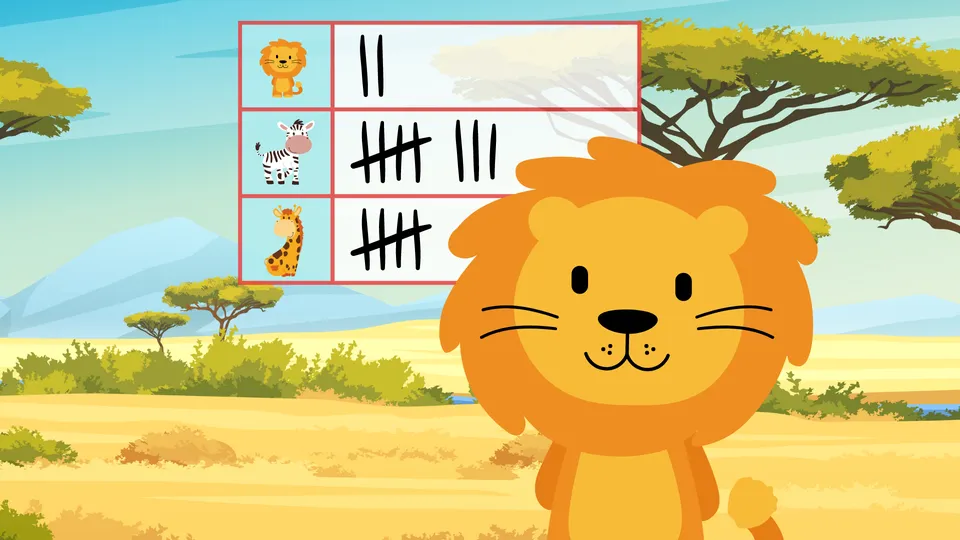
Student will learn how to read data from a tally chart with up to three categories: how many of an object are in a category, how many more or less are in one category than in another, and how many are in all.
Required: fluent counting and addition up to 20
Suggested materials: pencil and paper
Part of
Standards alignment
Common Core State Standards
- 1.MD.C.4 — Organize, represent, and interpret data with up to three categories; ask and answer questions about the total number of data points, how many in each category, and how many more or less are in one category than in another.
- 1.OA.A.2 — Solve word problems that call for addition of three whole numbers whose sum is less than or equal to 20, e.g., by using objects, drawings, and equations with a symbol for the unknown number to represent the problem.
- K.MD.B.3 — Classify objects into given categories; count the numbers of objects in each category and sort the categories by count.
- K.CC.B.5 — Count to answer "how many?" questions about as many as 20 things arranged in a line, a rectangular array, or a circle, or as many as 10 things in a scattered configuration; given a number from 1—20, count out that many objects.
Alabama
- MA19.1.16 — Organize, represent, and interpret data with up to three categories.
- MA19.1.16a — Ask and answer questions about the total number of data points in organized data.
- MA19.1.16c — Determine "how many" in each category using up to three categories of data.
- MA19.1.16d — Determine "how many more" or "how many less" are in one category than in another using data organized into two or three categories.
- MA19.1.1d — Compare quantities, with difference unknown, bigger unknown, and smaller unknown while solving word problems within 20.
Alaska
- 1.MD.7 — Organize, represent and interpret data with up to three categories. Ask and answer comparison and quantity questions about the data.
- 1.CC.1 — Skip count by 2s and 5s.
- 1.OA.2 — Solve word problems that call for addition of three whole numbers whose sum is less than or equal to 20 (e.g., by using objects, drawings and equations). Record and explain using equation symbols and a symbol for the unknown number to represent the problem.
- 1.OA.6 — Add and subtract using numbers up to 20, demonstrating fluency for addition and subtraction up to 10. Use strategies such as • counting on • making ten (8 + 6 = 8 + 2 + 4 = 10 + 4 = 14) • decomposing a number leading to a ten (13 - 4 = 13 - 3 - 1 = 10 - 1 = 9) • using the relationship between addition and subtraction, such as fact families, (8 + 4 = 12 and 12 - 8 = 4) • creating equivalent but easier or known sums (e.g., adding 6 + 7 by creating the known equivalent 6 + 6 + 1 = 12 + 1 = 13).
- K.CC.5 — Count to answer "how many?" questions about as many as 20 things arranged in a line, a rectangular array or a circle, or as many as 10 things in a scattered configuration; given a number from 1-20, count out that many objects.
Arizona
- 1.MD.C.4 — Organize, represent, and interpret data with up to three categories; ask and answer questions about the total number of data points, how many in each category, and how many more or less are in one category than in another.
- 1.OA.A.2 — Solve word problems that call for addition of three whole numbers whose sum is less than or equal to 20, e.g., by using objects, drawings, and equations with a symbol for the unknown number to represent the problem.
- K.CC.B.5 — Count to answer "how many?" questions about as many as 20 things arranged in a line, a rectangular array, or a circle, or as many as 10 things in a scattered configuration; given a number from 1—20, count out that many objects.
- K.MD.B.3 — Classify objects into given categories; count the numbers of objects in each category and sort the categories by count.
Arkansas
- 1.DA.1 — Organize, represent, and interpret data with up to three categories (e.g., tally tables, picture graphs, bar graphs).
- 1.DA.2 — Ask and answer questions about the total number represented such as how many in each category and how many more or less in one category compared to another.
- 1.CAR.2 — Use computational fluency to add and subtract within 20 using manipulatives and/or a variety of strategies.
- 1.CAR.7 — Solve real-world problems involving addition of three whole numbers whose sum is less than or equal to 20.
California
- 1.MD.C.4 — Organize, represent, and interpret data with up to three categories; ask and answer questions about the total number of data points, how many in each category, and how many more or less are in one category than in another.
- 1.OA.A.2 — Solve word problems that call for addition of three whole numbers whose sum is less than or equal to 20, e.g., by using objects, drawings, and equations with a symbol for the unknown number to represent the problem.
- K.MD.B.3 — Classify objects into given categories; count the numbers of objects in each category and sort the categories by count.
- K.CC.B.5 — Count to answer "how many?" questions about as many as 20 things arranged in a line, a rectangular array, or a circle, or as many as 10 things in a scattered configuration; given a number from 1—20, count out that many objects.
Colorado
- 1.MD.C.4 — Organize, represent, and interpret data with up to three categories; ask and answer questions about the total number of data points, how many in each category, and how many more or less are in one category than in another.
- 1.OA.A.2 — Solve word problems that call for addition of three whole numbers whose sum is less than or equal to 20, e.g., by using objects, drawings, and equations with a symbol for the unknown number to represent the problem.
- K.CC.B.5 — Count to answer “how many?” questions about as many as 20 things arranged in a line, a rectangular array, or a circle, or as many as 10 things in a scattered configuration; given a number from 1–20, count out that many objects.
Connecticut
- 1.MD.C.4 — Organize, represent, and interpret data with up to three categories; ask and answer questions about the total number of data points, how many in each category, and how many more or less are in one category than in another.
- 1.OA.A.2 — Solve word problems that call for addition of three whole numbers whose sum is less than or equal to 20, e.g., by using objects, drawings, and equations with a symbol for the unknown number to represent the problem.
- K.MD.B.3 — Classify objects into given categories; count the numbers of objects in each category and sort the categories by count.
- K.CC.B.5 — Count to answer "how many?" questions about as many as 20 things arranged in a line, a rectangular array, or a circle, or as many as 10 things in a scattered configuration; given a number from 1—20, count out that many objects.
Delaware
- 1.MD.C.4 — Organize, represent, and interpret data with up to three categories; ask and answer questions about the total number of data points, how many in each category, and how many more or less are in one category than in another.
- 1.OA.A.2 — Solve word problems that call for addition of three whole numbers whose sum is less than or equal to 20, e.g., by using objects, drawings, and equations with a symbol for the unknown number to represent the problem.
- K.MD.B.3 — Classify objects into given categories; count the numbers of objects in each category and sort the categories by count.
Florida
- MA.1.DP.1.1 — Collect data into categories and represent the results using tally marks or pictographs.
- MA.1.DP.1.2 — Interpret data represented with tally marks or pictographs by calculating the total number of data points and comparing the totals of different categories.
- MA.1.AR.1.2 — Solve addition and subtraction real-world problems using objects, drawings or equations to represent the problem.
- MA.K.DP.1.1 — Collect and sort objects into categories and compare the categories by counting the objects in each category. Report the results verbally, with a written numeral or with drawings.
Georgia
- 1.MDR.6.4 — Ask questions and answer them based on gathered information, observations, and appropriate graphical displays to compare and order whole numbers.
- K.MDR.7.3 — Ask questions and answer them based on gathered information, observations, and appropriate graphical displays to solve problems relevant to everyday life.
- 1.NR.2.1 — Use a variety of strategies to solve addition and subtraction problems within 20.
- K.MDR.7.2 — Classify and sort up to ten objects into categories by an attribute; count the number of objects in each category and sort the categories by count.
Hawaii
- 1.MD.C.4 — Organize, represent, and interpret data with up to three categories; ask and answer questions about the total number of data points, how many in each category, and how many more or less are in one category than in another.
- 1.OA.A.2 — Solve word problems that call for addition of three whole numbers whose sum is less than or equal to 20, e.g., by using objects, drawings, and equations with a symbol for the unknown number to represent the problem.
- K.CC.B.5 — Count to answer "how many?" questions about as many as 20 things arranged in a line, a rectangular array, or a circle, or as many as 10 things in a scattered configuration; given a number from 1—20, count out that many objects.
- K.MD.B.3 — Classify objects into given categories; count the numbers of objects in each category and sort the categories by count.
Idaho
- 1.MD.C.4 — Organize, represent, and interpret data with up to three categories; ask and answer questions about the total number of data points, how many in each category, and how many more or less are in one category than in another.
- 1.OA.A.2 — Solve word problems that call for addition of three whole numbers whose sum is less than or equal to 20 by using physical, visual, and symbolic representations.
- K.CC.B.5 — Given a group of up to 20 objects, count the number of objects in that group and state the number of objects in a rearrangement of that group without recounting. Given a verbal or written number from zero to 20, count out that many objects.
- K.MD.B.3 — Classify objects into given categories; count the numbers of objects in each category (up to and including ten) and sort the categories by count.
Illinois
- 1.MD.C.4 — Organize, represent, and interpret data with up to three categories; ask and answer questions about the total number of data points, how many in each category, and how many more or less are in one category than in another.
- 1.OA.A.2 — Solve word problems that call for addition of three whole numbers whose sum is less than or equal to 20, e.g., by using objects, drawings, and equations with a symbol for the unknown number to represent the problem.
- K.CC.B.5 — Count to answer "how many?" questions about as many as 20 things arranged in a line, a rectangular array, or a circle, or as many as 10 things in a scattered configuration; given a number from 1—20, count out that many objects.
- K.MD.B.3 — Classify objects into given categories; count the numbers of objects in each category and sort the categories by count.
Indiana
- 1.CA.2 — Solve real-world problems involving addition and subtraction within 20 in situations of adding to, taking from, putting together, taking apart, and comparing, with unknowns in all parts of the addition or subtraction problem (e.g., by using objects, drawings, and equations with a symbol for the unknown number to represent the problem). (E)
- 1.DA.1 — With guidance, collect data from a simple survey or collaborative investigation; organize data into appropriate single-unit bar graphs, pictographs, and/or tables and draw conclusions based on mathematical observations, comparisons, and grade-level computation strategies. (E)
- K.DA.1 — With guidance, collect and organize data into simple bar graphs, pictographs, and/or tables to identify patterns and make comparisons. (E)
- 1.CA.1 — Demonstrate fluency with addition facts and the corresponding subtraction facts within 20. Use strategies such as counting on; making ten (e.g., 8 + 6 = 8 + 2 + 4 = 10 + 4 = 14); decomposing a number leading to a 10 (e.g., 13 – 4 = 13 – 3 – 1 = 10 – 1 = 9); using the relationship between addition and subtraction (e.g., knowing that 8 + 4 = 12, one knows 12 – 8 = 4); and creating equivalent but easier or known sums (e.g., adding 6 + 7 by creating the known equivalent 6 + 6 + 1 = 12 + 1 = 13). Model the role of 0 and the equal sign in addition and subtraction using objects or drawings. (E)
- 1.NS.1 — Count to at least 120 by ones, fives, and tens from any given number. In this range, read and write numerals and represent a number of objects with a written numeral. (E)
Iowa
- 1.MD.C.4 — Organize, represent, and interpret data with up to three categories; ask and answer questions about the total number of data points, how many in each category, and how many more or less are in one category than in another.
- 1.OA.A.1 — Use addition and subtraction within 20 to solve word problems involving the problem types listed below, with unknowns in all positions, by using objects, drawings, and equations with a symbol for the unknown number to represent the problem. • Adding to. • Taking from. • Putting together. • Taking apart. • Comparing. (See Problem Types Table 1 in Appendix A)
- 1.OA.A.2 — Solve word problems that call for addition of three whole numbers whose sum is less than or equal to 20. For example, by using objects, drawings, and equations with a symbol for the unknown number to represent the problem.
- 1.OA.C.6 — Add and subtract within 20, using strategies such as: • Counting on. • Making ten (for example, 8 + 6 = 8 + 2 + 4 = 10 + 4 = 14). • Decomposing a number leading to a ten (for example, $13 − 4 = 13 − 3 − 1 = 10 − 1 = 9)$. • Using the relationship between addition and subtraction (for example, knowing that 8 + 4 = 12, one knows 12 − 8 = 4). • Creating equivalent but easier or known sums (for example, adding 6 + 7 by creating the known equivalent $6 + 6 + 1 = 12 + 1 = 13)$. • Counting up to subtract.
Kansas
- 1.MD.4 — Organize, represent, and interpret data with up to three categories; ask and answer questions about the total number of data points, how many in each category, and how many more or less are in one category than in another.
- 1.OA.1 — Use addition and subtraction within 20 to solve word problems involving situations of adding to, taking from, putting together, taking apart, and comparing, with unknowns in all positions, (e.g. by using objects, drawings, and situation equations and/or solution equations with a symbol for the unknown number to represent the problem.)
- 1.OA.2 — Solve word problems that call for addition of three whole numbers whose sum is less than or equal to 20, (e.g. by using objects, drawings, and equations with a symbol for the unknown number to represent the problem.)
- K.CC.5 — Count to answer “how many?” up to 20 concrete or pictorial objects arranged in a line, a rectangular array, or a circle, or as many as 10 objects in a scattered configuration; given a number from 1 to 20, count out that many objects.
- K.MD.3 — Classify objects into given categories; count the numbers of objects in each category and sort the categories by count (Limit category counts to be less than or equal to 10).
Kentucky
- KY.1.MD.4.c — Organize and represent data in a table/chart with up to three categories.
- KY.1.MD.4.d — Interpret data to answer questions about the table/chart that connects to the question posed, including total number of data points, how many in each category and how many more or less are in one category than in another.
- KY.1.MD.4 — Investigate questions involving categorical data.
- KY.1.OA.2 — Solve word problems that call for addition of three whole numbers whose sum is less than or equal to 20, by using objects, drawings and equations with a symbol for one unknown number to represent the problem.
Louisiana
- 1.MD.C.4 — Organize, represent, and interpret data with up to three categories; ask and answer questions about the total number of data points, how many in each category, and how many more or less are in one category than in another.
- 1.OA.A.1 — Use addition and subtraction within 20 to solve word problems involving situations of adding to, taking from, putting together, taking apart, and comparing, with unknowns in all positions, (e.g., by using objects, drawings, and equations with a symbol for the unknown number to represent the problem).
- 1.OA.A.2 — Solve word problems that call for addition of three whole numbers whose sum is less than or equal to 20, e.g., by using objects, drawings, and equations with a symbol for the unknown number to represent the problem.
Maine
- 1.MD.C.4 — Organize, represent, and interpret data with up to three categories; ask and answer questions about the total number of data points, how many in each category, and how many more or less are in one category than in another.
- 1.OA.A.2 — Solve word problems that call for addition of three whole numbers whose sum is less than or equal to 20, (e.g., by using objects, drawings, and equations with a symbol for the unknown number to represent the problem.)
- 1.OA.C.6 — Add and subtract within 20, demonstrating fluency for addition and subtraction within 10. Use strategies such as counting on; making ten (e.g., 8 + 6 = 8 + 2 + 4 = 10 + 4 = 14); decomposing a number leading to a ten (e.g., 13 - 4 = 13 - 3 - 1 = 10 - 1 = 9); using the relationship between addition and subtraction (e.g., knowing that 8 + 4 = 12, one knows 12 - 8 = 4); and creating equivalent but easier or known sums (e.g., adding 6 + 7 by creating the known equivalent 6 + 6 + 1 = 12 + 1 = 13).
- K.MD.B.3 — Classify objects into given categories; count the numbers of objects in each category and sort the categories by count. (Limit category counts to be less than or equal to 10.)
Maryland
- 1.MD.C.4 — Organize, represent, and interpret data with up to three categories; ask and answer questions about the total number of data points, how many in each category, and how many more or less are in one category than in another.
- 1.OA.A.2 — Solve word problems that call for addition of three whole numbers whose sum is less than or equal to 20, e.g., by using objects, drawings, and equations with a symbol for the unknown number to represent the problem.
- K.MD.B.3 — Classify objects into given categories; count the numbers of objects in each category and sort the categories by count.
Massachusetts
- 1.MD.C.4 — Organize, represent, and interpret data with up to three categories; ask and answer questions about the total number of data points, how many in each category, and how many more or less are in one category than in another.
- 1.OA.A.2 — Solve word problems that call for addition of three whole numbers whose sum is less than or equal to 20, e.g., by using objects, drawings, and equations with a symbol for the unknown number to represent the problem.
- K.CC.B.5 — Count to answer "how many?" questions about as many as 20 things arranged in a line, a rectangular array, or a circle, or as many as 10 things in a scattered configuration; given a number from 1–20, count out that many objects.
- K-LS1-1 — Observe and communicate that animals (including humans) and plants need food, water, and air to survive. Animals get food from plants or other animals. Plants make their own food and need light to live and grow.
Michigan
- 1.MD.C.4 — Organize, represent, and interpret data with up to three categories; ask and answer questions about the total number of data points, how many in each category, and how many more or less are in one category than in another.
- 1.OA.A.2 — Solve word problems that call for addition of three whole numbers whose sum is less than or equal to 20, e.g., by using objects, drawings, and equations with a symbol for the unknown number to represent the problem.
- 1.OA.C.6 — Add and subtract within 20, demonstrating fluency for addition and subtraction within 10. Use strategies such as counting on; making ten (e.g., 8 + 6 = 8 + 2 + 4 = 10 + 4 = 14); decomposing a number leading to a ten (e.g., 13 - 4 = 13 - 3 - 1 = 10 - 1 = 9); using the relationship between addition and subtraction (e.g., knowing that 8 + 4 = 12, one knows 12 - 8 = 4); and creating equivalent but easier or known sums (e.g., adding 6 + 7 by creating the known equivalent 6 + 6 + 1 = 12 + 1 = 13).
- K.MD.B.3 — Classify objects into given categories; count the numbers of objects in each category and sort the categories by count.
Minnesota
- 1.1.1.7 — Use counting and comparison skills to create and analyze bar graphs and tally charts. For example: Make a bar graph of students' birthday months and count to compare the number in each month.
- 2.1.2.6 — Use addition and subtraction to create and obtain information from tables, bar graphs and tally charts.
- 1.1.1.2 — Read, write and represent whole numbers up to 120. Representations may include numerals, addition and subtraction, pictures, tally marks, number lines and manipulatives, such as bundles of sticks and base 10 blocks.
- 1.1.2.1 — Use words, pictures, objects, length-based models (connecting cubes), numerals and number lines to model and solve addition and subtraction problems in part-part-total, adding to, taking away from and comparing situations.
- 1.1.2.3 — Recognize the relationship between counting and addition and subtraction. Skip count by 2s, 5s, and 10s.
Mississippi
- 1.MD.4 — Organize, represent, and interpret data with up to three categories; ask and answer questions about the total number of data points, how many in each category, and how many more or less are in one category than in another.
- 1.OA.1 — Use addition and subtraction within 20 to solve word problems involving situations of adding to, taking from, putting together, taking apart, and comparing, with unknowns in all positions, e.g., by using objects, drawings, and equations with a symbol for the unknown number to represent the problem.
- 1.OA.2 — Solve word problems that call for addition of three whole numbers whose sum is less than or equal to 20, e.g., by using objects, drawings, and equations with a symbol for the unknown number to represent the problem.
- 1.OA.6 — Add and subtract within 20, demonstrating fluency for addition and subtraction within 10. Use strategies such as counting on; making ten (e.g., 8 + 6 = 8 + 2 + 4 = 10 + 4 = 14); decomposing a number leading to a ten (e.g., 13 – 4 = 13 – 3 – 1 = 10 – 1 = 9); using the relationship between addition and subtraction (e.g., knowing that 8 + 4 = 12, one knows 12 – 8 = 4); and creating equivalent but easier or known sums (e.g., adding 6 + 7 by creating the known equivalent 6 + 6 + 1 = 12 + 1 = 13).
Missouri
- 1.DS.A.1 — Collect, organize and represent data with up to three categories.
- 1.DS.A.2 — Draw conclusions from object graphs, picture graphs, T-charts and tallies.
- 1.RA.A.2 — Solve problems that call for addition of three whole numbers whose sum is within 20.
- 1.RA.C.7 — Add and subtract within 20.
- K.DS.A.2 — Compare category counts using appropriate language.
Montana
- 1.MD.C.4 — Organize, represent, and interpret data with up to three categories; ask and answer questions about the total number of data points, how many in each category, and how many more or less are in one category than in another.
- 1.OA.A.1 — Use addition and subtraction within 20 to solve word problems within a cultural context, including those of Montana American Indians, involving situations of adding to, taking from, putting together, taking apart, and comparing, with unknowns in all positions, e.g., by using objects, drawings, and equations with a symbol for the unknown number to represent the problem.
- 1.OA.A.2 — Solve word problems within a cultural context, including those of Montana American Indians, that call for addition of three whole numbers whose sum is less than or equal to 20, e.g., by using objects, drawings, and equations with a symbol for the unknown number to represent the problem.
- K.CC.B.5 — Count to answer "how many?" questions about as many as 20 things arranged in a line, a rectangular array, or a circle, or as many as 10 things in a scattered configuration; given a number from 1-20, count out that many objects from a variety of cultural contexts, including those of Montana American Indians.
Nebraska
- 1.D.2.a — Ask and answer questions about the total number of data points, how many in each category, and compare categories by identifying how many more or less are in a particular category using a picture graph.
- 1.D.1.a — Collect, organize, and represent a data set with up to three categories using a picture graph.
- 1.N.5.e — Solve problems that call for addition of three whole numbers whose sum is less than or equal to 20 using flexible strategies with objects, drawings, and/or equations.
- 1.N.2.d — Understand patterns of skip counting by 2s, 5s, and 10s.
Nevada
- 1.MD.C.4 — Organize, represent, and interpret data with up to three categories; ask and answer questions about the total number of data points, how many in each category, and how many more or less are in one category than in another.
- 1.OA.A.2 — Solve word problems that call for addition of three whole numbers whose sum is less than or equal to 20, e.g., by using objects, drawings, and equations with a symbol for the unknown number to represent the problem.
- K.MD.B.3 — Classify objects into given categories; count the numbers of objects in each category and sort the categories by count.
- K.CC.B.5 — Count to answer "how many?" questions about as many as 20 things arranged in a line, a rectangular array, or a circle, or as many as 10 things in a scattered configuration; given a number from 1—20, count out that many objects.
New Hampshire
- 1.MD.C.4 — Organize, represent, and interpret data with up to three categories; ask and answer questions about the total number of data points, how many in each category, and how many more or less are in one category than in another.
- 1.OA.A.2 — Solve word problems that call for addition of three whole numbers whose sum is less than or equal to 20, e.g., by using objects, drawings, and equations with a symbol for the unknown number to represent the problem.
- K.MD.B.3 — Classify objects into given categories; count the numbers of objects in each category and sort the categories by count.
New Jersey
- 1.MD.C.4 — Organize, represent, and interpret data with up to three categories; ask and answer questions about the total number of data points, how many in each category, and how many more or less are in one category than in another.
- 1.OA.A.1 — Use addition and subtraction within 20 to solve word problems involving situations of adding to, taking from, putting together, taking apart, and comparing, with unknowns in all positions, e.g., by using objects, drawings, and equations with a symbol for the unknown number to represent the problem.
- 1.OA.A.2 — Solve word problems that call for addition of three whole numbers whose sum is less than or equal to 20, e.g., by using objects, drawings, and equations with a symbol for the unknown number to represent the problem.
New Mexico
- 1.MD.C.4 — Organize, represent, and interpret data with up to three categories; ask and answer questions about the total number of data points, how many in each category, and how many more or less are in one category than in another.
- 1.OA.A.2 — Solve word problems that call for addition of three whole numbers whose sum is less than or equal to 20, e.g., by using objects, drawings, and equations with a symbol for the unknown number to represent the problem.
- K.CC.B.5 — Count to answer "how many?" questions about as many as 20 things arranged in a line, a rectangular array, or a circle, or as many as 10 things in a scattered configuration; given a number from 1—20, count out that many objects.
- K.MD.B.3 — Classify objects into given categories; count the numbers of objects in each category and sort the categories by count.
- 2.NBT.A.2 — Count within 1000; skip-count by 5s, 10s, and 100s.
New York
- NY-1.MD.4 — Organize, represent, and interpret data with up to three categories; ask and answer questions about the total number of data points, how many in each category, and how many more or less are in one category than in another.
- NY-1.OA.1 — Use addition and subtraction within 20 to solve one step word problems involving situations of adding to, taking from, putting together, taking apart, and/or comparing, with unknowns in all positions.
- NY-1.OA.2 — Solve word problems that call for addition of three whole numbers whose sum is less than or equal to 20.
- NY-1.OA.6.a — Add and subtract within 20. Use strategies such as: • counting on; • making ten; • decomposing a number leading to a ten; • using the relationship between addition and subtraction; and • creating equivalent but easier or known sums.
North Carolina
- NC.1.MD.4 — Organize, represent, and interpret data with up to three categories. • Ask and answer questions about the total number of data points. • Ask and answer questions about how many in each category. • Ask and answer questions about how many more or less are in one category than in another.
- NC.1.OA.1 — Represent and solve addition and subtraction word problems, within 20, with unknowns, by using objects, drawings, and equations with a symbol for the unknown number to represent the problem, when solving: • Add to/Take from-Change Unknown • Put together/Take Apart-Addend Unknown • Compare-Difference Unknown
- NC.1.OA.2 — Represent and solve word problems that call for addition of three whole numbers whose sum is less than or equal to 20, by using objects, drawings, and equations with a symbol for the unknown number.
- NC.1.OA.6 — Add and subtract, within 20, using strategies such as: • Counting on • Making ten • Decomposing a number leading to a ten • Using the relationship between addition and subtraction • Using a number line • Creating equivalent but simpler or known sums
North Dakota
- 1.DPS.D.2 — Analyze data by answering descriptive questions.
- 1.AR.OA.4 — Solve authentic word problems with addition, including three numbers and unknowns, within 20.
- 1.AR.OA.5 — Solve authentic word problems with subtraction, including unknowns, within 20.
- 1.DPS.D.1 — Collect, organize, and represent data with up to three categories using picture and bar graphs.
- 1.NO.CC.5 — Skip count forward and backward by 5s and 10s from multiples and recognize the patterns of up to 10 skip counts.
Ohio
- 1.MD.4 — Organize, represent, and interpret data with up to three categories; ask and answer questions about the total number of data points, how many in each category, and how many more or less are in one category than in another.
- 1.OA.1 — Use addition and subtraction within 20 to solve word problems involving situations of adding to, taking from, putting together, taking apart and comparing, with unknowns in all positions, e.g., by using objects, drawings, and equations with a symbol for the unknown number to represent the problem.
- 1.OA.2 — Solve word problems that call for addition of three whole numbers whose sum is less than or equal to 20, e.g., by using objects, drawings, and equations with a symbol for the unknown number to represent the problem. Drawings need not show details, but should show the mathematics in the problem.
- 1.OA.5 — Relate counting to addition and subtraction, e.g., by counting on 2 to add 2.
Oklahoma
- 1.D.1.1 — Collect, sort, and organize data in up to three categories using representations (e.g., tally marks, tables, Venn diagrams).
- 1.D.1.3 — Draw conclusions from pictographs and bar graphs.
- 1.N.1.3 — Read, write, discuss, and represent whole numbers up to 100. Representations may include numerals, words, addition and subtraction, pictures, tally marks, number lines, and manipulatives.
- 1.N.1.4 — Count forward, with objects, from any given number up to 100 by 1s, 2s, 5s and 10s.
Oregon
- 1.DR.B.2 — Analyze data sets with up to three categories by representing data visually, such as with graphs and charts, and interpret information presented to answer investigative questions.
- 1.DR.A.1 — Generate questions to investigate situations within the classroom. Collect or consider data that can naturally answer questions by representing data visually.
- 1.OA.A.2 — Solve problems that call for addition of three whole numbers whose sum is less than or equal to 20 using objects, drawings or equations.
- 1.OA.C.6 — Add and subtract within 20, demonstrating fluency for addition and subtraction within 10 with accurate, efficient, and flexible strategies.
- K.DR.B.2 — Analyze data sets by counting the number of objects in each category and interpret results by classifying and sorting objects by count.
Pennsylvania
- CC.2.4.1.A.4 — Represent and interpret data using tables/charts.
- CC.2.4.K.A.4 — Classify objects and count the number of objects in each category.
- CC.2.4.3.A.4 — Represent and interpret data using tally charts, tables, pictographs, line plots, and bar graphs.
Rhode Island
- 1.MD.C.4 — Organize, represent, and interpret data with up to three categories; ask and answer questions about the total number of data points, how many in each category, and how many more or less are in one category than in another.
- 1.OA.A.2 — Solve word problems that call for addition of three whole numbers whose sum is less than or equal to 20, e.g., by using objects, drawings, and equations with a symbol for the unknown number to represent the problem.
- K.MD.B.3 — Classify objects into given categories; count the numbers of objects in each category (up to and including 10) and sort the categories by count.
- K.CC.B.5 — Count to answer "how many?" questions about as many as 20 things arranged in a line, a rectangular array, or a circle, or as many as 10 things in a scattered configuration; given a number from 1—20, count out that many objects.
South Carolina
- 1.MDA.4 — Collect, organize, and represent data with up to 3 categories using object graphs, picture graphs, t-charts and tallies.
- 1.MDA.5 — Draw conclusions from given object graphs, picture graphs, t-charts, tallies, and bar graphs.
- 1.ATO.2 — Solve real-world/story problems that include three whole number addends whose sum is less than or equal to 20.
- 1.ATO.6a — Demonstrate addition and subtraction through 20.
South Dakota
- 1.MD.C.4 — Organize, represent, and interpret data with up to three categories; ask and answer questions about the total number of data points, how many in each category, and how many more or less are in one category than in another.
- 1.OA.A.2 — Solve word problems that call for addition of three whole numbers whose sum is less than or equal to 20, e.g., by using objects, drawings, and equations with a symbol for the unknown number to represent the problem.
- K.MD.B.3 — Classify objects into given categories; count the numbers of objects in each category and sort the categories by count.
Tennessee
- 1.MD.C.5 — Organize, represent, and interpret data with up to three categories using pictographs, bar graphs, and tally charts. Ask and answer questions about the total number of data points, how many in each category, and how many more or less are in one category than in another.
- 1.OA.A.1 — Add and subtract within 20 to solve contextual problems, with unknowns in all positions, involving situations of add to, take from, put together/take apart, and compare. Use objects, drawings, and equations with a symbol for the unknown number to represent the problem. NOTE: While start unknown situations may be introduced in first grade, they are not expected to be mastered until second grade.
- 1.OA.A.2 — Add three whole numbers whose sum is within 20 to solve contextual problems using objects, drawings, and equations with a symbol for the unknown number to represent the problem.
- 1.NBT.A.1 — Count to 120, by ones, twos, and fives starting at any multiple of that number. Count backward from 20. Read and write numbers to 120 and represent a quantity of objects with a written number.
Texas
- 1.8A — collect, sort, and organize data in up to three categories using models/representations such as tally marks or T-charts;
- 1.3B — use objects and pictorial models to solve word problems involving joining, separating, and comparing sets within 20 and unknowns as any one of the terms in the problem such as 2 + 4 = [ ]; 3 + [ ] = 7; and 5 = [ ] - 3;
- 1.5B — skip count by twos, fives, and tens to determine the total number of objects up to 120 in a set;
- 1.8C — draw conclusions and generate and answer questions using information from picture and bar-type graphs.
Utah
- 1.MD.4 — Organize, represent, and interpret data with up to three categories; ask and answer questions about the total number of data points, how many in each category, and how many more or less are in one category than in another.
- 1.OA.1 — Use addition and subtraction within 20 to solve word problems involving situations of adding to, taking from, putting together, taking apart, and comparing, with unknowns in all positions. For example, use objects, drawings, and equations with a symbol for the unknown number to represent the problem.
- 1.OA.2 — Solve word problems that call for addition of three whole numbers whose sum is less than or equal to 20. For example, use objects, drawings, and equations with a symbol for the unknown number to represent the problem.
- K.CC.5 — Use counting to answer questions about "how many." For example, 20 or fewer objects arranged in a line, a rectangular array, or circle; 10 or fewer objects in a scattered configuration. Using a number from 1–20, count out that many objects.
Vermont
- 1.MD.C.4 — Organize, represent, and interpret data with up to three categories; ask and answer questions about the total number of data points, how many in each category, and how many more or less are in one category than in another.
- 1.OA.A.2 — Solve word problems that call for addition of three whole numbers whose sum is less than or equal to 20, e.g., by using objects, drawings, and equations with a symbol for the unknown number to represent the problem.
- K.MD.B.3 — Classify objects into given categories; count the numbers of objects in each category and sort the categories by count.
Virginia
- 1.1.c.v — Read and interpret data displayed in tables, picture graphs, and object graphs, using the vocabulary more, less, fewer, greater than, less than, and equal to.
- 1.PS.1e — Organize and represent a data set by sorting the collected data using various methods (e.g., tallying, T-charts).
- 1.PS.1g — Analyze data represented in object graphs, picture graphs, and tables and communicate results:
- 1.CE.1f — Represent, solve, and justify solutions to single-step addition and subtraction problems (join, separate, and part-part-whole) within 20, including those in context, using words, objects, drawings, or numbers.
- 1.NS.1c — Represent forward counting patterns when counting by groups of 5 and groups of 10 up to 120 using a variety of tools (e.g., objects, coins, 120 chart).
- 1.PS.1d — Determine the data needed to answer a posed question and collect the data using various methods (e.g., counting objects, drawing pictures, tallying).
Washington
- 1.MD.C.4 — Organize, represent, and interpret data with up to three categories; ask and answer questions about the total number of data points, how many in each category, and how many more or less are in one category than in another.
- 1.OA.A.2 — Solve word problems that call for addition of three whole numbers whose sum is less than or equal to 20, e.g., by using objects, drawings, and equations with a symbol for the unknown number to represent the problem.
- K.MD.B.3 — Classify objects into given categories; count the numbers of objects in each category and sort the categories by count.
Washington, D.C.
- 1.MD.C.4 — Organize, represent, and interpret data with up to three categories; ask and answer questions about the total number of data points, how many in each category, and how many more or less are in one category than in another.
- 1.OA.A.2 — Solve word problems that call for addition of three whole numbers whose sum is less than or equal to 20, e.g., by using objects, drawings, and equations with a symbol for the unknown number to represent the problem.
- K.MD.B.3 — Classify objects into given categories; count the numbers of objects in each category and sort the categories by count.
West Virginia
- M.1.19 — Organize, represent, interpret data with up to three categories; ask and answer questions about the total number of data points, how many in each category and how many more or less are in one category than in another.
- M.1.1 — Use addition and subtraction within 20 to solve word problems involving situations of adding to, taking from, putting together, taking apart, and comparing, with unknowns in all positions (e.g., by using objects, drawings, and equations with a symbol for the unknown number to represent the problem).
- M.1.2 — Solve word problems that call for addition of three whole numbers whose sum is less than or equal to 20 (e.g., by using objects, drawings, and equations with a symbol for the unknown number to represent the problem).
- M.1.9 — Count to 120, starting at any number less than 120. In this range, read and write numerals and represent a number of objects with a written numeral. Skip count to 120 by 2's. Skip count to 120 by S's and lO's.
Wisconsin
- M.1.MD.C.4 — Organize, represent, and interpret data with up to three categories; ask and answer questions about the total number of data points, how many in each category, and how many more or less are in one category than in another.
- M.1.OA.A.1 — Use addition and subtraction within 20 to solve word problems involving situations of adding to, taking from, putting together, taking apart, and comparing, with unknowns in all positions, e.g., by using objects, drawings, and equations with a symbol for the unknown number to represent the problem.
- M.1.OA.A.2 — Solve word problems that call for addition of three whole numbers whose sum is less than or equal to 20, e.g., by using objects, drawings, and equations with a symbol for the unknown number to represent the problem.
- M.K.MD.B.3 — Classify objects into given categories; count the numbers of objects in each category and sort the categories by count. Limit category counts to be less than or equal to 10.
Wyoming
- 1.MD.J.4 — Organize, represent, and interpret data with up to three categories; ask and answer questions about the total number of data points, how many in each category, and how many more or less are in one category than in another.
- 1.OA.A.1 — Use addition and subtraction within 20 to solve word problems involving situations of adding to, taking from, putting together, taking apart, and comparing, with unknowns in all positions, by using objects, drawings, or equations with a symbol for the unknown number to represent the problem.
- 1.OA.A.2 — Solve word problems that call for the addition of three whole numbers whose sum is less than or equal to 20, by using objects, drawings, or equations.
- 1.OA.C.6 — Add and subtract within 20, demonstrating fluency in addition and subtraction within 10. Use strategies such as counting on; making ten using the relationship between addition and subtraction.