A Trip to the Farm!
Ages 3–7 · 15 minutes · Science, Geography, Stories
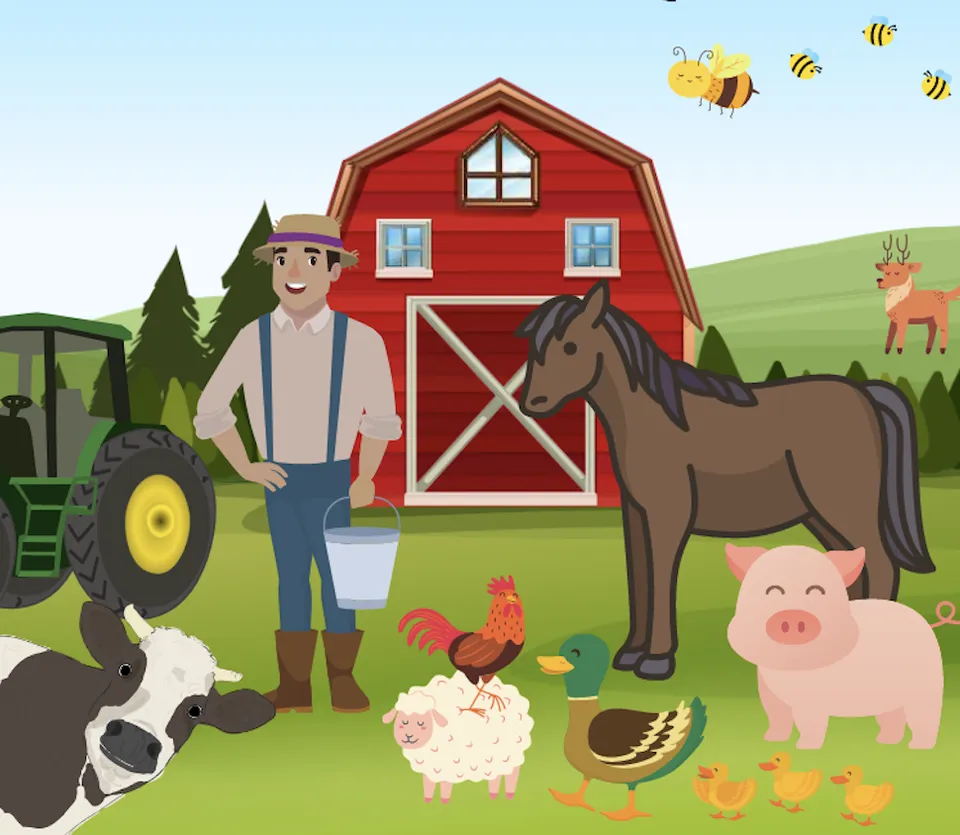
A Trip to a Farm! Learn about farmers' jobs, animals, crops & tractors- while learning beginning sounds, making connections & math skills.
Take a trip to the Farm! Learn about the farmer's jobs, farm animals, farm crops while learning beginning sounds, making connections, animal habitats, and basic math skills. Students will have use recollection skills to answer questions & incorporate real-life connections.
We'll even go on a tractor ride and enjoy some treat's too!
Part of
Standards alignment
Common Core State Standards
- ELD-SI.K-3.Narrate — Multilingual learners will… • Share ideas about one's own and others' lived experiences and previous learning • Connect stories with images and representations to add meaning • Ask questions about what others have shared • Recount and restate ideas • Discuss how stories might end or next steps
- D2.Eco.3.K-2 — Individually and with others, students… Describe the skills and knowledge required to produce certain goods and services.
- D2.Eco.4.K-2 — Individually and with others, students… Describe the goods and services that people in the local community produce and those that are produced in other communities.
- ELD-SI.K-3.Inform — Multilingual learners will… • Define and classify objects or concepts • Describe characteristics, patterns, or behavior • Describe parts and wholes • Sort, clarify, and summarize ideas • Summarize information from interaction with others and from learning experiences
Alabama
- SS10.K.7 — Describe roles of helpers and leaders, including school principal, school custodian, volunteers, police officers, and fire and rescue workers.
- SS10.2.7 — Explain production and distribution processes.
- SS10.K.2 — Identify rights and responsibilities of citizens within the family, classroom, school, and community.
Alaska
- RF.K.3.a — Demonstrate basic knowledge of one-to-one letter-sound correspondences by producing the primary sound or many of the most frequent sounds for each consonant.
- K.MD.2 — Make comparisons between two objects with a measurable attribute in common, to see which object has “more of”/“less of” the attribute, and describe the difference. For example, directly compare the heights of two children and describe one child as taller/shorter.
- RF.K.2 — Demonstrate understanding of spoken words, syllables, and sounds (phonemes).
- SL.K.4 — Describe familiar people, places, things, and events, and with prompting and support, provide additional related details.
- W.K.8 — With guidance and support from adults, recall information from experiences or gather information from provided sources to answer a question.
Arizona
- K.RF.3.a — Demonstrate basic knowledge of one‐to‐one letter‐sound correspondence by producing the primary or most frequent sound(s) for each consonant and the five major vowels.
- 1.E1.1 — Identify different occupations and the skills and education needed for those jobs in our community.
- 1.E3.1 — Describe the skills, knowledge, and sequence of events required to produce goods and services in our community.
Arkansas
- K.FR.21.F — Produce the most common sound for each letter of the alphabet with accuracy and automaticity.
- K.RC.4.RF — Build general and academic vocabulary and background knowledge of age and grade-appropriate topics through discussion, reading, and writing.
- E.1.K.10 — Identify where products used in daily life are produced.
- K.FR.5.PA — Isolate and pronounce the initial, medial vowel, and final sounds in three sound words.
- K.RC.2.RF — Answer questions about key details in a text.
California
- RF.K.3.a — Demonstrate basic knowledge of one-to-one letter-sound correspondences by producing the primary or many of the most frequent sound for each consonant.
- RF.K.2 — Demonstrate understanding of spoken words, syllables, and sounds (phonemes).
- SL.K.4 — Describe familiar people, places, things, and events and, with prompting and support, provide additional detail.
- W.K.8 — With guidance and support from adults, recall information from experiences or gather information from provided sources to answer a question.
Colorado
- P.MD.A.1 — Use comparative language, such as shortest, heavier, biggest, or later.
- RWC20-GR.PS-S.2-GLE.4.c — Attend to the beginning letters and sounds in familiar words.
- P.MD.A.2 — Compare or order up to five objects based on their measurable attributes, such as height or weight.
- RWC20-GR.PS-S.2-GLE.4.b — Recognize that letters of the alphabet have distinct sound(s) associated with them.
- SC.P.2.1.a — Observe, describe and discuss living things.
- SS.P.4.1 — Understand one's relationship to the family and community and respect differences in others.
Connecticut
- RF.K.3.a — Demonstrate basic knowledge of one-to-one letter-sound correspondences by producing the primary or many of the most frequent sound for each consonant.
- RF.K.2 — Demonstrate understanding of spoken words, syllables, and sounds (phonemes).
- SL.K.4 — Describe familiar people, places, things, and events and, with prompting and support, provide additional detail.
- W.K.8 — With guidance and support from adults, recall information from experiences or gather information from provided sources to answer a question.
- L.K.5.c — Identify real-life connections between words and their use (e.g., note places at school that are colorful).
Delaware
- RF.K.3.a — Demonstrate basic knowledge of one-to-one letter-sound correspondences by producing the primary or many of the most frequent sound for each consonant.
- SL.K.4 — Describe familiar people, places, things, and events and, with prompting and support, provide additional detail.
- L.K.5.c — Identify real-life connections between words and their use (e.g., note places at school that are colorful).
- W.K.8 — With guidance and support from adults, recall information from experiences or gather information from provided sources to answer a question.
- K-ESS3-1 — Use a model to represent the relationship between the needs of different plants and animals (including humans) and the places they live.
Florida
- ELA.K.F.1.2 — Demonstrate phonological awareness. • Blend and segment syllables in spoken words. • Identify and produce alliterative and rhyming words. • Blend and segment onset and rimes of single-syllable words. • Identify the initial, medial, and final sound of spoken words. • Add or delete phonemes at the beginning or end of a spoken word and say the resulting word. • Segment and blend phonemes in single-syllable spoken words.
- SS.K.E.1.1 — Describe different kinds of jobs that people do and the tools or equipment used.
- ELA.K.F.1.3 — Use knowledge of grade-appropriate phonics and word-analysis skills to decode words accurately. • Demonstrate knowledge of the most frequent sound for each consonant. • Demonstrate knowledge of the short and long sounds for the five major vowels. • Decode consonant-vowel-consonant (CVC) words. • Encode consonant-vowel-consonant (CVC) words.
- SC.K.L.14.3 — Observe plants and animals, describe how they are alike and how they are different in the way they look and in the things they do.
Georgia
- ELAGSEKRF3.a — Demonstrate basic knowledge of one to one letter-sound correspondences for each consonant.
- ELAGSEKL5.c — Identify real-life connections between words and their use (e.g., note places at school that are colorful).
- ELAGSEKSL4 — Describe familiar people, places, things, and events and, with prompting and support, provide additional detail.
- ELAGSEKSL6 — Speak audibly and express thoughts, feelings, and ideas clearly.
Hawaii
- K.RF.3a — Demonstrate basic knowledge of one-to-one letter-sound correspondences by producing the primary or many of the most frequent sound for each consonant.
- K.W.8 — With guidance and support from adults, recall information from experiences or gather information from provided sources to answer a question.
- K.RF.2 — Demonstrate understanding of spoken words, syllables, and sounds (phonemes).
- K.SL.4 — Describe familiar people, places, things, and events and, with prompting and support, provide additional detail.
- SS.K.1.7.3 — Compare roles and responsibilities of self and others at home, at school, and in neighborhood settings
Idaho
- K.MD.A.2 — Directly compare two objects with a measurable attribute in common, to see which object has “more of”/ “less of” the attribute, and describe the difference.
- K.ODC.OC.4 — Describe familiar people, places, things, and events with support.
- K.SS.3.1.3 — Describe some jobs that people do to earn money/rewards.
- K.SS.4.3.1 — Identify individuals who are helpful to people in their everyday lives.
- K.SS.4.3.2 — Identify ways to be helpful to family and school.
Illinois
- RF.K.3.a — Demonstrate basic knowledge of one-to-one letter-sound correspondences by producing the primary or many of the most frequent sound for each consonant.
- W.K.8 — With guidance and support from adults, recall information from experiences or gather information from provided sources to answer a question.
- SL.K.4 — Describe familiar people, places, things, and events and, with prompting and support, provide additional detail.
- L.K.5.c — Identify real-life connections between words and their use (e.g., note places at school that are colorful).
Indiana
- K.E.2 — Identify and describe different kinds of jobs that people do and the tools or equipment used in these jobs. (E)
- K.RF.6 — Identify and produce the beginning, middle (medial), and final sounds in three and four phoneme words. (E)
- K.RF.7 — Use letter-sound knowledge to decode the sound of each consonant. (E)
- K.LS.2 — Describe and compare the physical features of common living plants and animals.
Iowa
- RF.K.1.d — Recognize and name all upper- and lowercase letters of the alphabet.
- RF.K.2 — Demonstrate understanding of spoken words, syllables, and phonemes (sounds).
- SS.K.6. — Describe students’ roles in different groups of which they are members including their family, school, and community.
Kansas
- RF.K.3.a — Demonstrate basic knowledge of one-to-one letter-sound correspondences by producing the primary or many of the most frequent sounds for each consonant.
- RF.K.2 — Demonstrate understanding of spoken words, syllables, and sounds (phonemes).
- W.K.8 — With guidance and support from adults, recall information from experiences or gather information from provided sources to answer a question.
- RI.K.12.c — Identify real-life connections between words and their use (e.g., note places at school that are colorful).
Kentucky
- RF.K.3.a — Demonstrate basic knowledge of one-to-one letter-sound correspondences by producing the primary or many of the most frequent sounds for each consonant.
- RF.K.2.d — Isolate and pronounce the initial, medial vowel and final sounds (phonemes) in three-phoneme words.
- RF.K.1.d — Recognize and name all upper- and lowercase letters of the alphabet.
Louisiana
- K.16 — Identify jobs and industries within a school and community.
- K.8 — Describe the importance of fairness, responsibility, respect, and hard work. For example: a. Taking care of personal belongings and respecting the property of others. b. Following rules and recognizing consequences of breaking rules. c. Taking responsibility for assigned duties.
- L.K.5.c — Identify real-life connections between words and their use (e.g., note places at school that are colorful).
Maine
- R.3.K.a — Demonstrate basic knowledge of one-to-one letter-sound correspondences by producing the primary or many of the most frequent sound for each consonant.
- W.1.K.b — Gather information from provided sources and/or recall information from experiences in order to answer questions with guidance and support from adults.
- SL.3.K.a — Describe familiar people, places, things, and events and, with prompting and support, provide additional detail.
- L.5.K.c — Identify real-life connections between words and their use (e.g., note places at school that are colorful).
Maryland
- RF.PK.2.e — Isolate and pronounce the initial sound in spoken words
- RF.PK.3.b — Demonstrate basic knowledge of one-to-one letter sound correspondences by producing the most frequent sound for some consonants.
- identifying jobs and careers in their community.
- RF.PK.3.a — Recognize that words are made up of letters and their sounds.
Massachusetts
- K.T4.1 — With prompting and support, describe some things people do when they work inside and outside of the home, drawing on personal experience, literature, and informational texts.
Michigan
- K-C5.0.1 — Describe situations in which they demonstrated self-discipline and individual responsibility.
- K–G5.0.1 — Describe ways in which the environment provides for basic human needs and wants.
Minnesota
- 0.2.1.2 — Demonstrate one-to-one letter-sound correspondence.
- 0.3.1.2 — Confirm understanding of a text read aloud or information presented orally or through other media (e.g., poems, rhymes, songs) by asking and answering questions about key details and requesting clarification if something is not understood.
- K.3.2.1 — Use words to compare objects according to length, size, weight and position. For example: Use same, lighter, longer, above, between and next to. Another example: Identify objects that are near your desk and objects that are in front of it. Explain why there may be some objects in both groups.
- 0.1.1.1.a — Demonstrate understanding of spoken words, syllables and sounds (phonemes): identify and orally produce rhyming words, onset-rime and alliteration.
Missouri
- K.L.1.B.f — write and name the printed letters that match the sound
- K.R.1.A.b — asking and responding to questions about texts read aloud
- K.R.3.C.c — name the main topic and recall key details of the text
- K.R.1.A.c — retelling main ideas or important facts from a read aloud or familiar story
Montana
- K.MD.A.2 — Directly compare two objects with a measurable attribute in common, to see which object has "more of"/"less of" the attribute, and describe the difference. For example, directly compare the heights of two children and describe one child as taller/shorter.
- RF.K.3.a — Demonstrate basic knowledge of one-to-one letter-sound correspondences by producing the primary or many of the most frequent sound for each consonant.
- L.K.5.c — Identify real-life connections between words and their use (e.g., note places at school that are colorful).
- SL.K.4 — Describe familiar people, places, things, and events and, with prompting and support, provide additional detail.
- W.K.8 — With guidance and support from adults, recall information from experiences or gather information from provided sources to answer a question and include sources by and about American Indians.
Nebraska
- LA.K.F.3.a — Demonstrate basic knowledge of one-to-one sound to letter correspondences by producing the primary or many of the most frequent sounds for each consonant.
- LA.K.F.2.d — Blend onsets and rimes to form simple words (e.g., v-an, gr-ab).
- SS 2.2.3.b. — Describe how people in their communities earn income/wages through work.
- SS 1.2.3 — Explain that resources are used to produce goods and services.
Nevada
- RF.K.3.a — Demonstrate basic knowledge of one-to-one letter-sound correspondences by producing the primary or many of the most frequent sound for each consonant.
- SL.K.4 — Describe familiar people, places, things, and events and, with prompting and support, provide additional detail.
- W.K.8 — With guidance and support from adults, recall information from experiences or gather information from provided sources to answer a question.
- L.K.5.c — Identify real-life connections between words and their use (e.g., note places at school that are colorful).
New Hampshire
- SS.CV.2.4.1 — Examine the responsibilities of individuals as members of a family, school and community, e.g., community helpers or chores at home and school. (Themes: B: Civic Ideals, Practices, and Engagement, C: People, Places and Environment)
- SL.K.4 — Describe familiar people, places, things, and events and, with prompting and support, provide additional detail.
- SS.EC.2.1.2 — Describe the steps and materials needed to make a product, e.g., milk or crayons. (Themes: D: Material Wants and Needs, G: Science, Technology, and Society)
- SS.GE.2.5.1 — Recognize the role of natural resources in daily life, e.g., food, clothing, or shelter. (Themes: A: Conflict and Cooperation, C: People, Places and Environment, D: Material Wants and Needs)
- L.K.5.c — Identify real-life connections between words and their use (e.g., note places at school that are colorful).
New Jersey
- RF.K.3.a — Demonstrate basic knowledge of one-to-one letter-sound correspondences by producing many of the most frequently used sounds of each consonant.
- SL.K.4 — Describe familiar people, places, things, and events and, with prompting and support, provide additional detail.
- W.K.8 — With guidance and support from adults, recall information from experiences or gather information from provided sources to answer a question.
- L.K.5.c — Identify real-life connections between words and their use (e.g., note places at school that are colorful).
New Mexico
- RF.K.3.a — Demonstrate basic knowledge of one-to-one letter-sound correspondences by producing the primary or many of the most frequent sound for each consonant.
- RF.K.2 — Demonstrate understanding of spoken words, syllables, and sounds (phonemes).
- SL.K.4 — Describe familiar people, places, things, and events and, with prompting and support, provide additional detail.
- W.K.8 — With guidance and support from adults, recall information from experiences or gather information from provided sources to answer a question.
- 2.29 — Identify different types of jobs performed in their community.
- L.K.5.c — Identify real-life connections between words and their use (e.g., note places at school that are colorful).
New York
- PKRF3 — Demonstrate emergent phonics and word analysis skills.
- PKL4 — Explore and use new vocabulary in child-centered, authentic, play-based experiences.
- PKRF2 — Demonstrate an emerging understanding of spoken words, syllables, and sounds (phonemes).
- PKSL4 — Describe familiar people, places, things, and events.
- 2.9b — Members of a community specialize in different types of jobs that provide goods and/or services to the community. Community workers such as teachers, firefighters, sanitation workers, and police officers provide services.
North Carolina
- RF.K.4.a — Demonstrate basic knowledge of one-to-one letter-sound correspondences by producing the primary sound or many of the most frequent sounds for each consonant.
- RF.K.3 — Demonstrate understanding of spoken words, syllables, and sounds (phonemes).
- W.K.6 — With guidance and support from adults, recall information from experiences or gather information from provided sources to answer a question.
North Dakota
- K.F.11 — Orally use new academic, content-specific, grade-level vocabulary, and relate new words to prior knowledge.
- K.F.12b — Accurately and automatically produce the predictable consonant and short vowel sounds associated with uppercase and lowercase letters in non-sequential order.
Ohio
- K.7 — Humans depend on and impact the physical environment in order to supply food, clothing and shelter.
- K.9 — Individuals share responsibilities and take action toward the achievement of common goals in homes, schools and communities.
Oklahoma
- K.1.S.3 — Students will ask and answer relevant questions with prompting.
- K.2.PA.3 — Students will isolate and pronounce initial and final sounds in spoken words.
- K.2.PWS.3 — Students will produce the sounds for short and long vowels and the most common sound for consonants (e.g., a = /ă/ & /ā/, f = /f/, s = /s/, x = /ks/).
- K.4.R.3 — Students will begin to acquire new vocabulary and relate new words to prior knowledge.
- PK.3.R.2 — Students will answer basic questions (e.g., who, what, where, and when) about texts, photographs, or illustrations during shared reading or other text experiences with prompting.
- PK.2.PWS.3 — Students will produce some sounds represented by letters.
Oregon
- K.6 — Give examples of different jobs performed in communities.
- K.RF.3a — Demonstrate basic knowledge of one-to-one letter-sound correspondences by producing the primary or many of the most frequent sound for each consonant.
- K.L.5c — Identify real-life connections between words and their use.
- K.SL.4 — Describe familiar people, places, things, and events and, with prompting and support, provide additional detail.
- K.RF.2e — Isolate and pronounce the initial, medial vowel, and final phonemes in threephoneme words.
Pennsylvania
- CC.1.1.PK.D — Develop beginning phonics and word skills. • Associate some letters with their names and sounds. • Identify familiar words and environmental print.
- CC.1.2.PK.C — With prompting and support, make connections between information in a text and personal experiences.
- 3.4.K-2.A — Categorize ways people harvest, redistribute, and use natural resources.
- CC.1.4.PK.W — With guidance and support, recall information from experiences or books.
- CC.1.1.K.D — Know and apply grade-level phonics and word analysis skills in decoding words. • Demonstrate basic knowledge of one-to-one letter-sound correspondence. • Associate the long and short sounds with common spellings for the five major vowels. • Read grade-level high-frequency sight words with automaticity. • Distinguish between similarly spelled words by identifying the sounds of the letters that differ.
Rhode Island
- RF.K.3.a — Demonstrate basic knowledge of one-to-one letter-sound correspondences by producing the primary or many of the most frequent sound for each consonant.
- RF.K.2 — Demonstrate understanding of spoken words, syllables, and sounds (phonemes).
- SL.K.4 — Describe familiar people, places, things, and events and, with prompting and support, provide additional detail.
- SS1.3.2 — Jobs and careers Analyze different jobs and careers and how they contribute to the community and economy
South Carolina
- ELA.K.F.1 — Demonstrate early phonological awareness to basic phonemic awareness in spoken words. (FK -1.3-2.18 LF BR-430)
- ELA.K.F.3 — Know and apply phonics and word analysis skills in decoding and encoding words. (FK -1.3-2.18 LF BR-430)
South Dakota
- K.RF.3 — Know and apply grade-level phonics and word analysis skills in decoding words.
- K.SL.4 — Describe familiar people, places, things, and events. With prompting and support, provide additional detail.
- K.L.5.c — Identify real-life connections between words and their use.
- K.RF.2 — Demonstrate understanding of spoken words, syllables, and sounds (phonemes).
Tennessee
- K.06 — Recognize and describe different types of jobs, including work done in the home, school, and community.
- K.SL.PKI.4 — Describe familiar people, places, things, and events, and, with prompting and support, provide additional detail.
- K.FL.PA.2 — Demonstrate understanding of spoken words, syllables, and sounds (phonemes).
- K.FL.VA.7.b.iii — Make real-life connections between words and their use.
- K.W.RBPK.8 — With guidance and support from adults, recall information from experiences or gather information from provided sources to answer a question.
Texas
- K.2B.i — identifying and matching the common sounds that letters represent;
Utah
- K.4.2.c — Describe different types of jobs that people do and the tools and equipment that they use.
- 1.1.2.b — Explain the roles of the people in the neighborhood (e.g., police officer, firefighter, mail carrier, grocer, mechanic, plumber, miner, farmer, doctor, and tribal leader).
- K.4.2.a — Identify the jobs in the home and in the school.
Vermont
- D2.Civ.2.K-2 — Individually and with others, students… = Explain how all people, not just official leaders, play important roles in a community.
- D2.Eco.4.K-2 — Individually and with others, students… Describe the goods and services that people in the local community produce and those that are produced in other communities.
- D2.Eco.3.K-2 — Individually and with others, students… Describe the skills and knowledge required to produce certain goods and services.
Virginia
- K.1.f.i — Communicate comparative measures (e.g., heavier, lighter, longer, shorter, more, less, hotter, colder).
- K.3.c — The student will investigate and understand that physical properties of an object can be described. Properties include textures and feel.
- K.3.d — The student will investigate and understand that physical properties of an object can be described. Properties include relative sizes and weights of objects.
- K.RV.1.C — Use vocabulary from across content areas.
Washington
- RF.K.3.a — Demonstrate basic knowledge of one-to-one letter-sound correspondences by producing the primary or many of the most frequent sound for each consonant.
- W.K.8 — With guidance and support from adults, recall information from experiences or gather information from provided sources to answer a question.
- L.K.5.c — Identify real-life connections between words and their use (e.g., note places at school that are colorful).
- RF.K.2 — Demonstrate understanding of spoken words, syllables, and sounds (phonemes).
- SL.K.4 — Describe familiar people, places, things, and events and, with prompting and support, provide additional detail.
Washington, D.C.
- K.23 — Compare the different jobs individuals around the world perform and the ways in which specific goods and services are produced, both inside and outside of the home.
- RF.K.3.a — Demonstrate basic knowledge of one-to-one letter-sound correspondences by producing the primary or many of the most frequent sound for each consonant.
- K.27 — Identify products that we use in our daily lives, where they come from, and how they connect us to local and global communities.
- RF.K.2 — Demonstrate understanding of spoken words, syllables, and sounds (phonemes).
- SL.K.4 — Describe familiar people, places, things, and events and, with prompting and support, provide additional detail.
- W.K.8 — With guidance and support from adults, recall information from experiences or gather information from provided sources to answer a question.
West Virginia
- ELA.K.II.a — Demonstrate basic knowledge of one-to-one letter-sound correspondences by producing the primary or many of the most frequent sounds for each consonant.
- ELA.K.IV — Demonstrate understanding of spoken words, syllables, and sounds (phonemes).
- ELA.K.V.d — Recognize and name upper- and lowercase letters of the alphabet.
- SS.K.12 — Explore similarities and differences of life in the city (urban) and the country (rural).
- SS.K.17 — Explore time, places, people and events in relationship to student's own life (e.g., family trees, pictures, stories, etc.).
Wisconsin
- ELA.K.RF.3.a — Demonstrate basic knowledge of one-to-one letter-sound correspondences by producing the primary or many of the most frequent sounds for each consonant.
- ELA.K.SL.4 — With guidance and support, describe familiar people, places, things, and events.
- ELA.K.W.8 — With guidance and support from adults, recall information from experiences or gather information from provided sources to answer a question.
- SS.Econ4.b.1 — Classify different jobs people have and how these jobs help others. Explain what major public, private, and tribal institutions (e.g., schools, police, fire station) do for people.
Wyoming
- RF.K.3.a — Demonstrate basic knowledge of one-to-one letter-sound correspondences by producing the primary or many of the most frequent sound for each consonant.
- RF.K.2 — Demonstrate understanding of spoken words, syllables, and sounds (phonemes).
- SL.K.4 — Describe familiar people, places, things, and events and, with prompting and support, provide additional detail.
- SS2.4.2 — Identify tools and technologies, including those of Indigenous Tribes of Wyoming, that made or make life easier and sustainable (e.g., cars for getting one place to another, washing machines for washing clothes, flashlights to see in the dark, and usage of bison and natural resources). 2.MD.7 – 8 K-2-ETS1-1 – ETS1-3
- L.K.5.c — Identify real-life connections between words and their use (e.g., note places at school that are colorful).