The Grumpy Potato
Ages 3–8 · 8 minutes · English, Stories
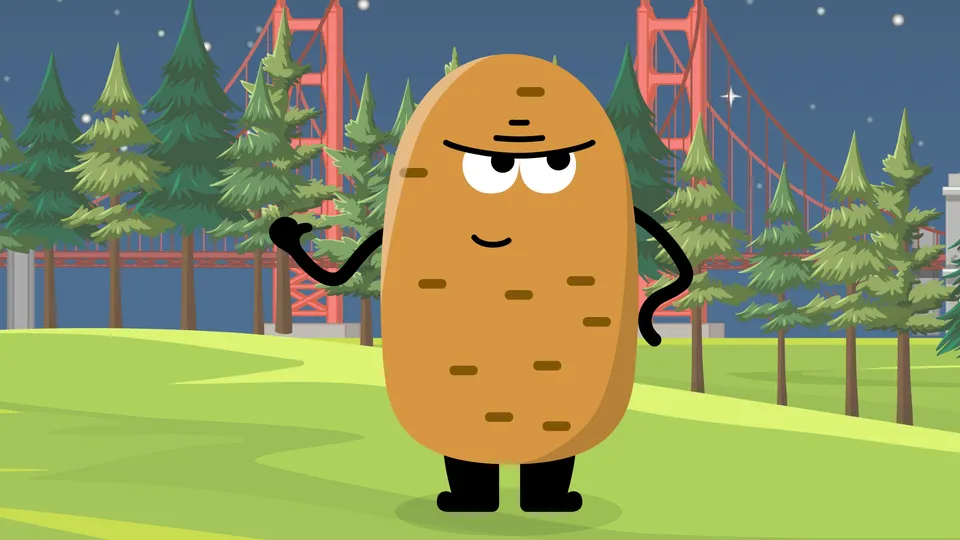
Pete is a grumpy spud. Help this tater teeter with kindness!
Feeling fried? The Grumpy Potato is too! Students can help Pete work through his emotions of anger and loneliness while learning about their own feelings as well. Find out if Pete can turn SWEET!
Part of
Standards alignment
Common Core State Standards
- ELD-SI.K-3.Narrate — Multilingual learners will… • Share ideas about one's own and others' lived experiences and previous learning • Connect stories with images and representations to add meaning • Ask questions about what others have shared • Recount and restate ideas • Discuss how stories might end or next steps
- ELD-SI.K-3.Argue — Multilingual learners will… • Ask questions about others’ opinions • Support own opinions with reasons • Clarify and elaborate ideas based on feedback • Defend change in one’s own thinking • Revise one’s own opinions based on new information
Alabama
- ELA21.2.35 — Demonstrate listening skills and build background knowledge by asking and answering questions about texts read aloud.
- ELA21.K.3 — Actively participate in teacher-led choral and shared reading experiences.
- ELA21.3.22a — Describe in detail the characters' behavior, emotions, and traits and explain how their actions influence events in the story.
Alaska
- RL.K.3 — With prompting and support, identify characters, settings, major events, and problem-solution in a story, song, or poem.
- L.K.5.c — Identify real-life connections between words and their use (e.g., note places at school that are colorful).
- RL.2.3 — Describe how characters in a story, play or poem respond to major events, problems, and challenges.
- SL.K.4 — Describe familiar people, places, things, and events, and with prompting and support, provide additional related details.
Arizona
- K.RL.1 — With prompting and support, ask and answer questions about key details in a text.
- 1.RL.3 — Describe characters, settings, and major events in a story, using key details.
- 2.RL.3 — Describe how characters in a story respond to major events and challenges.
- K.RL.3 — With prompting and support, identify characters, settings, and major events in a story.
- 1.RL.2 — Retell stories, including key details, and demonstrate understanding of their main idea, central message, or lesson.
Arkansas
- K.RC.2.RF — Answer questions about key details in a text.
- 1.RC.2.RF — Answer questions about key details in a text.
- C.1.K.7 — Discuss ways people improve communities which may include: • being a good neighbor • volunteering/helping • recycling • donating personal items/toys
California
- RL.K.1 — With prompting and support, ask and answer questions about key details in a text.
- 1.1.2 — Understand the elements of fair play and good sportsmanship, respect for the rights and opinions of others, and respect for rules by which we live, including the meaning of the "Golden Rule."
- RL.1.3 — Describe characters, settings, and major events in a story, using key details.
- RL.K.3 — With prompting and support, identify characters, settings, and major events in a story.
Colorado
- RWC20-GR.2-S.2-GLE.1-EO.a.iv — Describe how characters in a story respond to major events and challenges.
- RWC20-GR.PS-S.2-GLE.1-EO.g — Make predictions based on illustrations.
- SS.P.4.1 — Understand one's relationship to the family and community and respect differences in others.
- RWC20-GR.PS-S.2-GLE.1-EO.a — Show interest in shared reading experiences and looking at books independently.
Connecticut
- RL.K.1 — With prompting and support, ask and answer questions about key details in a text.
- RL.1.3 — Describe characters, settings, and major events in a story, using key details.
- RL.K.3 — With prompting and support, identify characters, settings, and major events in a story.
- RL.1.2 — Retell stories, including key details, and demonstrate understanding of their central message or lesson.
Delaware
- RL.K.1 — With prompting and support, ask and answer questions about key details in a text.
- RL.K.3 — With prompting and support, identify characters, settings, and major events in a story.
- C.2.K-3a — Students will understand that respect for others, their opinions, and their property is a foundation of civil society in the United States. Grade 2
- RL.1.2 — Retell stories, including key details, and demonstrate understanding of their central message or lesson.
- RL.1.3 — Describe characters, settings, and major events in a story, using key details.
Florida
- ELA.K.R.1.1 — Describe the main character(s), setting, and important events in a story.
- ELA.1.R.1.2 — Identify and explain the moral of a story.
Georgia
- ELAGSEKRL1 — With prompting and support, ask and answer questions about key details in a text.
- ELAGSE1RL2 — Retell stories, including key details, and demonstrate understanding of their central message or lesson.
- ELAGSE1SL2 — Ask and answer questions about key details in a text read aloud or information presented orally or through other media.
- ELAGSEKRL3 — With prompting and support, identify characters, settings, and major events in a story.
Hawaii
- K.SL.4 — Describe familiar people, places, things, and events and, with prompting and support, provide additional detail.
- 2.L.6 — Use words and phrases acquired through conversations, reading and being read to, and responding to texts, including using adjectives and adverbs to describe (e.g., When other kids are happy that makes me happy).
Idaho
- K.RC.TE.3 — Ask and answer questions about key details in texts heard.
- 2.RC.L.5b — Describe how characters in stories heard or read respond to major events and challenges.
- 1.VD.WB.2d — Identify words and phrases in stories or poems that suggest feelings or appeal to the senses.
Illinois
- RL.K.1 — With prompting and support, ask and answer questions about key details in a text.
- RL.1.3 — Describe characters, settings, and major events in a story, using key details.
- RL.K.3 — With prompting and support, identify characters, settings, and major events in a story.
- SS.2.EC.1 — Demonstrate how our choices can affect ourselves and others in positive and negative ways.
- RL.1.2 — Retell stories, including key details, and demonstrate understanding of their central message or lesson.
Indiana
- K.RC.1 — With support, ask and answer questions about main topics and key details in a text heard or read. (E)
- K.RC.4 — With support, make predictions about what will happen in a text.
- K.C.2 — Give examples of how to be a responsible family member and member of a group.
- K.CC.3 — Ask and answer questions about key details in a text read aloud or information presented orally or through other media. (E)
- K.RC.3 — Identify important elements within a text (e.g., characters, settings, or events). (E)
Iowa
- RL.K.1 — With prompting and support, ask and answer questions about key details in a text.
- RL.1.4 — Identify words and phrases in stories or poems that suggest feelings or appeal to the senses.
- L.K.5.c — Identify real-life connections between words and their use (e.g., note places at school that are colorful).
- RL.2.3 — Describe how characters in a story respond to major events and challenges, drawing on key details.
Kansas
- RL.K.1 — With prompting and support, ask and answer questions about key details in a text.
- RL.1.3 — Describe characters, settings, and major events in a story, using key details.
- RL.1.4 — Identify words and phrases in stories or poems that suggest feelings or appeal to the senses.
- RL.K.3 — With prompting and support, identify characters, settings, and major events in a story.
- Benchmark K.1.2 — The student will analyze the context and draw conclusions about choices and consequences.
Kentucky
- RL.K.2 — With prompting and support, orally recognize key details from a summary to demonstrate understanding of the lesson learned in the story.
- K.H.CO.1 — Describe interactions that occur between individuals/groups in families, classrooms and communities.
Louisiana
- RL.K.1 — With prompting and support, ask and answer questions about key details in a text.
- RL.1.3 — Describe characters, settings, and major events in a story, using key details.
- RL.K.3 — With prompting and support, identify characters, settings, and major events in a story.
- L.K.5.c — Identify real-life connections between words and their use (e.g., note places at school that are colorful).
- RL.1.4 — Identify words and phrases in stories or poems that suggest feelings or appeal to the senses.
Maine
- R.4.K.a — Ask and answer questions with prompting and support about who, what, when, where, and how.
- R.6.K.a — With prompting and support, identify characters, settings, and major events in a story.
- R.6.1.a — Describe characters, settings, and major events in a story, including details about who, what, when, where, and how.
- SL.2.K.a — Confirm understanding of a text read aloud or information presented orally or through other media by asking and answering questions about key details to seek help if something is not understood.
Maryland
- RL.K.1 — With prompting and support, ask and answer questions about key details in a text.
- RL.1.3 — Describe characters, settings, and major events in a story, using key details.
- RL.PK.1 — With modeling and support, answer questions about details in a text.
- L.K.5.c — Identify real-life connections between words and their use (e.g., note places at school that are colorful).
Massachusetts
- PreK.T1.4 — With prompting and support, ask and answer questions about literature and informational social studies texts read aloud, and act out or give examples of characters who show fairness, friendship, kindness, responsibility, and respect for one another.
- RL.PK.6 — With prompting and support, “read” the illustrations in a picture book by describing a character or place depicted, or by telling how a sequence of events unfolds.
- RL.PK.7 — With prompting and support, make predictions about what happens next in a picture book after examining and discussing the illustrations.
- L.PK.5.c — Apply words learned in classroom activities to real-life examples (e.g., name places in school that are fun, quiet, or noisy).
Michigan
- P4.3 — Explain different strategies students and others could take to address problems and predict possible results.
- K-C5.0.1 — Describe situations in which they demonstrated self-discipline and individual responsibility.
Minnesota
- 0.1.4.1 — Ask and answer questions about key details in a text, with prompting and support.
- 0.2.5.2 — Verbally or visually respond to a story, with support and guidance.
- 1.1.4.2 — Identify the central idea, message or moral of a text, with prompting as needed.
Mississippi
- CCRA.R.1 — Read closely to determine what the text says explicitly and to make logical inferences from it; cite specific textual evidence when writing or speaking to support conclusions drawn from the text.
- CCRA.R.3 — Analyze how and why individuals, events, or ideas develop and interact over the course of a text.
- SL.K.4 — Describe familiar people, places, things, and events and, with prompting and support, provide additional detail.
- L.K.5.c — Identify real-life connections between words and their use (e.g., note places at school that are colorful).
Missouri
- K.R.1.A.b — asking and responding to questions about texts read aloud
- K.R.1.C.a — text to self (text ideas and own experiences)
- 2.R.2.A.a — describe the setting, problems, solutions, sequence of events (plot), and big idea or moral lesson
Montana
- RL.K.1 — With prompting and support, ask and answer questions about key details in a text.
- RL.1.3 — Describe characters, settings, and major events in a story, using key details.
- RL.K.3 — With prompting and support, identify characters, settings, and major events in a story.
- L.K.5.c — Identify real-life connections between words and their use (e.g., note places at school that are colorful).
Nebraska
- LA.2.RP.2 — Describe characters and how they interact with one another.
- LA.K.RP.1 — With prompting and support, orally retell familiar stories, including key details, and demonstrate understanding of their central message or lesson.
- LA.K.SL.2.d — Demonstrate awareness of and sensitivity to the appropriate use of words (e.g., helpful/hurtful words).
- LA.K.V.2.d — With prompting and support, identify and explain descriptive words and phrases that suggest feelings or appeal to the senses.
Nevada
- RL.K.1 — With prompting and support, ask and answer questions about key details in a text.
- SS.K.10. — Share and discuss stories that illustrate honesty, courage, friendship, respect, and responsibility.
- RL.K.3 — With prompting and support, identify characters, settings, and major events in a story.
- SS.K.11. — Explore strategies to resolve conflicts in the classroom.
New Hampshire
- RL.K.1 — With prompting and support, ask and answer questions about key details in a text.
- L.K.5.c — Identify real-life connections between words and their use (e.g., note places at school that are colorful).
- RL.1.3 — Describe characters, settings, and major events in a story, using key details.
New Jersey
- RL.K.1 — With prompting and support, ask and answer questions about key details in a text (e.g., who, what, where, when, why, how).
- 6.1.2.CivicsCM.2 — Use examples from a variety of sources to describe how certain characteristics can help individuals collaborate and solve problems (e.g., open-mindedness, compassion, civility, persistence).
- RL.1.3 — Describe characters, settings, and major event(s) in a story, using key details.
- RL.K.3 — With prompting and support, identify characters, settings, and major events in a story.
New Mexico
- RL.K.1 — With prompting and support, ask and answer questions about key details in a text.
- 2.28 — Demonstrate respect for the feelings of people who are similar to or different from them.
- RL.K.3 — With prompting and support, identify characters, settings, and major events in a story.
- SL.K.NM.4 — With prompting and support: role play; make predictions; and follow oral and graphic instructions.
New York
- KR4 — Identify specific words that express feelings and senses. (RI&RL)
- KSL6 — Express thoughts, feelings, and ideas.
- 1.4c — Children can participate in problem solving, decision making, and conflict resolution within their home, school, and community.
- 1R4 — Identify specific words that express feelings and senses. (RI&RL)
- PKSL6 — Express thoughts, feelings, and ideas.
North Carolina
- RL.K.1 — With prompting and support, ask and answer questions about key details in a text.
- K.B.1.3 — Summarize stories that illustrate how positive character traits such as empathy, resilience, and respect, help people contribute to their communities.
- RL.K.3 — With prompting and support, identify characters, settings, and major events in a story.
- SL.K.2 — Confirm understanding of a text read aloud or information presented orally or through other media by asking and answering questions about key details and requesting clarification if something is not understood.
- RL.K.4 — With prompting and support, ask and answer questions about words in a text that suggest feelings or appeal to the senses.
North Dakota
- 1.R.8a — Identify characters' feelings or traits in a story, poem,or nursery rhyme during or after a shared reading or other text-listening experience.
- K.R.8a — Respond to or reenact characters' feelings in a story, poem,or nursery rhyme during or after a shared reading or other text-listening experience.
- 2.R.2 — Ask and answer questions about key details before, during, and after reading a variety of literary and informational texts to compare, contrast, predict or infer.
Ohio
- RL.1.3 — Describe characters, settings, and major events in a story, using key details.
- RL.K.1 — With prompting and support, ask and answer questions about key details in a text.
- RL.1.2.a — Demonstrate understanding of the lesson.
- RL.K.3 — With prompting and support, identify characters, settings, and major events in a story.
Oklahoma
- K.3.R.3 — Students will describe characters and setting in a story with prompting.
- K.3.R.2 — Students will ask and answer basic questions (e.g., who, what, where, and when) about texts, photographs, or illustrations during shared reading or other text experiences with prompting.
- PK.3.R.3 — Students will identify characters in a story with prompting.
- PK.1.S.3 — Students will ask and answer questions with prompting.
Oregon
- K.RL.1 — With prompting and support, ask and answer questions about key details in a text.
- K.RL.3 — With prompting and support, identify characters, settings, and major events in a story. Identify beginning/middle/end.
- 1.RL.3 — Describe characters, settings, and major events in a story, using key details.
- K.SL.2 — Confirm understanding of a text read aloud or information presented orally or through other media by asking and answering questions about key details and requesting clarification if something is not understood.
- 2.RL.3 — Describe how characters in a story respond to major events and challenges, including identifying the characters' feelings, the plot or problem, and how it is resolved.
Pennsylvania
- CC.1.3.PK.B — Answer questions about a particular story (who, what, how, when, and where).
- CC.1.3.2.C — Describe how characters in a story respond to major events and challenges.
- CC.1.3.PK.C — With prompting and support, answer questions to identify characters, settings, and major events in a story.
Rhode Island
- RL.K.1 — With prompting and support, ask and answer questions about key details in a text.
- RL.1.2 — Retell stories, including key details, and demonstrate understanding of their central message or lesson.
- RL.1.3 — Describe characters, settings, and major events in a story, using key details.
- RL.K.3 — With prompting and support, identify characters, settings, and major events in a story.
South Carolina
- ELA.K.AOR.1.1.INIS — Indicator Insights: Characters can be described by appearance, feelings, and actions. Events that move the plot forward are what characters do or events that happen; events can include, but are not limited to, cause and effect and problem and solution relationships.
- ELA.K.C.9.1 — Ask and answer questions in conversation on a topic.
- ELA.K.OE.3 — Make inferences to support comprehension.
- ELA.K.R.1.1 — Ask and answer questions (who, what, when, where, why, and how) about print and non-print sources to obtain and refine knowledge.
- K.CG.1 — Identify similarities and differences between people and discuss ways to protect and respect all people by practicing civic dispositions.This indicator was developed to encourage inquiry into diversity within the classroom and community. Further, inquiry promotes identifying civic dispositions (e.g., compassion, cooperation, empathy, honesty, and respect) that are already exhibited in the classroom setting and can be used for problem solving in the future.
South Dakota
- K.RL.1 — With prompting and support, ask and answer questions about key details in a text.
- 1.RL.1 — Ask and answer questions about key details in a text.
- 1.RL.2 — Retell stories, including key details, and demonstrate understanding of their central message or lesson.
- 1.RL.3 — Describe characters, settings, and major events in a story, using key details.
Tennessee
- K.RL.KID.1 — With prompting and support, ask and answer questions about key details in a text.
- 2.RL.KID.3 — Describe how characters in a story respond to major events and challenges.
- K.RL.KID.3 — With prompting and support, orally identify characters, setting, and major events in a story.
- 1.RL.CS.4 — Identify words and phrases in stories and poems that suggest feelings or appeal to the senses.
Texas
- K.1A — listen actively and ask questions to understand information and answer questions using multi-word responses;
- K.7C — describe the elements of plot development, including the main events, the problem, and the resolution for texts read aloud with adult assistance; and
- 1.1E — develop social communication such as introducing himself/herself and others, relating experiences to a classmate, and expressing needs and feelings.
Utah
- 1.2.1.d — Identify and express feelings in appropriate ways.
- 1.2.1.e — Articulate how individual choices affect self, peers, and others.
- K.2.1.b — Demonstrate positive relationships through play and friendship.
- K.2.1.e — Demonstrate respect for others, leaders, and the environment.
Vermont
- D2.Civ.7.K-2 — Individually and with others, students… Apply civic virtues when participating in school settings.
Virginia
- K.1.b — The student will apply history and social science skills to practice citizenship in the classroom by practicing honesty and showing kindness to oneself and others.
- K.RL.1.D — With prompting and support, generate predictions about story characters and events using the text.
- K.1.a — The student will apply history and social science skills to practice citizenship in the classroom by taking responsibility for one’s actions.
- K.1.c — The student will apply history and social science skills to practice citizenship in the classroom by recognizing the purpose of rules and practicing self-control.
- K.RL.1.B — With prompting and support, demonstrate knowledge of story structure by orally identifying characters, setting,important events, and details.
- K.RI.1.A — With prompting and support, ask and answer literal (who, what, when, where) or inferential (why, how) questions about what is read.
Washington
- RL.K.1 — With prompting and support, ask and answer questions about key details in a text.
- RL.K.3 — With prompting and support, identify characters, settings, and major events in a story.
- H2.K.2 — Explain how their actions may cause change in others.
- RL.1.3 — Describe characters, settings, and major events in a story, using key details.
Washington, D.C.
- RL.K.1 — With prompting and support, ask and answer questions about key details in a text.
- RL.K.3 — With prompting and support, identify characters, settings, and major events in a story.
- RL.1.3 — Describe characters, settings, and major events in a story, using key details.
- RL.1.2 — Retell stories, including key details, and demonstrate understanding of their central message or lesson.
West Virginia
- SS.K.2 — Participate in role play to resolve disputes, and demonstrate tolerance and acceptance of others and their ideas.
- SS.K.1 — Develop an understanding of citizenship and patriotism through a variety of experiences (e.g., appropriate behavior, sharing, taking turns, volunteering, being honest and demonstrating responsibility for materials and personal belongings).
Wisconsin
- ELA.K.SL.2 — With guidance and support, ask and answer questions about key details in a text read aloud or information presented orally or through other media.
- ELA.K.R.3 — With prompting and support, identify characters, settings, and important events in a story or pieces of information in a text. (RI&RL)
- ELA.K.R.4 — With prompting and support, identify specific words that express feelings or content- specific words within a text. (RI&RL)
- SS.BH1.b.2 — Identify situations and places that impact a person’s emotions.
Wyoming
- RL.K.1 — With prompting and support, ask and answer questions about key details in a text.
- RL.K.3 — With prompting and support, identify characters, settings, and major events in a story.
- RL.1.2 — Retell stories, including key details, and demonstrate understanding of their central message or lesson.
- RL.1.3 — Describe characters, settings, and major events in a story, using key details.
- RL.2.3 — Describe how characters in a story respond to major events and challenges.