Beside, Behind, Next To, and In Front
Ages 3–5 · 13 minutes · Math, English
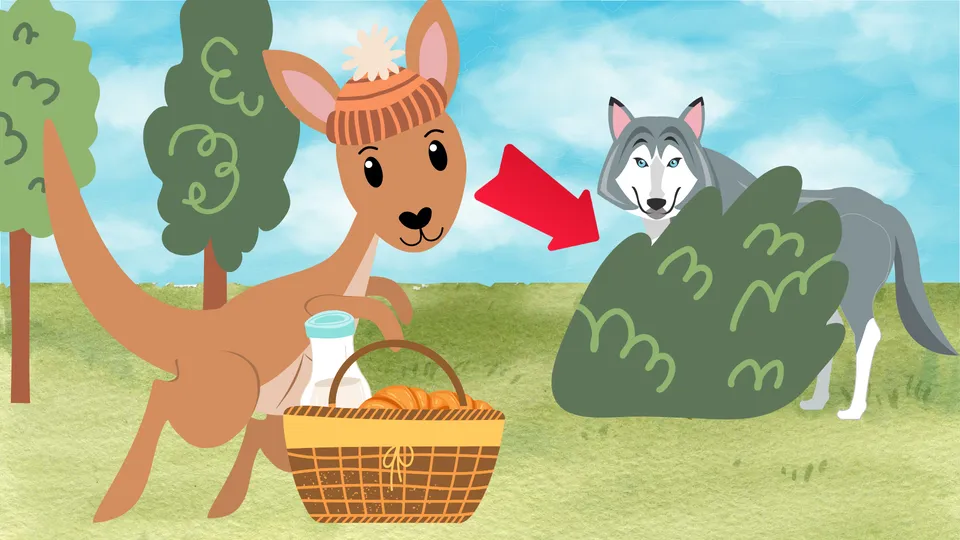
Lead the little kangaroo through the forest on his way to visit his grandma
Learn and practice the words and phrases "beside," "next to," "behind," and "in front of."
Students will practice positional words by accompanying the little kangaroo on his trip through the forest to visit his grandma.
Part of
Standards alignment
Common Core State Standards
- K.G.A.1 — Describe objects in the environment using names of shapes, and describe the relative positions of these objects using terms such as above, below, beside, in front of, behind, and next to.
- L.K.1.e — Use the most frequently occurring prepositions (e.g., to, from, in, out, on, off, for, of, by, with).
- L.K.6 — Use words and phrases acquired through conversations, reading and being read to, and responding to texts.
- RL.K.1 — With prompting and support, ask and answer questions about key details in a text.
Alabama
- ELA21.K.6 — Uses spatial and temporal concepts correctly.
- MA19.K.18 — Describe objects in the environment using names of shapes, and describe the relative positions of these objects using terms such as _above, below, beside, in front of, behind,_ and _next to._
- ELA21.K.17 — With guidance and support, orally utilize new academic, content-specific, grade-level vocabulary and relate new words to prior knowledge.
- ELA21.K.21b — Use new words and phrases acquired through conversations, reading and being read to, and responding to text.
- ELA21.K.7 — Restate and follow one- and two-step directions.
Alaska
- K.G.1 — Describe objects in the environment using names of shapes and describe their relative positions (e.g.,above, below, beside, in front of, behind, next to).
- L.K.1.e — Use the most frequently occurring prepositions (e.g., to, from, in, out, on, off, for, of, by, with).
- L.K.6 — Use words and phrases acquired through conversations, reading and being read to, and responding to texts.
- RL.K.1 — With prompting and support, ask and answer questions about a literary text using key details from the text.
Arizona
- K.G.A.1 — Describe objects in the environment using names of shapes, and describe the relative positions of these objects using terms such as above, below, beside, in front of, behind, and next to.
- K.L.1.d — Use the most frequently occurring prepositions (e.g., to, from, in, out, on, off, for, of, by, with).
- K.L.6 — Use words and phrases acquired through conversations, reading and being read to, and responding to texts.
- K.RL.1 — With prompting and support, ask and answer questions about key details in a text.
Arkansas
- K.GM.1 — Describe the positions of objects and geometric shapes in the environment. • Terms include: inside, outside, between, above, below, near, far, under, over, up, down, behind, in front of, next to, to the left of, and to the right of
- G.1.K.1 — Describe familiar places using words that communicate location (e.g., beside, past, before), direction (e.g., right/left), and distance (e.g., long/short).
- K.RC.2.RF — Answer questions about key details in a text.
- K.V.1 — Determine or clarify the meaning of words and phrases in a text read aloud.
California
- K.4.1 — Determine the relative locations of objects using the terms near/far, left/right, and behind/in front.
- K.G.A.1 — Describe objects in the environment using names of shapes, and describe the relative positions of these objects using terms such as above, below, beside, in front of, behind, and next to.
- L.K.6 — Use words and phrases acquired through conversations, reading and being read to, and responding to texts.
- RL.K.1 — With prompting and support, ask and answer questions about key details in a text.
Colorado
- K.G.A.1 — Describe objects in the environment using names of shapes, and describe the relative positions of these objects using terms such as above, below, beside, in front of, behind, and next to.
- P.G.B.4 — Understand and use language related to directionality, order, and the position of objects, including up/down and in front/behind.
- RWC20-GR.K-S.1-GLE.1-EO.b — Confirm understanding of a text read aloud or information presented orally or through other media by asking and answering questions about key details and requesting clarification if something is not understood.
- RWC20-GR.K-S.1-GLE.2-EO.h — Use new vocabulary that is directly taught through reading, speaking, and listening.
Connecticut
- K.G.A.1 — Describe objects in the environment using names of shapes, and describe the relative positions of these objects using terms such as above, below, beside, in front of, behind, and next to.
- L.K.1.e — Use the most frequently occurring prepositions (e.g., to, from, in, out, on, off, for, of, by, with).
- L.K.6 — Use words and phrases acquired through conversations, reading and being read to, and responding to texts.
- RL.K.2 — With prompting and support, retell familiar stories, including key details.
Delaware
- K.G.A.1 — Describe objects in the environment using names of shapes, and describe the relative positions of these objects using terms such as above, below, beside, in front of, behind, and next to.
- L.K.1.e — Use the most frequently occurring prepositions (e.g., to, from, in, out, on, off, for, of, by, with).
- L.K.6 — Use words and phrases acquired through conversations, reading and being read to, and responding to texts.
- RL.K.1 — With prompting and support, ask and answer questions about key details in a text.
Florida
- SS.K.G.1.1 — Describe the relative location of people, places, and things by using positional words.
- ELA.K.C.4.1 — Recall information to answer a question about a single topic.
- ELA.K.V.1.1 — Use grade-level academic vocabulary appropriately in speaking and writing.
- ELA.K.V.1.2 — Ask and answer questions about unfamiliar words in grade-level content.
Georgia
- K.GSR.8.2 — Describe the relative location of an object using positional words.
- ELAGSEKL1.e — Use the most frequently occurring prepositions (e.g., to, from, in, out, on, off, for, of, by, with).
- ELAGSEKL6 — Use words and phrases acquired through conversations, reading and being read to, and responding to texts.
- ELAGSEKRL1 — With prompting and support, ask and answer questions about key details in a text.
Hawaii
- K.G.A.1 — Describe objects in the environment using names of shapes, and describe the relative positions of these objects using terms such as above, below, beside, in front of, behind, and next to.
- K.L.1e — Use the most frequently occurring prepositions (e.g., to, from, in, out, on, off, for, of, by, with).
- K.L.6 — Use words and phrases acquired through conversations, reading and being read to, and responding to texts.
- K.RL.1 — With prompting and support, ask and answer questions about key details in a text.
- K.L.4 — Determine or clarify the meaning of unknown and multiple-meaning words and phrases based on kindergarten reading and content.
Idaho
- K.G.A.1 — Describe objects in the environment using names of shapes, and describe the relative positions of these objects using terms such as “above,” “below,” beside, “in front of,” “behind,” and “next to.”
- K.GC.GU.1c — Use frequently occurring prepositions (e.g., to, from, in, out, on, off, for, of, by, with).
- K.RC.L.5a — Retell key details of familiar stories, poems, and nursery rhymes heard.
- K.RC.TE.3 — Ask and answer questions about key details in texts heard.
- K.VD.WB.3 — With support, use words and phrases acquired through conversations, reading, and listening to texts.
Illinois
- K.G.A.1 — Describe objects in the environment using names of shapes, and describe the relative positions of these objects using terms such as above, below, beside, in front of, behind, and next to.
- L.K.1.e — Use the most frequently occurring prepositions (e.g., to, from, in, out, on, off, for, of, by, with).
- L.K.5 — With guidance and support from adults, explore word relationships and nuances in word meanings.
- L.K.6 — Use words and phrases acquired through conversations, reading and being read to, and responding to texts.
- RL.K.2 — With prompting and support, retell familiar stories, including key details.
Indiana
- K.G.1 — Use words related to location, direction, and distance, including here/there, over/under, left/right, above/below, forward/backward, and between. (E)
- K.RC.1 — With support, ask and answer questions about main topics and key details in a text heard or read. (E)
- K.CC.4 — Audibly recite poems, rhymes, and songs, and use complete sentences to describe familiar people, places, things, and events. With support, provide additional details on these topics.
Iowa
- K.G.A.1 — Describe objects in the environment using names of shapes and describe the relative positions of these objects using terms such as above, below, besides, in front of, behind, and next to.
- L.K.1.d — Use the most frequently occurring prepositions (e.g., to, from, in, out, on, off, for, of, by, with).
- L.K.6 — Use words and phrases acquired through conversations, reading and being read to, and responding to texts.
- RL.K.1 — With prompting and support, ask and answer questions about key details in a text.
- RL.K.7 — With prompting and support, describe the relationship between illustrations and the story in which they appear (e.g., what moment in a story an illustration depicts).
Kansas
- K.G.1 — Describe objects in the environment using names of shapes, and describe the relative positions of these objects using terms such as above, below, beside, in front of, behind, and next to.
- RL.K.1 — With prompting and support, ask and answer questions about key details in a text.
- SL.K.8 — Use words and phrases acquired through conversations, reading, and through being read to.
- RL.K.4 — Ask and answer questions about unknown words in a text.
Kentucky
- KY.K.G.1.b — Describe the relative positions of these objects using terms above, below, in front of, behind and next to.
- L.K.1.d — sentences using common prepositions.
- L.K.4.c — Use words and phrases acquired through conversations, reading and being read to, and responding to texts.
- L.K.5 — With guidance and support from adults, explore word relationships and nuances in word meanings.
Louisiana
- K.G.A.1 — Describe objects in the environment using names of shapes, and describe the relative positions of these objects using terms such as above, below, beside, in front of, behind, and next to.
- L.K.1.e — Use the most frequently occurring prepositions (e.g., to, from, in, out, on, off, for, of, by, with).
- L.K.6 — Use words and phrases acquired through conversations, reading and being read to, and responding to texts.
- RL.K.1 — With prompting and support, ask and answer questions about key details in a text.
Maine
- K.G.A.1 — Describe objects in the environment using names of shapes and describe the relative positions of these objects using terms such as above, below, beside, in front of, behind, and next to.
- L.1.K.d — Use the most frequently occurring prepositions (e.g., to, from, in, out, on, off, for, of, by, with).
- L.6.K.a — Use words and phrases acquired through conversations, reading and being read to, and responding to texts.
- R.4.K.a — Ask and answer questions with prompting and support about who, what, when, where, and how.
- SL.2.K.a — Confirm understanding of a text read aloud or information presented orally or through other media by asking and answering questions about key details to seek help if something is not understood.
Maryland
- L.PK.1.e — Gain exposure to the most frequently occurring prepositions (e.g. to, from, in, out, on, off, for, of, by with).
- identifying important objects in the classroom using the terms near/far, left/right, behind/in front, and up/down.
- K.G.A.1 — Describe objects in the environment using names of shapes, and describe the relative positions of these objects using terms such as above, below, beside, in front of, behind, and next to.
- L.PK.6 — Use words and phrases acquired through conversations, being read to, and responding to texts.
Massachusetts
- PK.G.A.1 — Identify relative positions of objects in space, and use appropriate language (e.g., beside, inside, next to, close to, above, below, apart).
- PreK.T2.1 — With prompting and support, describe location of people, animals, objects, and places, using words and phrases such as up, down, on, off, close, far away, beside, inside, next to, close to, above, below, apart correctly.
- K.G.A.1 — Describe objects in the environment using names of shapes, and describe the relative positions of these objects using terms such as above, below, beside, in front of, behind, and next to.
- L.K.1.a — Demonstrate the ability to produce and expand complete sentences using frequently occurring nouns, pronouns, adjectives, verbs, question words, and prepositions; name and use in context numbers 0–100 (see kindergarten mathematics standards for Counting and Cardinality).
Michigan
- K.G.A.1 — Describe objects in the environment using names of shapes, and describe the relative positions of these objects using terms such as above, below, beside, in front of, behind, and next to.
- L.K.1.e — Use the most frequently occurring prepositions (e.g., to, from, in, out, on, off, for, of, by, with).
- L.K.6 — Use words and phrases acquired through conversations, reading and being read to, and responding to texts.
- RL.K.1 — With prompting and support, ask and answer questions about key details in a text.
- L.K.5 — With guidance and support from adults, explore word relationships and nuances in word meanings.
Minnesota
- 0.3.1.1.1 — Describe spatial information depicted in simple drawings and pictures. For example: While looking at a picture, the student says, "The boy is in front of the house. The house is at the edge of the woods." Other words describing spatial information in a picture include up, down, left, right, near, far, back, in front of.
- K.3.2.1 — Use words to compare objects according to length, size, weight and position. For example: Use same, lighter, longer, above, between and next to. Another example: Identify objects that are near your desk and objects that are in front of it. Explain why there may be some objects in both groups.
- 0.3.1.2 — Confirm understanding of a text read aloud or information presented orally or through other media (e.g., poems, rhymes, songs) by asking and answering questions about key details and requesting clarification if something is not understood.
- 0.2.5.2 — Verbally or visually respond to a story, with support and guidance.
Mississippi
- K.G.1 — Describe objects in the environment using names of shapes, and describe the relative positions of these objects using terms such as above, below, beside, in front of, behind, and next to.
- L.K.1.e — Use the most frequently occurring prepositions (e.g., to, from, in, out, on, off, for, of, by, with).
- L.K.6 — Use words and phrases acquired through conversations, reading and being read to, and responding to texts.
- RL.K.1 — With prompting and support, ask and answer questions about key details in a text.
- K.G.1.3 — Explain a place using terms related to location, direction, size, and distance (e.g., up, down, left, right, far, near, etc.).
Missouri
- K.GM.C.7 — Describe the relative positions of objects in space.
- K.EG.5.B.a — Apply positional words to locations within the classroom
- K.R.1.B.e — using words and phrases acquired through conversations, reading and being read to, and responding to texts
- K.R.1.A.c — retelling main ideas or important facts from a read aloud or familiar story
Montana
- K.G.A.1 — Describe objects, including those of Montana American Indians, in the environment using names of shapes, and describe the relative positions of these objects using terms such as: above, below, beside, in front of, behind, and next to.
- L.K.1.e — Use the most frequently occurring prepositions (e.g., to, from, in, out, on, off, for, of, by, with).
- L.K.6 — Use words and phrases acquired through conversations, reading and being read to, and responding to texts.
- RL.K.7 — With prompting and support, describe the relationship between illustrations and the story in which they appear (e.g., what moment in a story an illustration depicts).
Nebraska
- K.G.1.c — Describe the relative positions of shapes in relation to other objects or shapes using terms such as above, below, in front of, behind, and next to.
- LA.K.RP.6 — With prompting and support, ask and answer questions about key details in a literary text.
- SS K.3.1.a — Communicate personal directions to describe relative locations of people and objects.
- LA.K.V.2.c — With prompting and support, ask and answer questions about key words and phrases to determine their meaning.
Nevada
- K.G.A.1 — Describe objects in the environment using names of shapes, and describe the relative positions of these objects using terms such as above, below, beside, in front of, behind, and next to.
- L.K.1.e — Use the most frequently occurring prepositions (e.g., to, from, in, out, on, off, for, of, by, with).
- L.K.6 — Use words and phrases acquired through conversations, reading and being read to, and responding to texts.
- RL.K.1 — With prompting and support, ask and answer questions about key details in a text.
- SL.K.2 — Confirm understanding of a text read aloud or information presented orally or through other media by asking and answering questions about key details and requesting clarification if something is not understood.
New Hampshire
- K.G.A.1 — Describe objects in the environment using names of shapes, and describe the relative positions of these objects using terms such as above, below, beside, in front of, behind, and next to.
- L.K.1.e — Use the most frequently occurring prepositions (e.g., to, from, in, out, on, off, for, of, by, with).
- L.K.6 — Use words and phrases acquired through conversations, reading and being read to, and responding to texts.
- SL.K.2 — Confirm understanding of a text read aloud or information presented orally or through other media by asking and answering questions about key details and requesting clarification if something is not understood.
New Jersey
- K.G.A.1 — Describe objects in the environment using names of shapes, and describe the relative positions of these objects using terms such as above, below, beside, in front of, behind, and next to.
- L.K.1.e — Use the most frequently occurring prepositions (e.g., to, from, in, out, on, off, for, of, by, with).
- L.K.6 — Use words and phrases acquired through conversations, reading and being read to, and responding to texts.
- RL.K.1 — With prompting and support, ask and answer questions about key details in a text (e.g., who, what, where, when, why, how).
- SL.K.2 — Confirm understanding of a text read aloud or information presented orally or through other media by asking and answering questions about key details and requesting clarification if something is not understood.
New Mexico
- K.G.A.1 — Describe objects in the environment using names of shapes, and describe the relative positions of these objects using terms such as above, below, beside, in front of, behind, and next to.
- L.K.1.e — Use the most frequently occurring prepositions (e.g., to, from, in, out, on, off, for, of, by, with).
- L.K.6 — Use words and phrases acquired through conversations, reading and being read to, and responding to texts.
- RL.K.1 — With prompting and support, ask and answer questions about key details in a text.
- RL.K.2 — With prompting and support, retell familiar stories, including key details.
New York
- NY-PK.G.1 — Describe objects in the environment using names of shapes, and describe the relative positions of these objects using terms such as top, bottom, up, down, above, below, in front of, behind, over, under, and next to.
- KL6 — Use words and phrases acquired through conversations, reading and being read to, and responding to texts.
- NY-K.G.1 — Describe objects in the environment using names of shapes, and describe the relative positions of these objects using terms such as above, below, beside, in front of, behind, and next to.
- KR2 — Retell stories or share key details from a text. (RI&RL)
North Carolina
- NC.K.G.1 — Describe objects in the environment using names of shapes, and describe the relative positions of objects using positional terms.
- PS.K.2.1 — Use models to compare the relative position of various objects observed in the classroom and outside using position words such as: in front of, behind, between, on top of, under, above, below, beside.
- L.K.6 — Use words and phrases learned through conversations, reading and being read to, and responding to texts.
- RL.K.2 — With prompting and support, retell familiar stories, including key details.
- K.G.1.3 — Identify locations in the classroom, community, and around the world with positional words.
North Dakota
- K.L.2e — spatial and time relationships such as up, down, before, and after.
- K.F.11 — Orally use new academic, content-specific, grade-level vocabulary, and relate new words to prior knowledge.
- K.L.2 — Identify parts of speech in sentences orally, with illustrations, or in writing:
- K.R.5 — Determine the meaning of unknown and multiple-meaning words and phrases through read-alouds or other text-listening experiences.
Ohio
- K.G.1 — Describe objects in the environment using names of shapes, and describe the relative positions of these objects using terms such as above, below, beside, in front of, behind, and next to.
- L.K.1.e — Use the most frequently occurring prepositions (e.g., to, from, in, out, on, off, for, of, by, with).
- L.K.6 — Use words and phrases acquired through conversations, reading and being read to, and responding to texts.
- RL.K.2 — With prompting and support, retell familiar stories, including key details.
- K.5 — Terms related to direction and distance, as well as symbols and landmarks, can be used to talk about the relative location of familiar places.
Oklahoma
- PK.3.R.2 — Students will answer basic questions (e.g., who, what, where, and when) about texts, photographs, or illustrations during shared reading or other text experiences with prompting.
- PK.4.R.3 — Students will begin to acquire new vocabulary and relate new words to prior knowledge.
- PK.5.R.2 — Students will hear different parts of speech through conversations, read-alouds, and interactive reading: • concrete objects as persons, places, or things (i.e., nouns) • words as actions (i.e., verbs) • color adjectives • spatial and time relationships such as up, down, before, and after
- PK.4.W.1 — Students will begin to use new vocabulary to produce and expand complete sentences in shared language activities.
- PK.8.R — Students will listen and respond to read-alouds, participate in shared reading, and interact independently with texts.
- PK.2.2 — Use basic directional terms in relation to the student’s relative location.
Oregon
- K.L.1e — Use the most frequently occurring prepositions.
- K.12 — Use terms related to location, direction, and distance (such as over/under, here/there, left/right, above/below, forward/backward, between).
- K.GM.A.1 — Describe objects in the environment using names of shapes and describe the relative positions of these objects in their environment.
- K.L.5 — With guidance and support, explore word relationships and nuances in word meanings.
- K.RI.1 — With prompting and support, ask and answer questions about key details in a text.
Pennsylvania
- CC.1.3.PK.J — Use new vocabulary and phrases acquired in conversations and being read to.
- CC.1.3.PK.F — Answer questions about unfamiliar words read aloud from a story.
- CC.1.3.PK.G — Describe pictures in books using details.
- CC.1.3.PK.I — With prompting and support, clarify unknown words or phrases read aloud.
Rhode Island
- K.G.A.1 — Describe objects in the environment using names of shapes, and describe the relative positions of these objects using terms such as above, below, beside, in front of, behind, and next to.
- L.K.1.a — Demonstrate the ability to produce and expand complete sentences using frequently occurring nouns, pronouns, adjectives, verbs, question words, and prepositions; name and use in context numbers 0–100 (see kindergarten mathematics standards for Counting and Cardinality).
- L.K.6 — Use words and phrases acquired through conversations, activities in the kindergarten curriculum, reading and being read to, and responding to texts.
- RL.K.1 — With prompting and support, ask and answer questions about key details in a text.
- SL.K.2 — Confirm understanding of a text read aloud or information presented orally or through other media by asking and answering questions about key details and requesting clarification if something is not understood.
South Carolina
- K.G.1 — Describe positions of objects by appropriately using terms, including below, above, beside, between, inside, outside, in front of, or behind.
- ELA.K.R.1.1 — Ask and answer questions (who, what, when, where, why, and how) about print and non-print sources to obtain and refine knowledge.
South Dakota
- K.G.A.1 — Describe objects in the environment using names of shapes, and describe the relative positions of these objects using terms such as above, below, beside, in front of, behind, and next to.
- K.L.1.e — Use the most frequently occurring prepositions.
- K.L.5 — With prompting and support, explore word relationships and subtle differences in word meanings.
- K.L.5.c — Identify real-life connections between words and their use.
- K.L.4 — Determine or clarify the meaning of unknown and multiple-meaning words and phrases based on kindergarten reading and content.
Tennessee
- K.FL.SC.6.f — Use the most frequently occurring prepositions when speaking and in shared language activities.
- K.08 — Use personal directions such as: up, down, near, far, left, right, in front of, and behind.
- K.G.A.1 — Describe objects in the environment using names of shapes and solids (squares, circles, triangles, rectangles, hexagons, cubes, cones, cylinders, and spheres). Describe the relative positions of these objects using terms such as above, below, beside, in front of, behind, between, and next to.
- K.RL.KID.1 — With prompting and support, ask and answer questions about key details in a text.
- K.RL.IKI.7 — With prompting and support, orally describe the relationship between illustrations and the story in which they appear.
Texas
- K.3C — identify and use words that name actions; directions; positions; sequences; categories such as colors, shapes, and textures; and locations.
- K.6C — observe and describe the location of an object in relation to another such as above, below, behind, in front of, and beside; and
- K.10D.v — prepositions;
Utah
- K.G.1 — Describe objects in the environment using names of shapes, and describe the relative positions of these objects using terms such as above, below, beside, in front of, behind, and next to.
- K.3.1.a — Locate objects in the classroom using the terms near/far, left/right, behind/in front, and up/down.
- K.R.5 — With prompting and support, ask and answer questions about key details in a text. (RL & RI)
- K.R.8 — Ask and answer questions about unknown words in a text. (RL & RI)
Vermont
- K.G.A.1 — Describe objects in the environment using names of shapes, and describe the relative positions of these objects using terms such as above, below, beside, in front of, behind, and next to.
- L.K.1.e — Use the most frequently occurring prepositions (e.g., to, from, in, out, on, off, for, of, by, with).
- L.K.6 — Use words and phrases acquired through conversations, reading and being read to, and responding to texts.
- RL.K.1 — With prompting and support, ask and answer questions about key details in a text.
Virginia
- K.RV.1.F — Use newly learned words and phrases in discussions and speaking activities.
- K.RL.3.C — With prompting and support, monitor listening comprehension.
- K.RV.1.A — Discuss meanings of words from a variety of texts and experiences.
- K.LU.1.D — Use adjectives to describe specific objects (quantity, size, age, shape, color, or location).
Washington
- K.G.A.1 — Describe objects in the environment using names of shapes, and describe the relative positions of these objects using terms such as above, below, beside, in front of, behind, and next to.
- L.K.1.e — Use the most frequently occurring prepositions (e.g., to, from, in, out, on, off, for, of, by, with).
- L.K.6 — Use words and phrases acquired through conversations, reading and being read to, and responding to texts.
- RL.K.2 — With prompting and support, retell familiar stories, including key details.
- RL.K.7 — With prompting and support, describe the relationship between illustrations and the story in which they appear (e.g., what moment in a story an illustration depicts).
Washington, D.C.
- K.G.A.1 — Describe objects in the environment using names of shapes, and describe the relative positions of these objects using terms such as above, below, beside, in front of, behind, and next to.
- L.K.1.e — Use the most frequently occurring prepositions (e.g., to, from, in, out, on, off, for, of, by, with).
- RL.K.1 — With prompting and support, ask and answer questions about key details in a text.
- RL.K.4 — Ask and answer questions about unknown words in a text.
West Virginia
- M.K.20 — Describe objects in the environment using names of shapes and describe the relative positions of these objects using terms such as above, below, beside, in front of, behind and next to.
- ELA.K.1 — With prompting and support, ask and answer questions about key details in a literary text.
- ELA.K.36.d — Use the most frequently occurring prepositions (e.g., to, from, in, out, on, off, for, of, by, and with).
- ELA.K.41 — Use words and phrases acquired through conversations, reading, being read to, and responding to texts.
- ELA.K.40 — With guidance and support from adults, explore word relationships and nuances in word meanings.
Wisconsin
- M.K.G.A.1 — Describe objects in the environment using names of shapes, and describe the relative positions of these objects using terms such as above, below, beside, in front of, behind, and next to.
- ELA.K.L.5.a — Frequently used nouns, verbs, and prepositions.
- ELA.K.SL.2 — With guidance and support, ask and answer questions about key details in a text read aloud or information presented orally or through other media.
- ELA.K.R.2 — With prompting and support, retell stories (RL); share key details from a text. (RI)
Wyoming
- K.G.H.1 — Describe objects in the environment using the names of shapes, and describe the relative positions of these objects using terms such as above, below, beside, in front of, behind, and next to.
- L.K.1.e — Use the most frequently occurring prepositions (e.g., to, from, in, out, on, off, for, of, by, with).
- L.K.6 — Use words and phrases acquired through conversations, reading and being read to, and responding to texts.
- SL.K.2 — Confirm understanding of a text read aloud or information presented orally or through other media by asking and answering questions about key details and requesting clarification if something is not understood.