Matching Pairs Game
Ages 3–6 · 5 minutes · Math, English
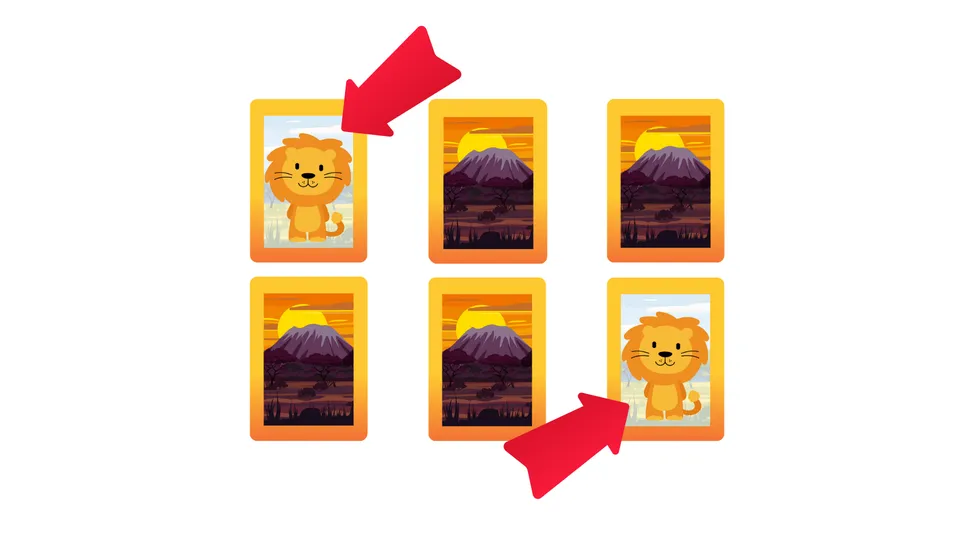
Find pairs of cards with matching pictures of animals
Child will practice describing positions in a 3x2 grid by playing a card game of finding pairs of cards with the same picture of an animal.
Requirements: child should be familiar with positional words to describe locations in a 3x2 grid such as top left, bottom middle, etc
Part of
Standards alignment
Common Core State Standards
- K.G.A.1 — Describe objects in the environment using names of shapes, and describe the relative positions of these objects using terms such as above, below, beside, in front of, behind, and next to.
Alabama
- ELA21.K.6 — Uses spatial and temporal concepts correctly.
- MA19.K.18 — Describe objects in the environment using names of shapes, and describe the relative positions of these objects using terms such as _above, below, beside, in front of, behind,_ and _next to._
- SS10.K.10 — Apply vocabulary related to giving and following directions.
Alaska
- K.G.1 — Describe objects in the environment using names of shapes and describe their relative positions (e.g.,above, below, beside, in front of, behind, next to).
Arizona
- K.G.A.1 — Describe objects in the environment using names of shapes, and describe the relative positions of these objects using terms such as above, below, beside, in front of, behind, and next to.
- 1.G1.2 — Use a grid to locate places.
- K.SL.6 — Speak audibly and express thoughts, feelings, and ideas clearly.
Arkansas
- K.GM.1 — Describe the positions of objects and geometric shapes in the environment. • Terms include: inside, outside, between, above, below, near, far, under, over, up, down, behind, in front of, next to, to the left of, and to the right of
California
- K.4.1 — Determine the relative locations of objects using the terms near/far, left/right, and behind/in front.
- K.G.A.1 — Describe objects in the environment using names of shapes, and describe the relative positions of these objects using terms such as above, below, beside, in front of, behind, and next to.
Colorado
- K.G.A.1 — Describe objects in the environment using names of shapes, and describe the relative positions of these objects using terms such as above, below, beside, in front of, behind, and next to.
- P.G.B.4 — Understand and use language related to directionality, order, and the position of objects, including up/down and in front/behind.
- SS.P.2.1 — Develop spatial understanding, perspectives, and connections to the world
Connecticut
- K.G.A.1 — Describe objects in the environment using names of shapes, and describe the relative positions of these objects using terms such as above, below, beside, in front of, behind, and next to.
Delaware
- K.G.A.1 — Describe objects in the environment using names of shapes, and describe the relative positions of these objects using terms such as above, below, beside, in front of, behind, and next to.
Florida
- SS.K.G.1.1 — Describe the relative location of people, places, and things by using positional words.
Georgia
- K.GSR.8.2 — Describe the relative location of an object using positional words.
- K.MP.6 — Attend to precision.
Hawaii
- K.G.A.1 — Describe objects in the environment using names of shapes, and describe the relative positions of these objects using terms such as above, below, beside, in front of, behind, and next to.
Idaho
- K.G.A.1 — Describe objects in the environment using names of shapes, and describe the relative positions of these objects using terms such as “above,” “below,” beside, “in front of,” “behind,” and “next to.”
- K.MP6 — Attend to precision.
Illinois
- K.G.A.1 — Describe objects in the environment using names of shapes, and describe the relative positions of these objects using terms such as above, below, beside, in front of, behind, and next to.
- SC-P1 — Some things stay the same while other things change.
Indiana
- K.G.1 — Use words related to location, direction, and distance, including here/there, over/under, left/right, above/below, forward/backward, and between. (E)
Iowa
- K.G.A.1 — Describe objects in the environment using names of shapes and describe the relative positions of these objects using terms such as above, below, besides, in front of, behind, and next to.
- SL.K.4 — Describe familiar people, places, things, and events and, with prompting and support, provide additional detail.
Kansas
- K.G.1 — Describe objects in the environment using names of shapes, and describe the relative positions of these objects using terms such as above, below, beside, in front of, behind, and next to.
Kentucky
- KY.K.G.1.b — Describe the relative positions of these objects using terms above, below, in front of, behind and next to.
Louisiana
- K.G.A.1 — Describe objects in the environment using names of shapes, and describe the relative positions of these objects using terms such as above, below, beside, in front of, behind, and next to.
- K.18 — Use maps and models to describe relative location. For example: locating objects and places to the right or left, up or down, in or out, above or below.
Maine
- K.G.A.1 — Describe objects in the environment using names of shapes and describe the relative positions of these objects using terms such as above, below, beside, in front of, behind, and next to.
Maryland
- K.G.A.1 — Describe objects in the environment using names of shapes, and describe the relative positions of these objects using terms such as above, below, beside, in front of, behind, and next to.
- identifying important objects in the classroom using the terms near/far, left/right, behind/in front, and up/down.
Massachusetts
- PK.G.A.1 — Identify relative positions of objects in space, and use appropriate language (e.g., beside, inside, next to, close to, above, below, apart).
- PreK.T2.1 — With prompting and support, describe location of people, animals, objects, and places, using words and phrases such as up, down, on, off, close, far away, beside, inside, next to, close to, above, below, apart correctly.
- K.T2.1 — Describe the location of people, objects, and places, using correctly words and phrases such as up, down, near, far, left, right, straight, back, behind, in front of, next to, between.
- K.G.A.1 — Describe objects in the environment using names of shapes, and describe the relative positions of these objects using terms such as above, below, beside, in front of, behind, and next to.
Michigan
- K.G.A.1 — Describe objects in the environment using names of shapes, and describe the relative positions of these objects using terms such as above, below, beside, in front of, behind, and next to.
- K–G1.0.2 — Use directions or positional words to identify significant locations in the classroom.
Minnesota
- K.3.2.1 — Use words to compare objects according to length, size, weight and position. For example: Use same, lighter, longer, above, between and next to. Another example: Identify objects that are near your desk and objects that are in front of it. Explain why there may be some objects in both groups.
- 0.3.1.1.1 — Describe spatial information depicted in simple drawings and pictures. For example: While looking at a picture, the student says, "The boy is in front of the house. The house is at the edge of the woods." Other words describing spatial information in a picture include up, down, left, right, near, far, back, in front of.
Mississippi
- K.G.1.3 — Explain a place using terms related to location, direction, size, and distance (e.g., up, down, left, right, far, near, etc.).
- K.G.1 — Describe objects in the environment using names of shapes, and describe the relative positions of these objects using terms such as above, below, beside, in front of, behind, and next to.
Missouri
- K.GM.C.7 — Describe the relative positions of objects in space.
- K.EG.5.B.a — Apply positional words to locations within the classroom
Montana
- K.G.A.1 — Describe objects, including those of Montana American Indians, in the environment using names of shapes, and describe the relative positions of these objects using terms such as: above, below, beside, in front of, behind, and next to.
- SL.K.4 — Describe familiar people, places, things, and events and, with prompting and support, provide additional detail.
Nebraska
- K.G.1.c — Describe the relative positions of shapes in relation to other objects or shapes using terms such as above, below, in front of, behind, and next to.
- LA.K.SL.1.e — Complete a task following one/two-step directions.
Nevada
- K.G.A.1 — Describe objects in the environment using names of shapes, and describe the relative positions of these objects using terms such as above, below, beside, in front of, behind, and next to.
New Hampshire
- K.G.A.1 — Describe objects in the environment using names of shapes, and describe the relative positions of these objects using terms such as above, below, beside, in front of, behind, and next to.
New Jersey
- K.G.A.1 — Describe objects in the environment using names of shapes, and describe the relative positions of these objects using terms such as above, below, beside, in front of, behind, and next to.
New Mexico
- K.G.A.1 — Describe objects in the environment using names of shapes, and describe the relative positions of these objects using terms such as above, below, beside, in front of, behind, and next to.
New York
- NY-PK.G.1 — Describe objects in the environment using names of shapes, and describe the relative positions of these objects using terms such as top, bottom, up, down, above, below, in front of, behind, over, under, and next to.
- K.6c — Places, physical features, and man-made structures can be located on a map or globe and described using specific geographic vocabulary.
- PKL4 — Explore and use new vocabulary in child-centered, authentic, play-based experiences.
North Carolina
- NC.K.G.1 — Describe objects in the environment using names of shapes, and describe the relative positions of objects using positional terms.
- K.G.1.3 — Identify locations in the classroom, community, and around the world with positional words.
- PS.K.2.1 — Use models to compare the relative position of various objects observed in the classroom and outside using position words such as: in front of, behind, between, on top of, under, above, below, beside.
Ohio
- K.G.1 — Describe objects in the environment using names of shapes, and describe the relative positions of these objects using terms such as above, below, beside, in front of, behind, and next to.
- L.K.6 — Use words and phrases acquired through conversations, reading and being read to, and responding to texts.
Oklahoma
- K.GM.2.1 — Use words to compare objects according to length, size, weight, position, and location.
- K.GM.2 — Compare and order objects according to location and measurable attributes.
- PK.2.2 — Use basic directional terms in relation to the student’s relative location.
Oregon
- K.GM.A.1 — Describe objects in the environment using names of shapes and describe the relative positions of these objects in their environment.
- K.12 — Use terms related to location, direction, and distance (such as over/under, here/there, left/right, above/below, forward/backward, between).
Pennsylvania
- CC.2.3.PreK.A.1 — Identify and describe shapes.
- CC.2.3.K.A.1 — Identify and describe two- and three- dimensional shapes.
Rhode Island
- K.G.A.1 — Describe objects in the environment using names of shapes, and describe the relative positions of these objects using terms such as above, below, beside, in front of, behind, and next to.
South Carolina
- K.G.1 — Describe positions of objects by appropriately using terms, including below, above, beside, between, inside, outside, in front of, or behind.
South Dakota
- K.G.A.1 — Describe objects in the environment using names of shapes, and describe the relative positions of these objects using terms such as above, below, beside, in front of, behind, and next to.
- K.G.1.2 — Use environmental directions or positional words including but not limited to up, down, above, and below to identify significant locations in the classroom
- K.SL.4 — Describe familiar people, places, things, and events. With prompting and support, provide additional detail.
Tennessee
- K.08 — Use personal directions such as: up, down, near, far, left, right, in front of, and behind.
- K.G.A.1 — Describe objects in the environment using names of shapes and solids (squares, circles, triangles, rectangles, hexagons, cubes, cones, cylinders, and spheres). Describe the relative positions of these objects using terms such as above, below, beside, in front of, behind, between, and next to.
Texas
- K.3C — identify and use words that name actions; directions; positions; sequences; categories such as colors, shapes, and textures; and locations.
- K.3A — use spatial terms, including over, under, near, far, left, and right, to describe relative location;
- K.6C — observe and describe the location of an object in relation to another such as above, below, behind, in front of, and beside; and
Utah
- K.3.2.c — Determine a location by using terms such as near/far, up/down, right/left.
- K.G.1 — Describe objects in the environment using names of shapes, and describe the relative positions of these objects using terms such as above, below, beside, in front of, behind, and next to.
- K.3.1.a — Locate objects in the classroom using the terms near/far, left/right, behind/in front, and up/down.
Vermont
- K.G.A.1 — Describe objects in the environment using names of shapes, and describe the relative positions of these objects using terms such as above, below, beside, in front of, behind, and next to.
Virginia
- K.LU.1.D — Use adjectives to describe specific objects (quantity, size, age, shape, color, or location).
Washington
- K.G.A.1 — Describe objects in the environment using names of shapes, and describe the relative positions of these objects using terms such as above, below, beside, in front of, behind, and next to.
Washington, D.C.
- K.G.A.1 — Describe objects in the environment using names of shapes, and describe the relative positions of these objects using terms such as above, below, beside, in front of, behind, and next to.
- K.20 — Explain the concept of relative location using directional words.
West Virginia
- M.K.20 — Describe objects in the environment using names of shapes and describe the relative positions of these objects using terms such as above, below, beside, in front of, behind and next to.
- SS.K.10 — Identify the difference between bodies of water and land masses on maps and globes, and demonstrate directions (e.g., left/right, up/down, near/far and above/under).
Wisconsin
- M.K.G.A.1 — Describe objects in the environment using names of shapes, and describe the relative positions of these objects using terms such as above, below, beside, in front of, behind, and next to.
- ELA.K.SL.4 — With guidance and support, describe familiar people, places, things, and events.
Wyoming
- K.G.H.1 — Describe objects in the environment using the names of shapes, and describe the relative positions of these objects using terms such as above, below, beside, in front of, behind, and next to.