Skip Counting with Number Lines
Ages 5–7 · 15 minutes · Math
Jump in and learn a new way to count by twos, threes, and fives
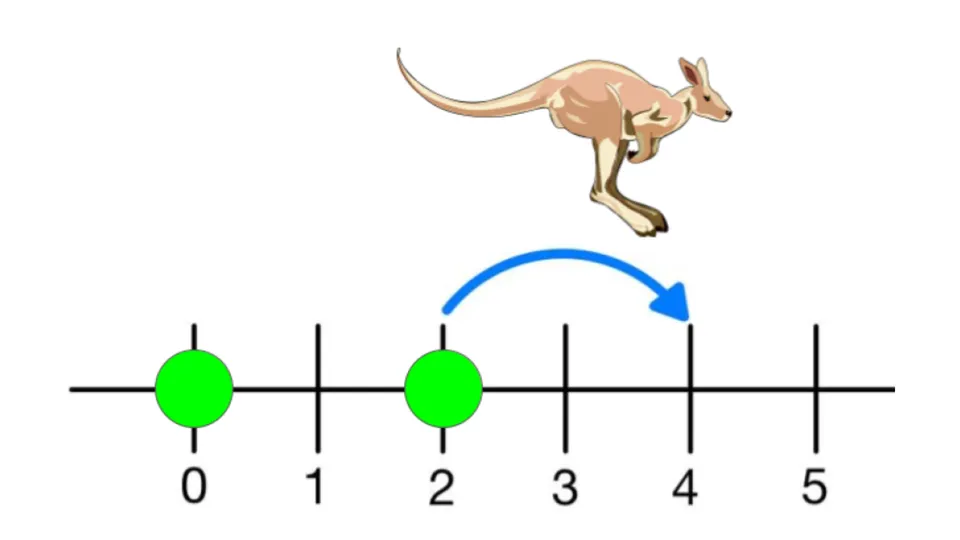
Skip counting allows students to count large numbers efficiently, whether they count by twos, threes, or fives. Students build familiarity with this new skill and work up to skip counting without a number line. Examples include wheels on bicycles, peas in pods, and arms on starfish!
Students should have some familiarity with number lines.
Part of
Standards alignment
Common Core State Standards
- 2.NBT.A.2 — Count within 1000; skip-count by 5s, 10s, and 100s.
- MP7 — Look for and make use of structure.
Alabama
- MA19.1.5 — Relate counting to addition and subtraction.
- MA19.1.9 — Reproduce, extend, and create patterns and sequences of numbers using a variety of materials.
- MA19.2.7 — Count within 1000 by ones, fives, tens, and hundreds.
Alaska
- 1.CC.1 — Skip count by 2s and 5s.
- 1.OA.5 — Relate counting to addition and subtraction (e.g., by counting on 2 to add 2).
- 2.OA.3 — Determine whether a group of objects (up to 20) is odd or even (e.g., by pairing objects and comparing, counting by 2s). Model an even number as two equal groups of objects and then write an equation as a sum of two equal addends.
Arizona
- 1.NBT.A.1 — Count to 120 by 1's, 2's, and 10's starting at any number less than 100. In this range, read and write numerals and represent a number of objects with a written numeral.
- 1.OA.C.5 — Relate counting to addition and subtraction (e.g., by counting on 2 to add 2).
- 2.NBT.A.2 — Count within 1000; skip-count by 5s, 10s, and 100s.
- MP7 — Look for and make use of structure.
Arkansas
- 1.NPV.2 — Skip count forward by multiples of fives within 120.
California
- 2.NBT.A.2 — Count within 1000; skip-count by 2s, 5s, 10s, and 100s.
- 1.OA.C.5 — Relate counting to addition and subtraction (e.g., by counting on 2 to add 2).
- MP7 — Look for and make use of structure.
- 2.MD.B.6 — Represent whole numbers as lengths from 0 on a number line diagram with equally spaced points corresponding to the numbers 0, 1, 2, …, and represent whole-number sums and differences within 100 on a number line diagram.
Colorado
- 1.OA.C.5 — Relate counting to addition and subtraction (e.g., by counting on 2 to add 2).
- 2.MD.B.6 — Represent whole numbers as lengths from 0 on a number line diagram with equally spaced points corresponding to the numbers 0,1,2, …, and represent whole-number sums and differences within 100 on a number line diagram.
- 2.NBT.A.2 — Count within 1000; skip-count by 5s, 10s, and 100s.
Connecticut
- 1.OA.C.5 — Relate counting to addition and subtraction (e.g., by counting on 2 to add 2).
- 2.NBT.A.2 — Count within 1000; skip-count by 5s, 10s, and 100s.
- MP8 — Look for and express regularity in repeated reasoning.
Delaware
- 1.OA.C.5 — Relate counting to addition and subtraction (e.g., by counting on 2 to add 2).
- 2.MD.B.6 — Represent whole numbers as lengths from 0 on a number line diagram with equally spaced points corresponding to the numbers 0, 1, 2, …, and represent whole-number sums and differences within 100 on a number line diagram.
- 2.NBT.A.2 — Count within 1000; skip-count by 5s, 10s, and 100s.
- MP7 — Look for and make use of structure.
Florida
- MA.1.NSO.1.1 — Starting at a given number, count forward and backwards within 120 by ones. Skip count by 2s to 20 and by 5s to 100.
- MA.2.AR.3.2 — Use repeated addition to find the total number of objects in a collection of equal groups. Represent the total number of objects using rectangular arrays and equations.
Georgia
- 1.PAR.3.2 — Identify, describe, and create growing, shrinking, and repeating patterns based on the repeated addition or subtraction of 1s, 2s, 5s, and 10s.
- 2.NR.3 — Work with equal groups to gain foundations for multiplication through real-life, mathematical problems.
- 2.PAR.4.1 — Identify, describe, and create a numerical pattern resulting from repeating an operation such as addition and subtraction.
- 2.NR.1.2 — Count forward and backward by ones from any number within 1000. Count forward by fives from multiples of 5 within 1000. Count forward and backward by 10s and 100s from any number within 1000. Count forward by 25s from 0.
Hawaii
- 1.OA.C.5 — Relate counting to addition and subtraction (e.g., by counting on 2 to add 2).
- 2.MD.B.6 — Represent whole numbers as lengths from 0 on a number line diagram with equally spaced points corresponding to the numbers 0, 1, 2, …, and represent whole-number sums and differences within 100 on a number line diagram.
- 2.NBT.A.2 — Count within 1000; skip-count by 5s, 10s, and 100s.
- MP8 — Look for and express regularity in repeated reasoning.
Idaho
- 1.NBT.A.1 — Starting at a given number, count forward and backwards within 120 by ones. Skip count by twos to 20, by fives to 100, and by tens to 120. In this range, read and write numerals and represent a number of objects with a written numeral.
- 2.MP.8 — Look for and express regularity in repeated reasoning.
- 2.NBT.A.2 — Count within 1,000; skip-count by fives, tens, and 100s. Identify patterns in skip counting starting at any number
- 1.OA.C.5 — Relate counting to addition and subtraction.
Illinois
- 1.OA.C.5 — Relate counting to addition and subtraction (e.g., by counting on 2 to add 2).
- 2.MD.B.6 — Represent whole numbers as lengths from 0 on a number line diagram with equally spaced points corresponding to the numbers 0, 1, 2, …, and represent whole-number sums and differences within 100 on a number line diagram.
- 2.NBT.A.2 — Count within 1000; skip-count by 5s, 10s, and 100s.
- MP.8 — Look for and express regularity in repeated reasoning.
Indiana
- 2.NS.1 — Count by ones, twos, fives, tens, and hundreds up to at least 1,000 from any given number. (E)
- 1.CA.4 — Create, extend, and give an appropriate rule for number patterns using addition within 100.
- 1.NS.1 — Count to at least 120 by ones, fives, and tens from any given number. In this range, read and write numerals and represent a number of objects with a written numeral. (E)
- K.CA.4 — Create, extend, and give an appropriate rule for simple repeating and growing patterns with numbers and shapes.
Iowa
- 1.OA.IA.C.1.a — Relate counting to addition and subtraction (for example, by counting on 2 to add 2).
- 2.NBT.A.2 — Count forward and backward within 1,000; skip-count forward and backward by 5s, 10s, and 100s.
- 2.OA.C.4 — Use repeated addition to find the total number of objects arranged in equal groups and rectangular arrays; write an equation to express the total as a sum of equal addends.
- SMP5 — Use appropriate tools strategically.
- SMP7 — Look for and make use of structure.
Kansas
- 1.OA.5 — Relate counting to addition and subtraction (e.g. by counting on 2 to add 2, counting back 1 to subtract 1).
- 2.NBT.2 — Count within 1000; skip-count by 2s, 5s, 10s, and 100s; explain and generalize the patterns.
- 2.MD.6 — Represent whole numbers as lengths from 0 on a number line diagram with equally spaced points corresponding to the numbers 0, 1, 2, …, and represent whole-number sums and differences within 100 on a number line diagram.
- MP.8 — Look for and express regularity in repeated reasoning.
Kentucky
- KY.1.OA.5 — Relate counting to addition and subtraction.
- KY.2.NBT.2 — Count forwards and backwards within 1000; skip-count by 5s, 10s and 100s.
- KY.2.MD.6 — Represent whole numbers as lengths from 0 on a number line with equally spaced points corresponding to the numbers 0, 1, 2, ... and represent whole-number sums and differences within 100 on a number line.
- MP8 — Look for and express regularity in repeated reasoning.
Louisiana
- 1.OA.C.5 — Relate counting to addition and subtraction (e.g., by counting on 2 to add 2).
- 2.NBT.A.2 — Count within 1000; skip-count by 5s, 10s, and 100s.
- 2.MD.B.6 — Represent whole numbers as lengths from 0 on a number line diagram with equally spaced points corresponding to the numbers 0, 1, 2, …, and represent whole-number sums and differences within 100 on a number line diagram.
- MP8 — Look for and express regularity in repeated reasoning.
Maine
- 1.OA.C.5 — Relate counting to addition and subtraction (e.g., by counting on 2 to add 2).
- 2.NBT.A.2 — Count within 1000; skip-count by 5s, 10s, and 100s. Identify patterns in skip counting at any number. (For example, 37, 47, 57 or 328, 428, 528, etc.)
- 2.MD.B.6 — Represent whole numbers as lengths from 0 on a number line diagram with equally spaced points corresponding to the numbers 0, 1, 2, ..., and represent whole-number sums and differences within 100 on a number line diagram.
- K.CC.B.5 — Count to answer “how many?” questions about as many as 20 things arranged in a line, a rectangular array, or a circle, or as many as 10 things in a scattered configuration; given a number from 1-20, count out that many objects.
Maryland
- 1.OA.C.5 — Relate counting to addition and subtraction (e.g., by counting on 2 to add 2).
- 2.NBT.A.2 — Count within 1000; skip-count by 5s, 10s, and 100s.
- MP8 — Look for and express regularity in repeated reasoning.
- 2.MD.B.6 — Represent whole numbers as lengths from 0 on a number line diagram with equally spaced points corresponding to the numbers 0, 1, 2, …, and represent whole-number sums and differences within 100 on a number line diagram.
Massachusetts
- 1.OA.C.5 — Relate counting to addition and subtraction (e.g., by counting on 2 to add 2).
- 2.NBT.A.2 — Count within 1,000; skip-count by 5s, 10s, and 100s. Identify patterns in skip counting starting at any number.
- 2.MD.B.6 — Represent whole numbers as lengths from 0 on a number line diagram with equally spaced points corresponding to the numbers 0, 1, 2, …, and represent whole-number sums and differences within 100 on a number line diagram.
- MP.8 — Look for and express regularity in repeated reasoning.
Michigan
- 1.OA.C.5 — Relate counting to addition and subtraction (e.g., by counting on 2 to add 2).
- 2.MD.B.6 — Represent whole numbers as lengths from 0 on a number line diagram with equally spaced points corresponding to the numbers 0, 1, 2, …, and represent whole-number sums and differences within 100 on a number line diagram.
- 2.NBT.A.2 — Count within 1000; skip-count by 5s, 10s, and 100s.
- MP7 — Look for and make use of structure.
Minnesota
- 1.1.2.3 — Recognize the relationship between counting and addition and subtraction. Skip count by 2s, 5s, and 10s.
- 1.2.1.1 — Create simple patterns using objects, pictures, numbers and rules. Identify possible rules to complete or extend patterns. Patterns may be repeating, growing or shrinking. Calculators can be used to create and explore patterns. For example: Describe rules that can be used to extend the pattern 2, 4, 6, 8, □, □, □ and complete the pattern 33, 43, □, 63, □, 83 or 20, □, □, 17.
- 2.2.1.1 — Identify, create and describe simple number patterns involving repeated addition or subtraction, skip counting and arrays of objects such as counters or tiles. Use patterns to solve problems in various contexts. For example: Skip count by 5s beginning at 3 to create the pattern 3, 8, 13, 18, … . Another example: Collecting 7 empty milk cartons each day for 5 days will generate the pattern 7, 14, 21, 28, 35, resulting in a total of 35 milk cartons.
Mississippi
- 1.OA.5 — Relate counting to addition and subtraction (e.g., by counting on 2 to add 2).
- 2.NBT.2 — Count within 1000; skip-count by 5s starting at any number ending in 5 or 0. Skip-count by 10s and 100s starting at any number.
- MP7 — Look for and make use of structure.
- MP8 — Look for and express regularity in repeated reasoning.
Missouri
- 1.NS.A.4 — Count by 5s to 100 starting at any multiple of five.
- 2.RA.B.2.a — Count by 2s to 100 starting with any even number.
- 2.GM.C.9 — Represent whole numbers as lengths on a number line, and represent whole-number sums and differences within 100 on a number line.
Montana
- 1.OA.C.5 — Relate counting to addition and subtraction (e.g., by counting on 2 to add 2).
- 2.NBT.A.2 — Count within 1000; skip-count by 5s, 10s, and 100s.
- MP7 — Look for and make use of structure.
- 2.MD.B.6 — Represent whole numbers as lengths from 0 on a number line diagram with equally spaced points corresponding to the numbers 0, 1, 2, …, and represent whole-number sums and differences within 100 on a number line diagram.
Nebraska
- 1.N.2.d — Understand patterns of skip counting by 2s, 5s, and 10s.
- 1.N.2 — Counting and Cardinality: Students will understand the relationship between numbers and quantities to extend the counting sequence.
- 2.G.4.a — Represent whole numbers as equally spaced lengths on a number line diagram. Use number lines to find sums and differences within 100.
Nevada
- 1.OA.C.5 — Relate counting to addition and subtraction (e.g., by counting on 2 to add 2).
- 2.NBT.A.2 — Count within 1000; skip-count by 5s, 10s, and 100s.
- 2.MD.B.6 — Represent whole numbers as lengths from 0 on a number line diagram with equally spaced points corresponding to the numbers 0, 1, 2, …, and represent whole-number sums and differences within 100 on a number line diagram.
- MP8 — Look for and express regularity in repeated reasoning.
New Hampshire
- 1.OA.C.5 — Relate counting to addition and subtraction (e.g., by counting on 2 to add 2).
- 2.MD.B.6 — Represent whole numbers as lengths from 0 on a number line diagram with equally spaced points corresponding to the numbers 0, 1, 2, …, and represent whole-number sums and differences within 100 on a number line diagram.
- 2.NBT.A.2 — Count within 1000; skip-count by 5s, 10s, and 100s.
- MP7 — Look for and make use of structure.
- MP8 — Look for and express regularity in repeated reasoning.
New Jersey
- 1.OA.C.5 — Relate counting to addition and subtraction (e.g., by counting on 2 to add 2).
- 2.MD.B.6 — Represent whole numbers as lengths from 0 on a number line diagram with equally spaced points corresponding to the numbers 0, 1, 2, ..., and represent whole-number sums and differences within 100 on a number line diagram.
- 2.NBT.A.2 — Count within 1000; skip-count by 5s, 10s, and 100s.
- 7 — Look for and make use of structure.
New Mexico
- 1.OA.C.5 — Relate counting to addition and subtraction (e.g., by counting on 2 to add 2).
- 2.NBT.A.2 — Count within 1000; skip-count by 5s, 10s, and 100s.
- MP7 — Look for and make use of structure.
- MP8 — Look for and express regularity in repeated reasoning.
- 2.MD.B.6 — Represent whole numbers as lengths from 0 on a number line diagram with equally spaced points corresponding to the numbers 0, 1, 2, …, and represent whole-number sums and differences within 100 on a number line diagram.
New York
- NY-1.OA.5 — Relate counting to addition and subtraction.
- MP.8 — Look for and express regularity in repeated reasoning.
- NY-2.MD.6 — Represent whole numbers as lengths from 0 on a number line with equally spaced points corresponding to the numbers 0, 1, 2, ..., and represent whole-number sums and differences within 100 on a number line.
- NY-2.NBT.2 — Count within 1000; skip-count by 5s, 10s, and 100s.
North Carolina
- MP.8 — Look for and express regularity in repeated reasoning.
- NC.1.OA.6 — Add and subtract, within 20, using strategies such as: • Counting on • Making ten • Decomposing a number leading to a ten • Using the relationship between addition and subtraction • Using a number line • Creating equivalent but simpler or known sums
- NC.2.NBT.2 — Count within 1,000; skip-count by 5s, 10s, and 100s.
- NC.2.MD.6 — Represent whole numbers as lengths from 0 on a number line diagram with equally spaced points and represent whole-number sums and differences, within 100, on a number line.
North Dakota
- 1.NO.CC.5 — Skip count forward and backward by 5s and 10s from multiples and recognize the patterns of up to 10 skip counts.
- 2.NO.CC.4 — Skip count forward and backward by 2s and 100s and recognize the patterns of skip counts.
- 1.AR.OA.7 — Identify, create, complete, and extend patterns that are repeating, increasing, and decreasing in a variety of contexts.
Ohio
- 1.OA.5 — Relate counting to addition and subtraction, e.g., by counting on 2 to add 2.
- 2.MD.6 — Represent whole numbers as lengths from 0 on a number line diagram with equally spaced points corresponding to the numbers 0, 1, 2,..., and represent whole number sums and differences within 100 on a number line diagram.
- 2.NBT.2 — Count forward and backward within 1,000 by ones, tens, and hundreds starting at any number; skip-count by 5s starting at any multiple of 5.
- MP.8 — Look for and express regularity in repeated reasoning.
- MP.7 — Look for and make use of structure.
Oklahoma
- 1.N.1.4 — Count forward, with objects, from any given number up to 100 by 1s, 2s, 5s and 10s.
- 1.N.1.5 — Count forward, without objects, by multiples of 1s, 2s, 5s, and 10s, up to 100.
- 1.A.1.1 — Identify, create, complete, and extend repeating, increasing, and decreasing patterns in a variety of contexts (e.g., quantity, numbers, or shapes).
Oregon
- 1.OA.C.5 — Relate counting to addition and subtraction.
- 2.NBT.A.2 — Count within 1000; skip-count by 5's, 10's, and 100's.
- MP7 — Look for and make use of structure.
- MP8 — Look for and express regularity in repeated reasoning
Pennsylvania
- CC.2.2.2.A.3 — Work with equal groups of objects to gain foundations for multiplication.
- CC.2.1.2.B.2 — Use place-value concepts to read, write, and skip count to 1000.
- Look for and express regularity in repeated reasoning.
Rhode Island
- 1.OA.C.5 — Relate counting to addition and subtraction (e.g., by counting on 2 to add 2).
- 2.MD.B.6 — Represent whole numbers as lengths from 0 on a number line diagram with equally spaced points corresponding to the numbers 0, 1, 2, …, and represent whole-number sums and differences within 100 on a number line diagram.
- 2.NBT.A.2 — Count within 1000; skip-count by 5s, 10s, and 100s. Identify patterns in skip counting starting at any number.
- MP7 — Look for and make use of structure.
South Carolina
- 1.ATO.5 — Recognize how counting relates to addition and subtraction.
- 1.NSBT.1b — Extend the number sequence to count by fives and tens to 100, starting at any number.
- 1.PS.7b — Recognize mathematical repetition in order to make generalizations.
- 2.MDA.5 — Represent whole numbers as lengths from 0 on a number line diagram with equally spaced points corresponding to the numbers 0, 1, 2, ..., and represent whole-number sums and differences through 99 on a number line diagram.
South Dakota
- 2.NBT.A.2 — Count within 1000; skip-count by 5s, 10s, and 100s, starting from any number in its skip counting sequence.
- 1.OA.C.5 — Understand counting on as addition and counting back as subtraction e.g. 5, (6,7,8) means 5 + 3 and 5, (4,3,2) means 5-3.
- MP8 — Look for and express regularity in repeated reasoning.
- 2.MD.B.6 — Represent whole numbers as lengths from 0 on a number line diagram with equally spaced points corresponding to the numbers 0, 1, 2, …, and represent whole-number sums and differences within 100 on a number line diagram.
- MP7 — Look for and make use of structure.
Tennessee
- 1.NBT.A.1 — Count to 120, by ones, twos, and fives starting at any multiple of that number. Count backward from 20. Read and write numbers to 120 and represent a quantity of objects with a written number.
- 2.MD.B.6 — Represent whole numbers as lengths from 0 on a number line and know that the points corresponding to the numbers on the number line are equally spaced. Use a number line to represent whole number sums and differences of lengths within 100.
- 2.NBT.A.2 — Recognize, describe, extend, and create patterns when counting by ones, twos, fives, tens, and hundreds and use those patterns to predict the next number in the counting sequence up to 1000 through counting. For example: 111, 113, 115, ...; 82, 84, 86, ...; 370, 380, 390. ; 100, 200, 300,…; etc.
Texas
- 1.5B — skip count by twos, fives, and tens to determine the total number of objects up to 120 in a set;
- 2.6A — model, create, and describe contextual multiplication situations in which equivalent sets of concrete objects are joined; and
Utah
- 1.OA.5 — Relate counting to addition and subtraction. For example, by counting on 2 to add 2.
- 2.MD.6 — Represent whole numbers as lengths from 0 on a number line diagram with equally spaced points corresponding to the numbers 0, 1, 2… Represent whole number sums and differences within 100 on a number line diagram.
- 2.NBT.2 — Count within 1,000; skip-count by fives, tens, and hundreds.
- 2.MP.7 — Look for and make use of structure.
Vermont
- 1.OA.C.5 — Relate counting to addition and subtraction (e.g., by counting on 2 to add 2).
- 2.MD.B.6 — Represent whole numbers as lengths from 0 on a number line diagram with equally spaced points corresponding to the numbers 0, 1, 2, …, and represent whole-number sums and differences within 100 on a number line diagram.
- 2.NBT.A.2 — Count within 1000; skip-count by 5s, 10s, and 100s.
- MP7 — Look for and make use of structure.
- MP8 — Look for and express regularity in repeated reasoning.
Virginia
- 1.NS.1c — Represent forward counting patterns when counting by groups of 5 and groups of 10 up to 120 using a variety of tools (e.g., objects, coins, 120 chart).
- 1.NS.1d — Represent forward counting patterns when counting by groups of 2 up to at least 30 using a variety of tools (e.g., beaded number strings, number paths [a prelude to number lines], 120 chart).
- 2.NS.1a — Represent forward counting patterns when counting by groups of 2 up to at least 50, starting at various multiples of 2 and using a variety of tools (e.g., objects, number lines, hundreds charts).
- 2.NS.1c — Describe and use patterns in skip counting by multiples of 2 (to at least 50), and multiples of 5, 10, and 25 (to at least 200) to justify the next number in the counting sequence.
Washington
- 1.OA.C.5 — Relate counting to addition and subtraction (e.g., by counting on 2 to add 2).
- 2.NBT.A.2 — Count within 1000; skip-count by 5s, 10s, and 100s.
- MP8 — Look for and express regularity in repeated reasoning.
- 2.MD.B.6 — Represent whole numbers as lengths from 0 on a number line diagram with equally spaced points corresponding to the numbers 0, 1, 2, …, and represent whole-number sums and differences within 100 on a number line diagram.
Washington, D.C.
- 1.OA.C.5 — Relate counting to addition and subtraction (e.g., by counting on 2 to add 2).
- 2.MD.B.6 — Represent whole numbers as lengths from 0 on a number line diagram with equally spaced points corresponding to the numbers 0, 1, 2, …, and represent whole-number sums and differences within 100 on a number line diagram.
- 2.NBT.A.2 — Count within 1000; skip-count by 5s, 10s, and 100s.
- MP8 — Look for and express regularity in repeated reasoning.
West Virginia
- M.1.9 — Count to 120, starting at any number less than 120. In this range, read and write numerals and represent a number of objects with a written numeral. Skip count to 120 by 2's. Skip count to 120 by S's and lO's.
- M.1.5 — Relate counting to addition and subtraction (e.g., by counting on 2 to add 2, by counting backwards 3 to subtract 3).
- M.2.3 — Analyze a number pattern to determine the rule: add 2, add 3, add 5, or add 10.
- MHM7 — Look for and make use of structure.
Wisconsin
- M.1.OA.C.5 — Use counting and subitizing strategies to explain addition and subtraction. a. Relate counting to addition and subtraction (e.g., by counting on 2 to add 2). b. Use conceptual subitizing in unstructured arrangements with totals up to 10 and structured arrangements anchored to 5 or 10 (e.g., ten frames, double ten frames, math rack/rekenrek) with totals up to 20 to relate the compositions and decompositions to addition and subtraction.
- M.2.NBT.A.2 — Count within 1,000; skip-count by fives, tens, and hundreds.
- M.2.MD.B.6 — Represent whole numbers as lengths from 0 on a number line with equally spaced points corresponding to the numbers 0, 1, 2 ... and represent whole-number sums and differences within 100 on a number line.
Wyoming
- 2.OA.C — Work with equal groups of objects to gain foundations for multiplication.
- 1.OA.C.5 — Relate counting to addition and subtraction using strategies, such as, by counting on and back.
- 2.MD.G.6 — Use a number line diagram with equally spaced points to:
- K.CC.B.5.A — Answer the question "how many?" by counting up to 20 objects arranged in a line, a rectangular array, a circle, or as many as 10 objects in a scattered configuration.