Top, Bottom and Middle
Ages 3–5 · 12 minutes · Math, English
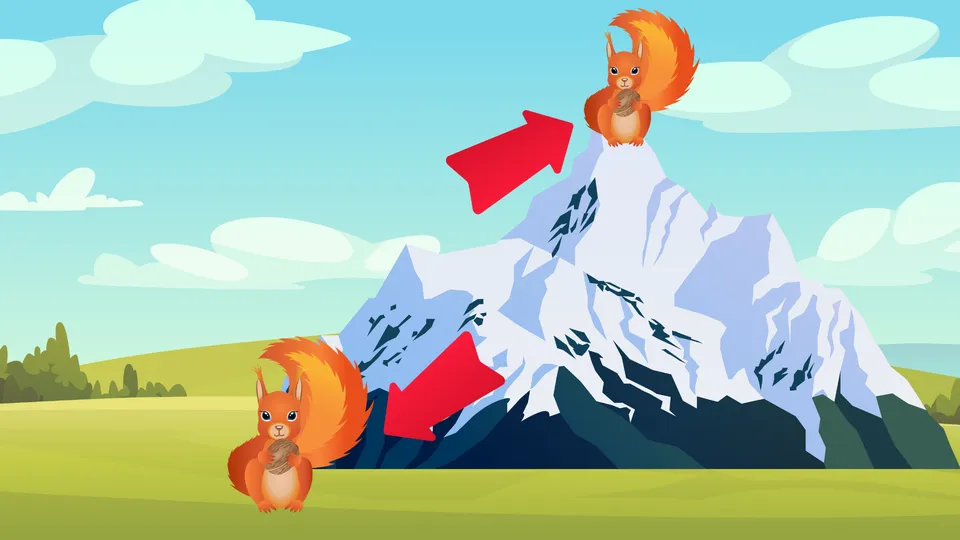
Reach the top of the mountain on this climbing expedition with a squirrel
Students will learn the difference between the top, middle and bottom parts of an object. After the lesson, students should be able to recognize and describe where an object is (at the top/middle/bottom) and identify which part of an object is the top and which is the bottom.
Part of
Standards alignment
Common Core State Standards
- K.G.A.1 — Describe objects in the environment using names of shapes, and describe the relative positions of these objects using terms such as above, below, beside, in front of, behind, and next to.
- ELD-SI.K-3.Inform — Multilingual learners will… • Define and classify objects or concepts • Describe characteristics, patterns, or behavior • Describe parts and wholes • Sort, clarify, and summarize ideas • Summarize information from interaction with others and from learning experiences
Alabama
- ELA21.K.6 — Uses spatial and temporal concepts correctly.
- ELA21.K.17 — With guidance and support, orally utilize new academic, content-specific, grade-level vocabulary and relate new words to prior knowledge.
- SS10.K.10 — Apply vocabulary related to giving and following directions.
- SS10.1.8.3 — Using vocabulary associated with geographical features, including _river, lake, ocean,_ and _mountain_
Alaska
- K.G.1 — Describe objects in the environment using names of shapes and describe their relative positions (e.g.,above, below, beside, in front of, behind, next to).
Arizona
- K.G.A.1 — Describe objects in the environment using names of shapes, and describe the relative positions of these objects using terms such as above, below, beside, in front of, behind, and next to.
- Objects and organisms can be described in terms of their parts.
Arkansas
- K.GM.1 — Describe the positions of objects and geometric shapes in the environment. • Terms include: inside, outside, between, above, below, near, far, under, over, up, down, behind, in front of, next to, to the left of, and to the right of
- G.1.K.1 — Describe familiar places using words that communicate location (e.g., beside, past, before), direction (e.g., right/left), and distance (e.g., long/short).
- G.1.K.2 — Identify and describe the physical characteristics of a place such as rivers, mountains, and forests using maps, globes, and photographs.
California
- K.G.A.1 — Describe objects in the environment using names of shapes, and describe the relative positions of these objects using terms such as above, below, beside, in front of, behind, and next to.
- K.4.1 — Determine the relative locations of objects using the terms near/far, left/right, and behind/in front.
- L.K.5.b — Demonstrate understanding of frequently occurring verbs and adjectives by relating them to their opposites (antonyms).
Colorado
- P.G.B.4 — Understand and use language related to directionality, order, and the position of objects, including up/down and in front/behind.
- RWC20-GR.PS-S.1-GLE.2-EO.c — Use increasingly complex and varied vocabulary.
- SS.P.2.1 — Develop spatial understanding, perspectives, and connections to the world
- K.G.A.1 — Describe objects in the environment using names of shapes, and describe the relative positions of these objects using terms such as above, below, beside, in front of, behind, and next to.
Connecticut
- K.G.A.1 — Describe objects in the environment using names of shapes, and describe the relative positions of these objects using terms such as above, below, beside, in front of, behind, and next to.
- L.K.5.c — Identify real-life connections between words and their use (e.g., note places at school that are colorful).
Delaware
- K.G.A.1 — Describe objects in the environment using names of shapes, and describe the relative positions of these objects using terms such as above, below, beside, in front of, behind, and next to.
- L.K.5.c — Identify real-life connections between words and their use (e.g., note places at school that are colorful).
Florida
- SS.K.G.1.1 — Describe the relative location of people, places, and things by using positional words.
- SS.K.G.3.1 — Identify basic landforms.
Georgia
- K.GSR.8.2 — Describe the relative location of an object using positional words.
- ELAGSEKL5.c — Identify real-life connections between words and their use (e.g., note places at school that are colorful).
- SS1G3.c — Identify and describe landforms (mountains, deserts, valleys, and coasts).
Hawaii
- K.G.A.1 — Describe objects in the environment using names of shapes, and describe the relative positions of these objects using terms such as above, below, beside, in front of, behind, and next to.
- SS.K.3.13.3 — Examine physical characteristics on maps and globes using positional words
Idaho
- K.G.A.1 — Describe objects in the environment using names of shapes, and describe the relative positions of these objects using terms such as “above,” “below,” beside, “in front of,” “behind,” and “next to.”
Illinois
- K.G.A.1 — Describe objects in the environment using names of shapes, and describe the relative positions of these objects using terms such as above, below, beside, in front of, behind, and next to.
Indiana
- K.G.1 — Use words related to location, direction, and distance, including here/there, over/under, left/right, above/below, forward/backward, and between. (E)
Iowa
- K.G.A.1 — Describe objects in the environment using names of shapes and describe the relative positions of these objects using terms such as above, below, besides, in front of, behind, and next to.
Kansas
- K.G.1 — Describe objects in the environment using names of shapes, and describe the relative positions of these objects using terms such as above, below, beside, in front of, behind, and next to.
Kentucky
- KY.K.G.1.b — Describe the relative positions of these objects using terms above, below, in front of, behind and next to.
- Objects and organisms can be described in terms of their parts.
Louisiana
- K.G.A.1 — Describe objects in the environment using names of shapes, and describe the relative positions of these objects using terms such as above, below, beside, in front of, behind, and next to.
- K.18 — Use maps and models to describe relative location. For example: locating objects and places to the right or left, up or down, in or out, above or below.
- K.19 — Identify basic landforms and bodies of water in a variety of visual representations, including mountains, hills, coasts, islands, lakes, and rivers.
- L.K.5.b — Demonstrate understanding of frequently occurring verbs and adjectives by relating them to their opposites (antonyms).
Maine
- K.G.A.1 — Describe objects in the environment using names of shapes and describe the relative positions of these objects using terms such as above, below, beside, in front of, behind, and next to.
- L.5.K.c — Identify real-life connections between words and their use (e.g., note places at school that are colorful).
Maryland
- identifying important objects in the classroom using the terms near/far, left/right, behind/in front, and up/down.
- K.G.A.1 — Describe objects in the environment using names of shapes, and describe the relative positions of these objects using terms such as above, below, beside, in front of, behind, and next to.
- L.PK.5.c — Identify real-life connections between words and their use (e.g., note objects in the classroom that are small).
- describing the relative location of Maryland by identifying the equator and north and south poles.
Massachusetts
- PK.G.A.1 — Identify relative positions of objects in space, and use appropriate language (e.g., beside, inside, next to, close to, above, below, apart).
- PreK.T2.1 — With prompting and support, describe location of people, animals, objects, and places, using words and phrases such as up, down, on, off, close, far away, beside, inside, next to, close to, above, below, apart correctly.
- K.T2.1 — Describe the location of people, objects, and places, using correctly words and phrases such as up, down, near, far, left, right, straight, back, behind, in front of, next to, between.
Michigan
- K.G.A.1 — Describe objects in the environment using names of shapes, and describe the relative positions of these objects using terms such as above, below, beside, in front of, behind, and next to.
- K–G1.0.2 — Use directions or positional words to identify significant locations in the classroom.
Minnesota
- 0.3.1.1.1 — Describe spatial information depicted in simple drawings and pictures. For example: While looking at a picture, the student says, "The boy is in front of the house. The house is at the edge of the woods." Other words describing spatial information in a picture include up, down, left, right, near, far, back, in front of.
- K.3.2.1 — Use words to compare objects according to length, size, weight and position. For example: Use same, lighter, longer, above, between and next to. Another example: Identify objects that are near your desk and objects that are in front of it. Explain why there may be some objects in both groups.
- 0.3.2.3.1 — Identify the physical and human characteristics of places, including real and imagined places. For example: Physical characteristics—landforms (Rocky Mountains, Mount Everest), ecosystems (forest), bodies of water (Hudson Bay, Indian Ocean, Amazon River), soil, vegetation, weather and climate. Human characteristics—structures (Great Wall of China, Eiffel Tower), bridges (Golden Gate Bridge), canals (Erie Canal), cities, political boundaries, population distribution, settlement patterns, language, ethnicity, nationality, religious beliefs.
Mississippi
- K.G.1 — Describe objects in the environment using names of shapes, and describe the relative positions of these objects using terms such as above, below, beside, in front of, behind, and next to.
- K.G.1.3 — Explain a place using terms related to location, direction, size, and distance (e.g., up, down, left, right, far, near, etc.).
- L.K.5.c — Identify real-life connections between words and their use (e.g., note places at school that are colorful).
Missouri
- K.GM.C.7 — Describe the relative positions of objects in space.
- K.EG.5.B.a — Apply positional words to locations within the classroom
Montana
- K.G.A.1 — Describe objects, including those of Montana American Indians, in the environment using names of shapes, and describe the relative positions of these objects using terms such as: above, below, beside, in front of, behind, and next to.
- L.K.5.c — Identify real-life connections between words and their use (e.g., note places at school that are colorful).
Nebraska
- SS K.3.1.a — Communicate personal directions to describe relative locations of people and objects.
- K.G.1.c — Describe the relative positions of shapes in relation to other objects or shapes using terms such as above, below, in front of, behind, and next to.
- SS K.3.2.a — Identify physical characteristics of place.
Nevada
- K.G.A.1 — Describe objects in the environment using names of shapes, and describe the relative positions of these objects using terms such as above, below, beside, in front of, behind, and next to.
- L.K.5.c — Identify real-life connections between words and their use (e.g., note places at school that are colorful).
New Hampshire
- K.G.A.1 — Describe objects in the environment using names of shapes, and describe the relative positions of these objects using terms such as above, below, beside, in front of, behind, and next to.
- SS.GE.2.1.3 — Identify major physical and human features in the United States and on Earth, e.g., cities, oceans, or continents. (Themes: C: People, Places and Environment, G: Science, Technology, and Society)
New Jersey
- K.G.A.1 — Describe objects in the environment using names of shapes, and describe the relative positions of these objects using terms such as above, below, beside, in front of, behind, and next to.
- L.K.5.b — Demonstrate understanding of frequently occurring verbs and adjectives by relating them to their opposites (antonyms).
- L.K.5.c — Identify real-life connections between words and their use (e.g., note places at school that are colorful).
New Mexico
- K.G.A.1 — Describe objects in the environment using names of shapes, and describe the relative positions of these objects using terms such as above, below, beside, in front of, behind, and next to.
- L.K.5.b — Demonstrate understanding of frequently occurring verbs and adjectives by relating them to their opposites (antonyms).
New York
- NY-PK.G.1 — Describe objects in the environment using names of shapes, and describe the relative positions of these objects using terms such as top, bottom, up, down, above, below, in front of, behind, over, under, and next to.
North Carolina
- NC.K.G.1 — Describe objects in the environment using names of shapes, and describe the relative positions of objects using positional terms.
- K.G.1.3 — Identify locations in the classroom, community, and around the world with positional words.
- PS.K.2.1 — Use models to compare the relative position of various objects observed in the classroom and outside using position words such as: in front of, behind, between, on top of, under, above, below, beside.
North Dakota
- K.L.2e — spatial and time relationships such as up, down, before, and after.
- K.L.2 — Identify parts of speech in sentences orally, with illustrations, or in writing:
Ohio
- K.G.1 — Describe objects in the environment using names of shapes, and describe the relative positions of these objects using terms such as above, below, beside, in front of, behind, and next to.
- K.5 — Terms related to direction and distance, as well as symbols and landmarks, can be used to talk about the relative location of familiar places.
- L.K.5.b — Demonstrate understanding of frequently occurring verbs and adjectives by relating them to their antonyms (opposites).
Oklahoma
- PK.5.R.2 — Students will hear different parts of speech through conversations, read-alouds, and interactive reading: • concrete objects as persons, places, or things (i.e., nouns) • words as actions (i.e., verbs) • color adjectives • spatial and time relationships such as up, down, before, and after
- PK.2.2 — Use basic directional terms in relation to the student’s relative location.
- PK.4.R.3 — Students will begin to acquire new vocabulary and relate new words to prior knowledge.
- PK.4.W.1 — Students will begin to use new vocabulary to produce and expand complete sentences in shared language activities.
- K.GM.2 — Compare and order objects according to location and measurable attributes.
Oregon
- K.12 — Use terms related to location, direction, and distance (such as over/under, here/there, left/right, above/below, forward/backward, between).
- K.GM.A.1 — Describe objects in the environment using names of shapes and describe the relative positions of these objects in their environment.
Pennsylvania
- CC.2.3.PreK.A.1 — Identify and describe shapes.
Rhode Island
- K.G.A.1 — Describe objects in the environment using names of shapes, and describe the relative positions of these objects using terms such as above, below, beside, in front of, behind, and next to.
South Carolina
- K.G.1 — Describe positions of objects by appropriately using terms, including below, above, beside, between, inside, outside, in front of, or behind.
- K.G.2 — Utilize sources of geographic information (e.g., digital sources, maps, or photographs/images) to define and identify cultural and/or natural features.This indicator was developed to encourage inquiry into natural features, such as mountains, oceans, and rivers and cultural features, such as buildings, restaurants, roads, and stores.
South Dakota
- K.G.A.1 — Describe objects in the environment using names of shapes, and describe the relative positions of these objects using terms such as above, below, beside, in front of, behind, and next to.
- K.G.1.2 — Use environmental directions or positional words including but not limited to up, down, above, and below to identify significant locations in the classroom
Tennessee
- K.08 — Use personal directions such as: up, down, near, far, left, right, in front of, and behind.
- K.G.A.1 — Describe objects in the environment using names of shapes and solids (squares, circles, triangles, rectangles, hexagons, cubes, cones, cylinders, and spheres). Describe the relative positions of these objects using terms such as above, below, beside, in front of, behind, between, and next to.
Texas
- K.3C — identify and use words that name actions; directions; positions; sequences; categories such as colors, shapes, and textures; and locations.
- K.3A — use spatial terms, including over, under, near, far, left, and right, to describe relative location;
- K.6C — observe and describe the location of an object in relation to another such as above, below, behind, in front of, and beside; and
Utah
- K.G.1 — Describe objects in the environment using names of shapes, and describe the relative positions of these objects using terms such as above, below, beside, in front of, behind, and next to.
- 1.3.1.b — Identify the equator and north and south poles.
- K.3.1.a — Locate objects in the classroom using the terms near/far, left/right, behind/in front, and up/down.
- K.3.2.c — Determine a location by using terms such as near/far, up/down, right/left.
Vermont
- K.G.A.1 — Describe objects in the environment using names of shapes, and describe the relative positions of these objects using terms such as above, below, beside, in front of, behind, and next to.
Washington
- K.G.A.1 — Describe objects in the environment using names of shapes, and describe the relative positions of these objects using terms such as above, below, beside, in front of, behind, and next to.
- L.K.5.b — Demonstrate understanding of frequently occurring verbs and adjectives by relating them to their opposites (antonyms).
Washington, D.C.
- K.G.A.1 — Describe objects in the environment using names of shapes, and describe the relative positions of these objects using terms such as above, below, beside, in front of, behind, and next to.
- K.20 — Explain the concept of relative location using directional words.
West Virginia
- M.K.20 — Describe objects in the environment using names of shapes and describe the relative positions of these objects using terms such as above, below, beside, in front of, behind and next to.
- SS.K.10 — Identify the difference between bodies of water and land masses on maps and globes, and demonstrate directions (e.g., left/right, up/down, near/far and above/under).
Wisconsin
- ELA.K.SL.4 — With guidance and support, describe familiar people, places, things, and events.
- M.K.G.A.1 — Describe objects in the environment using names of shapes, and describe the relative positions of these objects using terms such as above, below, beside, in front of, behind, and next to.
Wyoming
- K.G.H.1 — Describe objects in the environment using the names of shapes, and describe the relative positions of these objects using terms such as above, below, beside, in front of, behind, and next to.
- L.K.5.c — Identify real-life connections between words and their use (e.g., note places at school that are colorful).