Starting with Number Lines
Ages 4–6 · 10 minutes · Math
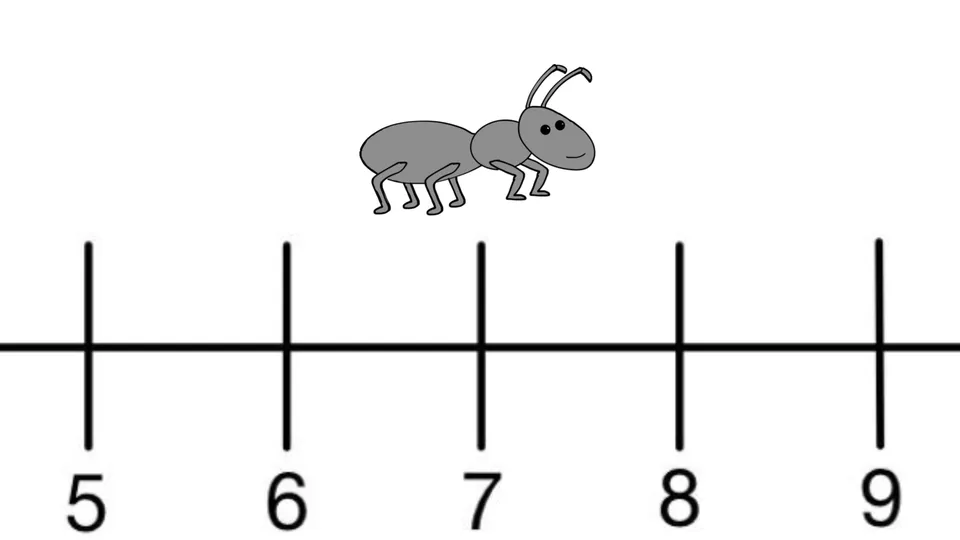
Follow the marching ant for an introduction to counting with number lines
Students practice counting forward and backward with numbers greater than 10 using number lines. They explore some applications of number lines in every day life and set the stage for addition, subtraction, and skip counting using number lines.
Students should already have some knowledge of numbers larger than 10.
Part of
Standards alignment
Common Core State Standards
- K.CC.A.2 — Count forward beginning from a given number within the known sequence (instead of having to begin at 1).
- K.CC.B.4.c — Understand that each successive number name refers to a quantity that is one larger.
- K.MP5 — Use appropriate tools strategically.
- 1.NBT.A.1 — Count to 120, starting at any number less than 120. In this range, read and write numerals and represent a number of objects with a written numeral.
Alabama
- MA19.1.10a — Count forward and backward by ones, starting at any number less than 120.
- MA19.K.2 — Count to 100 by ones beginning with any given number between 0 and 99.
- MA19.1.10 — Extend the number sequence from 0 to 120.
- MA19.K.1 — Count forward orally from 0 to 100 by ones and by tens. Count backward orally from 10 to 0 by ones.
Alaska
- K.CC.2 — Count forward beginning from a given number within the known sequence.
- 1.CC.3 — Order numbers from 1-100. Demonstrate ability in counting forward and backward.
- K.CC.4.c — Understand that each successive number name refers to a quantity that is one larger.
- K.MD.1 — Describe measurable attributes of objects (e.g., length or weight). Match measuring tools to attribute (e.g., ruler to length). Describe several measureable attributes of a single object.
Arizona
- K.CC.A.2 — Count forward from a given number other than one, within the known sequence (e.g., "Starting at the number 5, count up to 11.").
- K.CC.B.4.c — Understand that each successive number name refers to a quantity that is one larger.
- K.CC.A.1 — Count to 100 by ones and by tens.
Arkansas
- K.NPV.1 — Count to 100 by ones and tens; count forward by ones from any given number up to 100.
- 1.NPV.1 — Count forward and back within 120 by ones and tens from any given whole number.
- K.NPV.5 — Read, write, and represent whole numbers from 0 to 20.
California
- K.CC.A.2 — Count forward beginning from a given number within the known sequence (instead of having to begin at 1).
- 1.NBT.A.1 — Count to 120, starting at any number less than 120. In this range, read and write numerals and represent a number of objects with a written numeral.
- K.CC.B.4.c — Understand that each successive number name refers to a quantity that is one larger.
- K.CC.B.5 — Count to answer "how many?" questions about as many as 20 things arranged in a line, a rectangular array, or a circle, or as many as 10 things in a scattered configuration; given a number from 1—20, count out that many objects.
Colorado
- K.CC.A.2 — Count forward beginning from a given number within the known sequence (instead of having to begin at 1).
- 1.NBT.A.1 — Count to 120, starting at any number less than 120. In this range, read and write numerals and represent a number of objects with a written numeral.
- K.CC.B.4.c — Understand that each successive number name refers to a quantity that is one larger.
Connecticut
- K.CC.A.2 — Count forward beginning from a given number within the known sequence (instead of having to begin at 1).
- 1.NBT.A.1 — Count to 120, starting at any number less than 120. In this range, read and write numerals and represent a number of objects with a written numeral.
- K.CC.B.4.c — Understand that each successive number name refers to a quantity that is one larger.
Delaware
- K.CC.A.2 — Count forward beginning from a given number within the known sequence (instead of having to begin at 1).
- 1.NBT.A.1 — Count to 120, starting at any number less than 120. In this range, read and write numerals and represent a number of objects with a written numeral.
- K.CC.B.4.c — Understand that each successive number name refers to a quantity that is one larger.
Florida
- MA.K.NSO.2.1 — Recite the number names to 100 by ones and by tens. Starting at a given number, count forward within 100 and backward within 20.
- MA.K.NSO.2.3 — Locate, order and compare numbers from 0 to 20 using the number line and terms less than, equal to or greater than.
- MA.1.NSO.1.1 — Starting at a given number, count forward and backwards within 120 by ones. Skip count by 2s to 20 and by 5s to 100.
Georgia
- K.NR.2.1 — Count forward to 100 by tens and ones and backward from 20 by ones.
- K.NR.2.2 — Count forward beginning from any number within 100 and count backward from any number within 20.
- K.NR.1.3 — Given a number from 1-20, identify the number that is one more or one less.
- K.NR.2 — Use count sequences within 100 to count forward and backward in sequence.
- K.MP.5 — Use appropriate tools strategically.
Hawaii
- K.CC.A.2 — Count forward beginning from a given number within the known sequence (instead of having to begin at 1).
- 1.NBT.A.1 — Count to 120, starting at any number less than 120. In this range, read and write numerals and represent a number of objects with a written numeral.
- K.CC.B.4c — Understand that each successive number name refers to a quantity that is one larger.
Idaho
- K.CC.A.2 — Starting at a given number, count forward within 100 and backward within 20.
- 1.NBT.A.1 — Starting at a given number, count forward and backwards within 120 by ones. Skip count by twos to 20, by fives to 100, and by tens to 120. In this range, read and write numerals and represent a number of objects with a written numeral.
- K.CC.B.4.c — Understand that each successive number name refers to a quantity that is one larger. Recognize the “one more” pattern of counting using objects.
- K.MP5 — Use appropriate tools strategically.
Illinois
- K.CC.A.2 — Count forward beginning from a given number within the known sequence (instead of having to begin at 1).
- 1.NBT.A.1 — Count to 120, starting at any number less than 120. In this range, read and write numerals and represent a number of objects with a written numeral.
- K.CC.B.4.c — Understand that each successive number name refers to a quantity that is one larger.
Indiana
- K.NS.1 — Count to at least 100 by ones and tens. Count by one from any given number. (E)
Iowa
- K.CC.A.2 — Count forward beginning from any given number within the range of 0–100.
- K.CC.IA.A.2 — Count backwards beginning from any given number within the range of 0–20.
- 1.NBT.A.1 — Count forward and backward starting with any given number within the range of 0–120, In this range, read and write numerals and represent a number of objects with a written numeral.
Kansas
- K.CC.2 — Count forward beginning from a given number within the known sequence (instead of having to begin at 1).
- K.CC.3 — Read and write numerals from 0 to 20.
- K.CC.4.c — Understand that each successive number name refers to a quantity that is one larger.
Kentucky
- KY.K.CC.1.b — Count backwards from 30 by ones.
- KY.K.CC.2 — Count forward beginning from a given number within the known sequence within 100 (instead of having to begin at 1).
- KY.1.NBT.1.a — Count forward to and backward from 120, starting at any number less than 120.
- KY.K.CC.4.c — Understand that each successive number name refers to a quantity that is one larger.
Louisiana
- K.CC.A.2 — Count forward beginning from a given number within the known sequence (instead of having to begin at 1).
- K.CC.B.4.c — Understand that each successive number name refers to a quantity that is one larger.
- K.CC.A.1 — Count to 100 by ones and by tens.
Maine
- K.CC.A.2 — Count forward beginning from a given number within the known sequence (instead of having to begin at 1)
- K.CC.B.4c — Understand that each successive number name refers to a quantity that is one larger. Recognize the one more pattern of counting using objects.
- 1.NBT.A.1 — Count to 120, starting at any number less than 120. In this range, read and write numerals and represent a number of objects with a written numeral.
Maryland
- K.CC.A.2 — Count forward beginning from a given number within the known sequence (instead of having to begin at 1).
- K.CC.B.4.c — Understand that each successive number name refers to a quantity that is one larger.
- PK.CC.A.2 — Identify which number comes just after or just before a given number in the counting sequence to 10 with visual supports and manipulatives.
Massachusetts
- K.CC.A.2 — Count forward beginning from a given number within the known sequence (instead of having to begin at one).
- 1.NBT.A.1 — Count to 120, starting at any number less than 120. In this range, read and write numerals and represent a number of objects with a written numeral.
- K.CC.B.4.c — Understand that each successive number name refers to a quantity that is one larger. Recognize the one more pattern of counting using objects.
Michigan
- K.CC.A.2 — Count forward beginning from a given number within the known sequence (instead of having to begin at 1).
- 1.NBT.A.1 — Count to 120, starting at any number less than 120. In this range, read and write numerals and represent a number of objects with a written numeral.
- K.CC.B.4.c — Understand that each successive number name refers to a quantity that is one larger.
- 2.MD.B.6 — Represent whole numbers as lengths from 0 on a number line diagram with equally spaced points corresponding to the numbers 0, 1, 2, …, and represent whole-number sums and differences within 100 on a number line diagram.
Minnesota
- K.1.1.3 — Count, with and without objects, forward and backward to at least 20.
- K.1.1.4 — Find a number that is 1 more or 1 less than a given number.
- 1.1.1.2 — Read, write and represent whole numbers up to 120. Representations may include numerals, addition and subtraction, pictures, tally marks, number lines and manipulatives, such as bundles of sticks and base 10 blocks.
- 1.1.1.3 — Count, with and without objects, forward and backward from any given number up to 120.
Mississippi
- K.CC.2 — Count forward beginning from a given number within the known sequence (instead of having to begin at 1).
- K.CC.4.c — Understand that each successive number name refers to a quantity that is one larger.
- 1.NBT.1 — Count to 120, starting at any number less than 120. In this range, read and write numerals and represent a number of objects with a written numeral.
Missouri
- 1.NS.A.3 — Count backward from a given number between 20 and 1.
- K.NS.A.2 — Count forward beginning from a given number between 1 and 20.
- 1.NS.A.1 — Count to 120, starting at any number less than 120.
- K.NS.B.7 — Demonstrate that each successive number name refers to a quantity that is one larger than the previous number.
Montana
- K.CC.A.2 — Count forward beginning from a given number within the known sequence (instead of having to begin at 1).
- 1.NBT.A.1 — Count to 120, starting at any number less than 120. In this range, read and write numerals and represent a number of objects with a written numeral.
- MP7 — Look for and make use of structure.
Nebraska
- K.N.2.e — Count verbally forward and backward from any given number within 20.
- 1.N.2.a — Count verbally by ones and tens within 120 starting at any given number.
- K.N.2.b — Understand that each successive number name refers to a quantity that is one larger.
Nevada
- K.CC.A.2 — Count forward beginning from a given number within the known sequence (instead of having to begin at 1).
- 1.NBT.A.1 — Count to 120, starting at any number less than 120. In this range, read and write numerals and represent a number of objects with a written numeral.
- K.CC.B.4.c — Understand that each successive number name refers to a quantity that is one larger.
New Hampshire
- K.CC.A.2 — Count forward beginning from a given number within the known sequence (instead of having to begin at 1).
- K.CC.B.4.c — Understand that each successive number name refers to a quantity that is one larger.
New Jersey
- K.CC.A.2 — Count forward beginning from a given number within the known sequence (instead of having to begin at 1).
New Mexico
- K.CC.A.2 — Count forward beginning from a given number within the known sequence (instead of having to begin at 1).
- 1.NBT.A.1 — Count to 120, starting at any number less than 120. In this range, read and write numerals and represent a number of objects with a written numeral.
- K.CC.B.4.c — Understand that each successive number name refers to a quantity that is one larger.
New York
- NY-K.CC.2 — Count to 100 by ones beginning from any given number (instead of beginning at 1).
- NY-K.CC.4.c — Understand the concept that each successive number name refers to a quantity that is one larger.
- NY-K.CC.1 — Count to 100 by ones and by tens.
North Carolina
- NC.K.CC.2 — Count forward beginning from a given number within the known sequence, instead of having to begin at 1.
- NC.1.NBT.1 — Count to 150, starting at any number less than 150.
- NC.K.CC.1 — Know number names and recognize patterns in the counting sequence by: • Counting to 100 by ones. • Counting to 100 by tens.
North Dakota
- K.NO.CC.1 — Count verbally in sequential order by ones and tens to 100, making accurate decuple transitions (e.g., 89 to 90). Count verbally forward from any given number within 100.
- K.NO.CC.2 — Count backward from 20 by ones and from a given number within 10.
- 1.NO.CC.1 — Count forward by ones and tens from any given point within 120.
- 1.NO.CC.2 — Count backward by ones and tens from a given number within 120.
- K.NO.CC.3 — Identify and write any given numeral within 20.
Ohio
- K.CC.2 — Count forward within 100 beginning from any given number other than 1.
- K.CC.4.c — Understand that each successive number name refers to a quantity that is one larger.
Oklahoma
- K.N.1.5 — Count forward, with and without objects, from any given number up to 20.
- 1.N.1.8 — Use knowledge of number relationships to locate the position of a given whole number, up to 20, on an open number line.
- PK.N.1.1 — Count aloud forward in sequence by 1s to 20.
- K.N.1.6 — Read, write, discuss, and represent whole numbers from 0 to at least 20. Representations may include numerals, pictures, real-object and pictographs, spoken words, and manipulatives.
Oregon
- K.NCC.A.2 — Count forward beginning from a given number within 100 of a known sequence.
- K.NCC.A.3 — Identify number names, write numbers, and the count sequence from 0-20. Represent a number of objects with a written number 0-20.
- 1.NBT.A.1 — Count to 120, starting at any number less than 120. In this range, read and write numerals and represent a number of objects with a written numeral.
Pennsylvania
- CC.2.1.K.A.1 — Know number names and write and recite the count sequence.
Rhode Island
- K.CC.A.2 — Count forward beginning from a given number within the known sequence (instead of having to begin at one).
- 1.NBT.A.1 — Count to 120, starting at any number less than 120. In this range, read and write numerals and represent a number of objects with a written numeral.
- K.CC.B.4.c — Understand that each successive number name refers to a quantity that is one larger. Recognize the one more pattern of counting using objects
- K.CC.A.1 — Count to 100 by ones and by tens.
South Carolina
- K.NS.2 — Count forward by ones beginning from any number less than 100.
- 1.NSBT.1a — Extend the number sequence to count forward by ones to 120 starting at any number.
- K.NS.4c — Understand the relationship between number and quantity. Connect counting to cardinality by demonstrating an understanding that each successive number name refers to a quantity that is one more and each previous number name refers to a quantity that is one less.
South Dakota
- K.CC.A.2 — Count forward beginning from any given number within 100 (instead of having to begin at 1). Count backwards beginning from any given number within 20.
- 1.NBT.A.1.a — Count on from any given number.
- K.CC.B.4.c — Understand that each successive number name refers to a quantity that is one larger.
Tennessee
- K.CC.A.2 — Count forward by ones beginning from any given number within the known sequence (instead of having to begin at 1).
- K.CC.A.1 — Count to 100 by ones, fives, and tens. Count backward from 10.
- K.CC.B.5.c — Recognize that each successive number name refers to a quantity that is one greater and each previous number is one less.
Texas
- K.2A — count forward and backward to at least 20 with and without objects;
- 1.5A — recite numbers forward and backward from any given number between 1 and 120;
- K.2B — read, write, and represent whole numbers from 0 to at least 20 with and without objects or pictures;
- K.2F — generate a number that is one more than or one less than another number up to at least 20;
Vermont
- K.CC.A.2 — Count forward beginning from a given number within the known sequence (instead of having to begin at 1).
- 1.NBT.A.1 — Count to 120, starting at any number less than 120. In this range, read and write numerals and represent a number of objects with a written numeral.
- K.CC.B.4.c — Understand that each successive number name refers to a quantity that is one larger.
Virginia
- K.NS.1c — Represent forward counting by ones using a variety of tools, including five-frames, ten frames, and number paths (a prelude to number lines).
- K.NS.1e — Count forward orally by ones, within 100, starting at any given number.
- K.NS.1f — Count backward orally by ones when given any number between 1 and 20.
- K.NS.1g — State the number after, without counting, when given any number between 0 and 30.
Washington
- K.CC.A.2 — Count forward beginning from a given number within the known sequence (instead of having to begin at 1).
- 1.NBT.A.1 — Count to 120, starting at any number less than 120. In this range, read and write numerals and represent a number of objects with a written numeral.
- K.CC.B.4.c — Understand that each successive number name refers to a quantity that is one larger.
Washington, D.C.
- K.CC.A.2 — Count forward beginning from a given number within the known sequence (instead of having to begin at 1).
- 1.NBT.A.1 — Count to 120, starting at any number less than 120. In this range, read and write numerals and represent a number of objects with a written numeral.
- K.CC.B.4.c — Understand that each successive number name refers to a quantity that is one larger.
West Virginia
- M.K.2 — Count forward beginning from a given number within the known sequence (instead of having to begin at 1).
- M.K.1 — Count to 100 by ones and by tens.
- M.K.4 — Understand the relationship between numbers and quantities; connect counting to cardinality. a. When counting objects, say the number names in the standard order, pairing each object with one and only one number name and each number name with one and only one object. b. Understand that the last number name said tells the number of objects counted and the number of objects is the same regardless of their arrangement or the order in which they were counted. c. Understand that each successive number name refers to a quantity that is one larger.
- MHM7 — Look for and make use of structure.
Wisconsin
- M.K.CC.A.2 — Count forward beginning from a given number within the known sequence (instead of having to begin at 1).
- M.1.NBT.A.1 — Count to 120, starting at any number less than 120. In this range, read and write numerals and represent a number of objects with a written numeral.
- M.K.CC.B.4 — Understand the relationship between numbers and quantities; connect counting to cardinality. a. When counting objects, say the number names in the standard order, pairing each object with one and only one number name and each number name with one and only one object (one to one correspondence). b. When counting objects, say the number names in the standard order, pairing each object with one and only one number name and each number name with one and only one object (one to one correspondence). c. Understand that each successive number name refers to a quantity that is one larger and the previous number is one smaller (hierarchical inclusion).
Wyoming
- 1.NBT.E.1.A — Count forward and backward, starting at any number less than 120.
- K.CC.A.2 — Count forward beginning from a given number within the known sequence (instead of having to begin at 1).
- K.CC.A — Know number names and the count sequence.
- K.CC.B.4.C — Understand that each successive number name refers to a quantity that is one more, and each previous number name refers to a quantity that is one less.